Category Archives: Uncategorized

Iran’s Monstrous Record in 2016 by Majid Rafizadeh

  • Tehran has not become a rational and moderate state. Iran has instead become more empowered and emboldened to pursue its revolutionary ideals of anti-Americanism and anti-Semitism.When it comes to the JCPOA nuclear deal — which Iran never signed — Iranian leaders violated the deal three times in the past year.

  • UN Security Council resolution 2231 is clear. The resolution “calls upon Iran not to undertake any activity related to ballistic missiles designed to be capable of delivering nuclear weapons, including launches using such ballistic missile technology.”
  • Iran also increased strategic and tactical cooperation with Russia to undermine US interests, strengthening the Russia-China-Iran axis.
  • Iran ranks top in the world for executions per capita. Iran also became the world’s leading executioner of juveniles.

In 2016, Iran reached an unprecedented level when it comes to breaking international laws. It expanded interventionist policies in the region; pursued revolutionary principles of anti-Americanism and anti-Semitism; ignored several UN resolutions and the Joint Comprehensive Plan of Action (JCPOA) between the P5+1 and Tehran, which Iran never signed; continued regional hegemonic ambitions, and abused human rights.

With billions of dollars of revenue pouring into the pockets of Iran’s Supreme Leader Ayatollah Ali Khamenei and the Islamic Revolutionary Guard Corps (IRGC), Tehran did not become a rational and moderate state. Iran instead became more empowered and emboldened to pursue its revolutionary ideals of anti-Americanism and anti-Semitism.

Iran was listed as the top state sponsor of terrorism — “providing a range of support, including financial, training, and equipment, to groups around the world.”

When it comes to the JCPOA nuclear deal — which Iran never signed — Iranian leaders violated the deal three times.

The first violation was reported by Germany’s domestic intelligence agency, the Federal Office for the Protection of the Constitution, in July 2016. The agency stated that the Iranian government was pursuing a “clandestine” path to obtain illicit nuclear technology and equipment from German companies “at what is, even by international standards, a quantitatively high level.” German Chancellor Angela Merkel criticized Iran, but no action was taken.

According to the nuclear deal, Iran should request permission from a UN Security Council panel for “purchases of nuclear direct-use goods”, but Tehran did not. Another report by the Institute for Science and International Security drew attention to Iran’s violation as well:

“The Institute for Science and International Security has learned that Iran’s Atomic Energy Organization (AEOI) recently made an attempt to purchase tons of controlled carbon fiber from a country. This attempt occurred after Implementation Day of the Joint Comprehensive Plan of Action (JCPOA). The attempt to acquire carbon fiber was denied by the supplier and its government. Nonetheless, the AEOI had enough carbon fiber to replace existing advanced centrifuge rotors and had no need for additional quantities over the next several years, let alone for tons of carbon fiber. This attempt thus raises concerns over whether Iran intends to abide by its JCPOA commitments. In particular, Iran may seek to stockpile the carbon fiber so as to be able to build advanced centrifuge rotors far beyond its current needs under the JCPOA, providing an advantage that would allow it to quickly build an advanced centrifuge enrichment plant if it chose to leave or disregard the JCPOA during the next few years. The carbon fiber procurement attempt is also another example of efforts by the P5+1 to keep secret problematic Iranian actions.”

The next violation came in February 2016 as Iran exceeded its threshold for heavy water, used to produce nuclear weapons. In addition, in November 2016, according to a report by the International Atomic Energy Agency (IAEA), Iran again violated the deal by holding more heavy water than permitted. Iran was let go free both times with no consequences.

Third, when it comes violating several UN resolutions, in 2016, Iran significantly ratcheted up its production of ballistic missiles.

Iran test-fired at least eight ballistic missiles, capable of carrying multiple nuclear heads, an act in violation of the nuclear deal, as well as United Nations resolutions 1929 and 2231.

The JCPOA states that Iran should not undertake any ballistic missile activity “until the date eight years after the JCPOA Adoption Day or until the date on which the IAEA submits a report confirming the Broader Conclusion, whichever is earlier.”

The UN Security Council resolution (Paragraph 3 of Annex B of resolution 2231 of 2015) is clear. The resolution “calls upon Iran not to undertake any activity related to ballistic missiles designed to be capable of delivering nuclear weapons, including launches using such ballistic missile technology.”

Another UN Security Council resolution, 1929, also states:

“Iran shall not undertake any activity related to ballistic missiles capable of delivering nuclear weapons, including launches using ballistic missile technology, and that States shall take all necessary measures to prevent the transfer of technology or technical assistance to Iran related to such activities.”

It is accurate to argue that if not for the Obama Administration’s appeasement policies towards Iran, Tehran would not have received tremendous financial relief. Nevertheless, Iran’s Supreme leader Khamenei who enjoys the final say in Iran’s domestic and foreign policy, instigated more anti-American sentiments and continued lashing out at the “Great Satan“. Iran publicly harassed the US Navy, detained US sailors, and imprisoned several American citizens. Khamenei also repeatedly threatened Israel and made incendiary remarks about wiping Israel from the face of earth in less than 8 minutes. In December 2016, Khamenei stated that Israel would not exist in 25 years. He also published a book laying out a plan on how to destroy Israel.

Regionally speaking, as Tehran became more heavily armed with additional revenues and weaponry, it has increased its military interventions in Syria, Iraq, Yemen, and intensified its advisory, financial, weapons and intelligence assistance to its Shiite proxies and Bashar al Assad, bolstering the “Shia axis”. Iran also increased strategic and tactical cooperation with Russia to undermine US interests, strengthening the Russia-China-Iran axis.

Finally, and more fundamentally, when it comes to human rights, Iran set some of the worst records since its establishment in 1979. According to the Human Rights Watch, 2016 saw Iran escalating the mass executions of minorities, and the imprisonment of human rights and political activists. Now, Iran ranks top in the world for executions per capita. Iran also became the world’s leading executioner of juveniles, according to Amnesty International.

These are only some examples of Iran’s disregard for international laws and its human rights abuses.

There is definitely a positive correlation between, on the one hand, Iran gaining more dollars and, on the other hand, breaching international laws, committing egregious human rights violations, spreading its revolutionary values of anti-Americanism and anti-Semitism, destabilizing the region, intensifying regional conflicts and humanitarian tragedies, and pursing its regional ambitions.

Iran’s Massacre and Rising Crimes Against Humanity by Majid Rafizadeh

  • “You [Iranian officials] will be in the future etched in the annals of history as criminals. The greatest crime committed under the Islamic Republic, from the beginning of the Revolution until now, which will be condemned by history, is this crime [mass executions] committed by you.” — Ayatollah Hossein Ali Montazeri, who was one of the founding fathers of the Islamic Republic of Iran.

  • Intriguingly, all those people whom Montazeri is addressing and warning in the audio, currently appear to enjoy high positions.Iran’s massacre of more than 30,000 people was recently disclosed by Ayatollah Hossein Ali Montazeri’s son, Ahmad, a moderate cleric, who posted a confidential audio of his father on his website but was ordered by Iran’s intelligence service to remove it.

Born in Esfahan, Iran, Ayatollah Hossein Ali Montazeri was one of the founding fathers of the Islamic Republic of Iran. He is a human rights activist, an Islamic theologian, and was the designated successor to the Islamic revolution’s Supreme Leader Ayatollah Ruhollah Khomeini, until the very last moments of Khomeini’s life. His pictures were posted next to Khomeini’s in the streets.

In the recording, Montazeri states:

“You [Iranian officials] will be in the future etched in the annals of history as criminals. The greatest crime committed under the Islamic Republic, from the beginning of the Revolution until now, which will be condemned by history, is this crime [mass executions] committed by you.”

While some international human rights organizations, the Obama Administration and the United Nations appear to have turned a blind eye this massacre and other crimes against humanity, several officials have taken steps. A U.S. House of Representatives Resolution condemning the massacres and other executions was introduced by the House Homeland Security Chair, Mike McCaul, and cosponsored by Chairman Ed Royce, Ranking Member Eliot Engel, and Rules Committee Chair Pete Sessions. The resolution was introduced when Iranian President Hassan Rouhani, who heads a government that is ranked number one in the world for executions per capita, was addressing the 71st Session of the United Nation General Assembly. During his speech, according to the Associated Press, an unprecedented number of protesters gathered in Dag Hammerskjold Plaza outside the UN — including Senator Joe Lieberman, and Sir Geoffrey Robertson, former Head of the UN war crimes tribunal for Sierra Leone, who wrote a report on Iran’s 1988 massacre that was published on the United Nations Arts Initiative website.

The House resolution states:

Whereas over a 4-month period in 1988, the Government of the Islamic Republic of Iran carried out the barbaric mass executions of thousands of political prisoners and many unrelated political groups;

Whereas according to a report by the Iran Human Rights Documentation Center, the massacre was carried out pursuant to a fatwa, or religious decree, issued by then-Supreme Leader Ayatollah Ruhollah Khomeini, that targeted the People’s Mojahedin of Iran (PMOI), also known as the Mujahedeen-e-Khalq (MEK);

Whereas according to a November 2, 2007, report by Amnesty International, “between 27 July 1988 and the end of that year, thousands of political prisoners [in Iran], including prisoners of conscience, were executed in prisons nationwide.”;

Whereas according to Amnesty International, “the majority of those killed were supporters of the PMOI, but hundreds of members and supporters of other political groups … were also among the execution victims.”;

The resolution goes on to detail some of the most egregious crimes against humanity and “the greatest crime committed during the Islamic Republic, for which history will condemn us”:

… the killings were carried out on the orders of a judge, an official from the Ministry of Intelligence, and a state prosecutor, known to the prisoners as “Death Commissions” which undertook proceedings in a manner designed to eliminate the regime’s opponents;

Whereas those personally responsible for these mass executions include senior officials serving in the current Government of Iran;

Whereas prisoners were reportedly brought before the commissions and briefly questioned about their political affiliation, and any prisoner who refused to renounce his or her affiliation with groups perceived as enemies by the regime was then taken away for execution;

Whereas the victims included thousands of people, including teenagers and pregnant women, imprisoned merely for participating in peaceful street protests and for possessing political reading material, many of whom had already served or were currently serving prison sentences;

Whereas prisoners were executed in groups, some in mass hangings and others by firing squad, with their bodies disposed of in mass graves;

In addition: “the families of the executed were denied information about their loved ones and were prohibited from mourning them in public,” and more fundamentally:

“The current Supreme Leader Ali Khamenei was reportedly aware of, and later publicly condoned the massacre; Whereas in violation of its international obligations, the Government of Iran continues to systematically perpetrate gross violations of the fundamental human rights of the Iranian people;”

Intriguingly, all those people whom Montazeri is addressing and warning in the audio — all of those who were involved in these crimes — currently appear to enjoy high positions. Mostafa Pourmohammadi was a representative of the intelligence ministry at the notorious Evin Prison, and he was recently appointed by the so-called moderate President Hassan Rouhani to be justice minister. Ebrahim Raeisi was a public prosecutor and was appointed under Rouhani government to be the head of Astan Quds Razavi, which has billions of dollars in revenues. Hussein Ali Nayeri was a judge and is now a deputy of the Supreme Court of Iran.

In his memoir, Montazeri writes that he told Hussein Ali Nayeri to stop the executions at least in the month of Moharram, but Nayeri said: “We have executed 750 people in Tehran so far… once we finish the job with [execute] another 200 people, then we will listen to whatever you say”. Montazeri wrote several letters to the Supreme Leader Khomeini as well, warning him.
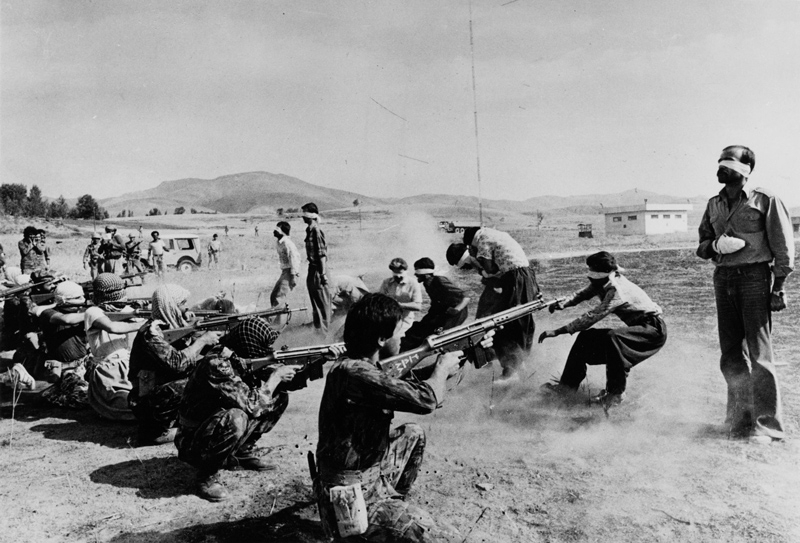
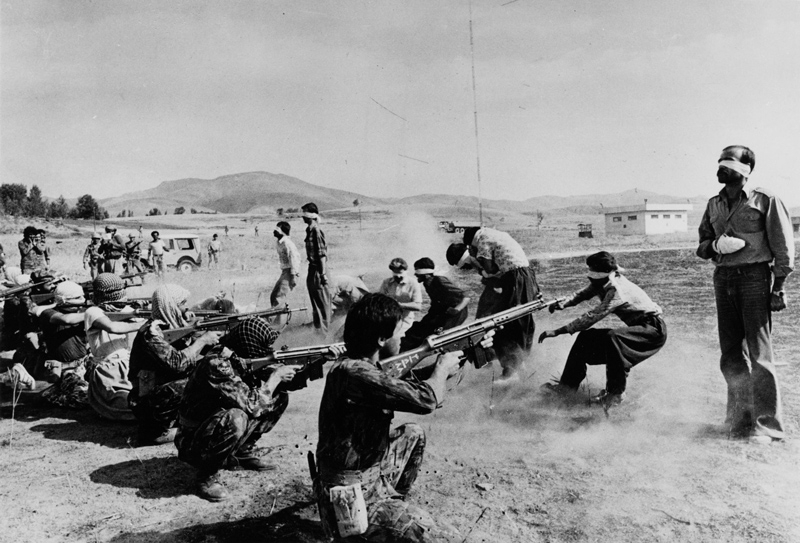
Jahangir Razmi’s Pulitzer Prize-winning photograph of the execution of Kurdish men and others by the Iranian Islamic regime in 1979.

We should not solely view Iran from the prism of the nuclear deal.

To be on the right side of history and to stand for individual rights, human rights, social justice and liberty, Congress needs to take action, condemn the Iranian government, pressure Iran to provide more information for the families of the victims, and urge the UN Special Rapporteur on the human rights situation in Iran and the UN Human Rights Council to open a full investigation, and create a commission, to follow up with this matter.

Dr. Majid Rafizadeh, political scientists and Harvard University scholar is president of the International American Council on the Middle East. He can be reached at Dr.rafizadeh@post.harvard.edu.
Iran’s Forward Operating Base against the U.S. by Thomas Quiggin

  • Iran’s aim is to use American’s northern neighbour, Canada, as a “forward operating base” for influence operations against the American government.


  • The Trudeau government has shown both a past and present affinity for dictatorial governments. Trudeau himself said he admires the government of the Peoples Republic of China and their “basic dictatorship.” He publicly mourned the passing of Cuban President Fidel Castro. The statement made no note of the 60-plus years of dictatorship, and Cuba’s brutal suppression of human rights.

  • Among its teachings, the Ontario Jaffari Mosque’s school suggested that boys should play sports so they can be “physically be ready for jihad whenever the time comes for it.” Girls, on the other hand, were told that they should “stick to hobbies that prepare them to become wives and mothers.

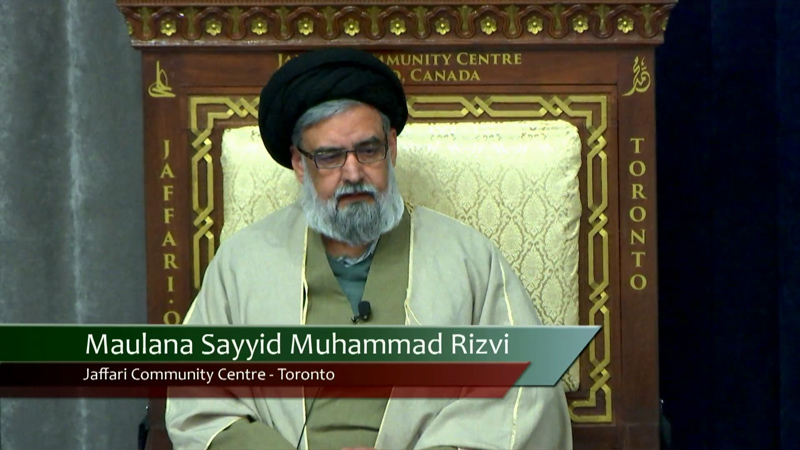
Imam Rizvi, of the Jaffari Mosque in Ontario, is a leading proponent of the Iranian/Khomeinist ideology in Canada. He believes and advocates that sex with 9-year-old girls is acceptable, as long as it occurs within munqati’ (temporary) or da’im (permanent) marriage. (Image source: IslamiCentre video screenshot)

Iran and its Islamist regime is currently making a major effort to expand its footprint in Canada. Their aim is to use American’s northern neighbour as a “forward operating base” for influence operations against the American government. In a recent video, Hassan Abbasi, a leadership figure in the Islamic Revolutionary Guard Corps (IRGC), was boasting about a “guerilla movement of Iranian agents living and working in the United States.” Iran, he says, is leading a clandestine army of potential martyrs within the US.

This does not seem to be an isolated event. Iranian diplomat Hamid Mohammadi said in 2012 there were many Iranian-Canadians “working in influential government positions” and called on others to “occupy high-level and key positions.”

Given Iran’s history of exporting violence and terrorism, that Iranians on both sides of the border are discussing how they are infiltrating North America should be of concern.

Continue Reading Article

Canada: Sold to the Highest Foreign Bidder

by Shabnam Assadollahi  •  May 4, 2017 at 4:00 am

  • In April, Prime Minister Justin Trudeau said that ISIS supporters have the right to defend their freedom, and was reported to have referred to Evangelical Christians as the “worst part of Canadian society.” These remarks came after is after he remained silent when Jewish centers received bomb threats, and despite Canada’s imams regularly calling for the annihilation of Jews.

  • Even more disturbing is a technical loophole in the Canada Elections Act. The law allows foreign entities to make contributions to Canadian candidates. This means that players such as Iran or Saudi Arabia will be able to further their agendas through a particular politician, as long as they pump him with funds for six months and a day prior to his official bid for office.

Canadian Prime Minister Justin Trudeau said three years go: “There is a level of admiration that I actually have for China, because their basic dictatorship is allowing them to turn their economy around on a dime.” In November, he called Fidel Castro “remarkable” and a “larger than life leader who served his people.” (Image source: U.S. Air Force)

A journalist was taken to task recently for calling Canadian Prime Minister Justin Trudeau an inelegant name during a press conference. In response, Josh Sigurdson justified his behavior in a YouTube video:

“The state-run media got to ask [Trudeau] questions — pre-screened ones, at that… How is it journalism to ask pre-selected questions of a politician? Restricting opposition, restricting free speech… pretending to stand for women while sending money to governments and dictatorships who stone women to death for driving and kill gays … that is the definition of scumbag.”

Although many might not have used that exact word to describe Trudeau, one might sympathize with the sentiment behind it.

Continue Reading Article

The Death of Facts

by Douglas Murray  •  May 3, 2017 at 5:00 am

  • Needless to say, none of this is true. Nowhere has Heather Mac Donald suggested that black people or any other type of person has “no right to exist”. The accusation is levelled without evidence. But as with all anti-free-speech activists today, the line is blurred not merely between actual words and violence, but between wholly imagined words and violence.

Heather Mac Donald, speaking at Claremont McKenna College on April 6, addressed a mainly empty room via live video-streaming, as angry student protesters surrounded the building. She then fled the college under the protection of campus security. (Image source: Claremont McKenna College video screenshot)

Every week in America brings another spate of defeats for freedom of speech. This past week it was Ann Coulter’s turn (yet again) to be banned from speaking at Berkeley for what the university authorities purport to be “health and safety” reasons — meaning the health and safety of the speaker.

Each time this happens, there are similar responses. Those who broadly agree with the views of the speaker complain about the loss of one of the fundamental rights which the Founding Fathers bestowed on the American people. Those who may be on the same political side but find the speaker somewhat distasteful find a way to be slightly muted or silent. Those who disagree with the speaker’s views applaud the banning as an appropriate response to apparently imminent incitement.

Continue Reading Article

France: What is the Presidential Campaign Really About?

by Yves Mamou  •  May 3, 2017 at 4:00 am

  • The result of this mess is that France as one country no longer exists.

  • People who voted for Le Pen seem to feel not only that they lost their jobs, but that they are becoming foreigners in their own country.

  • Macron, for many analysts, is the candidate of the status quo: Islamists are not a problem and reforming the job market will supposedly solve all France’s problems.

French presidential candidates Emmanuel Macron (left) and Marine Le Pen. (Image source: LCI video screenshot)

The French presidential race is the latest election to shake up establishment politics. The Parti Socialiste and Les Républicains, who have been calling the shots for the past forty years, were voted out of the race. The “remainers” are Emmanuel Macron, a clone of Canada’s Prime Minster Justin Trudeau; and Marine Le Pen, whom many believe will not win.

France is a fractured country. As in the US and the UK, the rift is not between the traditional left and right. Instead, it reflects divisions — cultural, social, and economic — that came with globalization and mass migration. A map released by the Ministry of the Interior after the first round of the presidential campaign illustrates the new political scenery.

Continue Reading Article

Germany: Migrant Crime Spiked in 2016

by Soeren Kern  •  May 2, 2017 at 5:00 am

  • Although non-Germans make up approximately 10% of the overall German population, they accounted for 30.5% of all crime suspects in the country in 2016.

  • Nearly 250,000 migrants entered the country illegally in 2016, up 61.4% from 154,188 in 2015. More than 225,000 migrants were found living in the country illegally (Unerlaubter Aufenthalt) in 2016.

  • The Berlin Senate launched an inquiry into why migrants disproportionally appear as criminals in the city-state compared to Germans.

Police in Bremen, Germany frisk a North African youth who is suspected of theft. (Image source: ZDF video screenshot)

An official annual report about crime in Germany has revealed a rapidly deteriorating security situation in the country marked by a dramatic increase in violent crime, including murder, rape and sexual assault.

The report also shows a direct link between the growing lawlessness in Germany and Chancellor Angela Merkel’s decision to allow in more than one million mostly male migrants from Africa, Asia and the Middle East.

The report — Police Crime Statistics 2016 (Polizeiliche Kriminalstatistik, PKS) — was compiled by the Federal Criminal Police Office (Bundeskriminalamt, BKA) and presented by Interior Minister Thomas de Maizière in Berlin on April 24.

Continue Reading Article

Germany Hit by Merkel’s Imported Crime Wave

by Vijeta Uniyal  •  May 2, 2017 at 4:30 am

  • According to the Germany’s annual crime report, compiled by the Federal Crime Bureau (BKA), there has been a more than 50% rise in migrant crime in the country compared to the year before.

  • They not only indulge in petty crime but have come to dominate serious and violent crime in Germany.

  • European mainstream media may keep on putting a positive spin on Merkel’s “courageous” and “selfless” stance, but her policy continues to incur heavy economic, social and human cost, not only on Germany, but on the cultural future of European civilisation.

At the height of the European migrant crisis in early 2016, when masses of migrants were pouring into Europe, the German Green Party Chairwoman Katrin Göring-Eckardt could not control her joy. “We have just received an unexpected gift in the form of people,” she told her fellow Germans, reminding them to be grateful. This gift, she said, was going to make the country “more religious, more colourful, more diverse and younger.” It was gift, it turns out, that keeps on giving.

According to the country’s annual crime report, compiled by the Federal Crime Bureau (BKA), there has been a more than 50% rise in migrant crime in the country compared to the year before.

The German newspaper Die Welt, which received an advance copy of the annual crime report, wrote:

Continue Reading Article

Do Not Be Fooled by These “Moderates” in Florida

by Joe Kaufman  •  May 2, 2017 at 4:00 am

  • Since its creation, the Deobandi movement has produced a number of militant offshoots, most notably the Taliban in Pakistan and Afghanistan, and spread its tentacles around the world, including in the United States. Shafayat Mohamed returned from India and set up one such tentacle in Florida.

  • As Thomas Friedman wrote, “We talked to the boys. All of them thought America was evil and that Osama bin Laden was a hero.”

  • Much like its sister madrasa in Pakistan, the Darul Uloom Institute and its imam, Shafayat Mohamed, follow in the line of the most extreme elements of the Deobandi movement. The only difference is that one is more than 7,000 miles away from American shores, and the other is right in our backyard.

Shafayat Mohamed. (Image source: Al-Hikmat TV video screenshot)

The Darul Uloom Institute — who? — in Pembroke Pines, Florida will hold its annual fundraising dinner and awards ceremony on May 6. If it is anything like last year’s gala, which saw honors go to a prominent local politician, a rabbi, and a pastor, you will hear some “moderate” messaging.

Do not, however, let this radical Islamic center’s attempt to ingratiate itself into mainstream American society fool you. Its history is mired in violence and hate.

The Darul Uloom Institute was founded by its imam, Shafayat Mohamed, in October 1994. Originally from Trinidad, Mohamed left for India in 1975, where he was educated at Darul Uloom Deoband, the school where the hardline Sunni Deobandi movement was established in May 1866. In a show of favor to his student, Darul Uloom Deoband selected Mohamed to lead a group of Americans in a 1979 tour of its facilities.

Continue Reading Article

Palestinians: Embattled, Weak Abbas Comes to White House

by Khaled Abu Toameh  •  May 1, 2017 at 5:00 am

  • The joke among Palestinians is that were it not for Israel is sitting smack in the middle, the two warring Palestinian states [the West Bank and the Gaza Strip] would be dispatching rockets and suicide bombers at each other.

  • Abbas is well aware that the Palestinian house is on fire. Instead of working to extinguish the blaze, however, Abbas spends his time spreading the lie that peace in our time is possible, if only Israel would succumb to his demands.

  • The story of Gaza — which went straight to Hamas after Israel handed it to Abbas — is not a tale Abbas likes to tell. The same scenario is likely to be repeated in the West Bank if Israel makes a similar move.

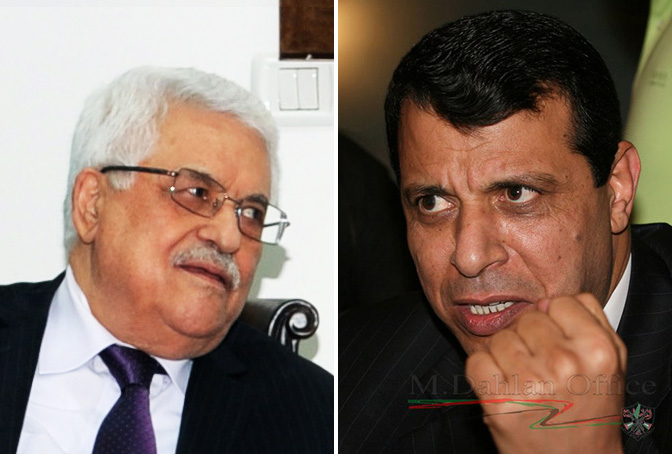
Palestinian Authority (PA) President Mahmoud Abbas (left) recently decided to slash by 30% the salaries of PA employees in Gaza. Abbas suspects that these employees, who are affiliated with his Fatah faction, have switched their loyalty to his arch-rival, Mohamed Dahlan (right). (Image sources: U.S. State Dept., M. Dahlan Office)

This week, Palestinian Authority (PA) President Mahmoud Abbas and US President Donald Trump will sit down together to talk. This is the first such meeting since the US presidential election, and it comes at a time when the Palestinian scene is characterized by mounting internal tensions, fighting and divisiveness. The disarray among the Palestinians, where everyone seems to be fighting everyone else, casts serious doubt on Abbas’s ability to lead the Palestinians towards a better future. The chaos also raises the question whether Abbas has the authority to speak on behalf of a majority of Palestinians, let alone sign a peace agreement with Israel that would be acceptable to enough of his people.

Abbas, however, seems rather oblivious to the state of bedlam among the Palestinians, and appears determined to forge ahead despite the radical instability he is facing.

Continue Reading Article

Palestinians: Does Anyone Here Care about Muslim Women?

by Bassam Tawil  •  May 1, 2017 at 4:30 am

  • These are embarrassing truths that the pro-Hamas feminist, Linda Sarsour does not want to hear. The rights of women who are being oppressed by Hamas are the last thing on her mind.

  • Sitting in the comfort of the U.S. and other Western countries, Linda Sarsour and her colleagues are too busy inciting against Israel to remember the plight of women in most Arab countries, including those living under the Palestinian Authority (PA) and Hamas. Sarsour’s claim, that Zionism and feminism are incompatible, is nothing but a grimy lie.

Prominent Palestinian-American feminist Linda Sarsour (left) demonstrates concern for women’s rights only when she can blame Israel. Sarsour has not said a word to defend women like anti-corruption campaigner Najat Abu Baker (right), who was stripped of her parliamentary immunity and expelled from the ruling Fatah faction by Palestinian Authority President Mahmoud Abbas.

The Palestinian Hamas terror movement recently banned Palestinians living under its control in the Gaza Strip from celebrating International Women’s Day. Hamas dismissed a decision by the Palestinian Authority (PA) government in the West Bank to give all civil servants a day off on this occasion, arguing that International Women’s Day was a “Western and foreign” event that is incompatible with Islamic traditions and teachings.

The Islamic movement also issued a warning to all public and private institutions in the Gaza Strip, including schools and universities, to refrain from marking the occasion.

Hamas’s decision drew sharp criticism from many Palestinians, especially women’s groups and human rights organizations, as well as the Palestinian Authority. The critics maintained that the ban was a sign of Hamas’s disrespect for women and their contribution to Palestinian society.

Continue Reading Article

French Elections: Emmanuel Macron, a Disaster

by Guy Millière  •  May 1, 2017 at 4:00 am

  • Anti-West, anti-Israeli and anti-Jewish diatribes were delivered to enthusiastic crowds of bearded men and veiled women. One hundred and fifty thousand people attended.

  • Emmanuel Macron promised to facilitate the construction of mosques in France. He declared that “French culture does not exist” and that he has “never seen” French art. The risk is high that Macron will disappoint the French even faster than Hollande did.

  • On the evening of the second round of elections, people will party in the chic neighborhoods of Paris and in ministries. In districts where poor people live, cars will be set on fire. For more than a decade, whenever there is a festive evening in France, cars are set on fire in districts where poor people live. Unassimilated migrants have their own traditions.

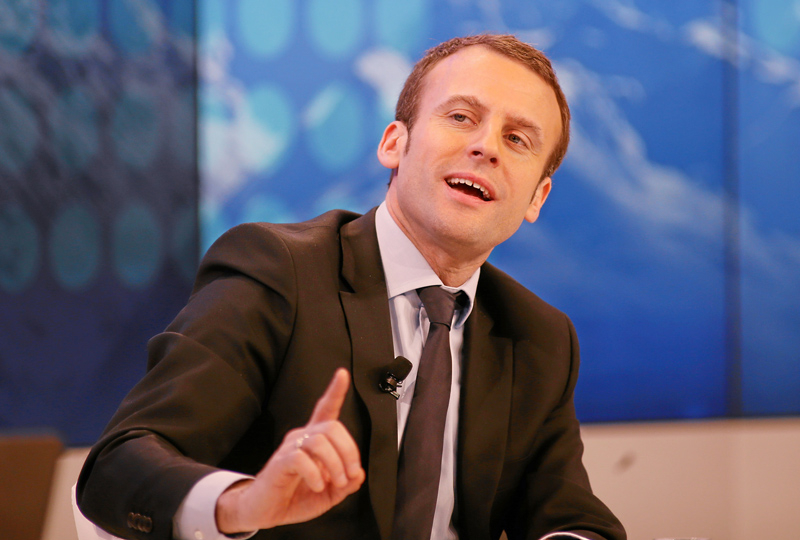
Emmanuel Macron, then Minister of the Economy, Industry and Digital Affairs of France, at the Annual Meeting 2016 of the World Economic Forum in Davos, Switzerland, January 22, 2016. (image source: World Economic Forum/Michele Limina)

Paris, Champs Elysees, April 20, 8:50 pm. An Islamic terrorist shoots at a police van. One policeman is killed, another is seriously wounded.

Continue Reading Article

Europe: What Happens to Christians There Will Come Here

by Giulio Meotti  •  April 30, 2017 at 5:00 am

  • “Be careful, be very careful. What has happened here will come to you.” — An elderly priest in Iraq, to Father Benedict Kiely.

  • Last year, more than 90,000 people chose to drop out of the Church of Sweden — almost twice as many as the year before. Meanwhile, in one year, 163,000 migrants, most of them Muslim, entered the country.

  • “Shouldn’t the issue of Middle Eastern Christians wake up European civilization to its core identity? Shouldn’t we in Europe and the West be telling ourselves that these attacks are also aimed at us?” — Mathieu Bock-Côté, in Le Figaro.

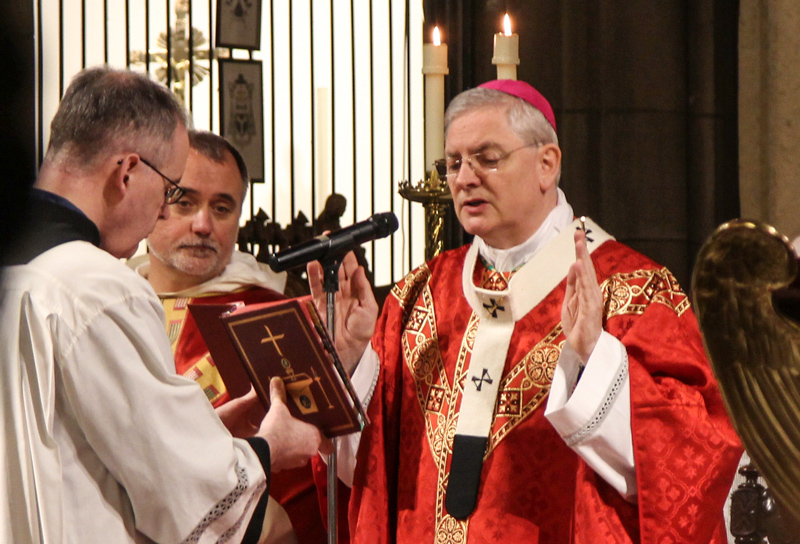
The Catholic Archdiocese of St Andrews and Edinburgh, headed by Archbishop Leo Cushley (right), is planning to cut the number of parishes from more than 100 to 30. (Image source: Lawrence OP/Flickr)

“I fear we are approaching a situation resembling the tragic fate of Christianity in Northern Africa in Islam’s early days”, a Lutheran bishop, Jobst Schoene, warned a few years ago.

In ancient times, Algeria and Tunisia, entirely Christian, gave us great thinkers such as Tertullian and Augustine. Two centuries later, Christianity has disappeared, replaced by Arab-Islamic civilization.

Is Europe now meeting the same fate?

In the Middle East, “Christianity is over in Iraq” due to Islamic extremism; in Europe, Christianity is committing suicide.

Within 20 years, more babies will be born to Muslim women than to Christian women world-wide; it is just the latest sign of the rapid growth that seems to be making Islam the world’s largest religion by the end of the century, according to a new study released by the Pew Research Center.

“Christianity is literally dying in Europe,” said Conrad Hackett, the head of the researchers who worked on the Pew report.

Continue Reading Article

“The Judeo-Christian Community”

by Amir George  •  April 30, 2017 at 4:30 am

  • “We hear day and night, ‘the Muslim community’ and ‘Muslim-majority nations.'”

  • “Why, then, cannot we use ‘the Judeo-Christian community’ or ‘Judeo-Christian majority nations’?”

  • “If we do not look after us, someone else will. But we may not like what comes out.”

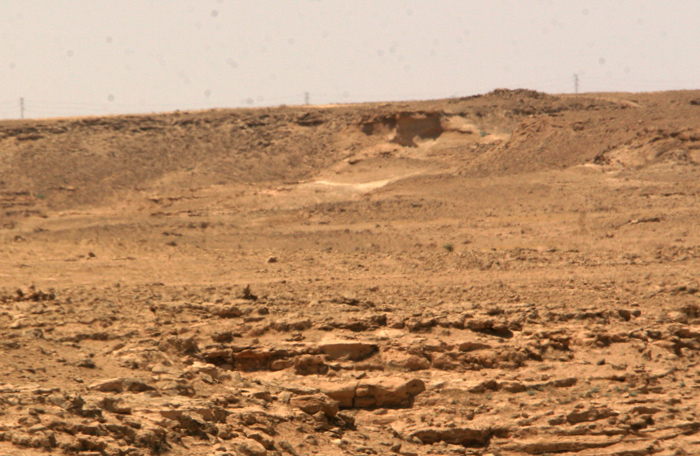
The Iraqi desert (illustrative). Image source: U.S. Marine Corps/Lance Cpl. James B. Hoke.

Seeing Turkey’s election this month, in which the Turks used their democratic freedom to vote themselves out of their democratic freedom — just to throw it out — should remind us that the Judeo-Christian values which we take for granted are more fragile than we may have thought.

Shortly after the liberation of Iraq in 2003, the only way to get into immediate postwar Baghdad was to get a ride in Amman, Jordan, and take it across the desert to Iraq.

A bulletin board in Jordan’s Amman Intercontinental Hotel would list who was going to Baghdad and we all hitched rides with whomever we could get.

So, on a crazy trip, the well-known “Baghdad Dash,” three of us crammed into a tiny, not so cool-looking car and made our way across the desert.

Halfway, the engine stopped. In typical Mohammedan fashion, the driver said “Insha’ Allah” (“God’s will”), got out of the car and walked off.

Continue Reading Article

Ethnic Slaughter in Bangladesh

by Arnab Goswami  •  April 30, 2017 at 4:00 am

  • Last year, the police themselves set fire to about 3,000 houses of minority people.

  • Most recently, the Bangladesh Army killed Romel Chakma, an indigenous student leader. He was only 18 and had one eye. The government forced the media to bury the news.

  • What is most perplexing is the silence of the international media and so-called humanitarian organisations.

Romel Chakma. (Image source: Arnab Goswami’s Blog)

The Bangladesh government at present is carrying out atrocities against religious and ethnic minorities. Some foreign organisations helped me to flee to safety in Germany after nine of my colleagues were hacked to death by extremists.

Unfortunately, all the minorities of the country are not as fortunate. Last year, the police themselves set fire to about 3,000 houses of minority people. Most recently, the Bangladesh Army killed Romel Chakma, an indigenous student leader. He was only 18 and had one eye. The army decided to pour Kerosene over his dead body and set it on fire.

The government forced the media to bury the news. It is different in Bangladesh; nobody cares about minority people anyway.

What is most perplexing is the silence of the international media and so-called humanitarian organisations. Please let the world know about the realities in Bangladesh.

This is an article on the murder. It contains the links to the murder news covered.

Continue Reading Article

Smokescreens in Islam: Confusing the Public about the Facts

by Denis MacEoin  •  April 29, 2017 at 5:00 am

  • Qadri’s admirable take on terrorism conceals another large elephant in the room. Islam has for centuries used violence against non-Muslims in what is considered a legitimate manner: through jihad. It is not simply that Muslim armies have fought their enemies much as Christian armies have engaged in war. Jihad is commanded in the later verses of the Qur’an, is endorsed in the Traditions and the biography of Muhammad, and codified in the manuals of shari’a law. Qadri knows this perfectly well, and at times inadvertently reveals as much in several ways.

  • Qadri does not just insist that Islam is a religion of peace and security. By tucking all references to jihad in footnotes in transliterated Arabic, he never has to explain what it is about and how it relates to his rulings on what is and what is not permissible.

  • It is hard to be a reasonably knowledgeable Muslim and not know that calls for violence pervade the Qur’an and sacred traditions, or that Islamic armies have been fighting European Christians, Indian Hindus, and others since the 7th century.

  • Islam, after all, conquered Persia, Turkey, North Africa and the Middle East, Greece, Spain and most of Eastern Europe — until its armies were stopped at the gates of Vienna in 1683.

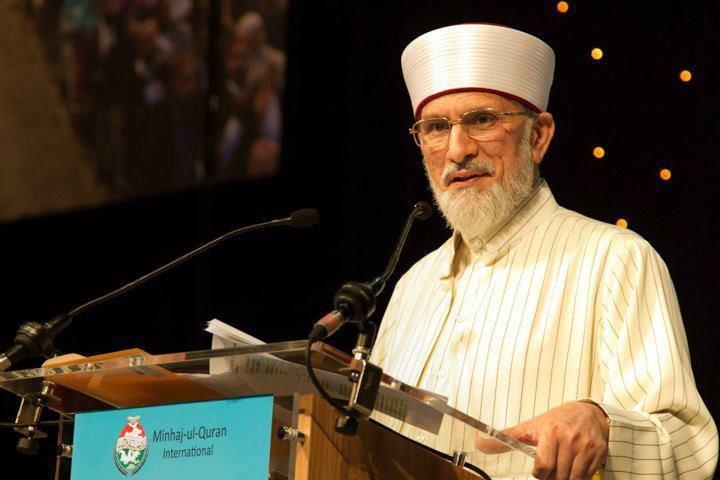
When Muhammad Tahir-ul-Qadri conceals important information and distorts Arabic vocabulary in order to drive home a narrative of Islam’s deep connection to peace and security, he is engaged in setting up a smokescreen. (Image source: ServingIslam/Wikimedia Commons)

Following the terrorist attack outside Britain’s Houses of Parliament on March 22, 2017, it was not surprising or wrong that many Muslims denounced the attack and declared it to be un-Islamic. Two days afterwards, Dr. Mohammed Qureshi, chairman of the Board of Trustees for the Shropshire Islamic Foundation, said:

We need to be united in this situation.

We should not give any religion a bad name and these people need to be dealt with in full force and there should be zero tolerance when it comes to dealing with them.

My heart goes out to these victims. And my heart goes out to the people’s families and those who are injured. I pray they all have peace in their minds.

He added:

There is no place for these acts in the religion of Islam.

The people are being radicalised and the young and vulnerable people need to be protected.

We need to disassociate this with Islam, as Islam is a religion of peace.

Continue Reading Article

Saudi Arabia’s ‘Lavish’ Gift to Indonesia: Radical Islam

by Mohshin Habib  •  April 29, 2017 at 4:00 am

  • Prior to Saudi Arabia’s attempts to spread Salafism across the Muslim world, Indonesia did not have terrorist organizations such as Hamas Indonesia, Laskar Jihad, Hizbut Tahrir, Islamic Defenders Front and Jemmah Islamiyah, to name just a few. Today, it is rife with these groups.

  • A mere three weeks after the Saudi king wrapped up his trip, at least 15,000 hard-line Islamist protesters took to the streets of Jakarta after Friday prayers, calling for the imprisonment of the capital city’s Christian governor, who is on trial for “blaspheming the Quran.”

  • In a separate crisis, crowds were demanding that Basuki Tjahaja Purnama (known familiarly as Ashok) be jailed for telling a group of fishermen that, as they are fed lies about how the Quran forbids Muslims from being governed by a kafir (infidel), he could understand why some of them might not have voted for him. If convicted, Ashok stands to serve up to five years in prison.

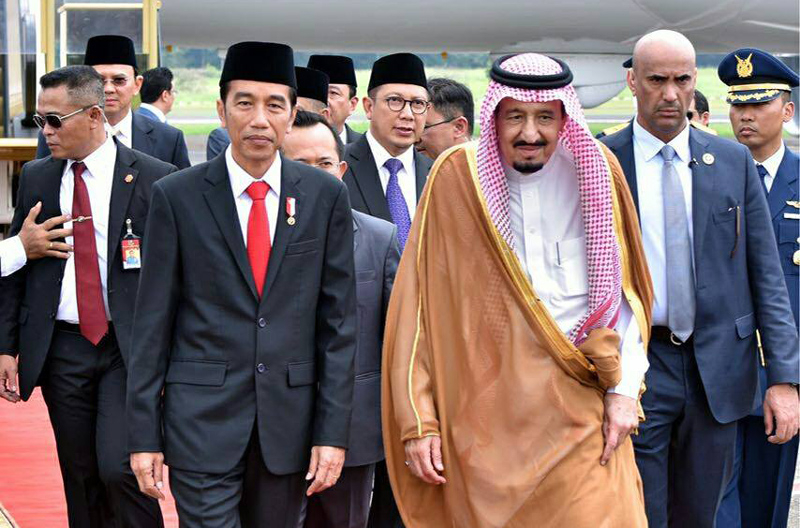
President Joko Widodo of Indonesia (foreground, left) meets with King Salman of Saudi Arabia (foreground, right), at Halim Perdanakusuma Airport in Indonesia. (Image source: Indonesian Presidential Palace)

Accompanied by a 1,500-strong entourage, Saudi King Salman bin Abdul Aziz arrived in Indonesia on March 1 for a nine-day gala tour. He was welcomed warmly not only as the monarch of one of the world’s richest countries, but as the custodian of Islam’s two holiest cities, Mecca and Medina.

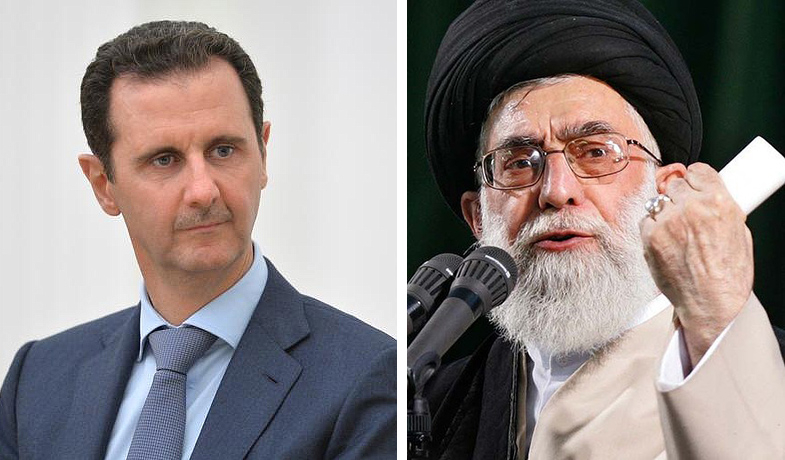
Iran’s Forces Outnumber Assad’s in Syria by Majid Rafizadeh

  • Pursuing a sectarian agenda, Iranian leaders have also fueled the conflict by sending religious leaders to Syria to depict the conflict as a religious war.Iran’s military forces and operations in Syria are significantly more than what has been generally reported so far.

The Syrian war has led to the rise and export of terrorism abroad as well as to one of the worst humanitarian tragedies, in which more than 470,000 people have been killed.

Iran has played a crucial role in maintaining in power President Assad, who has repeatedly used chemical weapons on civilians. Iran has promoted continuing the conflict.

While, according to reports by Iran’s Islamic Revolutionary Guard Corps (IRGC), the Syrian military has fewer than 50,000 men, Iran has deployed more than 70,000 Iranian and non-Iranian forces in Syria, and pays monthly salaries to over 250,000 militiamen and agents. According to a report entitled, “How Iran Fuels Syria War,” published by the National Council of Resistance of Iran (NCRI), non-Iranian mercenaries number around 55,000 men; Iraqi militias are around 20,000 men (from 10 groups), Afghan militias are approximately 15,000 to 20,000 men, Lebanese Hezbollah are around 7,000 to 10,000 men, and Pakistani, Palestinian and other militiamen number approximately 5,000 to 7,000.

In addition, the composition of Iranian IRGC forces are around 8,000 to 10,000 men, and 5,000 to 6,000 from the regular Iranian Army.

The major Iranian decision-makers in the Syrian conflict are Supreme Leader Ayatollah Ali Khamenei and the senior cadre of the Revolutionary Guards. Iran’s so-called moderate leaders — including President Hassan Rouhani and Foreign Minister Javad Zarif — are also in favor of Iran’s military, advisory, financial, and intelligence involvement in Syria. Rouhani repeatedly announced his support for Assad and pledged to “stand by [Syria].”

Khamenei insists on using more military power in Syria:

“[I]n December 2015, Khamenei ordered the IRGC to stand fast in the Aleppo region. He reiterated that if they retreated, their fate would be similar to the Iran-Iraq war and the regime would ultimately be defeated in Syria. Thus, in January 2016, the IRGC doubled the number of its forces in Syria to about 60,000 and launched extensive attacks in the region. However, despite tactical advances in some areas, these forces have been unable to even take control of southern Aleppo. IRGC faced a deadlock. In March 2016, Khamenei ordered the regular Army’s 65th Division (special operations) to be deployed around Aleppo, and increased the number of other forces as well. Plans for a major offensive to capture Aleppo were set in motion. During attacks by the IRGC and the Iranian army in April 2016, dozens of the regime’s forces, including IRGC commanders and staff, Iranian army personnel and foreign mercenaries from Iraq, Lebanon and Afghanistan, were killed. Although the IRGC and the Iranian regime’s regular army forces have failed to change the balance of military power in Syria, Khamenei insists on sending more IRGC and army forces into the Syrian quagmire. Seeing no way forward, and no way back.”

Iran has also played critical role in pushing Russia to intensify its military involvement in Syria by providing air support, so that the IRGC and its allies could help Iran’s military make quick territorial gains.

Iran has spent approximately USD $100 billion on the Syrian war. The sanctions relief given to Iran as a result of the “nuclear agreement” has significantly assisted the Iranian leaders’ ability to continue the war.

Iran also pays salaries to non-Iranian militias to participate in the war: “The Tehran regime spends one billion dollars annually in Syria solely on the salaries of the forces affiliated with the IRGC, including military forces, militias, and Shiite networks.”

Iran, for example, pays nearly USD $1,550 a month to the IRGC’s Iraqi mercenaries who are dispatched to Syria for a month-and-a-half, and approximately USD $100-200 a month to the Syrian militia fighters from the Syrian National Defense.

Pursuing a sectarian agenda, Iranian leaders have also fueled the conflict by sending religious leaders to Syria to depict the conflict as a religious war.

“Iran’s ruling regime has deployed a vast network of its mullahs to Syria, where their warmongering stirs up the fighters. And much like during the Iran/Iraq War, religious zealots are also sent to Syria to fuel the flames of religious fervor among the IRGC’s Basiij fighters and Afghan and Iraqi mercenaries.”

Iran has divided Syria into five divisions and haד over 13 military bases including the “Glass Building” (Maghar Shishe’i), which is the IRGC’s main command center in Syria, located close to the Damascus Airport. The IRGC placed its command center near the airport because,

“the airport would be the last location to fall. IRGC forces airlifted to Syria are dispatched to other areas from this location. One of the commanders stationed at the Glass Building is IRGC Brig. Gen. Seyyed Razi Mousavi, commander of IRGC Quds Force logistics in Syria. Between 500 and 1,000 Revolutionary Guards are stationed there.”

Other Iranian bases are scattered across Syria including in Allepo, Hama, and Latakia.

Since Brig. General Hossein Hamedani was killed in Syria, the current command of Iran’s forces in Syria lies with the Command Council, whose members include: IRGC Brig. Gen. Esmail Qaani (deputy of Qassem Soleimani who is the commander of the Quds Force) and IRGC Brig. Gen. Mohammad Jafaar Assadi (aka Seyyed Ahmad Madani).

The Syrian conflict has become the “root cause” of terrorism, which does not recognize borders and has spread to Europe and America. Since the Syrian war is the epicenter of terrorism, fighting terrorist groups such as ISIS without resolving the Syrian conflict is fruitless.

Terrorist groups such as ISIS are the symptoms, and the Syrian war is the disease. We need to address the disease and the symptoms simultaneously.

The best strategic and tactical approach is to cut off the role of a major player in the conflict: i.e. Iran. Without Iran, Assad would most likely not have survived the beginning phase of the uprising.

Iran kept Assad in power and gave birth to terrorist groups such as ISIS. In other words, Iran and Assad are the fathers of ISIS. Iran and Assad also played the West by claiming that they are fighting terrorism.

Considering the military forces and money invested in Syria, Iran is the single most important player in the Syrian war, and has tremendously increased radicalization of individuals, militarization and terrorism. Iran benefits from the rise of terrorism because it expands its military stranglehold across the region. Iran is top sponsor of terrorism, according to the latest report from U.S. State Department.

Iran will not agree to abandon Assad diplomatically.

In order to resolve this ripe environment of conflict for terrorism in Syria, Iran’s financial and military support to Assad should be strongly countered and cut off.

Dr. Majid Rafizadeh, political scientists and Harvard University scholar is president of the International American Council on the Middle East. He can be reached at Dr.rafizadeh@post.harvard.edu.

Iran’s Elections: Black Turbans vs. White Turbans by Mohammad Amin

  • Any distinction between “extremists” and “moderates” in Iran’s political establishment is false.Whatever the results of the upcoming Iranian elections, there will be no shift in Tehran’s human rights violations or core aims of regional hegemony and pursuit of nuclear weapons.

  • What does matter is the behavior of the West, particularly the United States, in the near future. If it again resorts to cooperating with Iranian-backed forces in Iraq and Syria, Khamenei will not only be able to pursue his regional and global interests unfettered, but will be better equipped to contain crises at home.

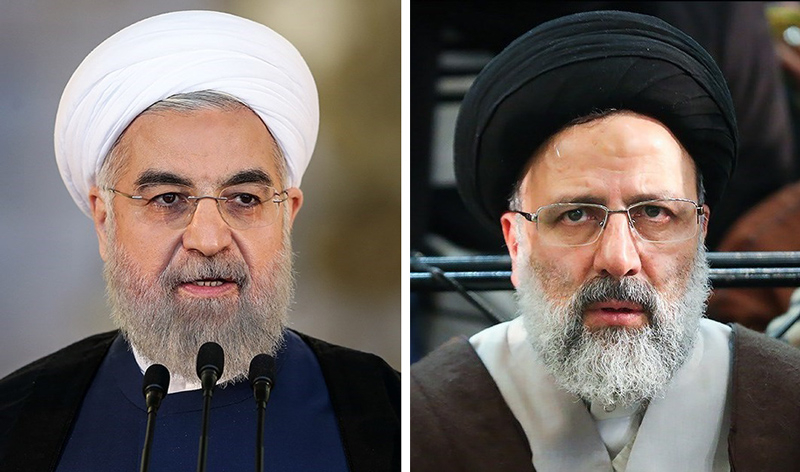
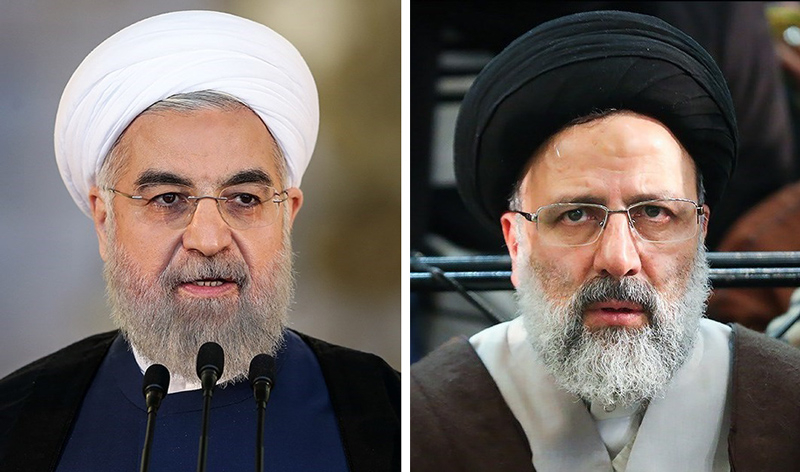
The presidential elections in Iran, scheduled for May 19, have observers wondering whether the “white turban” incumbent, Hassan Rouhani, will retain his position, or be defeated by his likely contender, the “black turban” mullah, Ebrahim Raisi, known for his key role in the 1988 massacre of more than 30,000 political prisoners.

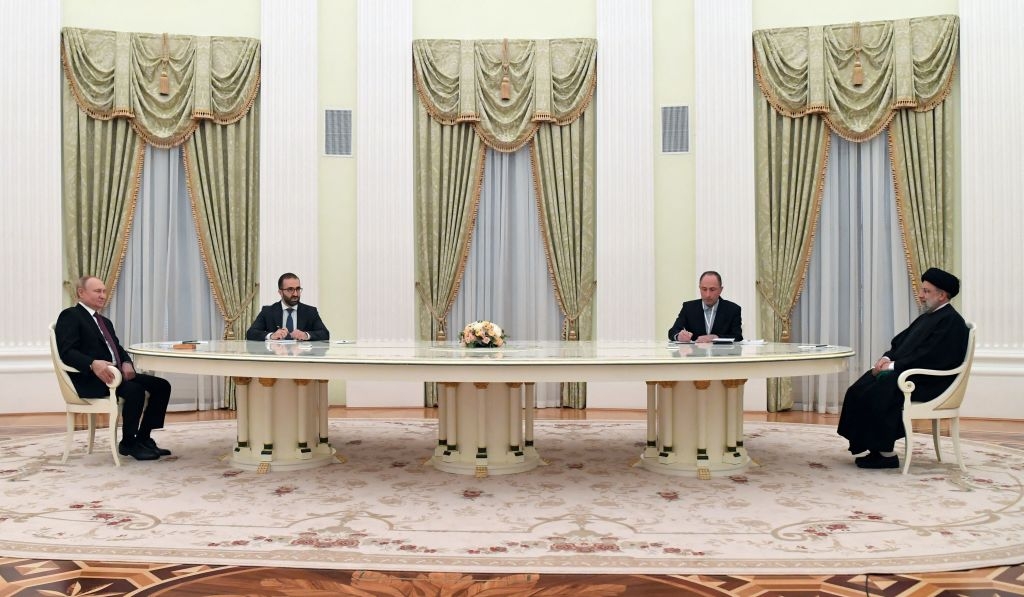
Iran’s elections have observers wondering whether the “white turban” incumbent, Hassan Rouhani (left), will retain his position or be defeated by his likely contender, Ebrahim Raisi (right), the “black turban” mullah. (Images source: Wikimedia Commons).

More importantly, the question on Western minds is how and in what way the Islamic Republic will be affected by either outcome.

The two periods in Iran’s recent history that need to be examined in order to answer this question are that of the tenure of former firebrand President Mahmoud Ahmadinejad (2005 to 2013), who also announced he is running again, and the one that has followed under Rouhani.

At the outset of the Ahmadinejad era, Iran’s GDP (using purchasing power parity) soared beyond $1 trillion, and two of the country’s greatest threats — Iraq under Saddam Hussein and Afghanistan under the Taliban — were eliminated. Both enabled Iranian Supreme Leader Ali Khamenei to solidify his stronghold.

Midway through this period, however, Iran’s economy fell sharply. Iran became the country with the fifth highest inflation rate in the world. Iran fell into a serious recession, and millions of Iranians found themselves unemployed. All this was going on even before the international community imposed sanctions on the regime in Tehran.

In the years that followed Ahmadinejad’s replacement by the so-called “moderate” Rouhani, sanctions were lifted; oil exports reached pre-sanction levels; billions of dollars’ worth of assets abroad were unfrozen; and hundreds of agreements were signed to expand business transactions with the West.

Nevertheless, the last year of Rouhani’s first term was characterized by yet another economic crisis, summarized in March by Iranian Road and Construction Minister Abbas Akhoondi as: banks going bankrupt, crippling national debt and low economic efficiency.

Iran’s economic crises mirrored its political ones. Despite a series of measures that the West imagined would usher in a new era, the opposite happened.

Indeed, although Iran signed the Joint Comprehensive Plan of Action (JCPOA) with world powers in July 2015 — and then-U.S. President Barack Obama persisted in attempts at easing tensions — the regime in Tehran, exceeding its own 30-year record, outdid itself in fundamentalist activities.

More than 3,000 executions of Iranians, for “crimes” such as “insulting Islam,” have taken place under Rouhani; Iran got involved in three Middle East wars — in Syria, Iraq and Yemen; and the regime’s semi-official Mehr news agency said that the Rouhani government has done more to advance strategic weapons development recently than in the past decade.

All of the above indicates that any distinction between “extremists” and “moderates” in Iran’s political establishment is false. As former U.S. Secretary of State Henry Kissinger famously put it: “An Iranian moderate is one who has run out of ammunition.”

This is still true, which means that whatever the results of the upcoming Iranian elections, there will be no shift in Tehran’s human rights violations or core aims of regional hegemony and pursuit of nuclear weapons.

In the event of a Rouhani victory, the country’s economy will remain crippled as factional disputes continue and divisions widen.

If Raisi becomes president, Khamenei and the Islamic Revolutionary Guards Corps(IRGC) will tighten their grip on the economy, thereby causing an even greater depression as they allocate the bulk of the country’s coffers to fuel regional wars and fund global terrorism.

As the late leader of the Communist Party of China, Deng Xiaoping, said during a speech in 1962: “It doesn’t matter whether the cat is black or white, as long as it catches mice.”

In today’s Iran, it does not matter whether the president’s turban is black (signifying its wearer is a descendant of the Prophet Mohammed through one of the 12 imams of Twelver Shi’ism) or white (meaning its wearer is not a descendant of the Prophet and is of non-Arab origin), as long as he remains loyal to the theocracy.

What does matter is the behavior of the West, particularly the United States, in the near future. If it again resorts to cooperating with Iranian-backed forces in Iraq and Syria, Khamenei will not only be able to pursue his regional and global interests unfettered, but will be better equipped to contain crises at home.

If, on the other hand, the U.S. adopts a policy of ending Tehran’s Middle East meddling (as its missile strike a Syrian regime airbase on April 6 indicates it might), the Islamic Republic’s domestic powder keg could explode, spelling disaster for the mullah-led regime, no matter which candidate wins the presidency.

Mohammad Amin, born in Tehran, is a prolific author and expert in Iranian international affairs, and a fellow researcher at the Foundation of Studies for the Middle East (FEMO) in Paris.

Translate »
Skip to toolbar