Category Archives: Uncategorized

Iran’s Threats Louder after Obama Appeasement by Majid Rafizadeh

  • Chants of “Death to America” and “Death to Israel” were heard across Iranian cities as thousands of Iranians marked the anniversary of the seizure of the U.S. Embassy in Tehran and the taking of 52 American hostages for 444 days by militant students.

  • The State Department’s reaction is classic: ignoring these developments and continuing with appeasement policies.
  • These anti-American demonstrations are not rhetoric, but are the cornerstone of Iran’s revolutionary principles and foreign policies, which manifest themselves in Iran’s support for terrorist proxies, support for Assad’s regime, and the scuttling of US and Israeli foreign policies in the region.
  • Many other Iranian officials who were engaged in attacks against the US currently serve in high positions. Hossein Salami, who enjoys one of these high-level positions, is the deputy commander in chief of the Islamic Revolutionary Guards Corps. He stated at the rally: “America should know that if they do not honor their agreement in the nuclear deal, we will resume uranium enrichment…”

After eight years of President Barack Obama’s policies of appeasement, Iran’s threats, such as “Death to America,” and “Death to Israel,” have grown even louder.

This week, the Iranian government orchestrated one the largest anti-American and anti-Israeli demonstrations, since 1979, echoing Iran Supreme Leader, Ayatollah Ali Khamenei’s recent messages.

The government provided facilities for the protesters. Chants of “Death to America” and “Death to Israel” were heard across Iranian cities as thousands of Iranians marked the anniversary of the seizure of the U.S. Embassy in Tehran and the taking of 52 American hostages for 444 days by militant students.

According to the Tehran-based bureau of the Los Angeles Times,

“The demonstrators brought by buses to the former embassy complex included young and old, university students, military staff and employees of state-run companies who voiced opposition to the nuclear deal Iran signed with the United States and world powers… Many echoed Iran’s Supreme Leader, Ayatollah Ali Khamenei…. Almost 1 in every 10 demonstrators at the former embassy — now widely dubbed a “den of espionage” — carried placards with Khamenei’s words: ‘We do not trust America.'”

Iranians protest outside the former US embassy in Tehran, on the anniversary of its storming by student protesters in 1979. (Image source: AFP video screenshot)

The chants were accompanied by burning American and Israeli flags, and Stars of David. This all is occurring in a country that is presided over by the so-called “moderate” president of Iran, Hassan Rouhani and his foreign minister, Javad Zarif; both continue to argue that Iran is a constructive state actor, does not hold hostility against any country, and that Tehran is looking to improve ties with the West and the international community — so long as Iran’s objectives are met.

The State Department’s reaction is classic: ignoring these developments and continuing with appeasement policies. State Department spokesman Mark Toner stated that the White House is not going to change its policies towards Iran:

“Like any country, there’s heated political rhetoric that comes out, and I’m just not going to respond to every instance of that in this case. No one likes to see this kind of hyper-charged rhetoric on the part of any government anywhere, and anti-American sentiments expressed. But again, we’re not going to base our whole relationship going forward … on these kind of heated political remarks.”

However, these large-scale anti-American demonstrations are not rhetoric, but are the cornerstone of Iran’s revolutionary principles and foreign policies, which manifest themselves in Iran’s support for terrorist proxies, support for Assad’s regime, and the scuttling of US and Israeli foreign policies in the region.

In fact, alleging crimes against the US plays very well within the political establishment of Iran. For example, one of the hostage takers who occupied the US embassy, Masoumeh Ebtekar, has climbed the political ladder remarkably. She was first the editor-in-chief of Keyhan International, an Iranian state-owned newspaper, and close advisor to the Supreme Leader. Later she was appointed as the head of the Environment Protection Organization of Iran during the “reformist” administration of President Mohammad Khatami. Afterwards the “moderate” President Rouhani appointed her as the Vice President of Iran, the first woman to serve such position.

The Agence France-Presse (AFP) news agency scored an interview with her during the “Death to America” rally. She boasted about taking US hostages and US documents from the embassy: “Revealing these documents was very similar to what WikiLeaks is doing these days. It was the WikiLeaks of that time.” According to the AFP,

“She now regrets the diplomatic isolation that followed the embassy siege, but she is still proud of their work in releasing documents found in the CIA’s files — some painstakingly reassembled after embassy staff frantically shredded as many as possible when the students stormed the building.”

Many other Iranian officials who were engaged in attacks against the US currently serve in high positions.

Hossein Salami, who enjoys one of these high-level positions, is the deputy commander in chief of the Islamic Revolutionary Guards Corps (IRGC). He stated at the rally, in reference to the role of the IRGC in the bombing of the U.S. Marines barracks in Lebanon, “In 1983, the flames of Islamic revolution flared among Lebanese youth for the first time, and in a courageous act, a young Muslim buried 260 United States Marines under the rebels east of Mediterranean Sea.”

Last week, Ayatollah Ali Khamenei reasserted his stance against the US more firmly, saying, “The US system is far away from values of humanity, death to America means death to a system which has nothing to do with humanitarian values.” Khamenei also dismissed diplomacy with the United States, arguing that these negotiations “will not resolve our problems… We should resolve the problems ourselves and with reliance on our capabilities and the young forces inside the country.”

Iran’s anti-American policies are buttressed and supported by Iran’s powerful military institutions, domestic militia groups such as the Basij, Iran’s proxies such as Hezbollah, and the hundreds of thousands of people who join these kinds of “Death to America” demonstrations. Iranian leaders evidently enjoy powerful loyalist employees and supporters.

As a passionate protestor told the Euronews, “We are here to chant slogans, and our slogans are a strong punch in the face of America. America can never touch our country, and as our leader said, America can’t do a damn thing.”

In addition, Hossain Salami, the acting commander of the IRGC, pointed out at the rally that: “America should know that if they do not honor their agreement in the nuclear deal, we will resume uranium enrichment and send the agreement … to the museum.”

Accordingly, “crowds chanted support for the Syrian government and other Shiite Muslim-led regimes in the Middle East, saying, “We will never give it up.”

For eight years, Washington pursued total appeasement policies with Iran. The four rounds of crippling UN Security Council sanctions, which took decades to put in place, were lifted immediately. Iran’s ballistic missile ambitions and test firings of missiles, in violation of the UN resolutions, were ignored. The expanding militaristic role of the Revolutionary Guard was taken lightly.

None of these appeasement policies changed the political calculations of Iranian leaders towards the US and Israel. In fact, based on these developments, Iranian leaders became more emboldened and empowered, to the extent that they repeatedly harass naval ships of the world’s superpower without fearing any repercussions. Iran uses its proxies to attack US ships.

“Death to America” and Iran’s anti-American policies will not change if the US continues to appease Iranian leaders. For Iran, appeasement policies do not mean diplomatic initiatives; concessions mean only weakness.

Iran’s Soft War Against America by Lawrence A. Franklin

  • Iran’s sophisticated employment of asymmetrical tactics such as “soft war” — which relies on the other side’s wishes, conscious or not, to be taken in — is apparently part of Tehran’s strategy to level the playing field against the U.S., despite America’s overwhelming military superiority.

  • Iran is now being treated by most of the world as a normal nation-state rather than the revolutionary, terror-supporting, totalitarian regime that in reality it is.

Iran is waging a “soft war” offensive — media, social media, charm — against the United States. Tehran believes it is scoring significant victories in this war, and it clearly has, as can be seen by the so-called “Iran deal” — technically no “deal” at all: one side, Iran, got everything.

Iran’s sophisticated employment of asymmetrical tactics, such as “soft war” — which relies on the other side’s wishes, conscious or not, to be taken in — is apparently part of Tehran’s strategy to level the playing field against the U.S., despite America’s overwhelming military superiority.

Tehran seems to think, with justification, that it has successfully exploited the Obama administration’s uncorseted desire for better bilateral relations into granting Iran concessions that are not part of the original Joint Comprehensive Program of Action (JCPOA).

One of these concessions is granting Iran access to the U.S financial system; U.S. Secretary of State John Kerry spent last week trawling through Europe, imploring bankers to do business with Iran, despite that minor detail that America will not.

Another concession is the U.S. offer to buy Iran’s heavy water, a product of its planned plutonium bomb-making reactor in Arak.

Still another concession is the U.S. administration’s failure to increase sanctions on Iran for repeatedly launching potentially nuclear-capable ballistic missiles — in violation of UN Security Council Resolution 2231.

The Iranian regime may well attribute these American concessions to its employment of the “jang-e-narm” (soft war) tactic of “smile diplomacy”: the media-friendly demeanor of President Hassan Rouhani and Foreign Minister Mohammad Javad Zarif.

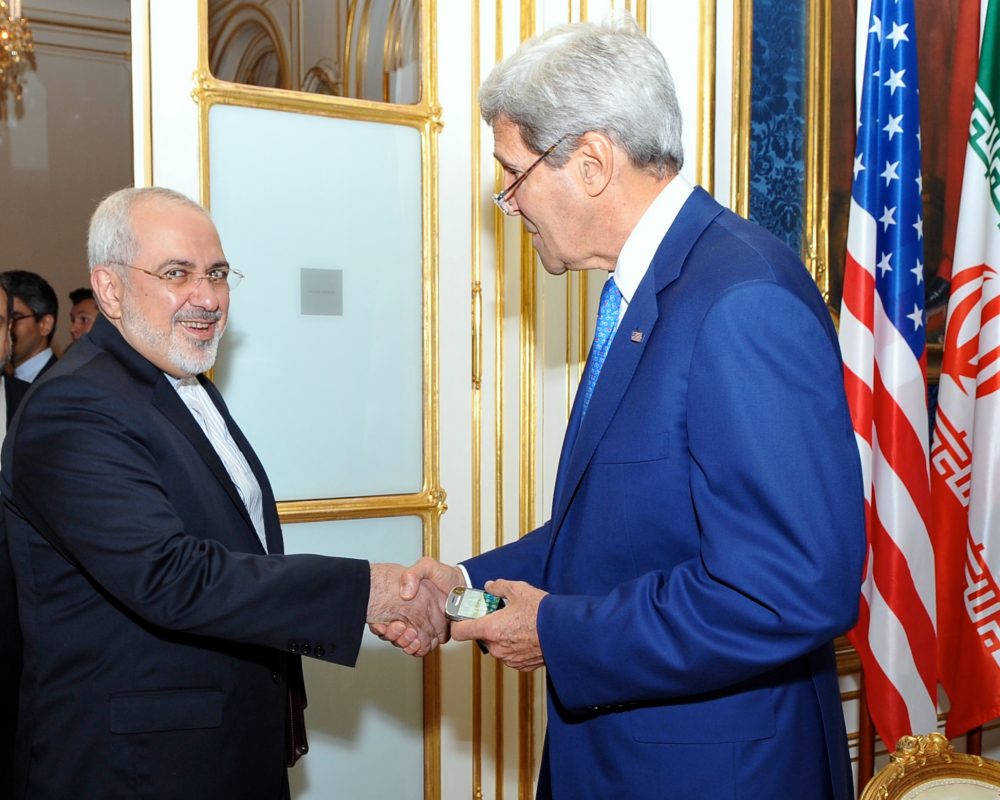
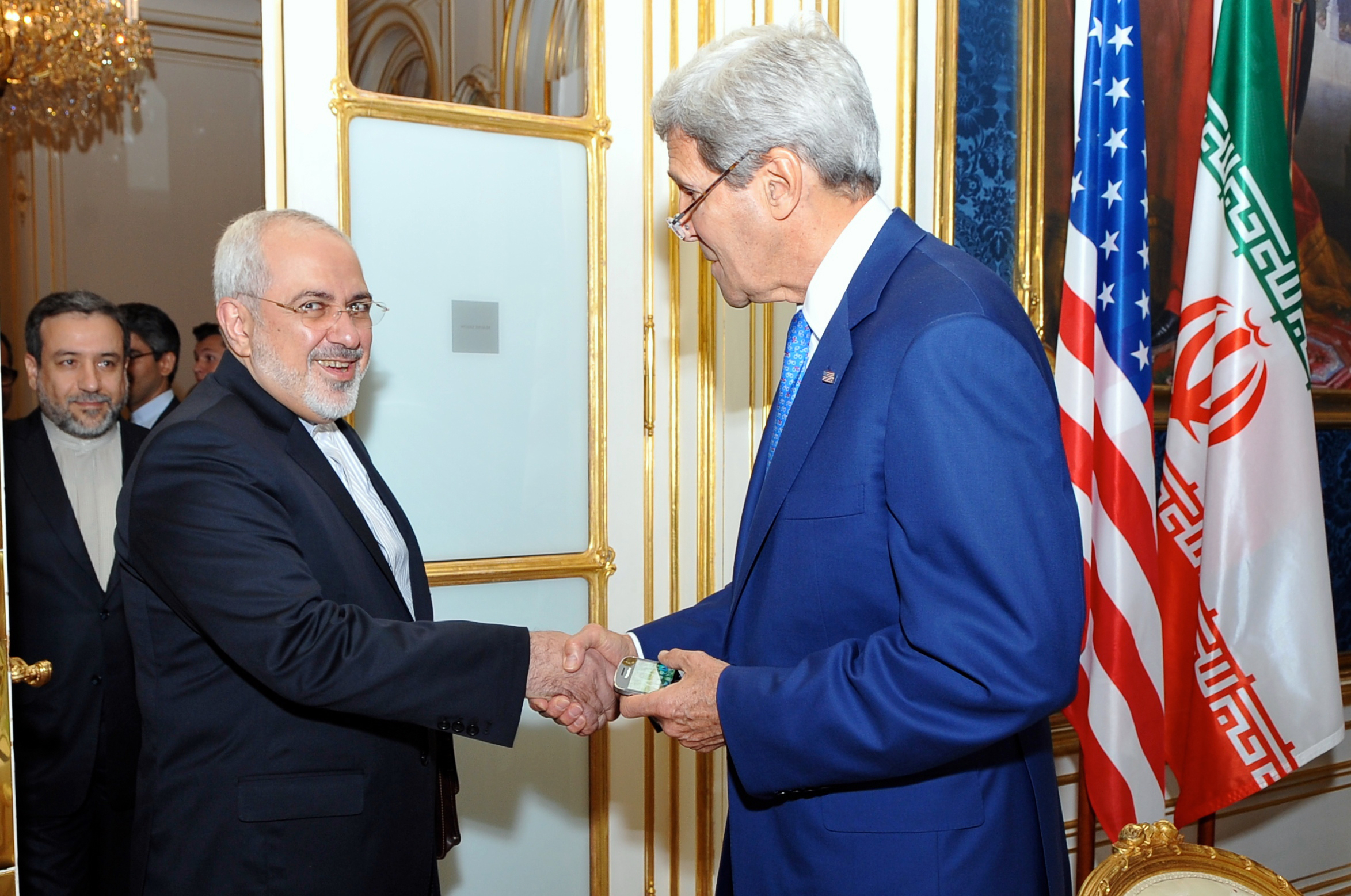
The Iranian regime may well attribute recent American concessions to its employment of the soft war tactic of “smile diplomacy”: the media-friendly demeanor of President Hassan Rouhani and Foreign Minister Mohammad Javad Zarif. Pictured: U.S. Secretary of State John Kerry shakes hands with Iranian Foreign Minister Mohammad Javad Zarif during talks in Vienna, Austria, July 14, 2014. (Image source: U.S. State Department)

Not surprisingly, those are the same tactics that Iran is accusing Washington of using against Iran. Iran has been alleging that the U.S. has been waging soft war attacks against it, via Facebook, YouTube, and Twitter, supposedly — according to Iran — to develop sympathies within Iran’s elites for Western culture, policies, and ideals. Presumably the next concession is that the U.S. be quiet and let Iran keep expanding as far as it likes. The other day, Iran threatened to block the transport of oil by closing the Strait of Hormuz at the mouth of the Persian Gulf.

This is the problem: Iran is now being treated by most of the world as a normal nation-state rather than the revolutionary, terror-supporting, totalitarian regime that in reality it is.

Iran also is using this narrative of an American-led soft war against Iran to institute tighter controls on Iranian citizens. Iran recently dispatched Basij paramilitary teams to elementary schools to instill revolutionary Islamic values in the students. Iran has also established “Atlas,” a new, government-controlled press agency modeled upon Qatar’s Al-Jazeera network. Iranian authorities most likely hope that this news service will counteract any untoward thoughts of liberalization that the “Arab Spring” might have conjured up to question the regime’s “stability.”[1] Iran has also stepped up internet censorship as well as efforts by the government’s plainclothes police to sever contacts between Western NGO personnel and Iran’s civil society activists.

Evidence of how seriously Iran views the potential of America’s supposed soft war tactics was its establishing a National Data Center to filter messages coming into Iran from Western media, in addition to Tehran’s sponsorship of its first National Forum on Soft War, in the autumn of 2015.

Meanwhile, pursuing both its hard war and soft war offensives, Iran continues to trumpet its ability to produce new weapons systems, including novel and illegal ballistic missiles.

The regime also boasts about its acquisition of weapons from outside the country, such as Russia’s S-300 air defense system.

Not surprisingly, this soft war saber-rattling by Shi’ite Iran has been increasing the security concerns of its neighboring Sunni Arab States. These concerns, in turn, cause the Gulf countries and others to demand that their American ally demonstrate that it is serious about halting Iranian expansion in the region. Recent visits to the Sunni states by high-level American political leaders (President Obama), ranking diplomats (Secretary of State John Kerry), and senior military figures (Secretary of Defense Ashton Carter and Chairman of the Joint Chiefs of Staff General Dunford) have sought to allay these fears; it is still not clear with what.

Meanwhile, Iran’s aggressive involvement in Syria, Yemen, and Iraq is clearly creating the impression among Gulf states and others that regional leadership is passing from Sunni Saudi Arabia onto a toxic Shi’ite Iran.

Dr. Lawrence A. Franklin was the Iran Desk Officer for Secretary of Defense Rumsfeld. He also served on active duty with the U.S. Army and as a Colonel in the Air Force Reserve, where he was a Military Attaché at the U.S. Embassy in Israel.

Iran’s Plans to Control a Palestinian State by Khaled Abu Toameh

  • The Iran nuclear deal, marking its first anniversary, does not appear to have had a calming effect on the Middle East.
  • Iran funnels money to Hamas and Islamic Jihad because they share its desire to eliminate Israel and replace it with an Islamic empire. The Iranian leaders want to see Hamas killing Jews every day, with no break. Ironically, Hamas has become too “moderate” for the Iranian leadership because it is not doing enough to drive Jews out of the region.

  • More Palestinian terror group leaders may soon perform the “pilgrimage” to their masters in Tehran. If this keeps up, the Iranians themselves will puppeteer any Palestinian state that is created in the region.

The Iran nuclear deal, marking its first anniversary, does not appear to have had a calming effect on the Middle East. The Iranians seem to be deepening their intervention in the Israeli-Palestinian conflict in general and in internal Palestinian affairs in particular.

This intervention is an extension of Iran’s ongoing efforts to expand its influence in Arab and Islamic countries, including Iraq, Yemen, Syria and Lebanon and some Gulf states. The nuclear deal between Tehran and the world powers has not stopped the Iranians from proceeding with their global plan to export their “Islamic Revolution.” On the contrary, the general sense among Arabs and Muslims is that in the wake of the nuclear deal, Iran has accelerated its efforts to spread its influence.

Iran’s direct and indirect presence in Iraq, Syria, Yemen and Lebanon has garnered some international attention, yet its actions in the Palestinian arena are still ignored by the world.

That Iran provides financial and military aid to Palestinian groups such as Hamas and Islamic Jihad has never been a secret. In fact, both the Iranians and the Palestinian radical groups have been boasting about their relations.

Iran funnels money to these groups because they share its desire to eliminate Israel and replace it with an Islamic empire. Like Hezbollah in Lebanon and the Houthis in Yemen, Hamas and Islamic Jihad agreed to play the role of Tehran’s proxies and enablers in the Israeli-Palestinian conflict.
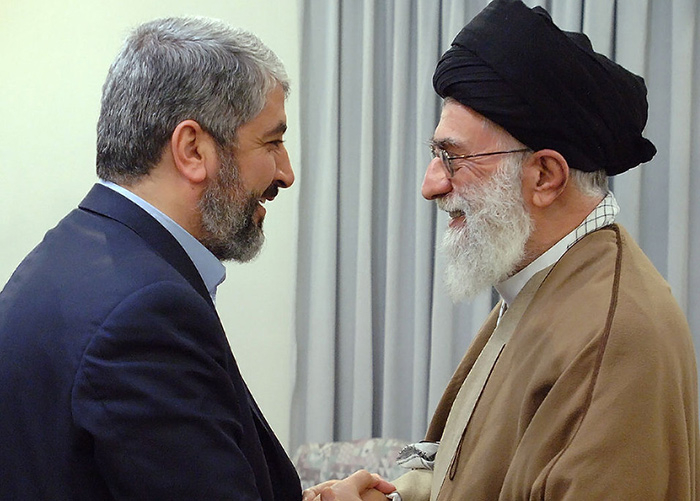
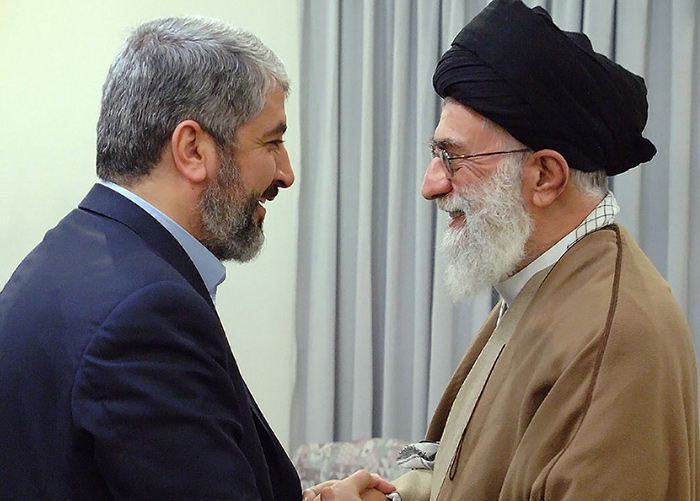
Iran used to funnel money to Hamas and Islamic Jihad because they share its desire to eliminate Israel and replace it with an Islamic empire. Relations between Iran and Hamas foundered a few years back, when Hamas leaders refused to support the Iranian-backed Syrian dictator, Bashar Assad. Pictured above: Hamas leader Khaled Mashaal (left) confers with Iranian “Supreme Leader” Ali Khamenei, in 2010. (Image source: Office of the Supreme Leader)

But puppets must remain puppets. Iran gets nasty when its dummies do not play according to its rules. This is precisely what happened with Hamas and Islamic Jihad.

Relations between Iran and Hamas foundered a few years back over the crisis in Syria. Defying their masters in Tehran, Hamas leaders refused to declare support for the Iranian-backed Syrian dictator, Bashar Assad. Things between Iran and Hamas have been pretty bad ever since.

First, the Assad government closed down Hamas offices in Damascus. Second, Assad expelled the Hamas leadership from Syria. Third, Iran suspended financial and military aid to Hamas, further aggravating the financial crisis that the Gaza-based Islamist movement had already been facing.

Islamic Jihad got it next. Iranian mullahs woke up one morning to realize that Islamic Jihad leaders have been a bit unfaithful. Some of the Islamic Jihad leaders were caught flirting with Iran’s Sunni rivals in Saudi Arabia and other Gulf countries. Even worse, the Iranians discovered that Islamic Jihad was still working closely with their erstwhile allies in the Gaza Strip, Hamas.

Iran had had high hopes for Islamic Jihad replacing Hamas as Tehran’s darling, and major proxy in the Palestinian arena. But here were Islamic Jihad leaders and activists working with their cohorts in Hamas, in apparent disregard of Papa Iran.

The mullahs did not lose much time. Outraged by Islamic Jihad’s apparent disloyalty, Iran launched its own terror group inside the Gaza Strip: Al-Sabireen (The Patient Ones). This group, which currently consists of several hundred disgruntled ex-Hamas and ex-Islamic Jihad members, was meant to replace Islamic Jihad the same way Islamic Jihad was supposed to replace Hamas in the Gaza Strip — in accordance with Iran’s scheme.

Lo and behold: it is hard to get things right with Iran. Al-Sabireen has also failed to please its masters in Tehran and is not “delivering.” Palestinian sources in the Gaza Strip say that Iran has realized that the investment in Al-Sabireen has not been worthwhile because the group has not been able to do anything “dramatic” in the past two years. By “dramatic,” the sources mean that Al-Sabireen has neither emerged as a serious challenger to Islamic Jihad or Hamas, and has not succeeded in killing enough Israelis.

So Iran has gone running back to its former bedfellow, Islamic Jihad.

For now, Iran is not prepared fully to bring Hamas back under its wings. Hamas, for the Iranians, is a “treacherous” movement, thanks to its periodic temporary ceasefires with Israel. The Iranian leaders want to see Hamas killing Jews every day, with no break. Ironically, Hamas has become too “moderate” for the Iranian leadership because it is not doing enough to drive Jews out of the region.

That leaves Iran with the Islamic Jihad.

In a surprise move, the Iranians this week hosted Islamic Jihad leader Ramadan Shalah and senior officials from his organization, in a renewed bid to revive Islamic Jihad’s role as the major puppet of Tehran in the Gaza Strip. Islamic Jihad officials said that the visit has resulted in the resumption of Iranian financial aid to their cash-strapped organization. As a result of the rift between Islamic Jihad and Iran, the Iranians are said to have cut off nearly 90% of their financial aid to the Palestinian terror organization.

Some Palestinians, such as political analyst Hamadeh Fara’neh, see the rapprochement between Iran and Islamic Jihad as a response to the warming of relations between Hamas and Turkey. The Iranians, he argues, are unhappy with recent reports that suggested that Turkey was acting as a mediator between Hamas and Israel.

Other Palestinians believe that Iran’s real goal is to unite Islamic Jihad and Al-Sabireen so that they would become a real and realistic alternative to Hamas in the Gaza Strip.

Whatever Iran’s intentions may be, one thing is clear: The Iranians are taking advantage of the nuclear deal to move forward with their efforts to increase their influence over some Arab and Islamic countries. Iran is also showing that it remains very keen on playing a role in the Israeli-Palestinian conflict — one that emboldens radical groups that are bent on the destruction of Israel and that share the same values as the Islamic State terror group.

Iran’s latest courtship of Islamic Jihad is yet another attempt by the mullahs to deepen their infiltration of the Palestinian arena by supporting and arming any terror group that strives to smash Israel. For now, it seems that Hamas’s scheme is working, largely thanks to the apathy of the international community, where many believe that Iran has been declawed by the nuclear deal.

But more Palestinian terror group leaders may soon perform the “pilgrimage” to their masters in Tehran. If this keeps up, the Iranians themselves will puppeteer any Palestinian state that is created in the region. Their ultimate task, after all, is to use this state as a launching pad to destroy Israel. And the Iranians are prepared to fund and arm any Palestinian group that is willing to help achieve this goal.

Khaled Abu Toameh is an award-winning journalist based in Jerusalem.
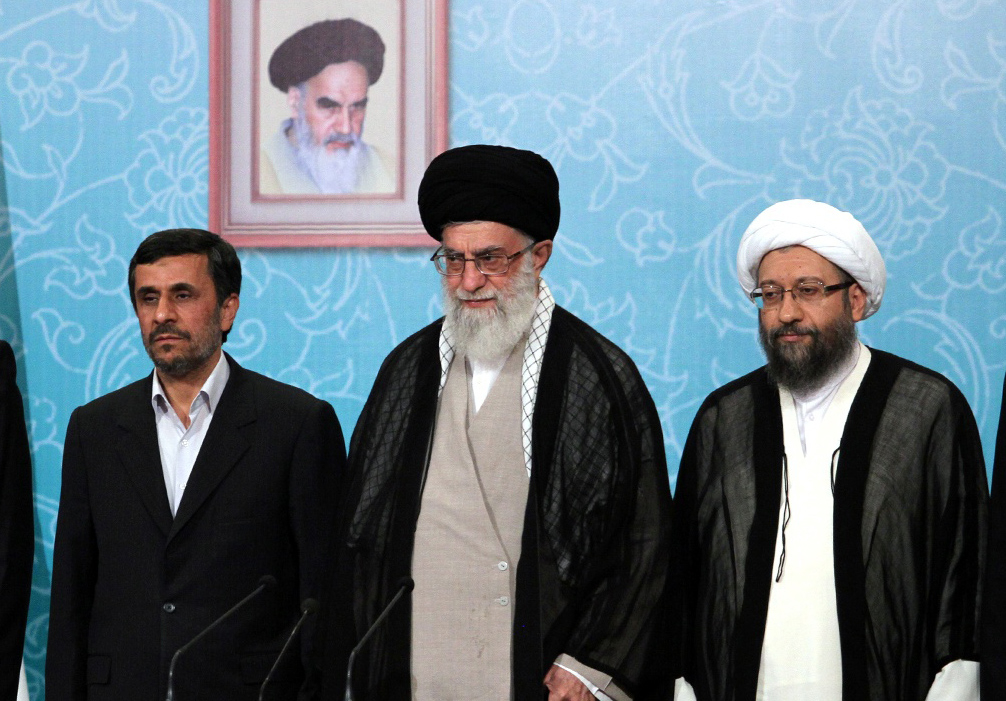
Iran’s Next Supreme Leader?

The process of selecting the successor to Supreme Leader Ayatollah Khamenei already seems underway.

  • President Rouhani, government cabinet officers, and deputies of the Majles (consultative assembly/parliament) usually have little to no influence in the vetting process of candidates.

  • The Revolutionary Guards, ranking intelligence officers, and the regime’s plutocrats do not want to elevate anyone with an independent power base or a charismatic personality.
  • Whoever is ultimately selected, regime stability at least for the next few years seems assured: anti-regime networks remain shredded after the 2009 nationwide protests were violently suppressed.

While U.S. policymakers, media talking-heads and many think tank pundits are fixated on the Joint Comprehensive Plan of Action (JCPOA) and Tehran’s nuclear weapons projects, the focus of Iran’s power-brokers is on regime continuity and leadership succession. Iran’s next parliamentary elections are scheduled for February 26, 2016.

The process of selecting the successor to Supreme Leader Ayatollah Khamenei already seems underway. Former President Ali Akbar Hashemi Rafsanjani (1989-1997) hinted as much, according to a Reuters report. The aging first generation of the 1979 Islamic Revolution’s leadership are determined to maintain regime stability during the transition to a new rahbar (leader) upon the retirement or death of Khamenei.

Those institutions that will play a large role in the selection process include: ranking members of the Islamic Revolutionary Guard Corps (IRGC), senior clergy in Qom, members of the Assembly of Experts,[1] and the Council of Guardians.[2]

President Hassan Rouhani, government cabinet officers, and deputies of the Majles (consultative assembly/parliament) usually have little to no influence in the vetting process of candidates.

Some Western media commentary, which can be inclined to mirror imaging — assuming “they” are like “us” — has hinted that former President Ali Akbar Hashemi Rafsanjani is a serious contender. This is not so. The 81-year-old Rafsanjani was long ago pushed to the side by political and religious hardline acolytes of the current leadership. As early as 2011, when Rafsanjani’s personal website registered growing popularity in a poll, it was shut down. Another sign of Rafsanjani’s marginalization is the decision by the Council of Guardians to disqualify him from submitting his candidacy for the Presidency in the 2012 presidential election. Still another is the dearth of coverage of the former president in Iran’s media. In one recent case, Iranian state television and the regime’s leading daily newspaper, Keyhan, appeared to excise his photo from a public event where he sat near Khamenei. Another sign is his reduced role in the 82-member Assembly of Experts, which holds its next election in February 2016. Rafsanjani was also defeated by Khamenei ally, Ayatollah Mohamad Yazdi, in a recent election for the Assembly’s Speakership.

The likely successor to Khamenei will be chosen from a vetting process that is probably already underway.

The next Supreme Leader likely will be selected from the following pools of talent: Tehran Friday Prayer Leaders, the Council of Guardians, and Iran’s Judiciary.

But if Khamenei’s demise is sudden, an interim leader may be selected from Qom’s several senior Ayatollahs.

The next Supreme Leader, however, is likely to be just as colorless as the present occupant of the office: the IRGC, ranking intelligence officers, and the regime’s plutocrats do not want to elevate anyone with an independent power base or a charismatic personality. They do they want someone like Rafsanjani who is independently wealthy and considered politically unreliable by hardliners. Nor will they be content with the radical hardline cleric, Mesbah Yazdi, who once was close to former President Mahmoud Ahmadinejad. However, Yazdi has been of late an exuberant, public supporter of Khamenei, especially since Ahmadinejad’s fall from favor.

One candidate who may be a serious contender for the office of Supreme Leader is the current chief of Iran’s judiciary, Ayatollah Sadegh Larijani. Nevertheless, whoever is ultimately selected, regime stability at least for the next few years seems assured: anti-regime networks remain shredded after the 2009 nationwide protests were violently suppressed.

Out with the old, in with the new?
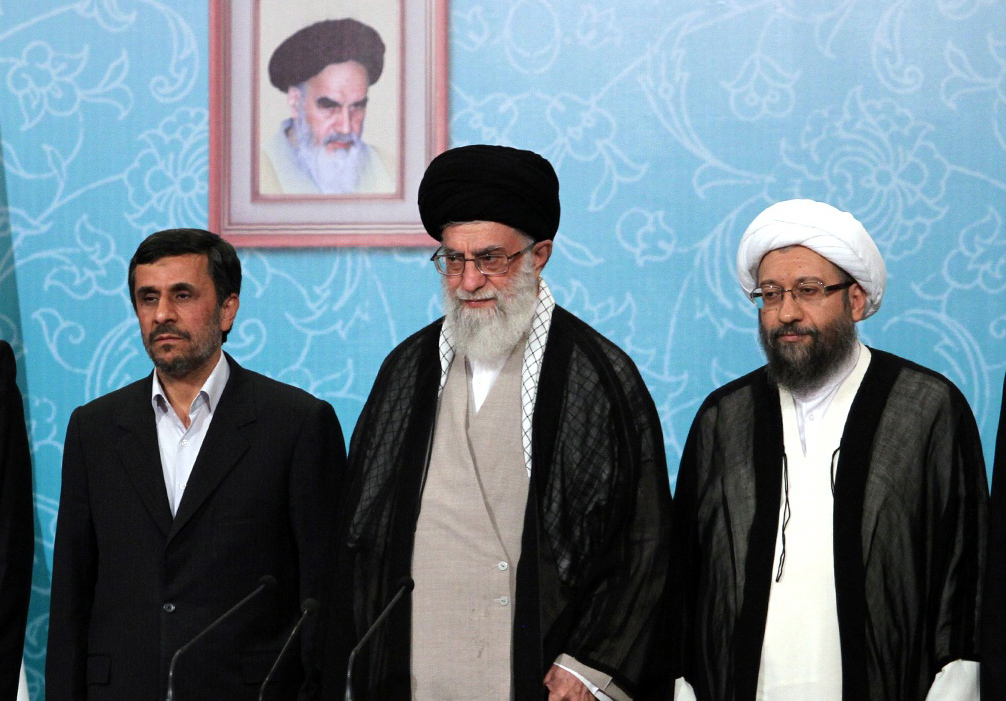
A serious contender to replace Ayatollah Khamenei (center) in the office of Supreme Leader is Ayatollah Sadegh Larijani (right). (Image source: Office of Supreme Leader)

Dr. Lawrence A. Franklin was the Iran Desk Officer for Secretary of Defense Rumsfeld. He also served on active duty with the U.S. Army and as a Colonel in the Air Force Reserve, where he was a Military Attaché at the U.S. Embassy in Israel.

Iran’s New Palestinian Terror Group: Al-Sabireen by Khaled Abu Toameh

  • The Iranians are also believed to have supplied their new terrorist group in the Gaza Strip with Grad and Fajr missiles that are capable of reaching Tel Aviv.

  • The leader of Al-Sabireen, Hisham Salem, is a former commander of Palestinian Islamic Jihad in the Gaza Strip. His activities and rhetoric have worried many in Hamas and Palestinian Islamic Jihad, who fear that his group is beginning to attract many of their followers.
  • Salem has been accused by many Palestinians of helping Iran spread Shia Islam inside the Gaza Strip, where all Muslims belong to the rival Sunni denomination.
  • This, of course, is bad news for [Palestinian President Mahmoud] Abbas, who is now watching as many of his former loyalists have come onto Iran’s payroll and are sharing its radical ideology.
  • Many Palestinians and Arabs in the region are already voicing concern. The last thing Abbas, Egypt’s President Sisi and Jordan’s King Abdullah need is another Iranian terror group such as Hezbollah in the Middle East.
  • It now remains to be seen whether the Obama Administration and other Western powers will wake up and realize that the Iranians are continuing to fool them, not only regarding Tehran’s nuclear program, but also concerning its territorial ambitions in the Middle East.
  • Unless the U.S. and Western powers realize that Iran remains a major threat to world peace, Al-Sabireen and other terrorist groups will one day manage to establish a UN-recognized Palestinian state that would pose an existential threat to Israel and destabilize the entire Middle East.

The nuclear deal between Iran and the world powers has paved the way for the Iranians to resume their efforts to spread their influence throughout the Middle East.

As the Obama Administration and the rest of the international community choose to look the other way, Iran evidently feels that this is the appropriate time to meddle in the internal affairs of Arabs and Muslims

Iran’s main goal, from all appearances, is to dominate the entire Middle East by destroying Israel and most of the Arab and Islamic regimes that are considered too “moderate” and “pro-West.” So far, thanks to the indifference of the Obama Administration and most Western countries, the Iranians seem to be marching in the right direction toward achieving their goal.

Iran is already deeply involved in Yemen, Syria, Iraq and Lebanon. In recent months, the Iranians have also returned to the Palestinian arena, this time through a new group called Al-Sabireen Movement For Supporting Palestine. Translated into English, Al-Sabireen means “The Patient One.”

The new Iranian-backed Al-Sabireen was established in wake of tensions between Iran and its two former allies in the Gaza Strip: Hamas and Islamic Jihad. Since the beginning of the Syrian crisis four years ago, relations between Tehran and Hamas and Islamic Jihad have been strained. The refusal of Hamas and Islamic Jihad publicly to support Iran’s ally, President Bashar Assad, in his fight against the Syrian opposition, has resulted in the expulsion of Hamas and Islamic Jihad leaders from Syria. It has also prompted the Iranians to cut off financial aid to the two groups, an abandonment that has left them facing a severe and unprecedented crisis — the worst in more than two decades.

Al-Sabireen, whose emblem is identical to that of another Iran proxy, Hezbollah, so far has about 400 followers in the Gaza Strip. Each one receives a monthly salary of $250-$300, while the senior officials of the group get at least $700.

Although Al-Sabireen has been operating in the Gaza Strip for several months now, its name surfaced two weeks ago when one of its top military commanders was shot and killed by the Israel Defense Forces (IDF). The man, Ahmed Sharif Al-Sarhi, was responsible for a series of shooting attacks on Israel before he was fatally shot by IDF snipers along the border with the Gaza Strip.

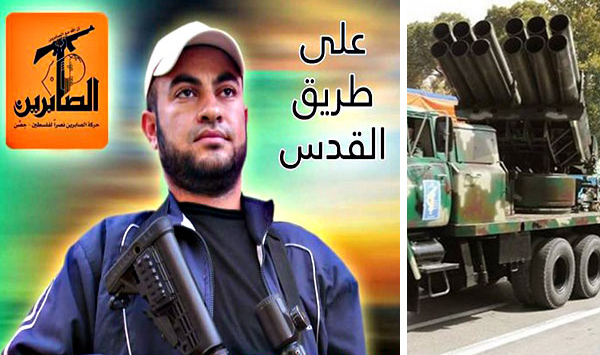
Al-Sabireen commander Ahmed Sharif Al-Sarhi (left) was responsible for a series of shooting attacks on Israel before he was fatally shot two weeks ago by IDF snipers along the border with the Gaza Strip. The Iranians are also believed to have supplied their new terrorist group in the Gaza Strip with Grad and Fajr missiles (right) that are capable of reaching Tel Aviv.

Palestinian sources said that most of the Al-Sabireen terrorists are former disgruntled members of Palestinian Islamic Jihad. The sources said that Iran has been supplying Al-Sabireen with various and new types of weapons that are being used to attack Israel. According to the sources, Al-Sarhi was killed by the IDF while he was trying to fire from a new Steyr HS .50 long-range sniper rifle he had recently received from the Iranians.

The Iranians are also believed to have supplied their new terrorist group in the Gaza Strip with Grad and Fajr missiles that are capable of reaching Tel Aviv.

The leader of Al-Sabireen, Hisham Salem, is a former commander of Palestinian Islamic Jihad in the Gaza Strip. His activities and rhetoric have worried many in Hamas and Palestinian Islamic Jihad, who fear that his group is beginning to attract many of their followers.

Two weeks ago, unidentified assailants stabbed and moderately wounded Salem shortly after he gave a newspaper interview in the northern Gaza Strip. Although no group has claimed responsibility, it is widely believed that the assailants belong to either Hamas or Palestinian Islamic Jihad. Salem has been accused by many Palestinians of helping Iran spread Shia Islam inside the Gaza Strip, where all Muslims belong to the rival Sunni denomination.

Al-Sabireen is also believed to have succeeded in recruiting scores of militiamen belonging to President Mahmoud Abbas’s Fatah faction in the Gaza Strip. These militiamen have gone to the Iranian-backed group mostly for financial considerations. This, of course, is bad news for Abbas, who is now watching as many of his former loyalists have come onto Iran’s payroll and are sharing its radical ideology.

Iran’s presence in the Gaza Strip — this time through Al-Sabireen — is bad news not only for Israel, but also for many Palestinians and Arabs in the region. The Egyptians, who have been waging a relentless war on Hamas, Palestinian Islamic Jihad and other terrorist groups in the Gaza Strip and Sinai, are already voicing concern over Iran’s new Palestinian proxy. The last thing Abbas, Egyptian President Abdel Fattah Sisi and Jordan’s King Abdullah need is another Iranian terror group similar to Hezbollah in the Middle East.

It now remains to be seen whether the Obama Administration and other Western powers will wake up and realize that the Iranians are continuing to fool them, not only regarding Tehran’s nuclear program, but also concerning its territorial ambitions in the Middle East. Iran’s Al-Sabireen group states that its main goal is to “eliminate the Zionist entity.”

On its way to achieving its goal, the group will also kill Arabs and Muslims who do not share its objectives and ideology. It also seeks to kill Israel’s Western friends, especially those living in the U.S. and Europe. Unless the U.S. and Western powers realize that Iran remains a major threat to world peace, Al-Sabireen and other terrorist groups will one day manage to establish a UN-recognized Palestinian state that would pose an existential threat to Israel and destabilize the entire Middle East.

Translate »
Skip to toolbar