Category Archives: Uncategorized

Iran’s Commitment to Shia in the Region

Iran’s commitment to Shi’ite interests seems firmly linked to its idea of its mission, as well as to the survival of its revolutionary regime. Iran’s theocracy is likely willing to pay a high price to safeguard this legacy. The West should not expect Iran to reduce its presence in Syria or Iraq, even under severe military pressure.


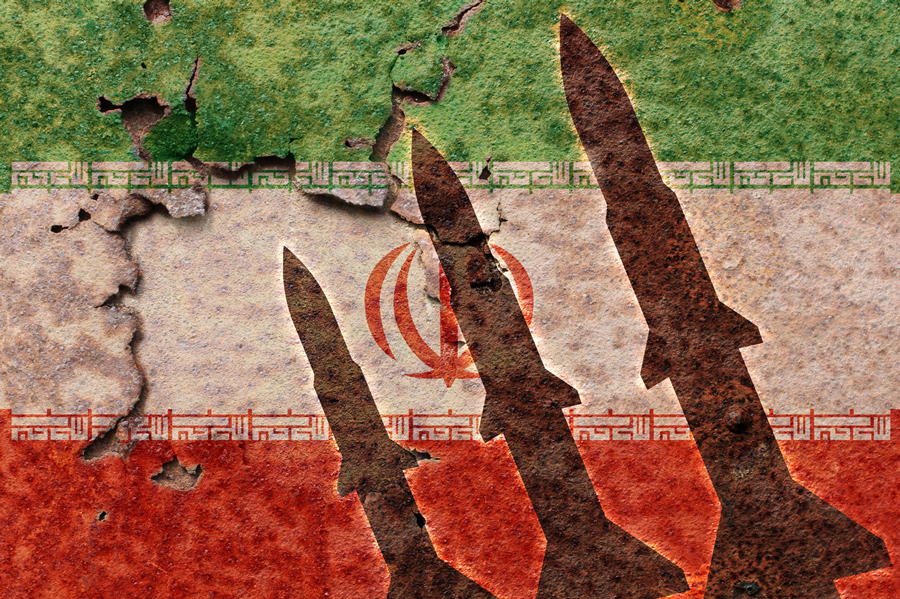
  • As the Obama Administration continues to reward Iran for violating its agreement not to build nuclear weapons under the nuclear Non-Proliferation Treaty (NPT), and violating its agreement not to build nuclear-capable missiles, and its refusal to sign the worthless “Iran Deal,” its presence is set to become even more unpleasant as it becomes more prominent.

The West does not seem to appreciate the intensity of Iran’s commitment to its Shi’ite cousins in Syria. The West also seems not to comprehend the depth of Iran’s spiritual ties to its centuries-old role as the champion of Shi’a Islam.

Much Western journalistic commentary addresses Iran’s commitment to the Assad regime in Damascus. Left underreported is the profound sense of shared religious identity between the Shia of Iran and the Shi’a Alawi minority of Syria. Iran’s determination to maintain Alawi supremacy in Syria transcends any personal attachment to the Assad administration.

In light of this month’s execution of a leading Shi’ite preacher Nimr al-Nimr by Saudi Arabia and the consequent heightened tension between Tehran and Riyadh, it might help policymakers to understand that the religious divide between Shi’ite and Sunni Muslims as an inveterate and unbridgeable chasm as that between ISIS and the United States.

Parts of the Saudi embassy in Tehran were burned on January 2, when a mob of Iranians attacked and ransacked the diplomatic mission. The attack came in response to Saudi Arabia’s execution of Shi’ite preacher Nimr al-Nimr the same day.

Iran’s Shi’ite Ayatollahs are on record declaring that Syria’s Alawites are genuine Shi’ites[1], a question finalized after a centuries-long dispute. The Iranian Shi’ite establishment had questioned the Syrian Alawi inclination to venerate Jesus, Mohammad and Ali as a pale reflection of the Christian theological concept of the Holy Trinity. Moreover, some Iranian Mullahs were not comfortable with the Alawi practice of celebrating Christmas. Iran evidently felt obligated to extend a protective cover to its Shi’ite co-religionists.

Another dimension of Iran’s support for regional Shi’ism is its close operational relationship with the Lebanon-based terrorist group, Hezbollah — the political arm of Lebanon’s Shi’ites. The links are so close that Tehran has been able to mobilize thousands of Lebanese Shi’ite volunteers to fight in support of the Assad regime in Syria. Iran’s theological ties to Lebanon’s Shi’ite Muslims also are deep and longstanding.

Iran’s sense of responsibility for Shi’ism beyond its borders seems linked to the historical Islamic world-power contest for hegemony between Sunni and Shi’ite Muslims. The Sunni, for centuries, have dominated and persecuted the Shi’ites, even in states where the Shiites have been in the majority. This century is first time the Shi’ites have started successfully to challenge Sunni supremacy in the region of the Persian Gulf. The George W. Bush Administration replaced Iraq’s ousted Sunni President, Saddam Hussein, with a basically Shi’ite leadership. And the Obama Administration, thorough the promised infusions of up to $150 billion (much of which Iran will presumably use to increase its terrorist activities worldwide), has paved the way for Iran to have the capability to assemble nuclear weapons and missile delivery systems.

But perhaps even the Americans could not, in an electoral system, have prevented Shi’ite predominance in a country where the Shi’ites constituted about two-thirds of Iraq’s population.[2] Next-door Iran is at least 75% Shi’ite.[3] The theological cadre from both countries receives its religious training in many of the same seminaries in Qom, Iran and Najaf, Iraq. Much of Iraq is now controlled by militia groups loyal to Tehran, not to Baghdad.[4]

Iran is also extending assistance to Bahrain’s Shi’ites, the vast majority of the island’s population.[5] Iran, which had controlled Bahrain before the island was colonized by Great Britain in the 19th century, had agreed to London’s grant of independence to the Gulf state in 1971. The agreement had served British imperial interests in the region. Yet Iran has evidently never been comfortable with the arrangement. The final secession of Bahrain from Iranian patrimony remains an open wound to Iran’s national pride. The Bahrain issue is particularly sensitive, as the United States Navy’s 5th Fleet is now headquartered there. The fleet’s naval assets enable the U.S. to guard the Persian Gulf below Iran’s southern border.

A religious reason, however, also motivates Tehran’s role in Bahrain. For more than two centuries, Bahrain has been governed by the al-Khalifas, a Sunni family originally from Qatar,[6] and sustained in power by Iran’s regional and religious arch-rival: Saudi Arabia. The Sunni ruling family in Riyadh even financed the construction of a 14-mile bridge linking Saudi Arabia and Bahrain, enabling a quick response to any possible move by Tehran to re-establish its dominance in the island. In 2011, Riyadh dispatched military units to Bahrain to suppress protests by the country’s Shi’ites, who were demanding more representation in keeping with their majority status on the island.

Iran also maintains extensive ties to the Shi’ite minority in Saudi Arabia’s Eastern Province, where most of the country’s oil fields are. The Saudi National Guard does not permit demonstrations against Riyadh’s policies. Imams who preach any opposition sentiment to the House of Saud are immediately imprisoned. One imam, Nimr, al-Nimr, was executed by the Saudis this month, presumably as a warning to Shi’ites in Saudi Arabia not even to think any dissenting thoughts.

Iran’s sense of duty to Shi’ite communities outside the Arab Middle East has also earned it influence, particularly in South Asia[7] and West Africa[8].

Iran’s commitment to Shi’ite interests seems firmly linked to its idea of its mission, as well as to the survival of its revolutionary regime. Iran’s theocracy is likely willing to pay a high price to safeguard this legacy. The West should not expect Iran to reduce its presence in Syria or Iraq, even under severe military pressure.

As the Obama Administration continues to reward Iran for violating its agreement not to build nuclear weapons under the nuclear Non-Proliferation Treaty (NPT), and violating its agreement not to build nuclear-capable missiles, and its refusal to sign the worthless “Iran Deal,” its presence is set to become even more unpleasant as it becomes more prominent.

Dr. Lawrence A. Franklin was the Iran Desk Officer for Secretary of Defense Rumsfeld. He also served on active duty with the U.S. Army and as a Colonel in the Air Force Reserve, where he was a Military Attaché at the U.S. Embassy in Israel.


[1] In 1972 Shi’ite cleric Ayatollah Hasan Mahdi al-Shirazi issued a Fatwa ruling that Shia and Alawis are “two synonymous words.” Ayatollah Musa al-Sadr, who disappeared on a visit to Libya reconfirmed al-Shirazi’s Fatwa. See also The Vanished Imam by Fouad Ajami, 1986. p 174.

[2] Encyclopedia Britannica (1997) and various other compilation sources support the statistics cited. However, B.E. claims the percentage of Shia among Iran’s Muslims is about 93%.

[3] Encyclopedia Britannica. Kuwait 30%, Syria/15%, Pakistan 15-20%, Bahrain/65%.

[4] The Council on Foreign Relations Initial Background Paper on Militia Groups in Iraq by Lionel Beehnor and follow-on versions, 9 June 2005.

[5] Encyclopedia Britannica.

[6] Al-Khalifa has governed Bahrain directly or indirectly since 1783.

[7] The key pro-Iranian militia/terrorist group in Pakistan’s mega-city of Karachi is the Tehrik-e-Jafaria.

[8] Iran has just lodged diplomatic protest against the alleged Nigerian Army’s recent massacre of Shi’a Muslims.

Iran’s Cash for Murder: Why is the UK Silent? by Douglas Murray

  • The Iranian distribution of cash to families of terrorists is an open incitement to an ongoing campaign of murder. It should by now have not only been condemned by the whole world, but have caused a colossal rethink among the P5+1 nations that signed the ill-judged accord with Iran.

  • It is worth considering another recent Iranian development: the decision — allegedly by a conglomeration of media outlets, but hardly able to be separated from the government in a country whose press is more “government” than “free” — to increase the cash-bounty on the head of the British novelist Salman Rushdie.
  • The British government has been strangely mute on the matter. The “normalised” relations with Iran were meant to lead to business opportunities for Britain and an increase in decent behavior from Tehran. Instead, the first major test of Iranian-British relations in several decades turns out to be precisely the same test that the late Ayatollah Khomeini drew up in 1989.

Last year, when America, Britain and four other countries (the P5+1) signed their joint plan of action with Iran there was no shortage of people who warned of the consequences. They warned that the deal would merely delay rather than prevent Iran from becoming a nuclear-armed power. They warned of the increased grip the mullahs would have on the country they purport to govern. And in particular, those not caught up in the P5+1 jubilation warned of what Iran would do with the tens of billions of dollars’ cash bonanza it would receive once the deal was done. Would Iran use this windfall solely to improve the lives of its people? Or might it spend at least a portion of this cash doing what it has been doing for nearly four decades: that is, spreading terror?

There have already been some signs that the ill-judged deal is embedding Iran’s worst behaviour rather than elevating the regime to any higher behavioral level.

In recent days we have learned that Iran is already planning to use its windfall to encourage Palestinian terror against the State of Israel. Speaking at the end of last month, the Iranian Ambassador to Lebanon used a press conference with a number of Palestinian factions to announce a new bounty-scheme to be sponsored by Iran. This scheme promises to reward financially those who carry out terror against Israel. The reward includes — according to the Iranian ambassador — a payment of $7,000 to the families of suicide bombers and other terrorists who die in the process of attacking any Israeli. And it also includes a promised payment of $30,000 to any terrorists’ families whose homes are destroyed by the Israel Defense Forces. The demolition of the home of a terrorist’s family house is one of the only disincentives that Israel or any other country could think of to dissuade people intent on suicide attacks. Now the Iranian government is trying to re-incentivise anyone who might wish to commit such an attack.

Speaking in Beirut, Iran’s ambassador to Lebanon, Mohammad Mathali, said, “Continuing Iran’s support for the oppressed Palestinian people, Iran announces the provision of financial aid to families of Palestinian martyrs who were killed in the ‘Jerusalem Intifada.'” He is apparently referring to the lone-wolf knife-attack type of terrorism that has killed and wounded dozens of Israelis in recent months. As such, the Iranian distribution of cash is an open incitement to an ongoing campaign of murder. It should by now have not only been condemned by the whole world, but have caused a colossal rethink among the P5+1 nations that signed the ill-judged accord with Iran. But of course, Israel is always put in a different league in the stakes of international terror. Target Israelis and the “justifications” fly, and explanations deceitfully fill the air of why terrorism against Israelis is not quite the same as other terrorism.

So it is worth considering another Iranian development of recent days. Which is the decision — allegedly by a conglomeration of media outlets, but hardly able to be separated from the government in a country whose press is more “government” than “free” — to increase the cash bounty on the head of British novelist Salman Rushdie. The announcement was that an additional $600,000 had been added to the existing cash reward for whoever kills the author of a novel, The Satanic Verses. It is a cash-incentive to murder that was first issued twenty-seven years ago by the Ayatollah Ruhollah Khomeini.
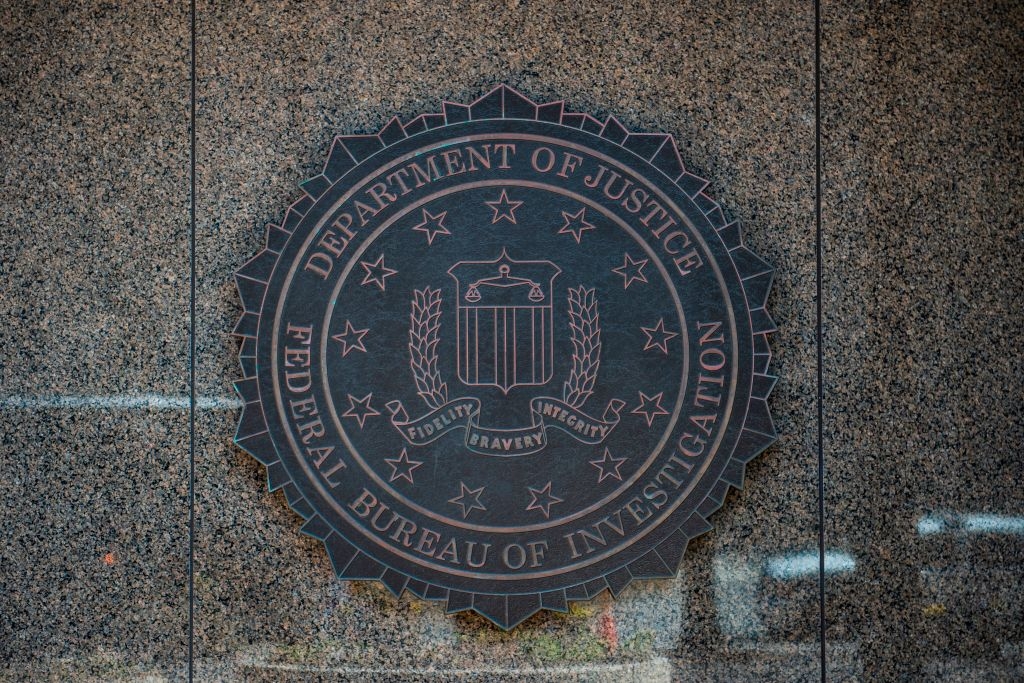
Iran’s then Supreme Leader Ayatollah Ruhollah Khomeini put a cash bounty on the head of British novelist Salman Rushdie 27 years ago. Last month, a group of Iranian media outlets added $600,000 to the cash reward.

The additional bounty has been condemned by human rights activists and free speech defenders in the West such as Richard Dawkins and PEN.

But the British government has been strangely mute on the matter. It is strange because last summer when, against absolutely no public or political push-back in the UK, Foreign Secretary Philip Hammond signed Britain up to the P5+1 agreement, there was only official rejoicing over what our signature would do. Such “normalised” relations with Iran were meant to lead to business opportunities for Britain and an increase in decent behavior from Tehran. Instead, the first major test of Iranian-British relations in several decades turns out to be precisely the same test that the late Ayatollah Khomeini drew up in 1989. Certainly there are politicians of the right and left, including those who have themselves been “incentivised” by Iran, who have predicted a new dawn in relations between the two countries. But does it really it look as though, on the matter of whether or not a British novelist can be sentenced to death by a cleric in Iran, we are going to have to pretend to agree to disagree?

Britain’s silence on this matter is a shameful position for the government of any civilised country to find itself in, just as the silence on the terror being spread against Israel is a shameful position for the civilised world to find itself in. But in these twin events we can already see the Iran deal’s early results. The deal has done nothing to civilise a barbarian regime. All it has done is to spread that regime’s barbarism around what used to be the civilised world.

Douglas Murray, a leading British news analyst and commentator, is based in London.
Iran’s Anti-Semitism by Majid Rafizadeh

  • Thanks to the lifting of sanctions, the prize for best Holocaust cartoon was lifted as well. Iran is now offering $50,000 for the best Holocaust cartoon, more than quadruple last year’s prize, which was $12,000.
  • The competition is expected to draw participants from more than 50 countries. It is sponsored by two organizations which are directly or indirectly linked to the Iranian regime: the Owj Media and Cultural Institute, funded by the Islamic Revolutionary Guard Corps, and the Sarsheshmeh Cultural Center, which is supported by the Islamic Development Organization (IDO). The Iranian parliament provides the IDO’s budget.
  • These kinds of Holocaust events and conferences in Iran are based on the notion that Holocaust did not occur.

This week, Iran is hosting its second annual Holocaust Cartoon Competition, even as some politicians and world leaders continue to argue that Iran is becoming a stabilizing force because it is re-joining the international community, by implementing the nuclear agreement and integrating into the global financial system.

The exhibition of Holocaust cartoons will open on May 14. Iran’s Holocaust Cartoon Competition reflects the Iranian regimes’ attempts to expand its efforts to promote anti-Semitism beyond the borders of its nation.

As Iran’s revenues are rising, thanks to the lifting of sanctions, the prize for the best Holocaust cartoon was lifted, as well. Iran is now offering $50,000 for the best Holocaust cartoon, more than quadruple last year’s prize, which was $12,000. According to Iran’s semi-official IRNA news agency, the conference is expected to draw participants from more than 50 countries.

The Iranian regime seems to be using global legitimacy, granted to its leaders by many Western politicians through the nuclear agreement and business deals, to promote the core pillars of its Islamic revolution, opposing the US and rejecting Israel’s right to exist, as well as its fundamental ideals.

In addition, it is worth noting that these kinds of global conferences, which work to deny the historical fact of the Holocaust, are aimed at undermining Israel’s legitimacy, as well as its right to exist. One of Iran’s major foreign policy and ideological objectives, which rests on the religious teachings of Ayatollahs Khomeini and Khamenei, is the struggle against Israel.

For more than 35 years, the Iranian regime has been trying to delegitimize Israel through both soft and hard power. Iran promotes its anti-Semitic and anti-Israel narrative through schools, social media, television, and non-stop political rhetoric. Its narrative has attracted an audience in the Middle East, as well as in the West.

The Iranian government claims that it has nothing to do with sponsoring such a conference and that it does not endorse such an event. Iranian Foreign Minister Mohammed Javad Zarif explained last week to the New Yorker, in response to this news: “It is not Iran. It is an NGO that is not controlled by the Iranian government. Nor is it endorsed by the Iranian government.”

Zarif added that Iran “does not support, nor does it organize, any cartoon festival of the nature that you’re talking about.”

Mr. Zarif is being disingenuous. The competition is sponsored by two organizations which are directly or indirectly linked to the Iranian regime: the Owj Media and Cultural Institute and the Sarsheshmeh Cultural Center, which is supported by the Islamic Development Organization (IDO). The Iranian parliament provides the IDO’s budget.

In Iran, governmental or non-governmental organizations (NGOs), groups, or institutions cannot hold events — whether cultural, economic or political — without the explicit or implicit approval of Iran’s officials. The approval normally comes from the Ministry of Culture, the Islamic Revolutionary Guard Corps (IRGC), Basij, intelligence agencies, Etela’at, Tehran Municipality or the Ministry of Islamic Guidance.

If the government is not involved in these kinds of events and NGO activities, why do no events exist that criticize the Supreme Leader or the ideological principles of Iran? Why are there only events that promote Ayatollah Khamenei and the revolutionary principles of the IRGC?

In short, it is impossible to hold such a large and global conference without the sponsorship and approval of the government.

The U.S. Holocaust Memorial Museum accurately pointed out in a statement that in Iran, “Previous [Holocaust cartoon] contests in 2006 and 2015 have had the endorsement and support of government officials and agencies.” The museum added that, “There are reports in the Iranian press that the Ministry of Culture is asserting its support for the upcoming contest.”

By denying any involvement in such conferences, Rouhani, Zarif and their team are playing the tactical shift that Supreme Leader Ali Khamenei and a senior cadre of IRGC designed long time ago. The tactical shift is to feign a softer tone on the international stage through the president and the foreign minister, while keeping the fundamentals of Khamenei and the IRGC’s policy intact.

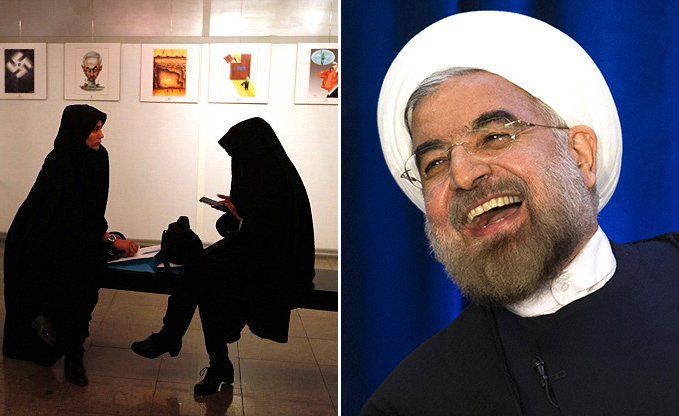
By denying the Iranian regime’s official involvement in the Holocaust cartoon contest, President Rouhani (right) and FM Zarif are feigning a softer tone on the international stage, while keeping the fundamentals of Ayatollah Khamenei and the Revolutionary Guards’s policy intact.

To gain more wealth through business deals and the lifting of sanctions, Rouhani and Zarif are faking a nicer façade and illusion on the international stage, while Khamenei and the IRGC continue with their longstanding objectives of opposing the US and Israel, and preserving Iran’s Islamic and revolutionary norms. Anti-Zionism and Anti-Semitism are two of the core values of Iran’s Islamic revolutionary principles. Khamenei and the IRGC leaders derive legitimacy from these revolutionary and ideological values.

These kinds of Holocaust events and conferences are not linked to “understanding” the Holocaust, as the Iranian leaders disingenuously argue. The conference premise is based on the notion that Holocaust did not occur.

Iran’s propaganda can normally turn this anti-Semitism into a motivation for violence and more terrorist acts.

Western powers are aware of the fact that the improving ties and rapprochement between Tehran and the West, particularly Washington, are contributing to legitimizing the Iranian regime. Nevertheless, it is incumbent on the international community to strongly condemn these hatred-driven moves by Iran’s regime.


Dr. Majid Rafizadeh is an Iranian-American political scientist, Harvard scholar, and president of the International American Council on the Middle East. He can be reached at Dr.rafizadeh@post.harvard.edu and followed at @Dr_Rafizadeh

Iran Trains Children for War by Majid Rafizadeh

  • According to the reports, Syrian authorities are withholding the bodies of more than 456 Palestinians who died under torture in prison. No one knows exactly where the bodies are being held or why the Syrian authorities are refusing to hand them over to the relatives.

  • Mainstream media outlets seem to prefer turning a blind eye to the plight of Palestinians living in Arab countries. This evasion harms first and foremost the Palestinians themselves and allows Arab governments to continue their policies of persecution and repression.
  • It remains to be seen whether the UN Security Council will get its priorities straight and hold an emergency session to discuss the murderous campaign against Palestinians in Syria. Perhaps, somehow, this will overtake “settlement construction” as a topic worthy of world condemnation.

2016 was a tough year for the Palestinians. It was tough not only for those Palestinians living in the West Bank under the Palestinian Authority (PA) regime, or the Gaza Strip under Hamas. When Westerners hear about the “plight” and “suffering” of Palestinians, they instantly assume that the talk is about those living in the West Bank or Gaza Strip. Rarely does the international community hear about what is happening to Palestinians in the Arab countries. This lapse doubtless exists because the misery of Palestinians in the Arab countries is difficult to pin on Israel.

The international community and mainstream journalists only know of those Palestinians living in the West Bank or the Gaza Strip. Of course, life under the Palestinian Authority and Hamas is no box of dates, although this inconvenient fact might be rather unpleasant to the ears of Western journalists and human rights organizations.

In any event, mainstream media outlets seem to prefer turning a blind eye to the plight of Palestinians living in Arab countries. This evasion harms first and foremost the Palestinians themselves and allows Arab governments to continue their policies of persecution and repression.

The past few years have seen horror stories about the conditions of Palestinians in Syria. Where is the media attention for the Palestinians in this war-stricken country? Palestinians in Syria are being murdered, tortured, imprisoned and displaced. The West yawns.

Foreign journalists covering the Middle East swarm by the hundreds throughout Jerusalem and Tel Aviv. Yet they act as if Palestinians can only be found in the West Bank and the Gaza Strip. These journalists have no desire to go to Syria or other Arab countries to report about the mistreatment and trespasses perpetrated by Arabs against their Palestinian brothers. For these journalists, Arabs killing and torturing other Arabs is not news. But when Israeli policemen shoot and kill a Palestinian terrorist who rams his truck into a group of soldiers and kills and wounds them, Western reporters rush to visit his family’s home to interview them and provide them with a platform to express their thoughts.

Palestinians living in Syria, however, are less fortunate. No one is asking how they feel about the devastation of their families, communities and lives. Especially not the hundreds of Middle East correspondents working in the region.

“The year 2016 was full of all forms of killings, torture and displacement of Palestinians in Syria,” according to recent reports published in a number of Arab media outlets.

“The last year was hell for these Palestinians and its harsh consequences will not be erased for many years to come. During 2016, Palestinians in Syria were subjected to the cruelest forms of torture and deprivation at the hands armed gangs and the ruling Syrian regime. It is hard to find one Palestinian family in Syria that has not been affected.”

According to the reports, Syrian authorities are withholding the bodies of more than 456 Palestinians who died under torture in prison. No one knows exactly where the bodies are being held or why the Syrian authorities are refusing to hand them over to the relatives.

Even more disturbing are reports suggesting that Syrian authorities have been harvesting the organs of dead Palestinians. Testimonies collected by some Palestinians point to a Syrian government-linked gang that has been trading in the organs of the victims, who include women and children. Another 1,100 Palestinians have been languishing in Syrian prisons since the beginning of the war, more than five years ago. The Syrian authorities do not provide any statistics about the number of prisoners and detainees; nor do they allow human rights groups or the International Committee of the Red Cross to visit prisons and detention centers.

The most recent report about the plight of Palestinians in Syria states that 3,420 Palestinians (455 of them females) have been killed since the beginning of the war. The report, published by the Action Group For Palestinians of Syria, also reveals that nearly 80,000 Palestinians have fled to Europe, while 31,000 fled to Lebanon, 17,000 to Jordan, 6,000 to Egypt, 8,000 to Turkey and 1,000 to the Gaza Strip. The report also mentions that 190 Palestinians died as a result of malnutrition and lack of medical care because their refugee camps and villages are under siege by the Syrian army and armed groups.

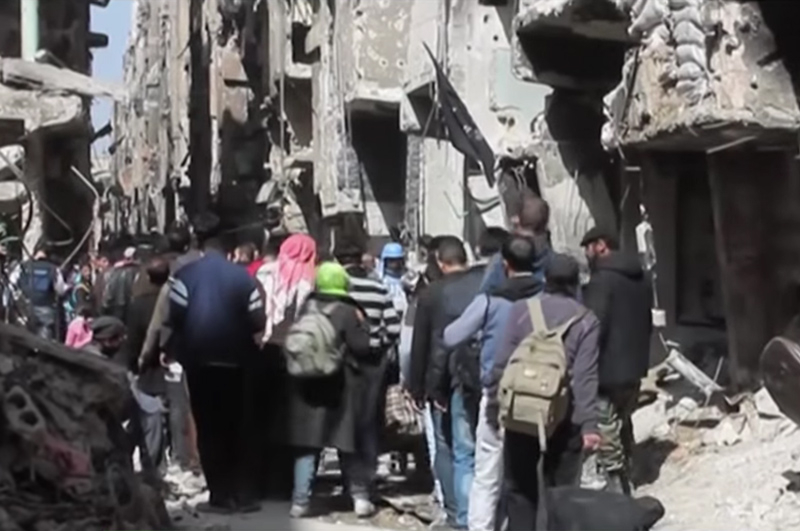
Palestinians flee Yarmouk refugee camp, near Damascus, after fierce fighting in September 2015. (Image source: RT video screenshot)

Alarmed by the indifference of the international community to their plight, Palestinians in Syria have resorted to social media to be heard in the hope that decision-makers in the West or the UN Security Council, obsessed as they are with Israeli settlements, might pay attention to their suffering. The latest campaign on social media, entitled, “Where are the detainees?” refers to the unknown fate of those Palestinians who have gone missing after being taken into custody by Syrian authorities. The organizers of the campaign revealed that in the past few years, 54 Palestinian minors have died under torture in Syrian prisons. The organizers noted that hundreds of prisoners and detainees, after they were apprehended by the Syrian authorities, remain unaccounted for.

Another report revealed that more than 80% of the Palestinians living in Syria have lost their jobs and businesses since the beginning of the civil war. The report added that to support their families, many Palestinian children have been forced to quit school and search for work.

Yet to the international community and Western media, these figures and reports about the Palestinians in Syria are ho-hum at best. The Arab countries care nothing about the Palestinians in Syria who are being killed, tortured and starved to death. In the Arab world, human rights violations are not news. When human rights are respected in an Arab country, that is news.

The Palestinian leadership in the West Bank and Gaza Strip are also blind to the suffering of their people in the Arab world, specifically in Syria. These so-called leaders are too busy ripping out each other’s political throats to be bothered with the welfare of their people, being smothered under the undemocratic and repressive regimes of the Palestinian Authority and Hamas. Such leaders are more concerned about President Donald Trump’s intention to the move the US embassy to Jerusalem than about their own people. In the past two weeks, Mahmoud Abbas and his officials have not missed an opportunity to warn that moving the US embassy to Jerusalem would spark unrest in the Middle East. The killing, torture and displacement of Palestinians in an Arab country seem not to be on their radar.

It remains to be seen whether the UN Security Council will get its priorities straight and hold an emergency session to discuss the murderous campaign against Palestinians in Syria. Perhaps, somehow, this will overtake “settlement construction” as a topic worthy of world condemnation.

Khaled Abu Toameh, an award-winning journalist, is based in Jerusalem.

Iran to Trump: Death to America Will Live On by Majid Rafizadeh

  • Ayatollah Ali Khamenei made it clear that Trump’s presidency causes “no difference” to Iran-US relationships. He called the Americans’ election “a spectacle for exposing their crimes and debacles.””Thank God, we are prepared to confront any possible incident.” — Iran’s Supreme Leader, Ayatollah Ali Khamenei.

  • From the perspective of Iranian moderates, reformists and hardliners, the US is not a superpower anymore; but a weak actor in the Middle East and on the global stage.
  • Iranian leaders also made it clear that Tehran will continue supporting Hezbollah and other groups that have been designated as terrorist groups by the US Department of State. These groups pursue anti-American and anti-Israeli agendas.

Ideologically speaking, Iran’s hardliners, primarily Supreme Leader Ayatollah Ali Khamenei and senior officials of the Islamic Revolutionary Guard Corps (IRGC) who enjoy the final say in Iran’s domestic and foreign policies, have made it clear that Iran will not change the core pillars of its religious and revolutionary establishment: Anti-Americanism and hatred towards the “Great Satan” and the “Little Satan”, Israel.

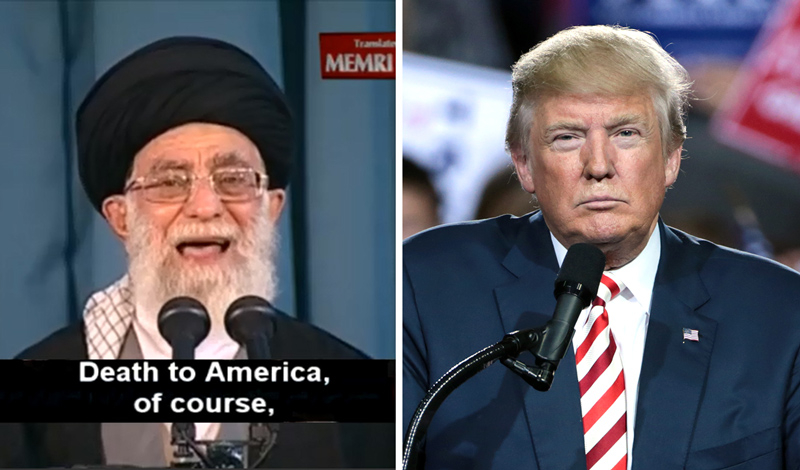
Supporters of Ayatollah Khamenei and the IRGC enthusiastically shouted “Death to America” in response to a recent speech that Khamenei gave, applauding the 1979 hostage-taking and takeover of the US Embassy in Tehran.

Iran’s major state newspapers carried anti-American headlines this week, quoting the Supreme Leader. In his latest public speech to thousands of people, which was televised via Iran’s state TV, Khamenei made it clear that Trump’s presidency will cause “no difference” to Iran-US relationships. Khamenei pointed out that, “We have no judgment on this election because America is the same America”. In his speech, Khamenei attacked President-elect Donald Trump and the American people. The Ayatollah called the US election “a spectacle for exposing their crimes and debacles.”

Other hardliners echoed the same message that there would be no change in Iran’s revolutionary principles and ideals against the US and its allies. The deputy commander of the Revolutionary Guards, Hossein Salami, told Iran’s Fars news agency: “When the Republicans were in power, they threatened us and showed their hostility… and when the Democrats were in power, the policies of the United States were the same.”

Khamenei also remarked that the US will remain the evil, or the “Great Satan,” saying:

“In the past 37 years, neither of the two parties who were in charge did us any good and their evil has always been directed toward us….We neither mourn nor celebrate, because it makes no difference to us… We have no concerns. Thank God, we are prepared to confront any possible incident.”

He added that the remarks made by Donald Trump “over the last few weeks on immoral issues — which are, for the most part, not baseless accusations — are enough to disgrace America.”

Militarily, strategically and geopolitically, Tehran’s core pillars of damaging US national interests, and scuttling US foreign policy objectives will remain intact.

Iran’s semi-official Fars news agency reported that Iran’s armed forces chief of staff, General Mohammad Hossein Bagheri, has heavily criticized Donald Trump for stating that the US will confront Iranian boats in the Gulf if they harass US Navy ships. In the last year, Iran has increasingly harassed and provoked US Navy ships, and detained 11 American sailors.

General Bagheri stated out that, “The person [Trump] who has recently achieved power, has talked off the top of his head! Threatening Iran in the Persian Gulf is just a joke.”

In 2016, the number of incidents of boats from Iran’s navy and Revolutionary Guards provoking and harassing the US Navy ships rose significantly to 31 incidents, highlighting that the IRGC evidently feels sufficiently emboldened to damage US national security publicly and on a regular basis. From the perspective of Iranian moderates, reformists and hardliners, the US is not a superpower anymore; but a weak actor in the Middle East and on the global stage.

In addition, Iran, with underlying anti-American objectives, is aggressively expanding its military presence and naval bases in foreign nations and international waters. Major General Mohammad Hossein Baqheri said, as cited by the Iranian Tasnim news agency, that the expanding presence in international waters and naval bases in foreign countries “could be ten times more efficient than nuclear power.” For the first time, the Iranian Navy’s 44th flotilla, comprised of a Bushehr logistic warship and an Alvand destroyer, has now sailed into the Atlantic Ocean as well.

Tehran is also considering having naval bases on the coasts of Yemen and Syria to support the Assad government and the Houthis. As Iran’s Chief of the General Staff told a gathering of senior naval commanders, “One day, we may need bases on the coasts of Yemen and Syria, and we need the necessary infrastructures for them under international maritime law.”

Iran’s naval commander, Rear Admiral Habibollah Sayyari, also told the gathering of senior naval commanders that boosting military presence in international waters reflects Iran’s power.

According to the Tasnim news agency, Iran’s navy has already deployed 49 flotillas to various maritime zones. Sayyari added that the flotillas showcased Iran’s symbol of power.”

Iranian leaders also made it clear that Tehran will continue supporting Hezbollah and other groups that are designated as terrorist groups by the US Department of State.

These groups pursue anti-American and anti-Israel agendas.

Khamenei and IRGC are sending a strong message that Iran will neither alter its core religious and revolutionary pillar of anti-Americanism, nor change its foreign policy and military objectives of damaging US interests. Iran’s policy towards the “Great Satan” will remain as it has been since the establishment of the Islamic Republic of Iran in 1979.

Dr. Majid Rafizadeh, political scientist and Harvard University scholar is president of the International American Council on the Middle East. He can be reached at Dr.rafizadeh@post.harvard.edu.

Translate »
Skip to toolbar