The mainstream media and their stable of “experts” consistently underestimate North Korea’s missile and nuclear weapon capabilities. The gap between how the media report on the North Korean nuclear missile threat and the reality of the threat has become so wide as to be dangerous.
In the aftermath of North Korea’s latest nuclear test on January 6, 2016, for instance, and its launch of a mock satellite on February 7, 2016, the American people were told that North Korea has not miniaturized a nuclear warhead for delivery by missile nor could the missile strike the U.S. with any accuracy.
Mirren Gidda, for example, writing in Newsweek, inexplicably claims “International experts doubt that North Korea has manufactured nuclear weapons small enough to fit on a missile.”
Yet this commonplace assertion that North Korea does not have nuclear-armed missiles is simply untrue.
Eight years ago, in 2008, the CIA’s top East Asia analyst publicly stated that North Korea had successfully miniaturized nuclear warheads for delivery on its Nodong medium-range missile. This capability indicates that the Nodong is able to strike South Korea and Japan, or, if launched off a freighter, even the United States.[1]
In 2009, European intelligence agencies at NATO headquarters also told the media that North Korea’s Nodong missiles were armed with nuclear warheads.[2]
In 2011, the Director of the Defense Intelligence Agency (DIA), Lt. General Ronald Burgess, testified before the Senate Armed Services Committee that North Korea has weaponized its nuclear devices into warheads for arming ballistic missiles.[3]
And as it turned out, North Korea achieved a long-range missile capability to strike the U.S. at least as early as 2012, according to testimony of administration officials before Congress. North Korea’s accomplishment occurred a bare two years outside of the fifteen-year “safe” window promised by the CIA in 1995.
In February and March of 2015, former senior national security officials of the Reagan and Clinton administrations warned that North Korea and Iran should be regarded as capable of delivering by satellite a small nuclear warhead to make an EMP attack against the United States.
In numerous articles that should have made media headlines — by Dr. William Graham (President Reagan’s Science Advisor, Administrator of NASA, and Chairman of the Congressional EMP Commission), Ambassador R. James Woolsey (President Clinton’s Director of Central Intelligence), Ambassador Henry Cooper (former Director of the Strategic Defense Initiative), and Fritz Ermarth (former Chairman of the National Intelligence Council) — have gone largely ignored by much of the media.[4]
On April 7, 2015, at a Pentagon press conference, Admiral William Gortney, Commander of North American Aerospace Defense (NORAD), responsible for protecting the U.S. from long-range missiles, warned that the intelligence community assesses North Korea’s KN-08 mobile ICBM could strike the U.S. with a nuclear warhead.
And on October 8, 2015, Gortney again warned the Atlantic Council: “I agree with the intelligence community that we assess that they [North Koreans] have the ability, they have the weapons, and they have the ability to miniaturize those weapons, and they have the ability to put them on a rocket that can range the [U.S.] homeland.”[5]
Given this overwhelming evidence of North Korea’s ability to strike the U.S., how strange that network and cable television and most major news outlets have never informed the American public that North Korea already has nuclear-armed missiles that can strike the United States.
Just weeks prior to North Korea’s fourth illegal nuclear test of an alleged hydrogen bomb on January 6, 2016, and prior to North Korea’s second successful orbiting of a satellite a month later, the Department of Defense (DoD) finished, in late 2015, a report to Congress. The report, which was not released to the public prior to the recent 2016 North Korean tests, appeared to be low-balling the North Korean nuclear missile threat.
The DoD report — finally released on February 12, 2016 — acknowledges that North Korea does indeed have a mobile ICBM: the KN-08. It is armed with a nuclear warhead that “likely would be capable” of striking the U.S. mainland, but “current reliability as a weapon system would be low” because the KN-08 has not been flight-tested.
Such hedging language about the KN-08 echoes repeated past assurances by the Obama Administration to the American people that North Korea does not yet have a miniaturized nuclear missile warhead, and cannot deliver on its threats to strike the United States.
The earlier DoD report from 2015 had also downplayed the North Korean nuclear missile threat by comforting readers that, “The pace of its progress will also depend, in part, on how much aid it can acquire from other countries.” Yet the DoD report is replete with evidence that North Korea is in fact receiving copious aid from Russia and China — including Golf-class ballistic missile submarines and an SS-N-6 submarine-launched ballistic missile from Russia.

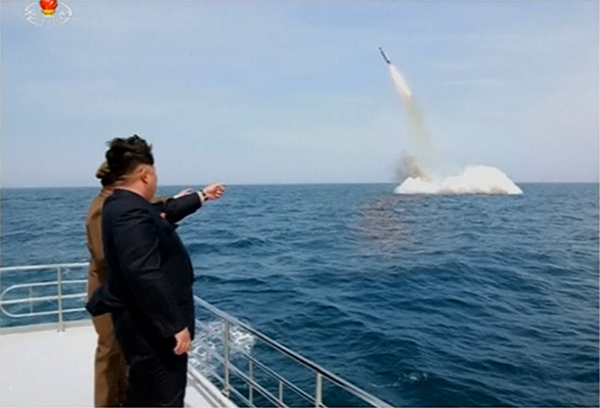
Kim Jong Un, the “Supreme Leader” of North Korea, supervises the April 22 test-launch of a missile from a submerged platform. (Image source: KCNA)
|
The DoD report from 2015 also acknowledges that North Korea is developing another system for a nuclear strike on the U.S., delivered by satellite; but also notes that the system currently lacks “a reentry vehicle.” However, a nuclear EMP attack delivered by satellite requires no reentry vehicle.
In short, the DoD report was inexplicably silent about North Korea’s current nuclear and missile capability, which, if used, could kill millions of Americans in an EMP attack — as warned by both the 2004 and 2008 Congressional EMP Commission reports.
A careful technical reading of the DoD report clearly confirms the very bad news that North Korea can strike the U.S. mainland with nuclear missiles right now. But the casual or non-expert reader can get the false impression from the report, as no doubt was intended, that President Obama was right to assert that there is no nuclear missile threat from North Korea. As one newspaper article on the DoD report declared in its headline, “Pentagon: North Korea Lacks Technology For Anti-U.S. Nuclear Strike.”
When not downplaying the missile and nuclear developments in North Korea, media reports tended to also discover benign North Korean motives for their missile and nuclear tests or technical arguments designed to lessen their import. One BBC report quoted Andrea Berger, for instance, from the Royal United Services Institute in London, who assured everyone that North Korea “wants a peace treaty with the USA” but “seems to believe that it will not be taken seriously until it can enter talks on this issue with sizeable military strength.”
The New York Times also echoed other analyses, claiming, “Although North Korea can learn much about the technology to build ballistic missiles from satellite launches, putting a satellite into orbit does not guarantee an ability to deliver a nuclear warhead on an intercontinental ballistic missile.”
The New York Times then further diminished the North Korean threat by commenting, “North Korea has never tested a ballistic-missile version of its Unha-series rockets. [And] after four nuclear tests by the North, Western analysts were still unsure whether the country had mastered the technology to build a warhead small enough to mount on a long-range missile” or “survive the intense heat while re-entering the atmosphere, as well as a guidance system capable of delivering a warhead close to a target.”[6]
North Korea’s H-Bomb
The dominant media assessment of North Korea’s nuclear test also followed the same “minimalist” pattern as its coverage of North Korea’s satellite-launch missile test.
The most common assumption by critics downplaying North Korea’s test was that the bomb was no more than 10 kilotons in strength and thus not anywhere near as advanced as a hydrogen bomb, as the North Korean’s claimed, nor appreciably different from previous North Korean tests.
Again, the conventional wisdom missed the real news. Let us explain.
Henry Sokolski, of the National Proliferation Education Center (NPEC), and Dr. Peter Vincent Pry, the Executive Director of the Congressional EMP Task Force, a former top staffer on the House Armed Services Committee, a former CIA analyst, and the co-author of this essay, both said “Not so fast.”
First, U.S. intelligence on North Korea is not perfect. Second, the test could very well have been what is known as a “boosted fission weapon” (which such experts as former Secretary of the Air Force and Reagan’s Deputy National Security Adviser Tom Reed believes it was),[7] rather than a primitive fission atomic bomb.
Remember, the U.S. and other intelligence services have not detected uranium or plutonium (A-Bomb fuels) in any of the North Korean tests, but they have detected tritium (H-Bomb fuel) in at least one. A boosted weapon could explain this anomaly.
One Rand analyst also thinks the test might have been of a boosted fission weapon, and uses a different seismic model that gives a test yield of 50 kilotons (KT) and not the 6-10 KT reported by South Korea and widely used by press reporting on the issue.
What Sokolski implies is that North Korea may be getting help from Russia or China, a possibility that changes the framework of how we in the U.S. have traditionally approached and dealt with proliferation of nuclear weapons, particularly the possible sophistication of nuclear threats from aspirant states.
If North Korea and Iran are getting help from Russia or China, as retired U.S. Northcom Commander General (Retired) Charles Jacoby agrees they are,[8] and do not have to rely only on their indigenous capabilities, their nuclear and missile programs at any time could be more advanced than is commonly thought. There is also the possibility that such advanced technology could be sold to other rogue regimes or by all of them to each other.
North Korea could, in fact, already have the H-Bomb. Everyone assumes that the North Korean test was not an H-Bomb because the seismic signal indicates that the yield was too low for an H-Bomb.
But North Korea could very well have conducted a “decoupled” nuclear test. In a decoupled test, the nuclear explosion is in a large cavern filled with shock-absorbing materials to reduce the seismic signal and conceal the true yield of the test. North Korea would not need help from Russia or China to do a decoupled test. It is both easy and well within North Korea’s capabilities.
A decoupled test could reduce the seismic signal by more than 10-fold. Thus, a test that looks like 10 kiloton yield in the seismic signal could have had a yield of 100 KT. Also, a 50 KT seismic signal could really have been a 500 KT test. Such high yields are in H-Bomb territory.
Alternatively, North Korea could be testing only the primary or first stage of a much more powerful two-stage H-Bomb.
In the last decades of the Cold War this is what the U.S. did to comply with the Threshold Test Ban Treaty (TTBT). The U.S. rarely tested its H-Bombs to full yield — both to comply with the TTBT and because if anything went wrong with a warhead, the problem would most likely be in the first stage.
After the July 1974 Threshold Test Ban Treaty (TTBT)[9] between the USA and the USSR, the U.S. never tested a nuclear weapon of more than 150 kilotons. Most tests were far below the 150 kiloton level and many were below 10 kilotons. And the U.S. has not tested to any yield in the past twenty years because component testing suffices even for America’s most powerful nuclear weapons.
Can the U.S. get away with this because its scientific knowledge is so much better than that of other nations? Russia, China, Britain, and France are not testing their H-Bombs either, as such testing is not necessary to be confident the bombs work. Israel developed the H-Bomb without testing it. South Africa was on the way to doing so, without testing, when it dismantled its arsenal under pressure from the Reagan administration.
Pakistan and India claim to have tested H-Bombs; many of the “instant experts” dismissing the North Korean threat, however, also insist Pakistan and India are not being truthful because the test yields were like North Korea’s recent test, also supposedly “too low.”
Most “experts” cannot believe that North Korea and Pakistan could duplicate what the superpowers have done and reinvent the H-Bomb. None appears to remember that critical design information for thermonuclear weapons was leaked by a magazine, The Progressive, when it published the article. “The H-bomb Secret.”[10]
The Carter administration, losing its case in the U.S. Supreme Court, objected to, but failed to stop, its publication. And “The H-Bomb Secret” is but just one example of copious critical design information for nuclear weapons that has been leaked, stolen, or foolishly declassified.
The EMP Commission and the authors of this article believe that North Korea tested what the Russians call a Super-EMP weapon. It better explains all the data.
Super-EMP Nuclear Warhead
The EMP Commission warned in its 2004 report, that “Certain types of relatively low-yield nuclear weapons can be employed to generate potentially catastrophic EMP effects over wide geographic areas, and designs for variants of such weapons may have been illicitly trafficked for a quarter-century.”
A Super-EMP weapon is designed to produce gamma rays, not a big explosive yield. So a Super-EMP weapon is consistent with all the North Korean tests, including low yield tests, such as the first 3 KT test, and two other suspected North Korean tests. Those were sub-kiloton yet also showed evidence of traces of tritium.
Because a Super-EMP weapon is low-yield, and not designed for blast effects, it can be easily tamped when tested. That possibility could account for America’s inability to detect any plutonium or uranium from North Korea’s tests.
One design of a Super-EMP weapon, of Russian origin, is virtually a pure fusion weapon, so that after an explosive test, there would be little or no plutonium or uranium to detect. As a Super-EMP weapon is, essentially, a very low-yield H-Bomb, it would be consistent with North Korea’s claim.
North Korea’s two successful satellite launches — of the KSM-3 in 2012 and the KSM-4 in 2016 — both look like tests of a Fractional Orbital Bombardment System (FOBS). The FOBS, a Soviet-era secret weapon, would, like a satellite, launch a warhead into low-earth orbit. The FOBS could therefore disguise a nuclear EMP attack as a peaceful space launch. It would conceal the intended target because its flight path masked that information. FOBS would also have allowed the Soviets to attack the United States from over the South Pole, the opposite direction from which U.S. early-warning radars and missile-interceptors, under the North American Aerospace Defense Command (NORAD), are oriented, both during the Cold War and today.[11]
North Korea’s KSM-3 satellite orbits the Earth at precisely at the right trajectory and altitude for making a surprise nuclear EMP attack on the United States — practicable only if the North Koreans have a warhead small enough for delivery by satellite, as a Super-EMP warhead would be.
North Korea has also flown a Nodong medium-range ballistic missile (MRBM) over Japan at an altitude consistent with a potential EMP attack.
Russian experts, one Chinese military commentator, and South Korea’s military intelligence all claim that North Korea has Super-EMP warheads. If we follow the rules for “all sources analysis,” this data should not be ignored.
In November 1999, the North Korea Advisory Group of the U.S. Congress reported that they were convinced that North Korea was developing nuclear weapons, despite the 1994 Agreed Framework deal with the United States, under which North Korea promised to not build such weapons. At the time, the Clinton Administration claimed no such work was being done by the North Koreans.[12] Yet we now know the Advisory Group was right, and the Clinton Administration wrong.
Implications for the Nuclear Missile Threat from Iran
The late Israeli Prime Minister Yitzhak Rabin warned us that it was a terrible mistake to hold talks with North Korea in Beijing in 1994 in an effort to persuade North Korea to stop missile exports to the Middle East.[13]
Rabin said that instead of trying to solve the problem, “North Korea tried to fool Israel. North Korea demanded $1 billion to stop the sales.” At the same time, according to Rabin, North Korea received hundreds of millions of dollars from Iran to produce missiles with longer ranges, threatening not only America’s Middle East allies but allies elsewhere, once the North Koreans received financial help from Iran’s mullahs.
The bottom line is that North Korea and Iran are strategic partners who cooperate on missile technology and probably nuclear technology. As both receive help from Russia and China, it is time to stop wishful thinking — that everything is fine, that diplomacy will work — and to face reality.
North Korea has nuclear-armed missiles that threaten the U.S. mainland — right now. Defending our homeland from that threat is an imperative, including protecting our full electrical grid, other critical infrastructures and of course our cities. And if North Korea has such a capability, how close is Iran to such weaponry?
The mainstream media must face these facts and start reporting that North Korea has nuclear-armed missiles that threaten the United States — right now. Defending the homeland now, including its critical electrical grid, from a nuclear EMP attack is imperative.
What should the United States therefore do?
First, the President should declare that a nuclear EMP attack on the United States is an existential threat to the American people and would warrant an all-out retaliatory response.
The President should prevent North Korea from further developing its long-range nuclear missile capabilities and capabilities to perform EMP attacks. The U.S. could surgically destroy — on the launchpad — any North Korean space-launch vehicle (SLV) or long-range missile prior to launch, or shoot down any SLV or long-range missile launch, including North Korea’s KSM-3 and KSM-4 satellites.
The administration should also provide support to, and work in close consultation with, the newly re-established Congressional EMP Commission. Their primary goal should be to protect DoD assets, military critical infrastructures, and the civilian electric grid that provides 99% of the electric power needed to sustain DoD power-projection capabilities.
The Congress also should immediately pass the Critical Infrastructure Protection Act (CIPA), which passed the House unanimously and now awaits action in the Senate. CIPA empowers the Department of Homeland Security to work with the utilities, State governments and emergency planners at all levels of government, to develop plans to protect and recover the national electric grid and other civilian critical infrastructures from an EMP attack.
Finally, the next President should revive President Ronald Reagan’s vision of the Strategic Defense Initiative (SDI) and develop and deploy space-based missile defenses. Space-based missile defenses will offer a realistic prospect of rendering nuclear missile threats obsolete, thus neutralizing the growing nuclear missile threats to the United States from North Korea, Iran, China, and Russia.
Dr. Peter Vincent Pry is Executive Director of the EMP Task Force on National and Homeland Security, a Congressional Advisory Board, and served in the Congressional EMP Commission, the Congressional Strategic Posture Commission, the House Armed Services Committee, and the CIA. Peter Huessy is President of Geostrategic Analysis, Senior Defense Consultant to the Mitchell Institute of the Air Force Association, and teaches nuclear deterrent policy at the US Naval Academy.
[1] Interview with CIA East Asia Division Chief Arthur Brown by Ruriko Kubota and Yosuke Inuzke, “DPRK Has Produced Small-Type Nuclear warheads,” Sankei Shimbun, Tokyo: October 1, 2008.
[2] “Spy Agencies Believe North Korea Has Nuke Warheads,” Agence France Presse, March 31, 2009.
[3] Lt. General Ronald Burgess, Director, Defense Intelligence Agency, “Worldwide Threat Assessment: Statement before the Committee on Armed Services, U.S. Senate,” Washington, D.C.: March 14, 2011 and “North Korea Nukes Might Fit On Missiles, Aircraft,” Global Security Newswire: NTI, March 14, 2011.
[4] “Experts: Iran Now A Nuclear-Ready State, Missiles Capable Of Hitting US” Newsmax (February 1, 2015); “When Iran Goes Nuclear,” Washington Times (March 2, 2015), and Ambassador Henry Cooper and Dr. Peter Vincent Pry, “The Threat To Melt The Electric Grid,” Wall Street Journal (April 30, 2015); Ambassador Henry Cooper, “North Korea’s H-Bomb–And Iran’s?” Family Security Matters (January 12, 2016).
[5] Admiral William Gortney, Commander, North American Aerospace Command, “Protecting the Homeland,” remarks at the Atlantic Council, October 7, 2015.
[6] The New York Times apparently does not understand that an EMP strike delivered with a nuclear warhead does not re-enter the atmosphere nor is accuracy particularly an issue. Detonated thirty to seventy kilometers high roughly over the center of the eastern seaboard of the United States would be sufficient; and “Why Does the New York Times So Hate Missile Defense?“, Gatestone Institute, June 11, 2013.
[7] Personal Conversation with Secretary Tom Reed by Peter Huessy, February 9, 2016 at the Institute of World Politics.
[8] Author’s Conversation with General (Retired) Charles Jacoby at Real Clear Defense forum on ballistic missile defense issues, February 9, 2016.
[9] Treaty between the United States of America and the Union of Soviet Socialist Republics on the Limitation of Underground Nuclear Weapon Tests (and Protocol Thereto) (TTBT). BUREAU OF ARMS CONTROL, VERIFICATION, AND COMPLIANCE Signed at Moscow July 3, 1974. Entered into force December 11, 1990.
[10] United States of America v. Progressive, Inc., Erwin Knoll, Samuel Day, Jr., and Howard Morland, 467 F. Supp. 990 (W.D. Wis. 1979), was a lawsuit brought against The Progressive magazine by the United States Department of Energy (DOE) in 1979. A temporary injunction was granted against The Progressive to prevent the publication of an article by activist Howard Morland that purported to reveal the “secret” of the hydrogen. Though the information had been compiled from publicly available sources, the DOE claimed that it fell under the “born secret” clause of the Atomic Energy Act of 1954.
[11] In Air Power Australia, “The Soviet Fractional Orbital Bombardment System Program“, Technical Report APA-TR-2010-0101 by Miroslav Gyurosi, January 2010.
[12] North Korea Advisory Group, Report to the Speaker, November 1999.
[13] The talks between Israel and North Korea were held in June 1993; see NTI-Jerusalem Post 18 Dec 1994, page 2, Rabin: “Earlier Talks with North Korea over missiles were a Major Mistake.”