

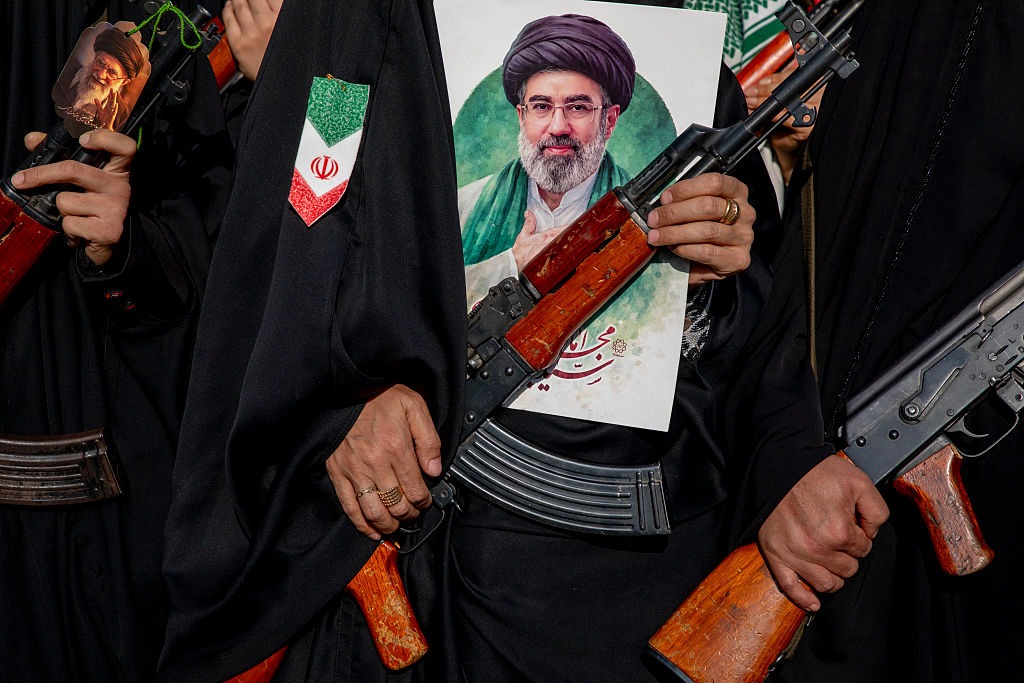
With the sword sheathed by Trump, the new breed of wannabe “jihadists” moving up the ladder believe they need to establish a reputation as radical bitter-enders who are determined, in the words of Saeed Jalili, one of their gurus, to rub the Great Satan’s nose in the dust. Part of [the Iranian regime’s] base consists of people who have a material interest in the continuation of the system.
That interest may consist of a share in the mafia network that controls over 40 percent of the economy. Many of the political and military leaders eliminated were millionaires, often with sizeable investments in Europe, Canada and the UAE.
IRGC chief Major General Hossein Salami was a board member of 32 companies. The late Admiral Ali Shamkhani was one of Iran’s five richest men.
However, the bulk of regime supporters with material interest in its survival fall into the category of just-about-managing families, enjoying minor privileges such as access to rare commodities, cash bonuses and positive discrimination places in universities and civil service.
You may be surprised that all factions within the regime wanted and still want to make a sweetheart deal with the Great Satan. The only problem is that each faction wants that privilege exclusively for itself and sabotages any deal done by a rival faction.
By saying that he already has unidentified partners in Tehran and is decided to preserve the regime with them in the driving seat, Trump undermines the potential dealmakers and incites the more radical elements to stick to a rejectionist posture.
A deal could be made only if it doesn’t appear to tip the balance in favor of one faction in Tehran, a new challenge for the bestselling author of “The Art of the Deal.”
In his torrent of tweets, US President Donald Trump often claims that though he didn’t intend to do so, he has succeeded in bringing regime change to Iran.
In the new regime he says he has created, he finds unnamed reasonable people with whom he could reach a deal to end the war and make Iran great again, as he has done in America.
Sometimes he even goes as far as implying that, barring a few finishing touches, the deal has already been made.
I think we should take his claims seriously because they offer a clue to the mindset of a key player in a war that few people wish to see continued.
But by claiming that regime change has already happened, he encourages those in Tehran who take that as an insurance policy that allows them to do whatever they like. Regime change is the only thing that frightens them enough to accept a deal to end the war.
In other words, what Trump says fans the fires of a hubris that has lit the fires of so many wars and conflicts in the region.
However, Trump isn’t completely off the mark when he suggests that the set-up in Tehran isn’t the same as it was before the US and its Israeli partner started bombing and killing political and military leaders.
By most accounts, the targeted killing of the Tehran leadership eliminated 168 top figures of a regime dominated by a clan that numbers a few hundred.
A major reshuffle has taken place, with dozens of younger figures moving up the ladder. Provided the regime survives, one might witness a generational change that could inject new blood into the zombie-like regime led by the late Ali Khamenei.
Many of those moving up the ladder haven’t yet received the usual written confirmation by the “Supreme Guide” because the newly minted Mujtaba Khamenei, the man supposed to incarnate the function, may not even be alive.
The threat of regime change was always the Damocles sword hanging above turbaned heads in Tehran. Whenever it was unsheathed, the mullahs backed down, as did the late Ruhollah Khomeini in 1988 and his successor Ali Khamenei in 2003 and 2015.
With the sword sheathed by Trump, the new breed of wannabe “jihadists” moving up the ladder believe they need to establish a reputation as radical bitter-enders who are determined, in the words of Saeed Jalili, one of their gurus, to rub the Great Satan’s nose in the dust.
According to best estimates, the regime’s core popular base represents around 10 to 15 percent of Iran’s population of 92 million. Part of that base consists of people who have a material interest in the continuation of the system.
That interest may consist of a share in the mafia network that controls over 40 percent of the economy. Many of the political and military leaders eliminated were millionaires, often with sizeable investments in Europe, Canada and the UAE.
IRGC chief Major General Hossein Salami was a board member of 32 companies. The late Admiral Ali Shamkhani was one of Iran’s five richest men.
However, the bulk of regime supporters with material interest in its survival fall into the category of just-about-managing families, enjoying minor privileges such as access to rare commodities, cash bonuses and positive discrimination places in universities and civil service.
To be sure, having a material interest in the survival of the regime doesn’t exclude ideological commitment to its ideological discourse. Nor does it mean a systematic opposition to negotiations and even normalization with the Great Satan.
The late Ali-Akbar Hashemi Rafsanjani, for example, was both wealthy and a supporter of making a deal with the US. The faction that still regards him as a source of inspiration also consists of wealthy men who believe the regime’s long-term survival requires normalization with the US. It is no accident that some 1,500 senior military and political officials of the country have family members living and working in the United States and Canada.
One misconception about the Islamic Republic of Iran is that it has always opposed any talks with the US.
The opposite is the case. The US established direct contact with Khomeini months before he returned to Iran to seize power.
President Jimmy Carter’s special emissaries Ramsey Clark and George Ball held talks with the ayatollah’s top aides in Paris.
The US Embassy in Iran had regular contacts with Khomeini’s henchmen such as Muhammad Beheshti and Martez Motahhari, via George Lambrakis.
Khomeini’s first prime minister, Mehdi Bazargan, held his first meeting with a senior official of a foreign power with US National Security Advisor Zbigniew Brzezinski. Then the two sides held long talks led by US Assistant Secretary of State Warren Christopher and Iranian Deputy Premier Behzad Nabavi. In one way or another, Iran has negotiated with all US presidents since Carter.
You may be surprised that all factions within the regime wanted and still want to make a sweetheart deal with the Great Satan. The only problem is that each faction wants that privilege exclusively for itself and sabotages any deal done by a rival faction.
What is left of the Tehran regime is today more ridden by factions than ever, and the absence of an active “Supreme Guide” to pull in the strings encourages the more radical elements to pull their holier-than-thou shenanigans regardless of the regime’s long-term interests.
By saying that he already has unidentified partners in Tehran and is decided to preserve the regime with them in the driving seat, Trump undermines the potential dealmakers and incites the more radical elements to stick to a rejectionist posture.
Trump has made a number of moves to embolden his imaginary dream team in Tehran. He agreed to indirect talks, whereas, as we mentioned, the two sides had held direct talks on many occasions.
Trump then agreed to replace the Steve Witkoff-Jared Khushner duo as lead negotiators with Vice President JD Vance, whom Tehran regarded as anti-war.
The choice of Pakistan as the new venue for talks was also to please the Iranians. Trump also pushed Qatar to release some $6 billion in Iran’s frozen assets transferred from South Korea.
Trump seems to have understood that regardless of what concessions he offers, Tehran — gripped by struggle for power — would be unable to make a deal to end the war. People like Majlis Speaker Muhammad-Baqer Qalibaf and Foreign Minister Abbas Araghchi may promise a lot but can deliver little.
A deal could be made only if it doesn’t appear to tip the balance in favor of one faction in Tehran, a new challenge for the bestselling author of “The Art of the Deal.”
egretnewseditor@gmail.com