
Trump is Right: Laws Across the Middle East to Prevent Normalization with Israel are ‘Crazy’ – and Poisonous

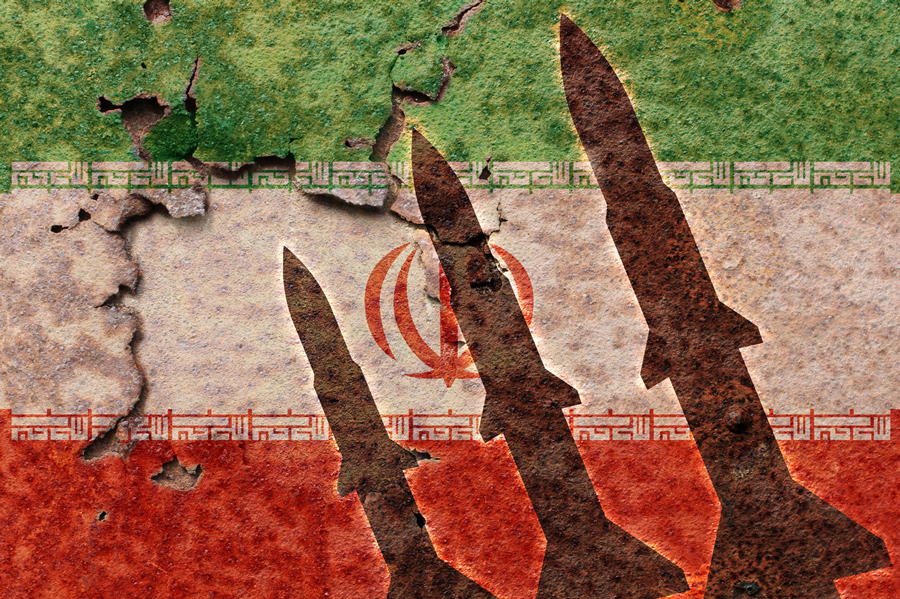
Trump is Right: Laws Across the Middle East to Prevent Normalization with Israel are ‘Crazy’ – and Poisonous

So long as Arabs and Muslims are taught by law, religion and social pressure that contact with Israelis is forbidden, the prospects for peace and coexistence will remain out of reach. If More »

Judge Jared Kushner by What He Changed

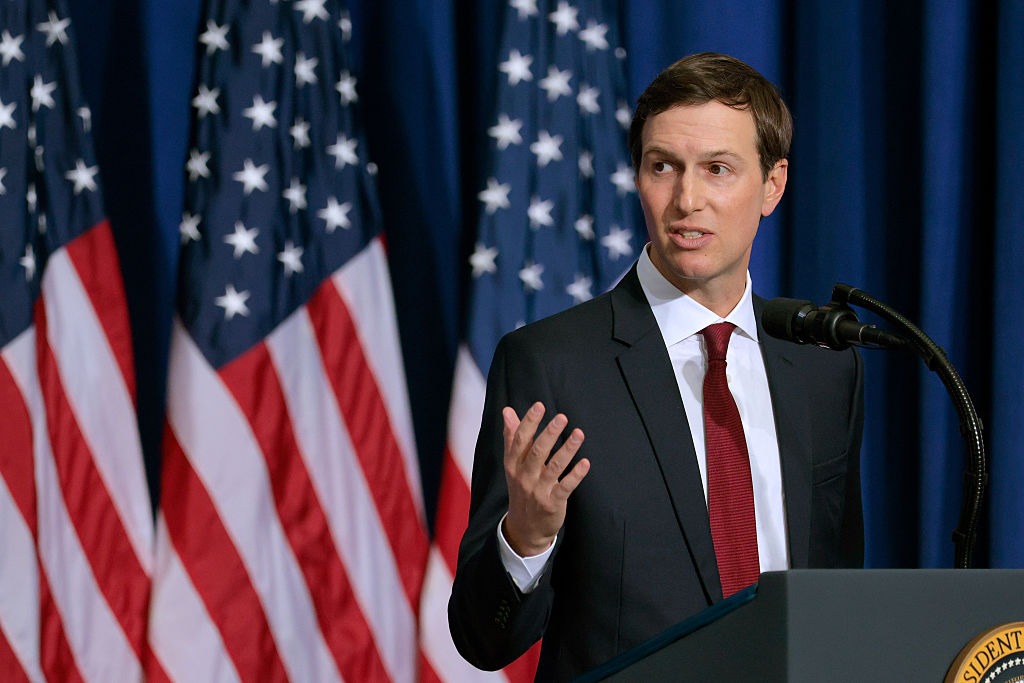
Judge Jared Kushner by What He Changed

Kushner recognized that a younger generation of Arab leadership was increasingly focused on investment, innovation, security cooperation, connectivity, logistics, and economic diversification. In such an environment, diplomacy could no longer be conducted More »

Mu Rwanda agatara katse, ibintu bimeze nabi cyane ubanza ibyo Ubuhanuzi bwavuze noneho batakibijyaho impaka!!!

Mu Rwanda agatara katse, ibintu bimeze nabi cyane ubanza ibyo Ubuhanuzi bwavuze noneho batakibijyaho impaka!!!

MINALOC, minisitiri y’ubutegetsi bw’igihugu, yasabye Abaturarwanda kugabanya inshuro bateka ku munsi mu rwego rwo kugabanya no gukoresha neza ibicanwa. Mu butumwa bwagenewe abaturage ku wa Gatandatu tariki 25 Mata 2026, ku muganda More »

‘Persecuting Christians Is a Booming Business’: The Extremist Persecution of Christians, January 2026

‘Persecuting Christians Is a Booming Business’: The Extremist Persecution of Christians, January 2026

“They want everyone to learn Islam, and… there are those who refuse, and they get killed.” A survivor, persecution.org, January 22, 2026, Democratic Republic of the Congo. “How can we understand that More »


Oliver Stone’s Response to Being Laughed at for Defending Putin: Blame the Jews by Alan M. Dershowitz

  • The essence of anti-Semitism is the bigoted claim that if there is a problem, then Jews must be its cause. This is the exact canard peddled by Stone — and is extremely dangerous if unrebutted. I challenge my old friend (and co-producer of Reversal of Fortune – the film based on my book) to debate me on the following proposition: Did Israel do more to influence the 2016 election than Russia?

When film director Oliver Stone could not come up with a plausible response to Stephen Colbert’s tough questions about why he gave a pass to Vladimir Putin for trying to influence the American presidential election, Stone resorted to an age-old bigotry: blame the Jews – or, in its current incarnation, shift the blame to the nation state of the Jewish people, Israel. Colbert was interviewing Stone about his new documentary, “The Putin Interviews” a film comprised of conversations he had with the Russian president over the past two years. The exchange regarding Israel did not make it to air but was relayed to the New York Post’s Page Six by a source who was in the audience.

When pressed by Colbert about his apparent fondness of the Russian dictator, Stone replied: “Israel had far more involvement in the U.S. election than Russia.” He then said again, “Why don’t you ask me about that?” Colbert responded: “I’ll ask you about that when you make a documentary about Israel!”

If Stone’s absurd response were not reflective of a growing anti-Semitism by the intolerant hard left (of which Stone is a charter member) it would be laughable. Indeed, Stone resorted to the “socialism of fools” (which is what German Social Democrat, August Bebel, coined anti-Semitism) precisely to save face because he was being mockingly laughed off stage by Colbert’s audience for giving Colbert ridiculous answers. Some of Stone’s bizarre pronouncements included:

“I’m amazed at his [Putin’s] calmness, his courtesy…he never really said anything bad about anybody. He’s been through a lot. He’s been insulted and abused.” Stone also expressed his “respect” for Putin’s leadership. But no answer was more ridiculous than his bigoted claim that Israel did more to try to influence the election than Russia.
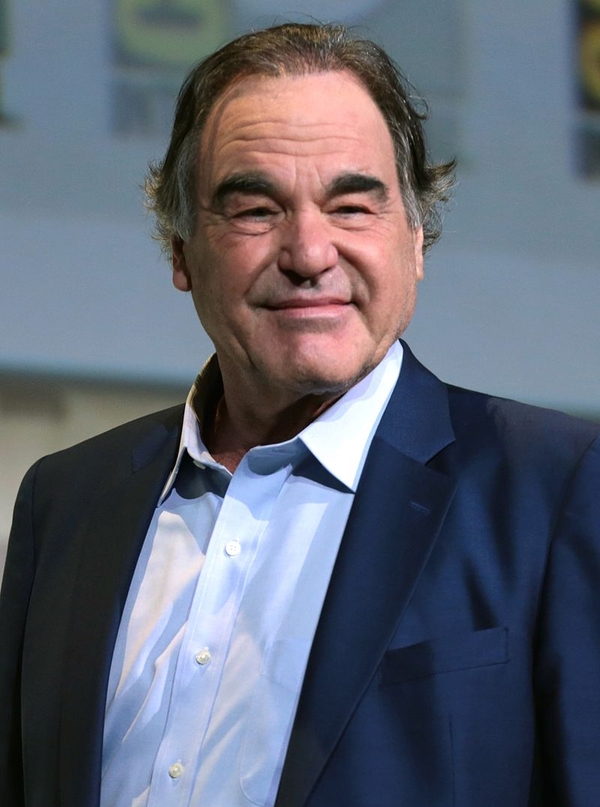
Oliver Stone (Image source: Gage Skidmore/Wikimedia Commons)

We know for certain that Russia (and that means Putin) desperately wanted Hillary Clinton to lose. We know that their surrogates timed leaks to cause maximum damage to her campaign. All of our intelligence agencies, in a rare show of unanimity, concluded that Russia went to great lengths to try to defeat Clinton.

What did Israel do? Stone hasn’t said. He just let the blood libel hang out there for other bigots, so they could say, “See, we knew the Jews were behind this; they always are.” There was an old Polish expression that said: if there is a bad outcome, the Jews must be behind it. Indeed, throughout history the last recourse of desperate bigots has been ‘blame the Jews.’ The modern version – pervasive among the hard left– is blame their nation-state, Israel.

The reason Stone did not provide any proof of his anti-Semitic accusation is because there is none. It simply is not true. Israel did not try to influence this election. The Israeli government took no position and its leaders were probably divided, as were its citizens, concerning the desired outcome. Prime Minister Netanyahu, for his part, remained neutral, emphatically stating before the election that he was “happy to work with whoever gets elected.”

Moreover, American Jews voted overwhelmingly in favor of Clinton. To be sure, some, such as Sheldon Adelson, contributed to Trump, but others, including many strong supporters of Israel, contributed heavily to Clinton. I would not be surprised if even in the face of Adelson’s huge contributions, more money from Jewish sources was contributed to Hillary Clinton’s campaign, but no one keeps track of such matters.

It is important to note that this is not an isolated incident. Stone’s bigotry towards Jews and their nation state is well documented. He has said that, “Hitler did far more damage to the Russians than [to] the Jewish people.”

And then argued that this fact is largely unknown because of “the Jewish domination of the media…there’s a major lobby in the United States. They are hard workers. They stay on top of every comment, the most powerful lobby in Washington.” He continued to say: “Israel has f***** up United States foreign policy for years.”

Moreover, Stone has also stated that, “Hitler is an easy scapegoat throughout history” and expressed affection for Cuban dictator, Fidel Castro, whom he called “a great leader.”

Clearly, there was no legitimate reason for Stone to bring up Israel in the context of a dialogue regarding Russia’s interference in the U.S. presidential election. By ducking questions about Putin and Russia, and then bizarrely accusing Israel of wrongdoing, Stone engaged in an old trope: blaming Jews – or the nation state of the Jewish people –for far reaching domestic political issues in foreign countries. By morphing the discussion about Putin’s untoward history of suppressing the press, killing political opponents, and engaging in cyber attacks against the U.S., into a polemic against Israel, Stone displayed his own bias.

The essence of anti-Semitism is the bigoted claim that if there is a problem, then Jews must be its cause. This is the exact canard peddled by Stone — and is extremely dangerous if unrebutted. I challenge my old friend (and co producer of Reversal of Fortune – the film based on my book) to debate me on the following proposition: did Israel do more to influence the 2016 election than Russia? If he agrees, he will once again be laughed off the stage.

Alan M. Dershowitz is the Felix Frankfurter Professor of Law, Emeritus, at Harvard Law School and author of “Taking the Stand: My Life in the Law” and “Electile Dysfunction: A Guide for the Unaroused Voter.”

Obama: Netanyahu’s visit too close to election for meeting.

Obama on U.S.-Israeli relationship 05:25

Watch the entire interview Sunday on “Fareed Zakaria GPS” at 10aET.

Washington (CNN)President Barack Obama says he will not meet with Israeli Prime Minister Benjamin Netanyahu in March because his trip to Washington comes too close to Israel’s upcoming elections.


“I’m declining to meet with him simply because our general policy is, we don’t meet with any world leader two weeks before their election,” Obama said in an interview with CNN’s Fareed Zakaria. “I think that’s inappropriate, and that’s true with some of our closest allies.”

House Speaker John Boehner invited Netanyahu to deliver a speech in front of Congress in March. He’s expected to use that speech to lobby for tough new sanctions against Iran — putting him at odds with Obama, who has threatened to veto additional sanctions as he tries to hash out a deal to halt Iran’s nuclear program.

READ: Democratic senators to hold back on Iran sanctions

Obama responds to drone landing at White House 02:22
PLAY VIDEO

The President said the United States and Britain had to quickly to put together a trip to Washington for Prime Minister David Cameron this month for the same reason Obama wasn’t meeting with Netanyahu. Cameron didn’t want to make it closer to his country’s May elections.

“He insisted that if he wants to come — and it was a very important meeting — he needs to be far away enough from the election that it doesn’t look like in some ways we’re meddling or putting our thumbs on the scale,” Obama said.

Obama downplayed differences with Israel over his approach to Iran, saying he hasn’t heard “a persuasive rebuttal of my argument that we crafted very effective sanctions against Iran specifically to bring them to the negotiations table.”

Israeli intelligence has confirmed that Iran has rolled back its stockpiles of highly enriched uranium, Obama said.

The President said imposing new sanctions now would give Iran a way out of the talks, an outcome no one wants.

“For us to undermine diplomacy at this critical time for no good reason is a mistake and that what we need to do is to finish up this round of negotiations, put the pressure on Iran to say yes to what the international community is calling for,” he said.

SEE: Why the Iran sanctions fight is a big deal

Obama said he’s confident he can successfully lobby Congress to approve a deal once it’s struck.

“I’ve said before that we will take no deal over a bad deal,” Obama said. “But if I can prove that the deal we’ve put in place assures us through indisputable verification mechanisms that Iran cannot achieve breakout capacity, if I’ve got a bunch of scientists and nuclear experts saying this assures us that Iran is not on the brink of being a nuclear weapons power, then that’s a public debate we should have.”

“And I will then ask every member of Congress to ask why would we reject that deal and prefer a potential military option that would be less effective in constraining Iran’s nuclear program and would have extraordinarily ramifications at a time when we’ve already got too many conflicts in the Middle East,” he said. “And I’m pretty confident I can win that argument.”

SEE: Obama says we need more drone regulations

Obama: Don’t Destroy the Peace Process by Turning it Over to the U.N.

The Obama Administration is sending strong signals that once the election is over it may make a major push to resolve the Israeli-Palestinian conflict at the United Nations. Despite repeated invitations by Israeli Prime Minister Benjamin Netanyahu to Palestinian Authority President Abbas to meet without preconditions, the stalemate persists. Some blame it on Palestinian unwillingness to recognize Israel as the nation state of the Jewish People and to compromise to the so-called “right of return.” Others — including the current U.S. Administration — lay the blame largely at the feet of the Netanyahu government for continuing to build in the West Bank, most recently approval of between 98 and 300 new homes in Shiloh. Whatever the reasons – and they are complex and multifaceted — President Obama should resist any temptation, during his final weeks in office, to change longstanding American policy — that only direct negotiations between the parties will achieve a lasting peace.


In particular, Obama should veto an expected French resolution in the Security Council establishing an international peace conference under the auspices of the U.N. The general parameters of the French resolution would likely call for:

“Borders based on the 1967 Lines with agreed equivalent land swaps; security arrangements preserving the sovereignty of the Palestinian State and guaranteeing the security of Israel; a fair, equitable, and negotiated solution to the refugee problem; an arrangement making Jerusalem the capital of both states.”

These guidelines may sound reasonable. Indeed, they are strikingly similar to the offers made to and reject by the Palestinian leadership in 2000-2001 from former Israeli Prime Minister Ehud Barak and former U.S. President Bill Clinton, and in 2008 by former Israeli Prime Minister Ehud Olmert. The U.N., however, has disqualified itself from playing any constructive role in the peace process. Recent attempts by the U.N. to intervene in the Israeli-Palestinian conflict have produced unmitigated disasters. The so-called Goldstone Report, which sought to investigate allegations of war crimes committed during the 2009 Israeli intervention in Gaza, was so blatantly biased against Israel that Richard Goldstone himself had to retract some of its key findings in 2011.

Since then, the U.N. has done nothing to reassure Israel that it is capable of offering an unbiased forum for negotiations. In the past year alone, the U.N. has singled out Israel for special criticism on issues like health rights, and most laughably, women’s rights, while failing even to mention regimes whose record on these issues is truly abominable. Last year alone, at least twenty separate resolutions were adopted by the U.N. General Assembly, which singled out Israel for special criticism. Most recently UNESCO attempted to erase millennia of Jewish history with regard to the Temple Mount in Jerusalem. In light of such behavior, the U.S. should not trust that Israel would receive a fair hearing at any U.N. sponsored peace conference.

As Netanyahu said in his most recent speech to the U.N. General Assembly, “The road to peace runs through Jerusalem and Ramallah, not through New York.” In other words, the only way forward for the Israeli-Palestinian peace process is bilateral negotiations between the two parties. Netanyahu and Abbas must sit down and agree to necessary but painful compromises aimed at establishing a Palestinian state, while addressing Israel’s security concerns, and the realities on the ground. Resolutions such as the proposed French resolution undermine such efforts by encouraging the Palestinians to believe that direct negotiations — and the mutual sacrifices they would entail — are unnecessary, and that a Palestinian state can be achieved on the basis of U.N. resolutions alone. It would also make it more difficult, if not impossible, for the Palestinian Authority to accept anything less than that already given them by the U.N. — which would in turn guarantee the failure of any realistic negotiations.

It is for these and other reasons that American policy has long been to veto or otherwise derail U.N. attempts to interfere with the Israeli-Palestinian peace process even when it is stalled. As President Obama said in 2013:

“We seek an independent, viable and contiguous Palestinian state as the homeland of the Palestinian people. The only way to achieve that goal is through direct negotiations between Israelis and Palestinians themselves.”

Hillary Clinton, too, has stated in the past, that she supports bilateral negotiations between the Israelis and Palestinians, and her campaign has said that she “believes that a solution to this conflict cannot be imposed from without.” So, too, has Donald Trump.

Recently, however, several past and present Obama officials have apparently advised the president to support, or at least not veto the French resolution, as well as a one-sided Palestinian push to have the U.N. declare Israeli settlements illegal. It would be wrong — and undemocratic — for Obama to unilaterally reverse decades of U.S. foreign policy during the lame duck period. After all, in 2011 his administration vetoed an almost identical Palestinian proposal that called for Israel to “immediately and completely cease all settlement activities in occupied Palestinian territory, including East Jerusalem”. Similarly, until now, Obama has repeatedly pressured the French and other European nations not to put forward any proposal related to the Israeli-Palestinian conflict, on the grounds that such initiatives discourage bilateral negotiations. This is surely the view of the majority of the Senate, which has its own constitutional authority to participate in foreign policy decisions. In fact, 88 senators signed an open letter to Obama in which they called on the President to veto any Security Council resolutions regarding the Israeli-Palestinian conflict.

The period between the election and the inauguration is the only time a president can act without the checks and balances of American democracy. He should not take action that would tie the hands of his successor.

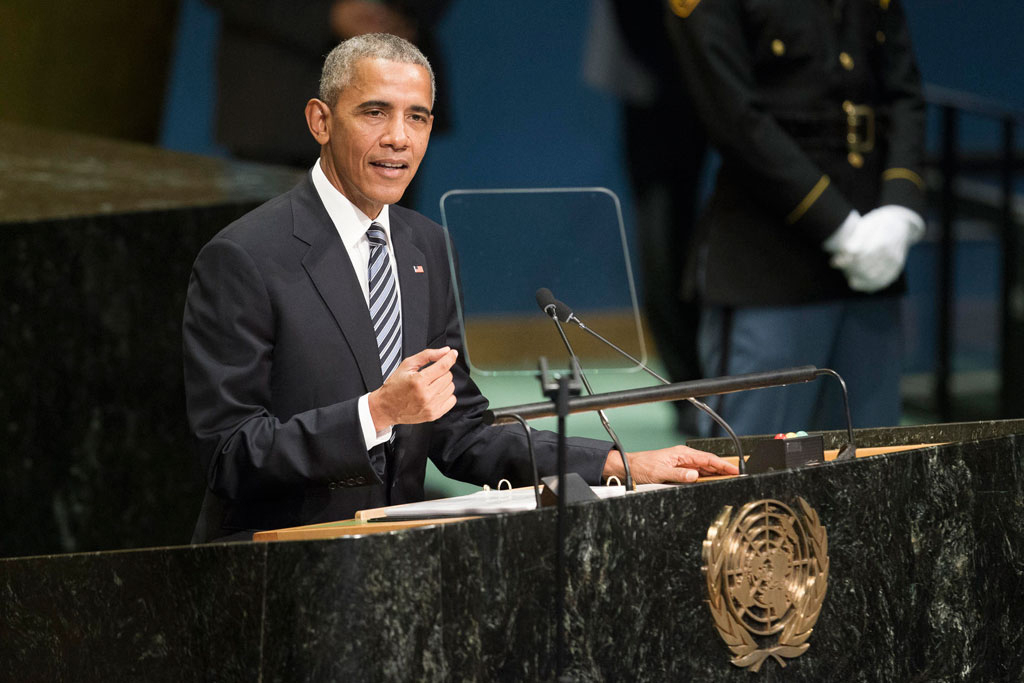
U.S. President Barack Obama addresses the UN General Assembly’s seventy-first session, September 20, 2016. (Image source: United Nations)

Obama must realize that no lasting peace can be achieved in the remaining months of his presidency: there are a multitude of complex and contentious issues — most notably the status of Jerusalem, the rights of so-called Palestinian refugees, and the situation in Gaza — that must be thoroughly addressed in order to achieve a lasting peace. Our next president will undoubtedly have to wade into the Israeli-Palestinian peace process again. The new administration — with the agreement of the Senate — should have full latitude to do what it deems most appropriate. It should not be stuck with parameters bequeathed to it by a President desperate to secure a short-term foreign policy “victory” that in the long term will make a resolution of the conflict more difficult to achieve.

If Obama feels that he must intrude in an effort to break the logjam before he leaves office, he should suggest that the current Israeli government offer proposals similar to those offered in 2000- 2001 and 2008 and that this time the Palestinian leadership should accept them in face-to face negotiations. But he should take no action (or inaction) that invites U.N. involvement in the peace process — involvement that would guarantee failure for any future president’s efforts to encourage a negotiated peace.

We should hear the views of both candidates on whether the U.S. should support or veto a Security Council resolution that would tie their hands were they to be elected president. It is not too late to stop President Obama from destroying any realistic prospects for peace.

Alan M. Dershowitz, Felix Frankfurter Professor of Law, Emeritus and author of Taking the Stand: My Life in the Law and Electile Dysfunction. An earlier and somewhat different version of this article appeared in the Boston Globe.

Obama’s Refugee Policy: Yes to Potential Terrorists, No to Victims of Genocide by Raymond Ibrahim

  • “Without doubt, Syrians of all confessions are being victimized by this savage war and are facing unimaginable suffering. But only Christians and other religious minorities are the deliberate targets of systematic persecution and genocide.” — U.S. Senator Tom Cotton, March 17, 2016.

  • Christians account for 10% of Syria’s total population — yet they account for less than 0.5% of the refugees received into America. Sunni Muslims are 74% of Syria’s population — yet 99% of those received into America. In other words, there should be 20 times more Christians and about one-quarter fewer Sunnis granted refugee status than there already have been.
  • ISIS is “taking advantage of the torrent of migrants to insert operatives into that flow.” — James Clapper, Director of National Intelligence.
  • Although the U.N. and U.S. know that Sunni refugees are terrorizing Christians in their camps, they abandon the true victims who deserve sanctuary in the West, while “humanitarianly” taking in their persecutors.

The Obama administration has been escalating a policy that both abandons Mideast Christians and exposes Americans to the jihad.

Late last year it was revealed that 97% of Syrian refugees accepted into the U.S. were Sunni Muslims — the same Islamic sect to which the Islamic State belongs— while fewer than half-a-percent were Christians.

This disparity has since gotten worse. From May 1 to May 23, 499 Syrian refugees — a number that exceeds the total number of refugees admitted during the last three years — were received into the United States. Zero Christians were among them; 99 percent were Sunni (the remaining one percent was simply listed as “Muslim”).

These numbers are troubling.

First, from a strictly humanitarian point of view — and humanitarian reasons are the chief reason being cited in accepting refugees — Christians should receive priority simply because currently they are among the most persecuted groups in the Middle East. Along with the Yazidis, Christians are experiencing genocide at the hands of ISIS, as the State Department recently determined. The Islamic State has repeatedly forced Christians to renounce Christ or die; has enslaved and raped them, and desecrated or destroyed more than 400 of their churches.

As Sen. Tom Cotton (R-Ark.) put it this March, “Without doubt, Syrians of all confessions are being victimized by this savage war and are facing unimaginable suffering. But only Christians and other religious minorities are the deliberate targets of systematic persecution and genocide.”

Sunni Muslims are not being slaughtered, beheaded, and raped for refusing to renounce their faith; they are not having their mosques burned, nor are they being jailed and killed for apostasy, blasphemy, or proselytization. On the contrary, non-ISIS affiliated Sunnis are responsible for committing dozens of such atrocities against Christian minorities every single month all throughout the Islamic world.[1]

Unsurprisingly, many Sunnis entering America and Europe — including the terrorists who killed 120 people in Paris, 32 people in Brussels, and 12 in California — share the same Sunni-sanctioned hate for and opposition to non-Muslim “infidels.” Director of National Intelligence James Clapper admits that ISIS is “taking advantage of the torrent of migrants to insert operatives into that flow.”

Even if one were to operate under the assumption that refugee status must be made available to all Syrians, regardless of religion, the simple demographics of Syria expose the pro-Sunni, anti-Christian bias of the current Obama refugee policy: Christians account for 10% of Syria’s total population — yet they account for less than 0.5% of the refugees received into America. Sunni Muslims are 74% of Syria’s population — yet 99% of those received into America. In other words, there should be 20 times more Christians and about one-quarter fewer Sunnis granted refugee status than there already have been.

Finally, the excuse given by those who defend this disparity rings totally false: According to the U.N. refugee agency UNHCR, Christian and other minorities “fear that registration might bring retribution from other refugees.” So supposedly they do not register and are left out of the process. As ongoing reports reveal, however, the majority of those at refugee camps — Sunnis — are persecuting the Christians in their midst, sometimes killing them. During one Mediterranean crossing from Libya to Sicily, Muslim “refugees” shouted “Allahu Akbar!” [“Allah is the Greatest!”] as they hurled as many as 53 Christians overboard.

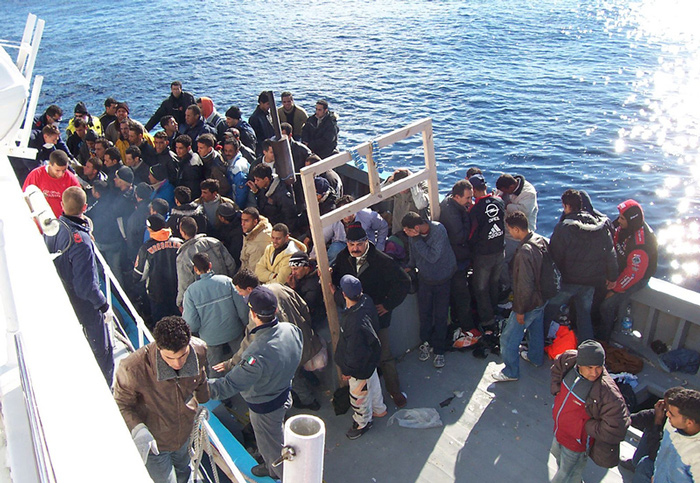
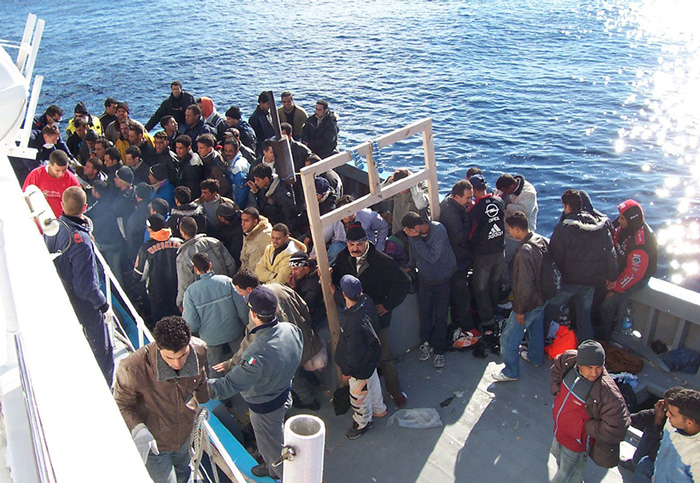
Migrants arrive by boat in Italy after crossing from Libya. (Image source: Wikimedia Commons/Vito Manzari)

Although the U.N. and U.S. know that Sunni refugees are terrorizing Christians in their camps, they abandon the true victims who deserve sanctuary in the West, while “humanitarianly” taking in their persecutors.

The Catholic Church and several mainline Protestant denominations are equally guilty. Most recently, “Christian refugees [were] ‘let down’ by Pope [Francis]: he promised to take them to Italy but then took only Muslims instead.”

Such hypocrisy has been on open display since recent the problem of the U.S. accepting refugees from the Middle East arose. Months ago, Barack Obama — who was raised a Sunni Muslim — described the proposal that preference should be given to Christian minorities as “shameful”: “That’s not American. That’s not who we are. We don’t have religious tests to our compassion,” he said loftily.

Today, however, it is clear from the statistics alone that there is a very clear bias[2] in the refugee program: it favors those most prone to committing acts of terror in America while ignoring those experiencing genocide. It is the Obama administration’s own refugee policies that are “shameful,” “not American,” and do not represent “who we are.”

Raymond Ibrahim is the author of Crucified Again: Exposing Islam’s New War on Christians (published by Regnery with Gatestone Institute, April 2013).

Obama’s Double Standard Toward Netanyahu by Alan M. Dershowitz

As President Obama winds up his farewell tour of Europe, it is appropriate to consider the broader implications of the brouhaha he created in Great Britain. At a joint press conference with Britain Prime Minister, David Cameron, President Obama defended his intrusion into British politics in taking sides on the controversial and divisive Brexit debate. In an op-ed, Obama came down squarely on the side of Britain remaining in the European Union — a decision I tend to agree with on its merits. But he was much criticized by the British media and British politicians for intruding into a debate about the future of Europe and Britain’s role in it.


Obama defended his actions by suggesting that in a democracy, friends should be able to speak their minds, even when they are visiting another country:

“If one of our best friends is in an organization that enhances their influence and enhances their power and enhances their economy, then I want them to stay in. Or at least I want to be able to tell them ‘I think this makes you guys bigger players.'”

Nor did he stop at merely giving the British voters unsolicited advice, he also issued a not so veiled threat. He said that “the UK is going to be in the back of the queue” on trade agreements if they exit the EU.

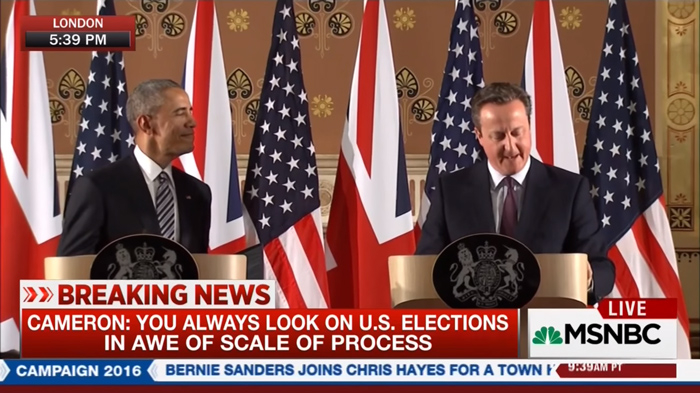
UK Prime Minister David Cameron and US President Barack Obama take a question at a press conference, on whether it is appropriate for Obama to say whether or not the UK should remain in the European Union, April 22, 2015.

President Obama must either have a short memory or must adhere to Emerson’s dictum that “foolish consistency is the hobgoblin of little minds.” Recall how outraged the same President Obama was when the Prime Minister of a friendly country, Benjamin Netanyahu, spoke his mind about the Iran Deal.

There are, of course, differences: first, Israel has a far greater stake in the Iran Deal than the United States has in whatever decision the British voters make about Brexit: and second, Benjamin Netanyahu was representing the nearly unanimous view of his countrymen, whereas there is little evidence of whether Americans favor or oppose Brexit in large numbers.

Another difference, of course, is that Obama was invited to speak by Cameron, whereas, Netanyahu was essentially disinvited by Obama. But under our tripartite system of government — which is different than Britain’s Unitary Parliamentary system — that fact is monumentally irrelevant. Netanyahu was invited by a co-equal branch of the government, namely Congress, which has equal authority over foreign policy with the president and equal authority to invite a friendly leader. Moreover, not only are the British voters divided over Brexit, but Britain’s Conservative Party itself is deeply divided. Indeed, the leading political figure in opposition to Britain remaining in the European Union is a potential successor to Cameron as leader of the Conservative Party. So these differences certainly don’t explain the inconsistency between Obama’s interference in British affairs and his criticism of Netanyahu for accepting an invitation from Congress to express his country’s views on an issue directly affecting its national security.

So which is it, Mr. President? Should friends speak their minds about controversial issues when visiting another country, or should they keep their views to themselves? Or is your answer that friends should speak their minds only when they agree with other friends, but not when they disagree? Such a view would skew the market place of ideas beyond recognition. If friends should speak about such issues, it is even more important to do so when they disagree.

A wit once observed that “hypocrisy is the homage vice pays to virtue.” It is also the currency of diplomacy and politics. That doesn’t make it right.

The President owes the American people, and Benjamin Netanyahu, an explanation for his apparent hypocrisy and inconsistency. Let there be one rule that covers all friends — not one for those with whom you agree and another for those with whom you disagree. For me the better rule is open dialogue among friends on all issues of mutual importance. Under this rule, which President Obama now seems to accept, he should have welcomed Prime Minister Netanyahu’s advocacy before Congress, instead of condemning it. He owes Prime Minister Netanyahu an apology, and so do those Democratic members of Congress who rudely stayed away from Netanyahu’s informative address to Congress.

Alan Dershowitz is the author of “Abraham: The World’s First (but Certainly Not Last) Jewish Lawyer.”

Translate »
Skip to toolbar