Category Archives: Uncategorized

The “Islamic Inquisition” and the Blasphemy Police by Douglas Murray

  • There is a small but undeniable number who are willing to kill and sometimes die in the cause of imposing their idea of blasphemy on non-Muslims around the world.

  • The editors signalled that they had had enough of the threats and enough of the danger. They censored themselves.
  • Today there might be thousands of people willing to publish cartoons of Mohammed on their Twitter accounts, but most of them hide behind aliases and complain about the cowardice of others.
  • Our societies like to think that terrorism and intimidation do not work. They do — or can — but only if we let them.

Ten years ago, one of the editors of a Danish newspaper called Jyllands-Posten had heard that that no cartoonist in Denmark would depict Islam’s prophet for a set of children’s books on the major world religions. Did such self-censorship really exist in modern Denmark? He sought to find out. So he published a spread of twelve cartoons intended to depict the founder of Islam.

Attacks on the newspaper followed — the most outspoken attempt at enforcing censorship since the death threats against Salman Rushdie for his novel, The Satanic Verses, in 1988, and the murder of Theo van Gogh for his film, Submission, in 2004. The knife in van Gogh’s back also went through a note demanding death threats for Ayaan Hirsi Ali, a Dutch MP at the time, and the Dutch MP, Geert Wilders.

Some of the cartoons printed by Jyllands-Posten led to attacks on the newspaper for having printed them. Some of the cartoons did not even feature Mohammed at all. One, of a Mohammed-like figure with a bomb in his turban, became famous. Local Danish Imams, disappointed at the relative beigeness of the cartoons, added more offensive cartoons of their own to a portfolio, and toured the Middle East with this, trying to whip up anger against Denmark. As many remember, the incitement worked. For a time, aside from all the looting, burnings and murders, the whole world seemed transfixed on these cartoons and what the reactions to them might mean.

Across a number of countries, there were independent outbreaks of mini cartoon-crises. The decision of Ezra Levant to stand alone and publish the cartoons in Canada led to a North American branch of the cartoon crisis. The decision of a number of Norwegian newspapers to print the cartoons, in solidarity with their neighbours, led to a Norwegian cartoon crisis. And, of course, in Paris, the decision of a single magazine — Charlie Hebdo — to continue depicting any and all historical figures, led to the slaughter of ten journalists and two police officers in the magazine’s Paris offices in January this year.

Stéphane Charbonnier, the fearless editor and publisher of Charlie Hebdo, who was murdered on January 7 along with many of his colleagues, is shown here in front of the magazine’s former offices, just after they were firebombed in November 2011.

Now is probably as good a time as any to ask a few questions — not least, whether we have learned anything at all. Certainly, non-Muslims around the world have learned a great deal more about Islamic sensibilities when it comes to depictions of their Prophet. From within Muslim communities in Europe and elsewhere, there has been a demonstration that there is a small but undeniable number who are willing to kill and sometimes die in the cause of imposing their idea of blasphemy on non-Muslims around the world.

Aside from the attempts on the lives of the staff of Jyllands-Posten, there have been attempts on the life of the Danish cartoonist Kurt Westergaard and the Swedish cartoonist who drew a Mohammed cartoon in solidarity after the first Danish cartoons, Lars Vilks. There have been countless other knocks on the door by the blasphemy police. In London, the publisher of a fawning book about the love life of Mohammed (The Jewel of Medina by Sherry Jones) narrowly survived an attempt to firebomb his offices. If there was a single place on earth that one might have thought could be immune from a visit by the Islamic Blasphemy Police it would probably be somewhere in Texas. But earlier this year, when a display of Mohammed cartoons in took place in Garland, the assassins turned up anyway, and were, fortunately, shot.

So, one lesson is that perhaps nowhere on earth is now safe from the Islam’s most stringent enforcers. They can crop up in remote parts of Scandinavia or in the heartland of America. They can show up at a newspaper office or at an individual’s home. And it is in this realization that the clearest lesson of the last decade has been learnt.

Last week, on the anniversary of the publication of the first Mohammed cartoons, Jyllands-Posten republished the original spread. The page and texts were laid out as they had been on that famous day ten year earlier. But one thing was missing: the cartoons. Where the original images had been — even the ones that did not depict Mohammed — there were only blank spaces. What had been possible in 2005 was no longer possible in 2015. One can hardly blame the publishers. After ten years of paying for security, and staff having to work in perhaps the most threatened newspaper office on earth, the editors of Jyllands-Posten signalled that they had had enough of the threats and enough of the danger. They censored themselves.

It took only ten years for most people across the West to learn about Islamic blasphemy — and in the end to abide by it. Today there might be thousands of people willing to publish cartoons of Mohammed on their Twitter accounts, but most of them hide behind aliases and complain about the cowardice of others.

A few days before the Mohammed cartoons’ anniversary, Mark Steyn, Henryk Broder and the Norwegian editor Vebjoern Selbekk addressed a conference in Denmark to commemorate the anniversary of the cartoons. It was held in the Danish Parliament, the only building there now deemed safe enough to withstand the now-traditional attack from the Islamic Blasphemy Police. Anticipating a terrorist attack, the UK Foreign Office and U.S. State Departments both warned their citizens to stay away from the area of the Parliament building that day. The restaurant in which we were meant to be having dinner cancelled the booking; they realized, when police and security officers scouted out the building in advance, who the guests might be.

Ten years ago, you could publish depictions of Mohammed in a Danish newspaper. Ten years later, it is hard for anyone who has been connected with such an act to find a restaurant in Copenhagen that will serve them dinner.

It is not just artists and writers who have learned the lesson; it is everyone — from newspaper conglomerates to the people who serve food in restaurants. Our societies like to think that terrorism and intimidation do not work. They do — or can — but only if we let them. Over the last ten years, a couple of brief eruptions of sanctimonious point-missing aside, it turned out to be fear — not Mohammed cartoons — that went viral.

Freedom, however, was never defended by more than a handful of people. Most prefer their comforts and a quiet life to anything that looks like a fight. But there are still more than a few good people across the world, and more than a handful of them in Scandinavia. If, in previous conflicts, one looked to pilots or statesman to lead the way, in this war against the new “Islamic Inquisition,” it is journalists, cartoonists, writers and artists who find themselves on the front lines and who need to lead. Some of them might be surprised to be in this position. They should not be. Freedom of expression and thought have always had vicious enemies. But the truth has always seen them off, and shall do again.

The “Fake News” Censorship Industry by Robbie Travers

  • Name a single person or organisation you trust to control your speech. Whom would you trust to control what you can read, or make decisions on what is true and what is false for you? Whom do you trust to police what you think?The German government thinks it knows exactly who should be the arbiter of truth and what articles you should be allowed to post. Itself!

  • This would lead to a monopolisation of the media industry. One or two large platforms would dominate the public debate; fringe voices would be ignored or cast aside.
  • Who is to police the police? Facebook, caught out, already had to dismiss those compiling their trending stories, when it was revealed that they had a runaway political bias and were routinely suppressing (conservative) material with which they did not agree.
  • The whole censorship industry is open to abuse; presumably, that is what censorship is for in the first place.

Name a single person or organisation you trust to control your speech. Whom would you trust to control what you can read, or make decisions on what is true and what is false for you? Whom do you trust to police what you think?

The German government thinks it knows exactly who should be the arbiter of truth and what articles you should be allowed to post. Itself!

After a bill was proposed by German lawmakers, which threatened fines of up to 500,000 euros ($522,000) for publishing “fake news,” Facebook decided to use an organisation called Correctiv, described as a German fact-checking non-profit organisation, to decide whether reported stories are “real” or “fake.”

This system would then encourage individual Facebook users to report other users’ posts to Correctiv. Facebook would then have Correctiv label any of the articles “fake news,” as they see fit.

Even then, this proposed response by Facebook was not harsh enough for some German lawmakers, who want articles deemed to be fake by the government to be removed within 24 hours, or else fine Facebook 500,000 euros. That move would undoubtedly lead to individuals abandoning Facebook for other social networks, or more probably, Facebook abandoning them. German attempts to police the Facebook could end up useless; to many, the plan looks suspiciously like a money-making stratagem.

A centralized “speech police” would also create a monopolisation of the media industry. One or two large platforms would dominate the public debate; fringe voices would be ignored and cast aside.
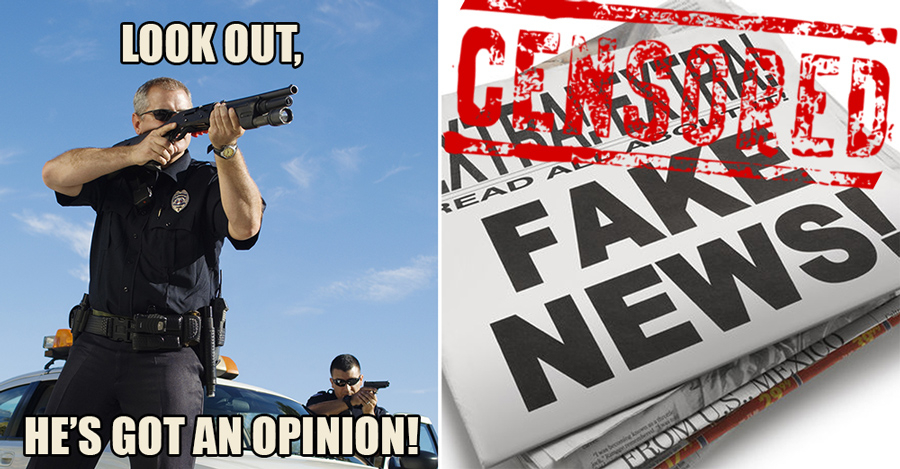
If there is an organisation created to adjudicate “truth,” how does one criticise the organisation? Surely an organisation with no mechanism to be criticized or left with the “honour system” to criticise itself should raise alarm bells.

News sources dismissed by governments may often speak the truth. What if they are right? Valuable news may come from outside the mainstream media.

At a time when the established media are not particularly trusted to begin with, how could censorship not harm faith in the news even more? In the event of any dispute, smaller companies would not be able to afford expensive lawyers to fight the German government. How long until the war chests of social media users empty, compared to the virtually inexhaustible resources of the German state?

Furthermore, how do all these policing networks ensure the neutrality of their staff, who are supposedly determining the accuracy of articles? Who is to police the police? Facebook, caught out, already had to dismiss those compiling their trending stories, when it was revealed that they had a runaway political bias and were routinely suppressing (conservative) material with which they did not agree.

Facebook’s “Trending News Team” banned people exposing jihadists, but allowed pages glorifying anti-police violence and pages promoting anti-Israeli terrorism. That is quite a track record.

Individuals, without even inciting violence, have been wrongly censored by Facebook. A former Gatestone writer, Ingrid Carlqvist, saw her account suspended; Gatestone writer Douglas Murray’s articles were censored from Facebook; and this author had his Facebook blocked for questioning Black Lives Matter. All the banned authors challenged politically correct revisions of events.

The whole censorship industry is open to abuse; presumably, that is what censorship is for in the first place. What is to stop individuals from stigmatizing an article multiple times? Algorithms and sophisticated computer programs could silence articles, as well. New information comes along, which changes statistics or facts that were believed to be accurate at the time. All it takes is a single complaint of “fake news” to tarnish a true article with that label — putting a stain on a journalist either out of political motivation, malice, or simply by mistake. Even algorithms make mistakes. People would start to wonder what they could report that would not be considered “fake news”. Is that the kind of press the free world wants?

The German government could start fining, as “fake news,” political opinions it finds “inconvenient” — a perfect way to close down discussion.

No government should be deciding what is worthy and what is unworthy of being published. News organisations often publish stories that governments might think is not in the national interest. It is much too easy to declare a story “fake” because it might not suit a political interest. That is the method used by dictatorships; it is correctly called authoritarian abuse.

The best way to counter fake news is to let people speak freely, check the facts, then present a counter-argument. The marketplace of ideas will decide its fate.

Robbie Travers, a political commentator and consultant, is Executive Director of Agora, former media manager at the Human Security Centre, and a law student at the University of Edinburgh.
The “Cat and Mouse” Problem of Hunger Strikes in Prison by Paul Leslie September 1, 2015 at 4:00 am

  • The European Court of Human Rights ruled that in situations where hunger strikes are organized as a means of pressuring the relevant authorities into releasing detainees, a refusal to comply with the demands of the hunger-strikers does not constitute a violation of Article 2 — provided that there is a regulatory system in place guaranteeing all the necessary measures are taken to monitor and manage these situations, including unrestricted access to appropriate medical care.


  • Israel has the benefit of the European Court rulings to refer to, as well as the provisions many fellow democracies have on their statute books concerning the membership of proscribed groups and the criteria for proscribing them — in the case of less liberal democracies like France, they are more wide-ranging than those applied in Israel.

Israel has a dilemma. Is it better when confronted with hunger-striking “activists” belonging to terror groups to let them starve themselves to death or not to let them starve themselves to death, even if it means feeding them by force.

In Britain, for instance, decisions about force-feeding in prisons have in general been governed by legislation that relates to the medical profession — and in particular those laws which pertain to mental health and mental incapacity — as well as being influenced by considerations linked to the criminalisation of aiding and abetting suicide.

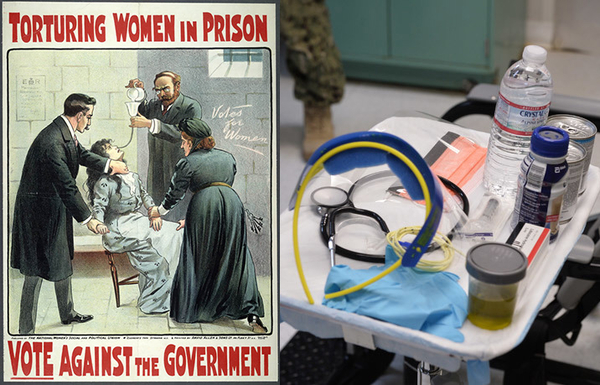
There has been nothing on the statute book specifically relating to hunger-striking detainees with the exception of the Prisoners (Temporary Discharge for Ill-Health) Act. This was adopted in 1913 by way of response to a specific set of historical circumstances. Suffragettes who were imprisoned for public order offenses and related illegal activities had embarked on hunger strikes.


The law, given the popular nickname of the Cat and Mouse Act, allowed hunger-striking prisoners, whose fasting had placed them at risk of death, to be temporarily discharged. Once their health was deemed to have been restored, they were to be recalled to prison to complete their sentences.


In a suffragette-related case, Leigh v Gladstone, of 1909, it had been held that the Home Office had a duty to preserve the lives of prisoners. Even after the passage of the 1961 Suicide Act, the management of hunger strikes in British prisons was largely dictated by the fear that allowing fasting prisoners to die might be considered aiding and abetting suicide. Consequently, force-feeding prisoners when considered medically essential continued to be the general practice.


Force-feeding, then and now.

This state of affairs changed after the statement in House of Commons by Roy Jenkins on 17 July 1974, in connection with the hunger striking Price sisters: “The doctor’s obligation is to the ethics of his profession and to his duty at common law; he is not required as a matter of prison practice to feed a prisoner artificially against the prisoner’s will.”

Henceforth, policy in the management of hunger strikes was no longer uniform and became more complex. (Australia is still influenced by British legislation and case law in this area.)

While French law upholds the right of prisoners not to be submitted to any medical treatment to which full and informed consent has not been given, in accordance with Article D. 362 of the Code of Criminal Procedure, it also permits force-feeding under medical supervision in situations where it has been determined by independent medical professionals that there has been such a deterioration in the physical condition of the hunger strikers that there is an immediate risk to their lives, in accordance with Article D. 364.

According to a ruling issued by the French Conseil d’État on August 16, 2004, in cases where there is an opportunity to do so, the physicians concerned must make all the necessary efforts to inform reluctant patients of the consequences of their decision to refuse treatment.

As far as the United States is concerned, cases involving force-feeding — which has never been found to be unconstitutional in cases where there is an immediate threat to life — have been considered at both federal and state level.

There have been, and continue to be, divergences in the ways different states manage hunger strikes in penal institutions.

Germany has specific legal provisions directly addressing the situations in which force-feedingmight be carried out — whether in prisons or in institutions where there are patients suffering from some forms of dementia, or from conditions which temporarily present as dementia.

In 1999 Muharrem Horoz, a sometimes violent opponent of the Turkish government, was placed in preventive detention by the Turkish authorities. He had been arrested for involvement in subversive activities against the Turkish state and various terrorist acts, including involvement in a bomb attack against the governor of Çankin. In 2001, to protest high security Turkish prisons that, instead of dormitories, accommodated cells that held one-to-three people, Horoz embarked upon a series of hunger strikes. He was hospitalized several times; but after his application for a release was rejected on the grounds that he had access to medical treatment, his hunger strikes culminated in his death on August 3, 2001.

His mother claimed that his right to life, guaranteed under Article 2 of the European Convention of Human Rights, had been violated. She petitioned the European Court of Human Rights (ECtHR). But its ruling of 31 March 2009Affaire Horoz c. Turquie (petition 1639/03), confirmed that a majority of the judges found not only was it impossible to establish a causal link between Horoz’s death and the refusal of the authorities to release him, but that, by ensuring that the detainee had full uninterrupted access to medical care and to any treatment deemed necessary, dispensed by fully qualified medical professionals, the Turkish state had satisfied its obligation to sustain him.

The ECtHR ruled that in situations where hunger strikes are organized as a means of pressuring the relevant authorities into releasing detainees, a refusal to comply with the hunger-strikers’ demands does not constitute a violation of Article 2 — provided that there is a regulatory system in place guaranteeing all the necessary measures are taken to monitor and manage these situations, including unrestricted access to appropriate medical care.

The Court determined that Horoz’s decision had been made freely, without any constraint, and that he was in full possession of his mental faculties, so that the Turkish authorities had the right to accept Horoz’s refusal of medical intervention, even if his refusal led to his death.

Bernard Rappaz is a repeat offender and serial hunger striker who has been imprisoned more than once for a number of offenses, including fraudulent activities and drug trafficking. On 20 March 2010, he began a hunger strike to protest, he said, the excessive severity of his prison sentence — five years, eight months – as well as the criminalization of the use and sale of cannabis. After being temporarily discharged by the authorities — for fifteen days in May 2010, during which time he ceased his hunger strike and was provided with the all the medical care required — he was returned to prison, where he resumed his hunger strike; but this time the authorities refused to consider any further temporary release. They instead upheld the principle — given legal force in Article 92 of the Swiss penal code — that prison sentences should be served without interruption, except in exceptional circumstances.

Rappaz was allowed to exhaust all the avenues of legal appeal against this decision, and several doctors were consulted by the penal authorities on this matter. Rappaz, in detention, continued to receive constant medical supervision — whether in his cell, or in hospital. When his hunger strike had finally weakened him to the extent that he was at risk of death, and he had been informed by qualified professionals of all the medical consequences of his hunger strike, the decision was made at the beginning of November to feed him, despite the opposition to force-feeding that had been expressed by several doctors. On 24 December 2010, he ended his hunger strike.

In a ruling by the ECtHR dated 26 March 2013, Bernard Rappaz contre la Suisse (petition 73175/10), a majority found that there were no grounds to condemn the Swiss authorities. Unlike other cases of force-feeding, where the rights of petitioners “not to be subjected to cruel or inhuman and degrading treatment” had been found to have been violated, the Swiss ruling found that the decision to feed Rappaz forcibly had been made in response to an immediate threat to his life, solely to satisfy a clear medical necessity and not to maintain discipline, or to break the will of the prisoner, or any other non-medical reason. Moreover, they ruled, the medical means to save his life did not inflict unnecessary or disproportionate suffering.[1]

Currently, Israeli authorities entrusted with the detention of potential or actual murderers belonging to terror groups whose ultimate aim is Israel’s destruction, have recently been faced with same painful “Cat and Mouse” decision as European countries: whether to allow hunger strikers to fast to death, give in to their demands, or force-feed them. Israel has the benefit of being able to refer to the ECtHR rulings. The rulings apply both in cases of prisoners convicted in regular criminal proceedings, and also in cases of security detainees against whom it is judged not (yet) advisable to present evidence, in order not to jeopardise intelligence contacts.

There are plenty of arguments that can and should be used to defend Israel from any unjust attacks directed against it regarding its treatment of hunger strikers.

It is also important to refer to the provisions many fellow democracies have on their statute books concerning the membership of proscribed groups and the criteria for proscribing them. In the case of more illiberal democracies like France — which allows for the banning of groups rightly or wrongly deemed racist, as well as having specific statutes that punish severely its equivalent of “criminal conspiracy” (“association de malfaiteurs”) where terrorism is involved — they are more wide-ranging than those applied in Israel.

Paul Leslie is an independent journalist living in London. He has degrees from Exeter College, Oxford University and the Sorbonne, where he received a doctorate.


[1] An analysis by Yonah Jeremy Bob, published by the Jerusalem Post on 17 June 2014, shortly before the adoption of a new law — incorporating all the necessary safeguards, both medical and non-medical and specifically permitting and regulating the force-feeding of — highlights the ethical or moral issues raised when decisions are made either to order the force-feeding of detainees or to allow them to fast without intervention, even if this leads to their deaths. The article also discusses the conflicting principles involved, and gives examples of the policies adopted by the governments of various democratic states to tackle the challenges of politically motivated hunger strikes.

The “Anti-Normalization” Campaign and Israel’s Right to Exist by Khaled Abu Toameh

  • For many Arabs and Muslims, the conflict with Israel is not about a withdrawal to the pre-1967 lines. These opponents have no intention of recognizing Israel’s right to exist, even if it allows for the creation of an independent and sovereign Palestinian state in the West Bank, Gaza Strip and East Jerusalem.

  • A leading cleric, Dr. Ali Daghi, Secretary-General of the International Muslim Scholars, wrote: “There is a consensus among Muslims, in the past and present, that if an Islamic land is occupied, then its inhabitants must declare jihad until it is liberated from the occupiers.”
  • “Anyone who calls for peace with the Zionists should be brought to trial for high treason. Normalization is treason.” — Ramzi Al-Harbi, Saudi writer.
  • Let us be clear: these are not fringe voices. This is mainstream Arab and Islamic society. What bothers them is not the “normalization” with the “Zionist entity,” but the fact that Israel exists. For the masses, jihad against Israel is the solution, not another peace initiative endorsed by unelected Arab dictatorships.

Arabs and Muslims are up in arms over a controversial visit to Israel by a retired Saudi general, Dr. Anwar Eshki, who is being accused of promoting “normalization with the Jews and the Zionist entity.” If “normalization” with Israel is being denounced as a major crime and sin, one can only imagine what “peace” with Israelis would be considered in the Arab and Islamic countries.

General Eshki and a delegation of Saudi academics and businessmen met with Israeli Foreign Ministry Director-General Dore Gold, the Coordinator of Government Activities in the Territories (COGAT), Maj.-Gen. Yoav Moderchai and several Knesset members from the opposition. The Saudi delegation also travelled to Ramallah, where its members met with Palestinian Authority (PA) President Mahmoud Abbas and other Palestinian officials.

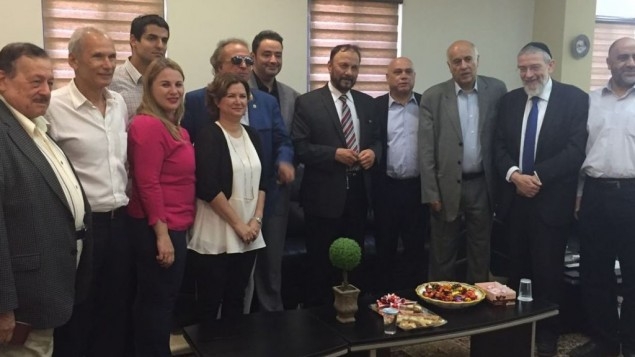
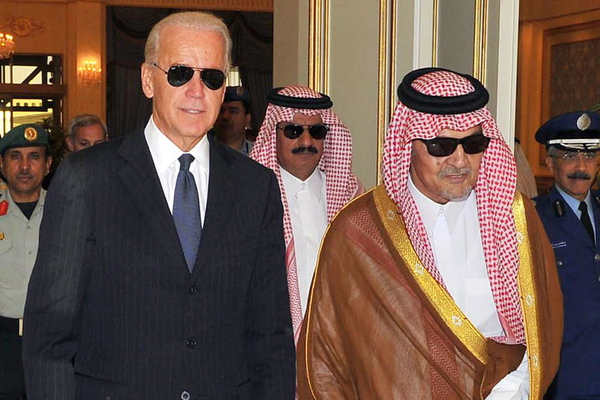
Retired Saudi general Anwar Eshki (center, in striped tie) and members of his delegation, meeting with Knesset members and others during a visit to Israel, on July 22, 2016. (Image source: Twitter)

The anger engendered by the unprecedented visit by the Saudi delegation to Israel shows that many Arabs and Muslims continue to believe that Israel has no right to exist despite the optimism voiced over the so-called Arab Peace Initiative of 2002.

Several Arab and Muslim leaders insist that, according to this initiative, an Israeli withdrawal to the pre-1967 lines and the establishment of an independent Palestinian state with East Jerusalem as its capital would lead to the creation of “normal relations” between their countries and Israel.

However, the outrage the Saudi delegation’s visit to Israel has triggered throughout the Arab and Islamic countries points to one conclusion: that for many Arabs and Muslims, the conflict with Israel is not about a withdrawal to the pre-1967 lines. Nor is the conflict about Palestinian rights and “normal relations” between Israel and the Arab and Islamic countries.

Those opposed to the visit are expressing their feelings under the banner of “Anti-Normalization” with Israel. The existence of Israel on “Muslim-owned” land, however, is the real problem. These opponents have no intention of recognizing Israel’s right to exist, even if it withdraws to the pre-1967 lines and allows for the creation of an independent and sovereign Palestinian state in the West Bank, Gaza Strip and East Jerusalem. This, of course, stands in sharp contrast with the spirit of the Arab Peace Initiative, which many in the Western world mistakenly believe would put an end to the Israeli-Arab conflict.

The first to express outrage over the visit were thousands of Saudis, including top Islamic clerics, who took to social media to express their poison and hatred for Israel and Jews. Many reminded their listeners of fatwas (Islamic religious decrees) banning any form of “normalization” with Israel and Jews, who are referred to as “infidels and polytheists.” The fatwas also forbid Muslims from giving up any part of “Muslim-owned” land to non-Muslims.

In Islam, if land has ever been under Muslim control, like southern Spain, el-Andalus, it must belong to Muslims to be as an endowment, or waqf, held in trust for Allah, in perpetuity. As the entire Middle East was under the control of the Muslim Ottoman Empire from 1259-1924, many Arabs and Muslims believe that the entire area belongs only to Islam, regardless of who may have lived there before.

Jews, who have lived continuously in Biblical Canaan and Judea for three thousand years, might well wonder how they can be accused of “occupying” their own land.

One of the leading clerics, Dr. Ali Daghi, Secretary-General of the International Muslim Scholars, wrote: “There is a consensus among Muslims, in the past and present, that if an Islamic land is occupied, then its inhabitants must declare jihad until it is liberated from the occupiers.”

Clearly the two-state solution is not the goal of this cleric and his friends. Nor are they interested in “Palestinian rights.” Rather Dr. Daghi is concerned about the “right” of Muslims to all the land, including those parts on which Israel exists today.

Another senior Saudi religious leader, Adel Al-Kalbani, the former imam of the Grand Mosque of Mecca, joined the “anti-normalization” campaign by declaring: “When we were young, they used to call them the Zionist enemy. For sixty years, this enemy has not changed. But we have changed!” The “change” he is talking about relates to those few Arabs and Muslims who are willing to recognize Israel’s right to exist.

Saudi sheikh Esam Al-Zamel said, “The hatred for Israel and the Zionist enemy is inscribed in the hearts of our generation. We must inscribe these values and principles in the hearts of our children.”

Another Saudi citizen, Sultan Al-Jumeri, said, “Normalization and extending a hand to the Zionist entity must remain a disgrace and sin that will chase the perpetrators to their last day. This is a betrayal of the history, the land and the martyrs.”

Fahd Al-Shumri, also of Saudi Arabia, remarked, “Normalization means recognition of “Israel.” This will lead to another phase: relinquishing the Al-Aqsa Mosque and recognizing the Jews’ right to the land of Palestine.”

For his part, Hassan Al-Mutairi, a Saudi preacher, wondered, “Is there any Muslim who supports normalization with the Zionists? The stone and tree will remain witness to our enmity to the Jews.”

He is referring to a hadith (the words and actions of Mohammed), which is also a part of the Hamas Charter, that states:

“Judgment Day will not come before the Muslims fight the Jews, and the Jews will hide behind the rocks and the trees, but the rocks and the trees will say: Oh Muslim, oh servant of Allah, there is a Jew behind me, come and kill him — except for the gharqad tree, which is one of the trees of the Jews.”

Some Saudi and Arab writers described the visit by the Saudi delegation as a “stab in the back” against the Boycott, Divestment and Sanctions Movement (BDS) against Israel. They urged the Saudi government to take immediate punitive measures against the former general and his delegation members, in order to deter others from committing such a “big crime” against Arabs and Muslims.

“Israel will remain our number one enemy in spite of the Zionists,” remarked Saudi writer Amal Zahid. Ramzi Al-Harbi, another writer from Saudi Arabia, commented, “Anyone who calls for peace with the Zionists should be brought to trial for high treason. Normalization is treason.”

Many Palestinians also joined the bandwagon by adding their incendiary and hateful remarks against the Saudis who visited Israel.

“We salute every Saudi who rejects normalization with the occupation,” said Palestinian political analyst Ibrahim Al-Madhoun.

Not surprisingly, Hamas, Islamic Jihad and other Palestinian groups also issued statements strongly condemning the visit of the Saudi delegation to Israel and calling for a ban on such trips. These groups even went as far as condemning a number of Palestinian Authority officials, such as Jibril Rajoub, for participating in the meetings between the Saudi delegation and Israeli officials.

The Palestinian “Resistance Committees,” a coalition of various Palestinian armed groups in the Gaza Strip, denounced the visit as a “crime against Palestine and its people.” The groups described the visit as “shameful” and warned against attempts by some Arabs and Muslims to “accept the existence of the Zionist terrorist entity on the land of Palestine.”

The widespread campaign against the visit of the Saudi delegation to Israel is the direct result of decades of anti-Israel indoctrination in the Arab and Islamic countries, including the Palestinians. At the core of this campaign is the denial of Israel’s right to exist and a denial of any Jewish link to “Muslim-owned” land.

Let us be clear: these are not fringe voices. This is mainstream Arab and Islamic society. The Palestinians, too, have long been part of this campaign, promoting their own “anti-normalization” drive to prevent anyone from meeting with Israelis.

By allowing (and sometimes endorsing) such campaigns, the Palestinian Authority is shooting itself in the head. Each time a PA official, including President Mahmoud Abbas, meets with Israelis, a large group of Palestinian “anti-normalization” activists react by denouncing the encounters and calling for a total boycott of Israel.

The anti-Israel BDS movement provides an inspiration to these haters. As far as the enemies of Israel are concerned, the campaign should not be only about boycotts, divestment and sanctions. As the fury over the visit to Israel clearly shows, what bothers them is not the “normalization” with the “Zionist entity,” but the fact that Israel exists.

The world can continue talking about the Arab Peace Initiative for as long as it wants. The facts on the ground show that the Arab and Muslim masses continue to see Israel as an alien body that was forcibly planted on “Muslim-owned” land. For the masses, jihad against Israel is the solution, not another peace initiative endorsed by unelected Arab dictatorships.

Khaled Abu Toameh, an award-winning journalist, is based in Jerusalem.

Tell Obama to Stop Spying on Netanyahu!

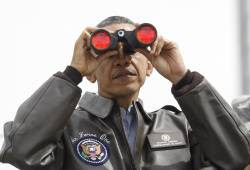
A recent report in the Wall Street Journal claims that President Obama gave the green light to the National Security Agency to spy on Israel and collect information, specifically from the Israeli Prime Minister’s Office. This is outrageous!


The Wall Street Journal published an expose on the White House and National Security Agency (NSA) in an article Wednesday titled, “U.S. Spy Net on Israel Snares Congress”, in which the authors claim President Obama instructed the NSA to continue spying on certain leaders, especially Israeli Prime Minister Benjamin Netanyahu, even after the president promised in 2014 to stop spying on allies.

According to the report, the NSA spied on Israel to provide the Obama administration with information on Netanyahu’s plans and Israel’s efforts to thwart the nuclear deal.

The report describes the various methods and “cyber-implants” used to intercept Netanyahu’s phone calls.

The Wall Street Journal noted that its account, stretching over both terms of the Obama administration, is based on interviews with more than two dozen current and former intelligence and administration officials and reveals, for the first time, the extent of American spying on the Israeli prime minister.

Translate »
Skip to toolbar