Category Archives: Uncategorized

The Atrocious Scandal of the UNESCO Vote on Jerusalem by Salim Mansur

  • It was over the ruins of these sacred Jewish sites, left behind by the Romans, that Arab conquerors of Jerusalem in the seventh century built two mosques, the Dome of the Rock and Al-Aqsa, to lay claim on the City of David for Islam.

  • There can be no dispute about Jewish links with Jerusalem, and Jewish rights to their sacred sites that long pre-date the arrival of Arabs bearing Islam to the City of David. This latest effort by the UNESCO, however to deny the Jewish nature of Jerusalem is much more than a scandal; it is a Stalinist measure to airbrush history by an organization which, according to its own charter, is supposed to be devoted without prejudice to the preservation of historical records.
  • There is precedent for such a resolution to nullify the recent UNESCO resolution on Jerusalem. In December 1991, the UN General Assembly voted to repeal the UN resolution passed in 1975 that declared, “Zionism is a form of racism.”
  • Muslim denial of the Jewish links to the City of David and their ancestral rights over Judea and Samaria, or Palestine, is ironically contrary to the Word of God in their own sacred scripture.
  • Their claim on Jerusalem, or the holy land, on the basis of Islam is simply not found in the Quran. On the contrary, the Quran is explicit in addressing Jews as “children of Israel” and speaking of them, as in “Remember those blessings of Mine with which I graced you, and how I favoured you above all other people.” (2:47)

A resolution on “Occupied Palestine” this past October, at the 200th session of the Executive Board of the UNESCO (United Nations Educational, Scientific and Cultural Organization) in Paris, France, was orchestrated by Arab and Muslim member-states as another attempt to diminish Jewish links with Jerusalem. UNESCO’s World Heritage Committee, despite Israel’s opposition, adopted the resolution by a vote of ten countries in favour, two opposed, and eight abstentions.

In 1975, UNESCO was already an official supporter of the UN declaration that “Zionism equals racism.” So it should come as no surprise that in October 2016, a UNESCO resolution pointedly ignored the Biblical Jewish connection to two of the faith’s holiest sites in Jerusalem: the Temple Mount and the Western Wall, which pre-date Islam by hundreds of years.

Instead, the resolution refers to the Temple Mount compound solely in Arabic: The Al-Aqsa Mosque/Al-Haram Al-Sharif, as it is called by Muslims. The resolution also unfairly rebukes Israel’s caring oversight of these sacred places.

In effect, the passage of this resolution amounts to diplomatic jihad by Qatar and Arab-Muslim countries of the Organization of Islamic Cooperation (OIC) against Israel. As usual, unaffected by historical fact, a corrupt UN agency, which should protect heritage sites and not debauch them, has provided support to the knife-wielding jihad of Palestinians — the same who are encouraged to commit murder and who then are praised for it by Mahmoud Abbas of the Palestine Authority (PA).

The Arab-Muslim countries together, as the 57-member OIC, including the “Palestine Authority” — form the largest single bloc in the UN; their numbers alone are mostly responsible for the one-sided prejudicial treatment of Israel in the UN.

Any fair-minded individual, however, will agree with Italian Prime Minister Matteo Renzi, “To say that the Jewish people has no connection to Jerusalem is like saying that the sun creates darkness.”

A reasonable response at UNESCO, or in any other forum, to this deranged effort of OIC members to delegitimize Jewish and Israeli links to Jerusalem, would rest on evidence, and not on airbrushing historical records.

One may note how often the stories of the Old and New Testament were enacted in the precinct of the Jewish Temple, as in the story of Jesus’s confrontation with the moneychangers. Then one may take into account the eyewitness testimony of Josephus Flavius, a priest in the Jewish Temple during the Herodian era and a rebel against Rome who eventually surrendered to the Romans. Josephus witnessed the Romans destroy the Jewish Temple in AD 70 and wrote an account of what occurred in his book, The Jewish Wars, which we have at hand to give us evidence of events in Jerusalem two thousand years ago.

In Rome, any present-day tourist can behold, on the ancient Arch of Titus, the engraved likeness of the Jewish candelabra (Menorah), which the Romans brought back from Jerusalem after ransacking the Jewish Temple.

In Rome, any present-day tourist can behold, on the ancient Arch of Titus, the engraved likeness of the Jewish candelabra (Menorah), which the Romans brought back from Jerusalem after ransacking the Jewish Temple. Pictured: Photo of a panel copy from the Arch of Titus, displayed in the Beth Hatefutsoth museum in Israel. (Image source: Wikimedia Commons/Sodabottle)

Then those who want to study the history of the sacred sites of Jews in their ancient city may read The Temple of Jerusalem by Professor Simon Goldhill of Oxford University. It was over the ruins of these sacred Jewish sites, left behind by the Romans, that Arab conquerors of Jerusalem in the seventh century built two mosques, the Dome of the Rock and Al-Aqsa, to lay claim on the City of David for Islam.

There can be no dispute about Jewish links with Jerusalem, and Jewish rights to their sacred sites that long pre-date the arrival of Arabs bearing Islam to the City of David. This latest effort by the UNESCO, however, to deny the Jewish nature of Jerusalem is much more than a scandal; it is a Stalinist measure to airbrush history by an organization which, according to its own charter, is supposed to be devoted without prejudice to the preservation of historical records.

In such circumstances, when the UN is abused by the numerical weight of Muslim countries, it might be asked on the basis of fairness: would UNESCO adopt a resolution that declares Muslim claims on Jerusalem as a sacred city for Islam untrue? It might not be far-fetched to imagine such a resolution submitted at some future session of the UNESCO, and adopted by a majority vote.

The likelihood of reversing the UNESCO resolution on Jerusalem by another resolution that affirms Jewish rights to the Temple Mount and the Western Wall has increased with the forthcoming change of administration in Washington, led by Donald Trump elected as the 45th President of the United States. There is precedent for such a resolution to nullify the recent UNESCO resolution on Jerusalem. In December 1991, the UN General Assembly voted to repeal the UN resolution passed in 1975 that declared, “Zionism is a form of racism.”

It is undeniable that the Muslim claim on Jerusalem as one of Islam’s sacred cities — the other two, far more major ones, being Mecca and Medina — rests on exceedingly shaky grounds.

It is an article of Muslim faith that the Quran is the Word of God. And there is no explicit mention of Jerusalem in the Quran.

At the beginning of Muhammad’s prophetic mission, he prayed in the direction (qiblah) of Jerusalem. Then, according to a verse in the Quran, he was directed to pray by turning “toward a qiblah which is dear to thee” (2:144), that is the Ka’aba (the cube) in Mecca.

Then follows the claim based on the story of Muhammad’s heavenly “night journey” from “the Inviolable Place of Worship to the Far Distant Place of Worship the neighbourhood whereof We have blessed” (17:1). Again, there is no explicit mention of Jerusalem in this opening verse from the chapter in the Quran known as Bani Israil or “The Children of Israel.”

It was much later, and after Muhammad’s demise, that the ulema (religious scholars) agreed the location of the “far distant place of worship” was the Temple Mount. It is a stretch, however, by Muslims to take the Quran’s elliptical reference to the Temple Mount and deny any link the site has with the Jewish faith and history. It is simply dishonest to make such inference in delegitimizing Jewish rights to the site that is indisputable historically as the grounds on which the Jerusalem Temple once stood.[1]

According to the earliest historians of Islam, the grounds of the Temple Mount was piled high with garbage, deposited there over the centuries by the Byzantine Christian inhabitants of the city. The same historians — Tabari (d. AD 923) was the most notable — report that when the Arab armies took Jerusalem in AD 638, the Byzantine Patriarch or ruler, Bishop Sophronius, indicated he wished to surrender the key of the city to the Muslim leader in person. Hence Umar, the second Caliph, or Successor of the Prophet (AD 634-44), came to Jerusalem, and Sophronius received him on the steps of the Church of the Holy Sepulchre.

When it was prayer time, as we find in the narratives of Syed Ameer Ali and F.E. Peters[2], based on the earliest Muslim sources, the Bishop invited the Caliph to pray inside the Church. Umar declined Sophronius’s invitation by observing that if he did, then those Muslims who came after him in following his example might lay claim on the Church. Umar obviously knew well the mentality of his people. Instead, Umar prayed outside in an open area where now stands the Mosque of Umar adjacent to the Church of the Holy Sepulchre.

But when Umar wanted to learn about the sacred sites of Jerusalem, the same historians record that it was a Jew by the name of Ka’b al-Ahbar, who had embraced Islam and was accompanying the Caliph, who guided him around the sites. Umar ordered the removal of garbage from the Temple Mount area, and Jews were granted permission to pray on the site that had been denied them under Byzantine rule.

When Arabs and Muslims deny Jewish links to Jerusalem, they are also then in denial of their own history. Their claim on Jerusalem, or the holy land, on the basis of Islam is simply not found in the Quran.

On the contrary, the Quran is explicit in addressing Jews as “children of Israel” and speaking of them, as in “Remember those blessings of Mine with which I graced you, and how I favoured you above all other people” (2:47). Or, as the Quran recalls the words of Moses to his people, “O my people! Go into the holy land which God hath ordained for you. Turn not in flight, for surely ye turn back as losers” (5:20-21).

An objective reading of the Quran — setting aside the later exegesis of the ulema as more or less politically motivated — and the accounts of the earliest Muslim historians does not give unequivocal support to claims of Muslim countries over Jerusalem. Indeed, Muslim denial of the Jewish links to the City of David and their ancestral rights over Judea and Samaria, or Palestine, is ironically contrary to the Word of God in their own sacred scripture.

It is Muslims who are in the wrong over Jerusalem. And no amount of their fallacious efforts in UNESCO, or at the UN, can airbrush the historic links of Jews with the City of David and deny Jews their rights to the sites most sacred to them, in the words of the Quran, as the people of the Book.

Salim Mansur is a Distinguished Senior Fellow at the Gatestone Institute. He teaches in the department of political science at Western University in London, Ontario. He is the author of “Islam’s Predicament: Perspectives of a Dissident Muslim” and “Delectable Lie: A Liberal Repudiation of Multiculturalism.”

The Arabs’ Historic Mistakes in Their Interactions with Israel by Fred Maroun

  • We Arabs managed our relationship with Israel atrociously, but the worst of all is the ongoing situation of the Palestinians. Our worst mistake was in not accepting the United Nations partition plan of 1947.Perhaps one should not launch wars if one is not prepared for the results of possibly losing them.The Jews are not keeping the Arabs in camps, we are.

  • Jordan integrated some refugees, but not all. We could have proven that we Arabs are a great and noble people, but instead we showed the world, as we continue to do, that our hatred towards each other and towards Jews is far greater than any concept of purported Arab solidarity.

This is part one of a two-part series. The second part will examine what we Arabs can do differently today.

In the current state of the relationship between the Arab world and Israel, we see a patchwork of hostility, tense peace, limited cooperation, calm, and violence. We Arabs managed our relationship with Israel atrociously, but the worst of all is the ongoing situation of the Palestinians.

The Original Mistake

Our first mistake lasted centuries, and occurred well before Israel’s declaration of independence in May 1948. It consisted of not recognizing Jews as equals.

As documented by a leading American scholar of Jewish history in the Muslim world, Mark R. Cohen, during that era, “Jews shared with other non-Muslims the status of dhimmis [non-Muslims who have to pay protection money and follow separate debasing laws to be tolerated in Muslim-controlled areas] … New houses of worship were not to be built and old ones could not be repaired. They were to act humbly in the presence of Muslims. In their liturgical practice they had to honor the preeminence of Islam. They were further required to differentiate themselves from Muslims by their clothing and by eschewing symbols of honor. Other restrictions excluded them from positions of authority in Muslim government”.

On March 1, 1944, while the Nazis were massacring six million Jews, and well before Israel declared independence, Haj Amin al-Husseini, then Grand Mufti of Jerusalem, declared on Radio Berlin, “Arabs, rise as one man and fight for your sacred rights. Kill the Jews wherever you find them. This pleases God, history, and religion. This saves your honor. God is with you.”

If we had not made this mistake, we might have benefited in two ways.

Jews would likely have remained in the Muslim Middle East in greater numbers, and they would have advanced the Middle Eastern civilization rather than the civilizations of the places to which they fled, most notably Europe and later the United States.

Secondly, if Jews felt secure and accepted in the Middle East among Arabs, they may not have felt the need to create an independent state, which would have saved us from our subsequent mistakes.

The Worst Mistake

Our second and worst mistake was in not accepting the United Nations partition plan of 1947. UN resolution 181 provided the legal basis for a Jewish state and an Arab state sharing what used to be British-controlled Mandatory Palestine.

As reported by the BBC, that resolution provided for:

“A Jewish State covering 56.47% of Mandatory Palestine (excluding Jerusalem) with a population of 498,000 Jews and 325,000 Arabs; An Arab State covering 43.53% of Mandatory Palestine (excluding Jerusalem), with 807,000 Arab inhabitants and 10,000 Jewish inhabitants; An international trusteeship regime in Jerusalem, where the population was 100,000 Jews and 105,000 Arabs.”

Although the land allocated to the Jewish state was slightly larger than the land allocated to the Arab state, much of the Jewish part was total desert, the Negev and Arava, with the fertile land allocated to the Arabs. The plan was also to the Arabs’ advantage for two other reasons:

  • The Jewish state had only a bare majority of Jews, which would have given the Arabs almost as much influence as the Jews in running the Jewish state, but the Arab state was almost purely Arab, providing no political advantage to Jews within it.
  • Each proposed state consisted of three more-or-less disconnected pieces, resulting in strong geographic interdependence between the two states. If the two states were on friendly terms, they would likely have worked in many ways as a single federation. In that federation, Arabs would have had a strong majority.

Instead of accepting that gift of a plan when we still could, we Arabs decided that we could not accept a Jewish state, period. In May 1948, Azzam Pasha, the General Secretary of the Arab League, announced, regarding the proposed new Jewish part of the partition: that, “This will be a war of extermination, a momentous massacre, which will be spoken of like the Mongolian massacres and the Crusades.” We initiated a war intended to eradicate the new state in its infancy, but we lost, and the result of our mistake was a much stronger Jewish state:

  • The Jewish majority of the Jewish state grew dramatically due to the exchange of populations that occurred, with many Arabs fleeing the war in Israel and many Jews fleeing a hostile Arab world to join the new state.
  • The Jews acquired additional land during the war we launched, resulting in armistice lines (today called the green lines or pre-1967 lines), which gave Israel a portion of the land previously allocated to the Arab state. The Jewish state also acquired much better contiguity, while the Arab portions became divided into two parts (Gaza and the West Bank) separated by almost 50 kilometers.

Perhaps one should not launch wars if one is not prepared for the results of possibly losing them.

In May 1948, Azzam Pasha (right), the General Secretary of the Arab League, announced, regarding the proposed new Jewish part of the partition: that, “This will be a war of extermination, a momentous massacre, which will be spoken of like the Mongolian massacres and the Crusades.”

More Wars and More Mistakes

After the War of Independence (the name that the Jews give to the war of 1947/1948), Israel was for all practical purposes confined to the land within the green lines. Israel had no authority or claim over Gaza and the West Bank. We Arabs had two options if we had chosen to make peace with Israel at that time:

  • We could have incorporated Gaza into Egypt, and the West Bank into Jordan, providing the Palestinians with citizenship in one of two relatively strong Arab countries, both numerically and geographically stronger than Israel.
  • We could have created a new state in Gaza and the West Bank.

Instead, we chose to continue the hostilities with Israel. In the spring of 1967, we formed a coalition to attack Israel. On May 20, 1967, Syrian Defense Minister Hafez Assad stated, “The time has come to enter into a battle of annihilation.” On May 27, 1967, Egypt’s President Abdul Nasser declared, “Our basic objective will be the destruction of Israel”. In June, it took Israel only six days to defeat us and humiliate us in front of the world. In that war, we lost much more land, including Gaza and the West Bank.

After the war of 1967 (which Jews call the Six-Day War), Israel offered us land for peace, thereby offering us a chance to recover from the mistake of the Six-Day War. We responded with the Khartoum Resolutions, stating, “No peace with Israel, no recognition of Israel, and no negotiations with Israel”.

Not having learned from 1967, we formed yet another coalition in October 1973 and tried again to destroy Israel. We achieved some gains, but then the tide turned and we lost again. After this third humiliating defeat, our coalition against Israel broke up, and Egypt and Jordan even decided to make peace with Israel.

The rest of us remained stubbornly opposed to Israel’s very existence, even Syria which, like Egypt and Jordan, had lost land to Israel during the Six-Day War. Today Israel still holds that territory, and there is no real prospect for that land ever going back to Syria; Israel’s Prime Minister recently declared that, “Israel will never leave the Golan Heights”.

The Tragedy of the Palestinians

The most reprehensible and the most tragic of our mistakes is the way that we Arabs have treated Palestinians since Israel’s declaration of independence.

The Jews of Israel welcomed Jewish refugees from Arab and other Muslim lands into the Israeli fold, regardless of the cost or the difficulty in integrating people with very different backgrounds. Israel eagerly integrated refugees from far-away lands, including EthiopiaIndiaMoroccoBrazilIranUkraine, and Russia. By doing so, they demonstrated the powerful bond that binds Jews to each other. At the same time, we had the opportunity similarly to show the bond that binds Arabs together, but instead of welcoming Arab refugees from the 1947/48 war, we confined them to camps with severe restrictions on their daily lives.

In Lebanon, as reported by Amnesty International, “Palestinians continue to suffer discrimination and marginalization in the labor market which contribute to high levels of unemployment, low wages and poor working conditions. While the Lebanese authorities recently lifted a ban on 50 of the 70 jobs restricted to them, Palestinians continue to face obstacles in actually finding employment in them. The lack of adequate employment prospects leads a high drop-out rate for Palestinian schoolchildren who also have limited access to public secondary education. The resultant poverty is exacerbated by restrictions placed on their access to social services”.

Yet, Lebanon and Syria could not integrate refugees that previously lived a few kilometers away from the country’s borders and who shared with the country’s people almost identical cultures, languages, and religions. Jordan integrated some refugees but not all. We could have proven that we Arabs are a great and noble people, but instead we showed the world, as we continue to do, that our hatred towards each other and towards Jews is far greater than any concept of purported Arab solidarity. Shamefully to us, seven decades after the Palestinian refugees fled Israel, their descendants are still considered refugees.

The worst part of the way we have treated Palestinian refugees is that even within the West Bank and Gaza, there remains to this day a distinction between Palestinian refugees and native Palestinians. In those lands, according to the year 2010 numbers provided by Palestinian Refugee ResearchNet at McGill University, 37% of Palestinians within the West Bank and Gaza live in camps! Gaza has eight Palestinian refugee camps, and the West bank has nineteen. The Jews are not keeping the Arabs in camps, we are. Palestinian President Mahmood Abbas claims a state on those lands, but we can hardly expect him to be taken seriously when he leaves the Palestinian refugees under his authority in camps and cannot even integrate them with other Palestinians. The ridiculousness of the situation is rivaled only by its callousness.

Where We Are Now

Because of our own mistakes, our relationship with Israel today is a failure. The only strength in our economies is oil, a perishable resource and, with fracking, diminishing in value. We have not done nearly enough to prepare for the future when we will need inventiveness and productivity. According to Foreign Policy Magazine, “Although Arab governments have long recognized the need to shift away from an excessive dependence on hydrocarbons, they have had little success in doing so. … Even the United Arab Emirates’ economy, one of the most diversified in the Gulf, is highly dependent on oil exports”.

Business Insider rated Israel in 2015 as the world’s third most innovative country. Countries from all over the world take advantage of Israel’s creativity, including countries as remote and as advanced as Japan. Yet we snub Israel, an innovation powerhouse that happens to be at our borders.

We also fail to take advantage of Israel’s military genius to help us fight new and devastating enemies such as ISIS.

Worst of all, one of our own people, the Palestinians, are dispersed — divided, disillusioned, and utterly incapable of reviving the national project that we kidnapped from under their feet in 1948 and that we have since disfigured beyond recognition.

To say that we must change our approach towards Israel is an understatement. There are fundamental changes that we ourselves must make, and we must find the courage and moral fortitude to make them.

The Jews are not keeping the Arabs in camps, we are.

Fred Maroun, a left-leaning Arab based in Canada, has authored op-eds for New Canadian Media, among other outlets. From 1961-1984, he lived in Lebanon.


The Arab-Israel Conflict: Back to the Future by Shoshana Bryen

  • What is commonly called the “Palestinian-Israeli conflict” is, in fact, the “Arab-Israel conflict.”Jordan illegally annexed the West Bank in 1950, and from that time Palestinian nationalism has been deadly for the Kingdom.

  • “I call on the Palestinian people to elect new leaders, leaders not compromised by terror… to build a practicing democracy, based on tolerance and liberty. If the Palestinian people actively pursue these goals, America and the world will actively support their efforts…. A Palestinian state will never be created by terror — it will be built through reform. And reform must be more than cosmetic change, or veiled attempts to preserve the status quo.” — President George W. Bush, 2002.
  • “There’s no way a deal can be made if they’re not ready to acknowledge a very, very great and important country.” — President Donald J. Trump, 2017.
  • The burden, then, is on the Arab states and the Palestinians.

The optics, certainly, were fine. It was good to see an American president and an Israeli prime minister standing together on the podium with what appeared to be genuine good will. Most important, and promising for the future, perhaps, was how they dealt with the “two state solution” mantra. There was, for the first time in years, nuance in both the American and the Israeli position toward what has become a slogan without meaning.

U.S. President Donald Trump and Israeli Prime Minister Benjamin Netanyahu address a press conference at the White House, February 15, 2017. (Image source: White House video screenshot)

Prime Minister Benjamin Netanyahu reiterated the possibility of two states with caveats he noted:

  • Palestinian acceptance of the legitimacy of Jewish sovereignty, echoing the words of the UN Partition Plan for Palestine for “a Jewish state.”
  • Israeli security control from the Mediterranean to the Jordan River. “Israel must retain the overriding security control over the entire area west of the Jordan River. Because… otherwise we’ll get another radical Islamic terrorist state in the Palestinian areas exploding the peace, exploding the Middle East.”

President Donald Trump deferred, as befits someone who won’t live with the consequences of actions taken 6,000 miles away:

“I like the (solution) that both parties like… I can live with either one. I thought for a while that two states looked like it may be the easier of the two. To be honest, if Bibi and the Palestinians, if Israel and the Palestinians are happy, I’m happy with the one they like the best.”

Between them, it was clear that the door has been opened to other possibilities. There were references to meetings (present and possibly future) with Sunni Arab states that are increasingly willing to be seen in Israel’s company.

It should be noted here that Qatar’s representative in Gaza said last week that he had “excellent relations” with a number of Israeli officials. He told the Times of Israel that the Palestinian Authority (PA) was “standing in the way of solutions to the power shortages and other problems” in Gaza. “I am in contact with senior Israeli officials and agencies and the relationship is great,” said Muhammad al-Amadi.

It is still true that Qatar funds a variety of jihadist movements and has been Hamas’s primary funder. But the U.S. Treasury Department praised Qatar for moves to deny jihadists access to funds, and Qatar’s patronage may decline further with the secret-ballot election of Iranian ally Yahye Sinwar to head the organization in Gaza. Trading Qatar for Iran in Gaza is not a plus for Israel, but it may benefit Israel’s Gulf State relations.

Saudi relations with Israel are an open secret — they use third parties to import Israeli high-tech and water technology. Israel has had a diplomatic mission in Abu Dhabi since 2015. Through similar cutouts, Israel has sold defense equipment to Saudi Arabia and the UAE. Relations with Egypt, particularly on security, are close and growing. Israel’s relations with Jordan have been key to Hashemite monarchy’s survival — and the monarch knows it.

None of this should be taken as a sign that Israel is anyone’s long-term friend or partner, but the opening for conversation other than “two states” is there. Where might that conversation go?

Back, perhaps, to the future.

What is commonly called the “Palestinian-Israeli conflict” is, in fact, the “Arab-Israel conflict.” The Arab states rejected Israel’s independence in 1948 and made war against it multiple times. UN Resolution 242 was designed to provide Israel with the security and legitimacy it had been denied by its accepting Israel’s control of territory beyond the 1949 Armistice Line until the Arabs came forward. Demonstrable Arab acceptance of UN Resolution 242 would pave the way for the “secure and recognized boundaries free from threats or acts of force” to which Israel is entitled.

It would also pave the way for a return to the 1993 Oslo Accords, which made no mention of statehood for the Palestinians, but which envisioned a “permanent settlement based on Security Council Resolutions 242 and 338.”

Jordan illegally annexed the West Bank in 1950, and from that time Palestinian nationalism has been deadly for the Kingdom. The 1970 Black September uprising against King Hussein caused thousands of casualties and resulted in the PLO being expelled from Jordan to Lebanon. King Hussein renounced Jordan’s illegal claim to the West Bank in 1988, paving the way for the Jordan-Israel peace treaty, but also trying to withdraw Jordan from a mess of its own creation. Continuing low-level violence in Jordan is the result. Without further discussion between the Palestinians and King Abdullah II, Palestinian nationalism continues to threaten an important American ally.

A settlement based on UN Resolution 242 could include a Palestinian relationship with both Israel and Jordan that is more than autonomy and less than statehood, with economic and social integration across the Jordan River.

As an adjunct, it is useful to remember that American support for the Palestinian experiment was not full-fledged support for statehood without conditions — until the Obama administration. It was President Clinton who signed the “something less than statehood” Oslo Accords, and President George W. Bush in his 2002 Rose Garden speech on Palestinian nationalism said:

I call on the Palestinian people to elect new leaders, leaders not compromised by terror… to build a practicing democracy, based on tolerance and liberty. If the Palestinian people actively pursue these goals, America and the world will actively support their efforts.

And when the Palestinian people have new leaders, new institutions and new security arrangements with their neighbors, the United States of America will support the creation of a Palestinian state whose borders and certain aspects of its sovereignty will be provisional until resolved as part of a final settlement in the Middle East.

A Palestinian state will never be created by terror — it will be built through reform. And reform must be more than cosmetic change, or veiled attempts to preserve the status quo.

This turns full circle to President Trump’s statement on the podium with Prime Minister Netanyahu:

“The Palestinians have to get rid of some of that hate that they’re taught from a very young age. They’re taught tremendous hate. I’ve seen what they’re taught. And you can talk about flexibility there too, but it starts at a very young age and it starts in the schoolroom. And they have to acknowledge Israel — they’re going to have to do that. There’s no way a deal can be made if they’re not ready to acknowledge a very, very great and important country.”

The burden, then, is on the Arab states and the Palestinians to meet obligations dating as far back as 1948 and proceeding through 1967 and 1993. When they arrive in the 21st century, a “solution” will be found for Israel, the Palestinians, and Jordan and even, perhaps, the unhappy residents of Gaza.

But not until then.

Shoshana Bryen is Senior Director of the Jewish Policy Center.

The Abbas “Bombshell” by Barry Shaw

  • If one person can stand at the UN and unilaterally declare a state, I advise the leader of the Kurds, the Catalans, the Druze and any other ethnic groups that feel entitled to have their independence to make their way to the building and do so.


  • It is, therefore, the European Union and several European governments, including France and the Netherlands, that are complicit with the Palestinian Authority (PA) in knowingly and purposefully violating their own, signed agreements. Moreover, according to the Oslo Accords, the PA was designated as an interim body, not a permanent one.

  • If one really wants to help the Palestinians, one will try to help rid them of their corrupt and repressive leaders; not reinforce them. The Palestinian people deserve better than this.

The “bombshell” that Palestinian Authority (PA) President Mahmoud Abbas threatened he was going to drop on the United Nations during his speech did not materialize.

This bombshell turned out to be a planned announcement of a Palestinian state “under Israeli occupation.”

If one person can stand at the podium of the UN and unilaterally declare a state, then I advise the leader of the Kurds, the Catalans, the Druze and any other ethnic groups that feel entitled to have their independence to make their way to the building and do so.

Apparently the U.S. Administration advised Abbas against the announcement, and Abbas backed down.

Abbas has had limited success playing the official forums of the United Nations and the European Union. They seem aligned with his agenda, but with no thought to the regional devastation that supplanting Israel — the region’s only democracy that that grants full human rights and equality with to all its citizens, including its Arab ones — with a corrupt and repressive regime would entail.

Polls repeatedly show that Israel’s Arabs — about a fifth if its population, and with their own political parties and members of parliament — would evidently, if secretly (for communal loyalty), rather remain in Israel than be in any Arab country, including one of their own. The international community also does not seem to take into consideration what displacing Israel would do to furthering the agendas of political Islamists and creating even more instability in the area.

Had Abbas gone ahead and made his announcement, not only would it have been an empty gesture, it would also have been a clearly illegal breach of the Oslo Accords and other internationally approved agreements that gave validity to the Palestinian Authority in the first place.

Abbas made three false claims in talks with UN officials during his New York visit.

He blamed Israel for ongoing tensions on the Temple Mount, when the violent riots were, in reality, perpetrated by Palestinian Muslims; they have been desecrating their own mosques by wrecking the furniture and using it for barricades to hide behind, while hurling rocks, firebombs and other missiles at non-Muslims on the Mount.

Abbas also accused Israel of not reviving peace negotiations when it was Abbas himself who continually stalled and walked away from consecutive Israeli Prime Ministers and declined to respond to repeated pleas by Israel’s current Prime Minister, Benjamin Netanyahu, to meet with him “anytime, anywhere.” Netanyahu, in fact, invited Abbas to meet him while they were both in New York this week. The invitation was again declined.

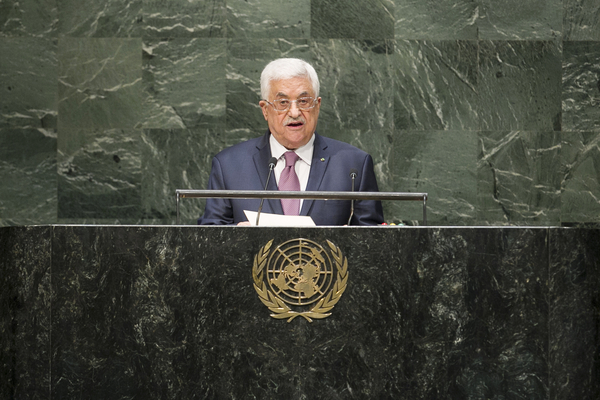
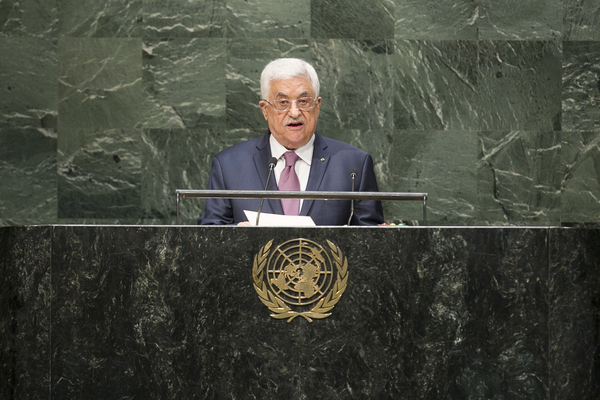
Palestinian Authority (PA) President Mahmoud Abbas addresses the United Nations General Assembly, on September 26, 2014. (Image source: UN)

Abbas also complained about Israel’s alleged failure to implement agreements with the Palestinians, but without specifying which agreements.

Ironically, it is only the constant protection by Israel’s security forces that is keeping Abbas alive while rivals from Hamas and defectors from his own party attempt to kill him and take over the territories under his control.

At bottom, it is the European Union as well as the Palestinian Authority that are in violation of the many signed international agreements. Everyone is invited to come to Israel to witness the illegal construction of buildings in what, under the Oslo Accords, is known as “Area C.” Area C means, according to the official Oslo Accords, that Israel has full administrative and military control of that area until such time as a permanent peace agreement is signed between the two parties. In other words, during that interim period, neither the PA, Israel, nor anyone else, has the right to construct or plant a flag anywhere designated as Area C. There have been, regrettably, countless breaches of this protocol. It is, therefore, the EU and several European governments, including France and the Netherlands, that are complicit with the PA in knowingly and purposefully violating their own, signed agreements.

It is Abbas’s Palestinian Authority with the collusion of European governments that are failing to implement signed agreements with Israel. Moreover, according to the Oslo Accords, the PA was designated as an interim body, not a permanent one.

Lately, Abbas has been saying repeatedly that he will resign — an empty threat directed at the international community, to suggest that without him, there would be chaos. The international community would do well not to fall for this or other ruses, often echoed by the BDS and other movements, which care more about hating Israel than helping Palestinians.

If one really would really like to help the Palestinians, one would try to help rid them of corrupt and repressive leaders; not reinforce them. The Palestinian people deserve better than this.

Barry Shaw is the Senior Associate for Public Diplomacy at the Israeli Institute for Strategic Studies. He is the author of “Fighting Hamas, BDS and Anti-Semitism.”

The “Two State Solution”: Irony and Truth by Louis René Beres

  • “The establishment of such a [Palestinian] state means the inflow of combat-ready Palestinian forces into Judea and Samaria … In time of war, the frontiers of the Palestinian state will constitute an excellent staging point for mobile forces to mount attacks on infrastructure installations vital for Israel’s existence…” — Shimon Peres, Nobel Laureate and Former Prime Minister of Israel, in 1978.

  • The Palestine Liberation Organization (PLO) was formed in 1964; three years before there were any “occupied territories.” Exactly what, then was the PLO planning to “liberate”?
  • Both Fatah and Hamas have always considered, and still consider, Israel as simply part of “Palestine.” On their current official maps, all of Israel is identified as “Occupied Palestine.”
  • “You understand that we plan to eliminate the State of Israel, and establish a purely Palestinian state. … I have no use for Jews; they are and remain, Jews.” — PLO Chairman Yasser Arafat, January 30, 1996 (2.5 years after signing the Oslo Peace Accords).
  • In view of these repeatedly intolerant Arab views on Israel’s existence, international law should not expect Palestinian compliance with any agreements, including those concerning use of armed force — even if these agreements were to include explicit U.S. security guarantees to Israel.

There is no lack of irony in the endless discussions of Israel and a Palestinian state.

One oddly neglected example is the complete turnaround of former Israeli prime minister Shimon Peres. Recognized today as perhaps the proudest Israeli champion of a “Two State Solution” — sometimes also referred to as a “Road Map to Peace in the Middle East” — Peres had originally considered Palestinian sovereignty to be an intolerable existential threat to Israel. More precisely, in his book, Tomorrow is Now (1978), Mr. Peres unambiguously warned:

“The establishment of such a (Palestinian) state means the inflow of combat-ready Palestinian forces into Judea and Samaria this force, together with the local youth, will double itself in a short time. It will not be short of weapons or other military equipment, and in a short space of time, an infrastructure for waging war will be set up in Judea, Samaria and the Gaza Strip. … In time of war, the frontiers of the Palestinian state will constitute an excellent staging point for mobile forces to mount attacks on infrastructure installations vital for Israel’s existence…”

Now, Prime Minister Benjamin Netanyahu, in apparent agreement with this original position of Peres on Palestine, is nonetheless willing to go along with some form or another of a Palestinian state, but only so long as its prospective leaders should first agree to “demilitarization.” Netanyahu, the “hawk,” is now in agreement with the early, original warning of Peres, the “dove.” Peres’s assessment has been Netanyahu’s firm quid pro quo.

For Israel, as Mr. Netanyahu understands, legal mistakes and misunderstandings could quickly give rise to potentially irreversible harms. With reference to the particular matter of “Palestine,” the underlying hazards are complex, longstanding, and possibly global. These hazards would also only be exacerbated by any newly mandated (by the U.S., Russia, and/or United Nations) Israeli return of the Golan Heights to Syria. Then, armed militants could once again start shooting down at the farmers below, laboring on the Israeli plain.

History can help us better to understand the real outcome of any “Two-State Solution.” From the beginnings of the state system, in 1648, following the Thirty Years’ War, and the Peace of Westphalia, states have routinely negotiated treaties to provide security. To the extent that they have been executed in good faith, these agreements are fashioned and tested according to international law. Often, of course, disputes arise when signatories have determined that continued compliance is no longer in their presumed national interest.

For Israel, its 1979 Peace Treaty with Egypt remains fundamental and important. Still, any oscillating regime change or Islamist ascendancy in Cairo could easily signal an abrogation of this agreement. These same risks of deliberate nullification could apply to an openly secular Egyptian government, should its leaders (today, this would mean President el-Sisi) decide, for absolutely any reason, that the historic treaty with Israel should now be terminated.

Any post-Sisi regime that would extend some governing authority to the Muslim Brotherhood, to its proxies, or to its jihadist successors (such as ISIS), could produce a sudden Egyptian abrogation. Although the cessation of treaty obligations by the Egyptian side would almost certainly represent a serious violation of the 1969 Vienna Convention on the Law of Treaties, the governing “treaty on treaties,” there is little if anything that Israel or the so-called “international community” could do in response. In the still-insightful words of seventeenth-century English philosopher, Thomas Hobbes: “Covenants, without the sword, are but words….” (Leviathan).

Back to Palestine. As recently as last Friday, Palestinian Authority (PA) television, not Hamas, threatened the Jews, not just Israelis, with genocide:

PA TV Preacher: “Allah, punish Your enemies, the enemies of religion, count their numbers and kill them to the last one, and bring them a black day. Allah, punish the wicked Jews, and those among the atheists who help them. Allah, we ask that You bestow upon us respect and honor by enabling us to repel them, and we ask You to save us from their evil.” [Official PA TV, April 22, 2016]

That is just part of a wider security problem. Under law, Israel has a “peremptory” (irrefutable, not open to challenge or appeal) right to remain “alive.” It was, therefore, entirely proper for Mr. Netanyahu to have previously opposed a Palestinian state in any form. After all, both Fatah and Hamas have always considered, and still consider, Israel as simply part of “Palestine.” On their current official maps, all of Israel — not just West Bank, Judea and Samaria — is prominently identified as “Occupied Palestine.” As for Jerusalem, an April 15, 2016, UNESCO resolution was expressly dismissive of “so-called” Jewish sites, including the Western Wall.

Palestine, while not yet a fully sovereign state, is still a “nonmember observer state” of the United Nations. In that more limited capacity, “Palestine” had already been admitted into UNESCO, and, unsurprisingly, joined enthusiastically in the April 15, 2016 resolution calling into question all “Jewish sites.”

In the strict Islamic view, and not merely in narrowly jihadi or Islamist perspectives, Israel is described as the individual Jew writ large. The Jewish State, in this doctrinal view, must be despised and uprooted on account of the allegedly innate and irremediable “evil” that purportedly lurks within each and every individual Jew. This insidiously murderous viewpoint is a far cry from the more fashionable idea that Israel is somehow despised in the region “only” for legitimate political reasons, that it is supposedly an “occupier.” In reality, the Israeli is routinely despised in the Islamic world because its people do not submit to Islam. This alleged Jewish infirmity can never hope to be “healed.”

A current Egyptian textbook of “Arab Islamic History,” used widely in teacher training colleges, expresses these basic and crudely determinative sentiments:

“The Jews are always the same, every time and everywhere. They will not live save in darkness. They contrive their evils clandestinely. They fight only when they are hidden; because they are cowards. … The Prophet enlightened us about the right way to treat them, and succeeded finally in crushing the plots they had planned. We today must follow this way, and purify Palestine from their filth.”[1]

In an earlier article in Al-Ahram by Dr. Lutfi Abd al-Azim, the famous commentator urged, with complete seriousness:

“The first thing that we have to make clear is that no distinction must be made between the Jew and the Israeli….The Jew is a Jew, through the millennia … in spurning all moral values, devouring the living, and drinking his blood for the sake of a few coins. The Jew, the Merchant of Venice, does not differ from the killer of Deir Yasin or the killer of the camps. They are equal examples of human degradation. Let us therefore put aside such distinctions, and talk only about Jews.”[2]

Writing also on the “Zionist Problem,” Dr. Yaha al-Rakhawi remarked openly in AlAhram

“We are all once again face to face with the Jewish Problem, not just the Zionist Problem; and we must reassess all those studies which make a distinction between “The Jew” and “The Israeli.” And we must redefine the meaning of the word “Jew” so that we do not imagine that we are speaking of a divinely revealed religion, or a minority persecuted by mankind … we cannot help but see before us the figure of the great man Hitler, may God have mercy on him, who was the wisest of those who confronted this problem … and who out of compassion for humanity tried to exterminate every Jew, but despaired of curing this cancerous growth on the body of mankind.”[3]

Finally, consider what Israel’s original Oslo Accords “peace partner,” Yasser Arafat, said on January 30, 1996, while addressing forty Arab diplomats at the Grand Hotel in Stockholm. Speaking under the title, “The Impending Total Collapse of Israel,” Arafat remarked unapologetically, and without any hesitation:

“We Palestinians will take over everything; including all of Jerusalem. … All the rich Jews who will get compensation will travel to America. … We of the PLO will now concentrate all our efforts on splitting Israel psychologically into two camps. Within five years, we will have six to seven million Arabs living in the West Bank, and in Jerusalem. … You understand that we plan to eliminate the State of Israel, and establish a purely Palestinian state. … I have no use for Jews; they are and remain, Jews.”

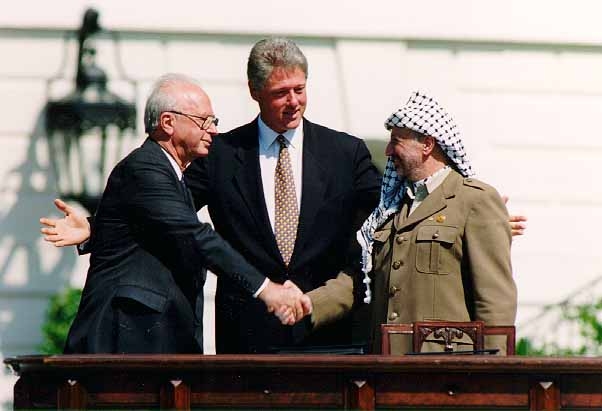
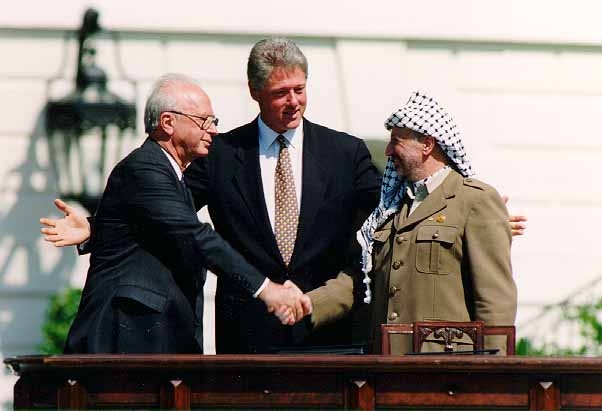
Israeli Prime Minister Yitzhak Rabin, U.S. President Bill Clinton, and PLO chairman Yasser Arafat at the Oslo Accords signing ceremony on September 13, 1993. In 1996, Arafat publicly stated: “We Palestinians will take over everything … You understand that we plan to eliminate the State of Israel, and establish a purely Palestinian state. … I have no use for Jews; they are and remain, Jews.” (Image source: Vince Musi / The White House)

In view of these repeatedly intolerant Arab views on Israel’s existence, international law should not expect Palestinian compliance with any pre-state agreements, including those concerning use of armed force. This is true even if these agreements were to include certain explicit U.S. security guarantees to Israel. Also, authentic treaties can be binding only upon states, therefore any inherently non-treaty agreement between a pre-state “Palestine” and Israel could quickly prove to be of little or no real standing or effectiveness.

What if the government of a new Palestinian state were somehow willing to consider itself bound by the pre-state, non-treaty agreement? Even in these very improbable circumstances, the functioning Palestinian government could still have ample pretext, and opportunity, to lawfully terminate the agreement. Palestine, for example, could withdraw from the “treaty” because of what it would regard as a “material breach” — a purported violation by Israel that had allegedly undermined the “object or purpose” of the agreement. It could also point toward what international law calls Rebus sic stantibus (“fundamental change of circumstances”).

Here, if Palestine might decide to declare itself vulnerable to previously unforeseen dangers — perhaps even not from Israel but from other Arab armies or their sub-state proxies — it could lawfully end its previous commitment to remain demilitarized.

There is another factor that explains why Prime Minister Netanyahu’s conditioned hope for Palestinian demilitarization remains misconceived, and why Prime Minister Peres’s earlier pessimism remains well-founded. After declaring independence, a new Palestinian government, one possibly displaying the same openly genocidal sentiments, could point to particular pre-independence “errors of fact,” or “duress,” as appropriate grounds to terminate the agreement. Significantly, the usual grounds that may be invoked under domestic law to invalidate contracts can apply equally under international law, both to actual treaties, and to less authoritative agreements.

Any treaty or treaty-like agreement is void if, at the time of entry, it is in conflict with a “peremptory” rule of international law, a rule accepted by the community of states as one from which no deviation is permitted. Because the right of sovereign states to maintain military forces for self-defense is always such a rule, “Palestine” could be well within its lawful rights to abrogate any agreement that had, before its independence, compelled demilitarization.

In short, Benjamin Netanyahu should take no comfort from any legal promises of Palestinian demilitarization. Should the government of a future Palestinian state choose to invite foreign armies or terrorists on to its territory, possibly after the original government had been overthrown by more militantly jihadist or other Islamic forces, it could do so not only without practical difficulties, but also without necessarily violating pertinent international rules.

The core danger to Israel of any presumed Palestinian demilitarization is always far more practical than legal. The “Road Map” to “Palestine” still favored by U.S. President Barack Obama and most European leaders, stems from a persistent misunderstanding of Palestinian history, and, simultaneously, of the long legal history of Jewish life and title to disputed areas in Judea and Samaria (the West Bank) and Jerusalem. At a minimum, President Obama and, even more importantly, his successor, should finally recognize that the Palestine Liberation Organization (PLO) was formed in 1964; three years before there were any “occupied territories.” Exactly what, then was the PLO planning to “liberate”? This is a primary question that still cries out for a reasonable response.

A Palestinian state, any Palestinian state, would represent a mortal danger to Israel. This danger could not be relieved, even by the stipulated requirements of Israel’s current prime minister, or by any pre-independence Palestinian commitments to “demilitarize.”

Ironically, if by chance, a new state of Palestine would actually choose to abide by such pre-state commitments, it could then become more susceptible to a takeover by a jihadist organization such as ISIS.

In a staggeringly complicated region, filled with ironies, there are legal truths that should assist Israeli leaders to choose a more promising remedy to war and terror than an illusory “Two-State Solution.” Shimon Peres’s early warnings about “Palestine” were on-the-mark and should be heeded today.

Louis René Beres is Emeritus Professor of International Law at Purdue University. He can be reached at: lberes@purdue.edu

Translate »
Skip to toolbar