Category Archives: Uncategorized
Uburiganya bw’Amahanga.
Nyuma y’imyaka (20);intambara yo mu bwoko bwa jenocide yakorewe abanyarwanda bo mu bwoko bw’Abatutsi,yahitanye abarenga milioni imwe nigice ubariyemo nabatwawe n’inzizu Nyabarongo,lake kivu,akagera,lake Victoria etc.
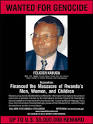
Mu minsi ishize amahanga yatangaje kumugaragaro ko,agiye gufatanya n’uRwanda,guhiga umuherwe Kabuga Feliciani,uyu munyemari yahizwe n’Urwanda igihe kinini ndetse byagiye bivugwa yuko,abayobozi bose bagiye bahagararira inzego z’ubuyobozi z’ubutasi bw’uRwanda ngo bagiye bahura na Kabuga F.Akabadahira umutungo utubutse kuburyo basigara bamukorera aho gukorera igihugu.
Amakuru aturuka mu nzego z’ubutasi bw’uRwanda,avuga yuko ngo,ibyo byose abayobozi b’izo nzego bagiye babiterwa ni uko Paul Kaga yagiye yigwizaho umutungo wenyine ntabibuke ngo amenyeko,aharabo bafatanije gusahura igihugu cy’Urwanda babohoje ku ngufu za gisirikare.
Amakuru agera ku inyangenewss.com,aravuga ko,umuherwe Kabuga,igihugu cyose ahungiyemo,ahita afasha police y’icyo gihugu,kuburyo nta gihugu cyakwifuza kumutanga,yewe kabona na America ubwayo bivugwa ko,urwego rw’ubutasi rwa C.I.A rutigeze rubura umuherwe Kabuga,ahubwo ko,baba bajijisha uRwanda kugirango kagame bamukinge agatambaro mu maso yibwire ko,barikumwe nawe.

Urugero twatanga rwahafi cyane n’uburyo America bwa mbere yasohoye itangazo ryo guhiga Kabuga,maze umwe mu bantu bari bazi aho yaraherereye mu gihugu cya Kenya,ahitwa Karen mu murwa mukuru wa Nairobi,mbere yuko bamugeraho uwo muntu waruyoboye izo ntasi za mahanga,yahise yicwa nizo ntasi yarajyanye kwereka aho Kabuga yihishe.
Biravugwa yuko Kabuga kugez’ubu ar’umwe mu bantu bafite umutungo utubutse muri bank y’isi yose!gusohora gusohora amwe mu matangazo,akaba baba bashaka ko,abahereza kuri uwo mutungo ubundi bakamwihorera,ntibishoboka ko,America yakwica Ussama Bin Radeni ngo bananirwe Kabuga Feliciani.
Ahubwo abakurikirana utuntu n’utundi baravuga ko,ar’inkinamico baba bikinira,ndetse na leta ya fpr ikabyungukiramo kuko ikomeje gufatira imitungo ye,uboshye ko ar’incike!Nyamara nk’uko padiri Thomas ahora yivugira ko ,ibihe bihora bisimburana iteka,uko niko byagendekeye abahutu nabatutsi bahora basimburana mu mateka y’impanga.
FPR rero ikwiye kwigishwa namateka kuburyo yareka kujya yihenura kuko amateka ahora yisubiramo,ejo uzabona ubwami busubiye ku ngoma kuko nibwo butahiwe,kuko za rep.zose zimaze kwimara agahinda zihora zisimburana arinako zica abanyagihugu.
Ubuhanuzi mu marembera y’Ingoma.
Kuwa 16 Nyakanga 2014, ubwo nari kumurwa mukuru w’ishushani mu gihugu cy’Ibabulini,naridi kumurimo w’Uwiteka,maze ijwi ry’Uwiteka rirambwira riti,mwana w’umuntu va kumurimo w’Uwiteka ujye kumurimo w’Uwiteka wandike ibyo wabwiwe kandi weretswe!kuko igihe gisigaya ari gito cyane kuko igihe gishyize cyera ngo ibyavuzwe na bahanuzi b’Uwiteka bisohore.
Ubwo navuye kumulimo njya kumulimo w’Uwiteka,maze nandika ibyahanuwe n’umuhanuzi mukuru hamwe n’umuhanuzi.
Kuwa 10 Nyakanga 14,byari mu masaha yasaa 06hoo na saa 07hoo,maze njyanwa mu  iyerekwa mbona bimwe mu bihugu bikomeye ku isi,bikora inama yogukura kagame kubutegetsi,abari muri iyo nama ntibigeze bifuza yuko haba har’umuntu numwe wamenya ko iyo nama yabaye kuko yabereye mu ibanga rikomeye cyane usibye ko,Uwiteka hamwe n’umuhanuzi mukuru bari bari muri iyo nama.Maze bemeza ko umugambi wogukura kagame kubutegetsi wemejwe kandi ko ntagisibya!Ni uko umwuka w’Imana arambwira ati mwana w’umuntu tangariza abatataniye mu mahanga ko Uwiteka amaze gukoresha abakozi be,inama yogukura umwakagara ku ngoma.
Dore abakozi banjye barangije inama,kandi nanjye nari mpari,bamaze kwemeza ko,kagame bagiye kumukuraho,bwira intama zanjye zitegure zishingikirize k’Uwiteka wenyine kuko ibihe birakomeye cyane,kuko bagiye gushinga umuhunda ku kirenge!?Dore ibyavugiwe mukanwa kabahanuzi ndabisohoje,abanyiringiye nzabakiza nzabagirira neza,nzabitaho,intama zanjye nzaziragirira,izinanutse zizabyabuha,izavunitse nzazunga,intabwa nzazitaho,imfumbyi nzazibera umubyeyi kuko abaziragiraga baragiriraga ibihembo,ndetse zimwe barazigurishije,izindi barazirya,izasagutse bazijugunyira amasega izindi ziratatana none kubera iyo mpamvu,nzazibera umushumba jyewe ubwanjye Uwiteka niko mvuze.
Dore akaga,ibyago,amakuba,birage kubafite umubiri mu gihugu cyawe,bwira ubwoko bwanjye bakure amaso kubitagira umumaro,kuko kumunsi wamakuba ubegereye bitazabasha kubakiza,kandi ndirahiye ntabwo nzongera kwemera ko banyambura icyubahiro cyanjye uko niko Uwiteka avuze!.
NB:Ngiye gutatanya ubwoko bw’Abayisiramu,kuko gukiranirwa kwabo kumaze kungera imbere bakoze ibyangwa n’Uwiteka Imana ya Israel,kubera iyo mpamvu nzabatatanya mbageze kumpera y’Isi uko niko Uwiteka avuze!Ibikorwa byabo ntibizongera kwibukwa ukundi uko niko Uwiteka avuze!.
Dore amaso y’Uwiteka ahora kubakiranutsi,kandi nzahora inkozi zibibi zihaye kwigarurira ubwoko bwanjye uko niko Uwiteka avuze!.
Dore abaguha umugisha nanjye nzabaha umugisha,abazakuvuma nanjye nzabavuma uko niko Uwiteka avuze!.Abazakugirira neza nzabakubira inshuro(7);uko niko Uwiteka avuze!.Humuriza ubwoko bwanjye ubabwire uti nibahumure kuko ngiye kubatabara uko niko Uwiteka avuze!.Ubwire abatataniye mu mahanga uti,nd’Uwiteka Imana ifuha ya Israel na Yakobo,bazabona kugira neza kwanjye!Abazakomeza amasezerano nzabana nabo,nzabagirira neza,nzabakiza,intimba yo mu mutima uko niko Uwiteka avuga!.
Dore umukumbi wanjye nzawuguyaguya,nzawegeranya,nzawusubiza ahawo mu rwuri rwawo,ndetse nzawuha gakondo yawo,uko niko Uwiteka avuze!.Izishwe n’inzara nzaziragira,izishwe n’inyota nzazuhira kumariba afutse uko niko Uwiteka Imana ya Israel avuze!.Nzazikiza ibikomere,izaremaye nzazimugurura, dore abashumba bose bari abibihembo ariko kuri wa munsi zizamenya yuko arijye Uwiteka Imana ya Israel nijye uvuze!.
Kuwa 11 Nyakanga 14 umwuka w’Uwiteka yaransanze,anjyana mu iyerekwa,maze nerekwa imibereho y’abanyarwanda bo mu bwoko bw’Abatutsi baturutse mu gihugu cya Uganda basengera mu itorero rya CLPR ku kimihurura kwa RUGUMBUGUZA Meshack.
N’uko nerekwa abo banyarwanda bateraniye murugo rw’umuririmbyi wo muri urwo rusengero,akaba n’umukwe wa Col.Pastor Twahirwa Dodo,witwa EUGENE,barimo barwanira amata y’umujago,hamwe n’amandazi!Inzu banyweragamo ayo mata y’umujago cyangwa icyayi,yari inzu yubatse ibikuta (4);ariko nta miryango cyangwa amadirishya yari ifite,hari hameze nko mukirongozi.
Nerekwa umuhanuzi mukuru atutse nko muri metro 100,yitegerezaga imihora cyangwa za ruhurura zari zizengurutse iyo nzu.Maze mbona haje umuntu amuzaniye amata atavanze ndetse n’umugati wose arawumuterera umuhanuzi mukuru arawusama arafungura‹Inzu,bisobanura igihugu cyambaye ubusa kitagira amasengesho,amata yumujago bibanura inzara no kurwanira ibyokurya,imihora nz za ruhurura n’inzira z’inkozi zibibi zinyanye no gukiranirwa›.
(b)Nerekwa inkozi zibibi zongera kwisuganya ngo zubake uruhimbi rwabadaimoni nari maze gusenyesha amasengesho,kugirango babashe kongera kwigarurira umugisha mwibano,ariko ntibyabakundira kuko umuhanuzi mukuru yahise ahagera aburizamo ibyo bikorwa byabo by’ubugizi bwanabi.
© Nerekwa umwuka w’inzika wuwahoze ayobora uRwanda perezida Habyarimana yuvenali,mbona yicaye kumuhanda wa Bank de Kigali,hafi y’agahanda kazamuka kajya ahahoze Radio Rwanda,nabonaga hari amaduka acuruza za costime,suit,maze Habyarimana arazifata zose avuga ko,arizo bamwibye ngo izo nizo yambaraga ari mukazi ubwo yari akiri mu Rwanda atajyanwa iwabo wa twese.
Mbona abagabo bab’abatutsi nabagore babo batangajwe cyane n’ukuntu Habyarimana agarutse kukwa ibyahoze ari ibye nyuma akaza kubikurwamo n’igihe cye cyari gisohoye!imyenda bisobanura ibikorwa,umwuka w’inzika uzasiga igihugu iheruheru cyangwa ubusa muyandi magambo.Intambara igiye gutangira icyirukanye Habyarimana nicyo kizirukana Kagame!
Kuwa 13 Nyakanga 14,nibwo nari mvuye kumulimo w’Uwiteka kumurwa mukuru w’ishushani mu gihugu cy’Ibabuloni,byari hagati ya sa 06hoo na sa 11hoo z’amanywa,maze nerekwa ukuntu ahanga amaze gutegura inzira y’inyeshyamba za fdlr zizanyuramo zitaha ngo zigere mu rwagasabo aho zizahanirwa hamwe n’inkozi zibibi ngenzi zazo aho zakoreye ibyaha byo kumena amaraso yabatariho urubanza nabakiranutsi!.
Maze nitegereje mbona fdlr zigeze kukibuga cy’indege zuriye indege zigana murwagasabo”Indege bisobanura urupfu cyangwa ububyutse bw’ibibi cyangwa ibyiza”mbona aba fdlr baranezerewe cyane kuko bahagarariwe ningwe bakaba bagiye kuvoma,bisobanuye yuko gutaha kwabo ariyo ntangiriro y’intambara aho kugirango ribe iherezo ry’intambara.
Kuwa 13 Nyakanga 2014,ahagana mu masaha ya 04hoo na sa 06hoo z’umugoroba najyanywe mu iyerekwa,umwuka w’Uwiteka yaransanze anjyana mu iyerekwa ajya kunyerekwa ibikorerwa mu isi y’umwuka,anyereka ko,igihe gishyize cyera ko,ibyahanuwe nabahanzu bisohoye vuba cyane,arambwira ati mwana w’umuntu byuka wandike ibyo ubonye kandi utangarize intama z’Uwiteka uzimenyeshe ko,igihe kigeze ngo iby’Uwiteka yavuze bisohore.
Dore kagame paul avuye ku ngoma,kandi amaraso menshi aramenetse,abantu bananiwe kwiringira Uwiteka biringira imbaraga zabo none bahembwe gukiranirwa kwabo.Ubwo nibambuye numva ndananiwe cyane kuko nubundi nibwo nari nkimara kuva gushyira ahagaragara ibyavuzwe n’Uwiteka menyako amazi atakiri yayandi ubwo nahise mfata urugendo nsubira mu murwa mukuru njya gushyira ibyavuzwe n’Uwiteka ahagaragara kugirango abatataniye mu mahanga bamenye ko,igihe cyo gukurwa mubunyage cyegereje.
Ubuhanuzi bwo muri 1999-2000.
Ubuhanuzi bwo muri 1999-2000 umuhanuzi Majeshi Leon yajyanywe mu iyerekwa,maze yerekwa ibyo kugaruka k’Umwami Yesu kristo,yeretswe Umwami Yesu aturuka mu bicu byo muburasira-zuba bw’isi. Maze agituruka mu bicu,isi yose ihinda umushyitsi,mbona ingabo z’abasirikare bose b’isi bitegura kurasa Umwami Yesu,izo ngabo zari ziyobowe n’inkotanyi-APR/RDF,nerekwa bafata intwaro zikomeye intwaro yarimo nto,niyitwa R.P.G izindi zose zari za burende/ibifaru.
Ubuhanuzi bwo muri 1999-2000 umuhanuzi Majeshi Leon yajyanywe mu iyerekwa,maze yerekwa ibyo kugaruka k’Umwami Yesu kristo,yeretswe Umwami Yesu aturuka mu bicu byo muburasira-zuba bw’isi. Maze agituruka mu bicu,isi yose ihinda umushyitsi,mbona ingabo z’abasirikare bose b’isi bitegura kurasa Umwami Yesu,izo ngabo zari ziyobowe n’inkotanyi-APR/RDF,nerekwa bafata intwaro zikomeye intwaro yarimo nto,niyitwa R.P.G izindi zose zari za burende/ibifaru.

Umwami Yesu,nta bwo yigeze agera kubutaka,ahubwo yagumye mukirere ahangana nayo mahanga yaramwiteguriye kumugirira nabia,ariko bose mbona bishwe n’ubwiza bwe bwari bumeze nk’imirabyo y’izuba ifite ubukanabukomeye cyane kuburyo batashoboraga kumureba mu mason go bashobore kurasa ibyo bisasu bya rutura.
(b) Nerekwa Umwami Yesu agaruka gutwara abakiranutsi,mbona ahereye kubana icyo gihe bari bafite imyaka (5) gusubira hasi,nerekwa umuhanuzi mukuru ndetse n’uwahanuye ibi,bose bambikwa amababa basanga Umwami Yesu mukirere,maze numva umuhanuzi mukuru avuga ngo,namahirwe kuko ibi atar’inzozi cyangwa iyerekwa nah’ubundi byari kuba bibabaje.Nkimara kumva ayo majwi nkurwa mu iyerekwa mbabaye cyane kuko nabonaga ar’ibintu bigaragara kandi bifatika mbabazwa ni uko nsubijwe mu mubiri.
©Nerekwa ububyutse buza mu isi y’abazima,mbona abahoze arabasirikare b’inkotanyi aribo batoranijwe gukorera Uwiteka muri ubwo bubyutse!Buzuye imbaraga z’Imana zidasanzwe,umwuka wera yari kuri bo,bakoreshwaga ibitangaza n’ibimenyetso bimeye maze isi yose igira ishyari baza mu Rwanda kureba ibihabera no gusaba umugisha uturuka kubantu b’Imana kugirango bagirirwe ubuntu n’Uwiteka Imaana yabakiranutsi.
Umwami Yesu,nta bwo yigeze agera kubutaka,ahubwo yagumye mukirere ahangana nayo mahanga yaramwiteguriye kumugirira nabia,ariko bose mbona bishwe n’ubwiza bwe bwari bumeze nk’imirabyo y’izuba ifite ubukanabukomeye cyane kuburyo batashoboraga kumureba mu mason go bashobore kurasa ibyo bisasu bya rutura.

(b) Nerekwa Umwami Yesu agaruka gutwara abakiranutsi,mbona ahereye kubana icyo gihe bari bafite imyaka (5) gusubira hasi,nerekwa umuhanuzi mukuru ndetse n’uwahanuye ibi,bose bambikwa amababa basanga Umwami Yesu mukirere,maze numva umuhanuzi mukuru avuga ngo,namahirwe kuko ibi atar’inzozi cyangwa iyerekwa nah’ubundi byari kuba bibabaje.Nkimara kumva ayo majwi nkurwa mu iyerekwa mbabaye cyane kuko nabonaga ar’ibintu bigaragara kandi bifatika mbabazwa ni uko nsubijwe mu mubiri.
©Nerekwa ububyutse buza mu isi y’abazima,mbona abahoze arabasirikare b’inkotanyi aribo batoranijwe gukorera Uwiteka muri ubwo bubyutse!Buzuye imbaraga z’Imana zidasanzwe,umwuka wera yari kuri bo,bakoreshwaga ibitangaza n’ibimenyetso bimeye maze isi yose igira ishyari baza mu Rwanda kureba ibihabera no gusaba umugisha uturuka kubantu b’Imana kugirango bagirirwe ubuntu n’Uwiteka Imaana yabakiranutsi.
UAE: “A Huge Leap from Medieval Ways” by Sara Al Nuaimi
-
The remarkable crown prince of Abu Dhabi, Sheikh Mohamed Bin Zayed Al Nahyan, donated land for the Hindu temple, to foster cultural and religious tolerance, and bring diversity to Abu Dhabi. The temple also fit newly passed UAE legislation establishing religious freedom.
-
-
As the prince explained, a “civilized, advanced” Abu Dhabi with sustainable development requires “concerted efforts from all sectors of the community” — Hindus included.
-
“This is a huge leap from medieval ways of thinking. Humanity is against aggression and stopping others from practicing their faith.” — Saleh Al Turigee of Saudi Arabia, who has 143,000 Twitter followers.
-
Positive voices from the UAE and elsewhere in the Middle East, especially Egypt, supported the temple. It shows that the non-extremist segment not only exists, but is ready to take on the extremists.
-
“Religion is for Allah only. All Imams agree that building temples for idol worshipping is a blasphemy.” — Waseem Yousef, imam of the Sheikh Zayed Mosque in Abu Dhabi. He quickly found his television show canceled.
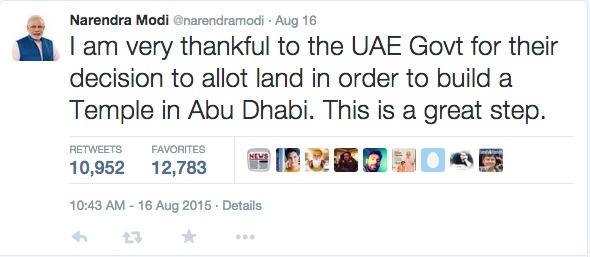
A tweet by India’s Prime Minister Modi on Aug. 16, during his visit to Abu Dhabi, prompted a unique cultural debate in the United Arab Emirates (UAE). Announcing to his 14.9 million followers that the UAE government had allotted land for a Hindu temple, he prompted a discussion on Twitter that generated over 25,000 tweets in the Arabic language alone (a very large number for public opinion in the UAE and other Arabian monarchies), coverage on the BBC, and more.
It was the remarkable crown prince of Abu Dhabi, Sheikh Mohamed Bin Zayed Al Nahyan, who donated land for the temple; he did so to foster cultural and religious tolerance and fit his longstanding effort to bring diversity to Abu Dhabi (another notable example was establishing the Guggenheim Museum). As the prince explained, a “civilized, advanced” Abu Dhabi with sustainable development requires “concerted efforts from all sectors of the community” — Hindus included. The temple also fit newly passed UAE legislation establishing religious freedom.
But the prospect of a state-supported Hindu temple immediately provoked an uproar, beginning with the Twitter hashtag (in Arabic) #BuildingAHinduTempleInAbuDhabi. The imam of the Sheikh Zayed Mosque in Abu Dhabi (where super-star Rihanna controversially had modeled her Arabian outfit), Waseem Yousef, kicked off the debate that same day with a tweet asserting that “Religion is for Allah only. All Imams agree that building temples for idol worshipping is a blasphemy.”
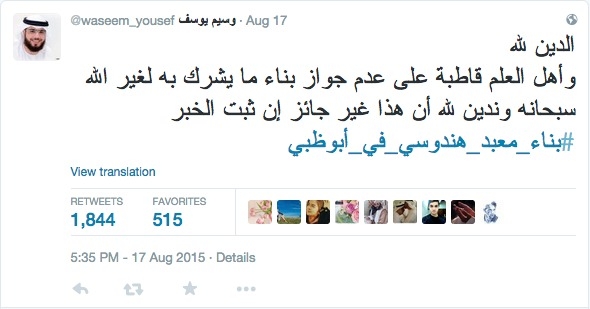
“Religion is for Allah only. All Imams agree that building temples for idol worshipping is a blasphemy.” — Waseem Yousef |
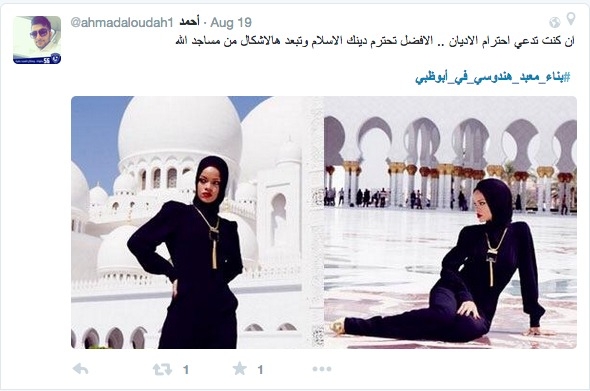
“If you truly respect religions, you’d keep these scumbags out of the mosques of Alla.h” — Ahmad Aloudah |
The popular UAE response to Youssef’s tweet came fast and hard: #StopWassim’sTVShow. And, indeed, he quickly found his television show interpreting dreams canceled.
News of the Hindu temple then crossed over to nearby countries, especially Saudi Arabia, where a surge of anti-Hindu sentiments smeared the crown prince, the UAE government, and all Emiratis.
Some anti-Hindu tweets cited the Prophet Muhammad breaking idols in Mecca. Others focused on the persecution of Muslims in Burma where Buddhists (not Hindus) destroyed a historic mosque and massacred Muslims.
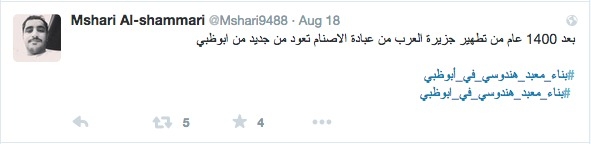
“1400 years ago the prophet purified Arabia from idol worshipping. Now it returns to Abu Dhabi.” — Mshari Al-Shammari |
Other Saudis were anti-freedom and progress. They apparently believe it collides with Islamic values, and refuse to consider the UAE as a model for balancing the two:
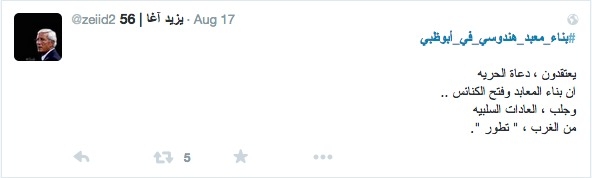
“They claim freedom, build churches and temples, but they’re actually taking bad habits from the West and calling it progress.” — @zeiid2 |
Some of the tweets attacked Abu Dhabi’s crown prince:
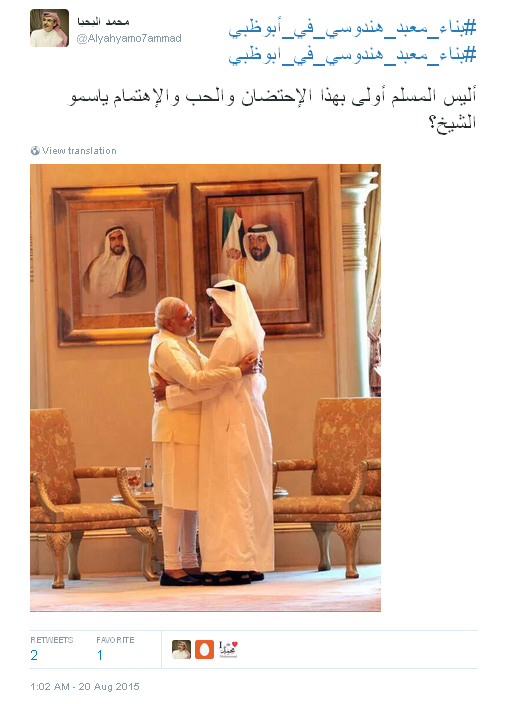
“Only Muslims are worthy of your love and compassion.” — @Alyahyamo7ammad |
The Islamic State in Iraq and Syria (ISIS) also weighed in:
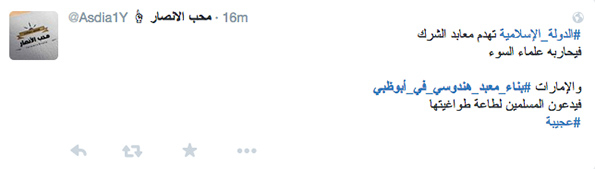
“We are destroying the temples of idol worshippers, and the UAE is calling Muslims to follow the infidels.” — @Asdia1Y |
Surprisingly, this was tweeted from a Canadian Muslim, referring to the Hindu temple:
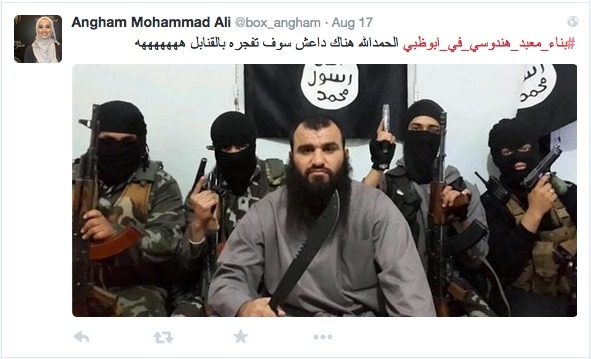
“Thank god for ISIS, which will blow it up soon.” — Angham Mohammad Ali |
The response, however, was not one sided. A tweet quickly emerged from Saudi Arabia under a trending hashtag #LiberalRational:
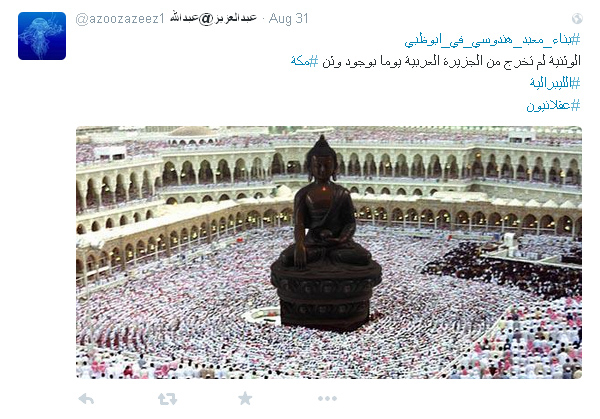
“Idol worshipping never left Mecca. Mecca is the idol that you worship.” — @azoozazeez1 |
Other twitter users from Saudi Arabia also followed suit, including the writer and public figure Saleh Al Turigee, who has 143,000 followers on Twitter.

“This is a huge leap from medieval ways of thinking. Humanity is against aggression and stopping others from practicing their faith.” — Saleh Al Turigee |
Positive voices from the UAE and elsewhere in the Middle East, especially Egypt, supported the temple; they pushed it forth as a symbol of love, freedom, knowledge, innovation, and humanity.
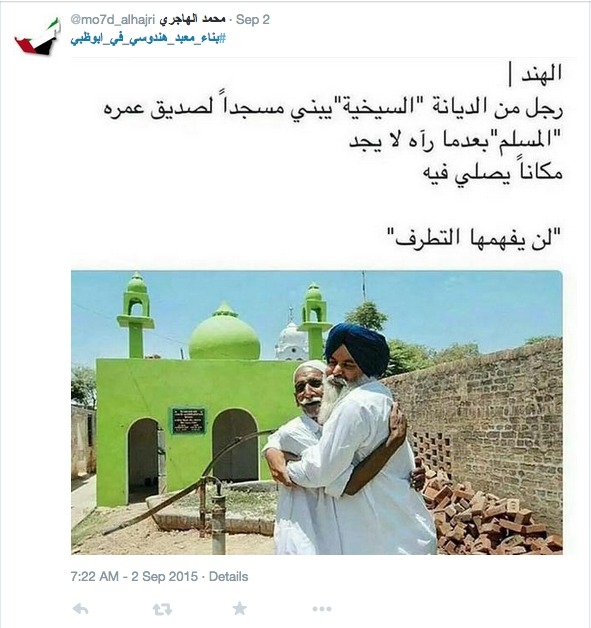
“India: A Sikh man builds a mosque for his Muslim childhood friend. Extremists will never understand this.” — @mo7d_alhajri |

“Religious freedom is a right for everyone, just as it is a right for you to have a mosque in non-Muslim countries” — F. K. Habeeb |
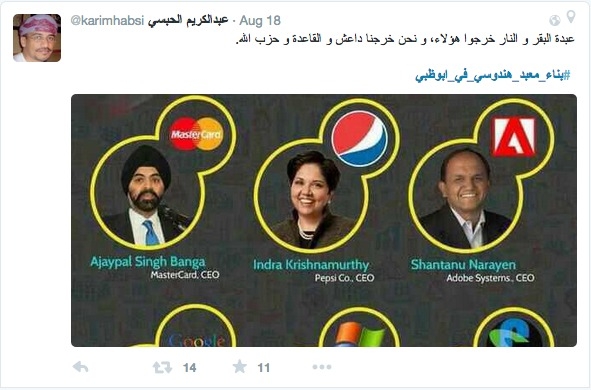
“Cow-worshippers produced the following people, and we produced ISIS, Al-Qaeda and Hezbollah.” — Karim Habsi, Oman. |
“UAE says Islam is a religion of humanity. ISIS says Islam is a religion of blood.” — Fatima Naoot, Egypt (492K followers/writer) |
Some tweets, both pro- and anti-temple, showed a sense of humor:
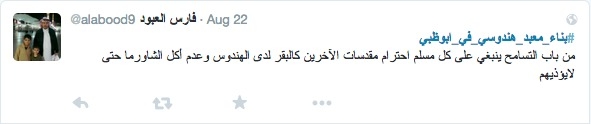
“Let’s just respect their Holy Cow and stop eating Kebabs.” “The cows would be happy.” — @alabood9 |
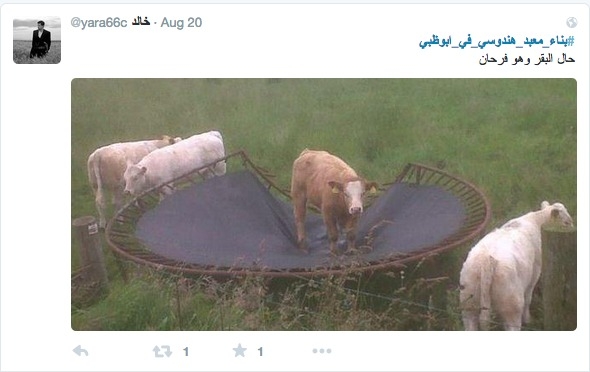
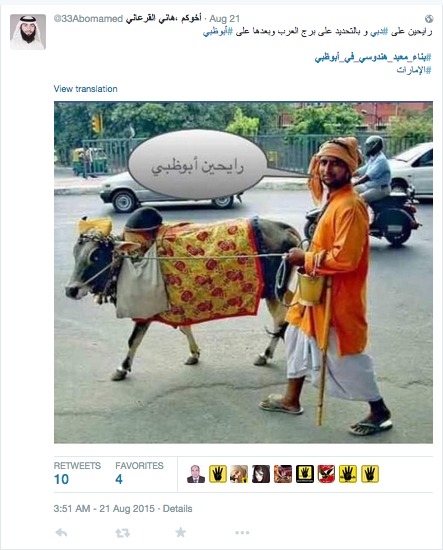
“We are on our way to Abu Dhabi” — @33Abomamed |
The Hindu temple issue reveals with special clarity the divide between Muslim extremists (who perceive the “Other” as an infidel) and Muslim non-extremists (who follow a spirit of openness, peace, and coexistence with different cultures in modern times). More importantly, it shows that a non-extremist segment not only exists, but is ready to take on the extremists. From Abu Dhabi’s crown prince, to the city’s population, to the larger body of Arabic-language Twitter activists, the non-extremists can stand up to — and sometimes defeat — the ISIS crowd.
As a UAE national who lives in Abu Dhabi, where 80% of the residents come from 161 foreign nationalities, I believe the people are looking forward to the openness represented by the Hindu temple. We look forward to its opening and see this as a welcome, significant step towards the defeat of the extremists in our midst.
Sara Al Nuaimi is an Emirati lady, a Muslim and a cultural activist based in Abu Dhabi
U.S. State Dept. Bars Christians from Testifying about Persecution Muslim Persecution of Christians, May 2015 by Raymond Ibrahim • July 24, 2015 at 5:00 am

- “This is an administration which never seems to find a good enough excuse to help Christians, but always finds an excuse to apologize for terrorists … I hope that as it gets attention that Secretary Kerry will reverse it. If he doesn’t, Congress has to investigate, and the person who made this decision ought to be fired” — Newt Gingrich, former Speaker, U.S. House of Representatives.
- “The U.S. insists that Muslims are the primary victims of Boko Haram… The question remains — why is the U.S. downplaying or denying the attacks against Christians?” — Emmanuel Ogebe, Nigerian human rights lawyer, Washington D.C.
- “Stop building churches. Convert to Islam, which is the true religion. Otherwise we will make a horrible example of you.” — Javed David, head of Hope for the Light Ministries, quoting a biker.
- The Free Front of Algeria demands that all Christian churches remaining in the North African nation must be closed and reopened as mosques.
- A Muslim mob in Deder, Ethiopia attacked a Christian man and forced him out of his home on pain of death in an effort to appropriate his land and build a mosque on it — despite recent court rulings confirming the Christian man’s property rights.
- Accounts of Muslim immigrants taunting and even assaulting Christians in Italy are increasing.
- “We are a poor nation. These people [Christian captives] have not done anything wrong and won’t harm anyone. We as Assyrians do not have this amount of [ransom] money you are asking for” — Bishop Mar Mellis, Syria.
During the height of one of the most brutal months of Muslim persecution of Christians, the U.S. State Department exposed its double standards against persecuted Christian minorities.
Sister Diana, an influential Iraqi Christian leader, who was scheduled to visit the U.S. to advocate for persecuted Christians in the Mideast, was denied a visa by the U.S. State Department even though she had visited the U.S. before, most recently in 2012.
She was to be one of a delegation of religious leaders from Iraq — including Sunni, Shia and Yazidi, among others — to visit Washington, D.C., to describe the situation of their people. Every religious leader from this delegation to Washington D.C. was granted a visa — except for the only Christian representative, Sister Diana.
After this refusal became public, many Americans protested, some writing to their congressmen. Discussing the nun’s visa denial, former House Speaker Newt Gingrich said:
This is an administration which never seems to find a good enough excuse to help Christians, but always finds an excuse to apologize for terrorists … I hope that as it gets attention that Secretary Kerry will reverse it. If he doesn’t, Congress has to investigate, and the person who made this decision ought to be fired.
The State Department eventually granted Sister Diana a visa.
This is not the first time the U.S. State Department has not granted a visa to a Christian leader coming from a Muslim region. Last year, after the United States Institute for Peace brought together the governors of Nigeria’s mostly Muslim northern states for a conference in the U.S., the State Department blocked the visa of the region’s only Christian governor, Jonah David Jang.
According to a Nigerian human rights lawyer based in Washington D.C., Emmanuel Ogebe, the Christian governor’s “visa problems” were due to anti-Christian bias in the U.S. government:
The U.S. insists that Muslims are the primary victims of Boko Haram. It also claims that Christians discriminate against Muslims in Plateau, which is one of the few Christian majority states in the north. After the [Christian governor] told them [U.S. authorities] that they were ignoring the 12 Shariah states who institutionalized persecution … he suddenly developed visa problems…. The question remains — why is the U.S. downplaying or denying the attacks against Christians?
The testimony of another nun, Sister Hatune Dogan, also made in May, indicates why the State Department may not want to hear such testimonials: they go against the paradigm that “Islam is peace.” According to Sister Hatune:
What is going on there [Islamic State territories], what I was hearing, is the highest barbarism on earth in the history until today… The mission of Baghdadi, of ISIS, is to convert the world completely to the Islamic religion and bring them to Dar Al Salaam, as they call it. And Islam is not peace, please. Whoever says ISIS has no connection to Islam or something like this is, he’s a liar. ISIS is Islam; Islam is ISIS… We know that in Islam, there is no democracy. Islam and democracy are opposite, like black and white. And I hope America will understand. America today has the power that they can stop this disaster on the earth, with other Western countries.
The rest of May’s roundup of Muslim persecution of Christians around the world includes, but is not limited to, the following accounts, listed by theme.
Muslim Attacks on Christian Churches
Pakistan: Three separate incidents involved attacks on churches:
1) On May 28, in the city of Chakwal, south of Lahore, Muslim men destroyed a Protestant church and beat six Christians, including the pastor. Some of those wounded had to be hospitalized. A few days earlier, Pastor Suhail Masih and his companions had been accused by local Muslims of carrying out “proselytism and conversions of Muslims,” according to a preliminary report.
2) Javed David, head of Hope for the Light Ministries in Lahore, and his associates, have been receiving death threats since February. The latest incident occurred in April, but became public knowledge only in May. According to David:
I had been to church in Sheikhupura to attend a meeting with colleagues. It was 8 o’clock in the evening when we left to return to Lahore. We were about to reach the main road when a motorbike drove up and blocked the way. Maybe they were following us. The two bikers were wearing a helmet (sic). One of them came up to my window and spoke to me. “We know what you are doing here,” he said. “Stop building churches. Convert to Islam, which is the true religion. Otherwise we will make a horrible example of you.”… [On another] occasion too, I was going home when a motorcycle stopped in front of me. The driver knocked on the window and threw in a piece of paper. I did not open it before I got home. It said, “This is an Islamic nation. We cannot allow church building. Either you convert to Islam or you leave this country! Stop building churches or you’ll pay the consequences!”
3) On May 29 in Faisalabad, around 2 a.m., a gang of Muslims on motorcycles attacked a church near the Sadar police station. They opened fire on the church and set its main gate on fire, damaging its windows. According to church cleric Dilawar Masih, “Though no human loss was reported in this incident, attackers gave a clear-cut message that Christians and their places of worship are not safe and they may be attacked any time by the terrorists.”
Egypt: Two churches were attacked:
1) On May 16, a homemade explosive device planted next to a Coptic Christian church was detonated around sunset. As the St. George Church in Tamiya (Fayum governorate) was mostly empty at the time, there were no casualties. However, the church’s administrative offices and second floor windows were shattered, creating chaos and panic in the area. Church security cameras captured the two men on a motorcycle, who stopped at the church. One of the men dismounted and placed a bag containing the bomb next to the church, and they then sped off.
2) On Sunday morning, May 31 in Senoras city, Fayum, masked men on motorcycles opened fire on an Evangelical church. Security forces guarding the church briefly exchanged fire with the masked men before they fled on their motorcycles. No one was reported hurt.
Canada: On May 26, a 22-year-old man of Muslim background was charged with alleged hate crimes committed against the St. Catherine of Siena Church and its neighboring elementary school in Mississauga, Ontario. Iqbal Hessan faces five counts of mischief, and over $5,000 in fines. On May 20, the Sacred Heart of Jesus statue that stands in front of the church was covered in black paint and the fingers of its outstretched arms were broken off. Behind the church, graffiti with the words “There is no Jew God” was scrawled across the brick wall along with a drawing of a face labelled “Jewsus.” That vandalism was the fourth time the church was targeted. On April 9, surveillance cameras caught a young man breaking into the church, ripping pages of the Sacramentary book on the altar, throwing them at the tabernacle, and then stealing one of the church’s sound-system speakers. On May 17, a drawing of a hand gesturing with the middle finger was found spray-painted on the front steps of the church. And on May 25, graffiti was sprayed on the school walls.
The St. Catherine of Siena Church and its neighboring elementary school in Mississauga, Ontario were vandalized this year by Iqbal Hessan, a 22-year-old Muslim man. |
Algeria: According to Abdel Fattah Zarawi, the Muslim leader of the Salafi party, also known as the Free Front of Algeria, any and all Christian churches remaining in the North African nation must be closed and reopened as mosques. Although the transformation of Christian churches into Muslim mosques is nearly as old as Islam itself — Algeria was Christian-majority and even gave the world St. Augustine before Islam invaded and conquered it in the seventh century — the Salafi leader tried to portray his proposal as a “grievance” against rising anti-Muslim sentiment in Europe, especially France. Launched on social media and networks, the Salafi campaign against Algerian churches even calls for the transformation of the nation’s most important churches into mosques — including the Church of Notre Dame d’Afrique in Algiers, the Church of St. Augustine in Annaba, and the Church of Santa Cruz in Oran — since “they have no relation whatsoever to the religion of Algerian Muslims,” in the words of the Free Front.
Saudi Arabia: Sheikh Adel al-Kalbani, former Imam of the Grand Mosque in Mecca and current prayer leader of Muhaisin Mosque in Riyadh, issued a tweet from his personal Twitter account, saying, “My beloved nation: It suffices me that you shelter me from hearing church bells ringing in you.” Due to his importance, the New York Times once issued an entire spread about al-Kalbani. The “hopeful” theme is how al-Kalbani managed to rise to the top in Saudi Arabia by becoming the first black Imam of the Grand Mosque in Mecca. No word in any English language media, however, about his abhorrence for Christian churches and their bells.
Turkey: A 900-year-old Christian church in Turkey is to be renovated into a functioning mosque — despite previous governmental assurances that it would be renovated into a museum. Enez’s Hagia Sophia, the name of the ancient church, is located inside the city of Ainos, along the border with Greece and stationed atop a hill, visible to all. Another centuries-old church, Hagia Sophia in Trabzon, along the Black Sea, was reopened in 2013 as a mosque, although it was a museum for many years. Meanwhile, a majority of Turks await the re-transformation of the greatest Hagia Sophia (Constantinople’s) into a mosque.
Yemen: A Catholic church was seriously damaged during a Saudi bombing raid around mid-May. The church of the Immaculate Conception in Aden had earlier been occupied by Houthi rebels who had vandalized its interior. The airstrike by Saudi bombers — in support of the Yemeni government in its struggle with the rebels — did further damage to the structure. Only one Catholic priest remains in Yemen. Two priests fled the country to escape the violence, while another, who was out of the country when the fighting began, has been unable to return. Twenty members of the Missionaries of Charities have chosen to remain in the war-torn country, tending to the sick and the poor.
Muslim Attacks on Christian Freedom
Pakistan: On Sunday, May 24, a Christian man in the Sanda neighborhood of Lahore was accused of blasphemy when some Muslims saw him burning newspapers that reportedly contained Arabic verses from the Koran. After the accusation, a Muslim mob caught the Christian, severely beat him, and even attempted to set him on fire. A few months earlier, another Muslim mob burned a Christian couple alive inside a kiln after they, too, were accused of insulting Islam. The Christian youth — named Humayun Masih, said to be “mentally unstable” — was imprisoned and charged under section 295-B of Pakistan’s penal code, which prohibits the desecration of the Koran. After the attack on the Christian youth, the Muslim mob, reportedly thousands, rampaged through the neighborhood and set fire to Christian homes and a church. Christians in the region were attacked, and most fled the region; some of the mob was armed and gunshots were heard.
Egypt: On May 5, another Coptic Christian was convicted of blaspheming against Islam: “ridiculing or insulting a heavenly religion” in violation of Article 98 (f) of the Egyptian Penal Code. A judge in Daqahliya sentenced Michael Munir Beshay to one year’s imprisonment and a fine of one thousand Egyptian pounds. As International Christian Concern puts it: “Despite steps taken by the Sisi-led government to bring about greater tolerance and reforms, the conviction of Beshay is just another of many recent incidents highlighting the continued persecution of the country’s Christian minority.”[1] And Bishoy Armia Boulous — formerly known as Mohammed Hegazy, an apostate from Islam to Christianity — has remained imprisoned now for approximately a year, well past the legal six-month investigation period. All this time, he has been subject to physical and verbal abuse, from both prison guards and fellow inmates, on account of his “apostasy” from, and “blasphemy” against, Islam. He has been denied a Bible and has not had eyeglasses since they were intentionally broken some time ago. [2]
Iran: Ibrahim Firouzi, a Muslim convert to Christianity, was sentenced to the maximum five years in prison for “action against national security through collusion and gathering.” After Firouzi converted to Christianity, he was arrested on August 25, 2013 and convicted of evangelizing, colluding with “anti-regime” foreign networks, launching a Christian website, and working against the Islamic Republic of Iran. Although his prison term was supposed to end on January 13, 2015, authorities continued to hold him illegally, and on March 8 they sentenced him to serve another five years “in very difficult conditions.”
Dhimmitude
Syria: After failed negotiations, the Islamic State (IS) refused to release 242 Christian hostages captured during a late February raid along the Khabur River. On May 1, the IS demanded $242 million USD for the release of 93 women, 51 children, and 98 men taken captive. The Assyrian church, family and friends, unable to raise such a large sum, made a lesser, undisclosed offer, which IS rejected, saying it would no longer negotiate concerning the fate of the captive Christians. Based on Islamic law, their fate will now likely be slavery (especially women and children) or execution (especially men).[3]
Ethiopia: A Muslim mob in Deder attacked a Christian man and forced him out of his home on pain of death, in an effort to appropriate his land and build a mosque on it — despite recent court rulings confirming the Christian man’s property rights. “Their first plan was to kill my husband,” said Fikere Mengistu’s wife. “Now, he has escaped from the area. We are fasting and praying for God to rescue us from this forceful action.” She remains with her five children, elderly mother-in-law and 30 other Christians, praying on the property. “We did our best try to defend our faith based on the law of the country… Muslims are out of the control of the government and the law. What can we do?” said Mengistu.[4]
Iraq: Juliana George, a 16-year-old Christian girl living in Baghdad, was abducted from her home. According to her family, a person knocked on the door of their home and when she answered, she was seized by four men who forced her into a waiting taxi and sped away. Her grandfather, Joseph, a priest, chased the taxi on foot and grabbed its door, but eventually fell to the side as the vehicle sped away. She was eventually released after her family paid a $55,000 ransom to the abductors for her return. Juliana’s father, George, said that she has been traumatized by the experience: “I fear for her and my two other daughters…. There is no reason to believe that we will not be targeted again. I don’t see how we can stay in Baghdad after this.”
Turkey: On the same year that millions around the world commemorated the centennial of the Armenian Genocide, Turkish authorities started the demolition of Kamp Armen, an Armenian orphanage in the metropolitan district of Tuzla, despite the attempts by some political representatives to intervene. The orphanage was built in 1962 on the initiative of the Armenian Protestant community. A brief historical recap of the orphanage follows:
Thanks to its activities, the institution has helped 1,500 children to grow up in an environment based on the spirituality and culture of Armenian Christianity. There was also Hrant Dink among its students, the Armenian Turkish journalist, founder of the bilingual magazine Agos, killed in 2007 after being repeatedly threatened with death for his positions on the Armenian Genocide. The Turkish State had expropriated the orphanage in 1987, and all legal attempt (sic) by the Armenian Protestant communities to regain control of the building fell on deaf ears.
Italian Dhimmitude
Accounts of Muslim immigrants taunting and even assaulting Christians in Italy are increasing. Earlier this year, a crucifix was violently destroyed in close proximity to a populated mosque, and a statue of the Virgin Mary was destroyed and urinated on by a group of North Africans in Italy. In addition:
- A Muslim schoolboy of African origin beat a 12-year-old girl at a school because she was wearing a crucifix around her neck. The boy, who had only started to attend the school a few weeks earlier, began to bully the Christian girl — “insulting her and picking on her in other ways all because she was wearing the crucifix” — before he finally assaulted her. Italian police did not charge the boy with any offense; they said he was a minor.
- On Sunday, May 10, after church mass, a group of young Muslim immigrants from the Islamic Center interrupted a Catholic procession in honor of the Virgin Mary. They shouted verbal insults and threats as the group passed in front of the Islamic Cultural Center in Conselice, a small town in lower Romagna. Approximately 100 Catholic Christians, including several small children, were preparing to receive their first Holy Communion. They were reportedly stunned and confused and halted the procession before regrouping and hurrying past the Center.
Egyptian Dhimmitude
On Sunday, May 24, in the village of Kafr Darwish, just south of Cairo, a Muslim mob attacked Coptic Christian homes by throwing stones and Molotov explosives at them. More than 10 homes were torched and damaged. This attack was apparently prompted by a familiar narrative: one of the Coptic villagers, Ayman Youssef, was accused of posting cartoons offensive to Muhammad on his Facebook account. Youssef is illiterate and says he lost his mobile phone a few days before the alleged Facebook posting. Village elders and security representatives held a “conciliation session” and decreed that Youssef’s entire family — including the 80-year-old father and 75-year-old mother — must leave the village if angry Muslims were to calm down. The Christian family was told by the village mayor Ahmed Maher that police “cannot guarantee their safety if they remained in the village.”
Dr. Khaled Montaser, an Egyptian intellectual and frequent critic of the Islamization of the country, discussed how discrimination against Coptic Christians is widespread in certain medical professions. He said during a televised program that, although the pioneer of Obstetrics and Gynecology in Egypt was a Coptic Christian (Dr. Naguib Mahfouz), his grandson is banned from entering these professions because he is a Christian. Montaser confirmed that this policy, even if not a formal law, has caused Christian students increasingly to continue their studies abroad. He pointed out that this “policy” has become a norm — one of many that discriminates against Copts.
In a 25-minute interview on Arabic satellite TV with Dr. Mona Roman, Coptic Christian Bishop Agathon fully exposed the plight of his Christian flock in Minya, Egypt — a region that has a large Coptic minority that is steadily under attack. It was pointed out that the Egyptian state itself is often behind the persecution of and discrimination against Christians. According to the bishop, local governmental authorities — including the State Security apparatus — do not just ignore the attacks on Copts, but are often the very ones behind them.[5]
During a recent interview on Egyptian television, Dr. Yunis Makioun, head of the Al-Nour Party, the political wing of the Salafis, insisted that Islam commands Muslims to “protect” the nation’s Christian minority — a reference to their “dhimmi” status — and treat them properly. Even so, said the Salafi spokesman, Muslims, according to Islam, are forbidden to offer greetings or congratulations to Copts on any Christian holiday.
Coptic Kidnappings
Since the “Arab Spring” came to Egypt, the kidnapping of Coptic Christians has been on the rise. In Nag Hammadi alone, 77 persons have been abducted, and two killed.
Makram Nazir , a 55-year-old Coptic Christian man was kidnapped and killed. Nazir was returning home from his second job in the middle of the night on April 26, when he was seized. His abductors called his brother and demanded a million Egyptian pounds (equivalent of $131,000 USD). As it was an impossible amount to raise, the Coptic man’s family negotiated a significantly reduced price by phone with the abductors. The brother went to the local police station, provided them with all the information, including recordings of the phone calls, but, according to Watan News, “no one made a single move or took the matter seriously.” After paying the ransom, three days passed before Nazir’s family found the Coptic man’s corpse in a canal. Killing Christian hostages even after being paid the ransom is not uncommon in Egypt. The same happened to 6-year-old Cyril Joseph: on May 2013, it was reported that his “family is in tatters after paying 30,000 pounds [about $4000 USD] to the abductor, who still killed the innocent child and threw his body in the sewer system, where the body, swollen and moldy, was exhumed.”
Armed gunmen seized an 8-year-old Coptic Christian child, Antonious Zaki Hani, who was walking with his mother to school in Nag Hammadi. Four armed gunmen appeared, forced the child from his mother on the threat of death, and fled in a car. The kidnappers demanded two million Egyptian pounds ($262,000 USD) in ransom. Police eventually released the boy 17 days after he was kidnapped, although some activists say police knew earlier where the boy was being held.
On May 2, another Coptic Christian girl, Marina Magdi Fahim, 17, vanished after leaving her home around midday in the Hanofil region of Alexandria. Her family reported her disappearance to the authorities. Human rights activists say the girl was not reported injured at any hospital — a sign that she was kidnapped. She has not been seen since.
A few days earlier, another 17-year old Coptic Christian was kidnapped in the village of al-Kom al-Qibliyya in Samalout. An eyewitness said he saw a Muslim neighbor named Ahmed Khalifa seize the girl. Although the family planned to organize a protest, the village elders counseled against it, lest it backfire by provoking more of the area’s Muslims to retaliate against the Christian minority of the region, as often happens whenever Copts ask for their human rights.
About this Series
While not all, or even most, Muslims are involved, persecution of Christians is expanding. “Muslim Persecution of Christians” was developed to collate some — by no means all — of the instances of persecution that surface each month.
It documents what the mainstream media often fails to report.
It posits that such persecution is not random but systematic, and takes place in all languages, ethnicities and locations.
[1] Beshay’s case is only one of several concerning Christians accused of, and punished for, insulting Islam. In April, Gad Yunan, a Coptic Christian teacher, and some of his Coptic students, were arrested on the charge of insulting Islam. Their crime was to have made a 30-second video on Yunan’s iPhone mocking the Islamic State — which Egypt’s Muslims and authorities apparently equate with mocking Islam, even as Muslims in the West insist ISIS has “nothing to do with Islam. Last year, Kerolos Shouky Attallah, a young Coptic Christian man accused of blaspheming Islam for simply “liking” an Arabic-language Facebook page administered by an anonymous group of Christian converts, was sentenced to six years in prison. The Copt did not make any comments on the site, share any of the postings or upload anything to it, and removed his name from the page once he realized that it might offend Muslims. In the hours preceding the sentencing, a rioting mob burned down several Christian-owned shops. He remains in hiding.
[2] According to lawyer Karam Ghobrial, the reason his client is being held and tortured in prison has to do with what made Bishoy notorious some years back in the first place: his audacity not only to convert to Christianity, but to try formally to change his religious identity from Muslim to Christian on his ID card — prompting much public animosity and death threats against him at the time.
[3] According to Bishop Mar Mellis:
We tried many times to negotiate with the people that captured them and for their release.
We offered them an amount of money in accordance with the law of jizya but sadly after a week the negotiator between us returned and told us that ISIS wanted $100,000 for each person. They were asking for over $23 million.
We are a poor nation. These people [Christian captives] have not done anything wrong and won’t harm anyone. We as Assyrians do not have this amount of money you are asking for. We offered an amount of money that we cannot disclose at this time. With the amount we offered, we thought it was acceptable, to have the return of the 230 people.
After two days, they [Islamic State] told us: “The amount the church offered was not acceptable. From now on, we will no longer negotiate with you.” We then thought we would wait, hoping they would come back to talk. Sadly, we received word that the 230 kidnapped people will be sent to the Court of Sharia in Raqqa, where a Muslim judge from Mosul will deliver their fate.
In the context of these ongoing attacks that the ancient Assyrian Christian community has been exposed to, particularly at the hands of IS, Archimandrite Emanuel Youkhana of the Assyrian Church of the East declared before a European parliament on human rights that “Assyrian Christians are facing a danger that threatens their existence in their historical regions.”
[4] According to International Christian Concern:
Fikere Mengistu’s family has owned their land for more than 90 years, but a mob of more than 20 Muslims in Kufanzik village remain intent on forcibly building a mosque on the Mengistu farm in defiance of the law. Muslims make up the religious majority in the area. They have destroyed his fence and have looted his possessions. In addition, the local police are complicit in these attempts to steal his land…. The authorities are letting it happen. In the past, he has faced threats from local police officers, has been forced to pay bribes, and has been imprisoned simply because he is a Christian.
[5] For example, when the Copts were having a serious council meeting with government officials about the possibility of building a church, one of the authorities actually contacted the Islamic sheikhs of the village asking whether they “stand with the Coptic church or with the State?” If the latter, each Muslim household was instructed to send one family member to protest against the proposed building of a church — so that security can then point to the mob and, as usual, just tell the Copts, “Sorry, no can do.”
Other times, State Security is complicit: Male and female Christian minors — currently 21 from just Minya alone, said the Coptic leader — are habitually abducted by surrounding Muslims. At the moment, the youngest Christian girl abducted had just started elementary school. Whenever any of these attacks occur, Copts, working with the church, prepare bundles of documents, including photos and other verifications, incriminating the culprits. These then are placed into the hands of top officials, to make sure they don’t get “lost” or “misplaced” by underlings. The bishop named many of these top people — at no small risk to himself — and said he even put such proofs and documents into the hands of the Director of Intelligence himself. “Absolutely nothing was done,” said the despondent Christian.
He discussed the difficulties that Copts encounter whenever they want to build a church — due to their dearth, some of the current churches serve tens of thousands of Christians — or even make simple repairs. By way of example, he explained how the Virgin Mary Church in Safaniya village has no bathrooms or running water. Christians “tried time and time again to get approval to build bathrooms, to no avail.” The bishop lamented how elderly and sick people sometimes urinate on themselves during service, while mothers must change their crying babies’ diapers right on the pews.
In response, authorities told the bishop to “Go and ask the Muslims of your region if they will approve the building of a church, or bathroom, or anything — and if they do, so will we.”
It should be noted that Islamic law specifically bans the construction or repair of churches.
Clearly frustrated, the bishop added: “We as Copts are human beings. And envy takes us when we see our Muslim brothers build mosques where they will, how they will, at any place and at any time. And the State helps them! But as for us, we cannot build anything and that which is already open is being closed…. We, the Copts, are citizens with rights; and we see Muslims get whatever they want, while we are always prevented.”
The Coptic bishop also said that sometimes Christians are punished whenever they go and “bother” authorities about their treatment. For example, when a Coptic delegation went to make a formal complaint, one of them was immediately kidnapped. His kidnappers demanded and received 120,000 Egyptian pounds for his release. Police were notified — even told where the exchange of money for hostage was to take place — but did absolutely nothing. The bishop referred to this incident as a “punishment” while Dr. Roman, the Coptic hostess, called Minya, Egypt a “State of Retribution” against those Copts who dare refuse to suffer quietly,” adding, “Al-Minya is apparently not an Egyptian province; it is governed by ISIS.”
Finally, Bishop Agathon made clear the despondency he and the average Christian in Egypt feel, repeatedly saying that, no matter which official they talk to, “nothing will change.” If anything, the plight of Egypt’s Christians has gone “from bad to worse,” said the bishop: “We hear beautiful words but no solution.”
Dr. Roman concluded by imploring Egyptian President Sisi, saying: “I’ve said it before: President Sisi is very meticulous and aware of the nation’s issues. Why, then, is it that the Coptic plight in Minya is being ignored? Why is he turning a blind eye toward it?”
Bishop Agathon concluded by saying that “Copts are between a state anvil and aggressor hammers,” meaning that, the state serves only to keep its Christian citizens in place while Islamic radicals pound away at them.
Raymond Ibrahim is author of Crucified Again: Exposing Islam’s New War in Christians (published by Regnery in cooperation with Gatestone Institute, April 2013).