Category Archives: Uncategorized

Russia’s Trap: Luring Sunnis into War by Burak Bekdil

  • Washington should think more than twice about allowing Turkey and Saudi Arabia, its Sunni allies, militarily to engage their Shiite enemies in Syria. Allowing Sunni supremacists into a deeper sectarian war is not a rational way to block Russian expansion in the eastern Mediterranean. And it certainly will not serve America’s interests.

  • Turkey and Saudi Arabia are too weak militarily to damage Russia’s interests. It is a Russian trap — and precisely what the Russians are hoping their enemies will fall into.

After Russia’s increasingly bold military engagement in war-torn Syria in favor of President Bashar al-Assad and the Shiite bloc, the regional Sunni powers — Turkey and its ally, Saudi Arabia — have felt nervous and incapable of influencing the civil war in favor of the many Islamist groups fighting Assad’s forces.

Most recently, the Turks and Saudis, after weeks of negotiations, decided to flex their muscles and join forces to engage a higher-intensity war in the Syrian theater. This is dangerous for the West. It risks provoking further Russian and Iranian involvement in Syria, and sparking a NATO-Russia confrontation.

After Turkey, citing violation of its airspace, shot down a Russian Su-24 military jet on Nov. 24, Russia has used the incident as a pretext to reinforce its military deployments in Syria and bomb the “moderate Islamists.” Those are the Islamists who fight Assad’s forces and are supported by Turkey, Saudi Arabia and Qatar. The Russian move included installing the advanced S-400 long-range air and anti-missile defense systems.

Fearing that the new player in the game could vitally damage their plans to install a Sunni regime in Damascus, Turkey and Saudi Arabia now say they are ready to challenge the bloc consisting of Assad’s forces, Russia, and Shiite militants from Iran and Lebanon.

As always, Turkish Prime Minister Ahmet Davutoglu spoke in a way that forcefully reminded Turkey-watchers of the well-known phrase: Turkey’s bark is worse than its bite. “No one,” he said on Feb. 9, “should forget how the Soviet forces, which were a mighty, super force during the Cold War and entered Afghanistan, then left Afghanistan in a servile situation. Those who entered Syria today will also leave Syria in a servile way.” In other words, Davutoglu was telling the Russians: Get out of Syria; we are coming in. The Russians did not even reply. They just kept on bombing.
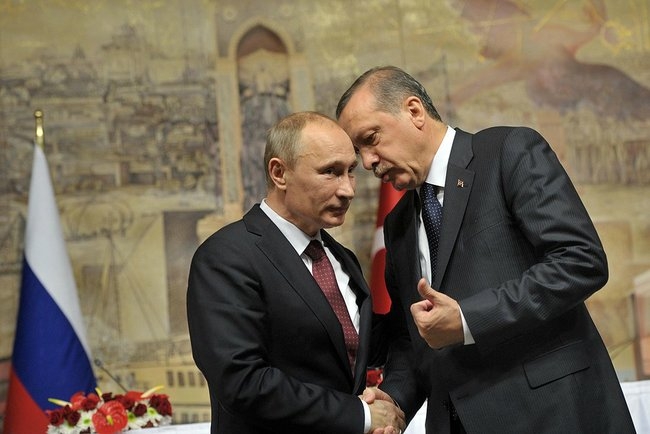
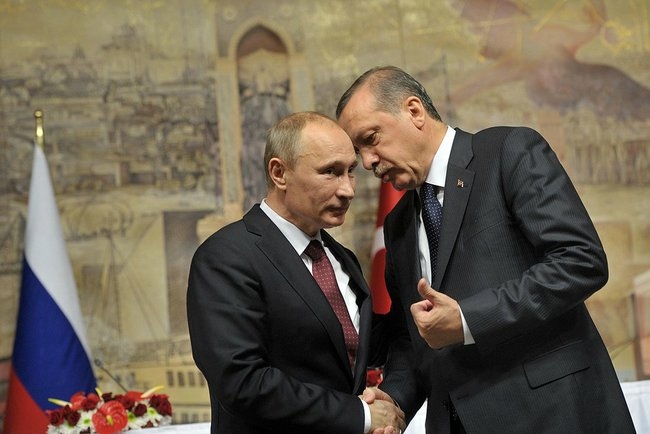
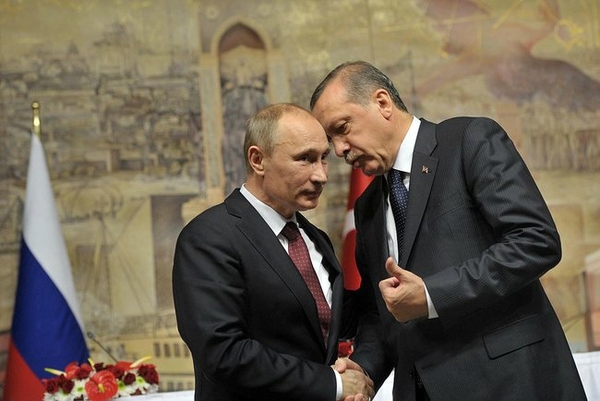
Will direct military involvement in Syria by Turkey and Saudi Arabia spark a NATO-Russia confrontation? Pictured: Russian President Vladimir Putin with Turkish President Recep Tayyip Erdogan (then prime minister), meeting in Istanbul on December 3, 2012. (Image source:kremlin.ru)

Turkey keeps threatening to increase its military role in Syria. Deputy Prime Minister Yalcin Akdogan pledged that Turkey will no longer be in a “defensive position” over maintaining its national security interests amid developments in Syria. “Can any team,” he said, “play defensively at all times but still win a match? … You can win nothing by playing defensively and you can lose whatever you have. There is a very dynamic situation in the region and one has to read this situation properly. One should end up withdrawn because of concerns and fears.”

Is NATO member Turkey going to war in order to fulfill its Sunni sectarian objectives? And are its Saudi allies joining in? If the Sunni allies are not bluffing, they are already giving signals of what may eventually turn into a new bloody chapter in the sectarian proxy war in Syria.

First, Saudi Arabia announced that it was sending fighter jets to the Incirlik air base in southern Turkey, where U.S. and other allied aircraft have been hitting Islamic State strongholds inside Syria. Saudi military officials said that their warplanes would intensify aerial operations in Syria.

Second, and more worryingly, Turkish Foreign Minister Mevlut Cavusoglu said that Turkey and Saudi Arabia could engage in ground operations inside Syria. He also said that the two countries had long been weighing a cross-border operation into Syria — with the pretext of fighting Islamic State, but in fact hoping to bolster the Sunni groups fighting against the Shiite bloc — but they have not yet made a decision.

In contrast, Saudi officials look more certain about a military intervention. A Saudi brigadier-general said that a joint Turkish-Saudi ground operation in Syria was being planned. He even said that Turkish and Saudi military experts would meet in the coming days to finalize “the details, the task force and the role to be played by each country.”

In Damascus, the Syrian regime said that any ground operation inside Syria’s sovereign borders would “amount to aggression that must be resisted.”

It should be alarming for the West if Turkey and Saudi Arabia, two important U.S. allies, have decided to fight a strange cocktail of enemies on Syrian territory, including Syrian forces, radical jihadists, various Shiite forces and, most critically, Russia — all in order to support “moderate” Islamists. That may be the opening of a worse disaster in Syria, possibly spanning over the next 10 to 15 years.

The new Sunni adventurism will likely force Iran to augment its military engagement in Syria. It will create new tensions between Turkey-Saudi Arabia and Iraq’s Shiite-dominated government. It may also spread and destabilize other Middle Eastern theaters, where the Sunni bloc, consisting of Turkey, Saudi Arabia and Qatar, may have to engage in new proxy wars with the Shiite bloc plus Russia.

Washington should think more than twice about allowing its Sunni allies militarily to engage their Shiite enemies. This may be a war with no winners but plenty of casualties and collateral damage. Allowing Sunni supremacists into a deeper sectarian war is not a rational way to block Russian expansion in the eastern Mediterranean. And it certainly will not serve America’s interests.

Turkey with Saudi Arabia are too weak militarily to damage Russia’s interests. It is a Russian trap — and precisely what the Russians are hoping their enemies will fall into.

Burak Bekdil, based in Ankara, is a Turkish columnist for the Hürriyet Daily and a Fellow at the Middle East Forum.
Russia’s Failed Adventure in Syria by Con Coughlin

  • Then there is the question of just how long Russia can afford to sustain its expensive military adventure in Syria. The Russian economy already has enough difficulties without having to bear the cost of Mr Putin’s latest act of military aggression.


Russian President Vladimir Putin may well come to regret agreeing to Iran’s request for Moscow to intervene militarily in Syria’s brutal civil war.

The shooting down of a Russian warplane over the Syrian border by Turkey has graphically illustrated the risks Moscow faces after the Kremlin agreed to intervene on behalf of Syria’s beleaguered President Bashar al-Assad.

Mr Putin took his fateful decision to launch military action in Syria after meeting Major-General Qassem Soleimani, the head of Iran’s notorious Quds Force, in Moscow last August. Visiting Moscow shortly after the conclusion of June’s deal on the future of Iran’s nuclear programme (JCPOA), Soleimani delivered a blunt warning to the Russian leader that the Assad regime, Russia’s long-standing strategic ally in the Middle East, faced defeat without outside support.

Major-General Soleimani’s intervention was sufficient to persuade Mr Putin to enter the Syria fray, and within weeks Russian SU-24 Sukhoi bombers were regularly attacking the positions of opposition fighters, while forces from Iran’s Islamic Revolutionary Guard Corps (IRGC) have been brought in as reinforcements to bolster the ranks of pro-Assad Syrian Army forces and their Lebanese Hizbollah allies.

Yet, even before last week’s shooting down of a Russian SU-24 bomber by a Turkish F-16 fighter, there were clear signs that the new joint Russian-Iranian offensive is struggling to make headway against the Syrian rebels.

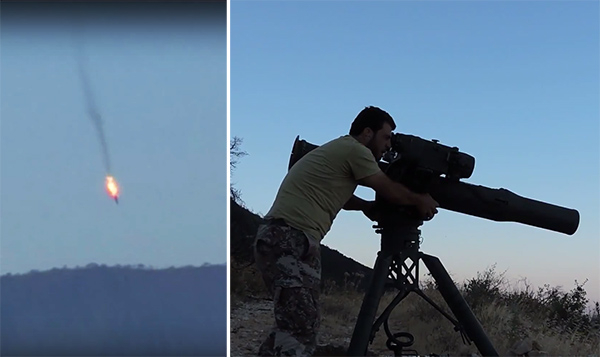
The first sign that Russia’s military intervention was not going according to plan came in October, when a Russian-backed plan to recapture the strategically important northern Syrian city of Hama was halted by stiff rebel resistance. Western intelligence sources say one decisive factor was the delivery to the rebels of 500 U.S.-made TOW anti-tank missiles, believed to have been provided by the Saudis.

In what has since become known locally as the “massacre of the tanks”, nearly 20 tanks and armoured personnel carriers fielded by the Assad regime were knocked out of action by the highly accurate TOW missiles.

Left: A Russian SU-24 bomber crashing after being shot down by a Turkish F-16 fighter on Nov. 24. Right: A Syrian rebel fighter prepares to fire a TOW missile at an Assad regime tank.

The fierce resistance put up by anti-government forces, which also claimed the lives of several senior Iranian Revolutionary Guard officers, dealt a serious blow to the morale of regime loyalists. It also resulted in a significant change of tactics on the part of the Russians who, aware of the limitations of the regime’s ground forces, have increased their reliance on air power to achieve their objective of defeating the rebels.

But while the Russians insist that their main attacks in Syria are being directed against fighters associated with the so-called Islamic State (ISIS), the reality is that they are bombing a large variety of anti-Assad forces – including those backed by the U.S.-led military coalition. One of the explanations given for the Turks shooting down a Russian SU-24 jet was that it had been bombing rebel groups backed by Turkey rather than ISIS, as the Russians later claimed.

The lack of progress made in Syria since Mr Putin first authorized Russian military involvement could soon have serious repercussions for the Kremlin.

Public support for the mission in Russia is starting to wane, after Investigators suggested the bombing of a Russian passenger jet over Egypt’s Sinai Peninsula at the end of October, killing all 224 on board, was carried out by ISIS terrorists in retaliation for Moscow’s military campaign.

Many Russians are also wary of the country becoming embroiled in another long, drawn-out military entanglement, as happened in Afghanistan in the 1980s and ultimately ended with the Soviet Union suffering an ignominious defeat.

And then there is the question of just how long Russia can afford to sustain its expensive military adventure in Syria. The Russian economy already has enough difficulties without having to bear the cost of Mr Putin’s latest act of military aggression. Moscow’s invasion of Afghanistan in the 1980s ultimately bankrupted the Soviet Union: the Syrian conflict could have a similarly catastrophic effect on modern Russia.

Russia Devouring the Eastern Mediterranean? by Burak Bekdil

  • Turkey shot down a Russian jet. No gain, but plenty of damage to its economy. Russia gave up one jet to Turkey and has made its military presence in Syria and the strategic eastern Mediterranean permanent.


  • Turkey can no longer speak to Russia about the possibility of ousting Assad.

  • Putin seems to be making sure that NATO will do nothing.

At this year’s G-20 summit in Antalya, Turkey, Russian President, Vladimir Putin, said that the radical jihadist Islamic State (IS) was being financed by donors from at least 40 countries, including some G-20 member states — clearly pointing his finger, without naming names, at Saudi Arabia and Turkey. A few days later, two Turkish F-16 jets shot down a Russian SU-24 warplane, and claimed that the Russian jet had violated Turkish airspace for 17 seconds on the country’s Syrian border — a violation Russia denies. This was the first time a Soviet or Russian military aircraft was shot down by a NATO air force since the end of WWII.

Turkey and Russia have long been in a proxy war in Syria: Russia, together with its quieter partner, China, supports the Shi’ite Iran-backed Syrian regime of President Bashar al-Assad; and Turkey explicitly supports Assad’s Sunni opponents [“moderate” jihadists] — apparently in the hope of building a Muslim Brotherhood/Hamas-type of regime in Damascus that would be friendly to its own Islamist government. After the downing of the Russian jet, the Turco-Russian proxy war has become less proxy.

No more Mr. Nice Guy.
Russian President Vladimir Putin twice refused to meet with Turkish President Recep Tayyip Erdogan on the sidelines of the Paris Climate Summit this week. Pictured: President Putin with then Prime Minister Erdogan, meeting in Istanbul on December 3, 2012. (Image source:kremlin.ru)

An angry Putin called the incident “a stab in the back.” He declined Turkish President Recep Tayyip Erdogan’s requests to discuss the issue. He twice refused to meet Erdogan on the sidelines of the Paris Climate Summit.

Russia’s foreign minister, Sergei Lavrov, quickly cancelled his official visit to Turkey — a visit that had been scheduled for the day after the downing of the Russian jet. At the outset, NATO member Turkey had taught Russia a good lesson. In reality, judging from the consequences, it all looks like a Russian gambit, with Turkey shooting itself in the foot and risking a new NATO-Russia conflict.

Russia’s ire seemingly is being expressed in economic terms:

  • Moscow said it will introduce visa restrictions for Turkish citizens, beginning Jan. 1, 2016.
  • Russian authorities detained a group of Turkish businessmen on charges of “false statements about their trip to the country.”
  • Press reports noted that Russia was considering limiting or excluding Turkish construction companies from the country, a potentially multi-billion dollar loss for the Turkish economy.
  • Moscow warned its citizens against visiting Turkey — a ban that could deal a big blow to Turkey’s lucrative tourism industry. Last year 4.5 million Russians visited Turkey, mostly its Mediterranean coast. Russian tour operators were warned to suspend business with Turkey.
  • The fate of two huge Turco-Russian energy projects remains unknown, as Russia’s energy minister, Alexei Ulyukayev, did not rule out sanctions hitting the Turkish Stream gas pipeline and a planned Russian nuclear energy plant in Turkey. Turkey buys about 55% of its natural gas from Russia. Its second largest gas supplier is Iran, Russia’s ally — and Turkey’s rival — in Syria.
  • Russia’s Minister of Agriculture, Alexander Tkachev, said that Russia would be replacing Turkish food imports with goods from Iran, Israel and Morocco.
  • Shipments of wheat to Turkey from key Russian ports were put on hold.
  • The Kremlin officially announced a wide range of sanctions on Turkey, including a ban on Turkish workers (with estimates that 90,000 will be fired by Jan. 1, 2016), restrictions on imported goods and services from Turkey and calls for “strengthening of port control and monitoring to ensure transport safety.”
  • Around 1,250 trucks carrying Turkish exports were blocked from entering Russia on Nov. 30 and were stranded at border posts, awaiting clearance.
  • Russian soccer clubs will be banned from signing Turkish players during the upcoming winter break.

All of that is commercially punitive. There is a more serious side of the Turco-Russian conflict that concerns NATO and western interests in the Middle East.

Russian Defense Minister Sergei Shoigu announced on Nov. 25 that Russia would deploy S-400 surface-to-air missile systems in its Hmeymim air base in Syria.

Turkey shot down a Russian jet. No gain, but plenty of damage to its economy. Russia gave up one jet and has made its military presence in Syria and the strategic eastern Mediterranean permanent. It has reinforced its bases in Syria and intends to build a new military base there. Turkey can no longer speak to Russia about the possibility of ousting Assad.

In a further move to escalate tensions, the Russian General Staff deployed one of its largest air defense ships at the edge of Turkish territorial waters in the Mediterranean. Russian military spokesman General Sergei Rudskoi said that Russian bomber aircraft would be “supported by chasers, and any kinds of threats will be responded to instantly.” Accordingly, The Moscow, one of the Russian Navy’s two largest warships and the flagship of Russia’s Black Sea Fleet, will be deployed where Turkey-Syria territorial waters connect.

In addition, Putin issued orders to deploy nearly 7,000 troops, plus anti-aircraft missiles, rocket launchers, and artillery to the Turkish border, and asked them to be in readiness for full combat.

There have been other military repercussions, too. Since the shooting down of the Russian jet, the Russian military has been regularly pounding the Syrian villages near the Turkish border that populated by the Turkmen, a Turkish ethnicity that supports jihadists in Syria — and is supported by Ankara. The Russians also have been hitting Turkish aid convoys bound for Turkmen villages. More than 500 Turks and Turkmen have been killed in Russian airstrikes. Meanwhile, the U.S.-led allied air strikes against IS have come to a halt. Neither Washington nor Ankara is keen for another conflict with Russia. So, IS and Russia keep on flourishing.

The Russian military has scrapped all contacts with the Turkish military, possibly waiting for the first Turkish military aircraft that violates foreign airspace to shoot.

Turkey has every liberty to challenge Russia and, inevitably, become the victim. But with its geostrategic, Islamist ambitions, it is exposing NATO allies to the risk of a fresh conflict with Russia — and at a time when the wounds of previous conflicts remain unhealed.

Putin has accused Turkey’s leaders of encouraging the Islamization of the Turkish society, which he said was a “problem.” He was not wrong. In fact, Islamism and neo-Ottoman ambitions are the source of Turkey’s (not-so) proxy war with Russia in the Syrian theater. Although Turkey, officially, is a NATO member and part of the allied campaign against IS, its Sunni Islamist ambitions over Syria hinder the global fight against jihadists. A Turco-Russian conflict is weakening the fight.

Putin seems to be making sure that NATO will do nothing.

Burak Bekdil, based in Ankara, is a Turkish columnist for the Hürriyet Daily and a Fellow at the Middle East Forum.
Ruracyageretse hagati y’Umuryango w’Ubumwe bwa Afurika na ICC

Umuryango w’Ubumwe bwa Afurika wahamagariye abanyamuryango bawo kuvuga rumwe ku kuba Urukiko Mpuzamahanga Mpanabyaha rukomeje kwibasira abayobozi bari ku butegetsi muri Afurika.


Uyu muryango ugizwe n’ibihugu 54 utangaza ko watunguwe no kuba Akanama ka Loni gashinzwe umutekano kataraha agaciro icyifuzo cyawo cyo gusubika urubanza rw’abakuru b’igihugu ba Kenya cyangwa ngo gatange igisubizo kiboneye.

Al Jazeera ivuga ko Botswana ari yo yonyine itavuga rumwe n’icyemezo cy’Umuryango w’Ubumwe bwa Afurika mu nama iheruka kuwa Gatandatu yabereye muri Etiyopiya ikitabirwa n’abakuru b’ibihugu 34.

Perezida wa Kenya, Uhuru Kenyatta n’umwungirije, William Ruto bakurikiranwe n’Urukiko Mpuzamahanga Mpanabyaha (ICC), ibyaha byibasiye muntu aho bivugwa ko ari bo bari bihishe inyuma y’imvururu zabaye nyuma y’amatora yo mu 2007, zigahitana abarenga 1,000. Aba bagabo bombi bahakana ibyaha baregwa.

Mu kwezi k’Ugushyingo umwaka ushize, Akanama ka Loni gashinzwe umutekano kateye utwatsi icyifuzo cya AU cyo gusubika uru rubanza rw’aba bayobozi ba Kenya. Uhagarariye Guatemala muri Loni, Gert Rosenthal avuga ko kugerageza gusubika urubanza ari “ugusuzugura” ibihugu byashatse gufasha Afurika mu gutanga ingabo zo kubungabunga amahoro n’imbaraga zigamije guteza imbere ubutabera ku mugabane.

Ibihugu umunani byo mu kanama ka Loni gashinzwe umutekano, byashyize umukono ku masezerano ashyiraho ICC cyangwa biyishyigikiye, birimo u Bwongereza, u Bufaransa na Leta Zunze Ubumwe za Amerika byarifashe bitinya ko umwanzuro ushobora kutazagira icyo ugeraho.

Umwanzuro watowe ku majwi arindwi gusa bityo ubura amajwi abiri ngo ushyirwe mu bikorwa kuko aka kanama kagizwe n’ibihugu 15.

Ni ubwa mbere Akanama ka Loni gashinzwe umutekano kadatanze umwanzuro ku buryo nk’ubu hatitabajwe kimwe mu bihugu bifite umwanya uhoraho muri aka kanama (veto).

RPRK INYABUTATU IKANGURIRA ABANYARWANDA UBWAMI BW’ABEGA:

 Uyu muryango wa za maneko wiheshe mu mutaka utacyiyitirira guharanira ubwami bw’urwanda,ubu bakaba bareruye ko baharanira ubwami bw’Abega bavuga ko bwo buzaba bugendera ku itegeko nshinga,naho UMwami Kigeli V Ndahindurwa bakavuga ko atigeze arahirira ubwami bugendera ku itegeko nshinga.


Nonese byashoboka gute ko RPRK inyabutatu yaba yaratangiye yamamaza Umwami w’Urwanda ko baharanira gutaha kwe,ndetse ko batanemera repubulika ya lll kuko iriho kuburyo butemewe namategeko bagiye bagaragaza za gihamya zijyanye ni myanzuro ya loni yasinyanye n’Umwami w’Urwanda Kigeli V Ndahindurwa aha twavuga nk’umwanzuro wa 1579,1580,1605,iyi myanzuro yose niko igaragaza ko repubulika y’Urwanda iriho kuburyo butemewe namategeko.

Biratangaje rero ukuntu ubu ngubu RPRK inyabutatu itangiye kwemera ko leta y’Urwanda noneho yemewe n’amategeko,ibyo babikora bazi neza yuko ngo ikinyoms cyo guhindura amazina yishyaka rirwanira ubwami bw’Abega ko bitazamenyekana nyamara abanyarwanda ibyo bamaze kubimenya ndetse nibitangaza makuru byaranditse bibavugaho byinshi bijyanye namabanga y’ikuzimu abega barimo gutegura ngo babone uko bazayobora Urwanda mu minsi iri mbere.

Abagize umutwe wa RPRK,inyabutatu bari muri wa mutwe wabantu 400,bateguwe bazakubita kudeta perezida kagame bagahita bashyiraho ubwami bw’Abega arinabwo ubu batangiye kujyenda bakangurira abnyarwanda babereka ko ubwami bwariho mbere butari bwemewe nabanyarwanda,ukagirango har’ubundi bwabayeho mbere y’uko habaho ubwomavuga ko butemewe.

Ahubwo se ubwemewe n’ubuhe?ngo barashaka guhimba ubwami modern bwa kiga na kagara!ahhhh,nzaba numva n’umwana w’umunyarwanda,birabe ibyuya ntibibe amaraso,kuko ndabona kega na kagara baza kudukuramo umwuka,ariko se muri millioni z’abanayarwanda barumva aribo bafite imbaraga kurusha abandi?nibagerageze ahari ntawamenya bazabigeraho.

Ariko se babigeraho bate?kandi numva inyambo zitangiye kuvumera n’ingoma karinga itangiye kuririmba no kwikubitaho imirishyo,ndetse n’intebe yabukunzi ikaba itangiye kubyinagira ubwo se baraherahe ? ko namarebe atangiye kuririmba ibyansi kuruhibi bikaba bitangiye guhehera byitegura kubuganiza amata kugirango amata aterekwe mugisabo cyamaze kwitirwa kugirango bacunde amata haboneka akamuri twari tumaze imyaka n’imyaniko tutumva urukarango.


IMPUNZI Z’ABANYARWANDA NIZABARUNDI MU GIHUGU CYA MALAWI,BAMWE BAGIYE KUJYANWA MU BIHUGU BYO HANZE ABANDI BASUBIZWE MU BIHUGU BYABO.


Amakuru aturuka mu gihugu cya Malawi mu kigo kimpunzi zibamo Abanyarwanda n’Abarundi,aravuga ko ubu impunzi zitacyizuye umutekano wazo nk’uko bikwiriye,amakuru avuga ko ngo iyo nkambi y’impunzi yaba igiye gufungwa ngo kubera ko umuryango wabibumbye ntabushobozi ugifite bwogukomeza gufasha izo mpunzi zibarizwa muri icyo gihugu cya Malawi.

Ubu zimwe mu mpunzi zaba zitarabona ibyangombwa zitangiye kwimuka zerekeza mu gihugu cya Zambia,aho zitekereza yuko zishobora kubona ubuhungiro,amakuru agera kukinyamakuru inyangenewss aremeza ko leta ya perezida Peter Nkurunziza niya Paul kagame aribo bashobora bari inyuma yiryo fungwa ry’iyo nkambi.

Kuko impunzi azabwiwe yuko ibihugu zikomokamo bivuze Urwanda n’Uburundi ko aramahoro nta ntambara ikirangwa mur’ibyo bihugu,kugeza ubu rero izo mpunzi zikaba zikomeje kuba mu gihirahiro kuko zitazi neza abazemererwa gutwarwa hanze nabatazemererwa,wenda kubatarabona impapuro z’ubuhunzi kuri bo birumvikana ariko ikibazo ni kubamaze kubona ibyangombwa kandi ntibazatwarwe hanze mubindi bihugu hanyuma kandi bakazisanga bashujwe Irwanda cyangwa Iburundi.

Ariko ntibyari bikwiriye gusubiza impunzi mubihugu zikomokamo igihe cyose ziba zitaragirira ikizere ibihugu zikomokamo,kuko nizo zizi ingorane zihura nazo mu bihugu zabyo,kuba basubizwa iwabo kungufu nyamara batizeye umutekano wabo,biragoye,dore nkubu mu Burundi hatangiye gututumba intambara nyuma y’igihe gito cyane hari habonetse agahengwe.

Mu Rwanda ni uko naho abaturage barara imitima iri hejuru ibisasu biterwa na leta kugirango ibone uko ishinja abo itavuga rumwe nayo abantu bamaze kubiomerekeramo ntibagira uko bangana,kandi igitangaje leta ikihutira guhita ibavunza wagirango hari cyo iba ibiziho kuko iyo ukoze ubushakashatsi usanga abantu bemera ko batera ibyo bisasu usanga akenshi arabasirikare ba RDF,bigira abasivile kugirango haboneke ibirego bajyana murukiko barega Kayumba na Ingabire.

Kuba impunzi zikiri mubihugu byo hanze igihugu cyumva nta mutekano gifite,nyamara aho kugirango bakore ibisabwa n’amategeko abene gihugu bose bibone ko igihugu bagifiteho uruhare ahubwo bagahimba imitwe yokwirukanisha izo mpunzi bakoresheje ruswa nandi mayeri za leta zikoresha biciye mu bijyanye n’ububanyi namahanga.

YAZITSE INZIGO MUNSI YISHYIGA:

Amakuru agera kukinyamakuru inyangenewss ahamya ko abarwanira ubutegetsi bo mu bwoko bwabarepubulike, barakataje mu gushyira ku mukono kumasezerano ajyanye n’ubufatanye mubyapolitiki yamashyaka mu mpindura matwara yabatavuga rumwe n’ubutegetsi bwa perezida Paul kagame na FPR.

Nyuma yuko repubulika ya lll baboneye ibateye utwatsi murwego rwo kwanga amashyaka yabo,ko yemerwa mu Rwanda kugirango batazbatesha umutwe murwego rwogusangira umugati w’igihugu,abatavugaga rumwe”abakiga n’Abanyenduga noneho bagezeho bemera gushyira umukono kumasezerano y’ubufatanye mubyapolitiki yokurwanya ubutegetsi bwa FPR.

Nyuma yuko abanyapolitiki bakomoka mu nduga, bisanze ko ntambaraga bafite mubyagisirikare,kuko politiki y’Urwanda buri gihe bimaze kumenyerwa yuko udafite ingabo zirwanya leta iriho ntimushobora kumvikana bitewe ni uko ar’igihugu kitemera demokarasi bayemera mu magambo ariko mubikorwa ntibishiboka iyo ndetse ahanini ikaba ariba arinayo ntandaro y’intambara zihora ziba buri gihe zigahitana ubuzima bw’abantu kubera inyungu z’abantu kugiti cyabo.

Ni muri urwo rwego Twagiramungu Faustin yagiranye amasezerano n’umutwe wa fdlr,kugirango bumve ko nabo bakomeye bereke namahanga ko ishyaka ryabo rifite umutwe w’ingabo bityo bagirire ikizere ishayaka bahagarariye babone imfashanyo ndetse nabaturage babagirire ikizere yuko bashobora gukuraho ubutegetsi bwa fpr bumaze imyaka 20,wagirango abategetsi bo mu Rwanda n’uwabaroze imyaka 20,ntawujya ayirenza kandi avaho aruko rishwe.

Ni ryari mu Rwanda tuzabona abanyepolitiki bashobora kuva kubutegetsi neza badakuweho nurupfu? Demokarasi iracyari kure nk’ukwezi, nabo barwanya fpr wasanga nabo bagiyeho ariko bavuga ibyo barwanya ubu ugasanga aribyo bakora, ese uratekereza ko nka rukokoma uwamuha intebe yo mrugwiro wagirango yapfa kuyirekura dore amaze no kugera muzabukuru yazakurwaho nurupfu nka Robert Mugabe wazimbabwe.

Ibyo byose Twagiramungu arabikora agirango agarure igitekerezo cy’ubuhemu cyatangiwe nasebukwe Kayibanda,ndatekereza ko ahubwo akwiye kwifatanya na Padiri Thomas kuko nawe arahanira abanyarwanda bakomoka mukarere ka nduga,dore ko by’umwihariko padiri Thomas we anizihiza umunsi wokwibuka Kayibanda aho nshatse kuvuga umunsi wakamarampaka ariwo munsi wabahutu mubutegetsi bwa repubulika ya lll ya FPR.

Ikindi kiyongereyeho bose bakaba arabanyacyangugu bakomoka mukarere kamwe,icyo abanyarwanda bakomeje kwibaza n’uburyo abanyarwanda bo mu bwoko bwarepubulike bakomeje kwigira injiji kubijyanye n’ubwami bw’Urwanda bagambaniye,ese ubwami nubugaruka bazabyifatamo gute?bazongera bakore ibishoboka kugirango babusenye?cyangwa bazemera kubuyoka!

Translate »
Skip to toolbar