Category Archives: Uncategorized

Islamists Infiltrate the Swedish Government One Month of Islam and Multiculturalism in Sweden: April 2016 by Ingrid Carlqvist

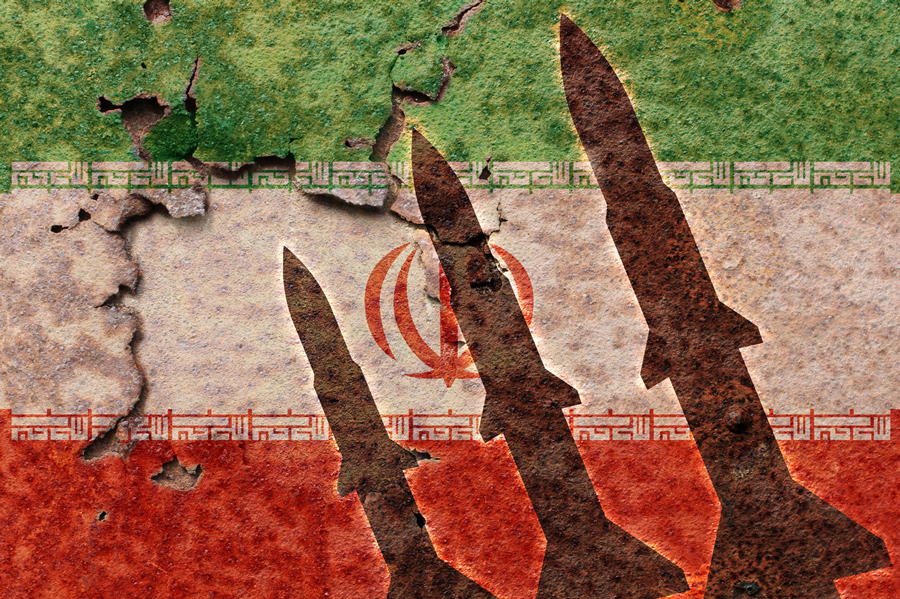
  • Thanks to the lifting of sanctions, the prize for best Holocaust cartoon was lifted as well. Iran is now offering $50,000 for the best Holocaust cartoon, more than quadruple last year’s prize, which was $12,000.

  • The competition is expected to draw participants from more than 50 countries. It is sponsored by two organizations which are directly or indirectly linked to the Iranian regime: the Owj Media and Cultural Institute, funded by the Islamic Revolutionary Guard Corps, and the Sarsheshmeh Cultural Center, which is supported by the Islamic Development Organization (IDO). The Iranian parliament provides the IDO’s budget.
  • These kinds of Holocaust events and conferences in Iran are based on the notion that Holocaust did not occur.

This week, Iran is hosting its second annual Holocaust Cartoon Competition, even as some politicians and world leaders continue to argue that Iran is becoming a stabilizing force because it is re-joining the international community, by implementing the nuclear agreement and integrating into the global financial system.

The exhibition of Holocaust cartoons will open on May 14. Iran’s Holocaust Cartoon Competition reflects the Iranian regimes’ attempts to expand its efforts to promote anti-Semitism beyond the borders of its nation.

As Iran’s revenues are rising, thanks to the lifting of sanctions, the prize for the best Holocaust cartoon was lifted, as well. Iran is now offering $50,000 for the best Holocaust cartoon, more than quadruple last year’s prize, which was $12,000. According to Iran’s semi-official IRNA news agency, the conference is expected to draw participants from more than 50 countries.

The Iranian regime seems to be using global legitimacy, granted to its leaders by many Western politicians through the nuclear agreement and business deals, to promote the core pillars of its Islamic revolution, opposing the US and rejecting Israel’s right to exist, as well as its fundamental ideals.

In addition, it is worth noting that these kinds of global conferences, which work to deny the historical fact of the Holocaust, are aimed at undermining Israel’s legitimacy, as well as its right to exist. One of Iran’s major foreign policy and ideological objectives, which rests on the religious teachings of Ayatollahs Khomeini and Khamenei, is the struggle against Israel.

For more than 35 years, the Iranian regime has been trying to delegitimize Israel through both soft and hard power. Iran promotes its anti-Semitic and anti-Israel narrative through schools, social media, television, and non-stop political rhetoric. Its narrative has attracted an audience in the Middle East, as well as in the West.

The Iranian government claims that it has nothing to do with sponsoring such a conference and that it does not endorse such an event. Iranian Foreign Minister Mohammed Javad Zarif explained last week to the New Yorker, in response to this news: “It is not Iran. It is an NGO that is not controlled by the Iranian government. Nor is it endorsed by the Iranian government.”

Zarif added that Iran “does not support, nor does it organize, any cartoon festival of the nature that you’re talking about.”

Mr. Zarif is being disingenuous. The competition is sponsored by two organizations which are directly or indirectly linked to the Iranian regime: the Owj Media and Cultural Institute and the Sarsheshmeh Cultural Center, which is supported by the Islamic Development Organization (IDO). The Iranian parliament provides the IDO’s budget.

In Iran, governmental or non-governmental organizations (NGOs), groups, or institutions cannot hold events — whether cultural, economic or political — without the explicit or implicit approval of Iran’s officials. The approval normally comes from the Ministry of Culture, the Islamic Revolutionary Guard Corps (IRGC), Basij, intelligence agencies, Etela’at, Tehran Municipality or the Ministry of Islamic Guidance.

If the government is not involved in these kinds of events and NGO activities, why do no events exist that criticize the Supreme Leader or the ideological principles of Iran? Why are there only events that promote Ayatollah Khamenei and the revolutionary principles of the IRGC?

In short, it is impossible to hold such a large and global conference without the sponsorship and approval of the government.

The U.S. Holocaust Memorial Museum accurately pointed out in a statement that in Iran, “Previous [Holocaust cartoon] contests in 2006 and 2015 have had the endorsement and support of government officials and agencies.” The museum added that, “There are reports in the Iranian press that the Ministry of Culture is asserting its support for the upcoming contest.”

By denying any involvement in such conferences, Rouhani, Zarif and their team are playing the tactical shift that Supreme Leader Ali Khamenei and a senior cadre of IRGC designed long time ago. The tactical shift is to feign a softer tone on the international stage through the president and the foreign minister, while keeping the fundamentals of Khamenei and the IRGC’s policy intact.

By denying the Iranian regime’s official involvement in the Holocaust cartoon contest, President Rouhani (right) and FM Zarif are feigning a softer tone on the international stage, while keeping the fundamentals of Ayatollah Khamenei and the Revolutionary Guards’s policy intact.

To gain more wealth through business deals and the lifting of sanctions, Rouhani and Zarif are faking a nicer façade and illusion on the international stage, while Khamenei and the IRGC continue with their longstanding objectives of opposing the US and Israel, and preserving Iran’s Islamic and revolutionary norms. Anti-Zionism and Anti-Semitism are two of the core values of Iran’s Islamic revolutionary principles. Khamenei and the IRGC leaders derive legitimacy from these revolutionary and ideological values.

These kinds of Holocaust events and conferences are not linked to “understanding” the Holocaust, as the Iranian leaders disingenuously argue. The conference premise is based on the notion that Holocaust did not occur.

Iran’s propaganda can normally turn this anti-Semitism into a motivation for violence and more terrorist acts.

Western powers are aware of the fact that the improving ties and rapprochement between Tehran and the West, particularly Washington, are contributing to legitimizing the Iranian regime. Nevertheless, it is incumbent on the international community to strongly condemn these hatred-driven moves by Iran’s regime.

Dr. Majid Rafizadeh is an Iranian-American political scientist, Harvard scholar, and president of the International American Council on the Middle East. He can be reached at Dr.rafizadeh@post.harvard.edu and followed at @Dr_Rafizadeh

Islamists Attack Christmas, but Europeans Abolish It by Giulio Meotti

  • A statue of the Virgin Mary was ordered taken away by a court in the French municipality of Publier. Senator Nathalie Goulet slammed the judges as “ayatollahs of secularism”.

  • A German school in Turkey just banned Christmas celebrations: the school, Istanbul Lisesi, funded by the German government, decided that Christmas traditions and carol-singing would no longer be allowed. A Woolworth’s store in Germany scrapped Christmas decorations telling customers that the shop “is now Muslim”.
  • Europe is already mutilating her own traditions “to avoid offending Muslims”. We have become our own biggest enemy.
  • Muslims are also reclaiming “the mosque of Cordoba”. Authorities in the southern Spanish city recently dealt a blow to the Catholic Church’s claim of ownership of the cathedral. Now Islamists want it back.
  • The final result of Europe’s self-destructive secularism could seriously be a Caliphate.

“Everything is Christian”, Jean-Paul Sartre wrote after the war. Two thousand years of Christianity have left a deep mark on the French language, landscape and culture. But not according to France’s Minister of Education, Najat Vallaud-Belkacem. She just announced that instead of saying “Merry Christmas”, state officials should use “Happy Holidays” — clearly a deliberate intent to erase from discourse and the public space any reference to the Christian culture in which France is rooted.

Jean-François Chemain called it the “eradication of any Christian sign in the public landscape”. A year ago, the controversy was ignited in the French town of Ploermel, where a court decided that the statue of Pope John Paul II, erected in a square, had to be removed for violating “secularism”.

Then, a statue of the Virgin Mary was ordered taken away by a court in the municipality of Publier. Senator Nathalie Goulet slammed the judges as “ayatollahs of secularism“.

The newspapers of the French “left”, outraged by the “right’s” ban on burkinis on the French Riviera, have been endorsing this anti-Christian policy.

France’s Council of State has just ruled that “the temporary installation of cribs [nativity scenes] in a public place is legal if it has a cultural, artistic or festive value, but not if it expresses the recognition of a cult or a religious preference”. What precautions to justify a millenary tradition!

In the town of Scaer, a nursing home has been the subject of a similar secularist complaint, for the presence of a fresco of the Virgin Mary. Then, it was the turn of the manger in the train station of Villefranche-de-Rouergue, in Aveyron. In the town of Boissettes, the church bells have been muted by court decision.

Fortunately, some ideas from the Observatory of Secularism — the organ established by President François Hollande to coordinate his neo-secularist policies — have not been implemented. One proposed even to eliminate some Christian national holidays to make room for the Islamic, Jewish and secular holidays.

President Hollande, on the occasion of Easter, “forgot” to express holiday wishes to the Christians of France. But a few months before, Hollande had extended his best wishes to the Muslims during the feast of Eid, which closes Ramadan. “Hollande’s greeting to Muslims is opportunistic and political. For the Socialist Party, it is a crucial electoral clientele”, said the French philosopher Gerard Leclerc in the newspaper, Le Figaro.

This Christianophobia is the Trojan Horse of Islam. As Charles Consigny writes in the weekly Le Point, “Through this tabula rasa of the past, France will make a clean sweep of its future”. Unfortunately, France is not an isolated case. Everywhere in Europe, a weary, secularist absence of purpose and confused values damns Christianity in favor of Islam.

A jihadist terrorist, targeting a symbol of Christian tradition, last week slaughtered 12 people at a Christmas market in Berlin. But Europe is already mutilating her own traditions “to avoid offending Muslims”. We have become our own biggest enemy.

The annual candlelit Saint Lucia (“Sankta Lucia“) procession, a Swedish Christian tradition celebrated for hundreds of years, is “dying” out. Uddevalla, Södertälje, Koping, Umeå, and Ystad are among the growing numbers of cities no longer holding this lovely cultural event. According to Jonas Engman, an ethnologist at the Nordic Museum, the declining interest in the St. Lucia procession accompanies a more general alienation from the culture of Christian Sweden. A study conducted by Gallup International reveals that in observing the Christian religion, Sweden is “the least religious in the West“. In the meantime, with a young, strong, driven sense of purpose and a set of sharia values, Islam is growing.

A German school in Turkey just banned Christmas celebrations. The school, Istanbul Lisesi, funded by the German government, decided that Christmas traditions and carol-singing would no longer be permitted. The Washington Post summarized the decision: “No teaching of Christmas customs, no celebrations and no Christmas caroling”. It is not an isolated incident. A Woolworth’s store in Germany also scrapped Christmas decorations, telling customers that the shop “is now Muslim”.

In Britain, David Isaac, the new head of the Equalities and Human Rights Commission (EHRC), told employers that they should not suppress Christian tradition out of fear of offending anyone. Previously, Dame Louise Casey, the British government’s integration “tsar”, warned that “traditions such as Christmas celebrations will die out unless people stand up for British values”.

In many Spanish towns, such as Cenicientos, the municipality of this Autonomous Community of Madrid removed the Christian Stations of the Cross. Then, Madrid’s mayor, Manuela Carmena, decided to remove the city’s traditional Nativity display at the Puerta de Alcalá.

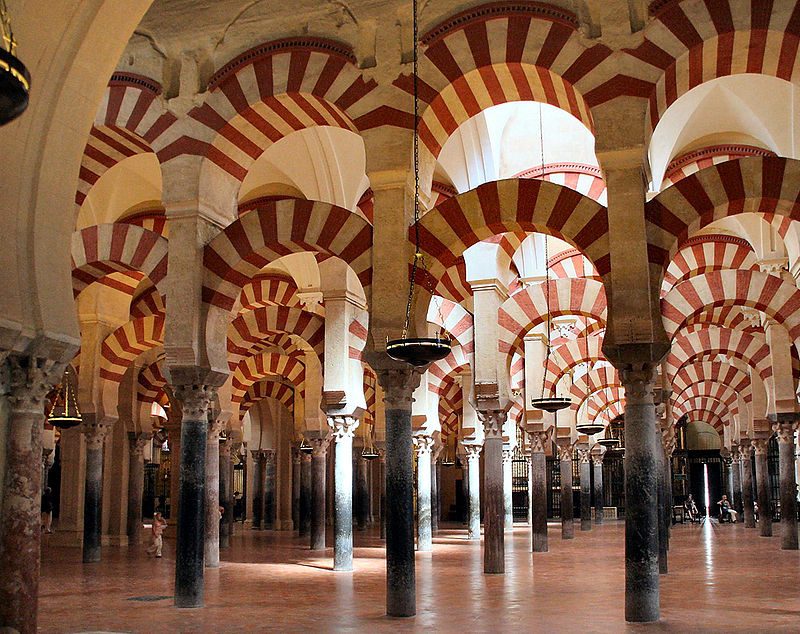
Muslims are also reclaiming “the mosque of Cordoba“. Authorities in the southern Spanish city recently dealt a blow to the claim of ownership of the cathedral by the Catholic Church. Built on the site of Saint Vincent’s church, it then served as a mosque for over 400 years when Islamic Spain was part of a caliphate, before the Christian kingdom of Castile conquered the city and converted it again into a church. Now Islamists want it back.
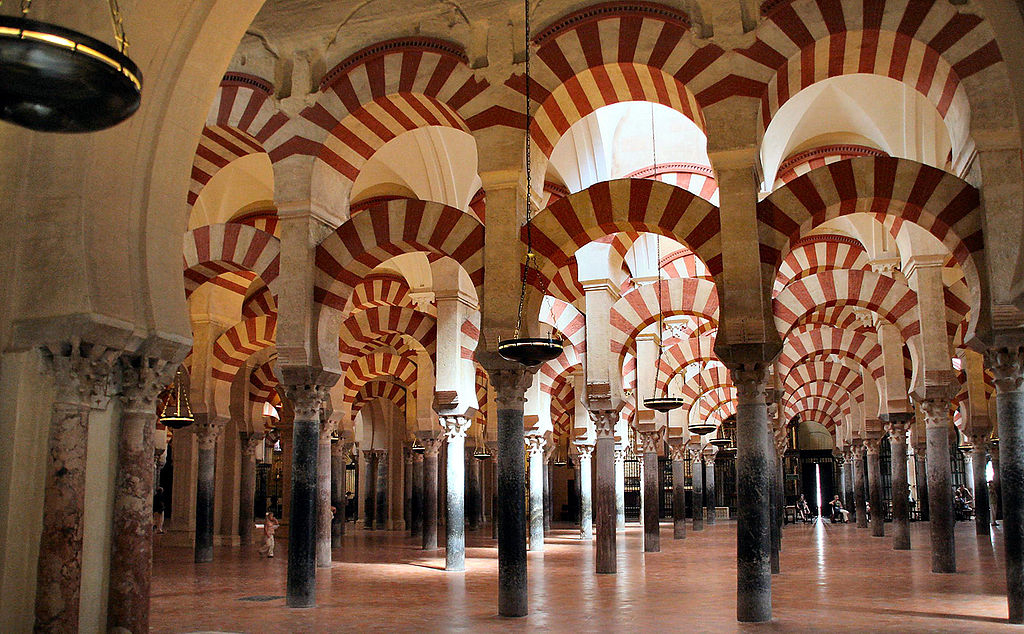
Muslims are also reclaiming “the mosque of Cordoba”. Authorities in the southern Spanish city recently dealt a blow to the claim of ownership of the cathedral by the Catholic Church. Built on the site of Saint Vincent’s church, it then served as a mosque for over 400 years when Islamic Spain was part of a caliphate, before the Christian kingdom of Castile conquered the city and converted it again into a church. (Image source: James Gordon/Wikimedia Commons)

Belgium, the most Islamized democracy in Europe, is also purging its Christian heritage. The Nativity, the traditional manger scene, has not been put up in the Belgian town of Holsbeek, just outside Brussels. Claims were scenes it was scrapped to “avoid offending Muslims”.

As reported by the newspaper La Libre, school calendars within Belgium’s French speaking community are also using a new secularized terminology: All Saints Day (Congés de Toussaint) is now be referred to as Autumn Leave (Congé d’automne); Christmas Vacation (Vacances de Noël) is now Winter Vacation (Vacances d’hiver); Lenten Vacation (Congés de Carnaval) is now Rest and Relaxation Leave (Congé de détente); and Easter (Vacances de Pâques) is now Spring Vacation (Vacances de Printemps). Then Belgium installed an abstract, de-Christianized Christmas tree in the capital, Brussels.

In the Netherlands, the Christian tradition of Black Pete is under attack and it will soon be abolished. In Italy, Catholic priests this year canceled Christmas to “avoid offending Muslims”.

The final result of Europe’s self-destructive secularism could seriously be a Caliphate, in which the fate of its ancient and beautiful churches recapitulates those in Constantinople, where the Hagia Sophia, for thousand years Christianity’s greatest cathedral, was recently turned into a mosque. The muezzin’s call now reverberates inside this Christian landmark for the first time in 85 years.

Islamic terrorists targeted Christmas in Berlin, but it is the Christian secularists who are abolishing it all over Europe.

Giulio Meotti, Cultural Editor for Il Foglio, is an Italian journalist and author.
Islamist Terrorism, European Denial by Yves Mamou

  • Europeans have delegated to the State the exclusive right to use violence against criminals. But Europeans, especially in France and Germany, are discovering that some kind of “misunderstanding” seems actually to be at work. Their State, the one that has the monopoly on violence, does not want to be at war with its Islamist citizens and residents. Worse, the State gives off the feeling that it is afraid of its Muslim citizens.

  • “The concept of the rule of law means that the citizen is protected from the arbitrariness of the State. Currently, the rule of law protects the attackers above all”. — Yves Michaud, French author and philosopher.

If a group of Jewish or Christian terrorists in Algeria, Egypt or Saudi Arabia had committed the same kind of stabbings, car-rammings, throat-slittings and shootings that France and Germany are suffering now, they would have provoked an immediate reaction. Tens of thousands — maybe hundreds of thousands — of enraged Muslims would have rushed into the streets to kill, stab or eviscerate the first group of Jews or Christians they met. Within 24 hours, no church or synagogue would be able to open its doors: all of them would have been burned to cinders.

These words are not to stigmatize anyone; they are meant to explain what terrorists want. According to Gilles Kepel, professor at the Paris Institute of Political Studies and a specialist of Islam, “ISIS calls for stabbing dirty and evil French people… because they want to trigger a civil war.” Muslim terrorists behind the wave of terrorist attacks apparently assume that thousands of French, Germans or Belgians will rush out into the streets, as they would do themselves, to kill, stab or eviscerate Muslims. Muslim sponsors of terrorism may not even be able to imagine that Europeans may not wish to participate in the pleasure of bloodthirsty riots.

The fact is that even if millions of Arabs and Muslims live in Europe today, Europeans are not Arabs and do not act as Arabs do. Westerners in Europe have delegated the “legitimate use of physical force” — commonly, if controversially, known as the “monopoly on violence” — to the State.

Max Weber, in his 1919 essay, “Politics as a Vocation”, claims that the State is any “human community that claims the monopoly of the legitimate use of physical force within a given territory.” In other words, Weber describes the State as any organization that succeeds in having the exclusive right to use, threaten, or authorize physical force against residents of its territory (“Gewaltmonopol des Staates“).

For French and Germans citizens, the mission of the State is to fight Islamist terrorists — harshly if necessary. But today, instead of the “legitimate violence” of the State, German and French citizens are encountering only denial. The State keeps denying that Islamist crimes are being openly committed in its territory. This denial comes in different forms:

1. The Real Victim is the Terrorist.

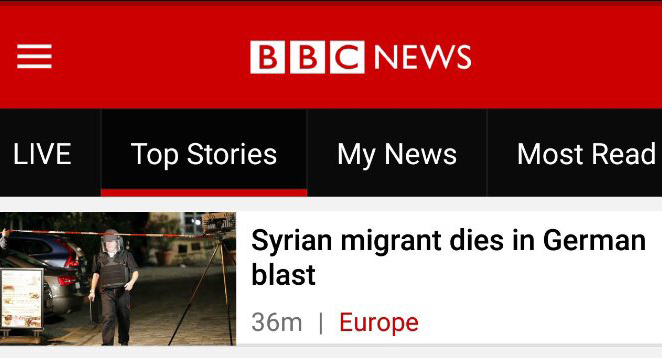
  • From Britain’s BBC: “Syrian Migrant Dies in German Blast.”
  • From Le Monde: “Germany: A Syrian Refugee Dies While Causing an Explosion in Front of a Restaurant in Bavaria” (Allemagne : un réfugié syrien meurt en provoquant une explosion devant un restaurant en Bavière). The headline (which has since been changed) is not about the diners in the restaurant who were targeted by the suicide bomber. The headline is about a victim, who is “the author of the explosion”. This “victim” — apparently only incidentally an Islamist criminal, according to this narrative — may have had a good reason to seek revenge! He was, after all, “a Syrian refugee whose entry into Germany was denied by the administration.” He was not deported for humanitarian reasons. The journalist barely mentions the 15 victims wounded, some severely, in the explosion. There is only one victim, the author of the suicide attack, which some journalists implied was not really a suicide attack, but maybe only a suicide. The man had history of psychiatric problems, after all.
  • According to the Wall Street Journal: “He was known to police and had been treated twice after trying to take his own life, Mr. Herrmann [the Bavarian Interior Minister] said. He was also known because of a previous drug misdemeanor, a police spokeswoman said.”

In short, the killer is not a killer but a poor, sick, young man.

After a Muslim suicide bomber injured 15 people on July 24 in Germany, many media outlets rushed to portray the terrorist as the victim.

2. He Was Not an Islamist, Just a Lunatic. Ali Sonboly, the 18-year-old German-Iranian gunman who murdered nine people at a Munich shopping mall on July 25 may be an Islamist killer, but he was more surely psychotic. According to Reuters:

“Materials found at the gunman’s home also showed he had been hospitalized for psychiatric care for three months around the same time, and was an avid player of violent video games, the officials told a news conference”.

Immediately after the attack, officials said the murderer was not an Arab but an Iranian — but that would simply make him a Shi’ite Muslim. According to Walid Shoebat, a Palestinian-American who converted to Christianity from Islam, “Sonboly is no Iranian. He is Syrian. His Facebook page showed that he is pro-Turkey’s Islamists”. However, even more bizarrely, some officials and media outlets said that Sonboly was inspired by the far-right Norwegian terrorist, Anders Breivik.

3. The Problem Is Not Islam or Islamism, but Too Many Guns on the Black Market. “German politicians have signaled that they will review the country’s gun laws, after a troubled 18-year-old was able to use a 9mm handgun and amass 300 rounds of ammunition in a shooting that left nine dead in Munich,” according to The Guardian.

4. The Victims Are Responsible for Their Own Murders. In Nice, France, after Mohamed Lahouaiej Bouhlel murdered more than 80 people by driving a 19-ton truck into a crowd celebrating Bastille Day, Julien Dray, a Socialist MP, said,

“The fireworks… It is a popular festival, there are families, children; it is often the only party that these children have, and so people are eager to go, and often checkpoints are removed to help the flow, because people do not want to wait, they want to leave, and that is unfortunately, is the time there may be a problem. “

5. The Attacker “Self-Radicalized” Rapidly. Even if the State is at fault, it found a good excuse to explain incompetence and lack of foresight: the terrorist “self-radicalized” so quickly that he was undetectable. The daily Le Figaro reported:

It seems that the perpetrator of the Nice attack “radicalized very quickly.” Interior Minister Bernard Cazeneuve called it “a new type of attack” that “demonstrates the extreme difficulty of combating terrorism.”

Cazeneuve added that Bouhlel, the Tunisian attacker, “was not known to the intelligence services.”

6. ISIS Is Not Islamist; It Is a Right-Wing Organization. We can sleep soundly, we are advised. The terrorists, we are told, are not Islamists but Fascists. “In claiming to be part of Daesh [ISIS], the two assassins show once again the bloody nature of this right-wing sect with policies that are racist, anti-Semitic, sexist and homophobic,” wrote SOS Racisme, an NGO financed by France’s Socialist government in a bid to seduce Muslim voters.

No doubt the next attacks will produce new and interesting explanations of this type whose aim is to reassure people.

Europeans have delegated to the State the exclusive right to use violence against criminals. But Europeans, especially in France and Germany, are discovering that some kind of “misunderstanding” seems actually to be at work. Their State, the one that has the monopoly on violence, does not want to be at war with its Islamist citizens or residents. Worse, the State gives off the feeling that it is afraid of its Muslim citizens.

The question now is: if the State does not want to fight Islamists murderers; if the State does not want to shut down Salafist mosques, deport hate preachers, and break the alliance between Islamists and organized criminals in the no-go zones of France and Germany; if the only solution proposed by President François Hollande is to “remain united”, unfortunately it will not work. “They attacked democracy,” Hollande said, “democracy will be our shield.”

But “national unity has no meaning when no serious measure is taken,” wrote Yves Michaud, the French author and philosopher, on his Facebook page:

“The concept of the rule of law means that the citizen is protected from the arbitrariness of the State. The same legal barriers cannot be used to protect those who want to kill citizens and destroy the res publica [republic]. … Currently, the rule of law protects the attackers above all”.

Yves Mamou, based in France, worked for two decades as a journalist for Le Monde.

Islamism’s Culture War Sets Sight on Multi-Billion Dollar Beauty Industry by Shireen Qudosi

  • The long game of Western Muslims averse to Western values, was largely unaffected by an altered political landscape as they transitioned to a new arena: culture.

  • “[F]ashion is one of the outlets in which we can start that cultural shift in today’s society to normalize the hijab in America.” — Melanie Elturk, CEO of Haute Hijab.
  • Beautiful Nura Afia in an advertising campaign is a far more appealing and consumer-friendly alternative to CAIR’s Nihad Awad or the political complexities of the Muslim Brotherhood. The face has changed but the message is constant.
  • Here you have the two faces of Islamist thought, one which underscores the myth of peace while privately exiling dissenting voices as ignorant, racist or bigoted. Meanwhile, CoverGirl and other brands upholding the hijab as a new standard of beauty, ignore the hijab’s very ugly origins.

As 2016 drew to a close, many people were on the edge of their seats after a defining presidential election between one choice (Clinton) who stood for the status quo and the other (Trump), seen as the harbinger of a resolute victory against radical Islam. For many Muslims, there was a third choice. Unanchored to the changing tides of elections, the long game of Western Muslims who are averse to Western values was largely unaffected by an altered political landscape. They had transitioned to a new arena: culture.

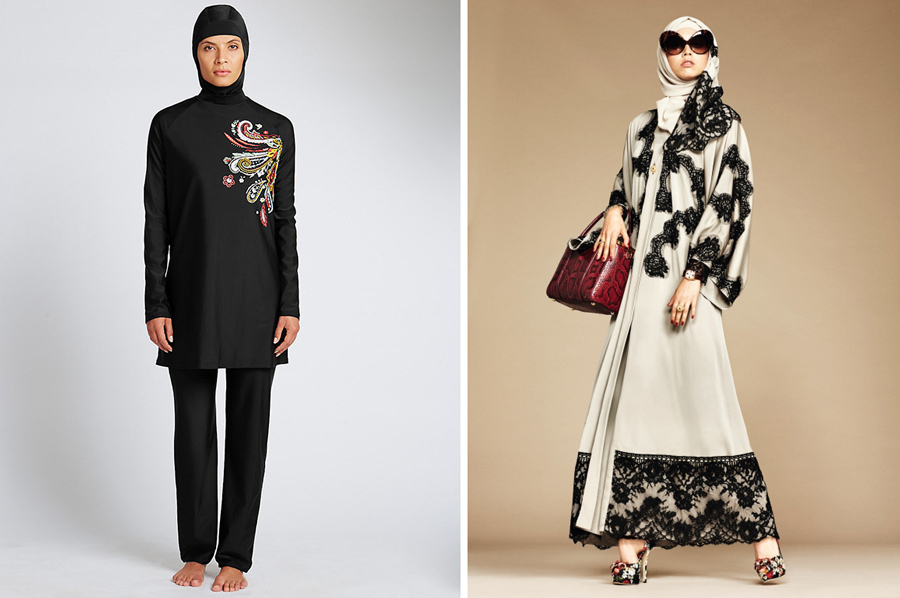
In 2016, the élite fashion label Dolce and Gabbana launched an “Abaya and Hijab Collection.” Months later, at New York Fashion Week, a sartorial Mecca, hosted the first catwalk spotlighting models fully donned in hijabs.

Islamist influence is now using Western culture to solidify Islamist values in society’s more coveted circles: fashion and beauty.

Left: Marks & Spencer’s Paisley Print Burkini. Right: An outfit from the Dolce & Gabbana Abaya and Hijab Collection.

Melanie Elturk, CEO of Haute Hijab, a leading U.S. hijab brand, openly shared a widely held belief that “fashion is one of the outlets in which we can start that cultural shift in today’s society to normalize the hijab in America.”

Later in the year, CoverGirl, a popular affordable makeup line, announced Muslim beauty blogger Nura Afia as its newest “brand ambassador.” A 23-year-old wife and mother, Afia hosts a YouTube channel, with over 200,000 subscribers, for hijab and makeup tutorials. She now stands with celebrities such as CoverGirl’s first male makeup model, James Charles; Modern Family star Sofia Vergara and pop singer Katy Perry in a campaign that highlights brands of makeup targeted at customers who applaud surface “diversity” and “equality.”

Posing together for a CoverGirl campaign aimed at portraying “diversity” were a male makeup model, a “hijabi,” a Latina TV star and a pop singer. It is a visual tableau trying to appeal to an audience that prizes “diversity” — one that sees “equality” based entirely on appearance rather than values or intrinsic worth. Rather than inquire into the marketplace of ideas that explores identity, faith and American values, we now have advertising campaigns that homogenize competing ideas into the funnel of multiculturalism. In this instance, a noted pop singer and a TV star are used as gateways to usher in the hijab as normal and perhaps even coveted.

Beauty and fashion industries in particular offer a mold in which intellectual discourse and cultural commentary is cast aside for opinion. That opinion is then shaped, packaged, and pushed as a product onto a population group already pliable to messaging. With CoverGirl’s newest “brand ambassador,” Nura Afia, the message echoes the mantra of hardline Islamist groups who have, since the presidential election, lost much of their political ground. Lost ground is now regained in new spheres through personalities such as Afia, without any association with political parties.

Beautiful Nura Afia in an advertising campaign is a far more appealing and consumer-friendly alternative to CAIR’s Nihad Awad or the political complexities of the Muslim Brotherhood. The face has changed but the message has not.

In an earlier Refinery29 interview, Afia had this message to share:

“Islam is such a beautiful religion. It’s peaceful and everyone else twists it, even within our own faith. Just from looking at social media, [I see] Muslims bash Muslims, so if that’s happening I can’t believe that we expect non-Muslims not to do the same. It’s just how humans are, I guess. It has nothing to do with religion.”

Yet, in a Facebook post just a month prior, Afia also shared this:

“If you find yourself no longer my friend on FB it’s because you either shared or posted some straight up ignorant, racist, or bigoted [expletive].”

Here you have the two faces of Islamist thought. The PR-friendly face of Islamist thought underscores the myth of peace, while on the other hand Islamism exiles dissenting voices as ignorant, racist or bigoted.

Meanwhile, CoverGirl and other brands uphold the hijab as a new standard of beauty, ignore the hijab’s extremely ugly origins. A handful of Islamic scholars believe the practice of hijab grew out of exclusionary practices designed to draw a distinction between “believing” women (Muslims) and “non-believing” women (non-Muslims). Islamic culture embraces piety through veiling the body of Muslim women, while at the same time it strips non-Muslim women of their dignity by seeing them as property and spoils of war to be parceled and consumed — a practice allowed by the faith.

The origin of the hijab tradition in Islam likely pre-dates the Quran, and comes from early Islamic society. The Quran, a book that outlines civilian and military life to the most granular detail, does not offer any doctrine that specifically dictates covering the hair. The Quranic verse (33:59) believed to mandate the hijab states:

“O Prophet, tell your wives and your daughters and the women of the believers to bring down over themselves [part] of their outer garments. That is more suitable that they will be known and not be abused. And ever is Allah Forgiving and Merciful.”

The practice of covering the hair grew from a slave-owning society. Speaking on Surah 33:59-60, which advises believing women to cover their bodies, Professor Barlas circulates a widely-shared view among academics:

“These are rather straightforward verses: if Muslim women don an outer garment (jil-bab), non-Muslim men will recognize them as such and not harass them. In early slave-owning societies, like Arabia, the ‘law of the veil’ set apart free women from slaves and therefore women who were off-limits from those who ‘were fair game’ (Lerner in Ahmed 1992:15). This was the society in which the first Muslim community took shape and it seems to have been under siege at the time.”

Professor Barlas’s assessment is debated by some Islamic scholars based on what they say is insufficient evidence; other Islamic scholars, including Professor Khaleel Mohammed, argue that the claim has merit.

The larger point is this: slavery at the time was a standard practice. It thrived culturally through acts of social and religious demarcations, such as the hijab, which became to many Muslims a sign of class supremacy, whereas women who were not veiled have been, and continue to be, harassed and attacked[1]:

“Except from their wives or those their right hands possess, for indeed, they are not to be blamed…” (Surah 70, Verse 30, Al-Ma’aarej, Sahih International)

Islam, to its credit, introduced many incentives to shift away from a slave-owning society, by making it simple to free slaves. According to Hadith (Sahih Bukhari Vol 3, Book 46, Number 693), for example, Muslims are rewarded in the afterlife for the act of freeing a slave; freeing the body of a slave is like freeing one’s own body from hellfire. Still, while Islam did not initiate slavery and while it did create pathways to move out of the practice, the faith never championed the right of all people to be free.

This failure is largely responsible for present-day slavery in Mauritania, a country to which devout Muslims flock to study Islam in an environment free from Western influence. This failure has also continued to permit rapes. These take place not only during wars from Sudan to Syria and the horrifying present day open enslavement of Yazidi women and children by ISIS and at international slave auctions in neighboring countries such as Saudi Arabia, bit also it seems, by various migrants to Europe.

It is then a fantastic stretch of the imagination when brands such as CoverGirl try to have consumers associate “equality” and “diversity” with hijabs and make-up. It also does not mirror the “Islam of peace” that many Muslims try to emphasize.

These deeper conversations are lost when the market through which Afia reaches out is largely uninterested in history, facts or any other evidence that prompts inquiry or reflection.

For Islamists, Afia and CoverGirl make excellent proxies in the push for normalizing the rigidity in the system of Islam by making it “chic to celebrate oppression.” Contrary to modern-day fantasies of the hijab “breaking barriers,” the hijab historically was used as a social barrier.

Normalizing the hijab reinforces the message that if you are not covered, you are not respectable and therefore not acceptable. That is the underbelly of Islamic culture: it controls thought and movement before attempting to corral other women into submission under the spoon-fed illusion of “diversity” and “equality.”

Shireen Qudosi, Director of Muslim Matters, at America Matters, is an American Muslim raised on three continents. She is writing her first book, Islam’s Origin Story.


[1] The Islamic scholar Dr. Tawfik Hamid also wrote a compelling piece, “Hijab, Even American Flag Hijab, Supports Historical Slave System.” Relying on multiple Islamic sources as evidence, Dr. Hamid exposes how the “hijab is a dress code in Islam that was designed to distinguish ‘free’ from ‘slave’ women.” Other modern Islamic thinkers, such as Asra Nomani and Hala Arafa add that Surah 33:59 wasn’t instruction to add a new layer of fabric, but to draw closer the jilbab (a long, overflowing gown) that was common at the time. Nomani and Arafa also cite the eight times “hijab” or its variation has appeared in the Quran; each time it was not in reference to piety but to draw distinction and barriers between two things:

The word hijab, or a derivative, appears only eight times in the Quran as an “obstacle” or “wall of separation” (7:46), a “curtain” (33:53), “hidden” (38:32), just a “wall of separation” (41:5, 42:52, 17:45), “hiding” (19:14) and “prevented” or “denied access to God” (83:15).”

Multiple references, both primary and secondary sources, point back to the hijab’s origin as not an act of piety, but an act of supremacy and distinction that made it easier for a slave system to thrive.

Islamism in Europe by Khadija Khan

  • Ironically, those who dare to speak out against extremists either face severe consequences, such as death threats, or are called anti-Muslim bigots. This kind of response often discourages progressive voices from speaking out, and understates the progress of counter-extremism even within the Muslim community. Opposition voices still might be there — more than ever. They just go underground.

  • Since the unprecedented terror attacks in France, Belgium and Germany, citizens across Europe have been living in constant fear. They seem to be sick and tired of the Muslim extremists; children might be in danger on their way to school, and shopping takes place under the protection of soldiers.
  • With Brexit, the election of Donald Trump, and Italy’s referendum, there seems to be a snowball effect. The growing influence of the Alternative for Germany (AfD), the National Front in France, the Party for Freedom in the Netherlands, the Freedom Party Austria and the Five Star Movement in Italy all appear to be byproducts of the same rhetoric.
  • The dull reaction of a vast number of European Muslims to the rising wave of terror and violence has also contributed to this shift. Increasing numbers of native-born Europeans seem angry and distrustful of their fellow Muslim citizens, especially when everyone else has come out loud and clear in denouncing terrorist crimes.

German authorities and those across Europe seem finally to be strengthening their campaign against the militant far-right, including Muslim extremists, during the past few weeks.

This awakening, however, seems to be coming after a major price that Europe had to pay in terms of death and chaos unleashed by terrorists in Germany, Belgium, France, Denmark, and so on.

Governments across Europe seem to be switching into panic mode to prevent the rise of European radicalism through the rise of the far-right, racism and nationalism throughout the entire continent.

German Chancellor Angela Merkel sounds as if she is backing down a bit from championing the influx of migrants and her slogan of “We can do it!” in developing a multicultural society. She not only vowed to Germans in an address last week that the migrant crisis must never be repeated; she also called for an all-out ban on the full-face veil covering in Germany.

Following Merkel’s lead, Interior Minister Thomas de Maizière also proposed a partial ban on veils, and pronounced them contrary to assimilation.

The dramatic shift in policy might be a consequence of the planned and perpetrated acts of terrorism by extremist Muslims, many of whom are the migrants on whom Merkel placed her hopes. It might also be the result of the resultant rise of European neo-Nazis. More likely, it would appear to come from an eye to re-election.

Merkel was declared by many the only defender of the free world after the election of Donald Trump as U.S. president. Perhaps, after the surprising victory of Donald Trump, she realized that it might be a good idea finally to address the grievances of her fellow countrymen.

The brutal rape and murder of a 19-year-old German woman, Maria Ladenburger, apparently by Afghan migrant who claims to be 17 years old, seems to have been the last nail in the coffin of Merkel’s open-door migrant policy, which she had promised to not to let go even after extreme opposition from within her own party’s leadership.

Ladenburger had been a medical student volunteering at a migrant housing facility. Her murderer had reportedly seen her in the shelter. The incident set off shockwaves not only in the Germany but also across Europe, especially after promises by Germany’s interior ministry to deport as many Afghan citizens as possible after failing to confirm any credible claims for asylum.

In the meanwhile, authorities in Berlin last weekend announced the arrest of an Afghan citizen who was actively involved in terrorist attacks in Afghanistan, while living part-time in Germany.

German police a few weeks back also launched an operation against a Salafist group in the country, whose members were brainwashing Muslim youths, mostly in Germany, to get jihadist training and join the Islamic State’s battle against the world in Syria and Iraq.

The Salafist organization had registered itself as a social work entity under the cover of distributing the Quran in markets and public places, and claiming to be bridging the gap between the West and Islam.

One suspect was arrested in Aschaffenburg and another was detained in Mannheim, on the allegation of plotting an Islamically motivated attack on a public place.

This recent shift in strategy is also a lesson that the West has learnt a bit too late, despite having experienced similar assaults not that long ago by the Nazis, Mussolini, Lenin, Stalin as well as terror organizations such as Baader Meinhof, al-Shebaab, ETA, the Red Brigades, Hamas, Al Qaeda, Palestinian Islamic Jihad and Hezbollah, to name just a few.

Since the unprecedented terror attacks in France, Belgium and Germany, citizens across the Europe have been living in constant fear. They seem to be sick and tired of the Muslim extremists; children might be in danger on their way to school, and shopping takes place under the protection of soldiers.

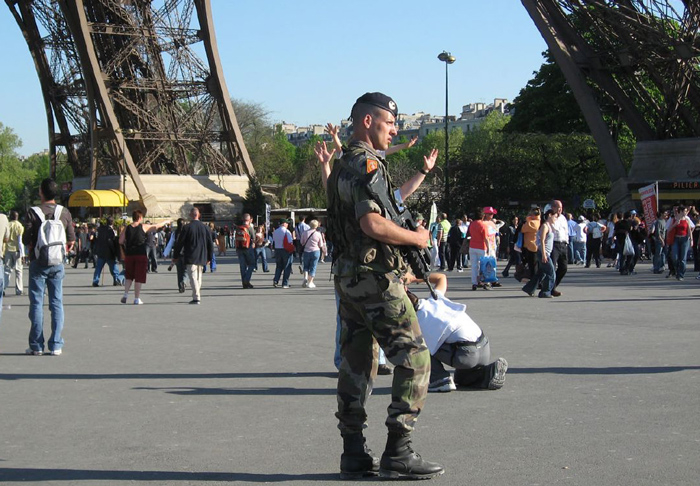
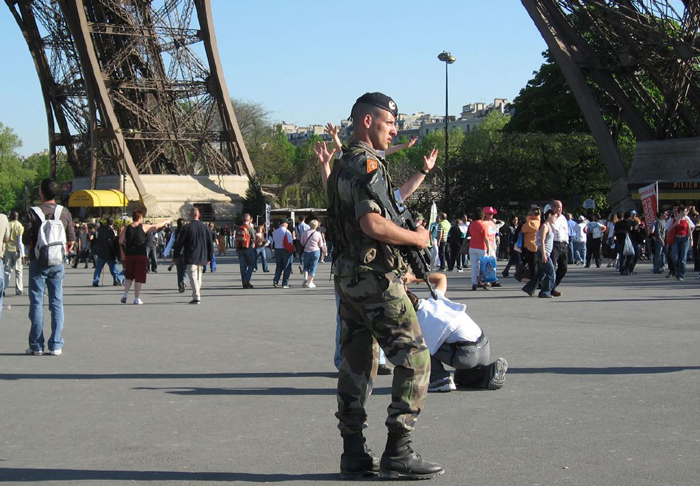
Since the unprecedented terror attacks in France, Belgium and Germany, citizens have been living in constant fear. In France, soldiers are deployed in the streets. Pictured: A soldier on guard at the Eiffel Tower in Paris. (Image source: Kirsteen/Flickr)

With Brexit, the election of Donald Trump, and Italy’s referendum, there seems to be a snowball effect. The growing influence of the Alternative for Germany (AfD), the National Front in France, the Party for Freedom in the Netherlands, the Freedom Party Austria and the Five Star Movement in Italy all appear to be byproducts of the same rhetoric.

The dull reaction of a vast number of European Muslims to the rising wave of terror and violence has also contributed to this shift. Increasing numbers of native-born Europeans seem angry and distrustful of their fellow Muslim citizens, especially when everyone else has come out loud and clear in denouncing terrorist crimes.

Ironically, those who dare to speak out against extremists either face severe consequences, such as death threats, or are called anti-Muslim bigots. This kind of response often discourages progressive voices from speaking out, and understates the progress of counter-extremism even within the Muslim community. Opposition voices still might be there — more than ever. They just go underground.

The majority of Muslims in the West seem oblivious to the fact that they would be the greatest victims of empowered lunatic extremists such as ISIS or neo-Nazis, because both would try to punish progressive Muslims either for remaining silent about terrorist attacks or for not joining the bandwagon for ISIS.

Progressive Muslims should realize that their voices matter at this sensitive time if they do not want to end up being losers between those two extremes.

The failed political policies of the global powers have started to translate into a dreadful future for humanity where a clone of Abu Bakr al-Baghdadi, Anders Breivik or a Neville Chamberlain clone might be calling the shots, and the civilized world would become a hell for those caught in the middle, the rest of us.

Khadija Khan is a Pakistan-based journalist and commentator.

Translate »
Skip to toolbar