Category Archives: Uncategorized

Israel Does Not Cause Anti-Semitism by Alan M. Dershowitz

In a recent letter to the New York Times, the current Earl of Balfour, Roderick Balfour, argued that it is Israel’s fault that there is “growing anti-Semitism around the world.”


Balfour, who is a descendent of Arthur Balfour, the British Foreign Secretary who wrote the Balfour Declaration a hundred years ago, wrote the following: “the increasing inability of Israel to address [the condition of Palestinians], coupled with the expansion into Arab territory of the Jewish settlements, are major factors in growing anti-Semitism around the world.” He argued further that Prime Minister Benjamin Netanyahu “owes it to the millions of Jews around the world” who suffer anti-Semitism, to resolve the Israel-Palestine conflict.

This well-intentioned but benighted view is particularly ironic in light of the fact that the Balfour Declaration had, as one of its purposes, to end anti-Semitism around the world by creating a homeland for the Jewish people. But now the scion of Lord Balfour is arguing that it is Israel that is causing anti-Semitism.

Roderick Balfour’s views are simply wrong both as a matter of fact and as a matter of morality. Anyone who hates Jews “around the world” because they disagree with the policy of Israel would be ready to hate Jews on the basis of any pretext. Modern day anti-Semites, unlike their forbearers, need to find excuses for their hatred, and anti-Zionism has become the excuse de jure.

To prove the point, let us consider other countries: has there been growing anti-Chinese feelings around the world as the result of China’s occupation of Tibet? Is there growing hatred of Americans of Turkish background because of Turkey’s unwillingness to end the conflict in Cypress? Do Europeans of Russian background suffer bigotry because of Russia’s invasion of Crimea? The answer to all these questions is a resounding no. If Jews are the only group that suffers because of controversial policies by Israel, then the onus lies on the anti-Semites rather than on the nation state of the Jewish people.

Moreover, Benjamin Netanyahu’s responsibility is to the safety and security of Israelis. Even if it were true that anti-Semitism is increasing as the result of Israeli policies, no Israeli policy should ever be decided based on the reaction of bigots around the world. Anti-Semitism, the oldest of bigotries, will persist as long as it is seen to be justified by apologists like Roderick Balfour. Thought Balfour does not explicitly justify anti-Semitism, the entire thrust of his letter is that Jew hatred is at least understandable in light of Israel’s policies.

Balfour doesn’t say a word about the unwillingness of the Palestinian leadership to accept Israel’s repeated offers of statehood to the Palestinians. From 1938 through 2008, the Palestinians have been offered and repeatedly rejected agreements that would have given them statehood. Even today, the Palestinian leadership refuses to accept Netanyahu’s offer to sit down and negotiate a final status agreement without any pre-conditions. Nor does Balfour mention Hamas, Hezbollah, and other terrorists groups that constantly threaten Israel, along with Iran’s publicly declared determination to destroy the state that Lord Balfour helped to create. It’s all Israel’s fault, according to Balfour, and the resulting increase in anti-Semitism is Israel’s fault as well.

Roderick Balfour ends his letter by essentially joining the boycott movement against Israel. He has declared his unwillingness to participate in the Centenary Celebration of the Balfour Declaration, until and unless Israel takes unilateral action to end the conflict. So be it. I am confident that the author of the Balfour Declaration would have willing participated in this celebration, recognizing that no country in history has ever contributed more to the world – in terms of medical, technological, environmental and other innovations — in so short a period of time (69 years) than has Israel. Nor has any country, faced with comparable threats, ever been more generous in its offers of peace, more committed to the Rule of Law, or more protective of civilians who are used as human shields by those who attack its civilians.

So let the Celebration of the Balfour Declaration go forward without the participation of Roderick Balfour. Let Israel continue to offer a peaceful resolution to its conflict with the Palestinians. And let the Palestinians finally come to the bargaining table, and recognize Israel as the Nation State of the Jewish people in the way that the Balfour Declaration intended.

Israel Deserves Better by Yleem D.S. Poblete

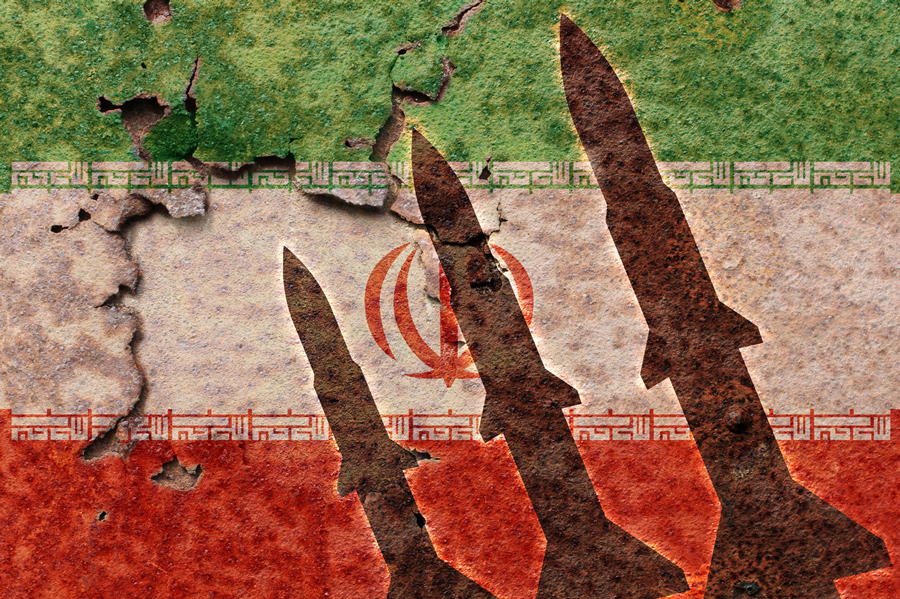
Iran continues to take Americans and other Westerners hostage, indicting three dual-nationals just days ago on unknown charges. This remains a troubling pattern of diplomatic blackmail, negotiation by coercion. Last month in Lebanon, a so-called parliamentarian for Hezbollah, a terrorist surrogate of the Iranian regime, called for “Israeli civilians to be kidnapped in a future war with Israel.” He “boasted” that Hezbollah’s missiles “can now reach Tel Aviv from Iran, not just Damascus, Beirut, or Cairo.”

The German intelligence service recently reported on numerous Iranian attempts to clandestinely obtain dual-use chemical, biological and nuclear technology. The report by the Bundesamt für Verfassungsschutz (BfV), the domestic intelligence service of the Federal Republic of Germany, also noted “a further increase in the already considerable procurement efforts in connection with Iran’s ambitious missile technology program, which could, among other things, potentially serve to deliver nuclear weapons.”

In early May, the Deputy Chief of Staff of the Iranian Armed Forces, Brigadier General Ali Abdollahi, reportedly revealed at a conference in Tehran that the regime had test-fired a high-precision ballistic missile “with a range of 2000 kilometers and pinpoint accuracy of 8 meters.” In March, Iran’s Islamic Revolutionary Guard Corps (IRGC) launched two Qadr medium-range ballistic missiles. On one of them, in Hebrew, was inscribed the phrase, “Israel must be wiped out.”

Iran’s Deputy Foreign Minister recently said, in response to the U.N. Secretary General’s statement that Iran’s ballistic missile tests are “not consistent” with the “spirit” of the multilateral nuclear agreement: “We will severely confront any move — be it political, legal, or technical — that hinders our missile program.”

Also recently, U.S. Department of Energy officials confirmed the purchase from Iran of nuclear materials. Congress voted to block such transactions but as media reports indicate that the purchase, amounting to $8.6 million in taxpayer funds, was conducted in April, the vote was to no avail.

More surprises could be in the offing. An oft-overlooked benefit in the JCPOA can be found in Annex III, where the parties decided to engage “in different areas of civil nuclear co-operation,” including construction and modernization of Iranian light water reactors, provision of technical assistance and on-the-job training.

Meanwhile, Israel has been denied a bilateral nuclear cooperation agreement with the U.S.

Some argue that, in light of the security challenges posed by Iran as well as other state and non-state actors, Israel should accept whatever the U.S. offers in the Memorandum of Understanding (MOU). This acceptance would be a mistake. A close ally — the only democracy in the Middle East — and a much needed partner in U.S. efforts to combat regional and global threats, Israel must not be turned into a beggar, particularly when Obama Administration policies have, arguably, contributed to an escalation of the dangers Israel faces.

Consider the billions in previously frozen assets released to Iran under the nuclear agreement. As least some of it, by Secretary of State Kerry’s own admission, will fall into the hands of the IRGC and other Iranian entities, affiliates, and surrogates designated as terrorists and terrorist-enablers. A separate $1.7 billion the U.S. Treasury transferred to the Central Bank of Iran in January of this year, as Tehran released Americans it had unjustly held captive for years, will be used to fund Iran’s military expansion.

For these and many other reasons, Israel’s reported MOU requests on security assistance, missile defense, and regional qualitative military advantage are justified.

Israel is a major strategic partner, as declared in the United States-Israel Strategic Partnership Act, enacted on December 19, 2014. The new law laid the foundation for expanded bilateral cooperation in a wide variety of spheres including defense, intelligence, and homeland- and cyber-security. Among other provisions, it enhanced “Israel’s trade status to expedite export licensing” for certain defense-related technologies and products, and expanded “authority for forward-deployed U.S. weapons stockpiles in the Jewish State.” Israel is also a major non-NATO ally and, in May of this year, was granted permission by the North Atlantic Council to open a diplomatic mission at NATO headquarters in Brussels.
Israel is a major strategic partner, as declared in the United States-Israel Strategic Partnership Act, enacted on December 19, 2014. The new law laid the foundation for expanded bilateral cooperation in a wide variety of spheres including defense, intelligence, and homeland- and cyber-security. Above, Israeli PM Netanyahu meets President Obama at the White House, May 20, 2011. (Image source: Israel PM office)

Perhaps it is time to fill the void in the security relationship with the Jewish State, elevate the discussions beyond an MOU, and consider a more fulsome security arrangement — one that is comparable to those with such trusted allies as the United Kingdom and Australia.

The Congress should lead the way, as the Obama Administration does not have “clean hands”. A newly released Senate Subcommittee report explains how the State Department awarded hundreds of thousands of dollars in government grants to an Israeli organization that used the funds to mount a campaign against Prime Minister Netanyahu in the 2015 parliamentary elections. President Obama once even questioned the necessity of maintaining Israel’s qualitative military edge.

Ultimately, the terms of any U.S.-Israel agreement must withstand comparison to the concessions offered Iran in the JCPOA and show unequivocally that Israel, a trusted ally and major strategic partner, fared better in negotiations than an unconstrained enemy.

Yleem D.S. Poblete, Ph.D. is a Fellow at the Institute for Policy Research at the Catholic University of America. She served for close to 20 years on the staff of the Committee on Foreign Affairs, U.S. House of Representatives, including as Chief of Staff. During her tenure, she was responsible for such consequential measures as the Iran Threat Reduction and Syria Human Rights Act of 2012, the Palestinian Anti-Terrorism Act of 2006, and the 2007 MOU with Israel.
Israel apology after plot against UK politicians

Al Jazeera reveals discussions of Israeli diplomat and UK civil servant to ‘take down’ anti-settlement politicians.Al Jazeera’s Investigative Unit uncovers Israel’s covert influence campaign in Britain


  • Investigation involved six-month undercover infiltration of anti-boycott campaign Discussions between Israeli diplomat and British civil servant to ‘take down’ politicians revealed The Israeli embassy has apologised to UK Deputy Foreign Secretary Sir Alan Duncan for comments made by one of its staff members on plans “to take [him] down” due to his criticism of Israel’s settlement activity in the occupied West Bank.

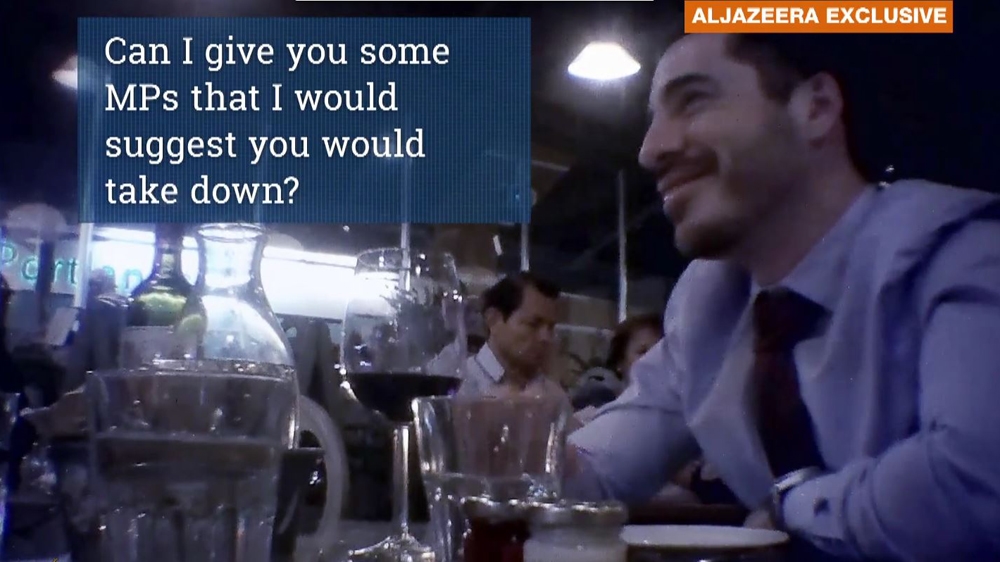
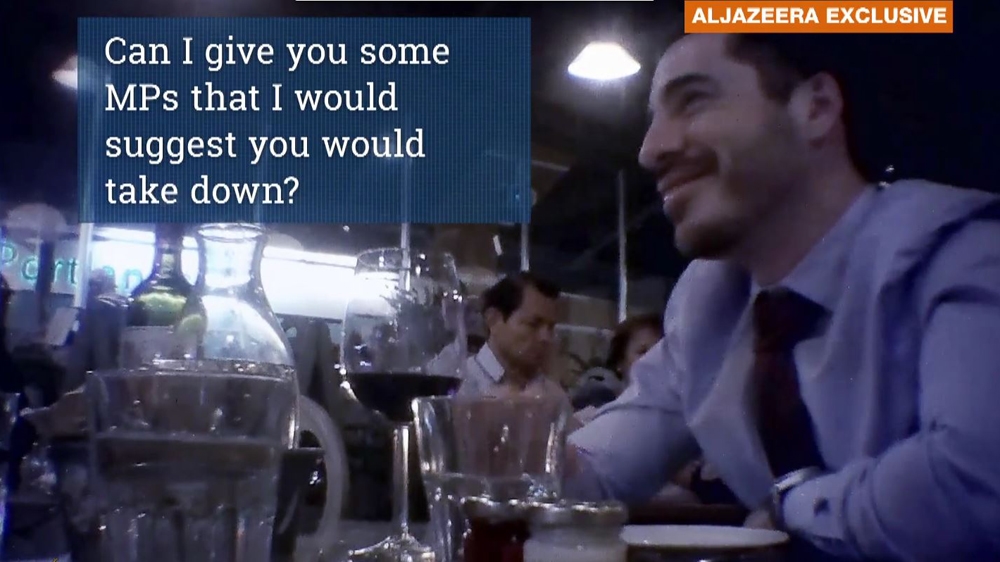
The comments, made by senior political officer at the Israeli embassy Shai Masot, were secretly captured on film during a six-month undercover operation by Al Jazeera’s Investigative Unit, which reveals plots by the Israeli diplomat and a British civil servant to destroy the careers of senior politicians.

In a conversation with Maria Strizzolo, who was then chief of staff to MP Robert Halfon, the deputy chairman of the ruling Conservative Party, Masot asked her if he could give her some names of MPs he would suggest she “take down”.

Masot named Duncan, who in 2014 said that while he fully supports Israel’s right to exist, he believes settlements on occupied Palestinian land represent an “ever-deepening stain on the face of the globe”. He also likened the situation in Hebron in the occupied West Bank to apartheid.

Shai Masot, senior political officer at the Israeli embassy [Al Jazeera]

Strizzolo later hinted that “a little scandal” might see Duncan dismissed.

At the same dinner table conversation, Masot described British Foreign Secretary Boris Johnson, Duncan’s boss, as an “idiot … without any kind of responsibilities”, while Strizzolo said he was “solid on Israel”.


RELATED: Israel’s parliamentary plot against UK politicians


Since the announcement by Al Jazeera’s Investigative Unit of its findings – and the international media coverage that followed – the Israeli embassy tweeted a response saying that Masot would be “ending his term shortly”, adding that Mark Regev, ambassador of Israel to the UK, had apologised to Duncan “and made clear that the embassy considered the remarks to be completely unacceptable”.

But this latest disclosure is just one among the Investigative Unit’s many findings, which will be revealed in a four-part series “The Lobby” that will be broadcast daily on Al Jazeera from January 15 at 22:30 GMT.

The undercover investigation reveals how the Israeli government is in the midst of a brazen, covert influence campaign in Britain.

For half a year, Robin (alias), an undercover reporter working with Al Jazeera’s Investigative Unit, met with members of Britain’s lobby network that enjoys strong support from the Israeli government by way of the Israeli embassy in London.

Robin posed as a graduate activist with strong sympathies towards Israel who was keen to help combat the Boycott, Divestment and Sanctions movement prominent in Britain.

Shaping foreign policy agenda

Strizzolo, while advising Robin, revealed that she had a strategy of manipulation to ensure Israel remains at the top of the UK’s foreign policy agenda.

“If at least you can get a small group of MPs that you know you can always rely on, when there is something coming to parliament and you know you brief them, you say: ‘you don’t have to do anything, we are going to give you the speech, we are going to give you all the information, we are going to do everything for you’,” she said.

She also advised trying to infiltrate Prime Minster’s Questions, a weekly session in which the leader of the country answers questions from MPs. The debate is televised live.

“If they already have the question to table for PMQs [Prime Minister’s Questions], it’s harder to say: ‘No, no, no, I won’t do it’,” she said.

Strizzolo then boasted how her own efforts once made an immediate impact on the national debate.

While in Israel with the Conservative Friends of Israel parliamentary group in 2014, she persuaded MP Halfon to question the prime minster in public over three missing teenagers believed to have been kidnapped and murdered “to get a response from the government”, Strizzolo said.

Halfon took the request and called on former prime minister David Cameron to support the Israeli government, which he said should do “everything possible to take out Hamas terrorist networks”.

In response, Cameron promised that Britain would “stand by Israel”.

Israel and “Palestine”: What International Law Requires by Louis René Beres

  • Under relevant international law, a true state must always possess the following specific qualifications: (1) a permanent population; (2) a defined territory; (3) a government; and (4) the capacity to enter into relations with other states.

  • While this contingent condition of prior demilitarization of a Palestinian state may at first sound reassuring, it represents little more than a impotent legal expectation.
  • For one thing, no new state is ever under any obligation to remain “demilitarized,” whatever else it may have actually agreed to during its particular pre-state incarnation.
  • “The legality of the presence of Israel’s communities the area (Judea and Samaria) stems from the historic, indigenous, and legal rights of the Jewish people to settle in the area, granted pursuant to valid and binding international legal instruments, recognized and accepted by the international community. These rights cannot be denied or placed in question.” — Ambassador Alan Baker, Israeli legal expert.

International law has one overarching debility. No matter how complex the issues, virtually everyone able to read feels competent to offer an authoritative legal opinion. While, for example, no sane person would ever explain or perform cardio-thoracic surgery without first undergoing rigorous medical training, nearly everyone feels competent to interpret complex meanings of the law.

This debility needs to be countered, at least on a case by case basis. In the enduring controversy over Palestinian statehood, there are significant rules to be considered. For a start, on November 29, 2012, the General Assembly voted to upgrade the Palestinian Authority (PA) to the status of a “Nonmember Observer State.”

Although it is widely believed by many self-defined “experts” that this elevation by United Nations has already represented a formal bestowal of legal personality, that belief is incorrect. Under law, at least, “Palestine” – whatever else one might happen to think of “fairness” – remains outside the community of sovereign states.

This juridical exclusion of “Palestine,” whether welcome or not, on selective political grounds, is evident “beyond a reasonable doubt.” The authoritative criteria of statehood that express this particular exclusion are long-standing and without ambiguity. Under relevant international law, a true state must always possess the following specific qualifications: (1) a permanent population; (2) a defined territory; (3) a government; and (4) the capacity to enter into relations with other states.

Moreover, the formal existence of a state is always independent of recognition by other states. According to the 1934 Convention on the Rights and Duties of States (the Montevideo Convention):

“Even before recognition, the state has the right to defend its integrity and independence, to provide for its conservation and prosperity, and consequently to organize itself as it sees fit….”

It follows that even a Palestinian state that would fail to meet codified Montevideo expectations could simply declare otherwise, and then act accordingly, “to defend its integrity and independence….”

More than likely, any such “defending” would subsequently involve incessant war and terror against “Occupied Palestine,” also known as Israel. The Palestine Liberation Organization (PLO) was formed in 1964, three years before there supposedly were any “Israeli Occupied Territories.” What, then, exactly, was the PLO trying to “liberate?”

Whenever the PA finally decides it is time openly to declare statehood, certain explicit Montevideo standards and corollary criteria of statehood will need to be invoked.

Much as the Government of Israel, seeking to challenge any such adversarial PA declaration, will then cite correctly multiple Oslo Agreement violations. The PA will counter-argue that its particular right to declare an independent state of Palestine is nonetheless fundamental, or “peremptory.” The PA will surely add as a footnote that its right of statehood according to jus cogens (“certain fundamental, overriding principles of international law, from which no derogation is ever permitted”) simply overrides all previously-existing expectations of a just peace with Israel.

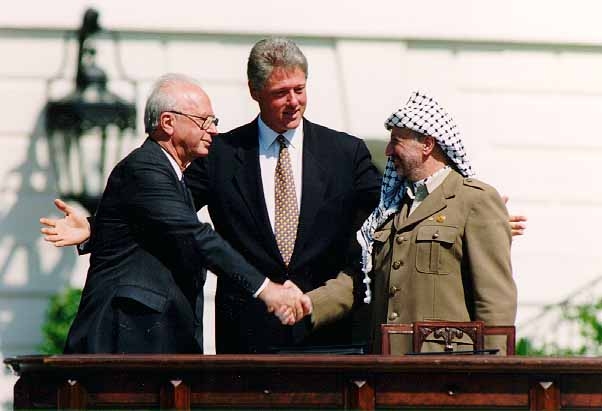
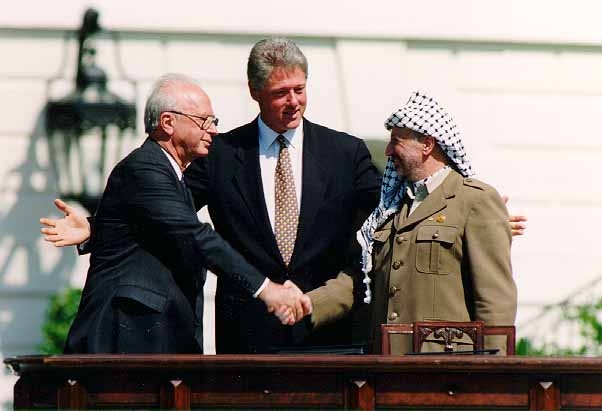
Israeli Prime Minister Yitzhak Rabin, U.S. President Bill Clinton, and PLO chairman Yasser Arafat at the Oslo Accords signing ceremony on September 13, 1993. (Image source: Vince Musi / The White House)

Undoubtedly, among other matters, the PA will cite (1) the plainly non-treaty quality of the Oslo Agreements (per definitions of “treaty” at the 1969 Vienna Convention on the Law of Treaties), and to (2) those basic and allegedly immutable human rights under international law that concern “self‑determination” and “national liberation.”

Now, of course, Prime Minister Netanyahu seems to have acknowledged the eventual creation of Palestine, but, among other things, only on the seemingly prudent condition of antecedent Palestinian “demilitarization.”

While this contingent condition may at first sound reassuring, it effectively represents little more than a contrived and ultimately impotent legal expectation. For one thing, no new state is ever under any obligation to remain “demilitarized,” whatever else it may have actually agreed to during its particular pre-state incarnation. For another, there is no discernible reason to believe that “Palestine” would ever make good on any of its pre-independence promises to Israel to support the Jewish State’s equally basic right to “peace and security.”

For “Palestine,” following formal statehood, the struggle with Israel would continue to be conceptualized as zero-sum; that is, on the corrosive assumption that absolutely any gain for Israel would represent a corresponding loss for Palestine. It could claim it was defending itself against anyone, including terrorist groups, and remain within its rights.[1]

Under the Montevideo Convention, all states are legally equal, enjoy the same rights, and have equal capacity in their exercise. The moment that the PA should proceed to declare a State of Palestine, the new country could become the effective juridical equal of Israel. To best maintain its indispensable national interests in such circumstances, Israel should insist that Palestine’s borders never be based upon pre-1967 lines.

A perfect core summation of such insistence is provided in the February 10, 2013 words of Israeli legal expert, Ambassador Alan Baker:

“The legality of the presence of Israel’s communities in the area (Judea and Samaria) stems from the historic, indigenous, and legal rights of the Jewish people to settle in the area, granted pursuant to valid and binding international legal instruments, recognized and accepted by the international community. These rights cannot be denied or placed in question.”

Accordingly, Israel should clearly affirm that Israeli “settlement activity” is in fact fully consistent with binding international law. Any contrary affirmation by a still-aspiring “Palestine” would be founded upon specious misrepresentations of this critical law.

Louis René Beres is Emeritus Professor of International Law at Purdue University. His just-published new book is titled Surviving Amid Chaos: Israel’s Nuclear Strategy. lberes@purdue.edu


[1] Over the years, a number of cases in United States federal courts have rejected the idea that the PLO, as “parent” of the PA, is in any way recognizable as the legitimate core of an independent Palestinian state. Earlier, perhaps, capable Israeli lawyers and policymakers might have been able to refer to such American case law in compelling support of an argument against Palestinian statehood. Today, however, after Oslo, and after so many years of incremental Israeli recognition of PLO/PA authority as legitimate, Israel will have to base its well-founded opposition to “Palestine” on other grounds.

Islamists Won: Charlie Hebdo Disappears by Giulio Meotti

“The newspaper is no longer the same, Charlie is now under artistic and editorial suffocation.” — Zineb el Rhazoui, French-Tunisian intellectual and journalist, author of Destroying Islamic Fascism. “We must continue to portray Muhammad and Charlie; not to do that means there is no more Charlie.” — Patrick Pelloux, another cartoonist who left the magazine. “If our colleagues in the public debate do not share part of the risk, then the barbarians have won.” — Elisabeth Badinter, philosopher, who testified in court for the cartoonists in the documentary, “Je suis Charlie.” After the Kouachi brothers slaughtered Charlie Hebdo’s journalists, they ran out into the street and cried: “We have avenged Muhammad. We killed Charlie Hebdo.” Two years later, it appears that they won. They succeeded in silencing the last European magazine still ready to defend freedom of expression from Islamism. Over twenty years, fear has already devoured important pieces of Western culture and journalism. They all disappeared in a ghastly act of self-censorship: the cartoons of a Danish newspaper, a “South Park” episode, paintings in London’s Tate Gallery, a book published by the Yale University Press; Mozart’s Idomeneo, the Dutch film “Submission”, the name and face of the US cartoonist Molly Norris, a book cover by Art Spiegelman and Sherry Jones’s novel, “Jewel of Medina”, to name just a few. Most of them have become ghosts living in hiding, hidden in some country house, or retired to private life, victims of an understandable but tragic self-censorship. Only the French satirical magazine Charlie Hebdo was missing from this sad, long list. Until now. The disappointment with what Charlie Hebdo has become is reflected in the words of the French journalist, Marika Bret: “From Italy we receive many threats.” The reference is not to some Italian jihadist cell, but to a September Charlie Hebdo cover that mocked victims of the earthquake in Italy. It seems that the satirical weekly, almost destroyed by French Islamists two years ago, has been “normalized”. Take Charlie’s recent covers. Against terrorists? No. Against those who called them “racists”? No. It was against Éric Zemmour, the brave French journalist at Le Figaro who has led a public debate about French identity. “Islam is incompatible with secularism, incompatible with democracy, and incompatible with republican government,” Zemmour wrote. Laurent Sourisseau, aka “Riss,” now the publishing director and majority owner of Charlie, was shot during the 2015 attack on the magazine, and lives under police protection. He depicted Zemmour on the cover with an explosive vest, effectively comparing him to a terrorist. Charlie Hebdo also recently satirized Nadine Morano, a critic of Islam, depicting her as a baby with Down Syndrome. Riss also recently published a comic book attacking another easy target of submissive conformists, entitled “The Dark Side of Marine Le Pen.” Le Pen leads France’s National Front party, with a platform fighting for national sovereignty and Europe’s Judeo-Christian identity. In Charlie, the political leader of the French “right” is dressed as Marilyn Monroe. For the first anniversary of the massacre at Charlie Hebdo’s office, Riss released a cover not with Mohammed, but depicting a murderous Judeo-Christian God, as if Riss’s colleagues had not been butchered by Islamists but by Catholics. Riss had, in fact, announced earlier that the magazine would “no longer draw Mohammed”. The first person at Charlie to capitulate was “Luz”, a well-known cartoonist. He surrendered, saying: “I will no longer draw Muhammad”. Charlie Hebdo, after Islamist terrorists murdered much of its staff in 2015, announced it would “no longer draw Mohammed.” Instead, the magazine now focuses on attacking critics of Islamism, and mocking the Judeo-Christian God. “The transplant that works worst,” said Jeannette Bougrab, the companion of Charlie’s late editor Stéphane Charbonnier, “is the transplant of balls.” Bougrab charged the attack’s survivors with bowing to terrorism and threats by betraying the legacy of free speech for which these truthful men were murdered. After the massacre of January 7, 2015, the cartoonist “Luz” cried in front of the cameras after presenting a cover depicting the survivors, in which Muhammad was portrayed as saying, “All is forgiven”. Luz then appeared in Le Grand Journal along with Madonna, and in a gesture of sad voyeurism, displayed his genitals, covered by the logo “Je suis Charlie”. Charlie’s “normalization” was also reflected in the recent dramatic decision to terminate the magazine’s relationship with another survivor, the French-Tunisian intellectual and journalist Zineb el Rhazoui, who also now has to live under police protection for her criticism of Islamic extremists. “The newspaper is no longer the same, Charlie is now under artistic and editorial suffocation,” she told Le Monde. Rhazoui is the author of a new book, “Détruire le Fascisme Islamique” (“Destroying Islamic Fascism”). “We must continue to portray Muhammad and Charlie; not to do that means there is no more Charlie”, said Patrick Pelloux, another cartoonist who left the magazine. There were seven cartoonists at Charlie Hebdo. Five were killed on January 7, 2015: Charb, Cabu, Honoré, Tignous and Wolinski. The other two, Luz and Pelloux, resigned after the massacre. The headline of the monthly Causeur captured the atmosphere: “Charlie Hebdo Commits Hara-Kiri,” playing with the Japanese form suicide and the previous name of Charlie (which was “Hara-Kiri”). Between murders, desertions and self-censorship, Charlie’s story is almost over. What is happening? Sadly, the Islamists’ threats and attacks are working. A similar crisis affected the Jyllands-Posten, the Danish newspaper that first published the 12 cartoons of Muhammad, which Charlie Hebdo immediately, to show solidarity, reproduced. “The honor of France was saved by Charlie Hebdo,” wrote Bernard-Henri Lévy when the magazine republished the Danish cartoons, while many “right thinking” media blasted the “Islamophobia” of those caricatures. “The truth is that for us it would be totally irresponsible to publish the cartoons today,” the director of Jyllands-Posten, Jorn Mikkelsen says to justify his self-censorship. “Jyllands-Posten has a responsibility to itself and its employees.” Such as Kurt Westergaard, author of the caricature of Mohammed with a bomb in his turban, who now lives in a house-fortress, with cameras and security windows and machine-gun toting guards outside. An ideological clash inside Charlie Hebdo developed well before the terror attack. Zineb el Rhazoui arrived at the weekly magazine through editor Stéphane Charbonnier, “Charb”, the brave journalist who lead the battle against Islamist intimidation in Europe. Even from his grave, he penned an “Open Letter to the Fraudsters of Islamophobia Who Play Into Racists’ Hands.” But, as Libération writes, “Riss opposed Charb; he is less politically identified, more introverted than him.” Charbonnier belonged to the generation of Philippe Val and Caroline Fourest, the libertarian journalists determined to criticize Islam, who, from 1992 to 2009, shaped the weekly magazine. “Charb? Where is Charb?”, shouted the terrorists in Charlie Hebdo’s office, to make sure they found the journalist they considered responsible for the Mohammed cartoons controversy. Philippe Val, who as a former Charlie Hebdo editor, was put on trial in Paris for printing those cartoons, published a book “Malaise dans l’inculture” (“Sickness in the Lack of Culture”), which attacks “the ideological Berlin Wall” that has been raised by the Left. In 2011, after a firebombing that destroyed Charlie’s offices, an appeal by frightened, intimidated journalists announced their refusal to support the magazine’s stance on Islam. Two years later, one of the signatories, Olivier Cyran, a former editor of Charlie Hebdo, charged the magazine with being “obsessive about the Muslims.” So did a former Charlie journalist, Philippe Corcuff, who accused his colleagues at the magazine of fomenting “a clash of civilizations.” The attacks continued with another former cartoonist at Charlie Hebdo, Delfeil de Ton, who, in Le Nouvel Observateur, after the 2015 massacre, shamefully accused Charb of “dragging” the staff into the slaughter by continuing to satirize Mohammed. After the Kouachi brothers slaughtered Charlie Hebdo’s staff, they ran out into the street and cried: “We have avenged Mohammed. We killed Charlie Hebdo.” Two years later, it appears that they won. They succeeded in silencing the last European magazine still ready to defend freedom of expression from Islamism. And they sent a special warning to all the others. Because after Charlie Hebdo, writing articles critical of Islam, or penning a cartoon, make them a target for assassination attempts and intimidation campaigns. The feminist and philosopher Elisabeth Badinter, who testified in court for the French cartoonists in the documentary, “Je suis Charlie,” said: “If our colleagues in the public debate do not share part of the risk, then the barbarians have won.” The magazine Paris Match asked Philippe Val if he could imagine the disappearance of Charlie Hebdo. Val replied: “This would be the end of a world and the beginning of Michel Houellebecq’s ‘Submission'”. After attacks comes self-censorship: submission. If Charlie Hebdo is tired and fleeing from responsibilities, who can blame it? But the others, the rest?

Translate »
Skip to toolbar