

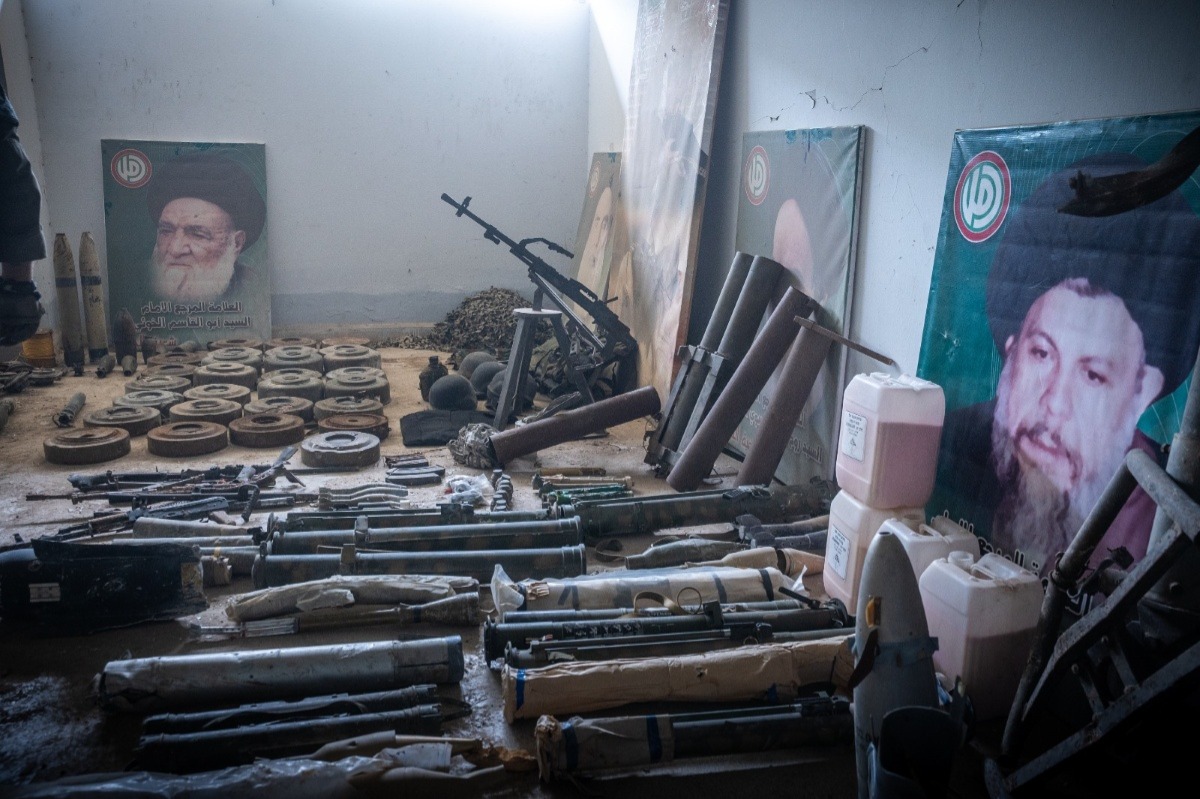
[T]he latest escalation in hostilities did not begin with Israel. It began with Hezbollah.Israel found itself faced with ongoing rocket fire from Lebanon and the presence of a heavily armed group on its border – in contravention of UN Security Council Resolution 1701, which had unanimously required of Lebanon: “three principles — no foreign forces, no weapons for nongovernmental militias, and no independent authority separate from the central government — as vital to a lasting Lebanese peace.”
Hezbollah’s operational tactics, like those of Hamas and other terrorist groups, is to embed its military infrastructure within civilian areas hiding weapons, command centers and operational assets in densely populated neighborhoods…. With Hezbollah’s military targets located in homes, hospitals and schools within civilian population centers, any efforts to neutralize them carry the tragic possibility of unavoidably harming civilians. It is a strategy deliberately designed to constrain Israel’s responses and generate international backlash against it.
Responsibility for these war crimes lies squarely with Hezbollah in Lebanon and Hamas in Gaza, which deliberately orchestrated them. Any resulting casualties cannot be judged outside this context.
In 2024, Hezbollah violated its ceasefire with Israel and also attacked in 2025 at Iran’s behest. Israel’s response comports with what any sovereign state would do when confronted with attacks on its territory and civilian population.
If there is to be any meaningful discussion about stability in the Middle East, it needs to begin with an honest acknowledgment of these realities. Otherwise, international reactions will continue to mischaracterize the problem by criticizing responses while overlooking their causes — and contributing to the conflict rather than to its resolution.
Once again, large segments of the international community, from the United Nations to key European governments, appear either unwilling or unable to confront the basic and uncomfortable reality that the latest escalation in hostilities did not begin with Israel. It began with Hezbollah.
This silence — or at best, selective acknowledgment — when, without provocation, rockets were launched into Israel, stands in blazing contrast to the instant outrage when Israel responds. That imbalance is not just dishonest; it distorts the foundation of how conflicts like this are understood.
One must begin with the simple but critical fact that there was no active, large-scale conflict between Israel and Hezbollah at the time the current escalation began. Israel was, however, facing direct threats and attacks in a broader confrontation with Iran. It was precisely then — when Israel was under pressure — that Hezbollah chose to act. The timing reflects a calculated decision to open a second front against Israel with the clear intention of intensifying the strain on its defenses.
What would any other country do if it were under attack by an enemy, and suddenly faced missile barrages into its towns and cities? Would it just stare at the sky and watch?
Presumably no state — whether in Europe, Asia, or the Americas — would tolerate such a situation. The seeming expectation that Israel, smaller than the state of New Jersey (roughly 22,000 sq. km), should absorb such attacks without a decisive response is not only unrealistic; it is fundamentally inconsistent with how sovereignty and self-defense are globally understood.
Hezbollah is not just some independent force acting in isolation. It is, by its own admission, founded by, intertwined with, and dependent on the Islamic Republic of Iran.
“Hezbollah arose in the wake of Iran’s 1979 Islamic Revolution,” according to Middle East expert Hussain Abdul-Hussain, “as part of an effort to establish an Islamic state in a Lebanon fractured by warring militias.”
Hezbollah’s weapons, funding, and strategic direction are explicitly linked to Tehran. Such a relationship transforms Hezbollah’s actions from spontaneous, isolated incidents into components of a broader regional strategy. When Hezbollah acts, it is not just a local terrorist group making tactical decisions — it is an extension of a regional power’s geopolitical agenda.
When considering ceasefires or diplomatic arrangements – for instance, Iran accepting a ceasefire while Hezbollah continued its attacks – the contrast exposes that any ceasefire failing to restrain Iran’s most powerful proxy remains incomplete. It allows the conflict to persist through indirect means, through the back door, while maintaining the only pretense of de-escalation. Such agreements are pretty much worthless.
Israel’s response, therefore, must be understood within that broader context.
Israel found itself faced with ongoing rocket fire from Lebanon and the presence of a heavily armed group on its border – in contravention of UN Security Council Resolution 1701, which had unanimously required of Lebanon:
“three principles — no foreign forces, no weapons for nongovernmental militias, and no independent authority separate from the central government — as vital to a lasting Lebanese peace. Underlying these principles was the recognition that while the flow of arms to terrorist groups like Hizballah is the most immediate threat to stability in Lebanon, the true key to long-term peace is an empowered and capable central government in Beirut.”
None of this, of course, took place. Instead, Hezbollah basically seized control of Lebanon, proceeding to cement domination over the military and the media, as well as having veto power over Lebanon’s cabinet. Hezbollah positioned itself along Lebanon’s short, 80 km border with Israel, and deployed approximately 150,000 rockets and missiles, aimed at Israel’s towns and cities.
Israel, after being attacked, unsurprisingly acted to neutralize the threat. Critics sometimes focus on the scale of Israeli operations, but scale alone is not the only valid metric on which to base judgment. The relevant question is: Does a state have the right to defend itself against an armed group attacking it and openly seeking its elimination? By any conventional standard of international relations, the answer is yes.
Hezbollah’s operational tactics, like those of Hamas and other terrorist groups, is to embed its military infrastructure within civilian areas — hiding weapons, command centers and operational assets in densely populated neighborhoods. This positioning deliberately creates a tragic and intended dilemma. With Hezbollah’s military targets located in homes, hospitals and schools within civilian population centers, any efforts to neutralize them carry the tragic possibility of unavoidably harming civilians. It is a strategy deliberately designed to constrain Israel’s responses and generate international backlash against it.
The use of military infrastructure within a civilian population violates international humanitarian law and constitutes a war crime when it intentionally places civilians at risk. Responsibility for these war crimes lies squarely with Hezbollah in Lebanon and Hamas in Gaza, which deliberately orchestrated them. Any resulting casualties cannot be judged outside this context.
Global reaction, however, disregarding who is actually responsible for these war crimes, as planned, follows a predictable and troubling pattern. Initial acts of aggression by Hezbollah of Hamas receive no attention or are framed ambiguously. When Israel responds, however, the narrative shifts dramatically and becomes a declaration of “It all started when he hit me back!” This call is followed by sympathy for the false grievance, widespread condemnation of Israel, which was attacked, and self-righteous, misplaced calls for its restraint. It is a pattern that reverses cause and effect, and focuses instead on the response while downplaying — or ignoring — the aggression. Such an approach does not contribute to peace; it slyly perpetuates getting the facts wrong. Possibly there are those who do not want the outcome of the conflict to align with the facts.
For nearly 80 years, tiny Israel has faced open and persistent threats to its existence from most of the 57 members of the Organisation of Islamic Cooperation, working with the support of Russia and much of Europe. Recent attacks from Lebanon — opening a second front on Israel’s north in addition to Hamas’s on its south — is a condition that no country could tolerate. The expectation that Israel should allow itself to be defeated is not simply unrealistic, it is detached from the norms applied to all other nations.
In 2024, Hezbollah violated its ceasefire with Israel and also attacked in 2025 at Iran’s behest. Israel’s response comports with what any sovereign state would do when confronted with attacks on its territory and civilian population.
If there is to be any meaningful discussion about stability in the Middle East, it needs to begin with an honest acknowledgment of these realities. Otherwise, international reactions will continue to mischaracterize the problem by criticizing responses while overlooking their causes — and contributing to the conflict rather than to its resolution.
egretnewseditor@gmail.com