

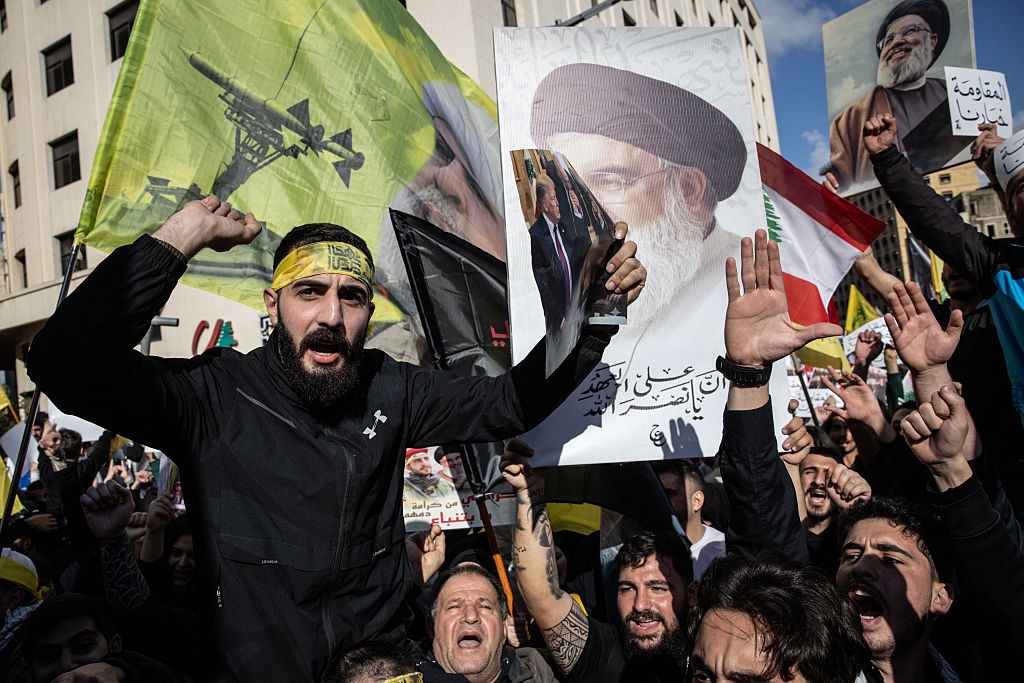
Hezbollah Secretary-General Naim Qassem dismissed the talks as “futile” and reaffirmed that his organization will not disarm. Wafiq Safa, a senior Hezbollah official, told The Associated Press that his organization will refuse to abide by any agreements that may result from the direct Lebanon-Israel talks: “[A]s for the outcomes of this negotiation between Lebanon and the Israeli enemy, we are not interested in or concerned with them at all…. We are not bound by what they agree to.”
These statements are not simply rhetoric. They are a proclamation that Hezbollah, not the Lebanese government, will determine whether Lebanon goes to war or pursues peace.
Lebanon has effectively become a protectorate of Iran. The consequences for the Lebanese people have been devastating.
This week, as the Lebanese government was preparing to participate in US-mediated talks with Israel in Washington, DC, Hezbollah, the Iran-backed terrorist organization, delivered its verdict: No negotiations, no compromise. Only war.
The talks, which took place on April 14, aim to ensure “long-term security of Israel’s northern border” while supporting Lebanon’s efforts to “reclaim full sovereignty over its territory.”
In a televised speech, Hezbollah Secretary-General Naim Qassem dismissed the talks as “futile” and reaffirmed that his organization will not disarm. Referring to statements by Israeli Prime Minister Benjamin Netanyahu that Hezbollah’s weapons must be dismantled and that Israel wants a real peace agreement with Lebanon, Qassem declared:
“We will not rest, stop or surrender. We will let the battlefield speak for itself. We will remain in the field until our last breath.”
Qassem added:
“We reject negotiations with the usurping entity… We call for a historic and heroic stance by canceling this negotiating meeting.”
Wafiq Safa, a senior Hezbollah official, told The Associated Press that his organization will refuse to abide by any agreements that may result from the direct Lebanon-Israel talks:
“[A]s for the outcomes of this negotiation between Lebanon and the Israeli enemy, we are not interested in or concerned with them at all…. We are not bound by what they agree to.”
These statements are not simply rhetoric. They are a proclamation that Hezbollah, not the Lebanese government, will determine whether Lebanon goes to war or pursues peace.
Lebanon today bears little resemblance to the country it once was.
Before the 1975-1990 civil war, Lebanon was known as the “Switzerland of the Middle East.” During the 1960s and 1970s, it enjoyed significant prosperity, strict banking secrecy laws, and a reputation as a safe, neutral financial hub for regional and international capital. Its banking sector was among the most sophisticated in the Arab world. It attracted foreign investment and established Beirut as one of the world’s leading financial centers.
French journalist Julien Ricour-Brasseur wrote in Middle East Eye in 2021:
“Lebanese citizens unwilling to attempt the desperate crossing of the Mediterranean are flocking to public offices to obtain visas to any possible destination. They are looking to somewhere beyond the sea, where the glow of green is beckoning, the green light of hope – and the dollar….
“The story of Lebanon could open like this: Once upon a time, there was a nation known as the Switzerland of the Middle East. And frankly, the story ends there.”
Lebanon was also distinguished by its sectarian diversity and religious pluralism, a place where multiple Muslim and Christian communities coexisted within a relatively open political system. Its geography, combining snow-capped mountains suitable for winter sports with a Mediterranean coastline, made it a major tourism destination. At its peak, Lebanon enjoyed one of the highest GDP per capita levels in the region and was regarded as a rare oasis of stability in a turbulent Middle East. This Lebanon, however, no longer exists.
Decades of civil war, corruption, and political paralysis have been a main driving force behind its decline. Yet Hezbollah’s emergence as an armed state within the state, and its repeated wars with Israel on behalf of its patrons in Iran, are key factors that have contributed to Lebanon’s collapse.
Lebanon is currently a failing state. In 2022, the United Nations wrote:
“The destructive actions of Lebanon’s political and financial leaders are responsible for forcing most of the country’s population into poverty, in violation of international human rights law, the UN Special Rapporteur on extreme poverty and human rights, Olivier De Schutter, said in a report published today…
“‘Impunity, corruption, and structural inequality have been baked into a venal political and economic system designed to fail those at the bottom, but it doesn’t have to be that way,’ said De Schutter, an independent expert appointed by the UN Human Rights Council.
“‘The political establishment knew about the looming cataclysm for years but did little to avert it. Well-connected individuals even moved their money out of the country…’
“‘Central Bank policies, in particular, led to a downward spiral of the currency, the devastation of the economy, the wiping out of people’s lifetime savings and to plunging the population into poverty.'”
Worse, Lebanon has effectively become a protectorate of Iran. The consequences for the Lebanese people have been devastating.
Hezbollah has dragged Lebanon into two calamitous confrontations with Israel in just the last three years.
The first took place after the October 7, 2023 Hamas-led invasion of southern Israel, when Hezbollah opened fire on Israel from Lebanon as a “support front” for its terrorist allies in the Gaza Strip.
The second war Hezbollah launched against Israel came after Israeli and American strikes against Iranian targets in June 2025. Hezbollah again initiated rocket and drone attacks on Israel in “solidarity” with the Iranian regime. Both rounds of fighting brought renewed destruction, displacement, and economic collapse on the Lebanese people.
The pattern is now clear: Hezbollah chooses death and destruction, and the Lebanese people pay the price.
Created, funded, and armed by the Iranian regime, Hezbollah continues to operate as Iran’s most powerful proxy in the Middle East. Its leaders pledge allegiance not to Lebanon, but to mullahs in Iran. Its weapons are not under the control of the Lebanese state. Its decisions on war and peace are dictated by Iran’s regional strategy rather than Lebanon’s national interests.
While not formal peace negotiations, the meeting in Washington this week signaled a possible step toward more structured dialogue and normalization between Israel and Lebanon.
Peace between Lebanon and Israel would, above all, benefit the Lebanese people. It would stabilize Lebanon, open the door to economic recovery, attract investment, and begin reversing decades of state collapse. More significantly, it would restore to Lebanon what Hezbollah has taken away: the ability to act as a sovereign state pursuing its own national interests.
The Hezbollah leader’s call to cancel the Washington talks reflects the terrorist organization’s fear that diplomacy could succeed and that Lebanon might begin to break free from the grip of the Iranian regime. For the Lebanese people, peace with Israel could offer something more basic: a chance to reclaim their country from the cycle of war, death and destruction. Until that reality changes, Lebanon will remain trapped not only in conflict with Israel, but in a deeper crisis of sovereignty, identity, and survival.
egretnewseditor@gmail.com