Category Archives: Uncategorized

What to Expect in Iran by Jagdish N. Singh

  • “The destruction of Israel is non-negotiable.” — Mohammad Neza Naghdi, Commander of Iran’s Basij paramilitary force.

  • Sanctions relief will mainly benefit Ayatollah Khamenei and members of the Revolutionary Guards: they control up to one-third of Iran’s economy.
  • Part of the Iranian regime’s grand strategy is to inflict “death to America” and replace it with its own radical version of Islamic governance. Ayatollah Khamenei himself called for America’s destruction amid nuclear negotiations.
  • Officials also believe Iran is indirectly funding the Islamic State (IS) in the Sinai. “Suitcases of cash” are sent directly to Hamas officials in the Gaza Strip; part of the money is then transferred to IS.
  • Iran now poses an even greater threat. If democracies today continue their present policies towards Iran, it will only embolden Iran’s regime to continue its quest to obtain nuclear weapons as well as its terrorism and human rights violations.

Humanity seldom seems to learn its lessons. The governments of the world’s leading democracies appear to be suffering from this predicament in their nuclear dealings with the Islamic Republic of Iran. To avoid catastrophe, democracies need quickly to correct their course.

One of the fatal blunders of Western democracies is their repeated commitment to appeasing and delaying action against aggressive regimes. Between the two World Wars, despite plenty of evidence of the widely-declared global racist agenda of Germany’s Adolf Hitler, democratic powers waited to take action until it was too late. Hitler was able to carry out a genocide that continues to haunt many nations.

Today, Western democratic governments, with their Eastern counterparts such as India, seem on a similar course in dealing with the Islamic Republic of Iran.

The domestic and international agenda of the Khomeinist government is publicly documented. Since the Iranian Revolution of 1979, part of the regime’s open grand strategy is to inflict “death to America,” the leader of the free world, and replace it with its own radical version of Islamic governance. Under the current Supreme Leader Ayatollah Ali Khamenei and his Islamic Revolutionary Guards Corps (IRGC), Iran has been gaining influence across the Middle East, Latin America, the Caribbean and South Asia. Despite nuclear talks with the West, Iran’s goal of “death to America” remains. The Ayatollah himself even called for America’s destruction amid nuclear negotiations.

Currently, Iran is a major player in aiding the autocratic regime of Basher al-Assad in Syria, the Houthis in Yemen, Hezbollah in Lebanon, Palestinian Islamic Jihad and Hamas in the West Bank and Gaza and the Islamic State (IS) in Egypt’s Sinai Peninsula.

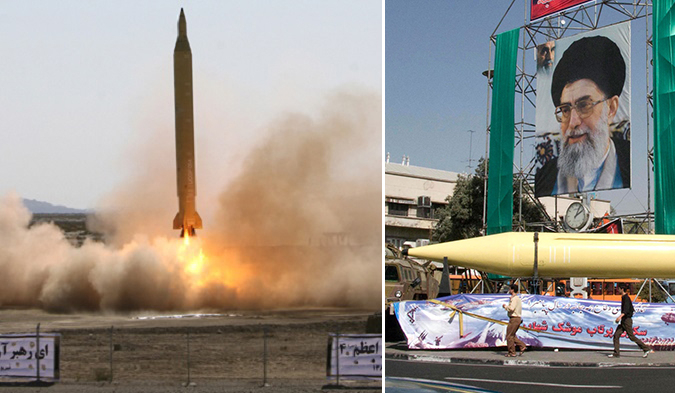
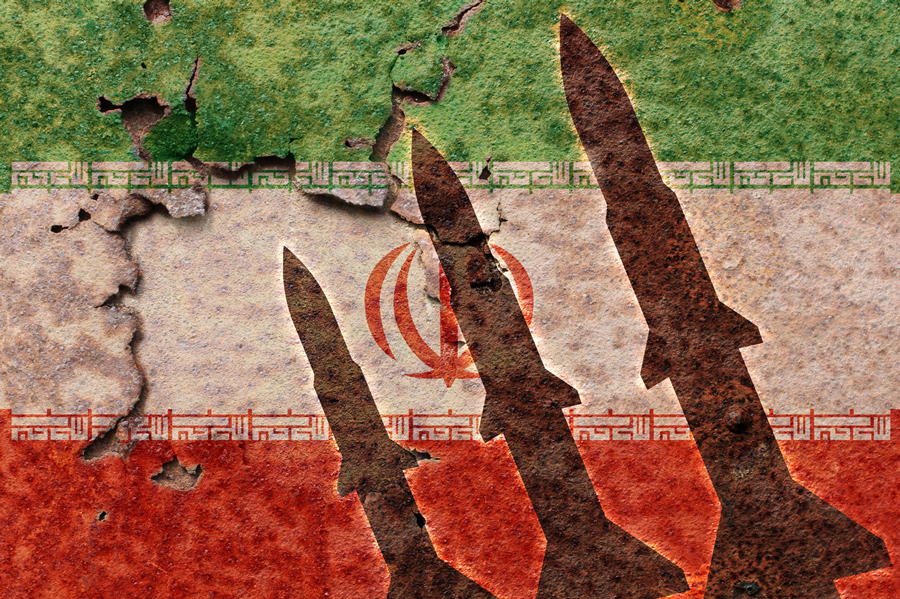
To advance its imperial agenda, Iran has proceeded to develop its conventional and nuclear ballistic missile program. According to Director of National Intelligence James Clapper, Iran has “one of the largest inventories of ballistic missiles in the Middle East.”

In line with Iran’s missile development program, Iran’s Revolutionary Guard Navy Rear Commander, Ali Fadavi, announced: “Based on the fifth five-year plan, we should materialize our objective of mass-producing military speedboats with the speed of 80 knots per hour… and are equipped with missiles with a range of 100km; the vessels no one can catch.”

Aside from its military aspirations, since the fall of the Shah in 1979, successive Iranian governments have voiced their plans to annihilate the State of Israel, the only pluralist democracy in the Middle East, and an effective military deterrent to Iran’s designs in the region.

Hostile messages have been pouring forth from Iran. Mohammad Neza Naghdi, Commander of the Basij paramilitary force, stated in clear terms in April 2015, that, “The destruction of Israel is non-negotiable.”

Major General Yahya Rahim Safavi, a former IRGC commander and a top military aide to Khamenei, warned in May 2015, that “More than 80,000 missiles are ready to rain down on Tel Aviv and Haifa.”

As late as November, Iran’s Supreme Leader Khamenei himself tweeted, “This barbaric, wolflike & infanticidal regime of #Israel which spares no crime has no cure but to be annihilated.”

Bewilderingly, Western democracies have chosen to overlook Iran’s speeches and actions. They chose instead to appease the regime. Last July, despite genuinely serious reservations expressed by international strategic and military experts (including retired American military officers), the United States, United Kingdom, France and Germany – the four democracies in the P5+1 — concluded a nuclear deal with themselves that they proposed to Iran. Iran so far has not signed the deal, and apparently even if it did, according to the U.S. Department of State, the deal would not be legally binding.

Tehran will greatly benefit financially from the terms of the nuclear agreement in the months to come. Under the administration of President Barack Obama, nuclear sanctions against Iran have been lifted. To advance the deal and make it more appealing to Iran, the president has also agreed to pay Iran a $1.7 billion settlement for $400 million in “frozen” assets held in the United States since 1981.

The Society for Worldwide Interbank Financial Telecommunication (SWIFT), “the electronic bloodstream of the global financial system,” had disconnected 15 Iranian banks from its system in 2012. after coming under pressure from both the United States and the European Union at the height of efforts to curb Iran’s nuclear ambitions. Today, SWIFT is ready to let those banned banks, including the Central Bank of Iran, use its system once again. Iran now has an even greater ability to fund its terrorist proxies around the world.

European political and business leaders have been rushing to Tehran to sign new agreements. On January 28, in Paris, Iran’s President Hassan Rouhani and France’s President Francois Hollande signed major business deals, including a joint venture between car-makers PSA Peugeot Citroen and Iran’s Khodro. Iran is in the process of buying 118 Airbus passenger planes to update its aging fleet. The construction group Bouygues and the French airport operator ADP are now set to build an extension for Tehran’s airport, while Vinci, another construction firm, has been commissioned to design, build and operate new terminals for the Mashhad and Isfahan airports. The French oil company Total has agreed to buy Iranian crude oil, and agreements in shipping, health, agriculture and water provision have also been signed.

Democratic India is also cultivating relations with Iran. In a meeting in May, India’s Minister of Road Transport and Highways, Nitin Gadkari, and Iranian Transport and Urban Development Minister, Abbas Ahmad Akhoundi signed a Memorandum of Understanding on India’s participation in the development of the Chabahar Port in Iran.

The Chabahar project will impart strategic leverage to India and its access to Afghanistan and energy-rich Central Asia by bypassing Pakistan. The distance between the Chabahar Port and Gujarat – India’s westernmost state, located near the Persian Gulf, is less than the distance between Delhi and Mumbai. Transit times are estimated to be reduced by a third. Indian firms have already agreed to lease two existing berths at the port and operate them as container and multi-purpose cargo terminals.

The Chabahar project, New Delhi calculates, will be highly beneficial. As India has invested over $2 billion in Afghanistan, the Indian government plans to link the Chabahar port with the Zaranj-Delaram road it built in Afghanistan, thereby opening alternative routes to Afghanistan and enhancing access to regional and global markets.

Russia and China, permanent members of the UN Security Council, are also strengthening their cooperation with Iran. Both Russia and China adopted a policy of ambivalence towards Iran and saw to it that sanctions imposed by the West were not too tough. They also repeatedly blocked attempts at sanctioning Iran’s ally, the current Syrian regime, out of concern over financial ties in the region.

China is also capitalizing on the lifting of sanctions against Iran. Chinese President Xi Jinping rushed to Iran after the so-called nuclear agreement to discuss a 25-year strategic cooperation plan. In a landmark deal worth up to $600 billion, Xi committed to increase trade between the two nations during the next decade. Beijing and Tehran also agreed to enhance security cooperation through intelligence-sharing, counter-terror measures, military exchanges and coordination. Incidentally, despite international sanctions, China-Iran trade increased from $3 billion in 2001 to more than $50 billion in 2014.

Given its fanatical and sectarian ideological agenda, Iran is likely to use the new funds to boost its armament program and ongoing clandestine terror acts. Sanctions relief will mainly benefit Khamenei and members of the IRGC: they control up to one-third of Iran’s economy.

Iran now poses an even greater threat to the entire civilized world. The pattern of Tehran’s behavior shows the government can never be trusted on any promises it makes not to advance its nuclear weapons program. Khamenei has made an open declaration that Tehran will not allow effective inspections of its military sites or interviews with its nuclear scientists.

The links of the IRGC’s Qods Force with Hezbollah, Hamas, Palestinian Islamic Jihad, the Houthis and other terror militias pose a major threat to peace and stability in the Middle East.

Hezbollah’s networks have expanded over the years, infiltrating Latin America and the Caribbean through Shiite cultural centers in the region. According to an official Argentine report, Tehran has established its terrorist, intelligence and operational networks throughout Latin America as far back as the 1980s. Iran’s intelligence activities in the region are being conducted directly by Iranian officials or through its proxy, Hezbollah. Criminal activity may already be underway in Brazil, Colombia, Chile, Paraguay, Uruguay, Suriname and Trinidad and Tobago. Iran’s involvement in the cocaine trade has bolstered the regimes regional access and strengthened ties with its allies in Venezuela, Ecuador, Bolivia and elsewhere.

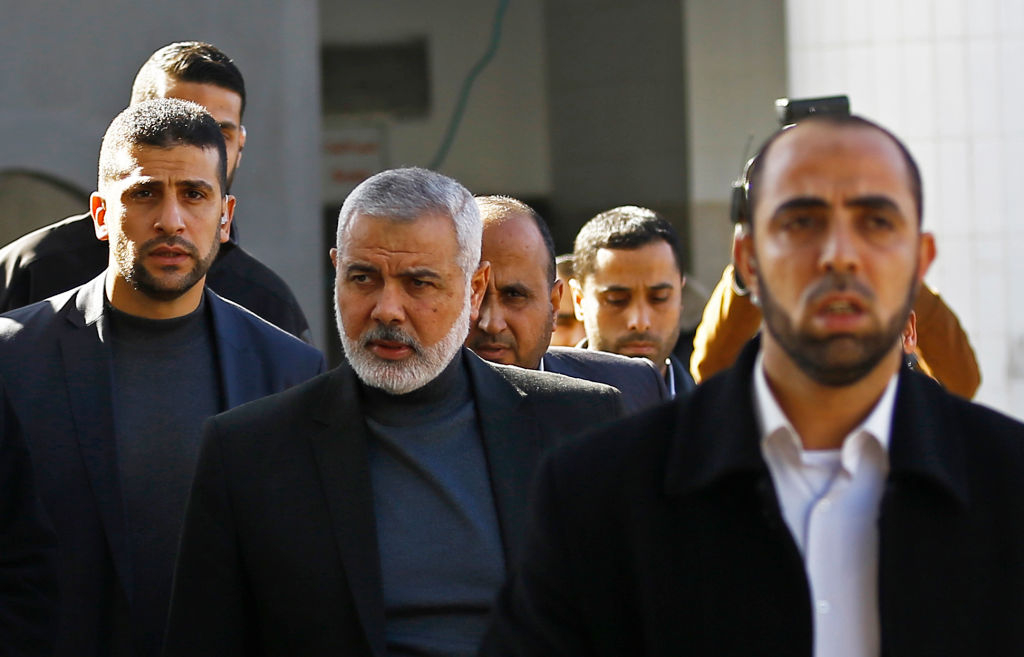
According to senior Western intelligence officials, the IRGC has transferred tens of millions of dollars to Hamas to be used for weapons, military equipment and training, and that Iran also delivers arms and funds to Hamas through the Red Sea and the Sinai. Officials also believe Iran is indirectly funding the Islamic State (IS) in the Sinai. “Suitcases of cash” are sent directly to Hamas officials in the Gaza Strip; part of the money is then transferred to IS.

Tehran’s links with Hamas and IS are part of a grander strategy of using proxy forces to gain hegemony over the Middle East and undermining American allies such as Egypt and Israel. In Lebanon, Iraq and Syria, Iran seeks to preserve its influence. By fighting IS, Iran strengthens existing pro-Iran regimes and maintains its relevance in the region.

While Iran does support IS indirectly in the Sinai, the government’s goal is to weaken the current Egyptian regime and the Sunni Arab alliance between Egypt, Saudi Arabia and Jordan. It has no problem with IS gaining strength in the Sinai right now. If IS does gain more power in the Sinai, Iran can use it to impose its own agenda in the future. Tehran evidently wants to use IS victories against Sunni states as an opportunity to take over.

Iran also supports the Gaza-based terror group al-Sabireen [“The Patient Ones”], established in the wake of previous tensions between Iran, Hamas and Islamic Jihad. The group has about 400 followers and its emblem is identical to that of Hezbollah. Each member receives a monthly salary of $250-$300, while senior members receive at least $700. Annually, the terror group receives a budget of $10 million from Iran, smuggled in suitcases through tunnels along the border with Egypt. Potential members are wooed by al-Sabireen through familiar channels of philanthropy and education. The group’s publications refer to the United States as “the source of superpower terrorism,” and its slogan is, “The road to the liberation of Palestinian goes through Karbala” — a Shiite holy city in Iraq.

Al-Sabireen has extended its operations from the Gaza Strip to the West Bank and Jerusalem with Iran’s backing. Hisham Salim, the founder of al-Sabireen, admitted that his group is directly financed by Iran. “We have an armed branch whose goal is to wage war on the Israeli occupation everywhere,” Salim said. “Within this framework we have members in the West Bank and Jerusalem.”

The Obama administration has forged ahead with its Iran policies despite knowing the regime’s support of global terrorism. U.S. President Barack Obama himself spoke about Iran’s terror activities in a press conference last year. “Now, we’ll still have problems with Iran’s sponsorship of terrorism; its funding of proxies like Hezbollah that threaten Israel and threaten the region; the destabilizing activities that they’re engaging in, including place like Yemen,” he said, adding that the nuclear “deal is not contingent on Iran changing its behavior. Its not contingent on Iran suddenly operating like a liberal democracy.”

History urges those living in democracies today to rein in their governments and correct their fatal Iran policies. The world cannot afford to overlook the damage of these governments. If democracies today continue their present policies towards Iran, it will only embolden Iran’s regime to continue its quest to obtain nuclear weapons as well as its terrorism and human rights violations.

Jagdish N. Singh is a leading journalist based in New Delhi, India.

What to Expect from an Independent Palestinian State by Fred Maroun

  • Palestinian leaders have repeatedly shown that their priority is not peace, or a two-state solution, or a Palestinian state, but repression.


  • If a Palestinian state is created without correcting these destructive practices, it is highly likely that the new Palestinian regime will follow the same pattern already established, and be a hatemongering, corrupt, undemocratic, oppressive, belligerent, and ineffective regime. This would not only be a security threat for Israel, it would mean more of the same for the Palestinians.

France, with the support of the United States, is leading a new attempt at peace between Israel and the Palestinians, with the implied goal that an independent Palestinian state would be created — but what should we expect from such a state?

Although past behavior is not a perfect predictor of future behavior, it is a strong indicator of it, especially if no corrective action has been taken.

Violence

When Israel withdrew from Gaza in 2005, Palestinian Authority President Mahmoud Abbas declared, “The dawn of freedom rises with the evacuation of the last Israeli soldier and settler.” Yet, instead of using that freedom to build a successful economy, Palestinians destroyed the greenhouses that the settlers had left, and terrorists launched rocket attacks against Israel. These attacks forced Israel to institute a naval blockade of Gaza, to limit the supply of weapons to terrorists.

The Oslo Accords signed by Israel and the Palestinians in the 1990s provided a transition period meant to lead to Palestinian statehood. However, instead of peaceful coexistence with Israel, the Palestinian leadership launched an assault that became known as the Second Intifada.

During the recent stabbing attacks by Palestinian terrorists, Abbas declared, “Each drop of blood that was spilled in Jerusalem is pure blood as long as it’s for the sake of Allah. Every shahid (martyr) will be in heaven and every wounded person will be rewarded, by Allah’s will.”

These violent actions and the incitement are not exceptions. They are part of a pattern of Arab denial of the Jews’ right to exist, which started well before Israel declared its independence, and that caused several wars and innumerable terrorist attacks against Israel.

Lack of democracy

Palestinian democracy has so far been a failure. Yasser Arafat was elected in July 1994 as president of the Palestinian Authority (PA) for a four-year term, but he stayed in power, without further elections, for more than 10 years until his death in November 2004. Mahmoud Abbas was elected President in May 2005, and is still in office, without further elections, eleven years later.

Hamas, which won the PA legislative elections of 2006, was never invited to take the PA reins of power, but it took control of the Gaza Strip through a violent overthrow of Fatah, and still controls Gaza — also without further elections — ten years later.

Fatah and Hamas have used elections to create a semblance of democracy, and both have abused their authority to go far beyond their legitimate mandates. Both routinely use control of the media, control of the education system, and violence to maintain their power, as documented extensively by Israeli-Arab journalist Khaled Abu Toameh.

Hamas leader Ismail Haniyeh (left) and Fatah leader Mahmoud Abbas (also president of the Palestinian Authority) are pictured voting in the last election for the Palestinian Legislative Council, which took place in 2006.

Corruption

Corruption in the PA and Hamas is widely recognized, by commentators who range from extreme anti-Israel, to somewhat moderate pro-Palestinian, to pro-Israel.

As reported by CBS News in 2003, “Yasser Arafat diverted nearly $1 billion in public funds to insure his political survival, but a lot more is unaccounted for.”

Abbas has continued the tradition. Haaretz reported that the Panama Papers “show that Tareq Abbas, the son of Palestinian Authority President Mahmoud Abbas, held shares worth nearly $1 million in a company associated with the PA”.

Khaled Abu Toameh has written that, “$4.5 billion the Americans invested in promoting Palestinian democracy went down the drain or ended up in secret Swiss bank accounts.”

Hamas, which was elected partly in opposition to Fatah corruption, is just as corrupt. Moshe Elad wrote in Tablet Magazine that the Hamas government, “is centralized and corrupt, it lacks effectiveness, bribery plays a very important role in society, and nepotism is prevalent, with just few families or relatives benefiting from state monopolies on basic services and commodities”.

Associated Press reported that 95.5% of Palestinians in the West Bank believe that the PA is corrupt while 82% of Palestinians in Gaza believe that Hamas is corrupt.

Promotion of hatred

As noted previously, promotion of hatred by Palestinian leaders is widespread, and it is the main obstacle to peaceful co-existence with Israel. An example of Palestinian hate propaganda is a made-for-children movie where, as reported by London’s Daily Mail,

“The little girl, dressed in a hijab, is seen pretending to stab two boys dressed as Israeli soldiers, who respond by ‘shooting’ her. Then, amid cheers from the baying crowd, a boy dressed as a masked terrorist massacres the soldiers with a replica semi-automatic weapon.”

The newspaper added that the video was filmed at a “festival of hate,” which was partly funded by a UK charity supported by British Labour Party leader Jeremy Corbyn and some other Labor MPs.

Oppression of the Palestinian people

Both Fatah in the West Bank and Hamas in Gaza run their governments as dictatorships, where freedom of speech is denied and where dissent is punished by jail, beatings, torture, or death. This retribution is widely recognized, even by organizations that are often considered biased against Israel, such as Human Rights Watch (HRW) and Amnesty International (AI).

In 2011, in a 35-page report, HRW documented “cases in which security forces tortured, beat, and arbitrarily detained journalists, confiscated their equipment, and barred them from leaving the West Bank and Gaza.”

In their 2015/16 report, Amnesty International wrote,

“The Palestinian authorities in the West Bank and the Hamas de facto administration in the Gaza Strip both restricted freedom of expression, including by arresting and detaining critics and political opponents. They also restricted the right to peaceful assembly and used excessive force to disperse some protests. Torture and other ill-treatment of detainees remained common in both Gaza and the West Bank.”

Lack of economic drive

Palestinian leaders have concentrated all their efforts on waging war against Israel and increasing their own personal wealth. The best economic opportunities presented to average West Bank Palestinians are in working on settlement construction or commuting daily to jobs in Israel.

The lack of Palestinian economic development in the West Bank is often blamed on Israel, yet when Israel withdrew from the Gaza Strip, Palestinian leaders did not seize that opportunity to build the economy of Gaza. They chose instead to spend their resources on rockets, terror tunnels, and enriching the leaders of Hamas.

Bad behavior is rewarded

Those who provide funding to the Palestinians are aware of this behavior, yet they have not used their influence to curb it. In fact, they reward it.

The Palestinian leadership in Gaza is rewarded for every war it initiates with Israel in two ways. During the war, it is rewarded by the international media, which provides wide coverage of Palestinian casualties while ignoring the terrorist actions that led to those casualties (thus playing into Hamas’s “dead baby strategy“). After the war, Gaza’s leadership is rewarded when more funding is provided for reconstruction, despite the knowledge that a large portion of it is used to rebuild the terrorist arsenal.

The Fatah/Palestinian Authority leadership in the West Bank is rewarded by international donors who provide ongoing funding to President Mahmoud Abbas while knowing the extent of the corruption of his regime and its lack of democracy.

Realism

Palestinian leaders have repeatedly shown that their priority is not peace, or a two-state solution, or a Palestinian state, but repression. If a Palestinian state is created without correcting these destructive practices, it is highly likely that the new Palestinian regime will follow the same pattern already established, and be a hatemongering, corrupt, undemocratic, oppressive, belligerent, and ineffective regime. This would not only be a security threat for Israel, it would mean more of the same for the Palestinians.

Current talk by Western leaders of peace, a two-state solution, and a Palestinian state makes no mention of these dangers. If those leaders wish to achieve a lasting peace that is beneficial to Israel and the Palestinians, rather than to create an unstable situation that could cause irreparable damage to both sides, peace discussions must account for the Palestinian reality.

Fred Maroun, a left-leaning Arab based in Canada, has authored op-eds for New Canadian Media, among other outlets. From 1961-1984, he lived in Lebanon.

What They Do Not Tell You about Indonesia by Jacobus E. Lato

  • The doctrine, “all Muslims are your brothers and sisters,” was now everywhere.Community prayers, Friday prayers, newspapers and television programs started roaring the idea of Islamic supremacy.

  • At community prayer meetings, one often hears discussion on how to behave as Muslims. Now many seminars, conventions, and newspapers, especially during Ramadan, discuss the greatness of Muslims and Islam.

My kampong [village] lies in the suburbs of Surabaya, the second biggest city in Indonesia. Densely packed in a narrow alley, it consists of more than forty houses, stacked like logs, with no gaps at all to sneak in between. A handful of residents work for the government or public schools; some run small household shops. Most residents are Muslim, except for three families who are Christian.

A handful of plants provide us with green, but just down the road scattered stores have been soaring: a big franchise department store, a gas station, banks with long rows of automatic teller machines and facilities that make us feel like a small part of growing Indonesia.

When we first moved here, it seemed ideal. There were only twelve families; they got together at events; we felt close. Communal meetings were held each month; the host would prepare snacks and even sometimes meals. If one of us were in the nearby hospital, we would usually drive together in groups to pay a visit after collecting small contributions to give the sick person. Only one lady, a convert to Islam, wore a headscarf; others only wore it when necessary: at public meetings, celebrations, or Independence Day, August 17.

Saturday nights were the long night. People sat outside on paving stones or rough and humble chairs, and discussed many matters, especially before elections. Indonesia was then under President Susilo Bambang Yudhoyono, a graduate of America’s Webster University.

Religious days were marked as moments of happiness and joy. People opened wide their hearts; heaven was coming down and moving us. We visited each other after Eid al Fitr‘s early morning prayer. Everyone said, “Minal Aidin Wal Fa Idzin” (“Many happy returns”) and “Mohon Maaf Lahir Batin” (“Please forgive my wrongdoings”). The long-held tradition of Megengan, when families exchange food or snacks — not just Muslims but Christians, Catholics, Hindus and Buddhists — always preceded Ramadan.

On Christmas, the three Christian families would welcome visitors. Visits to our house by our Muslim friends inspired us to see how great our nation was, and of course our religions. Our Muslim friends would say, “Merry Christmas”.

“Islam with a smiling face,” was what Newsweek called Indonesian Islam in 1996. The statement made us proud of our cultural hospitality (about 90% of Indonesians are Muslim): Everyone was kind; everyone was moderate; everyone respected humanistic values and a harmonious life.

But, along with the fall of Suharto after 32 years in power, a few Indonesian Muslims, who apparently share some worldwide dreams, began to try to realize this dream. Hardliner clerics, who had lived in exile under Suharto, returned. They made their way into the masses, into the power blocs supported by their networks and their donors. The dream, particularly among a handful of the educated elite, of establishing a Muslim state, or at least a Muslim society, began rushing to the surface.

There is no need for the innocent majority to have a “great idea”; their only needs are leaders and direction. The new leaders then disseminated their ideas: the greatness of Islam, the greatness of Muslims, the greatness of Islamic kinship. The doctrine, “all Muslims are your brothers and sisters,” was now everywhere.

Some hardliner clerics moved out from their traditional boarding schools and started climbing the political ladder. Some of them, including those clerics belonging to the Council of Indonesian Clerics (MUI) — the highest Islamic body in the country — and some of the descendants of Saudi or Yemeni clerics, bluntly displayed their new aroma of Islam: Middle East Islam. Community prayers, Friday prayers, newspapers and television programs started roaring the idea of Islamic supremacy.

Many changes took place. In 1980, under Suharto and his powerful, bureaucratic Golkar Party, women almost never wore a headscarf, let alone the monotonous hijab or niqab. Many women then were on the lookout for brand new colorful scarves and cosmetics. These women are lucky: new branded products, armed with halal certifications from our MUI, are on the rise in shops. Arabian-style dresses are on display in boutiques. Arab-style long coats with headscarves are commonplace. A sea of white dresses inundates the public squares, communal prayer meetings, mosques. A leading figure in Surabaya, who requested anonymity, said, “Nowadays Muslim women feel uncomfortable if they do not wear a headscarf. They might be considered unfaithful or not sufficiently devout.”

Men with long and loose beards, marked foreheads and Arabian-style dress hold a Muslim type of rosary; they chant various names of God as their lips move silently — are now common. At community prayer meetings, one often hears discussions on how to behave as Muslims. Seminars, conventions and newspapers, especially during Ramadan, discuss the greatness of Muslims and Islam.

Unfortunately, along with those developments, our happy moments are disappearing at high speed. Being Muslim, for some, means excluding others. A polarization happens; some people do not want to deal with people of another religion.

There are stories of raids on churches, Christian shrines and mosques run by the small Ahmadiya sect. Other religious days, especially Christmas, are now marked by those for and against them, thanks to fatwas.

MUI, Indonesia’s highest Islamic body, says it no longer wants Muslims to greet Christians during Christmas; it is considered a sin. Many people are afraid of being labeled unfaithful or blamed for being kind to Christians. We still can shake hands, but anything else is now forbidden. “Saying ‘Merry Christmas’ is against my religion,” a friend explained to me. “The greeting acknowledges Jesus Christ as Allah.”

Valentine’s Day is another of many concerns about the supposed “Christian influence.” Some department heads at educational agencies have issued circulars, banning students from celebrating it (here, here, here).

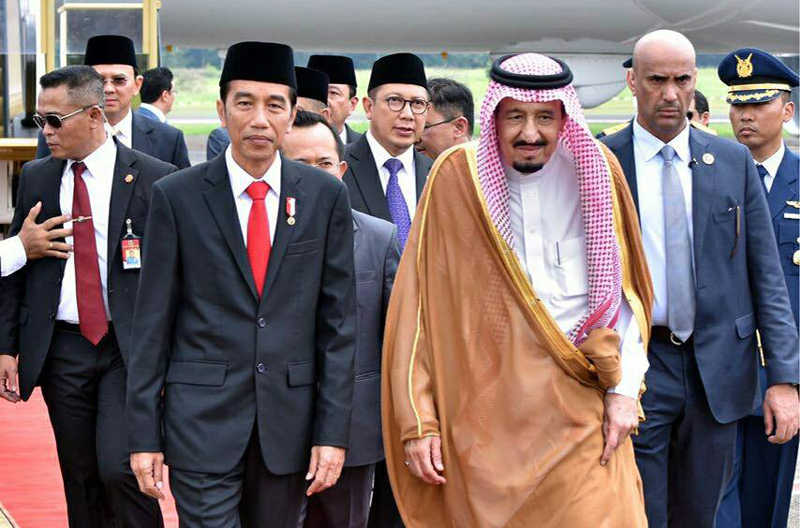
On March 12, King Salman of Saudi Arabia ended his visit to Indonesia; he boarded his royal airline and headed to Japan. Ash around the runway blew into the air. All memories of His Highness’s visit reside in our people’s mind, even while we were wishing His Majesty farewell.

After the oil boom, Iran’s Revolution and the 444 days of the U.S. Embassy hostage crisis in Iran, Indonesian Muslims believed Muslim power was returning.
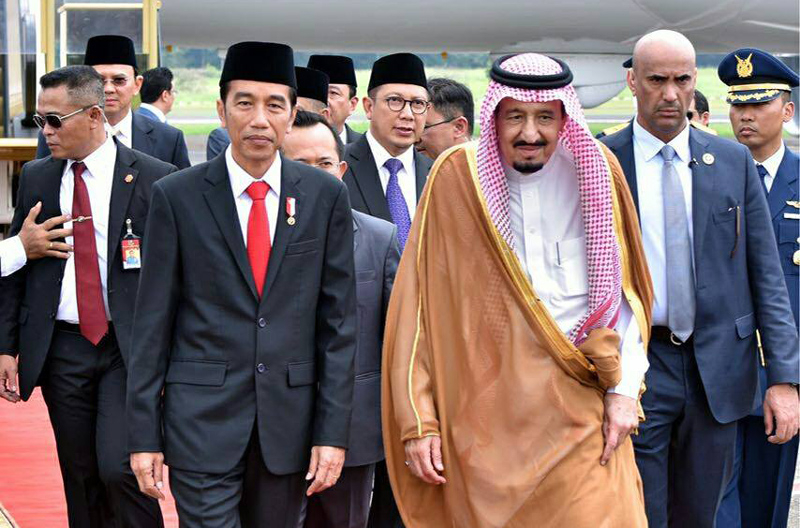
President Joko Widodo of Indonesia (foreground, left) meets with King Salman of Saudi Arabia (foreground, right), at Halim Perdanakusuma Airport in Indonesia. (Image source: Indonesian Presidential Palace)

Jacobus E. Lato, a writer, is based in Surabaya, Indonesia.
What Politicians Say vs. What People Can See

  • Throughout a bombing-and-murder campaign lasting three decades, the BBC never referred to the Irish Republican Army (IRA) as the “so-called IRA.” If you flatten ISIS’s military, the strong-horse appeal of ISIS would simply go away. If there is nothing to join, no one can join it.


  • Cameron’s and Obama’s tactic is to deny something that Muslims and non-Muslims can easily see and find out for themselves: that ISIS has a lot to do with Islam — the worst possible version, obviously, for Muslims and non-Muslims alike, but a version of Islam nevertheless.

    • A few days after the massacre of 30 British subjects on a Tunisian beach, the UK Prime Minister, David Cameron, used an interview on the BBC to berate the broadcaster and others for using the term “Islamic State.” Mr. Cameron’s suggestion was that the broadcaster should either refer to the “so-called Islamic State,” use the acronym “ISIL,” or adopt the Arabic term, “Daesh.”

      None of these suggestions is workable. The Irish Republican Army (IRA) was never the “army” of the Irish Republic. It was instead a group of sectarian terrorists who claimed to fight for a community that was largely disgusted by their actions. Yet throughout a bombing and murder campaign lasting three decades, the BBC never referred to the IRA as the “so-called IRA.” The group called itself the IRA, and so broadcasters and others referred to it as such. One might wish to call such groups all sorts of things, but calling by the name its leaders adopt is the easiest option of presenting the facts and not getting bogged down in nomenclature.

      The Prime Minister’s other suggestions — that the Islamic State should either be called “ISIL” or “Daesh” — are equally doomed to failure. For ISIL of course simply means “Islamic State of Iraq and Levant,” while “Daesh” is effectively an Arabic acronym of the same. If the aim of all this wordplay is that the general public dissociate “Islamic State” from Islam, there seems little hope that this will much help to break the connection. After all, what if someone — anyone — asks what ISIL or Daesh stand for? What should people then say in response?

      Of course, the problem that the Prime Minister got into on this occasion is the same problem he and all other world leaders get into whenever they adopt the “Islam is a religion of peace” line. What they are perfectly understandably trying to do is to disentangle more than a billion Muslims worldwide (and specifically the tens of millions of Muslims in Western democracies) from the violent jihadists in their religion. At the same time, they — again understandably — hope to give the message to their non-Muslim publics that they should not blame Muslims everywhere for the actions of this violent minority.

      This is a laudable aim, but it is doomed to failure because members of the public no longer rely on either politicians or the mainstream media as their only sources of information or news. They can perfectly well get on the internet and find things out for themselves, and it is in this growing gulf between what politicians say and what the general public can perfectly easily find out for itself that a real long-term danger could emerge.

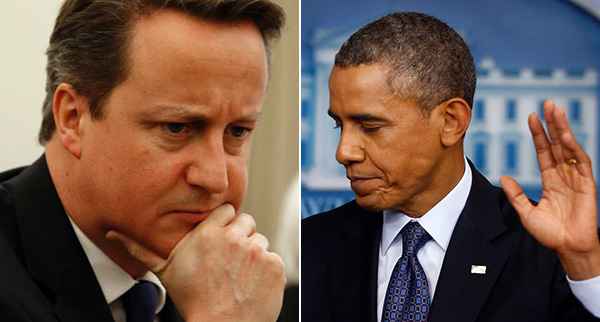
      Why won’t the public believe them when they explain that the “so-called Islamic State” has nothing to do with Islam? Pictured left, UK Prime Minister David Cameron. At right, US President Barack Obama.

      All this is really a reminder that if we are in a war with ISIS, it is one in which we are performing very badly. Consider something said by Mr. Cameron’s American counterpart a week after Cameron’s statement. President Barack Obama gave a press conference at the Pentagon in which he, too, discussed the group that must not be named. On this occasion, the President said that the fight against ISIS was “not simply a military effort,” and went on to say, “Ideologies are not defeated with guns, they are defeated by better ideas, a more attractive and more compelling vision.”

      Of course suggesting that there are many people who think a military solution alone can solve the ISIS problem is to create a straw man argument. But it is surely almost undeniable that the best thing on ISIS’s side at the moment (and the cause of their current recruitment drive) is that they are seen to be not only on the offensive but on the way up — gaining ground both figuratively and literally. When they take over whole cities in what used to be Syria or Iraq, radicalized young men and women from across the world, who might have been vacillating on whether or not to jump on board with the group, get galvanized in its direction. But if you flatten ISIS’s military, the strong-horse appeal of ISIS would simply go away. If there is nothing to join, no one can join it.

      President Obama is right to say that no ideology can be destroyed on the battlefield alone. The destruction of Nazi fascism in the 1940s was completed not only by its wholesale military defeat but by the world’s awareness of the evil of the Nazi ideology and its wholesale moral and ethical failure. If the destruction of ISIS’s ideology is to be complete, this too will have to be understood. But the U.S. and its allies ought to be wondering what is going wrong here. Although the numbers of citizens we are losing to ISIS constitute only tiny pockets of our own societies (if larger numbers across the Middle East and North Africa), we ought to consider how we are even losing people in ones and twos in a public relations war with this group.

      While the Nazis tried to hide their worst crimes from the world, the followers of ISIS repeatedly record and distribute video footage of theirs. Between free and open democratic societies, and a society which beheads women for witchcraft, throws suspected gays off buildings, beheads other Muslims and Christians, burns people alive, and does us the favour of video-recording these atrocities and sending them round the globe for us, you would have thought that there would be no moral competition. But there is. And that is not because ISIS has “better ideas, a more attractive and more compelling vision,” but because its appeal comes from a specific ideological-religious worldview that we cannot hope to defeat if we refuse to understand it.

      That is why David Cameron’s interjection was so important. The strategy Barack Obama and he seem to be hoping will work in persuading the general public that ISIS has nothing to do with Islam is the same tactic they are adopting in the hope of persuading young Muslims not to join ISIS. Their tactic is to try to deny something that Muslims and non-Muslims can easily see and find out for themselves: that ISIS has a lot to do with Islam — the worst possible version, obviously, for Muslims and non-Muslims alike, but a version of Islam nevertheless.

      ISIS can destroy its own credibility among advocates of human rights and liberal democracy. The question is how you destroy its credibility among people who want to be very Islamic, and think ISIS is their way of being so. Understand their claims and their appeal, and work out a way to undermine those, and ISIS will prove defeatable not only on the battlefield but in the field of ideas as well. But refuse to acknowledge what drives them, or from where they claim to get their legitimacy, and the problem will only have just started.

What North Korea Should Teach Us about Iran by Alan M. Dershowitz

We failed to prevent North Korea from developing nuclear weapons. As a result, our options to stop them from developing a delivery system capable of reaching our shores are severely limited.


The hard lesson from our failure to stop North Korea before they became a nuclear power is that we MUST stop Iran from ever developing or acquiring a nuclear arsenal. A nuclear Iran would be far more dangerous to American interests than a nuclear North Korea. Iran already has missiles capable of reaching numerous American allies. They are in the process of upgrading them and making them capable of delivering a nuclear payload to our shores. Its fundamentalist religious leaders would be willing to sacrifice millions of Iranians to destroy the “Big Satan” (United States) or the “Little Satan” (Israel).

The late “moderate” leader Hashemi Rafsanjani once told an American journalist that if Iran attacked Israel with nuclear weapons, they “would kill as many as five million Jews,” and that if Israel retaliated, they would kill fifteen million Iranians, which would be “a small sacrifice from among the billion Muslims in the world.” He concluded that “it is not irrational to contemplate such an eventuality.” Recall that the Iranian mullahs were willing to sacrifice thousands of “child-soldiers” in their futile war with Iraq. There is nothing more dangerous than a “suicide regime” armed with nuclear weapons.

The deal signed by Iran in 2015 postpones Iran’s quest for a nuclear arsenal, but it doesn’t prevent it, despite Iran’s unequivocal statement in the preamble to the agreement that “Iran reaffirms that under no circumstances will Iran ever seek, develop or acquire nuclear weapons.” (Emphasis added). Recall that North Korea provided similar assurances to the Clinton Administration back in 1994, only to break them several years later — with no real consequences. The Iranian mullahs apparently regard their reaffirmation as merely hortatory and not legally binding. The body of the agreement itself — the portion Iran believes is legally binding — does not preclude Iran from developing nuclear weapons after a certain time, variously estimated as between 10 to 15 years from the signing of the agreement. Nor does it prevent Iran from perfecting its delivery systems, including nuclear tipped inter-continental ballistic missiles capable of reaching the United States.

If we are not to make the same mistake with Iran that we made with North Korea, we must do something now – before Iran secures a weapon – to deter the mullahs from becoming a nuclear power, over which we would have little or no leverage.

Congress should now enact legislation declaring that Iran’s reaffirmation that it will never “develop or acquire nuclear weapons” is an integral part of the agreement and represents the policy of the United States. It is too late to change the words of the deal, but it is not too late for Congress to insist that Iran comply fully with all of its provisions, even those in the preamble.

In order to ensure that the entirety of the agreement is carried out, including that reaffirmation, Congress should adopt the proposal made by Thomas L. Friedman on 22 July 2015 and by myself on 5 September 2013. To quote Friedman:

“Congress should pass a resolution authorizing this and future presidents to use force to prevent Iran from ever becoming a nuclear weapons state … Iran must know now that the U.S. president is authorized to destroy – without warning or negotiation – any attempt by Tehran to build a bomb.”

I put it similarly: Congress should authorize the President “to take military action against Iran’s nuclear weapon’s program if it were to cross the red lines….”

The benefits of enacting such legislation are clear: the law would underline the centrality to the deal of Iran’s reaffirmation never to acquire nuclear weapons, and would provide both a deterrent against Iran violating its reaffirmation and an enforcement authorization in the event it does.

A law based on these two elements — adopting Iran’s reaffirmation as the official American policy and authorizing a preventive military strike if Iran tried to obtain nuclear weapons — may be an alternative we can live with. But without such an alternative, the deal as currently interpreted by Iran will not prevent Iran from obtaining nuclear weapons. In all probability, it would merely postpone that catastrophe for about a decade while legitimating its occurrence. This is not an outcome we can live with, as evidenced by the crisis we are now confronting with North Korea. So let us learn from our mistake and not repeat it with Iran.

Alan M. Dershowitz, Felix Frankfurter Professor of Law, Emeritus, at Harvard Law School and author of Taking the Stand: My Life in the Law and Electile Dysfunction: A Guide for the Unaroused Voter.

Translate »
Skip to toolbar