Category Archives: Uncategorized

Is Europe Choosing to Disappear? by Giulio Meotti

  • A sterile Europe apparently thought that civil liberties could be bargained away in exchange for a temporary peace. Everything became negotiable.

  • As British author Douglas Murray has asked, why were workers not brought in from European countries suffering high unemployment, such as Portugal, Italy, Greece or Spain?
  • A clear-eyed U.S. Congressman, Rep. Steve King, correctly said recently that, “You cannot rebuild your civilization with somebody else’s babies.” He instantly drew that white-hot fire reserved for people who tell truths that threaten treasured fantasies (think Giordano Bruno or Galileo).

The new data released by Italy’s National Institute for Statistics for 2016 sounds again like a death knell. There has been a new negative record of births: 474,000 compared to 486,000 for 2015, which had already fallen to historic lows. There were 608,000 deaths in 2016. In one year, Italy lost 134,000 people — the equivalent of a city of the size of Ferrara or Salerno.

The demographic “illusion” is kept only by the influx of immigration (135,000). If one needs an idea of what Italy would be without immigrants, look at Emilia-Romagna, one of Italy’s most populated and affluent regions: in 2035 it will have 20% fewer residents.

Italy is sometimes thought of Europe’s guinea pig: wherever Italy goes, much of Europe follows it, especially in the central and southern countries. In 1995, Antonio Golini, a professor at La Sapienza University and a former president of the National Institute of Statistics, was contacted by the director-general of Plasmon, Italy’s largest producer of baby food. Looking at the declining birth rates, the firm asked him if something could be done to prevent the company from going out of business. Plasmon started to make dietary products for adults.

A year ago, European geographers went in search of “the most desolate place in Europe“. They discovered it not in northern and cold Lapland, but in sunny Spain, specifically in the area of Molina de Aragon, two hours from Madrid. Depopulation has not been the consequence of the climate, as in the Russian steppe or northern forests, but of a demographic crisis.

A report by the National Statistical Institute of Spain explained how the Iberian peninsula has become the sick man of Europe: Spain loses 72 inhabitants every day; 20% fewer children are born there than two decades ago. Demographers draw a line where Spain has no future and 30% of the population will be over the age of 65. In some Spanish regions, the fertility rate barely reaches one child per woman. Deaths already exceed births. Even the newspaper El Pais asked, “Are the Spanish people in danger of extinction?“. The Spanish government just appointed a “sex czar” to try to figure out how to sustain the shrinking population.

Spain, in 2050, will be a depopulated nation dominated by older people and singles. The country will lose 5.3 million inhabitants: 11% of the current population. By that time, there will be 1.7 million Spanish children fewer than there are today. No children means that, in the long run, there will be no economic growth or prosperity; democracy will become a gerontocracy and Spain will embrace global irrelevance. Alejandro Macarrón Larumbe, director of the Foundation for Demographic Revival, has provided figures on the number of Spanish provinces that have already seen a loss of population.

The Islamic world has launched a demographic challenge to a sterile Europe. Turkish President Recep Tayyip Erdogan recently exhorted Muslims in Europe to have five children, “because you are the future of Europe“. It echoes what the President of Algeria, Houari Boumedienne, said in 1974: “The wombs of our women will give us victory”. They dream of conquering Europe through demography instead of terror — and it seems they are succeeding.

While Italian and Spanish statistics were released, another headline should have captured our attention: “Islam will surpass Christianity” — to become the world’s largest religion in 2070. There is a link not only between Europe’s empty cradles and Islam’s expansion, but also between Europe’s demographic suicide and its passivity facing its many troubles during the last two years: mass immigration, terrorism, intimidation.

No modern, affluent society ever stopped having children before. The influx of Muslim immigrants is a symptom, not a cause of Europe’s decline. Members of a healthy continent, who embrace the future in its most elementary form (raising a new generation), would have never have allowed foreign immigrants carving out separate spheres of sharia law in Europe’s multicultural enclaves.

As the British author Douglas Murray, has asked, why were workers not brought in from European countries suffering high unemployment, such as Portugal, Italy, Greece or Spain? A sterile Europe apparently thought that civil liberties could be bargained away in exchange for a temporary peace. Everything became negotiable, because everything seemed perishable. An entire continent is filled with aging occupants indulging in childlike illusions of “internationalism”, and claiming that all conflicts can be resolved peacefully, non-lethally and diplomatically. Europe’s culture is essentially pacifist. It demonizes war, and seeks pleasure and comfort above all else.

Europe’s demographic suicide also has serious consequences for the security of a society. During the transition to an elderly-majority state, democracy will be endangered. Welfare redistribution depends on younger workers providing payroll taxes to fund social security. What happens when an elderly majority can vote for itself more and more, at the expense of the dwindling young? National defense will be endangered. Today Europe already refuses to invest in the NATO alliance. Old people’s entitlements will take precedence over defense spending. States that will not spend money on defense will be vulnerable to those that do.

A clear-eyed U.S. Congressman, Rep. Steve King (R-Iowa), correctly said recently that, “You cannot rebuild your civilization with somebody else’s babies.” He instantly drew that white-hot fire reserved for people who tell truths that threaten treasured fantasies (think Giordano Bruno or Galileo).

Decline is a choice, not a destiny. There is still time, but not much, for Europeans to choose not to disappear.

Giulio Meotti, Cultural Editor for Il Foglio, is an Italian journalist and author.

Is China Heading to a 1930s-Style Crash? by Gordon G. Chang

  • One statistic summarizes the situation: in Q3, there was $460.6 billion of net capital outflow. No economy can survive outflows of that size. The Chinese economy has never made sense, but confidence held it together. Now, the confidence is gone.


  • There are indications that China’s economic growth rate is, in reality, close to zero. Take the most reliable indicator of Chinese economic activity, the consumption of electricity.

  • China’s Communist Party has been closing off the Chinese market to foreigners, recombining large state enterprises back into formal monopolies, increasing state ownership of enterprises, and shoveling more state subsidies to favored market participants.

  • Just about everyone correctly agrees that a new round of structural economic reform could restart growth.

“On conservative growth projections, China’s economy could well be bigger than the sum of all the G7 economies in real terms within the next decade,” writes Peter Drysdale, the editor of the popular East Asia Forum website.

Not everyone is as optimistic as Drysdale, but the general view is that China will work through a transitory period and enter a new phase of growth powered by consumer spending.

Are China’s economic problems merely temporary — a year or two at most — as the majority view suggests?

Perhaps, but there are also reasons to believe the country will have to endure prolonged hardship, either two or so decades of recession and stagnation or, more probably, a sharp 1930s-style crash followed by years of deep contraction.

Today, the Chinese economy is in far worse shape than most economists and other analysts think. China’s economy could not have been growing at the 6.9% pace reported by Beijing’s National Bureau of Statistics (NBS) for the third calendar quarter of this year or at the 7.0% rate claimed for each of the first two quarters.

It is more likely to have been the 4% that Willem Buiter, Citigroup’s chief economist, recently suggested, and perhaps the 2.2% that people in Beijing were privately talking about a few months ago. And maybe it is even less than that.

There are, after all, indications that China’s economic growth is, in reality, close to zero. Take the most reliable indicator of Chinese economic activity, the consumption of electricity. For the first nine months of the year, electricity consumption increased by only 0.8% according to China’s National Energy Administration.

Defenders of NBS’s gross domestic product (GDP) numbers argue the economy has shifted from energy-intensive manufacturing to services, so electricity is no longer indicative of economic trends. That, however, sounds like an excuse.

In any event, previous criticisms of the electricity numbers have been exaggerated, and Premier Li Keqiang, now China’s economic czar, said in 2007 that official economic growth statistics were “man-made” — unreliable — and that he looked to electricity figures when he wanted to know what was really going on.

Yet even if electricity is no longer as indicative as it once was, there are other statistics confirming the sharp deterioration of the economy. For instance, imports — a sign of both manufacturing and consumption trends — fell 15.7% in the first ten months of this year in dollar terms. October, when they dropped a worse-than-expected 18.8%, was the 12th-straight month imports have fallen, and that equals the record from 2009.

Another disturbing sign is found in price data. In Q3, nominal GDP growth of 6.2% was less than the officially reported real growth of 6.9%, indicating deflation.

Deflation is never a good sign, and China looks as if it is now caught in the trap of falling prices. That means a 1930-style adjustment — a crash, in common parlance — is increasingly possible. And maybe even likely.

The problem for China’s leaders is that nothing they have been doing in the past year to stimulate growth has been working. Six reductions in benchmark interest rates since last November and five reductions of the bank reserve-requirement ratio since February, for instance, have had no noticeable effect.

This monetary stimulus is unproductive because there is a lack of demand for money. Banks do not want to lend, and potential borrowers do not want to borrow. Central government technocrats can create money as if there is no tomorrow — M2, the broad gauge of money supply, was up 13.5% in October — but few see a need to invest available cash. So creating money this year has not resulted in growth.

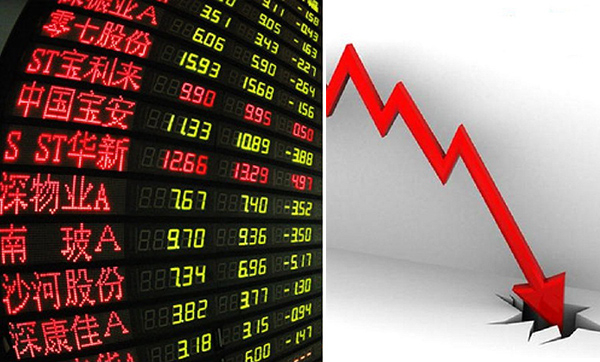
At the same time, two other government tactics have come a cropper. First, the reckless promotion of stock price rises, beginning during the fall of last year, was intended to create a wealth effect. The campaign, however, led to the dramatic collapse in equity prices in June. Beijing, incredibly, had not learned its lesson, and in recent months engaged in another round of government cheerleading. Chinese officials, however, should realize that a rise in prices without an improvement in fundamentals can only lead to another horrible bust.

Second, the still-inexplicable devaluation of the renminbi beginning August 11 has not helped either. The move caused a global run on the currency, and Beijing still has not changed sentiment even if it has, through extraordinary means, temporarily stabilized the situation.

Just about everyone correctly agrees that a new round of structural economic reform could restart growth, but such change has become exceedingly unlikely because:

  • powerful vested interests are blocking it;
  • there is now a perception in Beijing that reform will reduce growth at first and China cannot afford any dip;
  • President Xi Jinping’s idea of change is regressive.

Since coming to power as China’s leader, Xi has been reversing Deng Xiaoping’s policy of “reform and opening up.” He has, for instance, been closing off the Chinese market to foreigners, recombining already large state enterprises back into formal monopolies, increasing state ownership of enterprises, and shoveling more state subsidies to favored market participants.

Xi has also strangled his country’s financial markets in order to keep share prices high and currency values elevated. For example, this summer his government restricted stock-index futures because it considered these derivatives a source of downward pressure on stock prices, but the restrictions killed activity. China’s stock-index futures market, the world’s largest in mid-June when the slide began, was devastated, with transactions down 99% by September.

Even when Beijing has summoned the gumption to announce reforms, there has been more show than substance. For instance, late last month the People’s Bank of China, the central bank, announced it was eliminating the caps on deposit rates, but officials are now informally dictating to commercial banks the deposit rates they may offer.

Let us not be surprised by the end of liberalization in China. Xi Jinping’s signature initiative, encapsulated by the phrase “Chinese dream,” contemplates a strong state, and a strong state does not sit easy with the notion of market-oriented reform. Unfortunately for Xi, also the Communist Party’s general secretary, there are no solutions that are possible within the political framework he will not change.

Therefore, Xi’s government has fallen back on fiscal stimulus to create growth. Fiscal spending was up 36.1% in October, according to the Finance Ministry. This follows increases of 26.9% in September and 25.9% in August. In the first ten months of this year, fiscal spending was up 18.1% while revenue rose only 7.7%.

No analyst is cheering the new spendathon. Just about everyone knows China does not need another “ghost city.” And everyone is concerned about the debt that has been created to fuel growth. McKinsey Global Institute puts the country’s debt-to-GDP ratio at a worrisome 282% at the end of June 2014, but the number is surely higher than that now, perhaps in the vicinity of 350% once all hidden obligations are counted and GDP is accurately assessed.

And even with this extraordinary spending, growth has been anemic — if there has been any growth at all. Beijing’s problem at the moment is that there is deep pessimism about the prospects for the economy. One statistic summarizes the situation: in Q3, there was $460.6 billion of net capital outflow, as documented by Bloomberg. No economy — not even one the size of China’s — can survive outflows of that size.

The Chinese economy has never made sense, but confidence held it together. Now, the confidence is gone, and Beijing does not know how to get it back. Therefore, money is gushing out of the country.

“Deep winter will continue,” said Liu Dongliang, a China Merchants Bank economist, to Hong Kong’s South China Morning Post. Chinese leaders, not willing to open up their political system so they can reform the economy, should expect the weather to remain cold a very long time.

Gordon G. Chang is the author of The Coming Collapse of China, a contributor to Forbes.com, and a Distinguished Senior Fellow at Gatestone Institute.

Iran: Why the Mullahs Will Not Reform from Within by Heshmat Alavi

  • Iran’s entire power structure and most of its civil society is centralized under the personal control of the Supreme Leader. In this way, Iran’s dictatorship is every bit as entrenched as North Korea’s, making the idea of traditional regime change a pipe dream.

  • The mullahs created a regime — an entrenched revolution — specifically designed to resist change or reform, adopting a unique theocratic structure that uses both Islamic ideology and brutal force to maintain absolute power.
  • There is but one regime, and it has no interest in “reform.”
  • The membership of every single one of the many official-sounding bureaucratic organs is personally approved by the Supreme Leader. Indeed, any individual, or coalition of individuals who might serve as a check on his absolute power is, in fact, completely beholden to Khamenei’s whims, making him the most complete and powerful dictator on the planet.
  • Elections in this regime are not indicative of any form of “democracy”. Instead, they are merely a process of choosing among individuals vetted by the Supreme Leader. There are no factions based upon ideological differences, there is mere jockeying for position and the personal favor of the Supreme Leader.
  • Western governments’ policy of providing concessions to the Iranian regime in order to empower “reformist” factions is based on a fantasy — a fantasy which the Iranian regime deliberately encourages in order to fool naïve foreign leaders into easing sanctions and turning a blind eye to the nuclear program. In reality, Western concessions are strengthening Khamenei — further reducing the possibility of change, and increasing the likelihood of outright war.

Ever since Iran’s mullahs rose to power in 1979 and established an “Islamic Republic”, they have worked to consolidate power both at home and abroad. Given Iran’s growing belligerence toward its neighbors, persistent crackdowns on domestic dissidents, and frightening nuclear ambitions, foreign analysts often talk about the possibility of regime change in Tehran. But there is very little understanding of the obstacles to dethroning the mullahs — namely, that the entire power structure and most of civil society is centralized under the personal control of the Supreme Leader. In this way, Iran’s dictatorship is every bit as entrenched as North Korea’s, making the idea of traditional regime change a pipe dream.

The mullahs created a regime — an entrenched revolution — specifically designed to resist change or reform, adopting a unique theocratic structure that uses both Islamic ideology and brutal force to maintain absolute power.

The official name of this system is Velayat-e Faqih (“custodianship of the clergy”) and it places all religious and legal authority in the hands of the Supreme Leader. What this means, in both theory and in practice, is that the Grand Ayatollah Sayyed Ali Hosseini Khamenei (like Ruhollah Khomeini before him) plays a direct role in all the country’s affairs; and no individual, group, or committee in the country has the right to question or hold him accountable.

Khamenei exercises his authority through a morass of official-sounding bureaucratic organs, including the “Guardian Council”, “Expediency Council”, “Supreme Council of Leader, “Supreme National Security Council”, “Strategic Council of Foreign Policy”, and of course a “Council of Cultural Revolution”. What one must understand is that the membership of every single one of these organizations is personally approved by the Supreme Leader. Indeed, any individual, or coalition of individuals who might serve as a check on his absolute power is, in fact, completely beholden to Khamenei’s whims, making him the most complete and powerful dictator on the planet — perhaps exceeding even Kim Jong-un in unrivaled control of North Korea.

The Guardian Council is the Khamenei’s most important instrument; it has titular oversight of both the executive and legislative branches. All candidates for presidential or parliamentary election must be approved by this council, allowing him to exert his personal control over the outcome of elections. Likewise, all acts of parliament and new legislation must be confirmed by the Guardian Council.

Even decisions of the Guardian Council are subject to the Grand Ayatollah’s veto; he reserves the right to reject legislation or winning candidates. And some decisions, like senior judicial appointments, do not go through the Council at all. Meanwhile, the entire domestic and foreign financial system is controlled through a parallel system of committees and “foundations” which are likewise under Khamenei’s personal control.

While the Khamenei is the commander-in-chief of all the armed forces, his most feared weapon is the parallel army founded by his predecessor: the Islamic Revolutionary Guards Corps (IRGC). Fiercely loyal to the Supreme Leader and brutally ruthless, the IRGC is lethally efficient in protecting the regime at home and exporting the “revolution” abroad, in places as varied as Yemen and South America.

As commander-in-chief of all armed forces Khamenei appoints the joint chiefs of staff, commander of the IRGC, and senior commanders of the army and all security forces, making the possibility of a military coup extremely unlikely.

Iranian civil society is an illusion; all of the government and by extension most of the private sector are mere extensions of the Grand Ayatollah’s personal will. Velayat-e Faqih is the only state ideology; the only differences of opinion are about how it should be implemented.

Therefore, elections in this regime are not indicative of any form of “democracy”. Instead, they are merely a process of choosing among individuals vetted by the Supreme Leader. There are no factions based upon ideological differences, there is mere jockeying for position and the personal favor of the Supreme Leader.

Traditional “regime change” in Iran is inconceivable. The Western obsession of labeling the regime’s factions as “reformists” or “hardliners” is laughable. There is but one regime, and it has no interest in “reform”.
Traditional “regime change” in Iran is inconceivable. The Western obsession of labeling the regime’s factions as “reformists” or “hardliners” is laughable. There is but one regime, and it has no interest in “reform”.

This regime will only change if the entire Supreme Leadership structure, along with all its linked organs, especially the IRGC, are annulled and dissolved. Otherwise, whether the president is the “hardliner” Mahmoud Ahmadinejad or the “reformist” Hassan Rouhani, the regime’s policies will remain the same.

Western governments’ policy of providing concessions to the Iranian regime in order to empower “reformist” factions is based on a fantasy — a fantasy which the Iranian regime deliberately encourages in order to fool naïve foreign leaders into easing sanctions and turning a blind eye to the nuclear program. In reality, Western concessions are strengthening Khamenei — further reducing the possibility of change, and increasing the likelihood of outright war.

Heshmat Alavi is a political and rights activist. His writing focuses on Iran, ranging from human rights violations, social crackdown, the regime’s support for terrorism and meddling in foreign countries, and the controversial nuclear program. He tweets at @HeshmatAlavi & blogs at IranCommentary
Iran: The Return of Ahmadinejad & Co. by Majid Rafizadeh

  • Iran’s Supreme Leader and the senior cadre of the Islamic Revolutionary Guard Corps have been vocally critical of the nuclear deal. They fear further diplomatic and political rapprochement between the US and Iran, now that they have already achieved their objectives of the lifting of the four major rounds of the UN Security Council’s sanctions.

  • After the nuclear deal was implemented, polls showed that 63% of Iranians expected to see improvements in the economy and living standards within a year. But currently, in a new poll, 74% of Iranians said there had been no economic improvements in the past year.

Iran’s former president, Mahmoud Ahmadinejad, saying he wants to “redefine revolutionary ideals” set up by the leader of Iran’s 1979 Islamic revolution, Ayatollah Ruhollah Khomeini, appears to be launching a campaign to run in the upcoming Iranian presidential elections, in February, 2017.

Ahmadinejad was well-known for his incendiary and provocative speeches, which included denying the Holocaust. At the end of his presidential term, from 2005 to 2013, his approval rating was extremely low, and he managed to drive away most constituents across political spectrum, including the topmost hardline leaders. He also became the first Iranian president since 1979 to be summoned by the parliament (Majlis) to answer questions regarding his activities and policies.

After all of this, the common conception among politicians, scholars and policy analysts was that Ahmadinejad would never return to politics. It seemed that his retirement plan focused on founding a university and teaching, but his plan to open a university failed.

Despite his low popularity among people, however, the “principalists” (ultra-conservatives) were still on his side, due to his fierce anti-US, anti-Western and anti-Israel policies and rhetoric, as well as the fact that he remains a major figure in the coalition of several conservative groups, the Alliance of Builders of Islamic Iran.

After Ahmadinejad’s presidency, Iran’s Supreme Leader, Ayatollah Ali Khamenei, appointed him to the Expediency Council, Iran’s highest political arbitration body, which arbitrates between the Guardian Council (the supervisory body over the parliament and elections) and the Islamic Consultative Assembly (parliament). The Expediency Council is predominantly made up of Iran’s hardline clerics, and functions as an advisory institution to the Supreme Leader.

Although it seems that Ahmadinejad did not have any intention of returning after being out of the international spotlight for two years, other factors show that he never really left. Domestically, Ahmadinejad remained politically active, trying to unify and lead the hardliners. Since he left office, he has continued holding meetings with former ministers in Tehran.

In the last few months, however, Ahmadinejad’s desire to launch his campaign more forcefully and determinedly has become clearer as, once again, he began attracting the international spotlight, such as when he wrote an open letter to US President Barack Obama, demanding the transfer of $2 billion to Iran.

To capitalize on the popular vote and the presidential elections of 2017, Ahmadinejad has been focusing on attracting constituents from around Iran by traveling to smaller cities and towns, giving lectures and speeches; supporters of Ahmadinejad have called for his return.

During his presidency, people enjoyed subsidies on items including petrol, natural gas and electricity, and his government distributed monthly cash handouts of about $17 to every person. These, as well as criticism of corruption, injustice, and capitalism, were appealing to the rural population and the less affluent.

Ahmadinejad has also been vehemently criticizing Hassan Rouhani, the current Iranian president, as incompetent, and questioning his economic and foreign policies, and pointing out that, “There will be bumps and satanic obstacles in our path… One should not forget that the US is our enemy.”

The latest poll by the Center for International and Security Studies at the University of Maryland revealed that “Ahmadinejad now represents the single largest threat to Rouhani’s re-election, and trails the once-popular incumbent by only eight points. Suddenly, the ex-president seems once again to be a real political contender.”

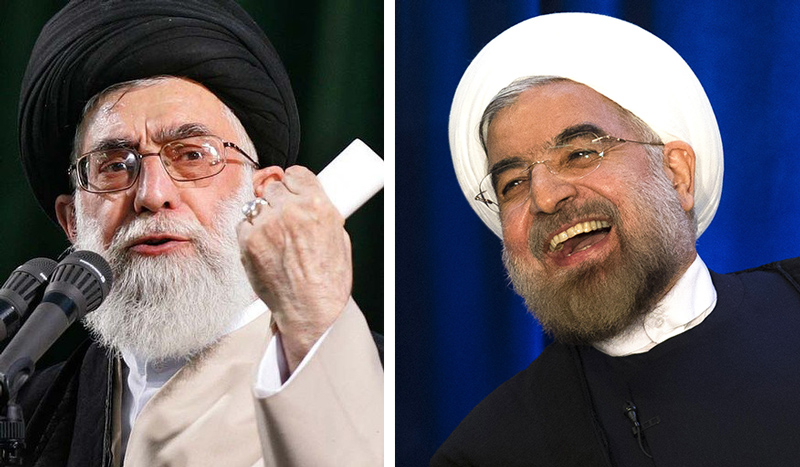
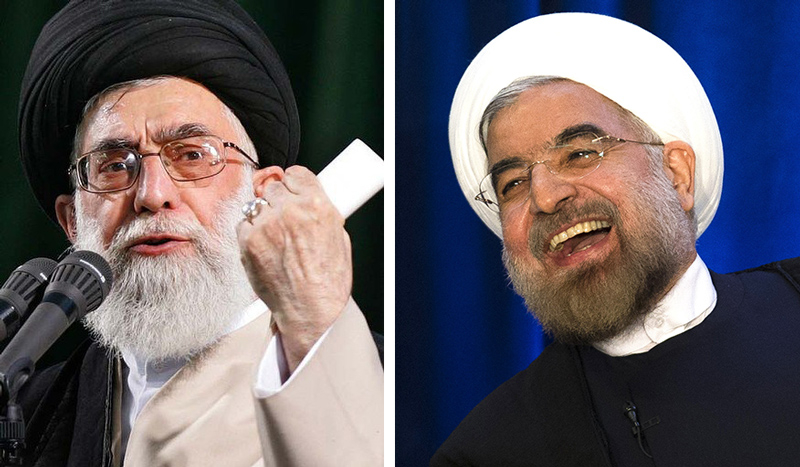
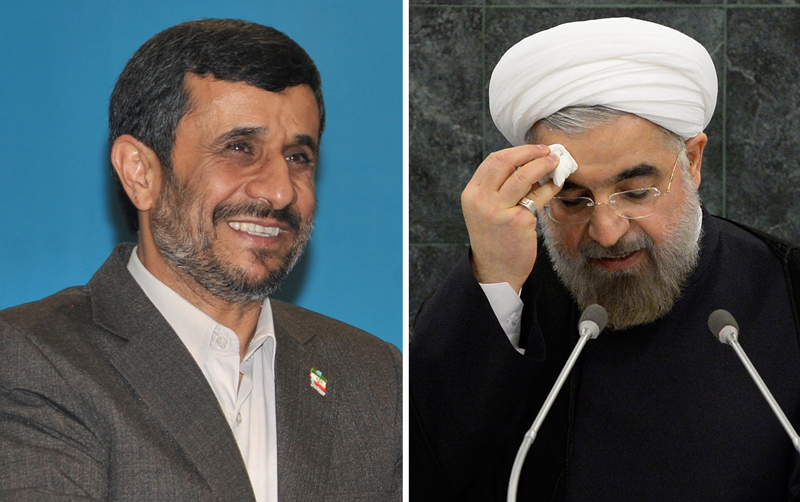
Mahmoud Ahmadinejad (left) can indeed be a viable contender against incumbent President Hassan Rouhani (right) in Iran’s 2017 presidential election, and is more likely the choice of the Supreme Leader and hardliners.

This is a ripe environment for him for several reasons.

First of all, the nuclear deal has become a popular issue among the hardliners. The Supreme Leader and senior cadre of the Islamic Revolutionary Guard Corps (IRGC) have been vocally critical of the nuclear deal. They fear further diplomatic and political rapprochement between the US and Iran, now that they have already achieved their objectives of the lifting of the four major rounds of the United Nations Security Council’s sanctions.

Ayatollah Khamenei warned against any relations with the US, and he also questioned the economic benefits of the nuclear agreement: “Weren’t the oppressive sanctions lifted so that the people would feel a change in their lives? Has there been a tangible effect on the people’s lives in the past six months?”

Second, the popularity of the nuclear deal has been on a decline among the population as well. After the nuclear deal was implemented, polls showed that 63% of Iranians expected to see improvements in the economy and living standards within a year. But currently, in a new poll, 74%of Iranians said there had been no economic improvements in the past year.

Ahmadinejad can indeed be a viable contender against Hassan Rouhani, and is more likely the choice of the Supreme Leader and the IRGC leaders, and the candidate favored by the hardliners and principalists.

Dr. Majid Rafizadeh, political scientists and Harvard University scholar is president of the International American Council on the Middle East. He can be reached at Dr.rafizadeh@post.harvard.edu.

Iran: The Deep State Endures by Lawrence A. Franklin

  • Western governments need to accept the harsh reality that the Islamic Republic of Iran remains a revolutionary regime. The IRGC has responsibility over all ballistic missile programs and research and development. The West also needs to internalize that all decisions over ballistic missiles and associated delivery systems, the pursuit of a nuclear weapons capability, export of the revolution, aggressive support of the Shi’a ascendancy in the Gulf and militant acts of inhumanity towards their own people are made by the deep state.

  • In short, the Iranian regime is much more Islamic than a Republic. The regime’s most reviled and inveterate enemies remain Israel and the United States.
  • Those Iranians opposed to the existing order have been broken physically and psychologically by a combination of regime cruelty and lack of support from the world’s democracies.

Despite the voluminous and biased reporting about the conclusions that should be drawn from Iran’s recent Majles (Consultative Assembly) elections, the results signify next to nothing.[1] Hundreds of candidates are disqualified from running by the Council of Guardians (COG) if they are judged to be opposed to the current Islamic regime, or on grounds of “moral turpitude” and other reasons that would be irrelevant in a true democracy. When given the limited choice from a thoroughly vetted set of pro-regime candidates, all of whom favor Islamic rule, the people will always vote for the more “liberal” of the alternatives. This is hardly surprising in a country where the existing martial, theocratic order remains highly unpopular.

Whatever the balance in the Majles between hardliners and those members who may be a bit more flexible on some economic and social issues, it matters little. There will always be a significant number of deputies who are former IRGC (Islamic Revolutionary Guard Corps) men, and who will hector a President’s cabinet members and political allies about decisions which run afoul of “deep state” institutions.[2]

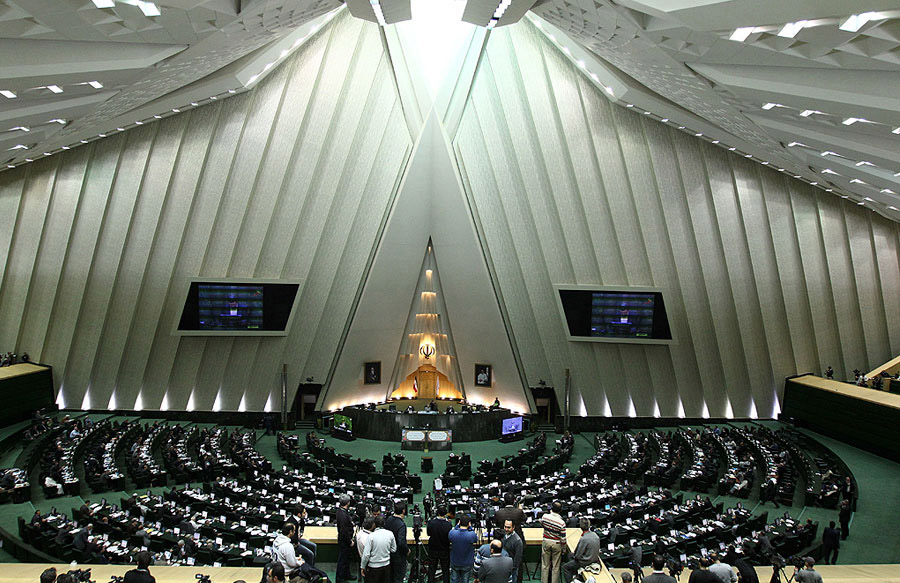
Iran’s Majles (Consultative Assembly). Image source: Mahdi Sigari/Wikimedia Commons

The political superstructure of Iran’s government is much like that of the former Soviet Union. The office of the President, the Majles, and the Civil/Criminal Court System have little real decision-making power in the Islamic Republic. They are more for show, for the people to let off steam, and for foreign observers who might imagine that from there, the seeds of democracy might take root.

Similar to all of the illusions and wishful thinking of the past, the Rouhani era will not usher in an Iran which will conduct itself like a conventional member of the nation-state system. The aforementioned superstructure institutions will remain superficial. Indeed, they serve as screen for the deep state institutions, which will not evolve. The unelected leaders of Iran’s deep state institutions are even more powerful today. No election has resulted in diminution of their power. These substructure institutions — the Council of Guardians, the Assembly of Experts, the Ministry of Information and Security (MOIS), the IRGC’s Intelligence Bureau, the Special Courts, and the Office of the Supreme Leader — remain largely insulated from external pressure and domestic transitory moods.

Western governments need to accept the harsh reality that the Islamic Republic of Iran remains a revolutionary regime. The IRGC has responsibility over all ballistic missile programs and research and development. The West also needs to internalize that all decisions over ballistic missiles[3] and associated delivery systems, the pursuit of a nuclear weapons capability, export of the revolution,[4] aggressive support of the Shi’a ascendancy in the Gulf[5] and militant acts of inhumanity towards their own people are made by the deep state.

In short, the regime remains much more Islamic than a Republic. The regime’s most reviled and inveterate enemies remain Israel and the United States.

Moreover, those Iranians opposed to the existing order have been broken physically and psychologically by a combination of regime cruelty and lack of support from the world’s democracies.[6] The people, though sullen, appear resigned to their fate. The dispirited state of the populace has proven advantageous for the ruling clique of the regime’s Praetorian Guard, the IRGC, the politically reactionary mullahs, and the economy’s kleptocrat-bureaucrats to rule with virtual impunity.

Dr. Lawrence A. Franklin was the Iran Desk Officer for Secretary of Defense Rumsfeld. He also served on active duty with the U.S. Army and as a Colonel in the Air Force Reserve, where he was a Military Attaché at the U.S. Embassy in Israel.


[1] A Majles in Islamic governments is more of a consultative assembly rather than a legislative body. It is more of a sounding board for various political constituencies. In fact, the original meaning of the term referred to a Council of Tribes. “The Oxford Dictionary of Islam” by John Esposito, 2003, p. 187. In Iran, it is the Council of Guardians which (Shuraya-e-Negahban) decides whether any bill passed by the Majles is theologically compatible with the Koran and Islam. See “Who Rules Iran” by Wilfried Buchta, Konrad Adenauer Stiftung, 2000, p. 59.A slightly different version of this institution is the Loya Jirga in Afghanistan.

[2] “Who Rules Iran: The structure of Power in the Islamic Republic” by Wilfried Buchta. See Chapter III: “The Internal Political Struggle (1997-2000). All of Iran’s previous six Presidents before Hassan Rouhani were victims of tense vocal challenges to Presidential and/or Cabinet level decisions. This was particularly true during President Khatami’s two terms (1997-2005).

[3] See Michael Eisenstadt’s Chapter on “Iran’s Military Dimension” in “Iran Under Khatami,” The Washington Institute for Near East Policy, 1998.

[4] “Islam and Revolution” by Imam Khomeini. Mizan Press: Berkeley, California, 1981. Imam Khomeini outlined in detail in his speeches and writings the Islamic Republic’s worldwide mission to establish Allah’s Kingdom on earth.

[5] Iran has dispatched thousands of troops, military advisers, militia warriors and spies to assist Shi’a causes in Syria, Yemen, Iraq, and Bahrain.

[6] See the HBO Film “For Neda” which focuses on the millions of protesters challenging the presidential election of Mahmoud Ahmadinejad to a second term in 2009. The film quotes the regime as claiming that the President had received 63% of the vote. During the student led protests in 1999 and the widespread national demonstrations after the fraudulent re-election of Ahmadinejad in 2009, the world’s democracies amounted to muted vocal support.

Translate »
Skip to toolbar