Category Archives: Uncategorized

On Campus: Minority Priorities by Douglas Murray

  • Like so many leaflets before them, these talked about the scourge of “privilege”. And whom did these pamphlets identify as the people with the most privilege?

  • At present, the people who preach tolerance in America and Canada are turning out to be the least tolerant.
  • And the people who complain of discrimination turn out to be leading practitioners of the oldest discrimination of all.

The free speech wars on North American campuses appear to have arrived at their inevitable endpoint. For years, American and Canadian students have played around with a new form of morality in education. It is based not on a traditional concept of searching for truth or investigating and analysing ideas, but rather on the concept that the veracity of an opinion can be discerned by the person uttering it.

In this way, a considerable number of people have apparently decided that a variety of “privileges” exist that make some speakers vital to listen to and others unnecessary, unless they agree to mouth a set of pre-ordained platitudes.

This concept, coupled with the idea that minorities require special protection from speech, have now finally delivered the moral breakdown that was always waiting for it. The warning signs have been there for years.

In 2010, the former editor of the left-wing magazine The New Republic, Martin Peretz, arrived to speak at Harvard University. There he was greeted by a group of around a hundred students and others who decided to shout at him as he arrived at their campus. They decided to greet him with chants of “Hey hey, ho ho, Marty Peretz has got to go.” And so, a generation of American students who can have had little, if any, knowledge of Peretz’s career or left-wing interests, chose to name him a racist and be done with him.

Being Jewish, a minority group, certainly did not offer any protection, and may indeed have harmed his cause; it already seemed that there were ordering-systems at work in the business of minority priorities.

By the time, then, that the British-born Milo Yiannopoulos was touring American campuses in 2016-17, protest movements were busily trying to work out precisely what orders of persecuted minorities should exist. As Yiannopoulos is openly gay, there was a slight queasiness about shutting him down — at first. People who are members of at least one minority group have a certain protected status, and as such a certain inevitably about ranking develops. But just as you can be marked up, you can be marked down. Yiannopoulos may be gay, but he has been rude about aspects of transsexualism. That view at least evened things out. However, his tendency to criticise Islam and Muslims moved him lower — indeed right down to the lowest level, that of white heterosexual male.

Activist and writer Milo Yiannopoulos, who is gay but has been rude about aspects of transsexualism, was supposed to speak at the University of California, Berkeley on February 1. That evening, a mob of 150 people, who opposed to Yiannopoulos’ presence, proceeded to riot, smash and set fire to the campus, causing more than $100,000 of damage. (Image source: RT video screenshot)

As though to prove that it was not just “provocateurs” who now incur the wrath of the Stepford students, this year, the distinguished sociologist Charles Murray (no relation) was due to speak at Middlebury College. The college authorities had warned students that while protests would be allowed, any attempts to disrupt the lecture would be looked at in a very different light.

Murray was due to address the themes of his 2012 book, Coming Apart, a seminal analysis of the social bifurcation and sense of being “left behind” that led to last year’s election results in America.

Students at a liberal college could ordinarily do with hearing someone explain the social forces that are pulling them and the rest of the country apart from each other.

But the students of Middlebury evidently decided that they did not need to hear this. Instead of simply staying away from the lecture, they chose to embed those divisions. Dozens of the students at Middlebury decided, it seems, that Murray was a racist. They had also decided, for reasons which nobody even bothered to explain, that he was “anti-gay”.

So, before and during Murray’s thwarted attempt to give a lecture, they bawled and chanted, among other things, a variant of the national anthem of modern North American campuses: “Hey hey, ho ho, Charles Murray has got to go.”

Later the same month, it was the Canadian professor and psychologist Jordan Peterson’s turn. He was meant to be lecturing at McMaster University. But students crowded around the front and sides of the lecture hall as he attempted, in his learned and professorial way, to enlighten the students on a variety of issues. Disruptive students, however, had apparently decided that Peterson was “anti-trans”, among other things. So they let off sirens and banged tins and repeatedly shouted, “Shut this down. Shut this down.”

Peterson is, it seems to have been decided, meant to be a person of privilege; trans people are meant to be part of a persecuted minority.

Once again, therefore, the disruption and intimidation were portrayed to seem justified.

As at Middlebury, the college authorities seemed to have no desire to discipline students who know so little of true liberalism that they should ordinarily have no place at an institution of learning. But of course, at these institutions, as at so many before them, the adults appear to have vacated the campus.

Students who want to protect their ears from white men telling them anything with which they do not already agree may cause these ugly and totalitarian scenes. They do not occur, notably, when truly ugly and totalitarian views emerge.

Although students up and down the land claim that words wound and even kill when they come from people who have never wounded or killed anyone, it seems that these or other students remain silent when, for example, a former Black Panther associate and supporter of innumerable totalitarian regimes, such as Angela Davis, turns up to speak.

At the end of the same month in which Murray and Peterson were prevented from speaking, Davis was invited to address Marquette University. Because she does all the boilerplate stuff such as stressing how various rights movements “make a positive difference in the world”, and otherwise telling students what many of them want to hear, her lecture at Marquette went off without interruption. Everyone in the packed hall listened politely and applauded her sentiments.

In other words, the approved event was not a lecture; it was a political rally.

Davis has certainly little or nothing new to say that would educate or challenge a hall full of students. Her narrative, like that of so many approved speakers, embeds the idea that there are people with privilege and that they should be persuaded or forced to share that privilege with everyone else.

So it is probably as well that people realise where this narrative leads. When you consistently break down a society along racial and sectarian lines for short-term political and personal gain, there is bound to be a group that must in the end lose out. That group may just turn out to be a minority as well.

Sure enough, the same month that Angela Davis was applauded and Peterson and Murray were silenced, some pamphlets turned up on campus at the University of Illinois at Chicago. Like so many leaflets before them, these talked about the scourge of “privilege”. And who did these pamphlets identify as the people with the most privilege? Why, the Jews of course. Or, as the pamphlets put it, “Ending white privilege… Starts with ending Jewish privilege.”

As with the Occupy Wall Street movement a few years ago, which also ended up with anti-Semitism at its core, who could seriously not have seen that this would be where all this would end? At present, the people who preach tolerance in the United States and Canada are turning out to be the least tolerant.

And the people who complain of discrimination turn out to be opening the door to practitioners of the oldest discrimination of all.

Douglas Murray, British author, commentator and public affairs analyst, is based in London, England.

On Boycotting Radical Islamic Nations by Nonie Darwish

  • The interviewer seemed shocked to hear that I do not have any Arab or Muslim friends who are protesting President Trump’s ban, and that many immigrants of Islamic origin support the ban and are fed up and embarrassed by what jihadists are doing.

  • The lesson America needs to know is that the West is not doing Muslims a favor by constantly treating them as children who should be shielded from reality. They hungry for the truth: that their educational system and mosque preaching are full of incitement, are abhorrent, hate-filled and the foundation upon which violent jihad is built.
  • Muslims need to know that the world does indeed have a justifiable and legitimate concern about Islam and actions done in the name of Islam by Muslims.
  • Muslims need to look at themselves in the mirror and see the world from the point of view of their victims. Instead, the West is sacrificing its culture, values, laws, pride and even self-respect.
  • It might compassion that leads the West to take in millions of Muslim refugees but it is reckless compassion. Do Westerners question the motivation of Islamic theocracies as to why ultra-rich Arab nations are sending us their refugees but taking in none?
  • Some “tough love” is urgently needed if Muslims are to be motivated to change and reform.

Early this morning an Arabic radio station in the Middle East called asking my opinion about President Trump’s ban on refugees and citizens of seven Muslim nations. The radio host, who sounded angry over the ban, was a Christian Arab. She was surprised to hear that I supported the ban and think that it should have taken place the day after 9/11.

She then asked me if I knew any Arab American activist who was against the ban because she wanted to interview someone against the ban. She seemed shocked to hear that I do not have any Arab or Muslim friends who are protesting the ban, and that many immigrants of Islamic and Middle East origin support the ban and are fed up and embarrassed by what jihadists are doing.

She said that all she sees on CNN and other channels are riots that portray almost all Americans supporting Muslims and against Trump. I am upset over the success of the leftist propaganda all over the Middle East. It brings back memories of the life of the hate indoctrination and misinformation I lived under for most of my life.

What would Muslim countries do to the West, I asked, if 19 American terrorists flew airplanes into Arab capitals and their government and military headquarters? What did she think Arabs would do if every week or so American terrorists would conduct synchronized killing sprees all over the Muslim world, gunning Muslims down, blowing them up with homemade pressure cookers, ramming into crowds with trucks? There was silence.

She then started calming down and said that of course she is against terrorism, “but”. I asked: “Do you see what jihad did to your Christian community in the Middle East?” She was silent for a minute, then it occurred to me that she might be afraid to continue the conversation because her bosses were probably Muslims.

I was sure she was going to hang up on me, but to my surprise she asked me to please hold. Then she was back, live from the studio, and started interviewing me and asked the same questions on air. I poured my heart out in Arabic to the Arab listeners.

The lesson here is that Arabs are hungry to hear the truth; this Arab station, instead of rejecting these ideas, ended up putting them on air. The lesson America needs to learn is that the West is not doing Muslims (especially the reformists) a favor by constantly treating them as children who should be shielded from reality.

Muslims need to know that the world does indeed have a justifiable and legitimate concern about Islam and actions done in the name of Islam by Muslims. Muslims need to look at themselves in the mirror and see the world from the point of view of their victims. Instead, the West is sacrificing its culture, values, laws, pride and even self-respect. Muslim culture needs a wake-up call telling them that, sooner or later, non-Muslim nations will close their doors to any kind of Muslim immigration if the jihad culture continues. That will also be a strong message to Muslims already in the West who still believe in jihad.
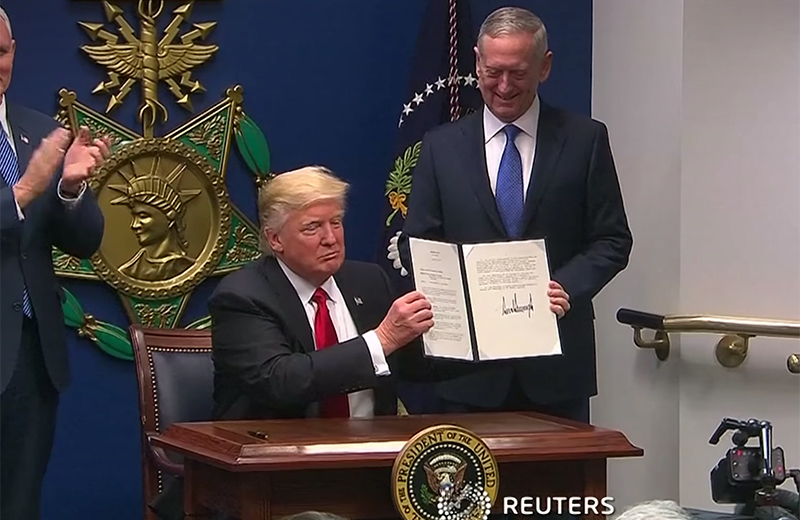
President Donald Trump signs an executive order restricting immigration, January 27, 2017. (Image source: Reuters video screenshot)

The Muslim people are hungry for the truth: that their educational system and mosque preaching are full of incitement, abhorrent, hate-filled and the foundation upon which violent jihad is built. The Islamic commandment to do jihad sacrifices Muslim men, women and children to kill and get killed.

As long as the West continues its appeasement of Islamic jihad, Islam will never reform and the West will lose. So far, the West has continued to extend a lifeline to the religion of Islam; a religion for which the number one enemy is the truth, and which struggles to suppress the truth.

It might be compassion that leads the West to take in millions of Muslim refugees, but it is reckless compassion. Why isn’t Saudi Arabia taking refugees temporarily until things settle down in Syria and Iraq? Do Westerners question the motivation of Islamic theocracies, as to why ultra-rich Arab nations are sending us their refugees but taking in none?

Who is really benefiting from the policy of appeasement, the acceptance of Sharia-stricken theocracies and their jihadist, hate-filled education? Some “tough love” is urgently needed if Muslims are to be motivated to change and reform.

Nonie Darwish, born and raised in Egypt, is the author of “Wholly Different; Why I chose Biblical Values over Islamic Values”
Oliver Stone’s Response to Being Laughed at for Defending Putin: Blame the Jews by Alan M. Dershowitz

  • The essence of anti-Semitism is the bigoted claim that if there is a problem, then Jews must be its cause. This is the exact canard peddled by Stone — and is extremely dangerous if unrebutted. I challenge my old friend (and co-producer of Reversal of Fortune – the film based on my book) to debate me on the following proposition: Did Israel do more to influence the 2016 election than Russia?

When film director Oliver Stone could not come up with a plausible response to Stephen Colbert’s tough questions about why he gave a pass to Vladimir Putin for trying to influence the American presidential election, Stone resorted to an age-old bigotry: blame the Jews – or, in its current incarnation, shift the blame to the nation state of the Jewish people, Israel. Colbert was interviewing Stone about his new documentary, “The Putin Interviews” a film comprised of conversations he had with the Russian president over the past two years. The exchange regarding Israel did not make it to air but was relayed to the New York Post’s Page Six by a source who was in the audience.

When pressed by Colbert about his apparent fondness of the Russian dictator, Stone replied: “Israel had far more involvement in the U.S. election than Russia.” He then said again, “Why don’t you ask me about that?” Colbert responded: “I’ll ask you about that when you make a documentary about Israel!”

If Stone’s absurd response were not reflective of a growing anti-Semitism by the intolerant hard left (of which Stone is a charter member) it would be laughable. Indeed, Stone resorted to the “socialism of fools” (which is what German Social Democrat, August Bebel, coined anti-Semitism) precisely to save face because he was being mockingly laughed off stage by Colbert’s audience for giving Colbert ridiculous answers. Some of Stone’s bizarre pronouncements included:

“I’m amazed at his [Putin’s] calmness, his courtesy…he never really said anything bad about anybody. He’s been through a lot. He’s been insulted and abused.” Stone also expressed his “respect” for Putin’s leadership. But no answer was more ridiculous than his bigoted claim that Israel did more to try to influence the election than Russia.

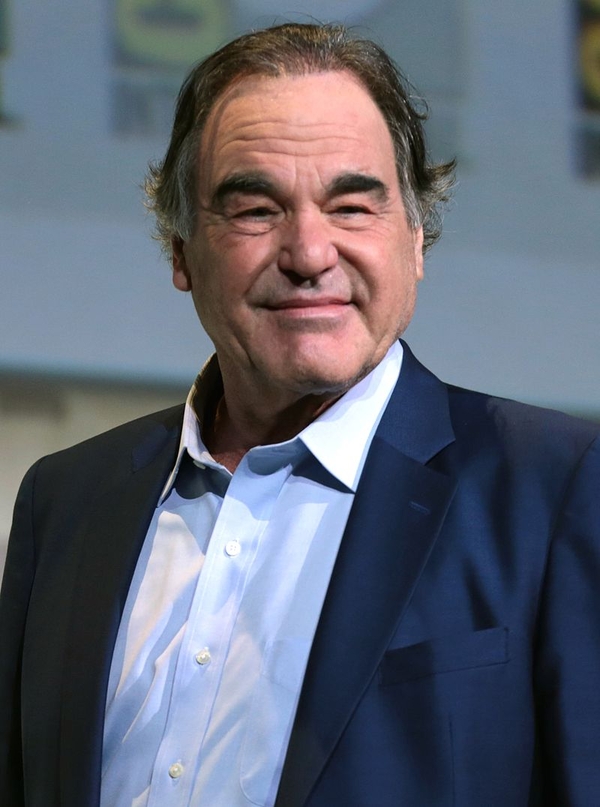
Oliver Stone (Image source: Gage Skidmore/Wikimedia Commons)

We know for certain that Russia (and that means Putin) desperately wanted Hillary Clinton to lose. We know that their surrogates timed leaks to cause maximum damage to her campaign. All of our intelligence agencies, in a rare show of unanimity, concluded that Russia went to great lengths to try to defeat Clinton.

What did Israel do? Stone hasn’t said. He just let the blood libel hang out there for other bigots, so they could say, “See, we knew the Jews were behind this; they always are.” There was an old Polish expression that said: if there is a bad outcome, the Jews must be behind it. Indeed, throughout history the last recourse of desperate bigots has been ‘blame the Jews.’ The modern version – pervasive among the hard left– is blame their nation-state, Israel.

The reason Stone did not provide any proof of his anti-Semitic accusation is because there is none. It simply is not true. Israel did not try to influence this election. The Israeli government took no position and its leaders were probably divided, as were its citizens, concerning the desired outcome. Prime Minister Netanyahu, for his part, remained neutral, emphatically stating before the election that he was “happy to work with whoever gets elected.”

Moreover, American Jews voted overwhelmingly in favor of Clinton. To be sure, some, such as Sheldon Adelson, contributed to Trump, but others, including many strong supporters of Israel, contributed heavily to Clinton. I would not be surprised if even in the face of Adelson’s huge contributions, more money from Jewish sources was contributed to Hillary Clinton’s campaign, but no one keeps track of such matters.

It is important to note that this is not an isolated incident. Stone’s bigotry towards Jews and their nation state is well documented. He has said that, “Hitler did far more damage to the Russians than [to] the Jewish people.”

And then argued that this fact is largely unknown because of “the Jewish domination of the media…there’s a major lobby in the United States. They are hard workers. They stay on top of every comment, the most powerful lobby in Washington.” He continued to say: “Israel has f***** up United States foreign policy for years.”

Moreover, Stone has also stated that, “Hitler is an easy scapegoat throughout history” and expressed affection for Cuban dictator, Fidel Castro, whom he called “a great leader.”

Clearly, there was no legitimate reason for Stone to bring up Israel in the context of a dialogue regarding Russia’s interference in the U.S. presidential election. By ducking questions about Putin and Russia, and then bizarrely accusing Israel of wrongdoing, Stone engaged in an old trope: blaming Jews – or the nation state of the Jewish people –for far reaching domestic political issues in foreign countries. By morphing the discussion about Putin’s untoward history of suppressing the press, killing political opponents, and engaging in cyber attacks against the U.S., into a polemic against Israel, Stone displayed his own bias.

The essence of anti-Semitism is the bigoted claim that if there is a problem, then Jews must be its cause. This is the exact canard peddled by Stone — and is extremely dangerous if unrebutted. I challenge my old friend (and co producer of Reversal of Fortune – the film based on my book) to debate me on the following proposition: did Israel do more to influence the 2016 election than Russia? If he agrees, he will once again be laughed off the stage.

Alan M. Dershowitz is the Felix Frankfurter Professor of Law, Emeritus, at Harvard Law School and author of “Taking the Stand: My Life in the Law” and “Electile Dysfunction: A Guide for the Unaroused Voter.”

Obama: Netanyahu’s visit too close to election for meeting.

Obama on U.S.-Israeli relationship 05:25

Watch the entire interview Sunday on “Fareed Zakaria GPS” at 10aET.

Washington (CNN)President Barack Obama says he will not meet with Israeli Prime Minister Benjamin Netanyahu in March because his trip to Washington comes too close to Israel’s upcoming elections.


“I’m declining to meet with him simply because our general policy is, we don’t meet with any world leader two weeks before their election,” Obama said in an interview with CNN’s Fareed Zakaria. “I think that’s inappropriate, and that’s true with some of our closest allies.”

House Speaker John Boehner invited Netanyahu to deliver a speech in front of Congress in March. He’s expected to use that speech to lobby for tough new sanctions against Iran — putting him at odds with Obama, who has threatened to veto additional sanctions as he tries to hash out a deal to halt Iran’s nuclear program.

READ: Democratic senators to hold back on Iran sanctions

Obama responds to drone landing at White House 02:22
PLAY VIDEO

The President said the United States and Britain had to quickly to put together a trip to Washington for Prime Minister David Cameron this month for the same reason Obama wasn’t meeting with Netanyahu. Cameron didn’t want to make it closer to his country’s May elections.

“He insisted that if he wants to come — and it was a very important meeting — he needs to be far away enough from the election that it doesn’t look like in some ways we’re meddling or putting our thumbs on the scale,” Obama said.

Obama downplayed differences with Israel over his approach to Iran, saying he hasn’t heard “a persuasive rebuttal of my argument that we crafted very effective sanctions against Iran specifically to bring them to the negotiations table.”

Israeli intelligence has confirmed that Iran has rolled back its stockpiles of highly enriched uranium, Obama said.

The President said imposing new sanctions now would give Iran a way out of the talks, an outcome no one wants.

“For us to undermine diplomacy at this critical time for no good reason is a mistake and that what we need to do is to finish up this round of negotiations, put the pressure on Iran to say yes to what the international community is calling for,” he said.

SEE: Why the Iran sanctions fight is a big deal

Obama said he’s confident he can successfully lobby Congress to approve a deal once it’s struck.

“I’ve said before that we will take no deal over a bad deal,” Obama said. “But if I can prove that the deal we’ve put in place assures us through indisputable verification mechanisms that Iran cannot achieve breakout capacity, if I’ve got a bunch of scientists and nuclear experts saying this assures us that Iran is not on the brink of being a nuclear weapons power, then that’s a public debate we should have.”

“And I will then ask every member of Congress to ask why would we reject that deal and prefer a potential military option that would be less effective in constraining Iran’s nuclear program and would have extraordinarily ramifications at a time when we’ve already got too many conflicts in the Middle East,” he said. “And I’m pretty confident I can win that argument.”

SEE: Obama says we need more drone regulations

Obama: Don’t Destroy the Peace Process by Turning it Over to the U.N.

The Obama Administration is sending strong signals that once the election is over it may make a major push to resolve the Israeli-Palestinian conflict at the United Nations. Despite repeated invitations by Israeli Prime Minister Benjamin Netanyahu to Palestinian Authority President Abbas to meet without preconditions, the stalemate persists. Some blame it on Palestinian unwillingness to recognize Israel as the nation state of the Jewish People and to compromise to the so-called “right of return.” Others — including the current U.S. Administration — lay the blame largely at the feet of the Netanyahu government for continuing to build in the West Bank, most recently approval of between 98 and 300 new homes in Shiloh. Whatever the reasons – and they are complex and multifaceted — President Obama should resist any temptation, during his final weeks in office, to change longstanding American policy — that only direct negotiations between the parties will achieve a lasting peace.


In particular, Obama should veto an expected French resolution in the Security Council establishing an international peace conference under the auspices of the U.N. The general parameters of the French resolution would likely call for:

“Borders based on the 1967 Lines with agreed equivalent land swaps; security arrangements preserving the sovereignty of the Palestinian State and guaranteeing the security of Israel; a fair, equitable, and negotiated solution to the refugee problem; an arrangement making Jerusalem the capital of both states.”

These guidelines may sound reasonable. Indeed, they are strikingly similar to the offers made to and reject by the Palestinian leadership in 2000-2001 from former Israeli Prime Minister Ehud Barak and former U.S. President Bill Clinton, and in 2008 by former Israeli Prime Minister Ehud Olmert. The U.N., however, has disqualified itself from playing any constructive role in the peace process. Recent attempts by the U.N. to intervene in the Israeli-Palestinian conflict have produced unmitigated disasters. The so-called Goldstone Report, which sought to investigate allegations of war crimes committed during the 2009 Israeli intervention in Gaza, was so blatantly biased against Israel that Richard Goldstone himself had to retract some of its key findings in 2011.

Since then, the U.N. has done nothing to reassure Israel that it is capable of offering an unbiased forum for negotiations. In the past year alone, the U.N. has singled out Israel for special criticism on issues like health rights, and most laughably, women’s rights, while failing even to mention regimes whose record on these issues is truly abominable. Last year alone, at least twenty separate resolutions were adopted by the U.N. General Assembly, which singled out Israel for special criticism. Most recently UNESCO attempted to erase millennia of Jewish history with regard to the Temple Mount in Jerusalem. In light of such behavior, the U.S. should not trust that Israel would receive a fair hearing at any U.N. sponsored peace conference.

As Netanyahu said in his most recent speech to the U.N. General Assembly, “The road to peace runs through Jerusalem and Ramallah, not through New York.” In other words, the only way forward for the Israeli-Palestinian peace process is bilateral negotiations between the two parties. Netanyahu and Abbas must sit down and agree to necessary but painful compromises aimed at establishing a Palestinian state, while addressing Israel’s security concerns, and the realities on the ground. Resolutions such as the proposed French resolution undermine such efforts by encouraging the Palestinians to believe that direct negotiations — and the mutual sacrifices they would entail — are unnecessary, and that a Palestinian state can be achieved on the basis of U.N. resolutions alone. It would also make it more difficult, if not impossible, for the Palestinian Authority to accept anything less than that already given them by the U.N. — which would in turn guarantee the failure of any realistic negotiations.

It is for these and other reasons that American policy has long been to veto or otherwise derail U.N. attempts to interfere with the Israeli-Palestinian peace process even when it is stalled. As President Obama said in 2013:

“We seek an independent, viable and contiguous Palestinian state as the homeland of the Palestinian people. The only way to achieve that goal is through direct negotiations between Israelis and Palestinians themselves.”

Hillary Clinton, too, has stated in the past, that she supports bilateral negotiations between the Israelis and Palestinians, and her campaign has said that she “believes that a solution to this conflict cannot be imposed from without.” So, too, has Donald Trump.

Recently, however, several past and present Obama officials have apparently advised the president to support, or at least not veto the French resolution, as well as a one-sided Palestinian push to have the U.N. declare Israeli settlements illegal. It would be wrong — and undemocratic — for Obama to unilaterally reverse decades of U.S. foreign policy during the lame duck period. After all, in 2011 his administration vetoed an almost identical Palestinian proposal that called for Israel to “immediately and completely cease all settlement activities in occupied Palestinian territory, including East Jerusalem”. Similarly, until now, Obama has repeatedly pressured the French and other European nations not to put forward any proposal related to the Israeli-Palestinian conflict, on the grounds that such initiatives discourage bilateral negotiations. This is surely the view of the majority of the Senate, which has its own constitutional authority to participate in foreign policy decisions. In fact, 88 senators signed an open letter to Obama in which they called on the President to veto any Security Council resolutions regarding the Israeli-Palestinian conflict.

The period between the election and the inauguration is the only time a president can act without the checks and balances of American democracy. He should not take action that would tie the hands of his successor.

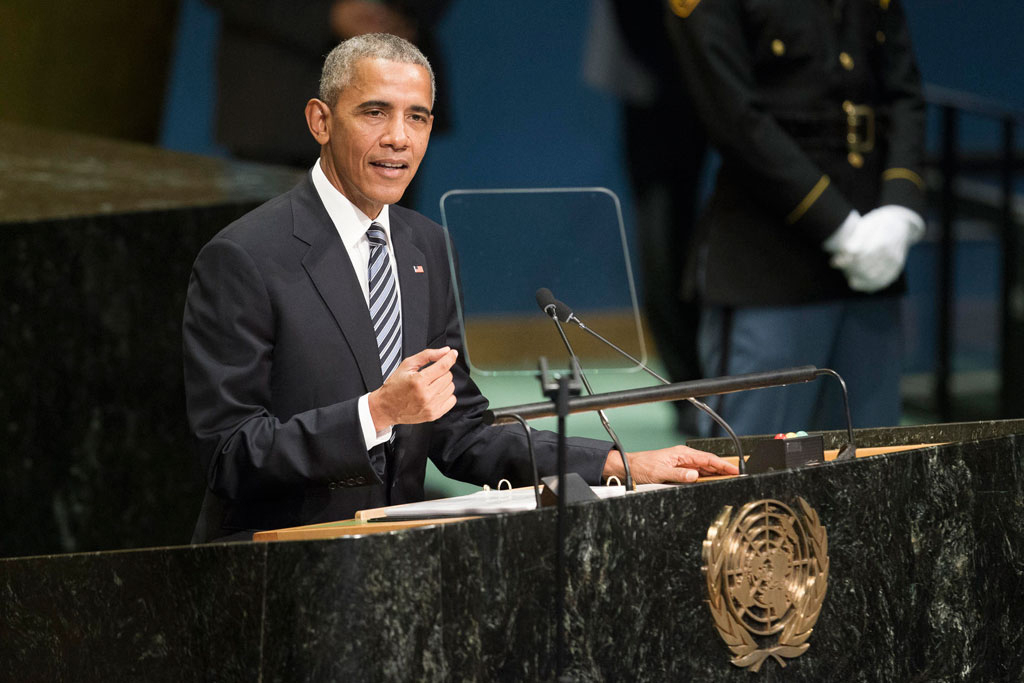
U.S. President Barack Obama addresses the UN General Assembly’s seventy-first session, September 20, 2016. (Image source: United Nations)

Obama must realize that no lasting peace can be achieved in the remaining months of his presidency: there are a multitude of complex and contentious issues — most notably the status of Jerusalem, the rights of so-called Palestinian refugees, and the situation in Gaza — that must be thoroughly addressed in order to achieve a lasting peace. Our next president will undoubtedly have to wade into the Israeli-Palestinian peace process again. The new administration — with the agreement of the Senate — should have full latitude to do what it deems most appropriate. It should not be stuck with parameters bequeathed to it by a President desperate to secure a short-term foreign policy “victory” that in the long term will make a resolution of the conflict more difficult to achieve.

If Obama feels that he must intrude in an effort to break the logjam before he leaves office, he should suggest that the current Israeli government offer proposals similar to those offered in 2000- 2001 and 2008 and that this time the Palestinian leadership should accept them in face-to face negotiations. But he should take no action (or inaction) that invites U.N. involvement in the peace process — involvement that would guarantee failure for any future president’s efforts to encourage a negotiated peace.

We should hear the views of both candidates on whether the U.S. should support or veto a Security Council resolution that would tie their hands were they to be elected president. It is not too late to stop President Obama from destroying any realistic prospects for peace.

Alan M. Dershowitz, Felix Frankfurter Professor of Law, Emeritus and author of Taking the Stand: My Life in the Law and Electile Dysfunction. An earlier and somewhat different version of this article appeared in the Boston Globe.

Translate »
Skip to toolbar