

A Muslim’s duty, we were taught in the Middle East, is to promote and establish Islamic government. Failing to do so means one’s religion and duty to Allah remain incomplete. Everyone must perform jihad (holy war; struggle in the cause of Islam) to impose Allah’s law on the world’s population. Everyone is a mujahid (fighter, from the word jihad). The promised end is one Islamic ruler under whom Allah’s sovereignty is complete on Earth.
We were also taught that when, in an election, the choice is between a Muslim and a non-Muslim candidate, a Muslim must always vote for the Muslim. Voting for a non-Muslim is voting against Allah. Character does not matter. Ability does not matter. All that matters is religion.
In Islam, you cannot be a passive religious observer. The core of Muslim identity, we were taught, requires active struggle for the political project. The founder of the Islamic Republic of Iran in 1979, Ayatollah Ruhollah Khomeini, put it: “We shall export our revolution to the whole world. Until the cry ‘There is no god but Allah’ resounds over the whole world, there will be struggle [jihad].”
This doctrinal demand makes it hard to believe the claims of Islamist nonprofit organizations that they are purely charitable and apolitical. American taxpayers lavishly subsidize them through the Internal Revenue Service’s 501(c)(3) tax-exempt status for charitable organizations.
According to the report, when the conduct of these groups was measured against IRS guidance on the ban against political campaign intervention by charities, the conduct detailed in the report closely tracks the agency’s examples of prohibited activity. These activities include endorsing candidates, seeking campaign donations, circulating campaign materials, giving platforms to candidates without comparable access for opponents, and releasing scorecards or voting records timed to election seasons.
Americans are effectively underwriting institutions that instruct congregants on how God requires them to vote and then handing the microphone to favored candidates.
[T]he IRS possesses the legal tools, the evidence, and its own training materials, yet appears to lack the will to act.
The report’s author, Mahyar Entezari, emphasized that every episode rests on video, audio, newsletters, convention materials, social media posts, and published accounts, but that “no organization has faced any consequence.”
[US Representative Chip] stated it is absurd that groups with links to terrorism continue to receive tax benefits that effectively have American taxpayers subsidizing threats against themselves.
The MEF has urged the IRS and Treasury Department to scrutinize every organization named in the report, apply available taxes and revocation remedies, and review groups still soliciting deductible contributions.
The report points out that the IRS and Treasury Department have the statutes, the guidance, and the evidence before them. The question is whether they will enforce the law and act on anything.
Growing up in Islamic societies in Iran and Syria, all of us could see that there is not even an iota of chance that any Islamist organization or mosque could exist as truly non-political or apolitical.
In schools and at university, we were taught that Islam differs fundamentally from other religions and spiritual practices. Whereas Christianity and Judaism allow for private faith and a separation between religion and state, Islam does not. From its inception in the seventh century, Islam was political. It was not a private spiritual matter. It was about creating a universal government run by Allah. Everything in society must be ordered by Sharia — what they call Allah’s law or God’s law.
A Muslim’s duty, we were taught in the Middle East, is to promote and establish Islamic government. Failing to do so means one’s religion and duty to Allah remain incomplete. Everyone must perform jihad (holy war; struggle in the cause of Islam) to impose Allah’s law on the world’s population. Everyone is a mujahid (fighter, from the word jihad). The promised end is one Islamic ruler under whom Allah’s sovereignty is complete on Earth. Until then, the struggle continues. Taqiyya — dissimulation, including lying when needed to protect Islam — is recommended to advance that end.
We were also taught that when, in an election, the choice is between a Muslim and a non-Muslim candidate, a Muslim must always vote for the Muslim. Voting for a non-Muslim is voting against Allah. Character does not matter. Ability does not matter. All that matters is religion.
In Islam, you cannot be a passive religious observer. The core of Muslim identity, we were taught, requires active struggle for the political project. The founder of the Islamic Republic of Iran in 1979, Ayatollah Ruhollah Khomeini, put it: “We shall export our revolution to the whole world. Until the cry ‘There is no god but Allah’ resounds over the whole world, there will be struggle [jihad].”
This doctrinal demand makes it hard to believe the claims of Islamist nonprofit organizations that they are purely charitable and apolitical. American taxpayers lavishly subsidize them through the Internal Revenue Service’s 501(c)(3) tax-exempt status for charitable organizations. A recent report from the Middle East Forum (MEF), “Weaponized Charity: Islamist Nonprofit Electioneering in America,” examines how certain tax-exempt Islamist groups have stepped directly into US electoral contests.
According to the report, when the conduct of these groups was measured against IRS guidance on the ban against political campaign intervention by charities, the conduct detailed in the report closely tracks the agency’s examples of prohibited activity. These activities include endorsing candidates, seeking campaign donations, circulating campaign materials, giving platforms to candidates without comparable access for opponents, and releasing scorecards or voting records timed to election seasons.
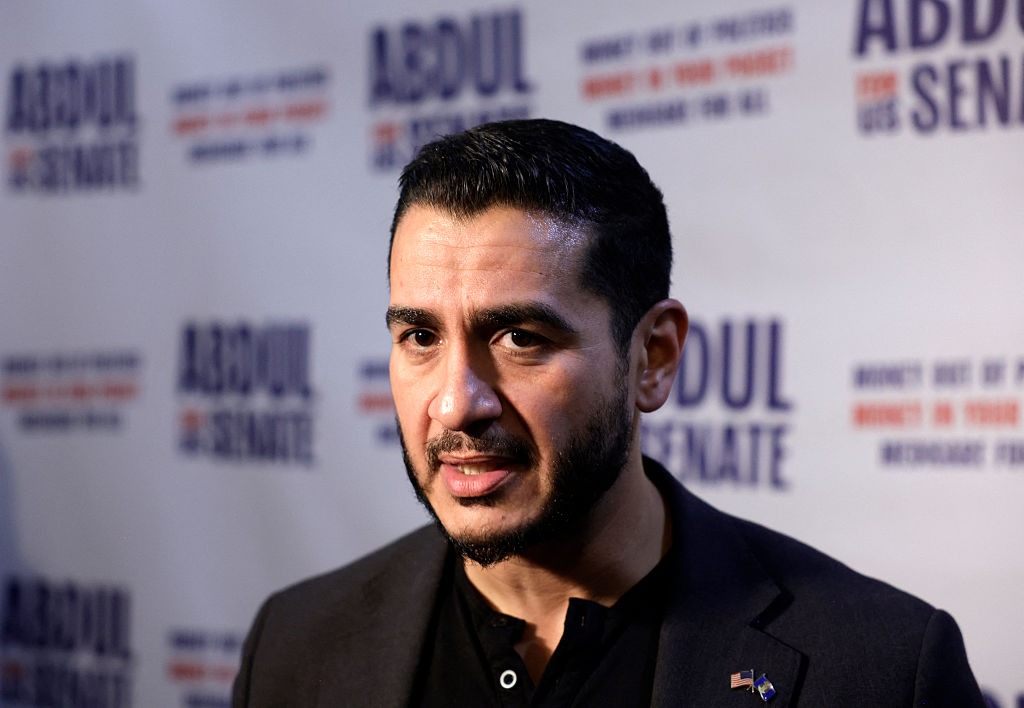
The most concrete illustration involves the 2026 Michigan Democratic Party primary for the US Senate. Abdul El-Sayed prevailed on August 4 by roughly 13,800 votes — a margin under one percent. In the preceding weeks, imams at several tax-exempt Michigan mosques urged support for him from the pulpit, and two of them brought the candidate onto the pulpit during services.
According to the report, at the Islamic House of Wisdom in Dearborn Heights, Imam Mohammad Ali Elahi — an Iranian-trained cleric who earlier served in the Islamic Republic of Iran Navy’s Political-Ideological Bureau — welcomed El-Sayed and told the congregation that he intended to vote for him. He reportedly added that voting is “as wajib [religiously required] as prayer” and called on everyone to “vote for Brother Abdul El-Sayed.”
The following day at the Karbalaa Islamic Educational Center in Dearborn, Imam Husham Al-Husainy reportedly appeared alongside El-Sayed and described a win for the candidate as a “victory to God.”
In Canton, an imam at the Muslim Educational Community Center of America told worshippers it was “mandatory” to elect “brother Abdul El-Sayed” because “at least we know he’s a Muslim.”
The report goes on illustrating that elsewhere, clerics employed language that the IRS itself regards as coded campaign messaging.
At the Islamic Institute of America, for instance, Imam Hassan Qazwini called voting a “religious duty” and cautioned against allowing a “Zionist candidate” to prevail.
On Labor Day weekend, the Islamic Society of North America (ISNA) provided El-Sayed a prominent speaking slot at its Detroit convention while his campaign operated an exhibitor booth featuring donation QR codes, campaign literature and “Muslims for Abdul” banners. The convention program described the candidate in language that mirrored material from a political action committee supporting him. After El-Sayed’s speech, ISNA’s chief executive, while asserting institutional neutrality, remarked that Muslims “know exactly what decision they should take.”
The IRS explicitly warns against political fundraising at candidate events.
The MEF investigation notes that the Council on American-Islamic Relations (CAIR) has issued color-coded congressional scorecards — some highlighting incumbents facing re-election — in every federal election year from 2018 through 2024, but not in the intervening non-election years. This timing pattern, it seems, is one the IRS views as evidence of election-related intervention. In addition, according to the MEF, the 2024 scorecard appeared on the website of CAIR Foundation, Inc., the group’s 501(c)(3) arm. CAIR, according to the report, has also outlined an expanded election effort for the current cycle.
The report cites additional cases, including a New Jersey mosque linked to Turkey’s Diyanet, which solicited donations on social media for a congressional candidate, a Queens mosque whose parent organization received funding from the Alavi Foundation (an entity federal prosecutors had accused of being controlled by Iran, later resolved in a 2026 settlement without admission of wrongdoing) which hosted Democratic primary candidates at Friday prayers, and other groups with documented connections to Iran, Turkey or the Muslim Brotherhood — several of whose branches the US government had designated as terrorist organizations in early 2026.
The MEF report states that despite the volume of documented activity, enforcement remains rare. The IRS has identified political campaign intervention in more than two-thirds of the 501(c)(3) organizations it has examined on this issue since 2004. Gregg Roman, executive director of the MEF, observed that tax exemption functions as a public subsidy, and that Americans are effectively underwriting institutions that instruct congregants on how God requires them to vote and then handing the microphone to favored candidates. Roman argued that the IRS possesses the legal tools, the evidence, and its own training materials, yet appears to lack the will to act.
The report’s author, Mahyar Entezari, emphasized that every episode rests on video, audio, newsletters, convention materials, social media posts, and published accounts, but that “no organization has faced any consequence.”
Some lawmakers have begun responding. US Representative Chip Roy of Texas introduced the No Tax-Exemptions for Terror Act, which would strip tax-exempt status from extremist organizations with close ties to terrorist groups, including CAIR. Co-sponsors include Representatives Randy Fine, Byron Donalds, Clay Higgins, Andy Ogles, Keith Self, Diana Harshbarger, Mary Miller, Andrew Clyde, Andy Biggs, and Eric Burlison.
Roy stated it is absurd that groups with links to terrorism continue to receive tax benefits that effectively have American taxpayers subsidizing threats against themselves. He pointed to CAIR’s associations with Hamas, the Muslim Brotherhood, and related networks, and noted that the organization’s national executive director had praised the October 7 attacks.
Senator Rick Scott introduced companion legislation, joined by Senator Marsha Blackburn. Both argued that organizations identified by the FBI as having terrorist connections should not receive charitable tax treatment and that America should not fund those it fights.
The MEF has urged the IRS and Treasury Department to scrutinize every organization named in the report, apply available taxes and revocation remedies, and review groups still soliciting deductible contributions. The MEF has also called on the Federal Election Commission to examine whether any of these entities provided things of value — such as pulpit time or official communication channels — to federal campaigns, and on state regulators in Michigan, New York, and New Jersey to open parallel inquiries under charitable-trust and campaign-finance laws. It calls on Congressional committees to refer the documented cases and to require greater public reporting on the IRS’s compliance work on political activity.
The report points out that the IRS and Treasury Department have the statutes, the guidance, and the evidence before them. The question is whether they will enforce the law and act on anything.
In Iran under the Shah, prior to the Islamic Revolution, Islamist organizations frequently began by presenting themselves as charitable or purely religious entities. They enjoyed the legal protections and financial advantages that the status conferred, then later revealed and expanded their political reach. The pattern is visible.
When US tax-exempt pulpits and convention floors can help decide a Senate primary by a margin of less than one percent, the longer-term stakes are foreseeable. Americans should not underestimate groups whose foundational doctrine, as was drummed into us, treat the political struggle for Islamic governance as a religious obligation.
As an eyewitness who grew up inside Islamic societies, I can assure the West without hesitation that there is not a chance — not even the slightest — that an Islamist organization or mosque can be genuinely apolitical or non-political. Politicization is woven into the identity itself. As we were taught, one’s duty is to struggle, to conquer, and to establish Islamic government across the world. That goal is not a side project. It is presented as the entire completion of the faith.
As shown in the MEF’s investigation, taxpayers are subsidizing organizations that enjoy tax-exempt privileges, collect public benefits, and pay nothing in return while advancing a political-religious agenda. Such groups already helped tip a Senate primary decided by less than one percent of the vote. Imagine the same networks applying the same methods to a presidential race. With margins that thin, the White House itself, as many are doubtless hoping, could one day be within reach. No religion must ever be allowed to become a vehicle for controlling a government while simultaneously ripping off the very taxpayers who underwrite its tax-free status.
egretnewseditor@gmail.com