

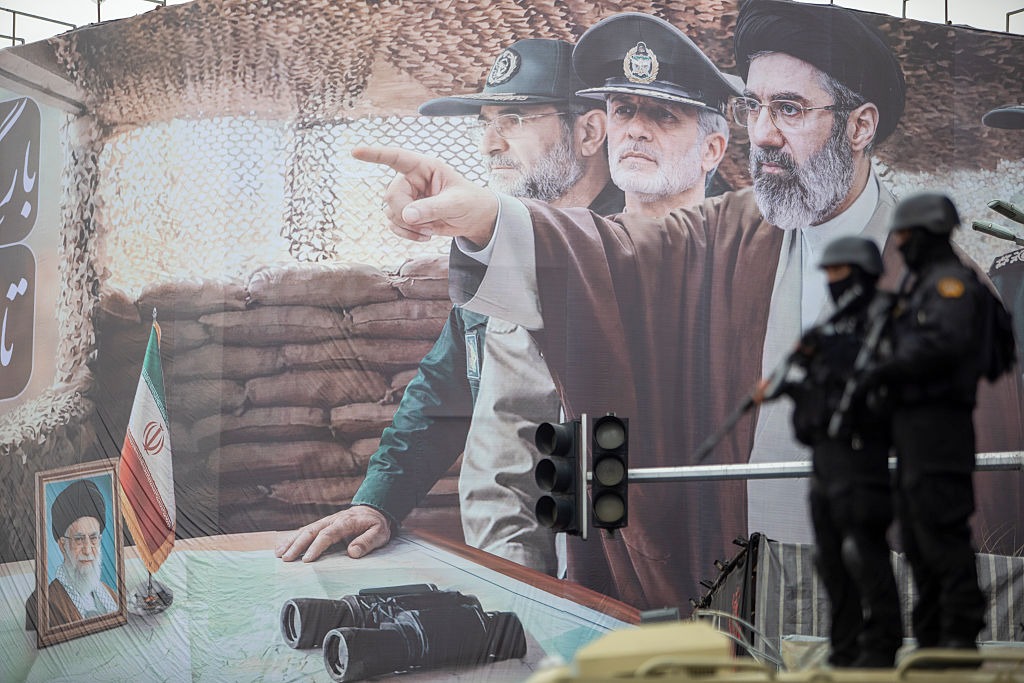
[D]espite having severed ties with half a dozen Muslim nations and firing missiles and drones at 10 others, [Iran’s] leadership belongs to the Khomeinist regime. bitter-enders and “reform-seekers” cite the still-hidden “Supreme Guide” Mojtaba Khamenei in support of their respective fantasies.
If US President Donald Trump offers them new concessions it would encourage them not to change course. If on other hand Trump unleashes his Mother of All Bombs (MOAB) on several targets, they would use it as justification for digging the hole they are in.
I don’t believe that the so-called “Iran problem” can be definitely resolved without regime change.
[R]egime change is a matter of Iranian people who have repeatedly shown their desire to return to the path of peace and economic development.
The old adage says “if you are in a hole, stop digging!” Yet, the leftover Khomeinist regime in Tehran seems determined to do the opposite.
Dozens of pseudo-politicians, politicized mullahs, retired generals and wannabe analysts appear on the small screen to declare “victory” and urge a nation that no longer believes their tale to continue “resisting until complete victory.” It is like continuing to dig the hole in the hope of one day hitting a gold mine.
In the process the diggers continue adding to an already long list of enemies they have created for almost five decades.
Pakistan has been trying to get them off the hook through diplomacy. Yet the bitter-enders attack it as a failed state and host of anti-Iran terrorist groups. The Islamic Revolutionary Guard Corps’ news site Tasnim even calls for direct military intervention in Pakistani territory to deal with those groups.
Kuwait is trying to remind Tehran of the good old days of brotherly relations but gets a kick in the teeth.
Qatar has been acting as a mediator more than sympathetic to Tehran, but is constantly booed as a lightweight trying to punch above its weight.
Oman, which has kowtowed to Tehran more than any other country, is rewarded by being ignored as a sovereign on the southern coast of the Strait of Hormuz. According to the latest official announcement in Tehran one coast is controlled by the IRGC and the other by the regular army.
Saudi Arabia is working hard to find a diplomatic way out of the current impasse but is rewarded by increased Iranian support for the Houthi rebels in Yemen. On Wednesday, Tasnim even claimed that the kingdom’s very existence was in danger.
The UAE, which has acted as the Khomeinist regime’s lungs for almost four decades, is branded Enemy Number 3 because of Abu Dhabi’s close ties with number one (the US) and number two (Israel). Iran’s truncated leadership even took the time to launch a childish campaign aimed at sabotaging the candidature of a UAE diplomat for UN Secretary-General.
Bahrain remains the target of especially violent propaganda attacks with frequent calls for its invasion and occupation.
Turkey resisted intense American pressure to avoid cutting off Iran’s transit lifeline and along with Saudi and Pakistan even invited Tehran to consider joining a new architecture of security for the region.
Yet, it too is now subject to new propaganda attacks and warned not to seek a leadership position in the Muslim world. The subtext is that despite having severed ties with half a dozen Muslim nations and firing missiles and drones at 10 others, such leadership belongs to the Khomeinist regime.
At the same time, the parallel world inhabited by the hodgepodge presented as government one finds individuals and groups that talk of change, reform and even a strategic change of trajectory from “resistance” to economic development.
Both bitter-enders and “reform-seekers” cite the still-hidden “Supreme Guide” Mojtaba Khamenei in support of their respective fantasies.
In recent days the number of people who claim to have actually seen Khamenei has risen to six, with Islamic Majlis Speaker Muhammad-Baqer Qalibaf and Secretary of the High Council of National Security Mohsen Reza’i, both retired IRGC generals, and Chief Justice Mohseni Eejeh saying they received that honor.
However, none of them says what actually was said apart from the “Supreme Guide” endorsing their contradictory positions. One gets the impression that the hidden “Guide” agrees with whoever calls on him.
The two factions talk of the past and muse about the future but offer no ideas about here and now. Both count on largely imaginary support from China and Russia to weather any storm ahead.
Tehran’s ambassador to Moscow, Kazem Jalali, says Russian President Vladimir Putin admires Iran’s leaders and, to beat the American quarantine, wishes to open the north-south transit route promised 30 years ago but never created.
In its present shape, the truncated leadership is unable to fight or to negotiate the end of hostilities.
If US President Donald Trump offers them new concessions it would encourage them not to change course. If on other hand Trump unleashes his Mother of All Bombs (MOAB) on several targets, they would use it as justification for digging the hole they are in.
If Benjamin Netanyahu survives as Israel’s Prime Minister and returns to “finishing the job,” presumably by killing more civilian and military officials and bombing more infrastructure, we would get the same result.
Is diplomacy still possible? Yes, in theory.
Demanding “unconditional surrender” as Trump once did is playing in the theatre of abstractions.
For diplomacy to succeed, a number of conditions must be met.
The first is a grand coalition consisting of all six Gulf Cooperation Council members, Turkey and Pakistan singing from the same hymn sheet.
That would require Oman, Qatar and Kuwait to abandon their fantasies about “special relations” with the Khomeinist regime. For its part, Abu Dhabi must abandon the forlorn hope of escaping harm thanks to support from Israel.
That would also require China and Russia to change their policy of using the Khomeinist regime as a pawn in their power-game against the United States and the European Union.
Even then, any diplomatic plan should include concrete demands from Tehran beyond the largely folkloric ones such as enriching uranium to lower grade, something that is easy to promise but hard to impose on a long-term basis.
One concrete demand is for Tehran to cease supporting the truncated Hezbollah in Lebanon and the Houthis in western Yemen. These are things that can easily be checked Tehran should end its 100-man military “advisory” mission and stop the supply of kits for missiles and drones to the Houthis.
The $100 million “humanitarian” aid promised for Lebanese Hezbollah could be channeled through Lebanon’s legal authorities to make sure it is spent only for the purpose claimed.
Even then, no deal should be made without public endorsement by all factions in Tehran including the “Supreme Guide”, the Islamic Majlis, the formal presidency, and the HCNS.
The error that Barack Obama made with his non-paper ambiguous deals should not be repeated.
Having said all that, I don’t believe that the so-called “Iran problem” can be definitely resolved without regime change.
The scorpion stings not because it is programmed by nature to do so. But regime change is a matter of Iranian people who have repeatedly shown their desire to return to the path of peace and economic development.
A truce that ends an unwinnable war could provide the space needed for a permanent defanging of the scorpion.
egretnewseditor@gmail.com