

While the Mecca Agreement is being touted by some as countries finally taking responsibility for their own defense instead of relying exclusively on the United States (as Saudi Arabia currently does), this arrangement looks set to produce “unintended consequences.”
The US seems to forget that after World War II, the last thing it wanted was for Europe and other regions to have strong military forces. Many in the West concluded that Germany had effectively started two world wars in one century and, in general, had trouble playing nicely with others. While protecting its allies might be expensive for the US, not protecting them could well cost more.
The same holds true for an alliance such as the Mecca Agreement. At first glance, it looks as if the Saudi-Pakistani-Turkish alliance might help the United States share a defense burden. In a longer view, the pact could well end up creating a far bigger defense burden.
The countries in the Mecca Agreement are not necessarily becoming America’s enemies. They could, however, work against the interests of the US and the West.
Saudi Arabia, which may have been flirting with the idea of joining the Abraham Accords but always came up with some “poison pill” and has just been permitted by US President Donald J. Trump to enrich uranium for nuclear reactors, has chosen to enter a defense partnership with Turkey and Pakistan – two countries whose governments have fiercely anti-Israel positions.
The concern, therefore, is that an increasingly powerful Turkey is seeking to translate the expansion of its military capabilities into a regional hegemony while simultaneously embracing an aggressive posture toward Israel, Cyprus and Greece.
If, for instance, Turkey receives the F-35 stealth fighter jets it is seeking from the United States, then attacks Israel, and Israel retaliates, will Pakistan then claim Turkey has “been attacked” and launch nuclear weapons at Israel? Is that long-term desire, in fact, at the root of the “defense pact”?
Turkey, moreover, is rapidly expanding its influence in Syria. Both Turkey and Qatar are major allies of the government of Syrian President Ahmed al-Sharaa, while Turkey has been deeply involved in developing Syria’s new armed forces.
Turkey is positioning itself as a leader of an increasingly assertive Sunni Islamist-oriented bloc. Pakistan is trying to convert its nuclear status into greater political influence, and Saudi Arabia is their financier and potential nuclear weapons partner.
The real danger is the strategic direction it represents, in response to a perceived decline in American influence, growing Turkish power, weakening prospects for a peaceful Middle East, and now the emergence of a new regional bloc whose leading members increasingly regard Israel, Cyprus, Greece and the West in general not as potential partners, but as adversaries.
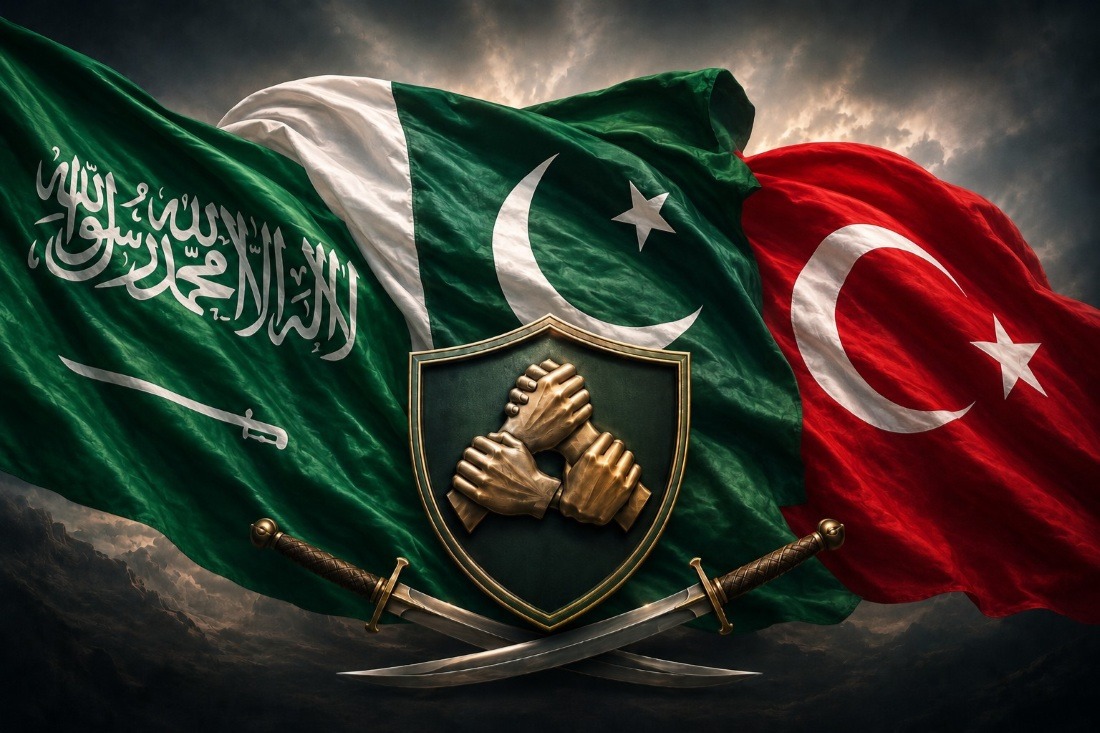
The Mecca Joint Defense Agreement signed by Saudi Arabia, Turkey, and Pakistan on August 7 should serve as a wake-up call for the United States and Israel. The agreement, which states that an armed attack against any one of the three countries will be considered an attack against all of them, has been presented by its signatories as a purely defensive agreement. Pakistani and Turkish officials insist that it is not directed against any particular country.
That, however, is possibly not quite true, and only part of the issue.
While the Mecca Agreement is being touted by some as countries finally taking responsibility for their own defense instead of relying exclusively on the United States (as Saudi Arabia currently does), this arrangement looks set to produce “unintended consequences.”
The US seems to forget that after World War II, the last thing it wanted was for Europe and other regions to have strong military forces. Many in the West concluded that Germany had effectively started two world wars in one century and, in general, had trouble playing nicely with others. While protecting its allies might be expensive for the US, not protecting them could well cost more.
The same holds true for an alliance such as the Mecca Agreement. At first glance, it looks as if the Saudi-Pakistani-Turkish alliance might help the United States share a defense burden. In a longer view, the pact could well end up creating a far bigger defense burden.
For nearly a century, the US has generously provided protection against countries threatening the West and Western interests. Now, in the Mecca Agreement, three important Muslim countries, two of them longtime partners of the United States and one a NATO member, are building a regional security framework that does not depend on Washington.
For decades, Saudi Arabia has regarded the United States as its principal security guarantor. Turkey remains a NATO member. Pakistan has had a long and complicated security relationship with Washington. Now these three countries are establishing their own collective-defense mechanism.
Some of America’s traditional partners apparently no longer have confidence in the United States as their protector. Saudi Arabia is clearly declaring that it no longer wants to place all its security eggs in the American basket.
The countries in the Mecca Agreement are not necessarily becoming America’s enemies. They could, however, work against the interests of the US and the West.
The seeds of Saudi mistrust were planted years ago. In 2019, Iran was blamed for the devastating attack on Saudi Arabia’s Abqaiq and Khurais oil facilities, temporarily knocking out a huge portion of Saudi oil production.
Yet Washington did not launch the military response many Saudis apparently expected. The episode reportedly “shook Saudi faith in the US.” The Middle East Institute wrote that the 2019 Iranian attack and the lack of a US response “virtually eliminated any Saudi confidence in the US security commitment.”
The Mecca Agreement appears to be another consequence of this loss of confidence.
Saudi Arabia brings enormous financial resources to the new partnership. Pakistan brings military experience and, significantly, is the only Muslim-majority country possessing nuclear weapons. Turkey brings one of NATO’s largest militaries and a rapidly advancing indigenous defense industry.
This does not necessarily mean that Pakistan’s nuclear umbrella has been extended to Saudi Arabia or Turkey. Moreover, it does not mean that the three countries will automatically go to war whenever one is attacked. Indeed, the operational details remain vague.
The political symbolism, however, should not be underestimated.
For Israel, the development is especially disturbing because it comes at a time when hopes of normalization with Saudi Arabia appear remote.
Saudi Arabia, which may have been flirting with the idea of joining the Abraham Accords but always came up with some “poison pill” and has just been permitted by US President Donald J. Trump to enrich uranium for nuclear reactors, has chosen to enter a defense partnership with Turkey and Pakistan – two countries whose governments have fiercely anti-Israel positions.
Jonathan Spyer, director of research at the Middle East Forum, wrote that before the Hamas invasion of Israel on October 7, 2023, Saudi Crown Prince Mohammed bin Salman was often viewed alongside the leaders of the United Arab Emirates and Bahrain as part of an emerging Gulf leadership seeking to move beyond traditional regional rivalries and toward economic and technological cooperation, including closer relations with Israel.
“It should not be assumed that Riyadh has conclusively abandoned this orientation,” Spyer cautioned. Nevertheless, he noted, in the post-October 7 Middle East, military considerations and “religious and civilizational symbolic loyalties” have returned to center stage.
The Mecca Agreement gives Saudi Arabia the opposite strategic framework precisely when Washington had hoped that deeper US-Saudi security cooperation could help facilitate Saudi normalization with Israel.
Turkey’s role is particularly dangerous.
Under President Recep Tayyip Erdogan, Turkey has for years positioned itself as one of Israel’s most hostile adversaries. Ankara has maintained close relations with Hamas and has repeatedly provided political support to the terrorist organization (such as here, here, here and here).
The concern, therefore, is that an increasingly powerful Turkey is seeking to translate the expansion of its military capabilities into a regional hegemony while simultaneously embracing an aggressive posture toward Israel, Cyprus and Greece.
If, for instance, Turkey receives the F-35 stealth fighter jets it is seeking from the United States, then attacks Israel, and Israel retaliates, will Pakistan then claim Turkey has “been attacked” and launch nuclear weapons at Israel? Is that long-term desire, in fact, at the root of the “defense pact”?
Spyer warns that the emerging Turkey-Pakistan-Saudi Arabia alignment is, at the rhetorical level, “jointly and extremely anti-Israel.” He points to Pakistani Defense Minister Khawaja Asif’s recent call for a united Islamic front against Israel and Erdogan’s claim that Zionism threatens everyone. More significantly, Spyer notes that Turkey and Qatar have been among Hamas’s “practical supporters.”
The Mecca Agreement, therefore, cannot be examined in isolation.
Turkey, moreover, is rapidly expanding its influence in Syria. Both Turkey and Qatar are major allies of the government of Syrian President Ahmed al-Sharaa, while Turkey has been deeply involved in developing Syria’s new armed forces. Israel, Cyprus and Greece therefore face the possibility of a growing Turkish strategic footprint stretching through Syria and into the wider Sunni Muslim world, backed by closer military cooperation with nuclear-armed Pakistan and Saudi financial power.
Turkey, in addition, brings sophisticated military technology to the equation. Ankara and Islamabad have steadily expanded their defense-industrial relationship, including cooperation involving aircraft, drones, and other military systems. Saudi money could significantly accelerate these projects.
Turkey is positioning itself as a leader of an increasingly assertive Sunni Islamist-oriented bloc. Pakistan is trying to convert its nuclear status into greater political influence, and Saudi Arabia is their financier and potential nuclear weapons partner.
Even if the Mecca Agreement never becomes a genuine “Islamic NATO” and remains partly symbolic, that does not make it harmless.
The real danger is the strategic direction it represents, in response to a perceived decline in American influence, growing Turkish power, weakening prospects for a peaceful Middle East, and now the emergence of a new regional bloc whose leading members increasingly regard Israel, Cyprus, Greece and the West in general not as potential partners, but as adversaries.
egretnewseditor@gmail.com