

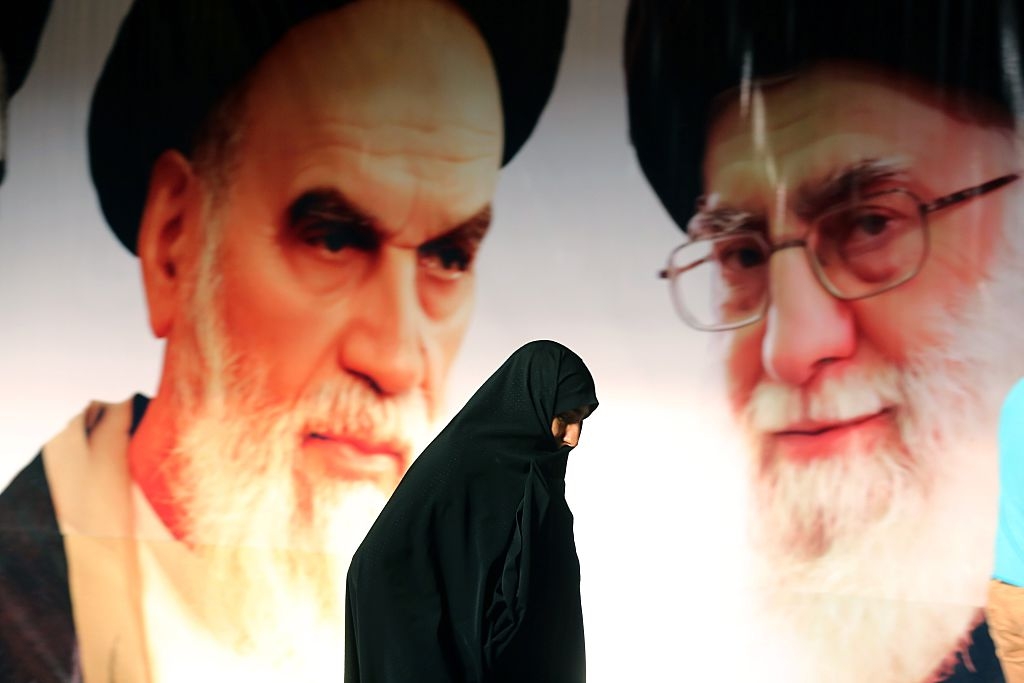
Is the war launched by Israel and the US against Iran already over bar the shouting? As far as the war that the Islamic Republic of Iran started in 1979, the answer is no. The regime created by Ayatollah Ruhollah Khomeini built its legitimacy around its claim of fighting against the “Great Satan” and its “Little” acolyte.
The latest phase of the 47-year war has weakened the regime to the point that it fears that an end of hostilities could reignite the street.
Today, by the best count, the positions of at least 20 provincial governors out of 31 and more than 20 ambassadors and at least 100 military and security commanders need to be filled either because traditional terms are over or because occupants have been “eliminated.”
Is the war launched by Israel and the US against Iran already over bar the shouting? As far as the war that the Islamic Republic of Iran started in 1979, the answer is no.
The regime created by Ayatollah Ruhollah Khomeini built its legitimacy around its claim of fighting against the “Great Satan” and its “Little” acolyte.
Almost all US presidents understood that fact. What they all tried to achieve was a prolongation of the lukewarm version of that war in the hope that one day, who knows when, there may be regime change.
Donald Trump is the first US president to believe that the desired change may be achievable during his tenure. And that, paradoxically, is why he may have unwittingly delayed that change with his erratic strategy.
For the first time in almost 48 years, what is left of the Khomeinist leadership is taking the possibility of regime change seriously and is trying to deal with it.
“We need to focus on the internal front,” warns Ali Rabi’ie, a veteran regime insider. By that he means what Mohammad Baqer Qalibaf, speaker of the Islamic Majlis (ersatz parliament), refers to as “the street.”
The latest phase of the 47-year war has weakened the regime to the point that it fears that an end of hostilities could reignite the street.
A cocktail of explosive problems has taken shape. More than four million people have lost their jobs, and thousands of businesses have gone bust. The government admits that over 5,000 public projects have been frozen for lack of funds or personnel to supervise them.
Iranian President Masoud Pezeshkian says there isn’t enough money to import gasoline from India, causing a 15 percent shortage that could bring hundreds of thousands of vehicles, including military ones, to a halt. (The regime spent its money building tunnels to hide its projectiles rather than refineries to process its crude oil.)
Worse still for the current leadership, the regime has lost control of the political narrative. The narrative of returning to the pre-revolution era and the constitutional form of government seems to be in the ascendancy.
Just over a year ago, the then “Supreme Guide” Ayatollah Ali Khamenei warned against a return to constitutional government (“mashruteh” in Persian) as a serious threat against Iran. In August 2025, dozens of activists were arrested on a charge of organizing events commemorating the 1906 Constitutional Revolution.
This month, however, Pezeshkian himself issued a long statement in praise of the once cursed mashruteh. That gave the green light for a series of events across Iran, with some universities breaking the summer recess to mark the 120th anniversary of the Constitutional Revolution.
All that may be dismissed as a tribute that vice pays to virtue or a cheap political gimmick by clueless politicians.
Nevertheless, highlighting an alternative narrative is of crucial importance because society, like nature, abhors a vacuum. People want to know that by ending the status quo, they won’t be jumping into the unknown head first.
The elimination of Khamenei senior created a vacuum that his anointed successor Mojtaba isn’t able to fill, if only for physical reasons.
Ali Khamenei was a Madison Avenue-level expert in public relations and self-promotion. Like President Donald Trump, he wanted to be constantly in the headlines, and although he seldom ventured outside his “beyt,” he was always in the news. One day he was receiving poets, another he was addressing “muezzins” from all over the country.
Foreign dignitaries and “Axis of Resistance” leaders lined up for photo-ops with him.
On quieter days, he would send cables to this or that mullah or other public figure with condolences for a loss or as a pat on the shoulder for real or imaginary success in the service of the regime. On Fridays, some 5,000 preachers acting as their master’s voice across Iran would read the text he had dictated during mass prayers.
The “beyt” was a giant octopus whose arms stretched in all directions. Military commanders were not allowed to hold meetings on their own even in an informal gathering with orange juice served. The “beyt” could summon any official, including the president, for briefing or instructions.
Referred to as “Agha” (a Turkish word meaning master) as an endearment, Khamenei had his personal representatives in every ministry, army division, major public company and even embassies in more than 40 capitals.
Having created more than a dozen “councils,” each headed by one of his acolytes, Khamenei made sure that, as the Persian poet said, not a single insect moved on a leaf without him knowing about it.
With “Agha” gone, those councils have gone into an eclipse that may never end. The Council of the Guardians of the Constitution, the Expediency Council, the Islamic Convergence Council, the Islamic Awakening Council, the Axis of Resistance Council, the Foreign Policy Strategic Board, the High Council of National Security, and the Assembly of Experts of Leadership haven’t had a session since “Agha” was assassinated by the Israelis.
With its speaker engaged in a power struggle, even the Islamic Majlis hasn’t held a full session for months.
Some octopus arms have either lost their heads or some key figures in “elimination” operations by Israel or the US.
Worse still, in some cases individuals tapped to fill posts left by the loss of military and/or political leaders have politely declined the invitation. Among them were a number of younger generation officers of the Islamic Revolutionary Guard Corps, which is now the subject of speculations about its merger with the regular army, a scheme prepared in 1999 but vetoed by “Agha.”
Under “Agha,” with one or two exceptions in four decades, no senior military or political official was allowed to keep his post for more than a decade. The undeclared rationale was that in a system whose center is fixed forever, its satellites ought to change within fixed periods.
Today, by the best count, the positions of at least 20 provincial governors out of 31 and more than 20 ambassadors and at least 100 military and security commanders need to be filled either because traditional terms are over or because occupants have been “eliminated.”
It took “Agha” 30 years to design and build a system that suited him. Even if he worked doubly hard, Mojtaba Khamenei isn’t able to budge his “beyt,” let alone the system shaped around it.
Thus, the phrase “we are at war” is a good prop to hide the regime’s impotence
In other words, by prolonging this peculiar pseudo-war, Trump or whoever advises him may be helping Khamenei or whoever plays his role to keep “the street” quiet with feigned patriotism.
egretnewseditor@gmail.com