

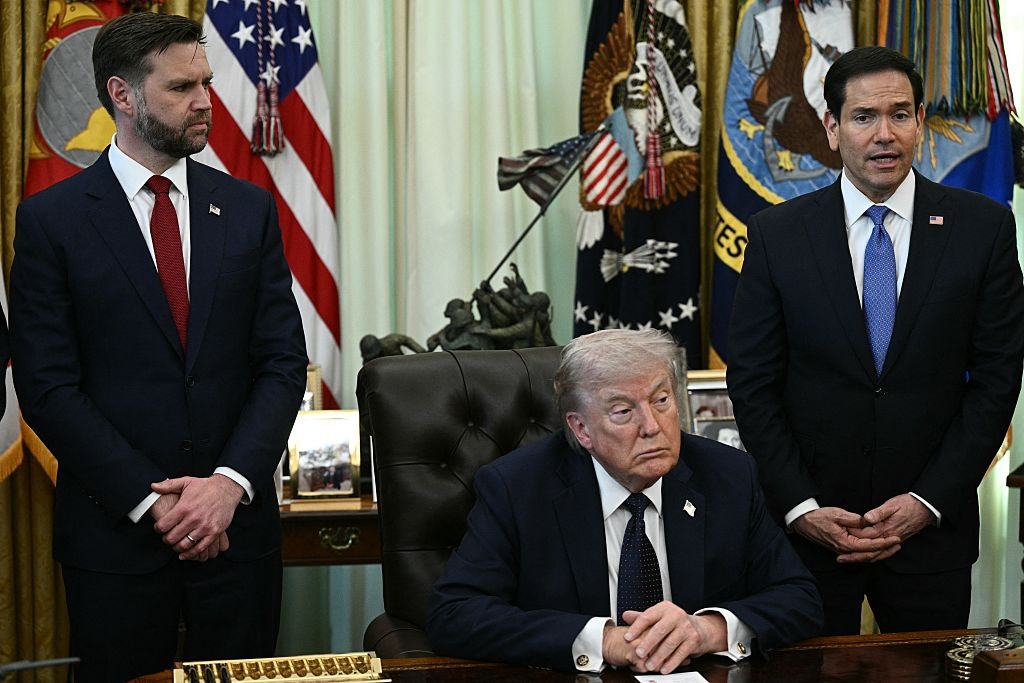
The Islamabad Memorandum of Understanding tells Iran that Hezbollah survives and Israel leaves. The Trilateral Framework says that Hezbollah disarms and that, until it does, Israel stays in Lebanon. The negotiations with Iran were led by Vice President JD Vance, who never wanted this war and made no secret of his wish to end it cheaply. He produced the Islamabad MOU, the paper Iran’s regime wanted to hear. The Trilateral Framework was created by Secretary of State Marco Rubio, who has spent his career treating Iran’s proxy network as a threat to be dismantled rather than soothed.
Iran negotiated the Islamabad MOU and believed it had won the war. It discovered that the Trilateral Framework, the only binding document, the one with mechanisms, was written to ensure the opposite.
Great powers, losing patience, sign a document and persuade themselves that it is strategy. The Islamic Republic of Iran has watched this habit in Western capitals for over 40 years and learned to feed on it. What it had not yet absorbed is that an administration can run two contradictory instruments at once, letting the weaker one absorb the enemy’s hopes while the stronger one quietly sets the terms.
That is the situation today in Lebanon. Within nine days, the United States put its name to two texts pointing in opposite directions. The first is the Islamabad Memorandum of Understanding, signed remotely by the US and Iran on June 17, its name inherited from the failed talks in Pakistan. Its 14 points open with a demand for the immediate end of hostilities, explicitly including Lebanon, and the restoration of Lebanese sovereignty. Iran’s regime intended this opening clause as a deed of eviction: Israel out of southern Lebanon, Hezbollah preserved, the situation frozen in the Islamist militia’s favor. The second document, the Trilateral Framework Agreement signed by the US, Lebanon and Israel at the State Department on June 26, says something Iran’s mullahs cannot accept and apparently did not see coming.
A memorandum of understanding is, in diplomatic practice, a statement of intent. It binds no one. It announces a direction and leaves the obligations for later, which is why exhausted powers reach for it, buying the language of peace at the price of nothing concrete. Iran understood this and pocketed the first clause as a guarantee. What it could not foresee was that the operational follow-on would be drafted by a different hand, answering to a different policy, and that the second text would gut the first without ever formally repudiating it.
The Trilateral Framework signed in Washington is not a memorandum. It is an implementation accord among Israel, Lebanon, and the United States, with Washington as guarantor of a sequenced and verifiable process. Where the Islamabad MOU treated Israeli withdrawal from Lebanon as the precondition, the Trilateral Framework inverts the order. The Lebanese Armed Forces will assume control of two pilot zones; Hezbollah is to be disarmed and its infrastructure dismantled; only upon verified disarmament does Israel progressively redeploy. A Military Coordination Group, facilitated by the United States, will supervise the mechanism. Hezbollah is not a party to any of it. Its weapons and infrastructure are the objects.
Consider what each document asks of the same actor. The Islamabad Memorandum of Understanding tells Iran that Hezbollah survives and Israel leaves. The Trilateral Framework says that Hezbollah disarms and that, until it does, Israel stays in Lebanon. The Washington framework carries a verification schedule, a coordination body, and an American signature on the operational page. The Islamabad MOU was the consolation Iran was permitted to believe and has no mechanism behind it at all.
A division of labor inside the Trump administration was deployed, and not concealed. The negotiations with Iran were led by Vice President JD Vance, who never wanted this war and made no secret of his wish to end it cheaply. He produced the Islamabad MOU, the paper Iran’s regime wanted to hear. The Lebanon framework was created by Secretary of State Marco Rubio, who has spent his career treating Iran’s proxy network as a threat to be dismantled rather than soothed. One man offered Iran the vocabulary of relief. The other wrote the document that conditions every concession on the disarmament of Iran’s most valuable proxy.
Hezbollah understood the trap faster than its patron. The day after the Washington signing, Hezbollah Secretary-General Naim Qassem declared the framework null and void, and insisted that the first article of the Islamabad MOU (Israel’s withdrawal) be implemented in its place. No amount of trilateral architecture, Qassem argued, could override the text Iran had secured. The terrorist militia that called the MOU a “gift of honour, dignity, and strength” now calls the Lebanon framework “a ‘humiliating’ and ‘shameful’ surrender” — the most candid judgment the document has drawn.
The Israeli reading was equally direct. At the signing, Israel’s Ambassador to the US, Yechiel Leiter, compressed the whole maneuver into a line: in this performance-based framework, Iran is out, Hezbollah is out, and the road between Israel and Lebanon is open. Israeli Prime Minister Benjamin Netanyahu was blunter, saying that Israel will remain in the security zone in southern Lebanon until Hezbollah is disarmed and the threat it poses to Israel is removed. His message to Iran was that it will have no foothold in Lebanon, neither it nor its proxy militia. That is not the language of a power that has agreed to leave.
None of this means the matter is settled. A framework is a sequence, not a fact, and sequences in Lebanon have a long record of stalling at the first zone. A report in the Jerusalem Post makes plain how modest the initial withdrawal is and how much depends on the Lebanese Armed Forces being tasked with disarming a militia that is stronger than the state. Hezbollah retains the power to make the “pilot zones” ungovernable, and Iran retains the power to reopen the file the moment American attention drifts. The contradiction between the two papers has not been resolved. It has been postponed, on terms favorable to Jerusalem.
The structure of the arrangement deserves to be seen plainly because it explains why the satisfaction in Iran curdled so quickly. Iran negotiated the Islamabad MOU and believed it had won the war. It discovered that the Trilateral Framework, the only binding document, the one with mechanisms, was written to ensure the opposite. This was not a single masterstroke and should not be sold as one. It was the older and colder craft of letting an adversary invest its hopes in the weaker instrument while the stronger one is prepared in the next room.
Whether this holds will be decided not in Washington but in the Lebanese villages south of the Litani River, where a terrorist militia that answers to Iran is being told to surrender the weapons that are its reason for existing. The framework can be enforced, or it can be evaded. What can no longer be claimed is that the United States agreed to Iran’s terms. It agreed to a paper that said so, and signed another that did not, and handed the second to the man who meant it.
egretnewseditor@gmail.com