Yearly Archives: 2017

The Israel-Bashing Industry’s “Intellectuals” by Giulio Meotti

  • These novelists hold a deep, uninformed, irrational hatred. Instead of backing the only country that gives full rights to all its citizens, they are instrumental in attacking not only Israel but the Jewish people.

  • What is notable is that every single time, these most illustrious writers “forget” to say why Israel built those fences, checkpoints and roadblocks in the first place.
  • Saramago, while he was visiting Ramallah, chose not to see and talk about the Israeli restaurants, malls and hotels turned into carpets of human bodies. The wholesale slaughter of Jews was the only reason Israel had to send tanks and soldiers back into the Palestinian cities after the Oslo Accords. Saramago did not mention the context; he preferred to give credence to a distorted, demonizing vision.

What is the only country about which can be said that its very existence is disputed? Clue: Not Zimbabwe, not Tuvalu, not even overrun Tibet. Which country’s boundaries, bought with blood in wars initiated by others, are challenged by all nations, who now seem determined to destroy it through boycotts, unjust defamation and purported “laws” that are applied to no other nation?

Which country fully respects the rights of women and every kind of ethnic, religious and sexual minorities, notwithstanding that it is condemned at the United Nations for being “the worst violator of women’s rights” — worse than Syria, Afghanistan, Somalia, Pakistan, China, Saudi Arabia, Iran and Sudan?

Which country provides its own enemy with water, electricity, food and medical treatment? Its military, to avoid enemy civilian casualties, warns its enemy to evacuate buildings before attacking them, and — instead of simply carpet bombing the enemy as all other nations do, including most democracies — sends its own soldiers possibly to die in ground operations?

The country is Israel — the only country that even famous writers, intellectuals and Nobel laureates target, demonize and criminalize.

There was a time when Nobel laureates for Literature, such as the German Heinrich Böll, the French Jean-Paul Sartre and the Italian Eugenio Montale, rushed to denounce injustice. Earlier, in the name of best Europe’s values — justice, freedom and solidarity — they condemned the threats to the State of Israel’s existence.

But today, these novelists hold a deep, uninformed, irrational hatred towards the same place. Instead of backing the only country that gives full rights to all its citizens, they are instrumental in attacking not only Israel but the Jewish people. In Germany, Hitler’s Mein Kampf is the new best-seller. In Europe today, you can even find a great number of books that wipe Israel off the map. And a provincial council near Glasgow, West Dunbartonshire, banned Israeli books from local libraries.

In the chorus of those who speak from journals, poems and novels, there have been a few noble exceptions. The Albanian writer Ismail Kadaré, a Muslim candidate positioned every year to win the Nobel Prize for Literature, turned down a request to boycott the tiny Jewish State. Israel, he says, faces “the threat of disappearance,” and he compared Israel to Albania under Nazi occupation. Also the author of the Harry Potter books, JK Rowling, refused to add her name to the list of Israel’s boycotters.

Their brave, solitary gestures highlight the sluggish, uninquiring conformity of the “intelligentsia’s” campaign to pile unmerited calumnies on Israel.

Worse, supposed “intellectuals” often spout raw anti-Semitism while giving a pass to the truly barbarous people among us. If the Nobel Committee had any decency, it would revoke the prizes it awarded for “Peace” to such “humanitarians” as Fidel Castro and Yasser Arafat. It is painful to watch the Nobel Committee make a fool of itself year after year, and it is painful to watch these so-called intellectuals be so unaware and filled with prejudice against the people who least deserve it.

An Italian writer, Dario Fo, a laureate of the Nobel Prize for Literature, just gave an interview to the newspaper, La Repubblica. Fo, talking about the Jewish patriarch, Moses, said: “Moses was killing women and children because they worshiped idols.” Mr. Fo went on blaming “the Jews’ brutality against those who follow other religions, as it happens today.” Excuse me? Is it the Jews who are burning people alive, drowning them in cages, slitting throats or crucifying anyone for following a different religion?

Mr. Fo’s comparison is as wrong as it is ghastly. It is not the Jews who suicide-bomb Palestinian buses, cafes, wedding halls and discotheques. It is not the Jews who now try to mow down Palestinians with cars or stab them in the street. It is the reverse — and has been for years.

The daily newspaper La Stampa charged Dario Fo with “recycling anti-Semitic stereotypes.” Fo is not new at this. In the 1970s, in one of his theatrical operas, “Resistance: Italian and Palestinian people speak,” the future Nobel Prize laureate compared Nazism to Zionism and the Palestinian fedayeen terrorists to the anti-Fascist partisans.

A few days after the 9/11 attacks, Fo also said that,

“the great speculators wallow in an economy that every year kills tens of millions of people with poverty — so what is 20,000 dead in New York? Regardless of who carried out the massacre, this violence is the legitimate daughter of the culture of violence, hunger and inhumane exploitation.”

Who gave this famous writer the right to defame, earlier, not only Israel’s name but also 9/11’s victims?

Another Nobel prize-winning novelist, Mario Vargas Llosa, as well as the Pulitzer Prize winner Dave Eggers, are among a group of international novelists who will contribute to a book of essays next year about “50 years of Israeli occupation” that will be published by Harper Collins, one of the publishers that wiped Israel off the map.

The book is part of an initiative by Breaking the Silence, a non-governmental organization (NGO) which makes sweeping charges against the Israeli army “based on anonymous and unverifiable hearsay ‘testimonies.'” while refusing to disclose the names of the Israeli soldiers who “testified.” Worse, it is being funded specifically “to incriminate the IDF” (Israel Defense Forces) and, was explicitly directed by European charities to prove that Israel acted improperly. In an article entitled, “Europe to Breaking the Silence: Bring Us As Many Incriminating Testimonies As Possible,” the watchdog group NGO Monitor disclosed that:

Contrary to BtS’ claim that “the contents and opinions in this booklet do not express the position of the funders,” NGO Monitor research reveals that a number of funders made their grants conditional on the NGO obtaining a minimum number of negative “testimonies.” This contradicts BtS’ declarations and thus turns it into an organization that represents its foreign donors’ interest, severely damaging the NGO’s reliability and its ability to analyze complicated combat situations.

Are these “prestigious” writers aware of the organization’s predetermined bias which is going to fund their new book?

There is also, of course, the problem of double standards and hypocrisy. These writers did not decide to put their pen at the service of the Syria’s civil war victims or the Christians and Yazidi who are suffering a genocide in Iraq. No, these writers targeted Israel, the only democracy in the Middle East, and its supposed “occupation” — which they fail to disclose was backed by the Palestinians themselves in the Oslo II Accord of 1995, Chapter 3, Article XVII Jurisdiction [1], which in fact turned the Palestinian people into the most protected Arab population in the entire Middle East. Go to Ramallah and Jenin and you will see the difference between how they live compared to the people living in Aleppo, Sana’a and Mosul.

The most prolific novelists in the Israel-Bashing Industry are, sadly, the British. “Sadly,” especially as Iran has within the last month raised the bounty offered on the head of a British citizen, Salman Rushdie, by another $600,000, in addition to the $3 million issued by Ayatollah Khomeini in 1989. That brings the incentive for murdering a novelist to roughly $4 million. About that, the British government has been shamefully silent. The only condemnation so far seems to have come from the Iranian journalist, Amir Taheri, the British journalist, Douglas Murray and from PEN.

Another “intellectual,” John Berger, a Booker Prize winner, called for artists to decline being published by Israeli publishers and to undertake a boycott of the Jewish State. Harold Pinter, the late Nobel Laureate playwright, has gone so far as to declare Israel “the central factor in world unrest,” presumably forgetting about Pakistan, Afghanistan, Iran, and Sudan. Showing how thin is the line separating criticism and anti-Semitism, Tom Paulin, poet, essayist and academic at Oxford, said Jewish “settlers” in Israel “should be shot dead.” A Scottish National Poet, Liz Lochhead, also joined a group calling for the boycott of Israel.

Dozens of the world’s literary stars, including Nobel laureates in literature such as J. M. Coetzee, Herta Mueller, Orhan Pamuk and the late Irish poet Seamus Heaney, added their names to a petition against Israel’s “occupation’s giant, cruel hand.” What is notable is that every single time, these most illustrious writers “forget” to say why Israel built those fences, checkpoints and roadblocks in the first place.

Donald Trump wants to build a wall with Mexico, the Arab sheikhdoms are closing the border with Oman, Spain built fences to keep out Moroccans, India is walling off Bangladesh, South and North Korea share a fortified border, Cyprus is divided by walls and Belfast is a fenced city of barriers.

But only Israel’s fence — built for defensive, humanitarian reasons, merely not to get blown up — is condemned by the International Court of Justice and receives round-the-clock coverage on CNN and front page stories in the New York Times. Why? Because the security barrier that saves lives was perverted by unjust people into an unjust barrier, with no mention of what happened to Israelis before that fence was put up. To paraphrase attorney Alan Dershowitz: If you made a fair and objective list of all the countries in the world that comply with human rights, from best to worst, Israel would have to be near the top, among the best.

One of the most chilling accusations against Israel has come from a northern European writer, Jostein Gaarder, an ostensible humanitarian, whose book, “Sophie’s World,” was translated into 53 languages, and with 26 million copies sold. Penning an article in the Norwegian newspaper Aftenposten, Gaarder wrote:

“If the entire Israeli nation should fall … and part of the population must flee to another Diaspora, then we say: may their surroundings stay calm and show them mercy. Shoot not at the fugitives! Take not aim at them! They are vulnerable now — like snails without shells! … Give the Israeli refugees shelter; give them milk and honey!”

Gaarder envisages the expulsion of the entire Jewish people from their land, and again dependent on European charity — in recent years not exactly a commodity in great supply.

Israel has been humiliated also by a German writer and Nobel Prize for Literature, Günter Grass, who published a poem in several European newspapers, in which he treated Israel as the purveyor of all ills and the instigator of every type of disorder. According to Mr. Grass, it is Israel that threatens Iran with a nuclear genocide, not the reverse.

This sanctimony should not have come from that writer: Grass, in fact, served in Nazi Germany’s armed SS force and defined East Germany’s Communism “a comfortable dictatorship.”

After a visit in the Palestinian Authority’s de facto capital, Ramallah, during the Second Intifada, after there were about 1,500 Jewish dead from terrorism, another winner of Nobel Prize for Literature, José Saramago, stated that the Israeli blockade of Ramallah was “in the spirit of Auschwitz” and “this place is being turned into a concentration camp.” A year later, Saramago commented that the Jewish people no longer deserve “the sympathy for the suffering they went through during the Holocaust.”

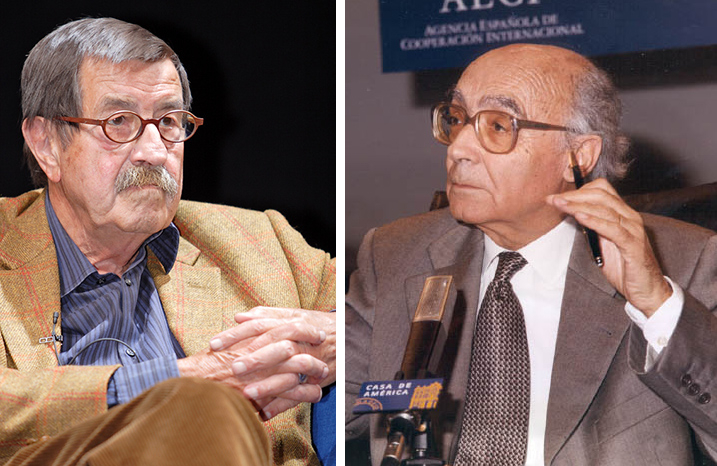
Nobel laureates who demonized: German novelist Günter Grass (left), who served in Nazi Germany’s armed SS force, claimed that Israel that threatens Iran with a nuclear genocide. Portuguese novelist José Saramago (right), gave credence to a distorted, demonizing vision that culminated in the perverse comparison between Hitler and Israel.

Mr. Saramago, while he was visiting Ramallah, chose not to see and talk about the Israeli restaurants, shopping malls and hotels turned into carpets of human bodies. The wholesale slaughter of Jews was the only reason Israel had to send tanks and soldiers back into the Palestinian cities after the Oslo Accords. Saramago did not mention the context; he preferred to give credence to a distorted, demonizing vision that culminated in the perverse comparison between Hitler and Israel, and the transformation of the Jewish State — the historical home of the Jews for nearly 4000 years, and lately the only sanctuary not to turn away Jews being persecuted or rounded up for death — into an “imperialist base.”

It is by repeating lies that Europe even accepted the big Mohammed al-Dura lie: a boy supposedly riddled to death with Israeli bullets, but there was not one drop of blood! Not only that, but after he was dead, he moved his hand to look out. Quite a feat. For a time, the lie even became the favorite table conversation for Europe’s upper classes.

This is how millions of Europeans have been persuaded to see Israel as the aggressor and the Palestinian terrorists as the victims. They read the inverted, Orwellian revision of history every day on the front pages. Look at what is happening now during this “Third Intifada”: it is filled with knives, stabbings of Jews, even charts on the internet showing where to stab a Jew to do the most damage. The many dead Israeli civilians and soldiers have totally disappeared from the television screen, but when Israeli soldiers shoot a Palestinian in the process of stabbing a Jew, they are labelled by a corrupt and racist media as “illegal executioners.”

What would these supposed intellectuals do if citizens were being stabbed in London, Rome or Berlin? The “intellectuals” and the media seem to be trying to make the Jews unable to defend themselves. The “intellectuals” and the media are preaching for Israel’s destruction.

Giulio Meotti, Cultural Editor for Il Foglio, is an Italian journalist and author.


[1] From the Oslo II Accord — Israeli-Palestinian Interim Agreement on the West Bank and the Gaza Strip, September 28, 1995, CHAPTER 3 – LEGAL AFFAIRS, ARTICLE XVII
 — Jurisdiction:

4. a. Israel, through its military government, has the authority over areas that are not under the territorial jurisdiction of the Council, powers and responsibilities not transferred to the Council and Israelis.

b. To this end, the Israeli military government shall retain the necessary legislative, judicial and executive powers and responsibilities, in accordance with international law. This provision shall not derogate from Israel’s applicable legislation over Israelis in personam.

The Islamization of Germany in 2016 “Germany is no longer safe.” by Soeren Kern

  • Mass migration from the Muslim world is fast-tracking the Islamization of Germany, as evidenced by the proliferation of no-go zones, Sharia courts, polygamy and child marriages. Mass migration has also been responsible for a host of social disruptions, including jihadist attacks, a migrant rape epidemic, a public health crisis, rising crime and a rush by German citizens to purchase weapons for self-defense — and even to abandon Germany altogether.

  • Development Minister Gerd Müller warned that the biggest refugee movements to Europe are still to come. He said that only 10% of the migrants from the chaos in Iraq and Syria have reached Europe so far: “Eight to ten million migrants are still on the way.”
  • “There are written instructions … today we are not allowed to say anything negative about the refugees. This is government journalism, and this leads to a situation in which the public loses their trust in us. This is scandalous.” — Wolfgang Herles, Deutschlandfunk public radio.
  • The Turkish government has sent 970 clerics — most of whom do not speak German — to lead 900 mosques in Germany that are controlled by the Turkish-Islamic Union for Religious Affairs (DITIB), a branch of the Turkish government’s Directorate for Religious Affairs, known in Turkish as Diyanet. Critics accuse Turkish President Recep Tayyip Erdogan of using DITIB mosques to prevent Turkish migrants from integrating into German society.
  • A Cologne police superintendent revealed that he was ordered to remove the term “rape” from an internal police report about the mass sexual assaults in Cologne on New Year’s Eve. He said that an official at the North-Rhine Westphalia Interior Ministry told him in an angry tone: “This is not rape. Remove this term from your report. Submit a new report.”
  • The German branch of Open Doors, a non-governmental organization supporting persecuted Christians, reported that thousands of Christians in German refugee shelters are being persecuted by Muslims, sometimes even by their security guards.
  • A 23-year-old Iraqi asylum seeker wearing a T-shirt with the words “I’m Muslim Don’t Panic” was assaulted by fellow refugees for offending Islam. He was beaten so badly that he was hospitalized.
  • Half of the three million ethnic Turks living in Germany believe it is more important to follow Islamic Sharia law than German law if the two are in conflict, according to a survey.
  • A document leaked to Der Spiegel revealed that more than 33,000 migrants who are supposed to be deported are still in Germany, being cared for by German taxpayers. Many of the migrants destroyed their passports and are believed to have lied about their countries of origin to make it impossible for them to be deported.
  • Migrants committed 142,500 crimes during the first six months of 2016, according to a report by the Federal Criminal Police Office. This is equivalent to 780 crimes committed by migrants every day, or 32.5 crimes each hour, an increase of nearly 40% over 2015. The data includes only those crimes in which a migrant suspect has been caught.
  • Bild, the largest-circulation newspaper in Germany, warned that the country was “capitulating to Islamic law.”

Germany’s Muslim population surpassed six million in 2016 for the first time ever. Germany now vies with France for the highest Muslim population in Western Europe.

The increase in Germany’s Muslim population is being fueled by mass migration. An estimated 300,000 migrants arrived in Germany in 2016, in addition to the more than one million who arrived in 2015. At least 80% (or 800,000 in 2015 and 240,000 in 2016) of the newcomers were Muslim, according to the Central Council of Muslims in Germany.

In addition to the newcomers, the rate of population increase of the Muslim community already living in Germany is around 1.6% per year (or 77,000), according to data extrapolated from a Pew Research Center study on the growth of the Muslim population in Europe.

Based on Pew projections, which were proffered before the current migration crisis, the Muslim population of Germany was to have reached an estimated 5,145,000 by the end of 2015.

Adding the 800,000 Muslim migrants who arrived in Germany in 2015, and the 240,000 who arrived in 2016, combined with the 77,000 natural increase, the Muslim population of Germany jumped by 1,117,000, to reach an estimated 6,262,000 by the end of 2016. This amounts to approximately 7.5% of Germany’s overall population of 82 million.

Mass migration from the Muslim world is fast-tracking the Islamization of Germany, as evidenced by the proliferation of no-go zones, Sharia courts, polygamy and child marriages. Mass migration has also been responsible for a host of social disruptions, including jihadist attacks, a migrant rape epidemic, a public health crisis, rising crime and a rush by German citizens to purchase weapons for self-defense — and even to abandon Germany altogether.

What follows is a chronological round-up of some of the key stories about the Islamization of Germany during 2016.

JANUARY 2016

January 1. Mobs of Muslim men of “Arab or North African” origin sexually assaulted hundreds of women in Cologne and other German cities. Cologne Police Chief Wolfgang Albers called it “a completely new dimension of crime.” The government and mainstream media were accused of trying to cover up the crimes to avoid fueling anti-immigration sentiment.

January 1. The Minister President of Baden-Württemberg, Winfried Kretschmann, rejected public concerns about the “alleged Islamization” of Germany. “How should Muslims, who represent a minority, Islamize our society?” he asked. Germans feel insecure, he said, because “people are afraid of strangers they do not know.”

January 3. Bremen Police Union Chairman Jochen Kopelke said that migrants were attacking city police with increasing frequency: “The tone has become extremely aggressive; sometimes the police must apply massive force to get a situation under control.” Bremen Senator Ulrich Mäurer added: “The excesses of violence against police officers show that these people have no respect for our constitutional order and its representatives.”

January 4. A leaked police report revealed chaos “beyond description” in Cologne on New Year’s Eve. Women were forced to “run a gauntlet” of drunken men of a “migrant background” to enter and exit the central train station. Police officers were unable to re-establish order. One migrant reprimanded a police officer: “I am Syrian; you have to treat me kindly! Mrs. Merkel invited me.”

January 6. Former Interior Minister Hans-Peter Friedrich said it was “scandalous that it took the mainstream media several days” to report on the sexual assaults in Cologne. He said public media was a “cartel of silence” exercising censorship to protect migrants from accusations of wrongdoing.

January 9. Development Minister Gerd Müller warned that the biggest refugee movements to Europe are still to come. He said that only 10% of the migrants from the chaos in Iraq and Syria have reached Europe so far: “Eight to ten million migrants are still on the way.”

January 9. A vigilante group began patrolling the streets of Düsseldorf to “make the city safer for our women.” Similar groups emerged in Cologne and Stuttgart.

January 12. Frank Oesterhelweg, a politician with the ruling Christian Democrats (CDU), caused a scandal when he said that police should be authorized to use deadly force to prevent migrants from raping German women. Bild reported that many German police officers are afraid of using lethal force “because of the legal consequences.”

January 17. Berlin clergyman Gottfried Martens accused German politicians and church leaders of ignoring the persecution of Christians by Muslims in German refugee shelters. He said that the Christians were facing “verbal threats, threats with knives, blows to the face, ripped crucifixes, torn Bibles, insults of being an infidel, and denial of access to the kitchen.”

January 18. A 24-year-old migrant from Sudan was released after being held for questioning at a police station in Hanover. After crossing the street, the man, who receives 300 euros ($335) a month in social welfare benefits, dropped his pants, exposed himself in public and shouted, “Who are you? You cannot do anything to me. Whatever I cannot get from the state, I will steal.”

January 20. Migrants invaded female changing rooms and showers at public swimming pools in Leipzig. City officials tried to keep the incidents quiet, but details were leaked to the media.

January 21. More than 200 migrants sued the German government for delays in processing their asylum applications.

January 26. In an

      interview
with Deutschlandfunk public radio, retired public media personality Wolfgang Herles admitted that public broadcasters receive “instructions from above” when it comes to reporting the news:

“We have the problem that we are too close to the government. The topics we cover are determined by the government. But many of the topics the government wants to prevent us from reporting about are more important than the topics they want us to cover…

“We must report in such a way that serves Europe and the common good, as it pleases Mrs. Merkel. There are written instructions … today we are not allowed to say anything negative about the refugees. This is government journalism, and this leads to a situation in which the public loses their trust in us. This is scandalous.”

January 28. Politicians in Kiel ordered city police to overlook crimes perpetrated by migrants. Police in North Rhine-Westphalia and Lower Saxony were also instructed to be lenient to criminal migrants.

January 28. A migrant from Sudan sexually assaulted a female police officer in Hanover as she was attempting to arrest him for theft. “Such brazen behavior towards a police officer has been unheard of until now,” said public prosecutor Thomas Klinge.

January 28. Berlin’s Tempelhof airport, the iconic site of the Berlin Airlift in 1948-49, became the biggest refugee shelter in Germany. Opposition politicians said the government was creating an “immigrant ghetto” in the heart of Berlin.

January 30. A gang of Afghan migrants on a Munich subway attacked two elderly men who tried to stop them from groping a woman. Although they had been denied asylum in Germany four years earlier, they were not deported because Afghanistan is “too dangerous.”

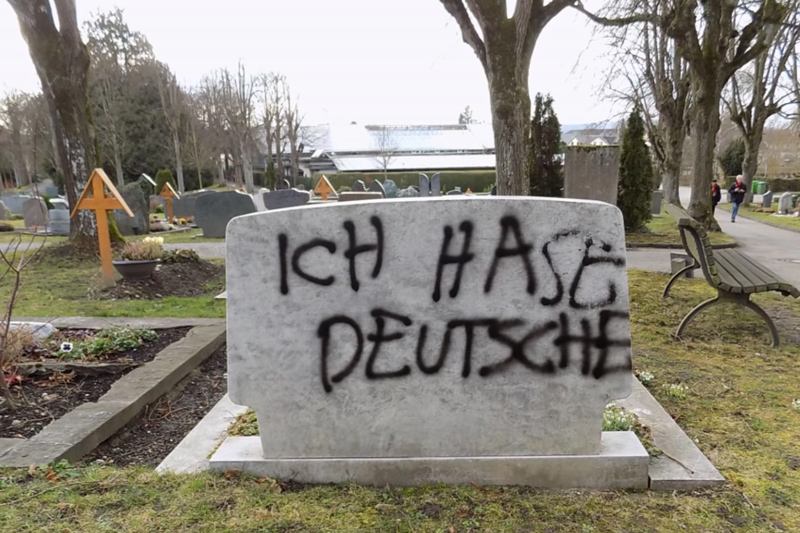
January 31. ISIS sympathizers defaced more than 40 gravestones at a cemetery in Konstanz with slogans such as, “Germans out of Syria,” “Christ is Dead” and “Islamic State.”
The words “I HATE GERMANS” are spray-painted on a gravestone, one of more than 40 vandalized by Islamic State sympathizers at a cemetery in Konstanz, Germany. (Image source: Silvan500 video screenshot)

January 31. In an effort to silence critics of the government’s open door migration policy, Vice Chancellor Sigmar Gabriel called on German intelligence to begin monitoring the Alternative for Germany (AfD), the third-largest party in Germany. The AfD is surging in popularity because of its anti-immigration platform.

FEBRUARY 2016

February 2. A total of 91,671 migrants — an average of around 3,000 migrants each day — entered Germany during the month of January 2016.

February 4. German police arrested four members of a cell allegedly planning jihadist attacks in Berlin. The ringleader — a 35-year-old Algerian who was staying at a refugee shelter in Attendorn with his wife and two children — arrived in Germany posing as an asylum seeker from Syria. He reportedly received military training from the Islamic State.

February 5. Hans-Georg Maassen, the head of Germany’s BfV domestic intelligence agency, revealed that more than 100 Islamic State fighters may be living in Germany as refugees, some of whom are known to have entered the country with fake or stolen passports.

February 8. German police arrested an alleged ISIS commander who was living at a refugee shelter in Sankt Johann. The 32-year-old jihadist, posing as a Syrian asylum seeker, entered Germany in the fall of 2015.

February 16. Migrants committed 208,344 crimes in 2015, according to a leaked police report. This figure represented an 80% increase over 2014 and worked out to around 570 crimes committed by migrants every day, or 23 crimes each hour, between January and December 2015.

The actual number of migrant crimes is far higher, however, because the report included only crimes that have been solved (aufgeklärten Straftaten). Statistics show that only around half of all crimes committed in Germany in any given year are solved (Aufklärungsquote). This implies that the actual number of crimes committed by migrants in 2015 exceeded 400,000.

February 16. Police raided the homes of 44 Salafists in Bremen. “It is rather apocalyptic that we have people living in the middle of our city who are prepared, from one day to the next, to participate massively in the terror of the Islamic State,” said Bremen Interior Minister Ulrich Mäurer.

February 25. Afghan asylum seekers assaulted three girls at the Sophienhof shopping mall in Kiel. After posting photographs of the girls on social media, the two men were joined by at least 30 other migrants who began to harass the girls. When police arrived, the migrants verbally and physically abused the officers. Only two of the perpetrators were apprehended.

February 26. A 15-year-old German girl of Moroccan descent stabbed and wounded a police officer at the central train station in Hanover. The stabbing was the first Islamic State-inspired terrorist attack in Germany. “The perpetrator did not display any emotion,” police said. “Her only concern was for her headscarf. Whether the police officer survived, she did not care.”

February 29. German authorities admitted they lost track of some 130,000 migrants who entered the country in 2015. The admission was in response to a parliamentary question from the opposition Left Party. The revelation raised concerns that unaccounted migrants could include jihadists who entered the country posing as refugees.

MARCH 2016

March 1. The Schleswig-Holstein branch of Chancellor Angela Merkel’s CDU announced plans to ensure that pork continues to be available at public canteens, child daycare centers and schools across the north German state. CDU politician Daniel Günther complained that canteens, nurseries and schools are removing pork from their menu in order not to offend Muslims. “The consumption of pork belongs to our culture,” he said. “No one should be obliged to do so. But we also don’t want the majority having to refrain from pork.”

March 3. The Arriba water park in Norderstedt, one of the largest such parks in Germany, announced that males and females would be segregated after two Afghan migrants raped a 14-year-old girl at the facility.

March 4. A court in Düsseldorf sentenced Nils Donath, a 25-year-old German national, to four-and-a-half years in prison for joining the Islamic State. The court heard how Donath, a convert to Islam, received weapons training and learned how to build bombs — and how he volunteered to carry out jihadist attacks in Europe.

March 7. Police in Cologne arrested a 25-year-old German national, Shahid Ilgar Oclu S, on charges of being a member of the Islamic State.

March 24. Following a wave of sexual assaults by migrants, the Mitteldeutsche Regiobahn, a railway in central Germany, announced plans to install women-only compartments.

March 31. The German Ministry for Families designated €200 million to fight the sexual abuse of women and children in refugee shelters.

APRIL 2016

April 3. Two migrants from Afghanistan were arrested for forcing a 14-year-old boy to perform sex acts on them at a public swimming pool in Delbrück.

April 10. A 26-year-old Syrian migrant admitted to setting fire to a migrant shelter in Bingen. He also admitted to painting swastikas outside the building in order to make it look as though the fire was set by anti-immigration protesters.

April 11. Hans-Georg Maassen, the head of Germany’s BfV domestic intelligence agency, expressed alarm at the growing number of radical mosques in Germany. “Many mosques are dominated by fundamentalists and are being monitored because of their Salafist orientation,” Maassen said. Many of the mosques are being financed by Saudi Arabia.

April 13. Andreas Scheuer, the General Secretary of the Christian Social Union (CSU), the Bavarian sister party to Angela Merkel’s CDU, called for an “Islam law” that would limit the influence of foreign imams and prohibit the foreign financing of mosques. His comments came amid reports that the Turkish government has sent 970 clerics — most of whom do not speak German — to lead 900 mosques in Germany that are controlled by the Turkish-Islamic Union for Religious Affairs (DITIB), a branch of the Turkish government’s Directorate for Religious Affairs, known in Turkish as Diyanet. Critics accuse Turkish President Recep Tayyip Erdogan of using DITIB mosques to prevent Turkish migrants from integrating into German society.

April 14. Angela Merkel and her coalition partners reached a compromise deal on a new “Integration Law” to spell out the rights and responsibilities of migrants in Germany: asylum seekers must attend German language classes and integration training or have their benefits cut. Critics said the law does not go far enough because it does not threaten with deportation those migrants who refuse to integrate.

April 14. Angela Merkel acquiesced to a demand by Turkish President Recep Tayyip Erdogan that German comedian Jan Böhmermann be criminally prosecuted for reciting a poem that lampooned Erdogan. She was accused of pandering to Erdogan’s autocratic government.

April 15. A 13-year-old German boy of Iraqi descent was arrested in Turkey after he attempted to join the Islamic State. Police said the boy, originally from Munich, was going to Syria to obtain combat training in order to return to Bavaria to carry out attacks there.

April 24. The Roman Catholic Cardinal of Cologne, Rainer Maria Woelki, ridiculed the Alternative for Germany (AfD) for saying that Islam is incompatible with the German constitution. “Whoever says ‘yes’ to church towers must also say ‘yes’ to minarets.”

MAY 2016

May 1. The anti-immigration Alternative for Germany (AfD) adopted a manifesto calling for curbs to migration and restrictions on Islam. The document called for a ban on minarets, Muslim calls to prayer and full-face veils.

May 2. Hans-Georg Maassen, the German spy chief, revealed that around 90 “predominately Arabic-speaking” mosques in Germany are under surveillance. He said they involve mostly “backyard mosques” where “self-proclaimed imams and self-proclaimed emirs” are “inciting their followers to jihad.”

May 2. A Cologne police superintendent revealed that he was ordered to remove the term “rape” from an internal police report about the mass sexual assaults in Cologne on New Year’s Eve. He said that an official at the North-Rhine Westphalia Interior Ministry told him: “This is not rape. Remove this term from your report. Submit a new report.” The revelation added to suspicions of a political cover-up to avoid fueling anti-immigration sentiments.

May 3. A 20-year-old Afghan migrant sexually assaulted a six-year-old boy in the changing room of a sports hall in Munich. Police said the same migrant had sexually assaulted an 11-year-old girl at a public swimming pool in 2013.

May 5. An INSA poll found that 60% of the Germans surveyed believe that Islam does not belong to Germany. Nearly half (46%) of those surveyed said they are worried about the “Islamization” of Germany.

May 9. The German branch of Open Doors, a non-governmental organization supporting persecuted Christians, reported that thousands of Christians in German refugee shelters are being persecuted by Muslims, sometimes even by their security guards. The report, which asserts that in most cases German authorities have done nothing to protect the victims, alleges that German authorities and police have deliberately downplayed and even covered up the “taboo issue” of Muslim attacks on Christian refugees, apparently to avoid fueling anti-immigration sentiments.

May 10. A German man shouting “Allahu Akbar” (“Allah is the Greatest”) and “infidels must die” stabbed one person to death and slashed three others in an early morning attack at a train station near Munich.

May 11. Turkish-born Muhterem Aras, 50, became the first Muslim woman to be elected as speaker of the state parliament in Baden-Württemberg. Her election was hailed as a Muslim integration success story. Aras has been a proponent of allowing migrants without German citizenship to vote in local elections.

May 12. An appeals court in Bamberg recognized the marriage of a 15-year-old Syrian girl to her 21-year-old cousin. The court ruled that the marriage was valid because it was contracted in Syria, where such marriages are allowed according to Islamic Sharia law. The ruling effectively legalized Sharia child marriages in Germany.

May 14. A Finance Ministry document revealed that the migrant crisis could end up costing German taxpayers €93.6 billion ($105 billion) between now and 2020. About €25.7 billion would be for social spending, such as unemployment benefits and housing support. About €5.7 billion would be destined for language courses and €4.6 billion for integrating refugees into the workforce.

May 15. Nearly a dozen women between the ages of 16 and 48 reported being sexually assaulted by male migrants at a music festival in the Kreuzberg district of Berlin. The attacks at the Carnival of Cultures, where groups of men encircled the women and assaulted and robbed them, were similar to those in Cologne and other German cities on New Year’s Eve.

May 16. Beatrix von Storch, the deputy leader of the Alternative for Germany (AfD), called on Germany’s main Islamic associations to “explicitly distance” themselves from Islamic sharia law, something they have so far refused to do. She said the AfD was not opposed to Muslims but to political Islam, which she said contradicts the German constitution.

May 18. Migrants sexually assaulted female passersby at the Boulevard Berlin shopping mall in the Steglitz district of the capital. At least 35 teenage migrants were loitering at the mall, in part because of free access to the internet. When security guards asked them to leave the premises, the youths called for back-up and soon dozens more migrants arrived to harass the guards.

May 22. A doctor in Cologne was sued for discrimination after he declined to treat a Muslim woman who refused to shake his hand. The woman said she could not shake the doctor’s hand on religious grounds. The doctor noted that the Koran does not prohibit handshakes.

May 23. A 23-year-old Iraqi asylum seeker wearing a T-shirt with the words “I’m Muslim Don’t Panic” was assaulted by fellow refugees for offending Islam. He was beaten so badly that he was hospitalized.

May 23. Bavarian Interior Minister Joachim Herrmann announced a plan to recruit migrants to the police force — regardless of whether they have acquired German citizenship. He said he hoped the initiative would create a “more direct line” to people with an immigrant background by hiring those who understand their mentality.

May 26. Increasing numbers of Germans are relocating to Hungary because of Chancellor Angela Merkel’s open door migration policy, according to the newsmagazine, Focus.

May 27. The head of the Protestant Church in Germany, Heinrich Bedford-Strohm, called for Islam to be taught in all German public schools as a way to prevent young Muslims from becoming radicalized. “Tolerance, freedom of religion and freedom of conscience should apply to all religions,” he said. “These principles can be best taught if religion is part of the state’s educational mission.”

May 27. A Protestant church in Hamburg held a funeral service for a convert to Islam who was killed in Syria while fighting for the Islamic State. The funeral at the St. Pauli church was for a teenager who was born in Cameroon and raised as a Christian in Hamburg. When he was 14 he converted to Islam, became radicalized and joined the German Salafist movement. He left for Syria on a false passport. Pastor Sieghard Wilm, who organized the “interfaith” funeral, said the church should be a “place of learning for the respect of other religions.”

May 29. Green party politician Stefanie von Berg called for new mosques to be built in every district of Hamburg so that the city’s burgeoning Muslim population has enough space to pray. She said the construction of new mosques is necessary to integrate the Muslim community. The Heinrich Böll Foundation, a think tank linked to the Green party, estimates that there are more than 150,000 Muslims in Hamburg, the second-largest city in Germany, but fewer than 50 mosques.

May 31. Male migrants sexually assaulted at least 18 women at an outdoor festival in Darmstadt. The attacks at the Schlossgrabenfest, in which large numbers of men surrounded women and sexually assaulted them, were similar to those that occurred in Cologne on New Year’s Eve.

May 31. The Dalai Lama said that Germany has accepted “too many” migrants and that they should eventually be returned to help rebuild their home countries. “Germany cannot become an Arab country,” he said in an interview with the Frankfurter Allgemeine Zeitung. “Germany is Germany.”

JUNE 2016

June 2. A new statistical survey of Germany showed that ethnic Turks are economically and educationally less successful than other immigrant groups. The report, produced by Destatis, Germany’s official statistics agency, showed that more than one-third (36%) of ethnic Turks live below the poverty line. Only 60% complete secondary school (Hauptschulabschluss), while less than 10% of ethnic Turks between the ages of 17 and 45 earn a Bachelor’s degree. Education is a determinative factor for successful integration, the report said.

June 2. Three Syrian jihadists were arrested for plotting a jihadist attack in Düsseldorf. A fourth individual was arrested in France. The plan involved two suicide bombers who would blow themselves up along the Heinrich-Heine-Allee, a busy street in the city center. Subsequently, other assassins would kill as many passers-by as possible with guns and bombs.

June 3. The head of the German police union, Rainer Wendt, said that budget cuts in the public sector made it impossible to vet all of the migrants coming into Germany. He was responding to demands that all migrants undergo immediate security checks.

June 12. Vice Chancellor Sigmar Gabriel compared members of the anti-Islam Alternative for Germany (AfD), the third-largest party in Germany, to the Nazis.

June 13. Half of the three million ethnic Turks living in Germany believe it is more important to follow Islamic Sharia law than German law if the two are in conflict, according to a survey. One-third also yearn for German society to “return” to the way it was during the time of Mohammed, the founder of Islam, in the Arabia of the early seventh century. The survey — which polled Turks who have been living in Germany for many years, often decades — refuted claims by German authorities that Muslims are well integrated into German society.

June 25. Police discovered a huge stockpile of military-grade weapons in a grocery store near a mosque in Cologne. “The danger posed by fundamentalist Salafists who are arming themselves to use violence in Germany is very great,” said local politician Ismail Tipi. “This secret raid makes this more than clear.”

June 30. A court in Ahrensburg found a 17-year-old migrant from Eritrea guilty of attempting to rape an 18-year-old woman at the Bad Oldesloe train station. After police arrived, the migrant resisted arrest and head-butted a police officer, who was hospitalized. The court gave the man a seven-month suspended sentence.

JULY 2016

July 1. A court in Bavaria ruled that a law that prohibits Muslim legal trainees from wearing headscarves is illegal.

July 3. A 24-year-old woman, raped by three migrants in Mannheim in January, admitted to lying about the identity of her attackers. Selin Gören, a Turkish-German woman, initially said that her attackers were German nationals, when in fact they were Muslim migrants. Gören said she lied because she was afraid of fueling racism against migrants.

July 4. The 30 biggest German companies have employed only 54 refugees, including 50 who have been hired as couriers by Deutsche Post, the logistics provider. The data cast doubt on Angela Merkel’s promise to integrate asylum seekers into the German labor market as quickly as possible. Company executives say the main problem is that migrants lack professional qualifications and German language skills.

July 7. The German parliament approved changes to the criminal code to expand the definition of rape. Also known as the “No Means No” (“Nein heißt Nein”) law, any form of non-consensual sex will now be punishable as a crime. Previously, only cases in which victims could show that they physically resisted their attackers were punishable under German law. The changes, which were prompted by the sex attacks in Cologne, were hailed as a “paradigm shift” in German jurisprudence.

July 7. More than six months after the Cologne attacks, a German court issued the first two convictions: The District Court of Cologne gave a 20-year-old Iraqi and a 26-year-old Algerian a one-year suspended sentence and then released the two men. Observers said the light sentences were a mockery of justice.

July 10. A Federal Criminal Police Agency (BKA) inquiry into the sex attacks in Cologne, Hamburg, Stuttgart, Düsseldorf and other German cities on New Year’s Eve found that more than 1,200 women were victims of attacks, which were perpetrated by more than 2,000 men, most of whom are believed to be from North Africa. BKA President Holger Münch said: “There is a relationship between the attacks and the strong wave of migration in 2015.”

July 13. The Platanus-Schule, a private bilingual school in Berlin, apologized to a Muslim imam after a teacher at the school called him “misogynistic” and “ill-adapted to German life” because he refused to shake her hand. Critics accused the school of endangering the principle of gender equality in Germany. The imam’s lawyer said the apology was insufficient.

July 14. Ruprecht Polenz, a former secretary general of the ruling Christian Democratic Union (CDU), said that the German law which regulates name changes (Namensrecht) should be amended to make it easier for Muslim migrants in Germany who feel discriminated against to change their legal names to Christian-sounding ones.

July 15. At least 24 women were sexually assaulted at a music festival in Bremen. The attacks were similar to the attacks in Cologne on New Year’s Eve. Police were able to identify only five perpetrators, all of whom are migrants from Afghanistan.

July 16. A document leaked to Der Spiegel revealed that more than 33,000 migrants who are supposed to be deported are still in Germany and are being cared for by German taxpayers. Many of the migrants destroyed their passports and are believed to have lied about their countries of origin to make it impossible for them to be deported.

July 17. An investigative report by Bavarian Radio BR24 found that deradicalization programs in Germany are failing because many Salafists do not want to become deradicalized.

July 19. A 17-year-old Afghan asylum seeker brandishing an axe and shouting “Allahu Akbar” seriously injured five people on a train in Würzburg. The assailant was shot dead by police after he charged at them with the axe. The teenager had been placed with a foster family just two weeks before the attack as a reward for being “well integrated.” Green Party MP Renate Künast criticized the police for using lethal force.

July 19. The managers of a German Red Cross refugee shelter in Potsdam were accused of covering up the sexual abuse of women at the facility.

July 20. The Federal Labor Office reported that the educational level of newly arrived migrants in Germany is far lower than expected: only a quarter have a high school diploma, while three quarters have no vocational training at all. Only 4% of new arrivals to Germany are highly qualified.

July 22. Ali Sonboly, an 18-year-old Iranian-German who harbored hatred for Arabs and Turks, killed ten people (including himself) and wounded 35 others at a McDonald’s in Munich.

July 23. A mob of men shouting “Allahu Akbar” barged into a nudist beach in Xanten and “insulted and threatened” the beachgoers. Police kept the incident hidden, apparently to avoid negative media coverage of Muslims “in these sensitive times.”

July 24. Mohammed Daleel, a 27-year-old migrant from Syria whose asylum application was rejected, injured 15 people when he blew himself up at a concert in Ansbach. The suicide bombing was the first in Germany attributed to the Islamic State.

July 24. A 21-year-old Syrian asylum-seeker murdered a 45-year-old Polish woman and her unborn baby in a machete attack in Reutlingen.

July 24. A 40-year-old migrant from Eritrea raped a 79-year-old woman in a cemetery in Ibbenbüren. The woman, who lives in a local nursing home, was visiting the grave of her late sister at 6AM when the attack occurred.

July 25. A 45-year-old Palestinian brandishing a “Rambo knife” and shouting “Allahu Akbar” tried to behead a doctor in Bonn. The attacker’s 19-year-old son had complained about the doctor’s treatment for a fractured leg. The man, holding the doctor down on the floor, said: “Apologize to my son. Go down on your knees and kiss his hand.”

July 25. Frank Henkel, a CDU Senator from Berlin, said: “No one should delude themselves: We obviously have imported some brutal people who are capable of committing barbaric crimes in our country. We have to say this clearly and without taboos. This also means that we must deal aggressively with Islamism. If we do not, we risk that German politics will be perceived as being detached from reality.”

July 25. Interior Minister Thomas de Maizière revealed that German authorities are currently investigating 59 refugees because of the “suspicion that they are involved in terrorist structures.”

July 27. Police in Ludwigsburg arrested a 15-year-old who they said was planning a mass-shooting. Police found more than 300 rounds of ammunition, as well as knives, chemicals and bullet-proof vests, during a search of the teenager’s home.

July 28. Angela Merkel insisted there would be no change to her open-door migration stance: “We decided to fulfill our humanitarian tasks. Refusing humanitarian support would be something I would not want to do and I would not recommend this to Germany…. Anxiety and fear cannot guide our political decisions.”

July 29. Thomas Jahn, the vice chairman of the Christian Social Union (CSU), lambasted Angela Merkel’s open-door migration policy: “We need to control our borders. That is the most important thing at the moment. And we need to send the dangerous people with Islamist ideology back to the countries outside Europe and the European Union.”

July 30. CSU politician Jens Spahn called for a burqa ban: “A ban on the full body veil — that is the niqab and the burqa — is overdue… I do not want to have to encounter any burqa in this country. In that sense, I am a burqaphobe.”

AUGUST 2016

August 2. Amid fears of Islamic terrorism, German officials raised the possibility of deploying the military within German borders for the first time since World War II.

August 11. Muslim patrols enforcing Sharia law were seen operating in the Wandsbek and Dammtor district of Hamburg.

August 16. Asylum seekers in Lower Saxony refused to accept job offers because they were “guests of Angela Merkel.”

August 19. Interior Minister Thomas de Maizière called for a partial ban on full-face veils in public. “We unanimously reject the burqa,” de Maizière said. “It does not fit in our open country.” North Rhine-Westphalia Interior Minister Ralf Jäger, said a burqa ban was misguided because it would require a ban on all religious garb: “Whoever forbids burqas, must also forbid people disguised as Saint Nicholas.”

August 25. Police in Hamburg launched a crackdown on purse-snatchers. More than 20,000 purses—roughly 55 a day—are stolen in the city each year. According to police, 90% of the purses are stolen by young males from North Africa or the Balkans.

August 28. A 26-year-old German national shouting Allahu Akhbar stabbed a 66-year-old woman and a 57-year-old man who were picnicking in Oberhausen.

August 28. Angela Merkel urged people of Turkish origin living in Germany not to bring their conflicts to Germany.

SEPTEMBER 2016

September 3. Only 2,500 people attended a mass rally in Berlin to protest the Alternative for Germany (AfD). The organizers of the rally, including members of the Green Party, and the Left Party, had expected around 10,000 demonstrators to show up.

September 3. The Vice Chairman of the DPolG German Police Union in Hamburg, Freddi Lohse, said that many migrant offenders view the leniency of the German justice system as a green light to continue delinquent behavior. “They are used to tougher consequences in their home countries,” he said. “They have no respect for us.”

September 4. Angela Merkel suffered a major blow when the Alternative for Germany (AfD) surged ahead of her Christian Democratic Union (CDU) in elections in her home state of Mecklenburg-West Pomerania. With 20.8% of the vote, the AfD came in second place behind the center-left Social Democrats (SPD) (30.6%). Merkel’s CDU came in third place, with 19% of the vote, the worst result it has ever had in Meck-Pomm, as the state is called for short. The election in Meck-Pomm was widely seen as a referendum on Merkel’s open-door migration policy.

September 6. Migrants committed 142,500 crimes during the first six months of 2016, according to a report by the Federal Criminal Police Office (Bundeskriminalamt, BKA). This is equivalent to 780 crimes committed by migrants every day, or 32.5 crimes each hour, an increase of nearly 40% over 2015. The data includes only those crimes in which a migrant suspect has been caught.

September 7. The Kiel Institute for the World Economy (IfW) calculated that Germany will spend some €20 billion on refugees in 2016. “Particularly large portions of the expenditure involve … the initial provision of accommodation or health care services, as well as services such as the renting of accommodations,” IfW said.

September 9. The German Interior Ministry, responding to a Freedom of Information Act request, revealed that 1,475 married children are known to be living in Germany as of July 31, 2016 — including 361 children under the age of 14. Most of the married children are from Syria (664), Afghanistan (157) and Iraq (100). Nearly 80% (1,152) are girls. The true number of child marriages in Germany is believed to be much higher than the official statistics suggest because many are being concealed.

September 13. Muslim fashion shops in Germany are serving as stepping stones to Islamic extremism, according to Germany’s ARD public broadcaster. They are “competing” with Western socialization by helping women adopt an orthodox Islamic way of life, eventually assimilating them into Salafism and subsequently, extremist Islam.

September 13. Three Syrian jihadists were arrested in Schleswig-Holstein. They were believed to be members of an Islamic State sleeper cell waiting for further instructions to carry out attacks in Germany.

September 17. Bavarian Interior Minister Joachim Herrmann accused the Federal Office for Migration and Refugees (BAMF) of failing to root out potentially tens of thousands of fake passports. Many migrants entering Europe as Syrians are, in fact, from another country of origin. Almost 40% of all Moroccans who entered Greece falsely represented themselves as Syrians, according to one study.

September 23. A new poll showed that support for the Alternative for Germany (AfD) surged to 16%, its best result ever, and more than three times the 5% needed to win seats in the parliament. According to the poll, Angela Merkel’s CDU is at 32%, while the Social Democrats, the junior partner in the ruling coalition, would get 22%. Together they would have 54%, enough for the ruling coalition to continue.

September 30. A 28-year-old migrant sexually assaulted a 27-year-old woman on a train. German media initially reported the nationality of the perpetrator but then deleted the information. “This article initially included the nationality of the offender,” a statement said. “The reference was subsequently removed because it did not correspond to our editorial guidelines — that is, there is no connection between nationality and action.”

OCTOBER 2016

October 1. Two migrants raped a 23-year-old woman in Lüneburg as she was walking in a park with her young child. The men, who remain at large, forced the child to watch while they took turns assaulting the woman.

October 2. A 19-year-old migrant raped a 90-year-old woman as she was leaving a church in downtown Düsseldorf. Police initially described the suspect as “a Southern European with North African roots.” It later emerged that the man is a Moroccan with a Spanish passport.

October 2. Finance Minister Wolfgang Schäuble called for the development of a “German Islam” to help integrate Muslims in the country.

October 4. The 2016 Munich Oktoberfest recorded its lowest turnout since 2001. Visitors reportedly stayed away due to concerns about terrorism and migrant-related sexual assaults.

October 17. The German Press Council reprimanded the weekly newspaper, Junge Freiheit, for revealing the nationality of three Afghan teenagers who raped a woman at a train station in Vienna, Austria. The press council said the nationality of the perpetrators is “not relevant” to the case. By revealing this information, the newspaper “deliberately and pejoratively represented the suspects as second-class persons.”

October 24. A YouGov poll found that 68% of Germans believe that security in the country has deteriorated due to mass migration. Nearly 70% of respondents said they fear for their lives and property in German train stations and subways, while 63% feel unsafe at large public events.

October 24. Serbian teenagers in Hamburg were allowed to walk free after gang-raping a 14-year-old girl and leaving her for dead in sub-zero temperatures. The judge said that although “the penalties may seem mild to the public,” the teens no longer posed a danger to society.

October 27. Public prosecutors charged Shaas Al-M, a 19-year-old Syrian jihadist who arrived in Germany posing as a refugee, with plotting to bomb popular tourist sites in Berlin, including the Brandenburg Gate and the Reichstag, for the Islamic State.

NOVEMBER 2016

November 3. Five Somali migrants went on a rampage after the owner of a pub in Wabern asked them to pay for the alcohol they had consumed. “We are Somalis, we don’t pay,” the men said before smashing up the establishment.

November 11. The Military Intelligence Service (Militärische Abschirmdienst, MAD) reported that more than 20 Islamists are serving in the German armed forces, and another 60 service members are suspected of being Islamists. Some 30 veterans are known to have gone to fight in Syria and Iraq. The report raised concerns that Islamists are joining the German armed forces in order to obtain combat training.

November 15. Interior Minister Thomas de Maizière banned the Salafist group, “The True Religion” (Die wahre Religion), for being unconstitutional. The group is behind a mass proselytization campaign — Project “Read!” — aimed at distributing 25 million copies of the Koran, translated into the German language, with the goal of placing one Koran into every home in Germany, free of charge. De Maizière said the campaign amounted to a “systematic infringement of our fundamental values.”

November 18. Public prosecutors charged two North African migrants for setting fire to a migrant shelter in Düsseldorf. The arson attack, which injured 26 people and caused more than 10 million euros in damage, was reportedly triggered by a dispute over food. The two men were angry because they felt there were not enough sweets offered at a buffet lunch.

November 20. A 38-year-old German-Kurdish man in Lower Saxony tied his ex-wife to his car and dragged her through the streets of Hameln. The crime drew attention to the problem of Sharia justice in Germany.

November 21. The Wuppertal District Court ruled that seven Islamists who formed a vigilante patrol to enforce Sharia law on the streets of Wuppertal did not break German law and were simply exercising their right to free speech.

November 23. Bild, the largest-circulation newspaper in Germany, warned that the country was “capitulating to Islamic law.”

November 27. German radio broadcaster Deutschlandradio Kultur reported that Muslim migrants enrolled in German schools are bullying their Christian counterparts. In some cases, the persecution is so great that Christian parents have moved their children to other schools.

November 29. A German intelligence officer confessed to plotting to bomb the Cologne-based headquarters of the domestic intelligence agency, the BfV. The 51-year-old convert to Islam was tasked with monitoring the German Salafist scene.

DECEMBER 2016

December 3. A 17-year-old Afghan migrant was arrested for raping and murdering a 19-year-old medical student in Freiburg. Police said she may have met her killer at the asylum shelter where she was a volunteer. Freiburg Mayor Dieter Salomon warned against making generalizations about migrants because this crime was an “isolated case.”

December 6. Eyeing reelection, Angela Merkel called for a burka ban: “The full veil is not appropriate here and it should be forbidden wherever that is legally possible.” In September, Merkel said she was opposed to a burka ban because it would violate “religious freedom.”

December 8. The Constitutional Court in Karlsruhe, Germany’s highest court, ruled that Muslim girls must take part in mixed swimming classes at school, finding against an 11-year-old pupil who had argued that even wearing a burkini, or full-body swimsuit, breached Islamic dress codes. The court rejected an appeal by the girl’s parents that she should be excused from the classes because a burkini did not conform to the Islamic standard of decency.

December 13. The trial began of a 45-year-old Iraqi migrant accused of sexually assaulting a 12-year-old boy 68 times at a refugee shelter in Spandau, Berlin. The perpetrator said his actions were the result of a “love affair.”

December 14. A judge in Oldenburg ruled that a 19-year-old Afghan migrant who groped two women at a festival in Bad Zwischenahn was not guilty of sexual assault. “It is quite conceivable that the young man wanted to communicate his interest for the women in this way,” the judge said.

December 16. A 12-year-old German boy of Iraqi descent tried to detonate a nail bomb at a Christmas market in Ludwigshafen.

December 19. At least 12 people were killed and dozens injured after a truck rammed into a Christmas market in Berlin. The main suspect in the attack was Anis Amri, a 23-year-old migrant from Tunisia who arrived in Germany in July 2015 and applied for asylum in April 2016. Although Amri’s application for asylum had been rejected in July 2016, he was not deported because he did not have a valid passport.

December 20. Frauke Petry, the chairwoman of the Alternative for Germany, said Angela Merkel bears responsibility for the attack on the Berlin Christmas market:

“The milieu in which such acts can flourish has been negligently and systematically imported over the past year and a half. Our borders, which were so irresponsibly opened, must once again be controlled. Germany is no longer safe.”

December 22. Bild reported that the head of the judicial authority in Hamburg, Till Steffen, refused to allow police to release pictures of the Berlin terror suspect, Anis Amri, for more than 12 hours after the attack because he feared that sharing the images would incite racial hatred.

December 22. Underage migrants at a refugee shelter in Freising were watching Islamic State propaganda videos, creating jihadist flags and posing with the insignia of the terrorist organization in front of the camera. “Watching IS-videos or crafting an IS-flag may indicate that a radicalization process is at an advanced stage,” German authorities said.

December 27. Police arrested seven migrants from Syria and Libya on charges of setting a homeless man on fire on Christmas Eve at the Schönleinstraße subway station in Berlin. Video footage captured them laughing as the man was burning on the platform. Police said all seven of the perpetrators, the youngest of whom is 15, arrived in Berlin as refugees.

December 31. Police in Cologne — who were tasked with avoiding a repeat of the mass sexual assaults that occurred in the city on New Year’s Eve in 2015 — were accused of racial profiling when they questioned more than 600 migrants from North Africa.

The Islamization of Germany in 2015 “We are importing religious conflict”

  • A mob of a thousand men of “Arab or North African” origin sexually assaulted more than 100 German women in downtown Cologne on New Year’s Eve. Similar attacks also occurred in Hamburg and Stuttgart. Cologne’s Mayor Henriette Reker, said that “under no circumstances” should the crimes be attributed to asylum seekers. Instead, she blamed the victims for the assaults.

  • “There is nothing wrong with being proud German patriots. There is nothing wrong with wanting Germany to remain free and democratic. There is nothing wrong with preserving our own Judeo-Christian civilization. That is our duty.” — Geert Wilders, Dutch politician, addressing a rally in Dresden.
  • “We are importing Islamic extremism, Arab anti-Semitism, national and ethnic conflicts of other peoples, as well as a different understanding of society and law. German security agencies are unable to deal with these imported security problems, and the resulting reactions from the German population.” — From a leaked government document, published by Die Welt.
  • Germany will spend at least €17 billion ($18.3 billion) on asylum seekers in 2016 — Die Welt.
  • Saudi Arabia is preparing to finance the construction of 200 new mosques in Germany to accommodate asylum seekers. — Frankfurter Allgemeine.

Germany’s Muslim population skyrocketed by more than 850,000 in 2015, for the first time pushing the total number of Muslims in the country to nearly six million.

Of the one million migrants and refugees who arrived in Germany in 2015, at least 80% (or 800,000) were believed to be Muslim, according to estimates by the Central Council of Muslims in Germany (Zentralrat der Muslime in Deutschland, ZMD), a Muslim umbrella group based in Cologne.

In addition to the newcomers, the natural rate of population increase of the Muslim community already living in Germany is approximately 1.6% per year (or 77,000), according to data extrapolated from a recent Pew Research Center study on the growth of the Muslim population in Europe.

Based on Pew projections, the Muslim population of Germany reached an estimated 5,068,000 by the end of 2014. The 800,000 Muslim migrants arriving in Germany in 2015, combined with the 77,000 natural increase, would indicate that the Muslim population of Germany jumped by 877,000, to reach an estimated 5,945,000 by the end of 2015. This would leave Germany vying with France for the highest Muslim population in Western Europe.

Muslim mass migration is fast-tracking the rise of Islam in Germany. It is also responsible for a host of social disruptions, including a rape epidemic, a public health crisis, and a rush by German citizens to purchase weapons for self-defense. What follows is a chronological round-up of some of the key stories in 2015.

JANUARY 2015

January 8. A survey published by the Bertelsmann Foundation found that because of the growing Muslim population: 57% of Germans believe that Islam is threatening to German society; 61% believe that Islam does not fit into Western society; 40%, feel like “foreigners in their own country.”

January 9. The newsmagazine, Der Spiegel, reported that Germany’s Federal Criminal Police Agency (Bundeskriminalamt, BKA) enacted a nationwide emergency plan to prevent Islamic terrorists from striking in Germany. Federal and state security agencies were ordered to locate the whereabouts of up to 250 German Islamists and other “relevant persons.” The magazine also reported that the BKA had evidence “that key European cities could be attacked at any time.”

January 11. The offices of the Hamburger Morgenpost were firebombed, after the newspaper, in solidarity with the French magazine Charlie Hebdo, republished its cartoons on the cover, in defense of free speech.

January 11. In an interview with Bild am Sonntag, Interior Minister Thomas de Maizière confirmed that German intelligence was monitoring “around 260 individuals” who could potentially strike at any moment. He said:

“We have about 260 dangerous individuals (Gefährder). We also have around 550 people who have travelled to the battle zones in Syria and Iraq. Between 150 and 180 of these have returned to Germany; 30 of them are battle-hardened fundamentalists. They pose a serious threat to our security. I am very concerned about well-prepared perpetrators such as those in Paris, Brussels, Australia and Canada. This situation is serious.”

According to Bild, at least 60 police officers are needed successfully to monitor just one German jihadist around the clock. The newspaper questioned whether Germany has enough security personnel to track all the potential terrorists. De Maizière conceded: “So far we have been lucky. Unfortunately, this may not always be the case.”

January 12. More than 25,000 people showed up in the city of Dresden for a weekly gathering of a burgeoning grassroots movement known as PEGIDA — short for “Patriotic Europeans against the Islamization of the West.” In what was the largest turnout yet, marchers wore black armbands and observed a minute of silence for “the victims of terrorism in Paris.”

On its Facebook page, PEGIDA wrote that the attack against Charlie Hebdo in Paris confirmed its worst fears. It said:

“The Islamists PEGIDA has been warning about for 12 weeks showed France that they are incapable of democracy and rather look to violence and death as an answer! Our politicians want us to believe the opposite. Must such a tragedy happen here in Germany first???”

January 12. Chancellor Angela Merkel repudiated the PEGIDA movement by saying that Islam “belongs to Germany.”

January 12. A 20-year-old Eritrean refugee and asylum seeker, Khaled Idris Bahray, a Muslim, was stabbed to death in Dresden. European media were quick to blame PEGIDA for inciting the murder. The London-based Guardian reported that the killing “exposes racial tensions” and “anti-immigration sentiment” in Germany. On January 22, however, German prosecutors said that Bahray’s 26-year old Eritrean roommate had confessed to the stabbing.

January 14. The German cabinet approved a plan to confiscate the national ID cards of known Islamists, making it harder for them to leave the country to fight for ISIS.

January 15. Police in Lower Saxony arrested a 26-year-old German-Lebanese jihadist, identified as Ayub B., and charged him with participating in the jihad in Syria. Also on January 15, police in Pforzheim raided the apartments of two Balkan Salafists.

January 16. More than 250 police searched 11 premises in Berlin. They arrested five Turkish Islamists, including a 41-year-old Turk identified as Ismet D., who refers to himself as the “Emir of Berlin.”

January 20. More than 200 police raided 13 properties linked to Islamists in Berlin and the eastern states of Brandenburg and Thuringia.

January 21. The founder and leader of PEGIDA, Lutz Bachmann, abruptly stepped down after German media published a photograph of him with an Adolf Hitler-style haircut and moustache. In Facebook posts, he also referred to asylum seekers as “trash” and “filth.” PEGIDA’s detractors said the photo, taken at least two years before the group’s rise to prominence, proves the movement was motivated by racism. Bachmann insisted that the photograph was an act of satire.

January 21. The Roman Catholic diocese of Münster banned Paul Spätling, a Roman Catholic priest, from preaching after he spoke at a PEGIDA rally in Duisburg. He told a group of 500 listeners: “Europe has been at war with Islam for 1,400 years. It is unbelievable that Chancellor Angela Merkel said ‘Islam belongs to Germany.'” Stephan Kronenburg, a spokesman for the diocese, said: “With his statements he stirs up hostility against Islam; we consider this dangerous.”

January 25. The prime minister of the eastern German state of Saxony, Stanislaw Tillich, disagreed with Merkel’s statement that “Islam belongs to Germany.” He said: “Muslims are welcome in Germany and can practice their religion. But this does not mean that Islam is part of Saxony.” The capital city of Saxony is Dresden, headquarters of the PEGIDA movement.

January 29. The carnival committee in Cologne dropped plans to build a Charlie Hebdo-themed float. The cancellation was prompted by fears that it might pose a security threat. The float was to be featured in the February 16 parade as an expression of support for France and Charlie Hebdo. The design, chosen by the public in an online poll, showed a cartoonist forcing a pencil into the barrel of a terrorist’s gun.

Also in January, the German supermarket chain, Aldi, removed a brand of liquid soap from store shelves after complaints that its packaging was offensive to Muslims. Aldi said the packaging of the Ombia 1001 Nights liquid soap, which depicts a mosque with dome and minarets, together with a lantern and a set of prayer beads, was intended to evoke a scene from the Middle East.

Muslim customers had posted complaints on Aldi’s Facebook page. “When I saw your liquid soap by Ombia on your shelves, I was a little shocked as it showed a mosque,” one customer wrote. “The mosque with its dome and minarets is a symbol that stands for dignity and respect for Muslims. That is why I do not find it appropriate to depict this meaningful image on an item of daily use.”

FEBRUARY 2015

February 8. The newspaper, Die Welt revealed that German public prosecutors were investigating 83 German jihadists for war crimes, based on atrocities committed in the name of the Islamic State.

February 12. The Hamburger Morgenpost reported that senior politicians representing the State of Saxony and the City of Dresden secretly used more than €100,000 ($115,000) in taxpayer money to pay for a PEGIDA counter-demonstration held in Dresden on January 10. The purpose of this demonstration, for which more than 35,000 people showed up, was to portray PEGIDA supporters as “intolerant” and “bigoted,” in contrast to the majority of Dresdeners, who are considered “cosmopolitan” and “committed to tolerance.”

February 15. The city of Braunschweig cancelled a planned carnival parade because of the “specific threat of an Islamist attack.”

February 26. The President of the Central Council of Jews, Josef Schuster, warned Jewish men not to wear skullcaps while in the Muslim districts of Berlin. “This is a development I would not have expected five years ago,” he said. “It is certainly frightening.”

MARCH 2015

March 6. Police in Bremen warned that Islamists were plotting to attack the city’s cathedral as well as a synagogue. Two suspects were arrested after a raid on a local mosque.

March 7. Sheik Abu Bilal Ismail, a Danish imam who called for the death of Jews during a sermon at Berlin’s Al-Nur mosque, was found guilty of hate speech and ordered to pay a fine of €9,600 ($10,300). “O Allah,” Ismail had said, “destroy the Zionist Jews. They are no challenge for you. Count them and kill them to the very last one. Do not spare a single one of them. Oh Lord, bring torment upon them.” He later said his words had been taken out of context.

March 12. A court in Berlin fined the father and two uncles of Nasser El-Ahmad, an 18-year-old Lebanese Muslim, for attempting to force him into marriage with a woman despite his being openly homosexual. El-Ahmad said his father had threatened to slit his throat and his uncle doused him with gasoline because they refused to accept this fact. Observers said the case showed that males can be victims of forced marriage, as well.

March 14. Hooligans, Salafists, PEGIDA and far-left counter-demonstrators all descended on the city of Wuppertal. It was the first time the groups all held simultaneous events. More than 1,000 police were deployed to maintain calm.

March 26. Interior Minister Thomas de Maizière banned the Salafist group Tauhid, which he said was recruiting jihadists to fight in Syria and Iraq.

APRIL 2015

April 8. Federal Police Chief Dieter Romann revealed that in 2014, more than 57,000 people had tried to enter the country illegally, a 75% jump in comparison to 2013. In addition, police arrested 27,000 people who had managed to enter the country and were living there illegally, a 40% jump from the year before. Most of the illegal immigrants were from Syria, Eritrea, Serbia, Somalia, Kosovo and Afghanistan.

April 13. Dutch politician Geert Wilders addressed a rally of the German grassroots anti-Islamization movement known as PEGIDA in the eastern city of Dresden. Wilders said: “There is nothing wrong with being proud German patriots. There is nothing wrong with wanting Germany to remain free and democratic. There is nothing wrong with preserving our own Judeo-Christian civilization. That is our duty.”

April 22. The Konrad Adenauer Foundation, a think tank in Berlin, announced the launch of the “Muslimisches Forum Deutschland.” The new forum aims to promote the voices of liberal Muslims in order to counter-balance the influence of extremist Muslim groups in Germany.

Also in April, the German rapper-turned-jihadist Dennis Cuspert appeared in an ISIS propaganda video rapping the following lyrics:

“To the enemies of Allah. Where are your troops? We can no longer wait. O Allah, destroy them! Grant us victory over them. Take from us. Make us honorable. Take from our blood. Fisabilillah [One who fights for the cause of Allah]…

“We want your blood. It tastes so wonderful…In Germany, sleeper cells lie in wait. The brothers are coming. Terrorize the Kafir [nonbeliever].”

MAY 2015

May 1. Police in Oberursel, a suburb of Frankfurt, cancelled a professional bicycle race with more than 5,000 participants, on fears that Islamic terrorists were planning to attack the event.

May 20. Interior Minister Thomas de Maizière addressed a conference in Berlin called “Jewish Life in Germany: Is it at Risk?” He said that in 2014, anti-Semitic hate crimes were up by 25% and that much of the increase was due to attacks perpetrated by Muslim immigrants.

May 23. The German Army announced that it would recruit its first imam for the 1,600 Muslims in uniform.

JUNE 2015

June 3. More than 90 police officers were deployed to break up a fight between 70 members of rival immigrant clans at a public playground in Moabit, an inner city neighborhood of Berlin. The fight began when two women got into an argument over a man, and turned violent after more and more family members participated. Two police officers were seriously hurt.

June 5. A 30-year-old Somali asylum seeker called “Ali S” was sentenced to four years and nine months in a Munich prison for attempting to rape a 20-year-old woman. Ali had previously served a seven-year term for rape, and had been out of prison for only five months before he attacked again. In an effort to protect the identity of Ali S, a Munich newspaper referred to him as “Joseph T.” — a name deemed more politically correct.

June 8. More than 50 police officers were deployed to break up a fight resulting from an argument at a wedding reception for Bosnian immigrants in Berlin. Within moments, more than a dozen other had people joined in. But as soon as the police arrived, the rival clans stopped fighting each other and began attacking them. One of the wedding guests hit a police officer over the head with a chair; critically wounding him. Other officers had bottles thrown at them, were spat on or verbally attacked.

June 10. A 26-year-old Muslim woman, Betül Ulusoy, was allowed to begin an internship as a junior lawyer in the town hall in Berlin. Local authorities had initially considered rejecting her application because she insisted on wearing a Muslim head-covering. Berlin’s neutrality law (Neutralitätsgesetz) stipulates that anyone who works for the city is prohibited from showing outward signs of religiosity. But city officials, apparently in order to avoid being accused of Islamophobia, made an exception for Ulusoy.

June 24. In an interview with the Rheinische Post, Interior Minister Thomas de Maizière said that the number of German jihadists fighting in Syria had risen to around 700. “The number has never been as high as it is now,” he said. The number of violent Islamists in Germany who are “prepared to commit politically motivated crimes of considerable importance” was around 330. He said there were more than 500 ongoing counter-terrorism efforts involving 800 Islamists.

June 26. The administrators of the Wilhelm-Diess-Gymnasium, a school in the Bavarian town of Pocking, warned parents not to let their daughters wear revealing clothing, in order to avoid “misunderstandings” with 200 Muslim refugees housed in emergency accommodations that happened to be in a nearby building. Their letter said:

“The Syrian citizens are mainly Muslim and speak Arabic. The refugees have their own culture. Because our school is directly next to where they are staying, modest clothing should be worn in order to avoid disagreements. Revealing tops or blouses, short shorts or miniskirts could lead to misunderstandings.”

June 29. A mob of Lebanese immigrants attacked two police officers attempting to arrest two men for smoking cannabis on a public sidewalk in Duisburg. Within minutes, the officers were surrounded by more than 100 men who tried to prevent the arrests. Ten squad cars and dozens of police reinforcements were required to rescue the policemen.

Also in June, a debate erupted over whether Muslim students should be exempted from mandatory visits to former concentration camps as part of Holocaust education programs. The dispute centered on a proposal that would require students in all secondary schools in Bavaria to visit Holocaust memorials as part of the school curriculum. The proposal was opposed by the governing Christian Social Union, which said that “many children from Muslim families… have no connection to our past and… will need much more time before they can identify with our history. We need to be careful about how we address this issue with these children.”

JULY 2015

July 17. For the first time ever in Germany, public television and radio channel Bayerischer Rundfunk aired Muslim prayers marking the beginning of the Eid el-Fitr holiday and the end of the fasting month of Ramadan.

July 20. Germany’s first Sharia-compliant bank, the Turkish-owned Kuveyt Turk Bank, opened for business in Frankfurt. The bank’s director, Kemal Ozan, said: “Our market research has shown that 21% of Muslims in this country would see an Islamic bank as their natural household bank.”

July 24. Two police officers in Gelsenkirchen, a city in North Rhine-Westphalia, were attacked by a mob of Lebanese immigrants after they tried to pull over a driver who ran a stoplight. The driver got out of the car and attempted to flee on foot. When police caught up with him, more than 50 people appeared from virtually nowhere to prevent the suspect’s arrest. A 15-year-old attacked a policeman from behind and began strangling him, rendering him unconscious. Massive amounts of police reinforcements and pepper spray were needed to control the situation.

July 25. A confidential police document leaked to the Rheinischen Post revealed that in 2014, a record-breaking 38,000 asylum seekers in Germany were accused of committing crimes in the country. Analysts believe this figure — which works out to more than 100 crimes a day — is only a fragment: many crimes are not made public.

July 25. The newsmagazine Der Spiegel reported that spiraling levels of violent crime by immigrants from the Balkans and the Middle East have turned parts of Duisburg, a key German industrial city, into “areas of lawlessness.” Such areas, according to a police report that was leaked, have effectively become “no-go” zones for police.

July 25. In an interview with the newsmagazine, Focus, the head of the police union in North Rhine-Westphalia, Arnold Plickert, warned of the emergence of no-go zones in the cities of Dortmund, Duisburg, Essen and Cologne. “Several rival rocker groups as well as Lebanese, Turkish, Romanian and Bulgarian clans are fighting for supremacy of the streets,” he said. “They make their own rules; here the police have no say in it.”

AUGUST 2015

August 3. A confidential document leaked to the newspaper Bild, revealed that the Hamburg transit authority (Hamburger Verkehrsverbund, HVV) ordered ticket inspectors to “look the other way” whenever they encounter migrants who are using public transportation without a ticket. The move ostensibly aims to protect the HVV against “bad press.”

August 6. Police revealed that a 13-year-old Muslim girl was raped by another asylum seeker at a refugee facility in Detmold. The girl and her mother reportedly fled their homeland to escape a culture of sexual violence; as it turns out, the man who raped the girl is from the country they had fled.

August 18. A coalition of four social work organizations and women’s rights groups sent a letter to the leaders of the political parties in the regional parliament in Hesse, warning them of the worsening situation for women and children in the refugee shelters. The letter said:

“The practice of providing accommodations in large tents, the lack of gender-separate sanitary facilities, premises that cannot be locked, the lack of safe havens for women and girls — to name just a few spatial factors — increases the vulnerability of women and children within the shelters. This situation plays into the hands of those men who assign women a subordinate role and treat women traveling alone as ‘wild game.’

“The consequences are countless rapes and sexual assaults. We are also receiving an increasing number of reports of forced prostitution. It must be stressed: these are not isolated cases.

“Women report that they, as well as children, have been raped or subjected to sexual assault. As a result, many women sleep in their street clothes. Women regularly report that they do not use the toilet at night because of the danger of rape and robbery on the way to the sanitary facilities. Even during daylight, passing through the camp is a frightful situation for many women.”

August 19. At least 20 Syrian migrants staying at an overcrowded refugee shelter in the eastern German town of Suhl tried to lynch an Afghan migrant after he tore pages from a Koran and threw them in a toilet. More than 100 police officers were called in to restore order, but when they arrived, were attacked with stones and concrete blocks. Seventeen people were injured in the melee, including 11 refugees and 6 police officers. The president of the German state of Thuringia, Bodo Ramelow, said that Muslims of different nationalities should be housed separately to avoid similar violence in the future.

August 21. Germany suspended the so-called Dublin Regulation — a law that requires people seeking refuge within the EU to do so in the first European country they reach — for asylum seekers from Syria. This means that Syrians reaching Germany will be allowed to stay while their applications are being processed. Critics said the move would encourage even more migrants to make their way to Germany.

August 27. Aiman Mazyek, director of the Central Council of Muslims in Germany (Zentralrat der Muslime in Deutschland, ZMD), a Muslim umbrella group based in Cologne, estimated that at least 80% of the migrants and refugees arriving in Germany in 2015 are Muslim.

August 30. German sociologist Hans Georg Soeffner warned that Germany was importing religious conflict:

“Immigration brings religious conflicts with it — like the ones between different Muslims. We must assume that the conflicts will grow. The refugees bring political and religious conflicts from their countries of origin to Germany — like the conflicts between Sunnis and Shiites, or liberal Muslims and Salafists. We are already familiar with the conflicts between Turks, Kurds, Alevites and the rest of Muslims, so we’ve seen these conflicts. But in view of the expected number of new immigrants, the conflicts will grow. And that is why we quickly have to begin promoting German values, meaning the constitution. Only then will the immigrants know what the rules here are.”

Also in August, the number of asylum seekers entering the country in a single month surpassed the 100,000 mark for the first time ever. A record 104,460 asylum seekers arrived in August 2015, bringing the cumulative total for the first eight months of 2015 to 413,535.

SEPTEMBER 2015

September 3. In an interview with Die Zeit, Interior Minister Thomas de Maizière said the integration of Muslim migrants from the Arab world would be more difficult than the integration of Turkish Muslims; at least 20% of migrants arriving in the country this year were illiterate.

September 7. Aiman Mazyek, director of the Central Council of Muslims in Germany, said that Muslim mass migration would significantly alter the nature of Islam in Germany. Until now, German Islam has been predominately Turkish in nature; in the future, it will become far more Arab.

September 8. The Frankfurter Allgemeine reported that Saudi Arabia was preparing to finance the construction of 200 new mosques in Germany to accommodate asylum seekers.

September 17. In an interview with the Rheinische Post, Hans-Georg Maassen, the director of the Germany’s domestic intelligence agency (Bundesamt für Verfassungsschutz, BfV), said that German Salafists were posing as aid workers and were offering gifts of money and clothing in efforts to recruit asylum seekers. Others were offering translation services and inviting migrants to their homes for tea. Still others were handing out leaflets with information about local Salafist mosques. Maassen said:

“Many of the asylum seekers have a Sunni religious background. In Germany there is a Salafist scene that sees this as a breeding ground. We are observing that Salafists are appearing at the shelters disguised as volunteers and helpers, deliberately seeking contact with refugees to invite them to their mosques to recruit them to their cause.”

September 19. In Bielefeld, Salafists were infiltrating refugee centers by bringing toys, fruits and vegetables for the migrants.

September 23. Municipal officials in Hamburg introduced an audacious bill in the local parliament that would allow the city to seize vacant commercial real estate (office buildings and land) and use it to house migrants.

September 25. Asadullah and Shazia Khan, migrants from Pakistan living in Darmstadt, went on trial for the “honor killing” of Lareeb, their 19-year-old daughter. Asadullah confessed to strangling his daughter with his bare hands because he did not approve of her boyfriend.

September 28. More than 70 asylum seekers in Hamburg began a hunger strike to pressure local authorities to provide them with better housing. “We are on a hunger strike,” said Syrian refugee Awad Arbaakeat. “The city lied to us. We were shocked when we arrived here.” The migrants said they were angry they were being asked to sleep in a huge warehouse rather than in private apartments. Hamburg officials say there are no more vacant apartments in the city, the second-largest in Germany.

Also in September, it emerged that hundreds of Muslim refugees are converting to Christianity, apparently in an effort to improve their chances of having their asylum applications approved. Under Islam, Muslims who convert to Christianity are guilty of apostasy, a crime punishable by death. The “converts” apparently believe that German immigration officials will allow them to stay in Germany if they can be persuaded that they will be killed if they are sent back to their countries of origin.

OCTOBER 2015

October 1. In Bad Kreuznach, a family of asylum seekers from Syria made an appointment to view a four-room rental property but refused to see the house because the real estate agent was female. According to real estate agent Aline Kern:

“One of the men, who spoke broken German, said they were not interested in viewing the property because I am a woman, I am blonde, and because I looked the men into their eyes. This was inappropriate. My company should send a man to show the property. I was taken aback. You want to help and then are sent away, unwanted in your own country.”

October 2. In an interview with Deutschlandfunk radio, Tania Kambouri, a German police officer and the author of a bestselling new book about the failure of German multiculturalism, described the deteriorating security situation in Germany due to migrants who have no respect for law and order. She said:

“For weeks, months and years I have noticed that Muslims, mostly young men, do not have even a minimum level of respect for the police. When we are out patrolling the streets, we are verbally abused by young Muslims. There is the body language, and insults like ‘sh** cop’ when passing by. If we make a traffic stop, the aggression increases ever further, this is overwhelmingly the case with migrants.

“I wish these problems were recognized and clearly addressed. If necessary, laws need to be strengthened. It is also very important that the judiciary, that the judges issue effective rulings. It cannot be that offenders continue to fill the police files, hurt us physically, insult us, whatever, and there are no consequences. Many cases are closed or offenders are released on probation or whatever. What is happening in the courts today is a joke.

“The growing disrespect, the increasing violence against police… We are losing control of the streets.”

October 5. The public television station ARD denied broadcasting “anti-Islamic propaganda” after it aired a photomontage of Chancellor Angela Merkel wearing an Islamic head dress. The image was shown in the background of a segment on refugee quotas in the “Report from Berlin” program, while moderator Rainald Becker said:

“Can we really do this? Or are we overwhelmed? If we succeed [in managing the migrant crisis], what will happen to our values? How will life change? How will we react if refugees have problems — with equality, with women’s rights, with press freedom and freedom of expression?”

ARD later said: “We regret that some viewers disagreed with, or even misunderstood, how our chancellor was portrayed.”

Left: Some of the hundreds of thousands of migrants who arrived in Munich during 2015. Right: Germany’s public television station ARD denied broadcasting “anti-Islamic propaganda” after it aired a photomontage of Chancellor Angela Merkel wearing an Islamic head dress.

October 14. In Osnabrück, an asylum seeker from Somalia successfully sued the German Agency for Migration and Refugees (Bundesamt für Migration und Flüchtlinge, BAMF) for taking too long to process his application. A judge ordered the BAMF to make a decision on his application within three months or provide him with financial compensation.

October 14. Sumte, a tiny village with 100 inhabitants in Lower Saxony, was required by the federal government to host 1,000 asylum seekers.

October 15. City officials in Hamburg revealed that 35,021 migrants arrived in the city during the first nine months of 2015. During this same period, Hamburg police were dispatched to the city’s refugee shelters more than 1,000 times — including 81 times to break up mass brawls, 93 times to investigate physical and sexual assaults, and 28 times to prevent migrants from killing themselves.

October 14. The president of the Bavarian Association of Municipalities (Bayerische Gemeindetag), Uwe Brandl, warned that Germany is now on track to have “20 million Muslims by 2020,” out of a population in 2014 of 81.1 million. He arrived at this figure after factoring in family reunifications — based on the assumption that individuals whose asylum applications are approved will subsequently bring to Germany an average of four additional members of their families.

October 20. Eight Islamists went on trial in Cologne. They were accused of stealing €19,000 ($20,500) from collection boxes in churches and schools in Siegen, then sending the money to ISIS.

October 21. More than 200 mayors in North-Rhine Westphalia signed an open letter to Chancellor Angela Merkel; they warned they were no longer capable of taking in more migrants.

October 25. The contents of a leaked government document published by Die Welt revealed growing alarm within the highest echelons of Germany’s intelligence and security apparatus about the consequences of Chancellor Angela Merkel’s open-door immigration policy.

The document warned that the “integration of hundreds of thousands of illegal migrants will be impossible given the large numbers involved and the already-existing Muslim parallel societies in Germany.” The document added:

“We are importing Islamic extremism, Arab anti-Semitism, national and ethnic conflicts of other peoples, as well as a different understanding of society and law. German security agencies are unable to deal with these imported security problems, and the resulting reactions from the German population.”

Also in October, the Evangelical Christian Church in the Rhineland was criticized by other Christians when it advised against attempting to evangelize Muslims migrants. In a position paper, the church argued that the passage in the 28th chapter of the Gospel of Matthew known as the Great Commission — “Go therefore and make disciples of all nations, baptizing them in the name of the Father and of the Son and of the Holy Spirit” — does not mean Christians should try to convert others. The paper argued: “A strategic mission to Islam or meeting Muslims to evangelize them threatens social peace and contradicts the spirit and mandate of Jesus Christ and is therefore to be strictly rejected.”

NOVEMBER 2015

November 6. The newsmagazine, Focus, reported that sales of pepper spray jumped by 600% since Germany’s migration crisis exploded in August 2015. Supplies of the product were completely sold out in many parts of the country and additional stocks would not become available until 2016. “Manufacturers and distributors say the huge influx of foreigners in recent weeks has apparently frightened many people,” Focus reported.

November 7. Jürgen Mannke, director of the Teacher’s Association of Saxony-Anhalt (Philologenverbandes Sachsen-Anhalt, PhVSA), was fired after advised underage female students to guard against “superficial sexual adventures” with Muslim asylum seekers. In the group’s quarterly membership magazine, Mannke wrote:

“An immigrant invasion is inundating Germany. Many citizens are ambivalent about this. There is no doubt that it is our human duty to help people who are facing existential distress due to war and political persecution. But it is extremely difficult to distinguish these people from those who come to our country for purely economic or even criminal motives….

“Already, we hear from conversations with acquaintances in many places about sexual harassment in their daily lives, especially on public transportation and in supermarkets. As responsible educators, we ask ourselves: How can we enlighten our young girls aged 12 and up so that they do not engage in superficial sexual adventures with often certainly attractive Muslim men?”

November 10. Gabriel Felbermayr, director of the Munich-based Center for International Economics (Ifo Zentrum für Außenwirtschaft), estimated in an interview with Der Spiegel that the migrant crisis will cost German taxpayers €21.1 billion in 2015 alone. “This includes costs for housing, food, day care centers, schools, German language courses, training and administration,” he said.

November 12. Speaking at a meeting of the Social Democrats (SPD) in Berlin, German Vice Chancellor Sigmar Gabriel argued that Germany should airlift a “large contingent” of migrants into Germany to prevent human traffickers from profiting from the migrant crisis. “No one should die on the way to Europe, which must be our goal,” he said. According to Gabriel, “What matters is not the number of people who come to Germany, but the speed at which they come.”

November 13. N24 television news reported that up to 50% of the asylum seekers arriving in Germany have gone into hiding and their whereabouts are unknown. They presumably include economic migrants and others who are trying to avoid deportation if or when their asylum applications are rejected.

November 13. In an interview with the public television channel ZDF, Chancellor Angela Merkel doubled down on her open-door asylum policy: “The Chancellor has the situation under control. I have my vision. I will fight for it.”

November 17. Authorities in Hanover called off a friendly soccer match between Germany and the Netherlands about 90 minutes before kickoff after police received a “credible” bomb threat. Chancellor Angela Merkel had planned to attend the match to show support for the victims of the jihadist attacks in Paris, in which 130 people were killed and more than 350 severely hurt.

November 20. The Christian Social Union (CSU), the Bavarian alliance partner of Angela Merkel’s Christian Democratic Union (CDU), called for Germany to ban the burqa in public spaces.

November 22. The head of the Federal Criminal Police Agency (Bundeskriminalamt, BKA), Holger Münch, acknowledged that German intelligence lacks the human resources necessary to track all of the most dangerous Islamists in the country. “Given the number of potential attackers, we must prioritize,” he said.

November 23. In an interview with Die Welt, Ahmad Mansour, an Israeli-Arab expert on Islam who has lived in Germany for more than a decade, said the German government is not doing nearly enough to combat extremist Islam. Mansour — a member of the Muslim Brotherhood for more than a decade until he abandoned extremist Islam in the late 1990s — said that many young Muslims in Germany “believe in conspiracy theories, cherish anti-Semitic thoughts and do not think democratically.” For these people, he said, “Islam is their only identity.”

Mansour said the German government “lacks a plan” to deal with the problem of extremist Islam. He added that much of the blame lies with “highly problematic” teachers of Islam who are radicalizing German youth. Commenting on the question of why jihadists have not yet carried out a major attack in Germany, Mansour said: “So far Germany has been lucky.”

November 29. Hundreds of migrants from Afghanistan, Iraq and Syria housed at an overcrowded refugee shelter at the former Tempelhof airport in Berlin attacked each other while waiting in line for lunch. More than 150 police were deployed to contain the situation. Other mass confrontations occurred in the Kreuzberg and Spandau districts of Berlin.

DECEMBER 2015

December 1. Salafists in the northern German state of Schleswig-Holstein distributed recruitment literature with the message: “Come to us. We will show you Paradise.”

December 1. City officials in Frankfurt sent teams of police, translators and social workers to refugee shelters to warn asylum seekers of the dangers of extremist Islam. The teams were also educating migrants about the German legal system, religious freedom and the equal rights for men and women.

December 3. In an interview with the Berlin newspaper, Der Tagesspiegel, Hans-Georg Maassen, the director of the Germany’s domestic intelligence agency (Bundesamt für Verfassungsschutz, BfV), said that the number of Salafists in Germany has now risen to 7,900 — up from 7,000 in 2014; 5,500 in 2013; 4,500 in 2012, and 3,800 in 2011. Although Salafists make up only a small fraction of the estimated six million Muslims living in Germany, intelligence officials say that most of those attracted to Salafi ideology are impressionable young Muslims who are willing to carry out terrorist acts at a moment’s notice in the name of Islam.

December 3. A poll by the newsmagazine Stern found that 61% of Germans believe jihadists will attack their country in the near future. The poll shows that 58% think the German military should be attacking the Islamic State, although 63% believe this would lead to retaliation in the form of terrorist attacks inside Germany. Overall, nearly 75% of Germans believe the government needs to do more to prevent terrorism in the country.

December 7. The German Interior Ministry revealed that 206,101 migrants had arrived in November alone.

December 8. Bavarian Social Minister Emilia Müller said that the number of migrants entering Germany in 2015 had officially passed the one million mark. “We urgently need an upper limit for the number of migrants, because Germany cannot continue to shoulder so many arrivals over the long term,” she said.

December 10. A court in Wuppertal ruled that Islamists who patrolled streets in the city as “Sharia police” did not break the law and will not be prosecuted. Nine men, wearing bright orange jackets with the words “Sharia police,” had been arrested in September 2014. The men had told passers-by not to visit bars, casinos or discotheques. The group had also carried notices in English saying “Sharia Controlled Zone,” in which alcohol, drugs, gambling, music, pornography and prostitution were forbidden. The court said the men had not violated any laws on uniforms and public gatherings. Prosecutors lodged an appeal.

December 17. Police in Stuttgart raided and shut down a Muslim association and mosque said to have supported financially — and recruited on behalf of — ISIS. Baden-Württemberg’s Interior Minister, Reinhold Gall, said The Islamic Educational and Cultural Center Mesdschid Sahabe was often frequented by Salafist preachers and Islamist fundamentalists from the West Balkans.

December 21. The newspaper, Die Welt, quoted police sources who revealed that only 10% of the one million migrants arriving in Germany in 2015 underwent background checks.

December 28. Local officials in Arnsberg banned the use of New Year’s fireworks outside refugee shelters to prevent the noise from triggering post-traumatic stress among people seeking asylum. “Those who come from a war zone associate explosions with gunfire and bombs rather than fireworks,” a spokesman for the local council, Christoph Söbbeler, said. “This could cause new trauma to those affected.”

December 29. The newspaper, Die Welt, revealed that Germany will spend at least €17 billion ($18.3 billion) on asylum seekers in 2016.

December 31. Police in Munich evacuated two major railway stations and cancelled New Year’s Eve celebrations after a “friendly intelligence agency” warned of an imminent attack. Bavarian Interior Minister Joachim Herrmann said authorities received information that ISIS suicide bombers could target the central station.

December 31. The public television broadcaster ZDF aired Chancellor Angela Merkel’s New Year’s address to the nation with subtitles in Arabic. She repeated her mantra, “we can do this,” referring to the challenge of integrating the one million migrants who arrived in Germany in 2015. “What is important is that we do not allow ourselves to be divided, not between generations or social classes, nor between those who have been here a long time and those who are new,” she said.

December 31. Shortly after Merkel’s New Year’s address, a mob of a thousand men of “Arab or North African” origin sexually assaulted more than 100 German women in downtown Cologne on New Year’s Eve. Similar attacks also occurred in Hamburg and Stuttgart. Cologne Police Chief Wolfgang Albers called it “a completely new dimension of crime.”

The mayor of Cologne, Henriette Reker, said that “under no circumstances” should the crimes be attributed to asylum seekers. Instead, she blamed the victims for the assaults: “One must behave wisely when moving around in a group. One behaves wisely by not demonstrating exuberant joy to everyone you meet and who smiles at you. Such gestures can be misunderstood.” Reker said her office would publish guidelines, presumably including a dress code, for German women and girls to follow to avoid similar incidents in the future.

Soeren Kern is a Senior Fellow at the New York-based Gatestone Institute. He is also Senior Fellow for European Politics at the Madrid-based Grupo de Estudios Estratégicos / Strategic Studies Group. Follow him on Facebook and on Twitter. His first book, Global Fire, will be out in early 2016.

The Islamization of France in 2015 “We are in a war against jihadist terrorism that threatens the entire world” by Soeren Kern

  • An estimated 40,000 cars are burned in France every year — a destruction often attributed to rival Muslim gangs. Every day, more than 80 cars are burned.

  • The rector of the Grand Mosque of Paris, Dalil Boubakeur, called for the number of mosques in France to be doubled over the next two years. Boubakeur said that 2,200 mosques are “not enough” for the “seven million Muslims living in France.” He demanded that unused churches be converted into mosques.
  • Prime Minister Manuel Valls revealed in April that more than 1,550 French citizens or residents are involved in terrorist networks in Syria and Iraq.
  • “Can we not talk about subjects that split opinion? If you talk about immigration, you are a xenophobe. If you talk about security, you are a fascist. If you talk about Islam, you are an Islamophobe.” – Henri Guaino, MP.
  • “Those who denounce the illegal behavior of fundamentalists are more likely to be sued than the fundamentalists who behave illegally.” – Marine Le Pen, leader of the National Front party.

The Muslim population of France reached 6.5 million in 2015, or around 10% of the overall population of 66 million. In real terms, France has the largest Muslim population in the European Union, just above Germany.

Although French law prohibits the collection of official statistics about the race or religion of its citizens, this estimate is based on several studies that attempted to calculate the number of people in France whose origins are from Muslim-majority countries.

What follows is a chronological review of some of the main stories about the rise of Islam in France during 2015:

JANUARY

January 1. The Interior Ministry announced the most anticipated statistic of the year: a total of 940 cars and trucks were torched across France on New Year’s Eve, a 12% decrease from the 1,067 vehicles burned during the annual ritual on the same holiday in 2014. Car burnings, commonplace in France, are often attributed to rival Muslim gangs that compete with each other for the media spotlight over which can cause the most destruction. An estimated 40,000 cars are burned in France every year.

January 3. A 23-year-old Muslim man in Metz tried to strangle a police officer while shouting “Allahu Akbar!” (“Allah is the greatest!”). The assault took place at the police station after the man, who was arrested for purse-snatching, asked the officer to bring him a glass of water. When the policeman opened the cell door, the man lunged at him. The officer was rescued by a colleague who saw the scene unfold on a video surveillance camera.

January 7-9. A series of jihadist attacks in Paris left 17 people dead. The first and deadliest of the attacks occurred on January 7, when French-born Islamic radicals Chérif and Saïd Kouachi stormed the offices of the magazine Charlie Hebdo and fatally shot eight employees, two police officers, and two others, and injured eleven other people. On January 8, a third assailant in the attacks, Amedy Coulibaly, shot and killed municipal police officer Clarissa Jean-Philippe in Montrouge, a suburb of Paris. On January 9, Coulibaly entered a HyperCacher kosher supermarket in Paris, killed four people and took several hostages. Coulibaly was killed when police stormed the store. His female accomplice, Hayat Boumeddiene, France’s “most wanted woman,” remains at large and is believed to have fled to Syria.

Last January, Amedy Coulibaly (left) murdered a policewoman and four Jews in Paris, before being shot dead by police. Right: Medics carry a victim wounded in an attack by Islamist terrorists, who shot hundreds of concert-goers, killing 90, at the Bataclan theater in Paris on November 13, 2015.

January 18. A poll by the firm, Institut français d’opinion publique (IFOP), published by Journal du Dimanche, showed that 42% of French people oppose the publication of cartoons depicting the Prophet Mohammed, such as those published by Charlie Hebdo, and indicated they believed there should be “limitations on free speech online and on social networks.” The vast majority (81%) said they favored stripping French nationality from dual nationals who have committed an act of terrorism on French soil. More than two-thirds (68%) said that French citizens should be banned from returning to the country if “they are suspected of having gone to fight in countries or regions controlled by terrorist groups.”

January 20. Prime Minister Manuel Valls said the terrorist attacks exposed a “territorial, social, ethnic apartheid” that is plaguing France. In a speech described as one of the strongest indictments of French society ever by a government figure, Valls said there was an urgent need to fight discrimination, especially in impoverished suburbs that are home to many Muslim immigrants. He said that despite years of government efforts to improve conditions in run-down neighborhoods, many people have been relegated to living in ghettos. He added:

“The social misery is compounded by daily discrimination, because someone does not have the right family name, the right skin color, or because she is a woman. I am not making excuses, but we have to look at the reality of our country.”

January 21. Valls announced a €736 million ($835 million) program to augment its anti-terrorism defenses amid a rapidly expanding jihadist threat. He said the government would hire and train 2,680 new anti-terrorist judges, security agents, police officers, electronic eavesdroppers and analysts over the next three years. The government will also spend €480 million on new weapons and protective gear for police. The initiative includes an enhanced online presence based on a new government website called “Stop Djihadisme.”

January 27. Police arrested five suspected jihadists, aged 26 to 44, in dawn raids in Lunel, a small town near the Mediterranean coast. At least ten, and possibly as many as 20 people from the town — with a population of just 25,000 — have travelled to Syria and Iraq to fight with the Islamic State.

January 28. An Ipsos/Sopra-Steria poll produced for Le Monde and Europe 1 Radio found that 53% of French citizens believe the country is “at war” and 51% feel that Islam is “incompatible” with the values of French society.

Also in January, artwork depicting women’s shoes on Muslim prayer rugs was removed from an exhibition in the Paris suburb of Clichy-la-Garenne after the Federation of Islamic Associations of Clichy warned it might provoke “uncontrollable, irresponsible incidents.” The artwork, made by the French-Algerian artist Zoulikha Bouabdellah, included high-heel shoes placed on the center of prayer rugs in shades of blue, white and red, symbolizing the French flag. She said she did not consider the work to be blasphemous, but curator Christine Ollier said it would be removed to “avoid polemics.” The act of self-censorship was criticized by other artists, who said that the freedom of expression was being undermined.

FEBRUARY

February 5. A teacher at France’s only state-funded Muslim faith school quit his job, saying that the Averroès Lycée (high school) in Lille was a hotbed of “anti-Semitism, sectarianism and insidious Islamism.” In an article published by Libération, philosophy teacher Sofiane Zitouni wrote:

“The reality is that Averroès Lycée is a Muslim territory that is being funded by the state. It promotes a vision of Islam that is nothing other than Islamism. And it is doing it in an underhand and hidden way in order to maintain its state funding.”

The school’s director, Hassan Oufker, said he would sue Zitouni, of Algerian descent, for defamation.

February 12. The Union of French Muslim Democrats (L’Union des démocrates musulmans Français, UDMF), a start-up Muslim political party, said it had begun fielding candidates in local elections in eight cities in France. UDMF founder Najib Azergui said his group wants to give a voice to the country’s Muslim community by: promoting Islamic finance; promoting the use of Arabic in French schools; working to overturn France’s ban on wearing the veil in schools, and fighting against the “dangerous stigmatization that equates Islam with terrorism.”

February 15. The government announced a series of measures to clamp down on the radical Islam being spread in mosques, including a ban on financial support from countries such as Qatar and Saudi Arabia. French Muslims opposed the move. Karim Bouamrane, a socialist politician said:

“If foreign countries are stepping in to fund mosques, it is because the French government won’t. Muslims cannot run the risk of refusing cash from outside, because the French government won’t allocate them funds to build mosques.”

Bouamrane said France’s 1905 law separating Church and State should be changed to allow the French state to provide financial support for Muslim worship.

February 16. Nacer Bendrer, a 26-year-old French citizen, was extradited to Belgium for his role in the May 20214 jihadist attack against the Jewish Museum in Brussels. He is suspected of helping compatriot Mehdi Nemmouche, 29, carry out the attack in which four people were murdered. When arrested near Marseilles, Bendrer was in possession of a Kalashnikov type of assault rifle, two automatic pistols and a shotgun. Bendrer and Nemmouche reportedly met while in prison in Salon-de-Provence in southern France between 2008 and 2010.

February 23. For the first time ever, French authorities confiscated the passports and identity cards of six French citizens who were allegedly planning to travel to Syria to join the Islamic State. The government said it might seize the passports of at least 40 others.

February 25. Interior Minister Bernard Cazeneuve unveiled a plan to “reform” the Muslim faith to bring it into line with the “values of the French Republic.” This, he said, would be done by means of a new “Islamic Foundation” devoted to conducting “revitalizing research” into a form of Islam that “carries the message of peace, tolerance and respect.” The government would create, among other measures, a new forum to: promote dialogue with the Muslim community; improve the training of Muslim preachers; combat radicalization in French prisons; and regulate Muslim schools.

MARCH

March 3. Prime Minister Manuel Valls announced that the state would double the number of university courses on Islam in an effort to stop foreign governments from financing and influencing the training of French imams. Valls said that he wanted more imams and prison chaplains who have been trained abroad to “undergo more training in France, to speak French fluently and to understand the concept of secularism.” There are currently six universities in France offering courses in Islamic studies and theology. Valls said he wanted to double that number to 12 and that the courses would be free of charge.

March 6. Mohamed Khattabi, the “progressive” imam of the Aicha Mosque in Montpellier, said in a sermon that selfishness is part of “the nature of women.” Khattabi — a Moroccan-Canadian who has lived in France for more than 20 years, and who claims to be a “promoter of an Islam within French society, of coexistence” — said:

“No matter how much good you bestow upon a woman, she will deny it. Her selfishness drives her to deny it. This holds true for all women, whether Western, Arab, Muslim, Jewish, or Christian. This is the nature of women.

“If a woman overcomes her nature and acknowledges [the truth] … Allah grants her a higher place in paradise. But if she succumbs to her nature, and refuses to acknowledge the man’s rights — or rather, the goodness that man bestows upon her — she is destined to go to [hell]…”

March 8. Prime Minister Manuel Valls warned that as many as 10,000 Europeans could be waging jihad in Iraq and Syria by the end of 2015:

“There are 3,000 Europeans in Iraq and Syria today. When you do a projection for the months to come, there could be 5,000 before summer and 10,000 before the end of the year. Do you realize the threat this represents?”

March 16. The Interior Ministry blocked five Islamist websites that, it said, were promoting terrorism. The sites included one belonging to al-Hayat Media Center, the propaganda wing of the Islamic State. Interior Minister Bernard Cazeneuve said: “I make a distinction between freedom of expression and the spread of messages that serve to glorify terrorism. These hate messages are a crime.” But the Human Rights Commissioner of the Council of Europe, Nils Muižnieks, criticized the move because it was carried out without judicial oversight: “Limiting human rights to fight against terrorism is a serious mistake and an inefficient measure that can even help the terrorists’ cause.”

March 17. Interior Minister Bernard Cazeneuve revealed that the government has stopped paying welfare benefits to 290 French jihadists fighting with the Islamic State. He said that the agencies responsible for distributing welfare payments were being notified as soon as it was confirmed that a French citizen had left the country to fight abroad.

March 19. Prime Minister Manuel Valls unveiled a new bill that would allow intelligence services to monitor and collect the email and telephone communications of anyone suspected of being a terrorist. “These are legal tools, but not tools of exception, nor of generalized surveillance of citizens,” he said. “There will not be a French Patriot Act,” he said, referring to American legislation bearing the same name. “There cannot be a lawless zone in the digital space. Often we cannot predict the threat, the services must have the power to react quickly.”

APRIL

April 4. The rector of the Grand Mosque of Paris, Dalil Boubakeur, called for the number of mosques in France to be doubled over the next two years. Speaking at a gathering of French Islamic organizations in the Paris suburb of Le Bourget, Boubakeur said that 2,200 mosques are “not enough” for the “seven million Muslims living in France.” He demanded that unused churches be converted into mosques.

April 7. The Secretary of State for State Reform, Thierry Mandon, claimed that the lack of “decent” places of worship for French Muslims was partly to blame for some of them turning to radical Islam. He said:

“There are not enough mosques in France. There are still too many cities where the Muslim faith is practiced in conditions that are not decent. We are forced to recognize that sometimes the Muslim places of worship are not satisfactory. If they are decent, open rather than underground or hidden, it will be better.”

April 8. Hackers claiming to belong to the Islamic State attacked TV5Monde, a French television network, and knocked it off the air globally. The network broadcasts in more than 200 countries. “We are no longer able to broadcast any of our channels. Our websites and social media sites are no longer under our control and are all displaying claims of responsibility by Islamic State,” the broadcaster’s director general, Yves Bigot, said. The hackers accused President François Hollande of having committed “an unforgivable mistake” by joining a US-led military coalition carrying out air strikes against ISIS positions in Iraq and Syria.

April 13. Prime Minister Manuel Valls revealed that more than 1,550 French citizens or residents are involved in terrorist networks in Syria and Iraq. The figures have almost tripled since January 2014.

April 13. An opinion poll produced for Atlantico found that nearly two-thirds (63%) of French citizens were in favor of restricting civil liberties in order to combat terrorism. Only 33% said they were opposed to having their freedoms reduced, although this number increased significantly among younger respondents.

April 15. A 21-year-old Muslim destroyed more than 200 gravestones at a Catholic cemetery in Saint-Roch de Castres, a town near Toulouse. Police sent the man to the hospital because he was in a “delusional state and unable to communicate.”

April 22. French police arrested Sid Ahmed Ghlam, a 24-year-old Algerian computer science student suspected of planning an attack on Christian churches in Villejuif, a suburb south of Paris. He was arrested after apparently shooting himself by accident. Police found three Kalashnikov assault rifles, handguns, ammunition and bulletproof vests, as well as documents linked to al-Qaeda and Islamic State, in his car and home. Police said Ghlam had expressed a desire to join the Islamic State in Syria.

April 21. A study by the Observatory of Religion in the Workplace (Observatoire du fait religieux en entreprise, OFRE) and the Randstad Institute found that 23% of the managers in France were regularly confronting religious problems at work, up from 12% in 2014. OFRE President Lionel Honoré said religious tension had increased since January because Muslims who feel stigmatized by the jihadist attacks in Paris were becoming more forceful in asserting their beliefs.

MAY

May 5. Sébastien Jallamion, a 43-year-old policeman from Lyon, was suspended from his job and fined €5,000 ($5,400) after he condemned the death of Frenchman Hervé Gourdel — who was beheaded by jihadists in Algeria in September 2014. Jallamion explained:

“I am accused of having created, in September 2014, an anonymous Facebook page, showing several ‘provocative’ images and commentaries, ‘discriminatory and injurious,’ of a ‘xenophobic or anti-Muslim’ nature. As an example, there was that portrait of the Caliph al-Baghdadi, head of the Islamic State, with a visor on his forehead. This publication was exhibited during my appearance before the discipline committee with the following accusation: ‘Are you not ashamed of stigmatizing an imam in this way?’ My lawyer can confirm this… It looks like a political punishment. I cannot see any other explanation.

“Our fundamental values, those for which many of our ancestors gave their life are deteriorating, and that it is time for us to become indignant over what our country is becoming. This is not France, land of Enlightenment that in its day shone over all of Europe and beyond. We must fight to preserve our values, it is a matter of survival.”

May 11. Sarah K., a 15-year-old French Muslim girl of Algerian descent who was banned from class twice for wearing a long black skirt to class, was allowed to return to school wearing a similar dress. Maryse Dubois, the head teacher of the Léo-Lagrange school in the town of Charleville-Mézières, had said she considered the long dress to be a conspicuous religious symbol and a violation of France’s secularism laws. Sarah’s mother said Dubois backed down after news of the incident went viral.

May 27. The leaders of a small mosque in Oullins, a suburb of Lyons, made legal history by using France’s 1905 law separating church and state to prevent a Salafist from radicalizing other members of the mosque. The law includes a clause that guarantees the right to worship and calls for sanctions against anyone found to be disrupting a worship service. A court in Lyons found Faouzi Saïdi, 51, guilty of being disruptive by criticizing the mosque’s imam and holding parallel prayers. Saidi, who was fined €1,500 ($1,640), said his only crime was to “have a big mouth.” He added: “I don’t understand why I’ve been convicted. I practice Islam as it is prescribed.”

JUNE

June 4. Former president Nicolas Sarkozy’s opposition party — rebranded as “The Republicans” — held a meeting on the question of “Islam in France or Islam of France” as part of a roundtable discussion on the “crisis of values” in France. Sarkozy said: “The question is not to know what the Republic can do for Islam, but what Islam can do to become the Islam of France.”

Muslim groups criticized the meeting. “We cannot participate in an initiative like this that stigmatizes Muslims,” said Abdallah Zekri, the president of the National Observatory on Islamophobia. The organizer of the meeting, MP Henri Guaino, countered: “Can we not talk about subjects that split opinion? If you talk about immigration, you are a xenophobe. If you talk about security, you are a fascist. If you talk about Islam, you are an Islamophobe.”

June 6. Prime Minister Manuel Valls said that more than 850 French citizens or residents had travelled to fight in Syria and Iraq. More than 470 are still there and 110 are believed to have been killed in battle.

June 7. Interior Minister Bernard Cazeneuve said that 113 French citizens or residents have died as jihadists on battlefields in the Middle East. There are 130 ongoing judicial proceedings concerning 650 persons related to terrorism, and 60 individuals have been banned from leaving the country.

June 7. More than a dozen members of Forsane Alizza (Knights of Pride), a group formed to defend Muslims against “Islamophobia,” went on trial in Paris for allegedly plotting terrorist attacks. The group — formed in August 2010 by a 37-year-old Franco-Tunisian, Mohamed Achamlane, who refers to himself as “Emir” — put a message on its website demanding that French forces leave all Muslim-majority countries. The message said: “If our demands are ignored, we will consider the government to be at war against Muslims.” In court, Achamlane said: “There is no radical or moderate Islam. There is only authentic Islam.”

Jun 15. Prime Minister Manuel Valls told a half-day conference on relations with the Muslim community that “Islam is here to stay.” He also stressed that there is no link between Islam and extremism. “We must say all of this is not Islam,” Valls said. “The hate speech, anti-Semitism that hides behind anti-Zionism and hate for Israel … the self-proclaimed imams in our neighborhoods and our prisons who are promoting violence and terrorism.” The conference did not discuss radicalization because the issue was deemed too sensitive.

June 23. A court in Paris rejected a case brought by a mother trying to sue the French government for failing to stop her teenage son from leaving to join jihadists in Syria. The boy was 16 when he left with three others from the French city of Nice in December 2013; he took a plane to Turkey, then traveled overland to Syria. His mother, identified only as Nadine A., argued that airport police in Nice should have stopped the boy because he had only a one-way ticket and no baggage. The court ruled that the airport officers were not responsible, and rejected her demand for €110,000 ($120,000) in compensation.

June 28. Prime Minister Manuel Valls told iTele that there are between 10,000 and 15,000 Salafists in France, and that 1,800 people were “linked” in some way to the Islamist cause. He said that the West was engaged in a “war against terrorism,” adding: “We cannot lose this war because it is fundamentally a war of civilization. It is our society, our civilization, that we are defending.”

June 29. Interior Minister Bernard Cazeneuve revealed that France has deported 40 imams for “preaching hatred” in the past three years: “Since the beginning of the year we have examined 22 cases, and around 10 imams and preachers of hatred have been expelled.”

June 29. Yassin Salhi, a 35-year-old father of three, confessed to beheading his boss and trying to blow up a chemical plant near Lyon. The severed head was found hanging on the fence outside the plant, next to two flags bearing the Muslim profession of faith. Salhi, a truck driver, was born in France to parents of Moroccan and Algerian descent. Before his arrest, Salhi took a picture of himself with the severed head and sent the image to a French jihadist fighting for the Islamic State in Syria. Salhi’s wife said: “We are normal Muslims. We do Ramadan.”

Also in June, in Bordeaux, the De L’Orient à L’Occidental grocery store, whose owners recently converted to Islam, scrapped a “gender ban” after facing a barrage of criticism. In an effort to ensure that males and females did not come into contact with one another in the store, the owners attempted to ban women from shopping on Mondays, Tuesdays, Wednesdays and Fridays, and to ban men on Thursdays, Saturdays and Sundays.

JULY

July 8. The weekly newsmagazine, Valeurs Actuelles, launched a nationwide petition titled, “Do not touch my church!” after the head of the Grand Mosque of Paris, Dalil Boubakeur, said that empty churches in France should be converted into mosques. The magazine pointed to an Ifop poll which showed that nearly seven out of ten respondents (67%) said they were opposed to turning French churches into mosques.

July 10. Mohamed Achamlane, 37, the Franco-Tunisian leader of a banned group called Forsane Alizza (Knights of Pride), was sentenced to nine years in prison on terrorism charges after police raids found weapons and a list of Jewish targets in his personal files. The group, created in 2010 with the purported goal of stopping the spread of “Islamophobia,” was banned by the government in March 2012 after jihadist propaganda appeared on its website.

July 14. Some 130 cars were burned in Paris to mark the Bastille Day, the French national day. More than 80 cars are burned every day in France, mostly by young Muslims.

July 15. French authorities foiled a jihadist plot to behead a high-ranking member of the French military at Port-Vendre, a military base near Perpignan, and post a video of the decapitation on the Internet. Counter-terrorism police arrested three men, including Djibril A., a former seaman with the French Navy.

July 22. A 21-year-old woman named Angelique Sloss was attacked by a mob of Muslim women after they saw her sunbathing with two friends in the Parc Léo-Lagrange in Reims. The women accused her of “immorally” exposing too much flesh at a public location.

AUGUST

August 13. A court in Dijon upheld a decision by Gilles Platret, the mayor of Chalon-sur-Saône, to stop offering alternatives to pork in school cafeterias. Platret welcomed the ruling as a “first victory for secularism.” The move was condemned by Muslim groups. Abdallah Zekri of the French Council for the Muslim Faith (Conseil français du culte musulman, CFCM) said:

“I can only condemn the decision of the mayor, which was not made to restore social peace in schools and is creating an outcry in the Muslim community. All Muslims respect secularism. Muslims have never asked for halal meals in canteens.”

August 16. French mayor Yves Jégo filed a petition to introduce a new law that would require all French public schools to offer a vegetarian option in the cafeteria. The initiative aims to help students who cannot eat pork due to religious reasons. Jégo said the topic of school lunch menus was a “source of a useless confrontation aimed in reality in most cases at the Muslim community” that “challenges our ability to make living together a reality.” More than 150,000 people have signed the petition.

August 21. Ayoub El-Khazzani, a 26-year-old Moroccan, was arrested after he boarded a high-speed Amsterdam-to-Paris train with 554 passengers on board and opened fire with a Kalashnikov rifle. He was subdued with the help of three Americans and a Briton. It later emerged that El-Khazzani had fought with ISIS in Syria and was known to at least four intelligence agencies.

SEPTEMBER

September 6. Marine Le Pen, the leader of the National Front party, accused Germany of exploiting the migrant crisis in an effort to drive down wages. Speaking to supporters in Marseilles, she said:

“Germany probably thinks its population is moribund, and it is probably seeking to lower wages and continue to recruit slaves through mass immigration. Germany seeks not only to rule our economy, it wants to force us to accept hundreds of thousands of asylum seekers.”

September 7. President François Hollande said France would take in 24,000 migrants over the next two years: “It is the duty of France. The right of asylum is an integral part of our soul and flesh. Our history demands this responsibility.”

September 8. Prime Minister Manuel Valls condemned two French mayors who said they would only take in Christian refugees. “You do not sort refugees on the basis of religion,” Valls said. “The right to asylum is a universal right.” The mayor of Roanne, Yves Nicolin, said he would only take in Christians, to be “certain they are not terrorists in disguise.” The mayor of Belfort, Damien Meslot, said he would only consider taking in Christian families from Iraq and Syria because “they are the most persecuted.”

September 22. Eric Zemmour, a French writer and political journalist, was acquitted of charges of inciting racial hatred. Zemmour had been prosecuted for comparing gangs of foreigners to the invading barbarians that followed the fall of the Roman Empire. In a May 2014 radio broadcast, he had said:

“The Normans, the Huns, the Arabs, the great invasions after the fall of Rome have now been replaced by gangs of Chechens, Roma, Kosovars, Maghrebins and Africans who rob, assault and pillage. Only homogenous societies such as Japan, which have for a long time said no to mass immigration and protected their natural barriers … have escaped this street violence.”

Prosecutors had called for him to be fined €5,000 ($5,400) and for the radio station RTL to be fined €3,000 euros for posting the broadcast on its Internet site. The court, however, declared: “Excessive and shocking though these words may appear, they only referred to a fraction of the communities and not to them in their entirety.”

September 27. Mohamed Chebourou, a 27-year-old French-Algerian Islamic extremist, went on the run after being granted a brief leave of absence from the Meaux-Chauconin prison in Seine-et-Marne, east of Paris. He was serving a seven-year sentence for robbery and was not to be released until 2019. He was later arrested in Algeria. France’s Justice Minister Christiane Taubira faced pressure to explain how an Islamic extremist could be granted a furlough from prison.

OCTOBER

October 12. A 15-year-old Muslim student was arrested after shouting “Allahu Akbar!” (“Allah is the Greatest!”) and shooting his physics teacher in the hand with a BB gun at a school in Châlons-en-Champagne. The boy said he wanted to die a martyr.

October 20. Marine Le Pen, the leader of the National Front party, went on trial on charges of inciting religious hatred after comparing Muslim street prayers to the Nazi occupation. At a campaign rally in Lyon in 2010, she had said:

“I am sorry, but for those who really like to talk about World War II, if we are talking about an occupation, we could talk about the [street prayers], because that is clearly an occupation of territory.

“It is an occupation of sections of the territory, of neighborhoods in which religious law applies — it is an occupation. There are no tanks, there are no soldiers, but it is an occupation nevertheless, and it weighs on people.”

Le Pen said she was a victim of “judicial persecution.” She added:

“It is a scandal that a political leader can be sued for expressing her beliefs. Those who denounce the illegal behavior of fundamentalists are more likely to be sued than the fundamentalists who behave illegally.”

October 29. Counter-terrorism police foiled a jihadist plot to attack the principle base of the French Navy in Toulon. They arrested Hakim Marnissi, a 25-year-old native of Toulon, who had been under surveillance since summer 2014, when he began posting ISIS propaganda on his Facebook page. Police believe Marnissi was radicalized by Mustapha Mojeddem, a French jihadist, also from Toulon, who is fighting with ISIS in Syria.

NOVEMBER

November 13. A series of coordinated jihadist attacks in Paris and its northern suburb, Saint-Denis, left 130 people dead and more than 360 injured. Three suicide bombers struck near the Stade de France in Saint-Denis, followed by suicide bombings and mass shootings at cafés, restaurants, and a concert hall in Paris.

November 14. In a televised address to the nation, President François Hollande blamed the Paris attacks on the Islamic State. Speaking from the Elysée presidential palace, Hollande said:

“It is an act of war that was committed by a terrorist army, a jihadist army, Daesh [Arabic acronym for the Islamic State], against France. It is an act of war that was prepared, organized and planned from abroad, with complicity from the inside.”

November 14. Ahmad Almohammad, one of the jihadists who blew himself up at the Stade de France, the venue targeted by three suicide bombers during a game between the national team and Germany on November 13, had posed as an asylum seeker to gain entry into the European Union. He had entered the European Union with a fake Syrian passport. It emerged that he had been welcomed ashore on the Greek island of Leros on October 3 by volunteers with the French charity, Médecins Sans Frontières (Doctors Without Borders).

November 16. In a rare speech to a joint session of parliament, President François Hollande warned: “We are in a war against jihadist terrorism that threatens the entire world.”

November 17. Thirty Muslims, all of Bangladeshi origin and living in Paris, turned up to protest the jihadist attacks on November 13. Paris is home to up to 1.7 million Muslims. One of the protesters, Mohammad Hassan, said:

“Muslims are not being loud enough. This needed to be done because some Muslims are afraid of coming out to say the truth. About five percent of Muslims support the terrorists. The rest of them need to speak out. I wish more Muslims would join us here.”

November 18. Police raided an apartment in the Paris suburb of Saint-Denis outside Paris, after they receive a tip that Abdelhamid Abaaoud, the architect of the Paris attacks, might be at the location. Two people were killed, including Hasna Aitboulahcen, a female suspect who detonated a suicide vest. Eight people were arrested.

November 18. A Jewish teacher was stabbed in Marseille by three people claiming to be supporters of the Islamic State. Three men on scooters approached the teacher in the street before showing him a picture of Mohamed Merah, a jihadist who killed seven people in a series of attacks in southern France in 2012. They then stabbed the teacher in the arm and leg.

November 24. Anouar Kbibech, the president of the French Council of the Muslim Faith (Conseil Français du Culte Musulman, CFCM), called for imams in France to obtain preaching licenses as a way to “fight against radicalization.” The certification would verify that imams “promote an Islam that is open and tolerant” and “respect the laws of the Republic.” This “empowerment” could be “withdrawn” if necessary.

November 30. The latest issue of the ISIS French-language magazine Dar al-Islam called on supporters in France to kill teachers who promote secularism in French schools. “It is therefore an obligation to fight and kill these enemies of Allah,” the magazine wrote (p.17).

DECEMBER

December 2. The Secretary General of Air France’s CGT labor union, Philippe Martinez, revealed the organization had expelled nearly 500 members suspected of being Islamic extremists.

December 2. Interior Minister Bernard Cazeneuve announced the closure of a mosque in Lagny-sur-Marne, east of Paris, on the grounds that it was spreading Islamic radicalism and recruiting for ISIS. It was the third mosque to be shut down on the grounds of extremism within a week.

December 13. Nearly 70 employees of the two main airports in Paris had their security clearances revoked after they were identified as being Islamic extremists. So-called red badges are issued to employees, including aircraft service technicians, baggage handlers and gate agents, who work in the secure zones of Roissy-Charles de Gaulle and Orly airports.

December 15. Marine Le Pen, the leader of the National Front party, was acquitted on charges of inciting hatred over comments she made likening Muslim street prayers to Nazi occupation. The presiding judge said that while Le Pen’s comments were “shocking,” they were protected “as a part of freedom of expression.”

December 16. Between 800 to 1,000 migrants tried to break into the Channel Tunnel near the French port city of Calais in a bid to reach Britain. Police, who used tear gas to disperse the crowd, said the number seeking to cross the Channel in a single day was “unprecedented.” Approximately 4,500 migrants from Africa, Asia and the Middle East live in squalid conditions at a makeshift camp in Calais known as the “Jungle.”

December 31. In his traditional New Year’s Eve address, President François Hollande warned that France could be subject to more jihadist attacks in 2016:

“We have just experienced a terrible year. Beginning with the cowardly attacks against Charlie Hebdo and Hypercacher, then the bloody assaults in Montrouge, Villejuif, Saint-Quentin Fallavier, then the Thalys train, and ending with the horrific acts of war in Saint-Denis and Paris… France is not finished with terrorism. The threat is still there. It remains at its highest level.”

Soeren Kern is a Senior Fellow at the New York-based Gatestone Institute. He is also Senior Fellow for European Politics at the Madrid-based Grupo de Estudios Estratégicos / Strategic Studies Group. Follow him on Facebook and on Twitter. His first book, Global Fire, will be out in early 2016.

The Islamists of Sweden by Nima Gholam Ali Pour

  • It seems clear that Muslim civil society in Sweden has an ideological direction that is close to the Muslim Brotherhood’s ideology, while they criticize the laws and measures that prevent Islamic terrorism.

  • The Islamic Association of Sweden (IFIS) writes on their website that they are members of the Federation of Islamic Organizations in Europe (FIOE). There are strong links between FIOE and the Muslim Brotherhood. When the United Arab Emirates decided to list the Muslim Brotherhood and all branches of the movement as terrorists, they also listed IFIS as terrorists.
  • The strength of the political influence of Sweden’s Muslim civil society is evidenced by a 1999 agreement between the Muslim Council of Sweden and the Social Democrat party, that “Muslims’ participation in social democracy will evolve so that: in 2002 there should be among social democratic elected representatives Muslims in 15 municipal lists, 5 county lists and on the parliamentary lists in at least five counties.”
  • When a debate started in 2014 on making it illegal for Swedish citizens to travel to other countries to participate in jihad, the Muslim Human Rights Committee claimed that such a law would be racist. Furthermore, they argued that people who fought in jihad abroad were not even a threat against Sweden.
  • The greatest threat from Islamism comes not from the suicide bombers who carry out spectacular attacks, but from Islamists quietly infiltrating our democratic institutions and normalizing their ideas among us. It is a threat that must be recognized and addressed.

In Sweden, there are a number of Muslim organizations that together constitute what is known as “Muslim civil society” (Muslimska civilsamhället). What is important, when discussing Muslim civil society in Sweden, is their political influence, their ideology and their structure.

IFIS

One of the most important organizations in Sweden’s Muslim civil society is the Islamic Association of Sweden (Islamiska Förbundet i Sverige — IFIS), established in 1981. Some of the goals of IFIS, which you can read about on their website, are to “influence and form opinions on issues that concern the Muslim group and its interests in Sweden” and “increase participation, influence and representation of Muslims in public institutions and bodies”. In other words, IFIS works as a lobby organization for Muslims in Sweden.

It is a lobby organization that has been successful.

Former IFIS chairman Abdirizak Waberi represented the second largest party, the Moderate Party, in parliament between 2010 and 2014, when this party was in government. When Waberi sat in parliament, he was a member of the defense committee, which decides the policies for the Swedish Armed Forces.

Waberi’s time in parliament was a remarkable experience for many Swedes. In several interviews before 2010, Waberi said he believed in a literal interpretation of the Koran. In an interview from 2006, he supported the idea that men could have four wives. In another interview from 2009, he said that he does not shake the hand of a woman; that men and women should not dance with each other, and that he would rather live in a country with Islamic sharia law. After these interviews, clearly revealing that Waberi is an Islamist, and that he got to represent Sweden’s second-largest party in parliament, apparently without Swedish media or anyone else providing scrutiny over his past statements.

Omar Mustafa, who took over as chairman of IFIS in 2011, after Waberi, was elected to the leadership of the Swedish Social Democratic Party (SAP) in April 2013. Mustafa’s election into the leadership of Sweden’s largest party triggered a reaction in which the media actually started to write about IFIS operations. The media reported that shortly before Mustafa was elected to the SAP leadership, IFIS had organized a conference in Stockholm, where it had invited speakers with anti-Semitic views. When the media began to examine IFIS’s operations more closely, Omar Mustafa was forced to resign from the Social Democratic leadership.

Despite the scandal around Omar Mustafa, IFIS continues to have a close relationship with both the largest party, the Social Democrats and the second largest party, the Moderate Party.

Mehmet Kaplan and “Swedish Muslims for Peace and Justice”

Mehmet Kaplan is an example of how a person with origins in Muslim civil society can climb up into the Swedish government. Kaplan was secretary of the Swedish Young Muslims (Sveriges Unga Muslimer — SUM) between the years of 1996-2000. Then he became the chairman of this organization, until 2002. Between 2005 and 2006, Kaplan was the press secretary for the Muslim Council of Sweden (Sveriges Muslimska Råd). In 2008, Kaplan founded the organization Swedish Muslims for Peace and Justice (Svenska Muslimer för Fred och Rättvisa — SMFR).

Kaplan was a member of the Green Party’s leadership between 2003 and 2011. He represented the Green Party in parliament between 2006 and 2014. Between 2014 and 2016, Kaplan was Sweden’s Minister of Housing.

After “alternative” media outlets in Sweden started writing about Kaplan’s dealings with various kinds of extremists, the Swedish mainstream media started to examine Kaplan. In 2014, Kaplan had already been criticized for having compared the Swedish jihadists who travel to Syria to join groups such as ISIS, with the Swedes who had gone to Finland during WWII to defend Finland from the Soviet military aggression.

When the media began to examine Kaplan, it emerged that in the summer of 2015, he had participated at a dinner where the leader of the fascist Turkish organization, the Grey Wolves, was in attendance. The media also found that Kaplan for several years had held meeting with the Islamist organization, Milli Görüs. It then emerged that Kaplan in 2009 compared Israel’s treatment of Palestinians with the Nazis’ treatment of Jews.

Mehmet Kaplan was a minister in Sweden’s government until April 2016, when he was forced to resign after revelations that he compared Israel’s treatment of Palestinians to that of the German Nazis’ treatment of Jews. (Image source: Wikimedia Commons/Jan Ainali)

Kaplan also sat for several years on the board of an organization called Charter 2008, which defends dangerous jihadists and criticizes the war against terrorism.

When Mehmet Kaplan founded Swedish Muslims for Peace and Justice (SMFR) in 2008, its “vision statement” stated:

“If you want to participate and influence the development of society, it is inevitable to become politically involved. Everything that is connected to power is ultimately linked to politics. Without power, it is not possible to create change. As an individual, organization and society, active players constantly seek power to get through various forms of changes, push through solutions to various societal problems, as well as the ability to express themselves about, as well as define, various societal challenges. One of SMFR’s goal is to gain power to change the world for the better.”

This “better” world is an Islamic world. In the same “vision statement”, SMFR writes:

“Islam should be the starting point for SMFR’s operations. It is on the basis of Islam where the main inspiration, commitment, drive, motivation, guidance and values will come from.”

SMFR embodies its goal by writing in its program that Islam should be a natural part of Europe’s cultural heritage. SMFR wants to work for a Swedish Muslim culture. In other words, SMFR works for the Islamization of Europe and Sweden.

SMFR is actively trying to realize their vision. The organization’s spokesperson and secretary-general, Yasri Khan, was nominated for the Green Party leadership and would certainly have been elected into the leadership, before a journalist in April 2016 revealed that Yasri Khan did not shake hands with women.

Members of the Green Party, which sits in the government of Sweden, apparently knew Yasri Khan refused to shake hands with women, and yet they were helping to elect him into the party leadership. The Green Party spokesman and Sweden’s Minister for Education, Gustav Fridolin, told the media:

“I knew about it. I had not realized how offensive some women think that it can be.”

Fridolin’s former press secretary is a woman named Anwahr Athahb. Only two years before Athahb became Fridolin’s press secretary, she had been elected to the vice-chairmanship of SMFR. Before that, she was the secretary of the organization. In 2014, Athahb was one of the Green Party’s leading candidates for the European Parliament. Her campaign-slogan was “The EU needs more Muslim women in Parliament”.

Today, Athahb works at an Arabic talk show on Sveriges Radio, Sweden’s national public taxpayer-funded radio broadcaster.

Muslim civil society’s political influence is great, reaches all the way up to the government, and that it exists in almost all major parties in Sweden.

Because there are so many examples of Muslim civil society’s political influence, it is not possible to include all examples in this article. But a final example may clarify how strong this influence is. Already in 1999, the Muslim Council of Sweden (SMR) signed an agreement with Sweden’s Social Democrat party that:

“In the coming term, Muslims’ participation in social democracy will evolve so that: in 2002 there should be among social democratic elected representatives Muslims in 15 municipal lists, 5 county lists and on the parliamentary lists in at least five counties.”

There are few lobbying organizations that can get the largest party in Sweden to sign an agreement with such clear and concrete promises.

Ideology

The Islamic Association of Sweden (IFIS) writes on their website that they are members of the Federation of Islamic Organizations in Europe (FIOE). There are strong links between FIOE and the Muslim Brotherhood.

Besides IFIS’s links to the Muslim Brotherhood through FIOE, IFIS often shows sympathy and support for the Muslim Brotherhood. In August 2013, IFIS held demonstrations in Stockholm in support of Egypt’s former Islamist President Mohamed Morsi, who had been deposed. The entire Muslim civil society in Sweden criticized the military coup against Morsi. Yet, the same Muslim civil society never criticizes the Islamist regimes in Iran and Saudi Arabia. When the United Arab Emirates decided to list the Muslim Brotherhood and all branches of the movement as terrorists, they also listed IFIS as terrorists, because the authorities in the UAE assessed that this organization in Sweden was part of the international network of the Muslim Brotherhood.

When a debate started in 2014 on making it illegal for Swedish citizens to travel to other countries to participate in jihad, the Muslim Human Rights Committee (Muslimska Mänskliga Rättighetskommittén), one of the organizations within Swedish Muslim civil society, claimed that such a law would be racist. Furthermore, they argued that people who fought in jihad abroad were not even a threat against Sweden.

So when it comes to ideology, it seems clear that Muslim civil society in Sweden has an ideological direction that is close to the Muslim Brotherhood’s ideology, while they criticize the laws and measures that prevent Islamic terrorism.

Structure

To understand the structure of Muslim civil society in Sweden, we need to look at Kapellgränd 10, in Stockholm, the official address for at least 15 different Muslim organizations, including the Stockholm Mosque. Muslim organizations such as IFIS, the European Muslim Rights Council, the Forum for Young Muslims, Sweden’s Imam Council, the Ibn Rushd Educational Association and the Swedish Muslim Scouts, use this same address for their organizations. The bulk of Muslim civil society in Sweden is controlled from Kapellgränd 10. Thus, the structure of Muslim civil society appears quite centralized.

The centralization of Muslim civil society can also be seen in that a few people sit in the leading positions of different Muslim organizations. If, for example, you take the organization, Ibn Rushd, which is an Islamic educational association in Sweden, its chairman is Helena Hummasten, who was chairman of the Muslim Council of Sweden until 2014. The principal of Ibn Rushd is Omar Mustafa, who was chairman of IFIS until 2016. The development manager of Ibn Rushd is Mustafa Tumturk, who is also a board member of the Muslim Council of Sweden. Mohammed Fateh Atia, who is responsible for digital development in Ibn Rushd, has also been vice-chairman of the Swedish Young Muslims (SUM). These are just a few examples of how a handful of people have strategic roles in several organizations in Sweden’s Muslim civil society.

Conclusions

Conclusions that can be drawn about Muslim civil society in Sweden include:

  • Muslim civil society has significant influence in almost all major Swedish political parties.
  • Muslim civil society’s influence is strong enough that one of their representatives was a government minister.
  • Muslim civil society in Sweden is an Islamist movement with organizational and ideological links to the Muslim Brotherhood.
  • Muslim civil society consists, on paper, of several organizations but in practice, it operates as a single organization in which a few people have the leading roles.

We have been talking mostly about Islamism as something foreign, not among us in the Western world. But the influence of Islamists, or extremist Muslims, in a Western country such as Sweden is large; there have been Islamists in the Swedish government and parliament, without the media or establishment even reacting.

The greatest threat from Islamism comes not from the suicide bombers who carry out spectacular attacks, but from Islamists quietly infiltrating our democratic institutions and normalizing their ideas among us. It is a threat that must be recognized and addressed.

Nima Gholam Ali Pour is a member of the board of education in the Swedish city of Malmö and is engaged in several Swedish think tanks concerned with the Middle East. He is also editor for the social conservative website Situation Malmö. Gholam Ali Pour is the author of the Swedish book “Därför är mångkultur förtryck“(“Why multiculturalism is oppression”).

Translate »
Skip to toolbar