Yearly Archives: 2017

The New Racists: Christians Who Hate Israel

  • That a serious Christian can place political agreement with an intransigent enemy before the simple morality of calling for an immediate end to terrorism beggars belief.


  • Given that the Palestinians refuse to recognize Israel or the rights of the Jewish people, the Pope’s recognizing a state of Palestine seems a contradictory gesture. By making this badly-thought-out choice, the Vatican simply encourages the Palestinians in their conviction that their tactics of violence, rejection of peace offers and glorification of terrorists and suicide bombers across their towns and villages is, regardless of all morality and prudent policy, the right course of action.

  • If morality is at stake, it will also enthuse them to continue with the lies about Jews, hate videos, hate preaching, false historicism, and school textbooks and TV shows that teach children to despise Jews as “sons of apes and pigs.” Is that what the Vatican really wants? Is that a goal remotely in keeping with the wishes of Pope Francis?

  • “Christian children are massacred, and everything is done in plain sight. Islamists proclaim on a daily basis that they will not stop until Christianity is wiped off the face of the earth. So are the world Christian bodies denouncing the Islamic forces for the ethnic cleansing, genocide and historic demographic-religious revolution their brethren is [sic] suffering? No. Christians these days are busy targeting the Israeli Jews. The Pope, who should represent the voice of one billion Catholics around the world, was not busy these days in writing an encyclical against the Islamic persecution of Christians. No, the Catholic Church was very busy in signing a historic agreement with the “State of Palestine,” a non-existent entity which, if it (God forbid) should be created, would be the first state after the Nazi Germany to officially ban the Jews and expel the remnant of its Christians.” – Giulio Meotti, journalist.

  • One might safely assume that Jesus would never have approved of Palestinian anti-Semitism, the preaching of bilious hatred, or the infliction of violence on innocent followers of the community to which he himself and his mother belonged.

  • According to Jerusalem Post columnist Max Samarov, “In a defining moment, UCC [United Church of Christ] officials rejected an amendment calling on the church to listen to Israeli perspectives and encourage cooperation between Israelis and Palestinians.” Clearly, a search for truth and an openness to dialogue form no part of the UCC’s agenda.

When the Vatican recognized a self-proclaimed “State of Palestine” on June 22, 2015, it not only defied international law — there is no such state to recognize — it acted immorally in religious terms.

In July, the Holy See praised the controversial nuclear deal between Iran and several Western states and said it viewed the agreement in “a positive light.” According to theCatholic News Agency, Bishop Oscar Cantu of New Mexico stated, applying a logic that defies understanding, that “Iran’s hostility to its neighbors in the Middle East is all the more reason for the international agreement on its nuclear program.” The agreement will allow Iran to acquire as many nuclear bombs as it likes after ten years, or sooner, plus the intercontinental ballistic missiles to deliver them to America.

Pope Francis rightly declares himself to be a man of peace, a religious pontiff and statesman dedicated to an end to violence everywhere on the globe, especially in the Middle East and North Africa, where fanaticism and slaughter are almost ubiquitous.

But why, then, would the Vatican, a city-state ruled by the Pope, give recognition to a would-be state that for over 67 years has been dominated by war and terrorism? The would-be state is also, according to a 2014 Anti-Defamation League poll, the most anti-Semitic in the world, with a political consensus that calls for the killing or expulsion of Jews. In current Palestinian theory, this slaughter would lead to the eradication of Israel and its replacement by an irredentist “State of Palestine,” which, in its turn, would quickly be transformed into a fundamentalist jihad state.

To be fair, Pope Francis himself has said (in an e-mail to Portuguese-Israeli journalist Henrique Cymerman) that “Whoever does not recognize the Jewish People and the State of Israel falls in anti-Semitism.” But given that the Palestinians refuse to recognize Israel or the rights of the Jewish people, recognizing a state of Palestine seems a contradictory gesture.

By making this badly-thought-out choice, the Vatican simply encourages the Palestinians in their conviction that their tactics of violence, rejection of peace offers (however generous), and glorification of terrorists and suicide bombers across their towns and villages is, regardless of all morality and prudent policy, the right course of action. And if morality is at stake, it will also enthuse them to continue with the clutter of lies about Jews, hate videos, myth-making, hate preaching, false historicism, and the use of school textbooks and TV shows that teach children to despise Jews as “sons of apes and pigs.” Is that what the Vatican really wants? Is that a goal remotely in keeping with the wishes of Pope Francis?

According to Italian journalist Giulio Meotti, the Vatican has been engaged in a deliberate coldness towards Israel since the emergence of Zionism at the end of the 19th century and the establishment of the Jewish state in 1948. He has advanced this argument at length in his 2013 study The Vatican Against Israel: J’Accuse. In a short article dated July 3, 2015, Meotti expands this argument. He does so by pointing out the shocking disparity in what so many churches do by focussing on Israel instead of acting to defend their own coreligionists in the Middle East.

Christianity is dying in Syria and Iraq. Christian churches are demolished, Christian crosses are burned and replaced with flags of the Islamic State, Christian houses are destroyed, entire Christian communities are displaced, Christian children are massacred, and everything is done in plain sight. Islamists proclaim on a daily basis that they will not stop until Christianity is wiped off the face of the earth.

So are the world Christian bodies denouncing the Islamic forces for the ethnic cleansing, genocide and historic demographic-religious revolution their brethren is [sic] suffering? No. Christians these days are busy targeting the Israeli Jews.

The Pope, who should represent the voice of one billion Catholics around the world, was not busy these days in writing an encyclical against the Islamic persecution of Christians. No, the Catholic Church was very busy in signing a historic agreement with the “State of Palestine,” a non-existent entity which, if it (God forbid) should be created, would be the first state after the Nazi Germany to officially ban the Jews and expel the remnant of its Christians.

We should pause here to ask why the Catholic Church has moved in this direction. It is, in part, a legacy of its centuries-old anti-Semitism, something that existed officially until the Second Vatican Council between 1962 and 1965, specified in Pope Paul VI’s encyclical Nostra Aetate, beginning in article 4 with the words, “As the sacred synod searches into the mystery of the Church, it remembers the bond that spiritually ties the people of the New Covenant to Abraham’s stock.” Unofficially, however, that underlying anti-Semitism continues, and nowhere more visibly than in the modern Catholic embrace of Marxist, socialist, postmodernist and other theories and — crucially — praxis, the putting into action of philosophical, theological or ideological ideas.

Although a concept with a long history in philosophy, praxis in the modern period has a particular association with Marxist thought. This strand, which has a marked influence on the Church even at the highest levels, is rooted in the beliefs of Liberation Theology, an approach to Christian practice that emerged in Latin America after the 1950s and has since spread worldwide. In its essential principles, Liberation Theology is rooted in genuine Christian belief, linked to the message of Jesus in his sermon known as the Beatitudes. It is “an interpretation of Christian faith out of the experience of the poor… an attempt to read the Bible and key Christian doctrines with the eyes of the poor”.[1]

In Latin America and some other places, however, this “option for the poor” embraced support for “liberation” movements, even violent ones. It is this that has led many Catholics to support the Palestinians in their struggle not just for “liberation” from Israeli so-called “occupation” but for the replacement of Israel by a wider Palestinian state — one that is being eyed for a new “occupation” by terrorists such as Hamas and ISIS.

Today, there are many forms of Liberation Theology, from Brazilian to Black to Feminist. There is even a Palestinian version supported by many Palestinian Christians and by pro-Palestinians abroad. Many Liberation theologians seem to have been deeply influenced by Marxist and socialist theory, and for this reason the Church originally rejected it. Over the years, however, there has been a growing shift towards similar approaches. General Ion Mihai Pacepa, formerly of the Romanian secret police, has claimed (with perhaps some exaggeration) that Liberation Theology was created by the Soviet Union, specifically by the KGB, meaning that it was part of a wider campaign to undermine the capitalist system in the West. Western “fellow travellers” who unwittingly furthered Soviet policies in Europe and North America were to be joined by unwitting theologians and laypeople.

If that is correct, it has certainly left a mark. Christian Communist Liberation Theology dates back as far as the work of Father Thomas J. Hagerty, a priest from New Mexico and a co-founder of Industrial Workers of the World in the late 19th and early twentieth centuries. It continues down to the present day. A more focussed version of this is the movement known as Christians on the Left (since 2013), formerly the Christian Socialist Movement from the 1960s. Non-denominational, it is allied to the British Labour Party’s left, is politically active, and seeks to “change the system” in order to make society more open to socialist political approaches.

Within the Catholic Church, a shift has taken place. Apparently recognizing that many of the goals of priests and laymen involved in work for social justice, help for the poor, assistance for minorities, freedom for slaves, and liberation for the oppressed are entirely above reproach, the Vatican has come to accept the nobly well-intended — but often sorely misrepresented — vision of supporting the poor that it had previously, and often perceptively, condemned.

The first sign of this came after 1971, during the reign of Pope Paul VI, who had previously rejected Marxist commitment to work in the world to alleviate suffering through political action. His views softened and he moved the Church in a less conservative direction.

After him, Popes John Paul II, Benedict, and the current Pope, Francis I, came to the position that the Catholic concept of solidarity (in which believers must value all human beings as individuals) was close to the Marxist idea of putting theory into social practice. This change is expressed clearly by Professor Edward Martin and Mateo Pimentel:

The Catholic Church advocates worker participation and contribution in economic matters as a solution to poverty, worker alienation, and exploitation. Such is the case in Marxist and socialist praxis. In this development, Marxist theory and analysis has become a significant part of the Church’s critiques of social and economic relationships and its support of human rights, in identifying the causes of poverty and injustice.

To the extent that this alignment of Marxism and Catholic tradition truly does effect the alleviation of suffering, it can only be commended. But sometimes radical political views about poverty that are misrepresented and badly implemented can lead well-meaning Christians ­– Catholic or not — into adopting political views that might be less commendable and even lead to injustice.

Foremost in this hijacking of values is the way in which so many Christian churches and NGOs have been led to prioritize hatred for Israel and support for Palestinian “resistance.” In doing so, they act under many illusions created by the Palestinians and their socialist and communist (and often Jew-hating) allies, who prey on the hearts and consciences of people of faith: That Israel is an “apartheid state,” that Israeli settlements in Judaea and Samaria are illegal under international law, that Israeli occupation of the West Bank is illegal, that Israel deliberately commits war crimes against the Palestinians, and much more. If any of these allegations were true, a Christian response would be wholly understandable. But Christians, like many others, often choose to accept whatever lies the enemies of Israel churn out, without using scepticism, cross-checking information or even exercising common sense.

At an anti-Israel Christian conference some years ago, a representative of the Ecumenical Accompaniment Programme spoke eloquently for half an hour about the evils of Israeli checkpoints and the damage they did (in an “apartheid” way, of course) to Palestinian victims. It did not once occur to her that there might have been quite a different reason for the presence of checkpoints: the extent to which Palestinians in the past (and even now) have crossed into Israel to blow up innocent Jews and Arabs, shoot them, or knife them. Having experienced many checkpoints in Northern Ireland during the Troubles there, it seemed blindingly obvious to me why Israel would want to protect its citizens in this way. And it should have been obvious to a Christian of good will to see that the prevention of death and injury is more important than the minor inconvenience of waiting in a queue. Yet it was not obvious at all.
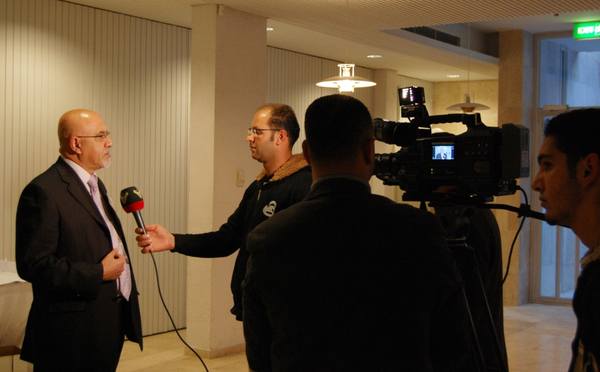
Rifat Odeh Kassis, co-author and general coordinator of the World Council of Churches (WCC) Kairos Palestine initiative, former head of the WCC’s Ecumenical Accompaniment Programme in Palestine and Israel, and Special Adviser to the WCC’s General Secretary, is pictured above giving an interview to Al-Manar TV, the official TV channel of Lebanon’s Hezbollah terrorist organization. (Photo source: Kairos Palestine)

If we pass on from Catholicism to other Christian churches, organizations and NGOs, there seem to be a great many that constantly berate Israel and defend the Palestinians, whatever either side says or does.

One might safely assume that Jesus would never have approved of Palestinian anti-Semitism, the preaching of bilious hatred, or the infliction of violence on innocent followers of the community to which he himself and his mother belonged, not to mention the believers who followed him.

Many Christians have transformed themselves into deeply biased political activists, as much influenced by the anger of Marxist theory as by the teachings of the Gospels. Others, like the movement Sabeel, work at the theological level, stripping Jews of their rights as a people whose identity is derived from a belief in God, a community of people, many of whom believe they have been invested with a deep responsibility to perform tikkun olam, the “repairing of the world.” In other words, Jews are single out for abuse despite the fact they were the earliest exponents of social action in the real world, not the next. There is a high level of hypocrisy when Christians who work to repair the world in their way condemn the actions of Israel, a country that has visibly improved the lives of millions.

The view of Christians like Sabeel, who are motivated by the outdated theological doctrine of supersessionism (that the Jews are no longer a people of God and have been replaced in God’s eyes by the Christians) is troubling, yet their message chimes with the views of their fellow believers in many places. Beneath that theological façade, however, unfortunately lurks a very real body of incipient or actual anti-Semitism.

The modern period has seen this concern for social activism grow, especially among younger evangelicals.[2]

One well-known evangelical is former US president Jimmy Carter, whose support for the Palestinian cause has been well documented. His 2006 book Peace Not Apartheid has been widely applauded by Palestinians, but deeply criticized by the former head of the Carter Center, Kenneth Starr, who resigned because of the book’s countless factual errors and lies that he lamented Carter refused to correct. The book was also strongly criticized by Abraham Foxman of the Anti-Defamation League (in The Deadliest Lies, chapter 5) and others. Carter states that the Palestinians should only end “the suicide bombings and other acts of terrorism when international laws and the ultimate goals of the Roadmap for Peace are accepted by Israel” — in contravention of the Oslo Accords, in which both parties agreed to negotiate a peace.

That a serious Christian can place political agreement with an intransigent enemy before the simple morality of calling for an immediate end to terrorism beggars belief. Yet Carter is not alone.

Christian political activists work for the most part through NGOs, covering their views and actions under the allure of goodwill to all men or a vocation of reconciliation. To the extent that they want peace, they are to be congratulated. But all too often, the sorry truth seems to be that their choice is to subvert a fair and just peace by advocating the “Palestinian solution” — namely, the use of violent and potentially genocidal methods to defeat, expel and ideally slaughter the Jews. This gives cause for the gravest concern.

Not only that, but the views of Hamas, Islamic Jihad and possibly a majority of Palestinians (and certainly their leadership) are based on strict adherence to Islamic shari’a law, which maintains that any territory, once conquered, must belong to the Islamic political theocracy in perpetuity. Any such territory, if it should escape from Muslim hegemony (as happened in Spain, Portugal and India) must be brought back within the fold by subterfuge or, if necessary, violence — a plan that will inevitably lead to disastrous consequences for Christians, Jews, and other non-Muslims.

How thoroughly ironic is it then, that Christians who support Palestinian irredentism thereby endorse the application of a legal system that claims to have superseded all others, especially the judicial norms of Christian countries.

Adherence to shari’a norms also constitutes a slap in the face to modern international law, to the principles of the Enlightenment, and to the Christian ethics of tolerance, fairness, and the pursuit of truth.

According to the Dutch scholar Rudolph Peters, the Islamic version of international law is based entirely on the existing laws governing jihad: whatever is inside shari’a law is legal, whatever is outside shari’a law is not. If another legal system (national or international) contradicts shari’a rulings, then it is deemed illegal. Hence, UN resolutions, the mandate system of the League of Nations, and any number of treaties are regarded as invalid by radicals in Hamas, Islamic Jihad, ISIS, al-Qaeda and other organizations. Why would Christian churches, in their pursuit of peace, want to endorse that? No doubt they will say they do not, even as they turn the other cheek to the terrorists who now are slaughtering and enslaving Christians across the Middle East.

Ironically, those who support the Palestinians do support shari’a law — by default — as Hamas and other Palestinian groups cite jihad as their reason for being. According to Article 13 of the Hamas Charter (the Mithaq Harakat al-Islamiyya al-Filastiniyya), for instance, “there is no solution to the Palestinian problem except through jihad” (la hall li’l-qadiyya al-filastiniyya illa bi’l-jihad).

More than that, overt Christian support for Islamic intolerance and war constitutes an outright denial of their own scriptures. Regardless of what the Qur’an really says, many devout Muslims, including Palestinians, consider the Old and New Testaments to have been misinterpreted or, at worst, falsified by Jews and Christians. More than that, this doctrine (known as tahrif) has allowed Palestinian preachers and intellectuals to overturn the entire narrative of the Tanakh, the Jewish Bible. They do this by claiming that they themselves are the real descendants of an ancient Palestine, dating back many thousands or even tens of thousands of years. The corollary is that there was never any Jewish presence there at all, no land of Israel, no people of Israel. They maintain there was never a first or second Jewish Temple, that other Jewish shrines — such as the Cave of the Patriarchs (Ma’arat Ha-Machpelah) in Hebron — are really Muslim shrines, and that the prophesied return of the Jews to the Holy Land is false. Now, to be frank, this contradicts many verses in the Qur’an and other early Islamic writings as much as it flies in the face of all sound historical texts and archaeological evidence. Even a ten-year-old child can see clearly just how falsified the Palestinian narrative of its origins is.

There seems to be no let-up in Christian-inspired actions against Israel. On June 30 this year, the United Church of Christ (UCC), a socially liberal million-strong protestant denomination in the United States, voted 508 to 124 in favour of divestment and boycott, with 38 abstentions. It was one of two resolutions on the Israeli-Palestinian conflict debated by the church. The resolution that called the actions of Israel, in both the West Bank and the Gaza Strip, “acts of apartheid,” received 51% of the vote, but it failed to reach the two-thirds majority it needed to be passed. Had it been passed, the UCC would have been the first American church to describe Israeli behaviour as apartheid.

According to Jerusalem Post columnist Max Samarov, “during the UCC conference, when a dissenting speaker lamented that the UCC ‘did not allow’ mainstream Jews and Israelis to have a voice at the table, few voters seemed to care. In a defining moment, UCC officials rejected an amendment calling on the church to listen to Israeli perspectives and encourage cooperation between Israelis and Palestinians.” Clearly, a search for truth and an openness to dialogue form no part of the UCC’s agenda, which remains opposed to any initiatives outside their rigidly enforced political dogma. And all this in the United States, a country built on democratic standards.

This vote was in keeping with two earlier resolutions against Israel, such as one that called for Israel to tear down its anti-terror security barrier with the West Bank — but without asking the Palestinians to cease their terrorist attacks on Israeli civilians. That a Christian church should call for an act that would result in dozens and eventually hundreds of murders of innocent Israelis leaves anyone with a sense of conscience aghast.

Writing for the Committee for Accuracy in Middle East Reporting in America (CAMERA), Dexter Van Zile remarks that

“Not only did the UCC’s 2015 General Synod fail to speak up about the corruption of the Palestinian Authority and the violence and ideology of groups like Hamas and Hezbollah in its resolutions, it did not offer up any official condemnation of ISIS and Boko Haram, two groups that have engaged in horrific crimes against humanity on two different continents – often specifically targeting Christians. The General Synod also failed to condemn the Syrian government, which has repeatedly used chemical weapons against its own citizens in that country’s civil war.

“The conclusion is inescapable: As a body, the UCC’s General Synod is irrationally obsessed with Israel and indifferent to Arab and Muslim misdeeds, no matter how outrageous and horrific. Misdeeds perpetrated by Arabs and Muslims simply do not offend the sensibilities of the UCC’s deliberative body with the same force as Israel’s efforts to defend itself from terrorism. This distorted focus immeasurably harms Muslim and Christian victims of Islamist aggression who warrant world attention and rescue.”

In 2014, the Presbyterian Church (USA) approved a resolution to divest from three companies that supplied Israel with equipment used in the West Bank, the resolution passed without due application to the actual legal status of the territory administered by Israel.

In May 2015, another Protestant evangelical and Pentecostal movement sponsored a Global Congress in Jerusalem. Empowered 21 is a worldwide organization based in Tulsa, Oklahoma, which claims to represent 640,000 believers. This organization, which has grandiose plans to evangelize every person on earth by 2033 (an objective not only beyond its means but flatly impossible in any Muslim country) nevertheless seeks to play a role in world affairs. Its chief problem lies in its collaboration with Palestinian Christian leaders who demonize Jews, delegitimize Israel, and present a supersessionist theology. It sponsors two of the most important anti-Israel Christian groups in the region, the Bethlehem Bible College and the Christ at the Checkpoint conferences. These conferences perpetuate the doctrine that Jews are an obstacle to God’s purpose in the world. They present a version of replacement theology couched in Palestinian terms, claiming that Jesus and the first Christians (in Jerusalem) were not Jews but the ancestors of today’s Palestinians, regarded as the indigenous inhabitants of the land and the only people with a right to it.

It is important to note that the General Synod of the UCC (referred to above) invited Rev. Dr. Mitri Raheb, the pastor of the Evangelical Lutheran Christmas Church in Bethlehem, to deliver a sermon at a service held the night before the votes on Israel. According to a report by CAMERA:

“During his talk, Raheb wrote the Jewish people out of their scriptures and out of the Land of Israel itself, repeatedly referring to the people of ancient Israel as ‘the Palestinians’ or the ‘people of Palestine.’ He did, however, use the word Israel in reference to the ‘occupation’. Raheb’s ugly effort to write the Jews out of the Bible is contrary to the spirit and letter of a resolution passed by the UCC’s 1987 General Synod which condemned replacement theology (which it referred to as ‘supersessionism’), but that did not stop delegates from giving the pastor a standing ovation.”

It has been argued that anti-Zionism within many churches is “a symptom of the death throes of mainline Protestantism.”

“All of the denominations that have gone into the camp of advocacy for divestment, divestment and sanctions are losing members at a catastrophic pace. For example: the United Methodist Church, Episcopal Church, Evangelical Lutheran Church have all lost around 30% of their membership over the last couple of decades…. Within the whole body of Christian[s] in our part of the world [the U.S.] these Liberal-Protestant denominations are losing membership by very large factors, while those denominations that have stood apart from the WCC [World Council of Churches] have been gaining in membership, by approximately the same factors.”

This may, in part, explain why the mainline churches have moved to the radical left on several issues, including support of the Palestinians, in an effort to win back members from a population that is generally more liberal than, say, fifty years ago. But it does not explain why so many evangelical and Pentecostal denominations, as we have seen, share this anti-Zionism while being, for the most part, more conservative in their social views. Nor should it diminish our awareness of the role churches and other bodies linked to the WCC still play in promoting BDS and generally propagating a pro-Palestinian narrative that plays into calls for the abolition of Israel and the expulsion or genocide of the Jewish population there.

Under the influence of Christian Aid, a World Council of Churches affiliate with a marked socialist agenda, many churches in Britain are also engaged in boycott, divestment and sanctions (BDS) activities.

According to Chana Shapira, writing for the Jerusalem Center for Public Affairs:

Christian Aid works to influence public opinion and policy with a two-pronged approach of Israel-delegitimization and funding of far-left pro-Palestinian organizations. It also works with the Ecumenical Accompaniment Programme in Israel and Palestine (EAPPI), a project of the World Council of Churches that recruits volunteers to participate in on-site propaganda tours, and then work as activists back home. In very loose terms, Christian Aid provides funding and EAPPI provides personnel.

Pro-Palestinian positions are advanced while there is a complete absence of any representation of moderate Israeli viewpoints. Errors of omission are frequent. ‘Israeli’ statements generally appear as anonymous, unverifiable remarks allegedly made by Israelis who defame Israel and the IDF.

Christian Aid’s biased agenda is supported by WCC member churches. Although it is not clear that these in fact represent the majority views of church members, this is the policy view adhered to by the clerical elites. The volume of material condemning Israel’s policies overwhelmingly dwarfs the few official statements supporting Israel’s right to exist.

Shapira’s lengthy and fully referenced article is essential reading for anyone seeking to understand the impact of Christian Aid in the UK, where it is supported by a government agency, the Department for International Development, and a group of 41 churches. She provides a detailed breakdown of major UK churches, Anglicans, Methodists and others, and their work with Christian Aid’s agenda. Outside the UK, Christian Aid supports Marxist and socialist political NGOs such as B’Tselem and Breaking the Silence, a stance that contradicts the organization’s stated aims of relieving poverty.

Depressing as this all is, there are glimmers of hope in unexpected places. In Israel, a multi-party group within parliament formed the Knesset Christian Allies Caucus in order to strengthen cooperation between Christians in general and the state of Israel. Its mission statement reads as follows:

The mission of the Knesset Christian Allies Caucus is to build direct lines of communication cooperation and coordination between the Knesset and Christian leaders around the world. We strive to establish relationships between the members of Knesset and leaders of Churches, Christian organizations and political representatives throughout the globe.

The Knesset Christian Allies Caucus has attracted an increasingly diverse and growing number of Christian leaders globally. The Caucus works with Christians who support Israel alongside those who are undecided on their position towards Israel. Many Christians recognize that their belief in the Bible connects them to the land and the people of Israel. On this basis, we work together to achieve our goals.

Also in Israel, the Christian Empowerment Council, headed by Father Gabriel Naddaf, a controversial Greek Orthodox priest from the Aramean community, works hard to integrate Christian Arabs into Israeli society, encouraging enrolment in the Israel Defense Force through a separate organization, the Israeli Christians Recruitment Forum, for which he is the spiritual leader. Naddaf has written feelingly about the opposition to his work among many Arab Christians and Palestinians, opposition that has led to death threats, his excommunication, and constant harassment. Isolated though he may be, he has brought large numbers of young Christian Arabs to join the IDF and integrate fully into Israeli life.

In the United States Christians United for Israel, a large lobbying group, has been described by the Washington Post as “America’s largest and most dependable pro-Israel group.” Pulitzer Prize-winning columnist Charles Krauthammer has said, “I do not know of an organization in the world more important to Israel than CUFI.”

According to CUFI, with a membership of two million, it has “driven hundreds of thousands of emails to government officials, held 2,162 pro-Israel events in cities and towns across the country, garnered more than 1.2 million Facebook fans, brought 304 leading pastors to Israel on 12 Pastors Leadership Tours, has trained more 2,500 students on how best to stand with Israel, presently has recognized college chapters on 140 campuses as well as an active presence at an additional 163 universities.”

CUFI has now opened a branch in the United Kingdom, where it has started to work along similar lines, but with a smaller following. It follows in the footsteps of a much older UK organization, Christian Friends of Israel (CFI), a non-denominational body with activists across the country. CFI also has branches throughout the world, and has had a centre in Jerusalem since 1985. Over the past year, Nigel Goodrich, a Christian pastor in Scotland, has successfully created some seven Friends of Israel groups in Edinburgh, Glasgow, Dumfries and Galloway, and elsewhere, and has organized large conferences attended mainly by Christians but also Jews, who are acting solidly with him and his following. This author has lectured at his conferences in Edinburgh and Glasgow, and can affirm the genuine enthusiasm and love of Israel displayed by the audiences. Inspired by Goodrich’s example, Glasgow Friends of Israel now runs a weekly stall in Buchanan Street, where the vicious anti-Israel Scottish Palestine Solidarity Campaign have held sway for many years.

Clearly, there is a new momentum within some Christian churches that presents a serious challenge to those denominations that are anti-Zionist. Where organizations such as Christian Aid seem more motivated by political considerations and adaptations of Marxist philosophy, these new supporters of Israel appear to be inspired by a love for the Bible and the rights it offers to Israel and its people, the Jews.

It is too early to say, but a shift seems to be taking place. As Christians in the West become more and more aware of the slaughter and expulsion of Christians in the Middle East, and the ongoing war of Muslim extremists against them, many have started to realize that the enemy they now face is the same enemy the Jews have been facing for centuries, especially since the establishment of the State of Israel in 1948.

There may yet come a time when Christians opposed to Israel understand that its abolition would mean the end of any protection for their fellow believers across the region and a dramatic clampdown on Christian freedom across the Muslim world.

Dr. Denis MacEoin formerly lectured in the Religious Studies Department at Newcastle University.


[1] Philip Berryman, Liberation Theology: Essential Facts about the Revolutionary Movement in Latin America–and Beyond, Philadelphia: Temple University Press, (1987), p. 4.

[2] “In a 2000 Princeton University survey, nearly two-thirds of U.S. evangelicals considered themselves liberal or (especially) moderate rather than conservative. In another survey in 2009, 35 percent of evangelicals were Democrats, 34 percent Republicans, and the rest independents. Many views of evangelicals defy stereotypes; for example, in 2008, 60 percent of evangelicals felt that the government should help the poor more.” From “The Evangelical Left in History and Today” by Craig S. Keener, Huffington Post, April 19, 2012.

The National Iranian American Council (NIAC) by Majid Rafizadeh

  • Some Iranian-Americans argued that NIAC’s policies did not seem to be aimed at improving the lives of Iranian-Americans, but were political and partisan policies more likely aimed at making more money, getting more fame, media publicity and self-promotion, satisfying those who provide funding to them, or going towards where the money is.

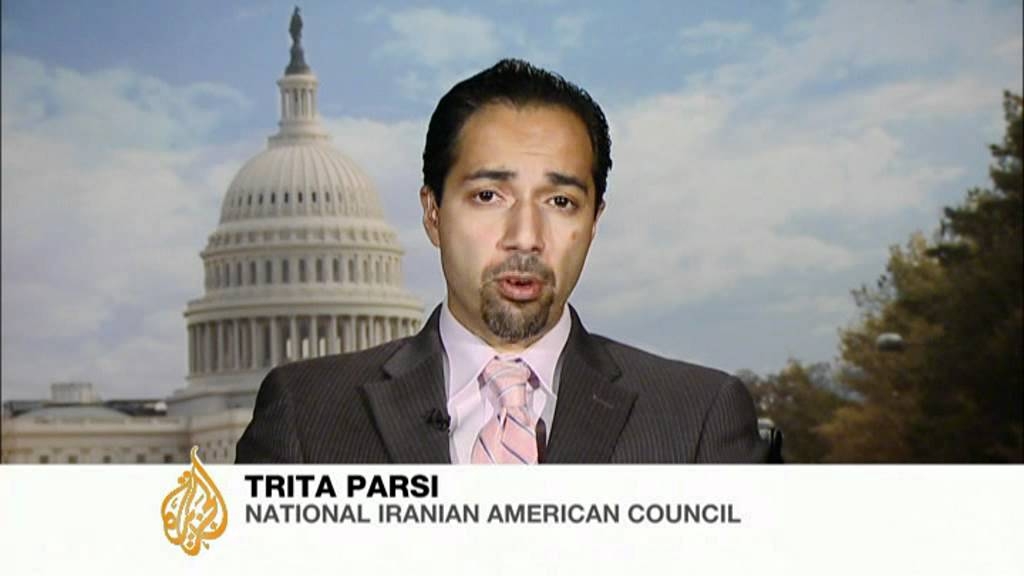
  • “I think Trita Parsi does not belong to the Green Movement. I feel his lobbying has secretly been more for the Islamic Republic.” — Mohsen Makhmalbaf to the Washington Times.
  • “It appears that this may be lobbying on behalf of Iranian government interests. Were I running the counterintelligence program at the bureau now, I would have cause to look into this further.” — Kenneth Piernick, FBI special agent in counterintelligence and counterterrorism.

I have often been asked why someone with my credentials joined the National Iranian American Council (NIAC) — a political institution, not “nonpartisan” as it sometimes suggests — and advanced the interests of Iran’s ruling clerics, who now lead the world in human rights violations, with a regime that ranks number one in executions per capita.

They also ask why one would work with an organization that is run by a director who is not even Iranian-American; not an American citizen, but holds Iranian and Swedish passports?

Before coming to the United States, I did not know about NIAC and no one I knew in Iran was aware of it either.

Although I wanted to contribute socially in helping Iranian-American communities in the U.S., I also did not want to join a partisan political organization that pretended to help the communities but instead was partisan and sought money, fame, and media attention.

At first, NIAC seemed fine: its mission statement says, “The National Iranian American Council is a nonpartisan, nonprofit organization dedicated to strengthening the voice of Iranian Americans and promoting greater understanding between the American and Iranian people.”

But soon after joining, I discovered several issues.

First, after joining NIAC in a voluntary and unpaid capacity, I felt as if I were back in the Islamic Republic of Iran. I began receiving calls and emails from NIAC indicating that some media outlets were introducing me as “ambassador” for NIAC. Well, one does not always get to choose what title the TV media outlets or magazine use to introduce one. Further, in many instances, journalists would Google my name and find it listed as ambassador for NIAC on its website.

I was still wondering why NIAC would be opposed to the idea that media introduces me as their ambassador. Later on, I encountered an article which said:

“NIAC’s inner contradictions never cease to surprise me, but then I guess that is the nature of Politics. Trita Parsi who staunchly opposed Western intervention in Libya virtually blaming it on Sarkozy’s warmongering and conforted [sic] in his views by the ever clueless moralist Hamid Dabashi accusing the hidden agenda’s of Western ‘Imperialism’ with his Broken record rants on European ‘Neo Colonialism’ while people were being mercilessly slaughtered by Libya’s Caligula has now added to it’s [sic] new list of Ambassador’s [sic] for 2012 an Iranian academic of Syrian heritage. But One who for a change seems to speak some sense in regard to a country he seems to understand far more deeply than NIAC understands Iran…”

It seemed most likely their opposition to me being introduced as their ambassador had to do with my personal views, which differed from those of NIAC. I criticized Iran’s political establishments, strongly condemned human right violations, criticized the Syrian regime for the bloodshed, and Iran’s Islamic Revolutionary Guard Corps (IRGC) for assisting the Syrian regime.

It soon felt as if my freedom of expression were being taken away. I started to worry that a journalist somewhere might quote an interview or text and use the title “Ambassador to the National Iranian American Council,” if he might have found my name on its website. I would then have to track down the journalist, find his or her contacts, and plead with him or her to remove the title. I was also worried that I might say something on television or write something that NIAC might not like. These fears of expressing myself freely were similar to those that I grew up with having lived and worked in Iran and Syria.

I was also wondering why, if NIAC had issues with my personal views, it kept me for some months more. Perhaps, I wondered, it might have had to do with what I had mentioned to them earlier: that I knew some philanthropists who might donate money to the institution.

I also felt that NIAC’s image was bigger than what the organization really was. Its website gave the impression that it is large, influential institution, and only works to advance the interests of all Iranian-Americans.

Many Iranian-Americans had mentioned that the NIAC did not represent them, and that it is solely a political institution pursuing its own interests. Some argued that NIAC’s policies did not seem to be aimed at improving the lives of Iranian-Americans, but were political and partisan policies more likely aimed at making more money, getting more fame, media publicity and self-promotion, satisfying those who provide funding to them, or going towards where the money is.

I also started to wonder whether the NIAC and Trita Parsi’s lawsuit against the journalist Hassan Daioleslam, which they lost, was a way to silence criticism, restrict freedom of expression and of the press, frighten people and silence journalists.

The appellate judges wrote:

“Throughout discovery, the Appellants (NIAC and Parsi) engaged in a disturbing pattern of delay and intransigence. Seemingly at every turn, NIAC and Parsi deferred producing relevant documents, withheld them, or denied their existence altogether. Many of these documents went to the heart of Daioleslam’s defense. The Appellants’ failure to produce documents in a timely manner forced Daioleslam — whom they had hualed into court — to waste resources and time deposing multiple witnesses and subpoenaing third parties for emails the Appellants should have turned over. Even worse, the Appellants also misrepresented to the District Court that they did not possess key documents Daioleslam sought. Most troublingly, they flouted multiple court orders.”

“We have previously recognized a trial judge’s authority to punish and deter abuses of the discovery process, and we do so again today. A court without the authority to sanction conduct that so plainly abuses the judicial process cannot function. We affirm the bulk of the District Court’s sanctions as the wages of Appellants’ dilatory, dishonest, and intransigent conduct, though in a couple of minor respects, we reverse and remand for reconsideration under the proper standard.”

Moreover, during the

      oral argument
in October 2014,

“one of the three appellate judges in the Court of Appeals, Judge Robert Wilkins reminded NIAC and Trita Parsi of their numerous false and misleading declarations to the court and told NIAC’s attorney: “I have got to tell you that your client is lucky that I was not the district judge, because you will be here appealing much more severe and higher sanctions because I think he [the district court judge] had extreme patience in dealing with lots of misleading and false representations and countless times when your client was trying to slice the baloney very thin, as far as trying to parse what their obligations were.”

The defendant, Daioleslam, stated,

“NIAC sued me in April 2008 to break me under financial burdens. I hired a lawyer and paid from my own pocket until I had no more resources. I asked for help and in September 2008 contacted the Legal Project at Middle East Forum. They contacted several law firms and finally, Sidley Austin LLP and Senior Litigation Partner and 2012 Best Lawyers’ Chicago Products Liability Lawyer of the Year Mr. Timothy Kapshandy graciously accepted to defend me pro bono.

I am grateful to the Iranian-American community, to the Middle East Forum, to Dr. Daniel Pipes, to Sidley Austin and its attorneys who defended my case, notably Mr. Timothy Kapshandy.”

It seemed that the media outlets, politicians, or some institutions that give funds or grants seem to have fallen for the image of the NIAC as being very influential in the U.S. and Iran, having very powerful connections in Iran or in the U.S., and being the representative of almost all Iranian-Americans. Those who are major decision makers in Iran — Supreme Leader Ayatollah Ali Khamenei and senior officials of the IRGC — keep issues within their gilded circle and those Iranians to whom we have access, are not the major decision makers in the Islamic Republic of Iran.

To illustrate this issue, one possible example is the case of Siamak Namazi, a friend of the NIAC director and co-founder of NIAC. If the NIAC and Trita Parsi were really influential in Iran and had connections with the major decision makers, they would have most likely had Namazi released instead of him languishing as a political prisoner in Tehran’s Evin prison.

It seems that the White House, the mainstream media, some journalists and politicians, and some donor organizations have been totally fooled by the exaggerated influence and image of the NIAC.

Nevertheless, the “Ploughshares” group, which the White House has identified as a key surrogate in “selling” the Iran nuclear deal, gave NIAC more than $281,000.

The Associated Press’s Big Story added that,

“In The New York Times Magazine article, [Ben] Rhodes [deputy national security adviser] explained how the administration worked with nongovernmental organizations, proliferation experts and even friendly reporters to build support for the seven-nation accord that curtailed Iran’s nuclear activity and softened international financial penalties on Tehran.

“‘We created an echo chamber,’ said Rhodes, a deputy national security adviser, adding that ‘outside groups like Ploughshares’ helped carry out the administration’s message effectively.”

The editor and publisher Robert Lifson argues, “In the wake of Ben Rhodes chortling to the New York Times over how easy it was to fool the American media to get favorable coverage of the Iran nuclear deal comes news that the media “echo chamber” (as Rhodes called it) was funded by a hard-left foundation.”

Some questions remain unanswered: Where and how did NIAC spend this money?

According to the Washington Times, “Mohsen Makhmalbaf, an acclaimed Iranian filmmaker and unofficial spokesman for Iran’s opposition Green Movement” told The Times previously that “I think Trita Parsi does not belong to the Green Movement. I feel his lobbying has secretly been more for the Islamic Republic.”

Journalists, policy makers, and organizations should be careful not to exaggerate the NIAC’s influence and give it more attention than it deserves; doing so might only help the NIAC to gain publicity, funding, access to American politicians, and so on.

Two crucial issues that NIAC possibly fears are: Ignoring the NIAC or following up with what Washington Times stated about the possibility of violations of federal law, “Now a lawsuit has brought to light numerous documents that raise questions about whether the organization is using that influence to lobby for policies favorable to Iran in violation of federal law.”

The Washington Times adds that

“Much of NIAC’s less public work has come to light through e-mails, documents, board of directors meeting minutes and strategy memos that were made public as part of the discovery process during a current defamation lawsuit against a critic of the group… Law enforcement experts who reviewed some of the documents, which were made available to The Times, by way of the defendant in the suit, said that e-mails between Mr. Parsi and Iran’s ambassador to the United Nations at the time, Javad Zarif – and an internal review of the Lobbying Disclosure Act – offer evidence that the group has operated as an undeclared lobby and may be guilty of violating tax laws, the Foreign Agents Registration Act and lobbying disclosure laws…. Neither Mr. Parsi nor anyone else at NIAC has registered as a lobbyist or filed papers with the Justice Department as a local agent of the Iranian government or Iranian companies. Mr. Parsi was shown and read the documents cited in this article.”

The Washington Times asked two ex- federal law enforcement officials about this issue:

“‘Arranging meetings between members of Congress and Iran’s ambassador to the United Nations would in my opinion require that person or entity to register as an agent of a foreign power; in this case it would be Iran,’ said one of those officials, former FBI associate deputy director Oliver ‘Buck’ Revell. The other official, former FBI special agent in counterintelligence and counterterrorism Kenneth Piernick, said, ‘It appears that this may be lobbying on behalf of Iranian government interests. Were I running the counterintelligence program at the bureau now, I would have cause to look into this further.'”

The Muslim Who Died Saving Christians “The True Strength of Islam” by Jacobus E. Lato

  • Riyanto had already made the choice to sacrifice personal safety to protect Christians from falling prey to radical Islamists.Riyanto was one of many Muslims who answered the great President Gus Dur’s call to express the “true strength of Islam” by safeguarding religious minorities.

  • Today, a growing number of Muslims in Indonesia are going against this current. They consider it a sin even to say, “Merry Christmas,” let alone allow those who celebrate it to do so in peace. It is now more crucial than ever, therefore, to hold up Riyanto’s legacy as a reminder of the past and as a light for the future.

When a 25-year-old, known just as Riyanto, entered the Eben Haezer Church of Pentecostal Assembly in East Java on Christmas Eve of 2000, he did not know that his life was about to end. He had been aware, however, of the risk he was taking by being there altogether, particularly on Christmas Eve. As a member of the Banser — the youth wing of Indonesia’s largest Muslim cultural organization, the Nahdlatul Ulama (NU) — he had already made the choice to sacrifice personal safety to protect Christians from falling prey to radical Islamists.

Shortly after mass, as parishioners began to exit the Protestant house of worship, the reverend handed Riyanto and other guards at the entrance an unattended bag he had found among the pews. Looking inside the package and realizing that it contained a bomb, Riyanto took swift action. “Get down!” he called out to all those who were still inside the building.

But Riyanto himself did not duck. Instead, he clutched the explosive tightly to his chest, in an effort to prevent mass casualties. Within seconds, Riyanto was blown to bits.

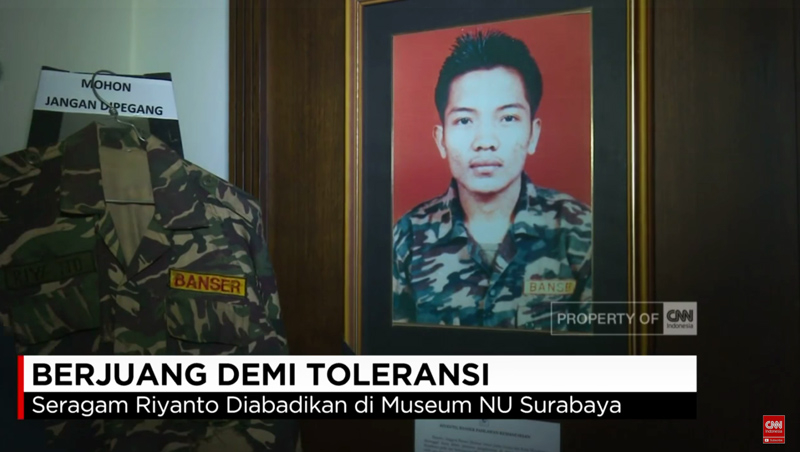
Riyanto was one of four Banser members guarding the church in Mojokerto, a small town south of Surabaya, Indonesia’s second-largest city. His name, like his heroic death, is hailed among moderates in the Muslim-majority country as a symbol of its credo of Bhineka Tunggal Ika (“Unity in Diversity”), which crosses all party and religious lines. His uniform is even on display at the NU Museum.

A photo of Riyanto, displayed alongside his uniform, at the NU Museum in Surabaya, Indonesia. (Image source: CNN Indonesia video screenshot)

Every year since his death, the Wahid Foundation — named after Indonesia’s fourth president, the late Abdurrahman Wahid (known familiarly as Gus Dur) — has presented awards in Riyanto’s honor to hundreds of students in state and religious schools, with the goal of encouraging tolerance and peace.

To keep Riyanto’s memory alive in the minds of moderate Muslims, the Mojokerto municipality named a street after him. In addition, every Christmas, the Eben Haezer congregation dedicates a prayer to him. Last Christmas Eve, the head of East Java’s Banser Regional Coordination Unit proposed that the anniversary of Riyanto’s death be marked as the “Day of Humanity.”

The practice of guarding houses of worship in Indonesia began in 1965, when the country’s Communist Party launched a coup against the government and killed oppositionists. When Suharto became president in 1967, the practice was no longer necessary and came to halt. But it reemerged during the post-Suharto “reformation” era, which began in 1998, and hardline groups began attacking Christians, raiding their churches and looting their property.

Riyanto was one of many Muslims who answered the great President Gus Dur’s call to express the “true strength of Islam” by safeguarding religious minorities. This multicultural outlook was the cornerstone of the NU. Today, a growing number of Muslims in Indonesia are going against this current. They consider it a sin even to say, “Merry Christmas,” let alone allow those who celebrate it to do so in peace. It is now more crucial than ever, therefore, to hold up Riyanto’s legacy as a reminder of the past and a light for the future.

Jacobus E. Lato, an author, is based in Surabaya, Indonesia.

The Muslim Council of Britain’s Little Problem Miqdaad Versi and Dodgy Facts by Douglas Murray

  • The Muslim Council of Britain (MCB) presented themselves in the manner of debt collectors: standing beside a big bruiser stressing how sorry they were to have to demand this payment, but that they were only just holding back their big, angry friend.

  • Unfortunately for them, during the last Labour government in Britain the MCB’s behaviour and beliefs were exposed by the more progressive Muslim voices who were by then coming along, and also by a wider society which had become wise to the tricks of these self-appointed “community leaders.”
  • The Daily Mail issued an apology, allowing supporters of the radical National Union of Students president to pretend that she was the victim of a smear campaign by self-confessedly inaccurate media reports rather than a nasty anti-Semite whose back was being covered by a full-time pedant with dodgy facts.
  • Miqdaad Versi is happy to apply rigorous standards to others, but holds exceedingly lax standards himself so long as he can carry on his own campaigning work against the UK government’s counter-terrorism and counter-extremism programmes.
  • Sadly for Versi, the British public’s security concerns are not caused by very slightly inaccurate media reports but rather by the deadly accurate bomb blasts and shooting attacks around the world which nobody needs to make up and nobody can fully cover over.

When considering the roles that various people worldwide play in advancing various causes, a lot of attention is paid to the people who blow themselves up. A fair amount of time is spent on the victims of such people. But relatively little time is spent focusing on the people whose role is clearly to tire everyone to death.

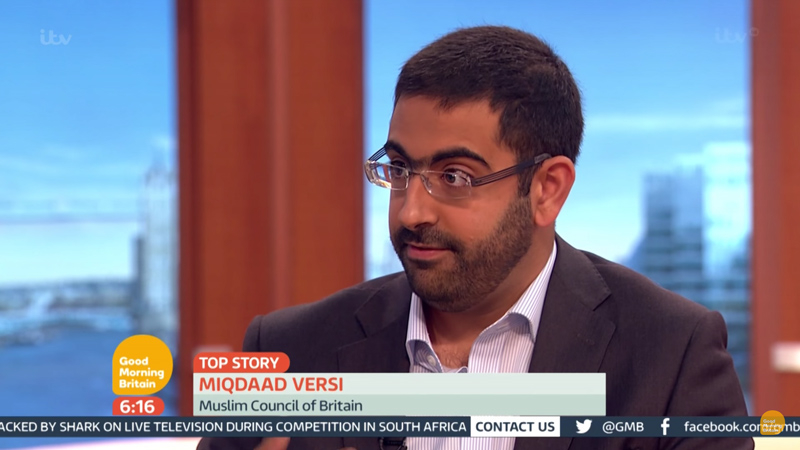
In this regard, it is worth introducing to a wider audience the existence of a man called Miqdaad Versi. This man works for the Muslim Council of Britain (MCB), an organisation which enjoyed a certain amount of access to the British government after the Satanic Verses affair, 9/11, 7/7 and other atrocities. During those years, they presented themselves in the manner of debt collectors: standing beside a big bruiser stressing how sorry they were to have to demand this payment, but that they were only just holding back their big, angry friend.

Unfortunately for them, during the last Labour government in Britain, the MCB’s behaviour and beliefs were exposed by the more progressive Muslim voices who were by then coming along, and also by a wider society which had become wise to the tricks of these self-appointed “community leaders.” The Labour government took a strong exception to the MCB’s then-Deputy Secretary General, Daud Abdullah, signing the ‘Istanbul Declaration’. As Home Office Minister Hazel Blears said at the time, it “supports violence against foreign forces — which could include British naval personnel… and advocating attacks on Jewish communities all around the world.”

In the years since then, the MCB has had a problem. Its self-appointed task is to act as an interlocutor with the government, but the government will not speak to them, a state of affairs which leaves the leadership of the MCB with a lot of time on their hands. Happily, the group’s Assistant Secretary General, Miqdaad Versi, has found a way to fill that time. Last year he hit the headlines in Britain for an especially observant piece of mid-morning television watching. While filling up his day, Mr Versi noticed that a piece of paper, on which the lead character in a children’s cartoon, called “Fireman Sam,” at one point slipped, appeared to resemble a page of Arabic writing.

By watching the clip over and over again, Mr Versi discovered that the page of writing resembled a passage from chapter 67 of the Quran. As a result, the makers of “Fireman Sam” were forced to issue a statement assuring the world that a full-scale investigation was underway into how this happened, and that, in addition:

“We are taking immediate action to remove this episode from circulation and we are reviewing our content production procedures to ensure this never happens again.”

Then last month — thanks to the BBC — we got an update on Miqdaad Versi’s activities. In January, the Victoria Derbyshire show ran a special feature on Mr Versi. The article — “The man correcting stories about Muslims” — portrayed Versi as an intrepid crusader for truth. In particular, it focussed on his work of systematically and continually complaining to the UK’s new press regulator, Ipso, whenever he thinks that a story in the British media contains inaccurate reporting on Islam or Muslims.

The BBC report described, for instance, how Versi had managed to get a major correction from the Sunday Times. In a front-page piece on a recent report into the state of integration in Britain by Dame Louise Casey, the Sunday Times had run the headline “Enclaves of Islam see UK as 75% Muslim.” The contents of the report were wholly accurate — the headline writer at the Sunday Times had merely wrongly extrapolated one point in the story and wrongly recounted the fact that pupils at one school featured in Casey’s report had said they thought the UK was between 50 and 90 percent “Asian.” The Sunday Times subsequently ran a correction. On another occasion, Versi had managed to get a correction from the Daily Mail which he presented as “huge.” The correction was that in a story about the President of the National Union of Students, Malia Bouattia, the paper had reported that Bouattia had said that young Muslims were going to join ISIS “because of government cuts to education” and had referred to a Birmingham university as a “Zionist outpost” because “it had a large Jewish society.”

Versi’s complaint about this piece centred on claiming that Bouattia had not said that cuts were the “only” reason people were joining ISIS, and that her suggestion that a British university was a “Zionist outpost” was not “because” of its large Jewish society. Both claims were highly disputable. Versi also complained that a use of the word “groups” should have been the singular, “group.” On the basis of this, the Daily Mail issued an apology, allowing supporters of the radical National Union of Students’ (NUS) President to pretend that she was the victim of a smear campaign by self-confessedly inaccurate media reports rather than a nasty anti-Semite whose back was being covered by a full-time pedant with dodgy facts.

Miqdaad Versi. (Image source: ITV video screenshot)

One interesting aspect of Mr Versi’s work, and the hagiographic write-up he received from the BBC, is that Versi is not immune from a bit of inaccuracy himself. He often seems, in fact, given to a considerable level of inaccuracy himself.

On the day that the BBC were giving Versi his rave review, he was on social media sharing an untrue story claiming that the government’s Prevent counter-radicalisation strategy was forcing King’s College London to monitor all student emails. The story was wholly bogus (KCL’s policy of reserving the right to monitor all emails on their system came a year before such a policy became a legal duty). But the fact that Versi was sharing this story was typical of the double-ledger he runs when it comes to facts. He is happy to apply rigorous standards to others, but holds exceedingly lax standards himself, so long as he can carry on his own campaigning work against the UK government’s counter-terrorism and counter-extremism programmes — or continue to exercise his own low standards in trying to cover for people who are designated as “extremists” by the UK government . Or indeed, in belonging to an organisation correctly identified as an “enabler” of prejudice against the minority Ahmadiyya community.

None of this came up in the BBC’s report, nor would any observer have particularly expected it to. The story of this double book-keeper would certainly make a more interesting story. But it would be less exciting than the story of the lone, caped crusader whose meaningless pedantry appears to be exercised in the hope of boring everyone else into submission. Sadly for Miqdaad Versi, the British public’s security concerns are not caused by very slightly inaccurate media reports but rather by the deadly accurate bomb blasts and shooting attacks around the world — attacks which nobody needs to make up and nobody can fully cover over.

Douglas Murray, British author, commentator and public affairs analyst, is based in London, England.

The Muslim Brotherhood: Wellspring of Terrorism by Judith Bergman

  • The Muslim Brotherhood (MB) in Egypt released an official statement calling on its supporters to “prepare” for “jihad”, in January 2015.

  • “The Muslim Brotherhood at all levels have repeatedly defended Hamas attacks… including the use of suicide bombers and the killing of civilians.” — UK government expert review of the Muslim Brotherhood, December 2015.
  • The Muslim Brotherhood not only funds one of the most virulent terrorist groups, Hamas, but there is barely any daylight between the various leaderships of the Muslim Brotherhood in Egypt, Jordan and Hamas.
  • Most of the terrorists who later founded al Qaeda were rooted in the MB. Osama bin Laden was apparently recruited as a young man to the MB, whereas Ayman al Zawahiri joined the MB at the age of 14 and went on to found the Egyptian Islamic Jihad (EIJ),”an organization that…. holds many of the same beliefs as the MB but simply refuses to renounce violence inside Egypt” — Foundation for Defense of Democracies.
  • The Muslim Brotherhood believes today what it has always believed: that a caliphate, where sharia law will rule, must be established through jihad. Refusing to designate the Muslim Brotherhood a foreign terrorist organization would be a grave mistake, playing straight into the strategy of the Brotherhood and, once more, revealing to the world the extreme gullibility of the West.

The Trump administration is considering designating the Muslim Brotherhood (MB) a foreign terrorist organization, and Human Rights Watch is outraged.

“Designating the Muslim Brotherhood a ‘foreign terrorist organization’ would wrongly equate it with violent extremist groups like Al-Qaeda and the Islamic State and make their otherwise lawful activities illegal,” said Human Rights Watch. The press release went on to repeat the old claim that “…the Muslim Brotherhood in Egypt officially renounced violence in the 1970s and sought to promote its ideas through social and political activities”.

Adding its voice to the Muslim Brotherhood’s apologists, the New York Times wrote:

“A political and social organization with millions of followers, the Brotherhood officially renounced violence decades ago and won elections in Egypt after the fall of President Hosni Mubarak in 2011. Affiliated groups have joined the political systems in places like Tunisia and Turkey, and President Barack Obama long resisted pressure to declare it a terrorist organization.”

For decades, the Muslim Brotherhood has pushed a specific public narrative, intended exclusively for Western consumption. Just how extremely effective the MB has been was demonstrated in 2011, when then Director of National Intelligence James Clapper, unbelievably, claimed that the MB was “… largely secular… has eschewed violence and has decried Al Qaeda as a perversion of Islam…They have pursued social ends, a betterment of the political order in Egypt…there is no overarching agenda, particularly in pursuit of violence”.

Nothing could be farther from the truth.

The founder of the Muslim Brotherhood, Hassan Al-Banna made jihadist violence a focal point of his movement. He wrote, “Death is art” and “Fighting the unbelievers involves all possible efforts that are necessary to dismantle the power of the enemies of Islam.” The MB inducts members into its deliberatively secretive and opaque network with the pledge that “Jihad is our way” and “Dying in the way of Allah is our highest hope.”

It is, in fact, difficult to overstate the importance of the MB in promoting and spreading jihad in the 20th century and onwards[1]. As the UK government’s expert review of the MB, published in December 2015, concluded:

“[The Muslim Brotherhood’s] public narrative — notably in the West — emphasized engagement not violence. But there have been significant differences between Muslim Brotherhood communications in English and Arabic; there is little evidence that the experience of power in Egypt has caused a rethinking in the Muslim Brotherhood of its ideology or conduct. UK official engagement with the Egyptian Muslim Brotherhood produced no discernible change in their thinking. Indeed even by mid-2014 statements from Egyptian Muslim Brotherhood-linked media platforms seem to have deliberately incited violence”.

The UK review goes on to say:

“The Muslim Brotherhood at all levels have repeatedly defended Hamas attacks against Israel, including the use of suicide bombers and the killing of civilians. The Muslim Brotherhood facilitate funding for Hamas. The leadership of the Egyptian Muslim Brotherhood, its Jordanian counterpart and Hamas are closely connected. There are wider links with Muslim Brotherhood affiliates throughout the region and senior Muslim Brotherhood figures and associates have justified attacks against coalition forces in Iraq and Afghanistan”.

In other words, the Muslim Brotherhood not only funds one of the most virulent terrorist groups, Hamas, but there is barely any daylight between the various leaderships of the Muslim Brotherhood in Egypt, Jordan and Hamas. (According to article two of the Hamas Charter, “The Islamic Resistance Movement [Hamas] is one of the wings of Moslem Brotherhood in Palestine. Moslem Brotherhood Movement is a universal organization which constitutes the largest Islamic movement in modern times”).

The indictment could not be more damning.

Another terrorist group rooted in the Muslim Brotherhood is Egyptian terrorist group Jamaat al-Islamiyya. This group came into existence, conveniently, when it broke away from the Muslim Brotherhood, after the latter denounced the use of violence in the 1970s. Creating a new terrorist organization was a brilliant strategy, which allowed for the Muslim Brotherhood to polish its image as a peaceful organization, leaving the dirty terrorist work to so-called “offshoots” or proxies. Indeed, Jamaat al-Islamiyya used the writings of the Muslim Brotherhood’s chief ideologue, Sayyid Qutb, as an ideological basis. Sheikh Omar Abdel Rahman, who was convicted and jailed in the United States as the perpetrator of the 1993 attack on the World Trade Center, was the spiritual leader of Jamaat al-Islamiyya.

The New York Times itself featured a lengthy article called “The Philosopher of Islamic Terror” about Sayyid Qutb in its magazine in March 2003, stating that he was “…the intellectual hero of every one of the groups that eventually went into Al Qaeda, their Karl Marx… their guide”. Most of the terrorists who later founded al Qaeda were rooted in the Muslim Brotherhood. Osama bin Laden was apparently recruited as a young man to the MB, whereas Ayman al-Zawahiri joined the MB at the age of 14 and went on to found the Egyptian Islamic Jihad, “an organization that holds many of the same beliefs as the MB but simply refuses to renounce violence inside Egypt”, according to The Foundation for Defense of Democracies (FDD). It subsequently merged with bin Laden’s organization. The lead hijacker of 9/11, Mohammed Atta, was also a member of the MB. The list goes on.

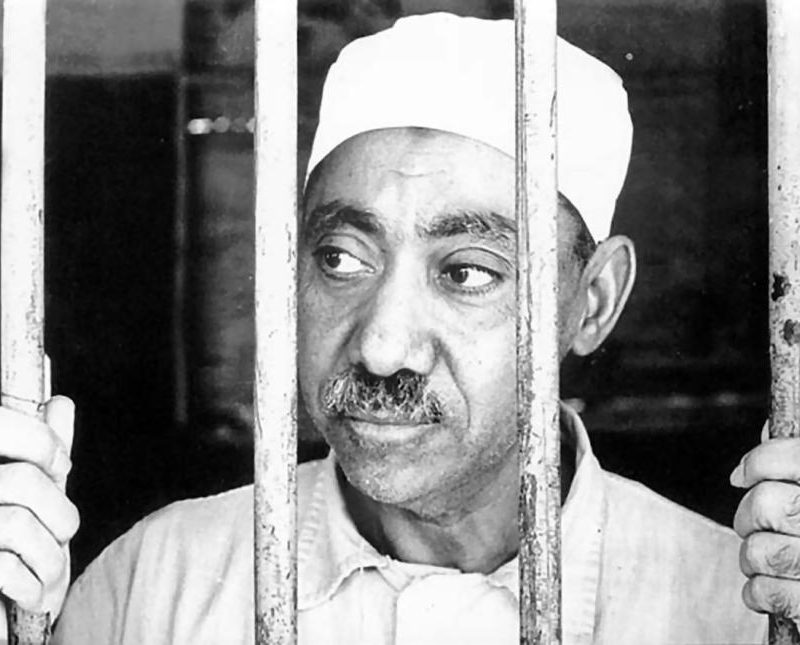
“The objective, then, is to strike terror into the hearts of God’s enemies, who are also the enemies of the advocates of Islam…” — Sayyid Qutb, chief ideologue of the Muslim Brotherhood in the 1950s and 1960s.

In January 2015, the Muslim Brotherhood in Egypt released an official statement calling on its supporters to “prepare” for jihad:

“It is incumbent upon everyone to be aware that we are in the process of a new phase, where we summon what is latent in our strength, where we recall the meanings of jihad and prepare ourselves, our wives, our sons, our daughters, and whoever marched on our path to a long, uncompromising jihad, and during this stage we ask for martyrdom.”

The statement also quotes at length the founder of the Muslim Brotherhood, disproving the claim that the Muslim Brotherhood has broken with its violent past:

“Imam al-Bana prepared the jihad brigades that he sent to Palestine to kill the Zionist usurpers and the second [Supreme] Guide Hassan al-Hudaybi reconstructed the ‘secret apparatus’ to bleed the British occupiers.”

After the official statement was released, Eric Trager, a fellow at the Washington Institute for Near East Policy (WINEP), stated:

“Muslim Brothers have been committing violent acts for a very long time. Under [Egypt’s former president, Mohamed] Morsi, Muslim Brothers tortured protesters outside the presidential palace. After Morsi’s ouster, they have frequently attacked security forces and state property… But until now, the official line from the Brotherhood was to support this implicitly by justifying its causes, without justifying the acts themselves. So the Brotherhood’s open call to jihad doesn’t necessarily mean a tactical shift, but a rhetorical one.”

Terrorism expert and national security reporter Patrick Poole added:

“It [the call for jihad] invokes the Muslim Brotherhood’s terrorist past, specifically mentioning the ‘special apparatus’ that waged terror in the 1940s and 1950s until the Nasser government cracked down on the group, as well as the troops sent by founder Hassan al-Banna to fight against Israel in 1948. It concludes saying that the Brotherhood has entered a new stage, warns of a long jihad ahead, and to prepare for martyrdom… What remains to be seen is how this announcement will be received inside the Beltway, where the vast majority of the ‘experts’ have repeatedly said that the Brotherhood had abandoned its terrorist past, which it is now clearly reviving, and had renounced violence,”

There is nothing peaceful, lawful or democratic about the Muslim Brotherhood. It believes today what it has always believed and openly stated: that a caliphate, where sharia law will rule, must be established through jihad. Refusing to designate the Muslim Brotherhood a foreign terrorist organization would be a grave mistake, playing straight into the strategy of the Brotherhood and, once more, revealing to the world the extreme gullibility of the West and its boundless willingness to believe anything the Muslim Brotherhood throws its way.

Judith Bergman is a writer, columnist, lawyer and political analyst.


Translate »
Skip to toolbar