Yearly Archives: 2017

INGOMA NKORAMARASO YA FPR,MU MUGAMBI WO KUMARA ABATUTSI.


Amakuru aturuka mubiro bikuru bya FPR,agera ku kinyamakuru inyangeNewss.com,aravuga yuko haba hari gahunda yo kwica abanyarwanda bo mu bwoko bw’Abatutsi bari mu gihugu baba bakekwaho kuba bemera cyangwa kuba bashyigikiye ishyaka rikorera mubuhungiro ritavuga rumwe n’ubutegetsi bwa Kigali ariryo RNC.


Bamwe mubatanga ayamakuru bakorera mucyitwa National Executive Committe (NEC) basabye ko amazina yabo atashyirwa ahagaragara kubera impamvu z’umutekano wabo,baragira bati,mur’ikigihe ibintu bikomeje kuba amayobera,har’ingeso yadutse mubacuruzi aho umuntu aba agufitiye umwenda wamafaranga wamwishyuza aho kugirango akwishyure ahubwo ahita akurega muri FPR ko ngo ushyigikiye umuryango wa politiki ukorera hanze y’Urwanda RNC,iyo urumuhutu birumvikana uhuzwa na FDLR.

Izi mfura zivuga ko,ibi birego muri iki gihe ar’ibirego bikomeye cyane,ngo kuko NEC yafashe ibyemezo ko umucuruzi wese uzavugwaho gushyigikira RNC agomba guhita akeneshwa ako kanya ndetse n’imitungo agahita ayamburwa hakoreshejwe RRA,bakamushyiraho imyenda y’imisoro yabaringa kugirango haboneka imwe mu mpamvu yo kumucenesha kugirango adahunga akajya kubarwaniriza hanze y’igihugu.

Bakomeza bavuga ko,ngo ibi biri muri bimwe bimaze gukenesha igihugu kuburyo budasanzwe nubwo Urwanda rwihagararaho,ariko ngo ibintu byaracitse,ngo bigeze aho noneho batangira gufata kumutungo w’igihugu uba warategenijwe kuzagoboka igihugu igihe cya kaga gatunguranye ngo kuba leta yarageze aho itangira kugurisha imwe mu migabane yayo binyujijwe mu mpapuro z’indanga migabane ngo nikimwe mubimenyetso bigaragaza ko igihugu kigeze mu marembera.

Umuhanzi KIZITO MIHIGO akaba arumwe mubasore ba batutsi babimburiye abandi kurira imisozi imaze kumera mu murwa mukuru wa Kigali hakurya y’imisozi y’igikundiro kandi uwo musozi akaba atabasha kuwurira nk’uko ubuhanuzi bubivuga,nyamara buriya birenge niwowe ubwirwa!

Uwo mugani waturutse kumugabo wagiye gusambanya umugore wamugenziwe,maze nyirirugo arataha,wamugabo yihisha murugi undi amaze kwinjira mu nzu umugore ati ariko ibirenge byawe biranuka icyuya undi ati ese urinda winuba wampaye amazi nkakaraba,ubwo yayasutse mu ikarayi ayajyana inyuma y’inzu agarutse ati nayagejejeyo arongera ati urabe wumve birenge niwowe ubwirwa,nyirirugo asohotse undi nawe aba abonye akanya ko gusohoka.

Kubacira uwo mugani ntayindi mpamvu ibinteye,ahubwo ni uko urupfu rwamaze guhumurira gakondo,abarokore nibo bajya baririmba ngo ijuru ryahumuye we!!Nanjye reka mvuge nti urupfu rwahumuye we!mbese niba gupfa ntawe byishe niki utinya? Buriya ndiwowe nafata urwo rutsyo rukuri kumugongo nkaruhirika hirya yawe,narangiza ngahambura amaguru nkazamuka mugisenge cy’inzu,narangiza ngasimbuka nkagwa hejuru yamacumu ngafata ibisogororo nkabihambira kubikomere ngatabara aho kugirango bazantege umushi nzabure icyo nzahiga ubwo imfura zizaba zateranye aho kugirango mpire mu nzu nk’umugome wese.

Ingaruka n’inkurikizi zabaye kubanyarwanda,kubera urugomo bagiriwe nabazungu Bababiligi bakoreye ubwami bw’Urwanda.

Ingaruka n’inkurikizi zabaye kubanyarwanda,kubera urugomo bagiriwe nabazungu Bababiligi bakoreye ubwami bw’Urwanda.

Nyuma yaho ubwami  bw’uRwanda bugiriwe urugomo nabazungu Bababiligi bakoreye abanyarwanda bari bifitiye ubuyobozi bubabereye,hanyuma bakaza gukorerwa urugomo nabo banyamahanga,bitwaje imbaraga no kuba bari bafite ibikoresho by’ubugizi bwa nabi,ibyo bikaba byaraviriyemo abanyarwanda guhunga igihugu cyabo bagata imitungo yabo,ingo zabo,imiryango yabo yagiye itatana kuburyo bunyuranye.


Ababiligi bamaze kubona yuko abanyarwanda bakomeye kumuco wabo wamahoro,bahise bashaka bamwe muri abo banyarwanda nk’uko bizwi neza ko ibyara mweru na muhima,maze agace gato kabanyarwanda gahabwa ubutegetsi bwo gukandamiza abandi banyarwanda.

Abahutu bakomoka mum majyepfo bari bayobowe na Gerigoire Kayibanda bahabwa ubutegetsi bafashe ku ngufu za gisirikare cy’abazungu bababiligi,maze baheza abanyarwanda bo mu bwoko bw’Abatutsi karahava,nyuma y’imyaka nk’icumi,umuvumo wo gukubaganira ubwami bw’Urwanda utangira kubagiraho ingaruka.

Nibwo Abahutu bo mu majyepfo Nduga bahuye n’ikibazo cya kudeta maze baricwa karahava,ibyo bakoreye Abatutsi bitangira kubagaruka kubera bananiwe kubahiriza umuco nyarwanda wa mahoro bishinga abazungu ariko mu byukuri nibo byagizihe ingaruka zikomeye kuko imiryango yabo ntiyashoboye no kubona nibura imibiri yabo.

Ubwo kuwa 05th Nyakanga 1973 Abakiga nabo bafata ubutegetsi ku ngufu za gisirikare kuburyo bunyuranije namategeko bagera ikirenge mu Kayibanda,nabo sinakubwira bimara agahinda bakora ibidakorwa binyuranije n’uburenganzira bwa muntu.Barica,bafata abagore babatutsi-kazi ku ngufu za leta,ndetse babihimbamo indirimbo ivuga ngo:Umugore mwiza n’umututsikazi,umuhanda nikaburimbo,inzoga nziza ni shapanye.Bari baradamaraye cyane kuburyo bumvaga ko zitahindura imirishyo!

Kuwa 06th mata 2014 babonye ko byose bishoboka nyuma yuko ingabo za fpr zahanuye iyo ndege ahagana mu masaha 8:30 z’ijoro maze abanyarwanda bahura n’icuraburindi,umuvumo wo guhemukira ubwami bw’uRwanda urongera wubura inzika.Abanyarwanda bagera kuri millioni imwe nigice 1.5 z’abanyarwanda zirahatikirira.Muri iyi mibare harimo abanyarwanda babahutu n’Abatutsi,ndetse n’imirambo yatawe mu mazi,inzuzi,inyanja nibindi nk’ibyo.

FPR ifata ubutegetsi ku ngufu igera ikirenge mu Habyarimana nk’uko yabigenje ninako nabo babigenje,bategekesha ingufu zose zishoboka,mu mwaka wa cumi 19 wubutegetsi bwa fpr nibwo ibintu byabaye bibi cyane,aho ndavuga mu mwaka wa 2010 ubwo Gen.Nyamwasa yahungaga,nibwo fpr yatangiye gushyira kumugaragaro ibyifuzo byayo byo guca ibihanga byabanyarwanda batavuga rumwe n’ubutegetsi.

Kugaza aho basanze abanyarwanda mu bihugu babahungiyemo,bagakomeza kubakorera ubugizi bwa nabi,Col.Patrick Karegeya wishwe kuwa 31st Ukuboza 2013,nyuma yuko bahusha Gen.Nyamwasa inshuro zigera kuri (4);ntabwo ubutegetsi bwa fpr bwashizwe gutangaho abanyarwanda ibitambo kubera igitutu cya fdlr bahise bafata abanyarwanda bose babakekwaho kuba ar’imiryango ya fpr hamwe n’inshuti zabo ibihumbi bigera kuri 46000 by’abanyarwanda byahise bibirirwa irengero.Ibyo byose byakozwe mu rwego rwogutera iterabwoba abanyarwanda kugirango babaceceke.

Amakuru agera kunyangenews aturuka mu nzego nkuru zigihugu zishinzwe iperereza NSS,ziravuga ko,ibihumbi 46000 byose uko byakabaye kuko bagiye batwara imiryanga cyangwa umuryango bishatse kuvuga ngo umugore ,umugabo,abana bose bashyizwe mum makamyo batwarwa ahitwa GABIRO-MISHENYI mu kigo cya gisirikare babatwikisha amavuta ya essance kugirango imibiri yabo itazagaragara bigateza ikibazo kumiryango iharanira uburenganzira bwa muntu igatangira gukurikira leta y’uRwanda.

Amakuru akomeza avuga ko,ngo,abagize uruhare muri iki gikorwa,ngo nabasirikare bakomoka mu miryango y’Abega bab’Akagara,cyane biganje mu mutwe wabajepe barinda umukuru w’igihugu Gen.Paul Kagame umwakagara mukuru ushaka kwimika ingoma y’Abega bab’Akagara ubwami bwabo bugasimbura repubulika itemewe namategeko.

Amakuru avuga iyindi mibiri yajugunywe muruzi rw’Akagera kegeranye hafi cyane n’ikigo cya gisirikare kibarizwa aho GABIRO bikaba bivugwa yuko ariyo mibiri yabonetse mu kiyaga cya rweru cyo mu gihugu cyo mu Burundi,uwo n’uwundi muvumo ugira (4) uterwa n’urugomo,ubuhemu byakorewe ubwami bw’uRwanda,nyamara abanyarwanda bagatabaye abanyarwanda bakomeje kugaragaraza inyota y’ubutegetsi kugirango bakomeze kuyobora abanyarwanda mu buryo butemewe namategeko.

Ubu leta ya fpr ikaba ikomeje gutegura jenocide igiye gukorerwa abanyarwanda,dore ko yatangiye gushyirwa mu bikorwa aho bica abanyarwanda gahoro gahoro byitwa barwanya umwanzi w’igihugu,mbese kugira ibitekerezo binyura n’ubutegetsi bisobanura ko ar’ukwanga igihugu?

Ubu abanyarwanda bameze nk’itungo ritegereje kubagwa umwanya uwariwo wose,ariko ikibabaje,abiyita abanyapolitike baharanira umutekano kwishyira ukizana by’abanyarwanda,bigaragara ko,badashyize hamwe kubera gushaka ubutegetsi ku ngufu za gisirikare mu buryo butajyanye namategeko.Ibi byose barabizi ariko ntibashobora gushyira hamwe ngo bashyigikire ubwami bw’uRwanda bwemewe namategeko,ndetse no muri ONU akaba aribwo buzwi ariko ibyo byose barabyirengagiza bagashaka gukomeza umurongo w’ikinyoma bamenyereye ko bigwizaho imitungo ni miryango yabo.

Leta ya fpr yatanze ruswa nyinshi cyane kugirango uRwanda rushyirwe mu kanama gashinzwe umutekano ku isi babifashijwemo n’Abanyamerica nabo babemerera kujya muri Congo kubasahurira zahabu bakayibaha kugiciro cyosi ugereranije nibindi biciro byo ku isi,aya makuru avuga ko,uRwanda rwari rugamije kugaragaza imbaraga mu batavuga rumwe nayo kugirango batinye hatazagira uyi rwanya.Ariko bibagirwa ko,ibyara mweru na muhima,kandi na nyina wundi abyara umuhungu.

Indonesia: Free Speech vs. Treason by Jacobus E. Lato

  • On April 19, the campaign of Jakarta’s radicals chanting, “We want a Muslim governor!” paid off, as Ahok was defeated in the gubernatorial election. Exit polls on election day indicated that religion was the main factor behind the voting.

  • On May 10, Indonesia’s radicals scored a second victory, when Ahok was found guilty of blaspheming Islam and sentenced to two years in prison.
  • The verdict came as a surprise even to the prosecutors of the case — they had requested only a suspended sentence for the offense of “inciting hatred”.

In the two decades since the fall of Indonesian President Suharto’s 32-year reign in 1998, the use of the accusation of “treason” as a governmental tool to quash political opposition gradually reemerged in the world’s largest Muslim-majority country.

Today, however, those trying to overthrow the leadership are Islamists intent on unraveling the fabric of a pluralistic society.

This situation has led to the debate over freedom of speech and the separation of church and state — or, here, mosque and state.

Four recent rallies in the capital city of Jakarta illustrate the nature of what has become a full-blown controversy. In each case, protesters gathered outside mosques after Friday prayers for what they claim are “spontaneous” demonstrations made necessary by their clerics’ lack of financial resources to plan and stage such events. But evidence collected by Indonesian authorities indicates otherwise.

The first such protest took place on October 14, 2016. Its purpose was to demand that criminal proceedings be launched against Jakarta Governor Basuki Tjahaja Purnama — familiarly known as Ahok — for “blasphemy.”

Ahok, a Christian of Chinese descent, was appointed to his position in 2014, when Joko Widodo became president of Indonesia. Hardline Muslim groups argued that a Christian should not be allowed to govern a Muslim-majority city. To back up their claim, they cited the Quran.

Their fury grew even greater when Ahok was running for reelection: he asked fishermen in Pulau Seribu not to be “deceived” by politicians using the Quranic verse, al-Maidah 51 (“…do not take the Jews and the Christians as allies”), to dissuade them from supporting him.

Although Ahok subsequently apologized for his statement, he was put on trial for blasphemy. Thousands of Islamists, shouting “Burn Ahok!” and “We want a Muslim governor!”, marched from the Istiqlal Mosque through the city. This ostensible eruption of emotions, according to deputy head of the Islamic Defenders Front (Front Pembela Islam, or FPI), had nothing to do with the upcoming gubernatorial election. It was, he said, religiously motivated. However, the presence at the rally of former House Speaker Amin Rais indicated that politics played just as big a role as faith.

The second rally took place less than three weeks later, on November 4. According to the head of the FPI, some 7.5 million Muslims turned out that day. At the end of it, one protester had died of an asthma attack and two police trucks had been set on fire by an angry mob.

Hours before the third rally, on December 2, police arrested 11 people on suspicion of treason for trying to overthrow the government. Among these were: the daughter of former President Suharto; prominent economist and activist Sri Bintang Pamungkas and two brothers, Jamran and Rizal Khobar, both members of the Islamic Students Association, a group responsible for an attack on security officials during the previous rally.

In addition to the allegation of treason, Pamungkas was detained over social media posts, particularly a YouTube video from the previous month. Rizal and Jamran were accused of violating Indonesia’s 2008 Electronic Information and Transactions Law.

Ahead of the fourth rally in question, on March 31, a second batch of arrests was carried out by police. Among those detained was Muhammad Al Khaththath, a leader of the hardline Islamic People’s Forum.
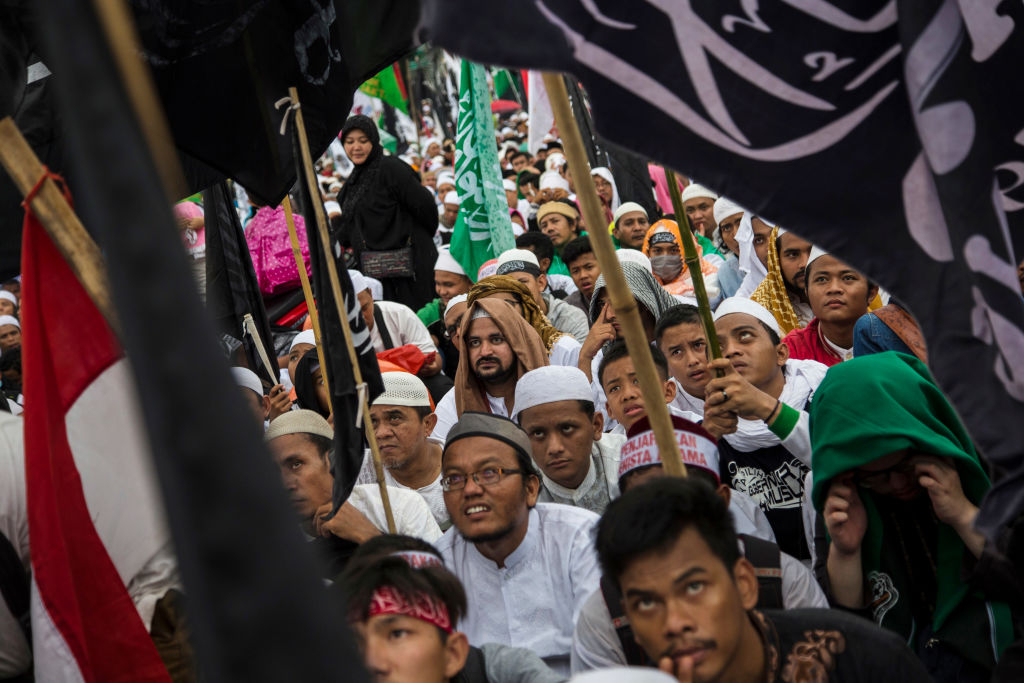
Indonesian Islamists listen to a speech by an imam during a protest against Jakarta governor Ahok, on March 31, 2017 in Jakarta, Indonesia. (Image source: Ed Wray/Getty Images)

Although the case can be made, as it is in the West, for distinguishing between treason and the right to criticize one’s government, the issue in Indonesia is currently more complex, due to the extremist religious agenda of the opposition. Rather than looking to their religious leaders to determine matters of faith, many are using Islam as a political weapon, and breaking laws that were written to protect the very minorities who are now being treated as second-class citizens.

On April 19, the campaign of Jakarta’s radicals, chanting “We want a Muslim governor!” paid off, as Ahok was defeated in the gubernatorial election. On May 10, Indonesia’s radicals scored a second victory, when Ahok was found guilty of blaspheming Islam and sentenced to two years in prison, effective immediately.

The verdict, which came as a surprise even to the prosecutors of the case, who had requested only a suspended sentence for the offense of “inciting hatred,” was handed down by a five-judge panel of the North Jakarta District Court.

One of the judges, Abdul Rosvad, explained the decision by saying, “…[A]s a public officer, the defendant should have known that religion is a sensitive issue so he should have avoided talking about [it].” Rosvad also denied allegations that Ahok’s arrest, trial and imprisonment were politically motivated.

“This is a pure criminal case,” he said.

However, the popular Christian governor was defeated by rival Anies Baswedan, a Muslim, and exit polls on election day indicated that religion was the main factor behind the voting.

Dr. Melissa Crouch, of Australia’s University of New South Wales, told the Sydney Morning Herald that the verdict should not have come as a surprise. “To be accused of blasphemy in Indonesia is effectively to be found guilty,” she said. “This gives a lot of power to those — such as religious leaders — who may make the initial complaint to police regarding blasphemy charges.”

Ahok’s lawyers say they will be appealing the verdict.

Jacobus E. Lato is a writer and former editor, based in Surabaya, Indonesia.
India’s War on Terror: Solution is Self-Defense, Not Consensus by Jagdish N. Singh

  • Instead of eliminating the invaders, Nehru made a deadly mistake: He took the matter for mediation to the United Nations.


  • UN member states have never even been able to agree on a definition of terrorism. Some of the states, such as Pakistan, Iran and Saudi Arabia, overtly or covertly practice, promote or fund terrorism.

  • Emboldened by international and Indian inaction, Pakistan has continued masterminding terror strikes against India.

  • New Delhi might do well bear in mind a central message from the history of wars: The dialogue of peace and non-violence alone is futile with those who understand only the language of power and punishment.

  • India, like Israel, would do better to fight its own war on terror.

In the wake of the recent coordinated terror strikes in Paris on November 13, India’s Prime Minister, Narendra Modi, has made a fresh appeal for a concerted global strategy to fight terrorism. In his opening remarks at the ASEAN-India Summit in Kuala Lumpur on November 21, he said, “Terrorism has emerged as a major global challenge. … we should see how we can enhance our cooperation at the regional and international level, including through support for adoption of Comprehensive Convention on International Terrorism.”

The previous week, addressing the G20 leaders at Antalya on November 15, Modi had lamented, “We don’t have a comprehensive global strategy to combat terrorism… we tend to be selective in using the instruments that we have… We should strengthen efforts to prevent supply of arms to terrorists, disrupt terrorist movements and curb and criminalize terror financing.”

Sadly, there is nothing new in Modi’s appeal to combat terror. Such an appeal has also been made by India’s previous leaders. In 2005 then-Prime Minister Manmohan Singh said to the media on his arrival from the United Kingdom: “Terrorism is a global phenomenon. We have faced this scourge for the last 20-25 years. The incident (London transit bombings) calls for joint efforts to combat the scourge.”

While possibly sounding profound, such an appeal makes little practical sense. A United Nations consensus against terrorism looks far-fetched. In the immediate post-9/11 landscape, the UN passed various resolutions. They underlined moral and legal obligations on the part of all UN member-states to fight terror together. There is no evidence, however, that they ever coordinated intelligence or devised a concerted strategy to combat anything other than Israel — the only transparent, accountable and pluralistic democracy in the Middle East. UN member states have never even been able to agree on a definition of terrorism. Some of the states, such as Pakistan, Iran and Saudi Arabia, overtly or covertly practice, to promote or fund terrorism.[1]

In the post-9/11 landscape, the world’s major powers have preferred to focus on strengthening their own homeland security, notwithstanding their fashionable diplomatic postures of consensus at major international forums.

Given this reality, India, with all its moral, legal, diplomatic and military strength, would do better to fight its own war on terror.

Terrorism in India, in its current form, dates back to 1947. It on October 26, 1947 that Pakistan came up with the ideology of Islamist terrorism and dispatched its warriors — Pakistani soldiers in guise of Pakhtoon raiders — into India’s Kashmir to capture it. The Indian Prime Minister, Jawaharlal Nehru, could have crushed the invaders then and there.[2]

Instead of eliminating the invaders, however, Nehru made a deadly mistake: He took the matter for mediation to the United Nations. India has paid heavy price for this ever since. The Indian state of Jammu and Kashmir has remained deprived of two fifths of its territory — Pakistan-occupied Kashmir. The United Nations passed a ceasefire resolution on December 31, 1948 that merely divided the state. A 1951 UN resolution provided for a referendum under the UN supervision after Pakistan withdrew its troops from the part of Kashmir (PoK) that Pakistan captured in 1947. But the United Nations never pressured Pakistan to honor the resolution and vacate the PoK.

Thereafter, emboldened by international and Indian inaction, Pakistan has continued masterminding terror strikes against India from time to time. According to an August 11, 2008 report in the magazine India Today, between 1980 to 2008, terrorism claimed around 150,000 lives in India.[3] The former Chief Minister of Himachal Pradesh, Shanta Kumar, wrote on August 23, 2011 in the New Delhi newspaper Punjab Kesari that in 1989, the Kashmir Valley had a population of over half a million Pandits, the only Hindu natives of Kashmir. Their number stands reduced to about four thousand today. By 2000, terrorists had killed over 34,252 citizens and wounded another 17,484. They set fire to over 10,000 houses and destroyed huge amounts of individual and public property in the state. This has left the minorities in the Kashmir Valley with no choice but to flee their homes.

American Congressman Frank Pallone’s letter of August 23, 2004 to India’s Prime Minister, Manmohan Singh at that time reads:

“The Pandits [Hindus of Kashmir] have suffered more than any group as a result of the conflict in Kashmir, and violence continues to threaten their existence. This group is under constant threat of attack from Islamic terrorists, and many have fled the region as a result of these threats. For the last 15 years, Kashmiri Pandits have been refugees in their own country. What was once a population of nearly 350,000 in the Kashmir valley has now been reduced to a paltry 8,000-person populace. The ethnic cleansing of Pandits from Kashmir started as a result of targeted assassinations leading to forced exile of the entire minority community in the early stages of insurgency. Such horrible events were then repeated in the last few years when Islamic insurgents committed mass massacres of Pandits in villages and hamlets throughout Kashmir.”

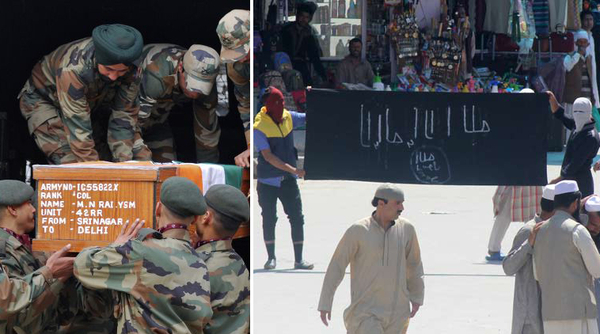
Left: Indian soldiers carry the coffin of Indian Army Colonel M N Rai, who was killed in January 2015 by terrorists in Kashmir. Right: Masked Islamist radicals in Kashmir display a version of the black flag of jihad.

Such harsh realities demand that India’s leaders cease looking for any imagined, miasmic global ” consensus” — which never appears — and develop a more workable, realistic policy to combat terror.

India could learn from other democracies, such as Israel, which has also suffered many years of terrorism, and has resorted, for its national security, to a policy of self-defense.

At bottom, modern-day terrorism seems to be a new tool of certain self-styled Islamists to invoke a violent interpretation of their widely practiced religion. They appear to use it to try to capture power and establish an absolutist, theocratic regime.

Needless to say, the patriotism of Muslim community, or that of any other religious community in India is beyond doubt. In an interview with CNN, Prime Minister Modi rightly said, “Indian Muslims will live for India. They will die for India.”

New Delhi could use such a welcome social asset to focus on boosting its own defense and security capabilities to crush terrorism. New Delhi might do well bear in mind a central message from the history of wars: The dialogue of peace and non-violence alone is futile with those who understand only the language of power and punishment.

India might consider a “frank talk” with the forces of terrorism both within and outside the Pakistani establishment. Fortunately, India has remained blessed with an apolitical military. There is also no dearth of highly professional elements in its security and intelligence agencies. India also possesses a broad tradition of different cultural and religious streams, both foreign and domestic, and relative communal harmony[4], including in its Muslim community. It is with assets such as these, as well as an increasing military prowess, that New Delhi should be fighting terror.

Jagdish N. Singh is a senior Indian journalist based in New Delhi.


[1] for instance, Pakistan’s attacks on Mumbai in 2008; the listing of Iran on the U.S. Department of State’s 2014 State Sponsors of Terrorism; and, for Saudi Arabia, support for terror. According to Clinton’s leaked memo, Saudi donors constituted “the most significant source of funding to Sunni terrorist groups worldwide”.

[2] The state of Jammu and Kashmir had become an integral part of India after its Maharaja at the time, Hari Singh, signed the Instruments of Accession to India (October 27, 1947). The Indian Army was capable of eliminating the problem from India’s territory. Mahatma Gandhi also apparently foresaw the consequence of the invasion and advised Prime Minister Nehru to drive the raiders out. (Durga Das, India from Curzon to Nehru and After, New Delhi: Rupa& Co, 1977), p.270; Also, V Ramamurthy, Mahatma Gandhi:The Last 200 Days, Chennai: Kasturi & Sons, 2004, p.289.

INDEGE IBAYE AMAYOBERA, YABURIWE IRENGERO.

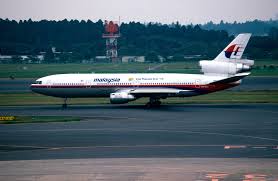
Amakuru dukesha itangaza makuru ry’amashusho rikorera mu gihugu cya US, CNN, ririmeza yuko indege yo gihugu cya Malaysia kumurwa mukuru wicyo gihugu witwa KUALA LUMPUR hahagurutse indege yo mu bwoko bwa boing MH 370 kuwa 06th z’uku kwezi yerekeza mu gihugu cy’Ubushinwa kumurwa mukuru wa Beinjing.


Amakuru avuga ko kuva yahaguruka kukibuga kindege kumurwa mukuru wa Kuala Lumpur iyo ndege itarongera kuboneka yaburiwe irengero, babanje gukeka ko yaba yaraguye munyanja,maze hitabazwa inararibonye muby’indege harimo abanyamerica ,abanyaburayi,nabanyasia,ariko ntakintu babashije kugeraho.

Dushingiye kumakuru atangwa na CNN,biravugwa yuko hashakishijwe kubuso bungana na km kare ibihumbi 92000,ariko bakaba ntacyo babashije kugeraho twibutse ko ubwo bushakashatsi bwakorerwaga munsi y’inyanja itukura”Red sea” ndetse hamwe n’inyanja yirabura “Black Sea” cyangwa muri Ocean.

Abashinzwe ubushakashatsi bamaze guheba byabaye ngombwa ko icyo gikorwa gihagarikwa, kuko ntakundi byari kujyenda,ariko amakuru akomeza gutangazwa hirya no hino mu itangaza makuru ngo birashoboka ko Ubushinwa baba batabushira makenga,ngo bakaba barayobeje iyo ndege kugirango bahemukire igihugu cya Malaysia kugirango babashyire mugihombo.

Ariko ibyo byose bivugwa, twakwibutsa ko nta gihamya nakimwe kubabivuga ntashingiro baba bafite ngo berekakane ko haraho bihuriye n’ukuri,ngaho ngibyo ibitangaza Imana ijya ikora abantu bikabarenga,gusa abanyamerica bamaze igihe kinini bemeza ko haba hariho ibindi biremwa biri kuindi migabane yindi yisi ngo ibyo biremwa byitwa Alins ngo bijya bitwara indege muri buriya buryo ikabura.

Ndetse biravugwa ko iriya ndege yaba atari iya mbere ibuze muburyo nkaburiya ngo zijya zibura burundu ntibamenye irengero ryayo,ibyo biremwa ngo bifite ubushobozi buruta ubw’abantu ngo ndetse nabyo ubwabyo ngo byaba binafite indege bigendamo ariko ngo zitandukanye nizabana baba bantu. Nkuko bivugwa nabahanga muby’ikirere ngo ibyo biremwa bijya biza bigahindura ibikorwa abantu baba bakoze hano ku isi, bakabihinduramo ukundi kuntu byo bishaka, urugero ushobora kuba ufite umurima wamasaka hanyuma byo bikaza bigahindura jaride nziza cyane,ariko amasaka yawe agakomeza kuba amasaka ahubwo byo bijya hejuru yamasaka bikaba ariho bitegura iyo miteguro yabyo,iby’Imana ikora biratangaje kandi nta nuwamenya uko akawamugani wayandirimbo.


Translate »
Skip to toolbar