Monthly Archives: June 2017

Russian Imperialism Meets Illusions of Ottoman Grandeur

Earlier in 2015, President Recep Tayyip Erdogan said that he found it difficult to understand what Russia was doing in Syria, since “it does not even border Syria.”


  • By that logic, Turkey should not be “doing anything” in the Palestinian territories, Somalia, Egypt, Pakistan, Afghanistan or any of the non-bordering lands into which its neo-Ottoman impulses have pushed it.

In a 2012 speech, Turkish Prime Minister Ahmet Davutoglu, then foreign minister, predicted that Syrian President Bashar al-Assad’s days in power were numbered and that he would depart “within months or weeks.” Almost three and a half years have passed, with Assad still in power, and Davutoglu keeps on making one passionate speech after another about the fate of Syria.

Turkey’s failure to devise a credible policy on Syria has made the country’s leaders nervous. Both Davutoglu and President Recep Tayyip Erdogan have lately resorted to more aggressive, but less convincing, rhetoric on Syria. The new rhetoric features many aspects of a Sunni Islamist thinking blended with illusions of Ottoman grandeur.

On December 22, Davutoglu said, “Syrian soil is not, and will not be, part of Russia’s imperialistic goals.” That was a relief to know! All the same, Davutoglu could have been more direct and honest if he said that: “Syrian soil will not be part of Russia’s imperialistic goals because we want it to be part of Turkey’s pro-Sunni, neo-Ottoman imperialistic goals.”

It is obvious that Davutoglu’s concern is not about a neighboring territory becoming a theater of war before it serves any foreign nation’s imperialistic goals. His concern, rather, is that neighboring soil will become a theater of war and serve a pro-Shiite’s imperialist goals. Hardly surprising.

“What,” Davutoglu asked Russia, “is the basis of your presence in Syria?” The Russians could unconvincingly reply to this unconvincing question: “Fighting terror, in general, and ISIL in particular.”

But then Davutoglu claims that the Russian military hits more “moderates” (read: merely jihadist killers, not to be mixed with jihadist barbarians who behead people and cheerfully release their videos). Translation: more Islamist targets and fewer ISIL targets.

A legitimate question to ask the Turkish prime minister might be: What is the basis of “moderate” Islamists’ presence in Syria — especially when we know that a clear majority of the “moderate” fighters are not even Syrians. According to Turkish police records, they are mainly Chinese Uighurs, several Europeans and even one from Trinidad and Tobago.

Could the basis be the religious bond? Could Prime Minister Davutoglu have politely reminded the Russians that the “moderate” fighters are Muslim whereas Russia is not? But then, one should ask, using Davutoglu’s logic, “What is the basis of the U.S.-led Western coalition’s airstrikes in Syria?” Since when are the Americans, British, Germans and French Muslims?

In Turkish thinking, there is just one difference between non-Muslim Russia’s presence in Syria and non-Muslim allies’ presence: The non-Muslim Russians seriously threaten the advancement of our pro-Sunni sectarian war in the Levant, whereas the non-Muslim allies can be instrumental in favor of it. Hence Turkey’s selective objection to some of the non-Muslim players in Syria.

Earlier in 2015, President Recep Tayyip Erdogan said that he found it difficult to understand what Russia was doing in Syria, since “it does not even border Syria.” By that logic, Turkey should not be “doing anything” in the Palestinian territories, Somalia, Egypt, Pakistan, Afghanistan or any of the non-bordering lands into which its neo-Ottoman impulses have pushed it over the past several years. By the same logic, also, Turkey should be objecting to any allied (non-Muslim) intervention in Syria, or to any Qatari or Saudi (non-bordering) intervention in the Syrian theater.

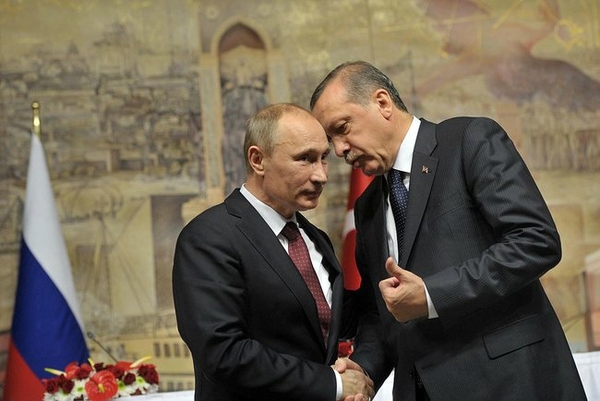
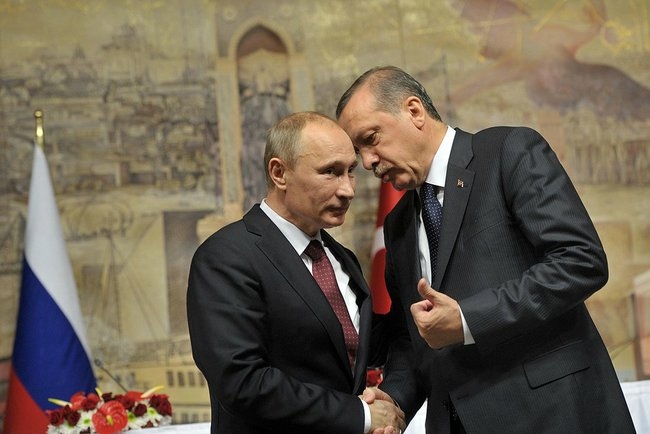
Turkish President Recep Tayyip Erdogan has said that he found it difficult to understand what Russia was doing in Syria, since “it does not even border Syria.” Pictured: Russian President Vladimir Putin (left) with then Prime Minister Erdogan, meeting in Istanbul on December 3, 2012. (Image source: kremlin.ru)

In the unrealistic imperial Turkish psyche, only Turkey and the countries that pursue regional ambitions convergent with Turkey’s can have any legitimate right to design or re-design the former Ottoman lands.

Such self-righteous and assertive thinking can hardly comply with international law. The Turks and their imperial ambitions have already been declared unwelcome in Libya, Tunisia, Egypt, Lebanon, Syria and Iraq. Nor would such ambitions be welcomed in any former Ottoman land to Turkey’s west. But if, as Turkey’s Islamists are programmed to believe, “historical and geographical bonds” give a foreign nation the right to design a polity in another nation, what better justification could the Russians have had for their post-imperial designs in Crimea?

When they have a moment of distraction from their wars against Western values, the West, Israel, Jews or infidels, the Sunni and Shiite Islamists in the Middle East fight subtle-looking (but less subtle than they think) and cunning (but less cunning than they think) wars and proxy wars, and accuse each other of pursuing sectarian policies. Turkey’s rulers are no exception.

Burak Bekdil, based in Ankara, is a Turkish columnist for the Hürriyet Daily and a Fellow at the Middle East Forum.

Russia: Rubber Ducks and Green Paint by Shoshana Bryen

  • How the United States responds to these protests abroad can determine not only the future of those protesting, but also the future of the governments that find themselves under pressure.

  • Russia seeks superpower status in the Middle East and Europe, but real superpower status has always required the ability to shoulder burdens abroad without fear of upheaval at home.
  • Ignoring the Green Movement in Iran was a missed opportunity for the West and a tragedy for the people of Iran. It is not America’s job to create or foment unrest in Russia or anywhere else. But it is in the interest of the West to support and hearten those who have the courage to take on a corrupt and aggressive government.

For all the hyperbole in Washington about Russian hacking, Russian disinformation, Russian influence, and Russian espionage, the really remarkable events in Russia over the weekend appear barely to have registered.

One hundred years after the assassination of the last Czar, and two-and-a-half decades after the fall of the communist regime, Russian people have taken to the streets.

In early March, anti-corruption activist Alexei Navalny posted a report on YouTube detailing the corruption of Prime Minister Dmitry Medvedev. After more than 13 million views in roughly three weeks, people, including a large number of teenagers, answered Navalny’s call for public protest. They flooded the streets of 95 Russian cities, as well as London, Prague, Basel, and Bonn. Many carried rubber ducks — or real ducks — referring to reports of a luxury duck farm on one of Medvedev’s properties.

Navalny is now in jail.
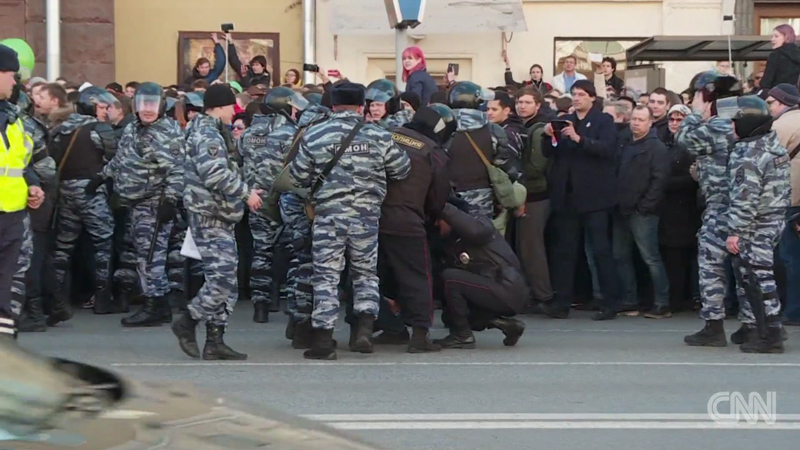
Police in Moscow arrest an anti-corruption protestor on March 26, 2017. (Image source: CNN video screenshot)

Depending on the source, 7,000-8,000 (Russia’s Interior Ministry) or 25,000-30,000 (Navalny’s Anti-Corruption Foundation) people turned out in Moscow, and hundreds — or thousands — were arrested. The Anti-Corruption Foundation claims there were more than 150,000 protesters across the country.

Navalny himself was doused with bright green dye by an opponent in an eerie parallel to the poisoning that disfigured the face of Ukrainian politician Victor Yushchenko. Navalny’s supporters, in solidarity, have taken to green face paint.

These courageous protests may call to mind the 2015 “Sunflower” movement in Taiwan or the “Umbrella” movement in Hong Kong. The former opposed Taiwanese trade with China, a plan that could have made the island dependent on the mainland for its economic future. The latter demanded the “full autonomy,” promised by Britain and agreed to by China, when the British departed in 1999. Both were notable for the number of students in the forefront. The protests also call to mind the Arab Spring demonstrations of 2011, grounded in the belief by Arab citizens that their governments were hopelessly corrupt; also Iran’s massive 2009 Green Movement protests, in which citizens believed the government had conducted a fraudulent election.

For the Trump administration, this moment is immensely important.

How the United States responds to these protests abroad can determine not only the future of those protesting, but also the future of the governments that find themselves under pressure.

Taiwan, a fully functioning democracy, saw a change of government in its latest election. Hong Kong’s change of government, however, was fully controlled by Beijing. The Arab Spring opened the way for power vacuums that allowed the rise of ISIS and al Qaeda. And Iran’s government smashed the nascent rebellion so thoroughly that no large-scale protest has been able to take place there since.

It has been said that Vladimir Putin personally has a high favorability ratings in Russia because he restored predictability and stability after the turbulent Gorbachev-through-Yeltsin period and because he is a nationalist. Corruption, however, is endemic — and Putin has been ruthless in wiping out politicians and journalists who poke too closely into it.

Putin critic and lawmaker Denis Voronenkov (2017), Boris Nemtsov (2015), human rights lawyer Stanislav Markelov (2009), journalists Anastasia Baburova (2009) Natalia Estemirova (2009), Anna Politkovskaya (2005) and Paul Klebnikov (2004), and politician Sergei Yushenkov (2003) were all shot. Boris Berezovsky (2013) died after falling out with Putin; the cause of his death has not yet been established. Alexander Litvinenko was poisoned in 2006. The lawyer Sergei Magnitsky (2009) died in police custody. Last week, his family’s lawyer, Nicolai Gorokhov, was said to have fallen out of a fourth floor window “while installing a hot tub.”

Vladimir Kara-Murza, leader of the Russian political opposition, directly accused the Kremlin of assassinating political enemies. Earlier this month, Kara-Murza was in a life-threatening coma with elevated levels of heavy metal in his blood; it was the second time he was poisoned. Partially recovered now and not in Russia, Kara-Murza called it retaliation for his work with American lawmakers on the Magnitsky Act, designed to prevent human rights abusers in Russia from keeping their wealth in Western countries.

Perhaps Navalny’s call to the public is grounded in the understanding that, one by one, brave people can be eliminated, but thousands at a time in the streets are harder to target. The outpouring of support by young people who have never known any government other than that of Putin or Medvedev is an indication of how deeply they understand.

The usual method of tamping down widespread unhappiness is with money. But the Russian economy has been in a recession for two years, in part due to the decline in oil prices, and its “rainy day” fund has declined from $91.7 billion in September 2014 to $32.2 billion two years later, according to the Russian Finance Ministry. Defense spending is slated to drop by 27% in the draft 2017 budget.

On the nationalist side, the Russian public historically does not like losing soldiers in foreign wars — think “Afghanistan.” Losses in Ukraine, never officially enumerated by the Russian government, were accepted grudgingly as part of the price for restoring Crimea. But casualties in Syria cannot be dealt with so easily. The number remains small — according official counts just over 100, including both soldiers and military contractors — but there seems to be widespread unease. More than a few (small) anti-war demonstrations have been seen in Moscow and St. Petersburg. The public is aware of the scale of Russian and Syrian bombing and the resulting casualties of a war that are not understood to be of importance in the homeland. They may be important to us — and to the Russian government, but the Russian people have never liked wars unrelated to Russian territory. That is probably why they could accept Stalingrad, but balked at Afghanistan.

Russia seeks superpower status in the Middle East and Europe, but real superpower status has always required the ability to shoulder burdens abroad without fear of upheaval at home. World War II is a clear example of American success, but when the domestic situation was turbulent in the late 1960s, the U.S. withdrew from Vietnam and spent decades restoring its international credibility. A shaky domestic situation in Russia may force Putin to consider spending more resources at home than abroad.

Ignoring the Green Movement in Iran was a missed opportunity for the West and a tragedy for the people of Iran. It is not America’s job to create or foment unrest in Russia or anywhere else. But it is in the interest of the West to support and hearten those who have the courage to take on a corrupt and aggressive government. President Trump can take a page from Ronald Reagan, who spoke out for the rights of the people, especially Soviet refuseniks, even as he worked to negotiate arms-control with Gorbachev.

If we ignore the rubber ducks and green paint, it will be at our peril.

Shoshana Bryen is Senior Director of the Jewish Policy Center.
Russia’s Trap: Luring Sunnis into War by Burak Bekdil

  • Washington should think more than twice about allowing Turkey and Saudi Arabia, its Sunni allies, militarily to engage their Shiite enemies in Syria. Allowing Sunni supremacists into a deeper sectarian war is not a rational way to block Russian expansion in the eastern Mediterranean. And it certainly will not serve America’s interests.

  • Turkey and Saudi Arabia are too weak militarily to damage Russia’s interests. It is a Russian trap — and precisely what the Russians are hoping their enemies will fall into.

After Russia’s increasingly bold military engagement in war-torn Syria in favor of President Bashar al-Assad and the Shiite bloc, the regional Sunni powers — Turkey and its ally, Saudi Arabia — have felt nervous and incapable of influencing the civil war in favor of the many Islamist groups fighting Assad’s forces.

Most recently, the Turks and Saudis, after weeks of negotiations, decided to flex their muscles and join forces to engage a higher-intensity war in the Syrian theater. This is dangerous for the West. It risks provoking further Russian and Iranian involvement in Syria, and sparking a NATO-Russia confrontation.

After Turkey, citing violation of its airspace, shot down a Russian Su-24 military jet on Nov. 24, Russia has used the incident as a pretext to reinforce its military deployments in Syria and bomb the “moderate Islamists.” Those are the Islamists who fight Assad’s forces and are supported by Turkey, Saudi Arabia and Qatar. The Russian move included installing the advanced S-400 long-range air and anti-missile defense systems.

Fearing that the new player in the game could vitally damage their plans to install a Sunni regime in Damascus, Turkey and Saudi Arabia now say they are ready to challenge the bloc consisting of Assad’s forces, Russia, and Shiite militants from Iran and Lebanon.

As always, Turkish Prime Minister Ahmet Davutoglu spoke in a way that forcefully reminded Turkey-watchers of the well-known phrase: Turkey’s bark is worse than its bite. “No one,” he said on Feb. 9, “should forget how the Soviet forces, which were a mighty, super force during the Cold War and entered Afghanistan, then left Afghanistan in a servile situation. Those who entered Syria today will also leave Syria in a servile way.” In other words, Davutoglu was telling the Russians: Get out of Syria; we are coming in. The Russians did not even reply. They just kept on bombing.

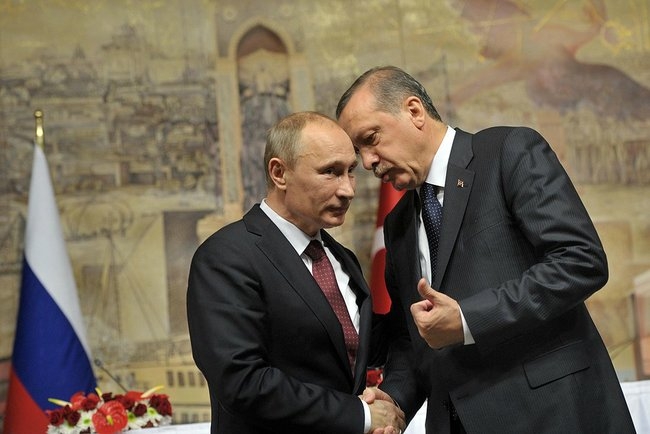
Will direct military involvement in Syria by Turkey and Saudi Arabia spark a NATO-Russia confrontation? Pictured: Russian President Vladimir Putin with Turkish President Recep Tayyip Erdogan (then prime minister), meeting in Istanbul on December 3, 2012. (Image source:kremlin.ru)

Turkey keeps threatening to increase its military role in Syria. Deputy Prime Minister Yalcin Akdogan pledged that Turkey will no longer be in a “defensive position” over maintaining its national security interests amid developments in Syria. “Can any team,” he said, “play defensively at all times but still win a match? … You can win nothing by playing defensively and you can lose whatever you have. There is a very dynamic situation in the region and one has to read this situation properly. One should end up withdrawn because of concerns and fears.”

Is NATO member Turkey going to war in order to fulfill its Sunni sectarian objectives? And are its Saudi allies joining in? If the Sunni allies are not bluffing, they are already giving signals of what may eventually turn into a new bloody chapter in the sectarian proxy war in Syria.

First, Saudi Arabia announced that it was sending fighter jets to the Incirlik air base in southern Turkey, where U.S. and other allied aircraft have been hitting Islamic State strongholds inside Syria. Saudi military officials said that their warplanes would intensify aerial operations in Syria.

Second, and more worryingly, Turkish Foreign Minister Mevlut Cavusoglu said that Turkey and Saudi Arabia could engage in ground operations inside Syria. He also said that the two countries had long been weighing a cross-border operation into Syria — with the pretext of fighting Islamic State, but in fact hoping to bolster the Sunni groups fighting against the Shiite bloc — but they have not yet made a decision.

In contrast, Saudi officials look more certain about a military intervention. A Saudi brigadier-general said that a joint Turkish-Saudi ground operation in Syria was being planned. He even said that Turkish and Saudi military experts would meet in the coming days to finalize “the details, the task force and the role to be played by each country.”

In Damascus, the Syrian regime said that any ground operation inside Syria’s sovereign borders would “amount to aggression that must be resisted.”

It should be alarming for the West if Turkey and Saudi Arabia, two important U.S. allies, have decided to fight a strange cocktail of enemies on Syrian territory, including Syrian forces, radical jihadists, various Shiite forces and, most critically, Russia — all in order to support “moderate” Islamists. That may be the opening of a worse disaster in Syria, possibly spanning over the next 10 to 15 years.

The new Sunni adventurism will likely force Iran to augment its military engagement in Syria. It will create new tensions between Turkey-Saudi Arabia and Iraq’s Shiite-dominated government. It may also spread and destabilize other Middle Eastern theaters, where the Sunni bloc, consisting of Turkey, Saudi Arabia and Qatar, may have to engage in new proxy wars with the Shiite bloc plus Russia.

Washington should think more than twice about allowing its Sunni allies militarily to engage their Shiite enemies. This may be a war with no winners but plenty of casualties and collateral damage. Allowing Sunni supremacists into a deeper sectarian war is not a rational way to block Russian expansion in the eastern Mediterranean. And it certainly will not serve America’s interests.

Turkey with Saudi Arabia are too weak militarily to damage Russia’s interests. It is a Russian trap — and precisely what the Russians are hoping their enemies will fall into.

Burak Bekdil, based in Ankara, is a Turkish columnist for the Hürriyet Daily and a Fellow at the Middle East Forum.

Russia’s Failed Adventure in Syria by Con Coughlin

  • Then there is the question of just how long Russia can afford to sustain its expensive military adventure in Syria. The Russian economy already has enough difficulties without having to bear the cost of Mr Putin’s latest act of military aggression.


Russian President Vladimir Putin may well come to regret agreeing to Iran’s request for Moscow to intervene militarily in Syria’s brutal civil war.

The shooting down of a Russian warplane over the Syrian border by Turkey has graphically illustrated the risks Moscow faces after the Kremlin agreed to intervene on behalf of Syria’s beleaguered President Bashar al-Assad.

Mr Putin took his fateful decision to launch military action in Syria after meeting Major-General Qassem Soleimani, the head of Iran’s notorious Quds Force, in Moscow last August. Visiting Moscow shortly after the conclusion of June’s deal on the future of Iran’s nuclear programme (JCPOA), Soleimani delivered a blunt warning to the Russian leader that the Assad regime, Russia’s long-standing strategic ally in the Middle East, faced defeat without outside support.

Major-General Soleimani’s intervention was sufficient to persuade Mr Putin to enter the Syria fray, and within weeks Russian SU-24 Sukhoi bombers were regularly attacking the positions of opposition fighters, while forces from Iran’s Islamic Revolutionary Guard Corps (IRGC) have been brought in as reinforcements to bolster the ranks of pro-Assad Syrian Army forces and their Lebanese Hizbollah allies.

Yet, even before last week’s shooting down of a Russian SU-24 bomber by a Turkish F-16 fighter, there were clear signs that the new joint Russian-Iranian offensive is struggling to make headway against the Syrian rebels.

The first sign that Russia’s military intervention was not going according to plan came in October, when a Russian-backed plan to recapture the strategically important northern Syrian city of Hama was halted by stiff rebel resistance. Western intelligence sources say one decisive factor was the delivery to the rebels of 500 U.S.-made TOW anti-tank missiles, believed to have been provided by the Saudis.

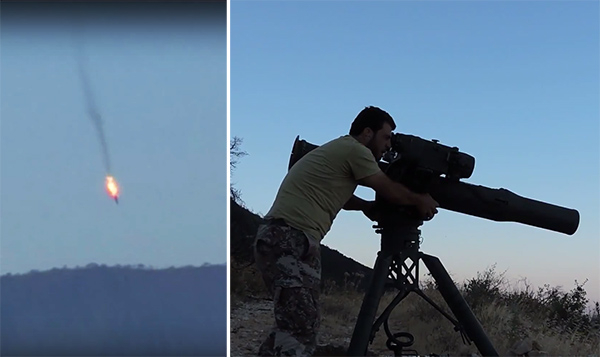
In what has since become known locally as the “massacre of the tanks”, nearly 20 tanks and armoured personnel carriers fielded by the Assad regime were knocked out of action by the highly accurate TOW missiles.

Left: A Russian SU-24 bomber crashing after being shot down by a Turkish F-16 fighter on Nov. 24. Right: A Syrian rebel fighter prepares to fire a TOW missile at an Assad regime tank.

The fierce resistance put up by anti-government forces, which also claimed the lives of several senior Iranian Revolutionary Guard officers, dealt a serious blow to the morale of regime loyalists. It also resulted in a significant change of tactics on the part of the Russians who, aware of the limitations of the regime’s ground forces, have increased their reliance on air power to achieve their objective of defeating the rebels.

But while the Russians insist that their main attacks in Syria are being directed against fighters associated with the so-called Islamic State (ISIS), the reality is that they are bombing a large variety of anti-Assad forces – including those backed by the U.S.-led military coalition. One of the explanations given for the Turks shooting down a Russian SU-24 jet was that it had been bombing rebel groups backed by Turkey rather than ISIS, as the Russians later claimed.

The lack of progress made in Syria since Mr Putin first authorized Russian military involvement could soon have serious repercussions for the Kremlin.

Public support for the mission in Russia is starting to wane, after Investigators suggested the bombing of a Russian passenger jet over Egypt’s Sinai Peninsula at the end of October, killing all 224 on board, was carried out by ISIS terrorists in retaliation for Moscow’s military campaign.

Many Russians are also wary of the country becoming embroiled in another long, drawn-out military entanglement, as happened in Afghanistan in the 1980s and ultimately ended with the Soviet Union suffering an ignominious defeat.

And then there is the question of just how long Russia can afford to sustain its expensive military adventure in Syria. The Russian economy already has enough difficulties without having to bear the cost of Mr Putin’s latest act of military aggression. Moscow’s invasion of Afghanistan in the 1980s ultimately bankrupted the Soviet Union: the Syrian conflict could have a similarly catastrophic effect on modern Russia.

Russia Devouring the Eastern Mediterranean? by Burak Bekdil

  • Turkey shot down a Russian jet. No gain, but plenty of damage to its economy. Russia gave up one jet to Turkey and has made its military presence in Syria and the strategic eastern Mediterranean permanent.


  • Turkey can no longer speak to Russia about the possibility of ousting Assad.

  • Putin seems to be making sure that NATO will do nothing.

At this year’s G-20 summit in Antalya, Turkey, Russian President, Vladimir Putin, said that the radical jihadist Islamic State (IS) was being financed by donors from at least 40 countries, including some G-20 member states — clearly pointing his finger, without naming names, at Saudi Arabia and Turkey. A few days later, two Turkish F-16 jets shot down a Russian SU-24 warplane, and claimed that the Russian jet had violated Turkish airspace for 17 seconds on the country’s Syrian border — a violation Russia denies. This was the first time a Soviet or Russian military aircraft was shot down by a NATO air force since the end of WWII.

Turkey and Russia have long been in a proxy war in Syria: Russia, together with its quieter partner, China, supports the Shi’ite Iran-backed Syrian regime of President Bashar al-Assad; and Turkey explicitly supports Assad’s Sunni opponents [“moderate” jihadists] — apparently in the hope of building a Muslim Brotherhood/Hamas-type of regime in Damascus that would be friendly to its own Islamist government. After the downing of the Russian jet, the Turco-Russian proxy war has become less proxy.

No more Mr. Nice Guy.
Russian President Vladimir Putin twice refused to meet with Turkish President Recep Tayyip Erdogan on the sidelines of the Paris Climate Summit this week. Pictured: President Putin with then Prime Minister Erdogan, meeting in Istanbul on December 3, 2012. (Image source:kremlin.ru)

An angry Putin called the incident “a stab in the back.” He declined Turkish President Recep Tayyip Erdogan’s requests to discuss the issue. He twice refused to meet Erdogan on the sidelines of the Paris Climate Summit.

Russia’s foreign minister, Sergei Lavrov, quickly cancelled his official visit to Turkey — a visit that had been scheduled for the day after the downing of the Russian jet. At the outset, NATO member Turkey had taught Russia a good lesson. In reality, judging from the consequences, it all looks like a Russian gambit, with Turkey shooting itself in the foot and risking a new NATO-Russia conflict.

Russia’s ire seemingly is being expressed in economic terms:

  • Moscow said it will introduce visa restrictions for Turkish citizens, beginning Jan. 1, 2016.
  • Russian authorities detained a group of Turkish businessmen on charges of “false statements about their trip to the country.”
  • Press reports noted that Russia was considering limiting or excluding Turkish construction companies from the country, a potentially multi-billion dollar loss for the Turkish economy.
  • Moscow warned its citizens against visiting Turkey — a ban that could deal a big blow to Turkey’s lucrative tourism industry. Last year 4.5 million Russians visited Turkey, mostly its Mediterranean coast. Russian tour operators were warned to suspend business with Turkey.
  • The fate of two huge Turco-Russian energy projects remains unknown, as Russia’s energy minister, Alexei Ulyukayev, did not rule out sanctions hitting the Turkish Stream gas pipeline and a planned Russian nuclear energy plant in Turkey. Turkey buys about 55% of its natural gas from Russia. Its second largest gas supplier is Iran, Russia’s ally — and Turkey’s rival — in Syria.
  • Russia’s Minister of Agriculture, Alexander Tkachev, said that Russia would be replacing Turkish food imports with goods from Iran, Israel and Morocco.
  • Shipments of wheat to Turkey from key Russian ports were put on hold.
  • The Kremlin officially announced a wide range of sanctions on Turkey, including a ban on Turkish workers (with estimates that 90,000 will be fired by Jan. 1, 2016), restrictions on imported goods and services from Turkey and calls for “strengthening of port control and monitoring to ensure transport safety.”
  • Around 1,250 trucks carrying Turkish exports were blocked from entering Russia on Nov. 30 and were stranded at border posts, awaiting clearance.
  • Russian soccer clubs will be banned from signing Turkish players during the upcoming winter break.

All of that is commercially punitive. There is a more serious side of the Turco-Russian conflict that concerns NATO and western interests in the Middle East.

Russian Defense Minister Sergei Shoigu announced on Nov. 25 that Russia would deploy S-400 surface-to-air missile systems in its Hmeymim air base in Syria.

Turkey shot down a Russian jet. No gain, but plenty of damage to its economy. Russia gave up one jet and has made its military presence in Syria and the strategic eastern Mediterranean permanent. It has reinforced its bases in Syria and intends to build a new military base there. Turkey can no longer speak to Russia about the possibility of ousting Assad.

In a further move to escalate tensions, the Russian General Staff deployed one of its largest air defense ships at the edge of Turkish territorial waters in the Mediterranean. Russian military spokesman General Sergei Rudskoi said that Russian bomber aircraft would be “supported by chasers, and any kinds of threats will be responded to instantly.” Accordingly, The Moscow, one of the Russian Navy’s two largest warships and the flagship of Russia’s Black Sea Fleet, will be deployed where Turkey-Syria territorial waters connect.

In addition, Putin issued orders to deploy nearly 7,000 troops, plus anti-aircraft missiles, rocket launchers, and artillery to the Turkish border, and asked them to be in readiness for full combat.

There have been other military repercussions, too. Since the shooting down of the Russian jet, the Russian military has been regularly pounding the Syrian villages near the Turkish border that populated by the Turkmen, a Turkish ethnicity that supports jihadists in Syria — and is supported by Ankara. The Russians also have been hitting Turkish aid convoys bound for Turkmen villages. More than 500 Turks and Turkmen have been killed in Russian airstrikes. Meanwhile, the U.S.-led allied air strikes against IS have come to a halt. Neither Washington nor Ankara is keen for another conflict with Russia. So, IS and Russia keep on flourishing.

The Russian military has scrapped all contacts with the Turkish military, possibly waiting for the first Turkish military aircraft that violates foreign airspace to shoot.

Turkey has every liberty to challenge Russia and, inevitably, become the victim. But with its geostrategic, Islamist ambitions, it is exposing NATO allies to the risk of a fresh conflict with Russia — and at a time when the wounds of previous conflicts remain unhealed.

Putin has accused Turkey’s leaders of encouraging the Islamization of the Turkish society, which he said was a “problem.” He was not wrong. In fact, Islamism and neo-Ottoman ambitions are the source of Turkey’s (not-so) proxy war with Russia in the Syrian theater. Although Turkey, officially, is a NATO member and part of the allied campaign against IS, its Sunni Islamist ambitions over Syria hinder the global fight against jihadists. A Turco-Russian conflict is weakening the fight.

Putin seems to be making sure that NATO will do nothing.

Burak Bekdil, based in Ankara, is a Turkish columnist for the Hürriyet Daily and a Fellow at the Middle East Forum.

Translate »
Skip to toolbar