Monthly Archives: June 2017

Turkey: Payback Time? by Burak Bekdil August 30, 2015 at 4:00 am

  • It came as no surprise that the Islamic State recently threatened to “conquer Istanbul.”

  • The AKP, preparing for snap elections on Nov. 1 — only five months after parliamentary elections were held on June 7 — must now fight two asymmetrical wars against radical Islamists and Kurdish separatists at the same time and in three theaters of war: Iraq, Syria and Turkey. It is also calculating the damage the renewed wave of violence could inflict on its popularity in the elections.


The Kurdish militants and the jihadists from the Islamic State of Iraq and Syria (Islamic State, or IS), which have been battling each other in northern Syria for the past several months, now have a common enemy: Turkey.

After several months of reluctance, Turkey has just joined a U.S.-led, international coalition fighting IS. Turkey agreed to allow the U.S. military to use Turkish air bases for airstrikes against IS strongholds in Syria. Turkey said on August 24 that it would, together with the U.S., soon launch comprehensive air strikes against IS targets. “The technical talks have been concluded, yesterday, and soon we will start this operation, comprehensive operations, against Daesh [IS],” Turkish Foreign Minister Mevlut Cavusoglu said. One might say, “too little, too late.”

Instead of covertly supporting IS, Turkey should long ago have done everything in its military capacity to crush IS before it grew too strong and captured large swaths of lands in Syria and Iraq, both of which neighbor Turkey.

Turkey’s half-hearted and belated decision to join the coalition forces targeting IS may bring in some military value added to the campaign. But it also exposes Turkey to IS attacks from inside the country.

A survey last year found that slightly over 11% of Turks did not view the Islamic State as a terrorist organization. That means there are over eight million Turks who somehow sympathize with the group. Eight million versus just 126: The Turkish Justice Ministry revealed that there were only 126 people in Turkish prisons on charges of being a member of IS. Hence the unnerving threat of IS attacks on Turkish cities, most probably by the group’s “sleeper cells” inside Turkey. It came as no surprise that IS recently threatened to “conquer Istanbul.”

IS has released a 7-minute video clip in Turkish, filmed in Raqqa, the capital of its “Caliphate.” Soon, an unidentified Turkish jihadist said, Istanbul would be “conquered” by the armies of the “Caliph”:

“Soon, Turkey’s east will be dominated by the atheist PKK [Kurdish militants], and the West will be dominated by the Crusaders. They will kill children, rape women, and enslave you. O people of Turkey; before [it is] too late, you should rise up and fight against these atheists, these Crusaders and these traitors. You should also repent. You should condemn democracy, secularism, human-made laws, tomb-worshipping and other devils.”

Columnist Mustafa Akyol wrote: “And if we don’t do this, we are in trouble. We should ‘wait for humiliation on Earth, before punishment in the afterlife.’ And ISIL is eager to bring that earthly ‘humiliation’ in the name of God.”

For the moment, IS is a hypothetical threat. If its militants decide to detonate bombs in Turkish cities, it will become real. Meanwhile, Turkey is fighting a more real threat, another asymmetrical war. Since the Kurdish militants that come under various flags like the PKK, YPG or KCK, on July 11 ended a ceasefire they had declared in March 2013, more than 50 members of Turkey’s security forces have been killed, mostly in IED (improvised explosive device) attacks across Turkey’s predominantly Kurdish southeast. In retaliation, Turkey claims its air strikes against PKK strongholds in northern Iraq have killed more than 700 militants.

The PKK’s attacks recently have become a major embarrassment for President Recep Tayyip Erdogan and the ruling Justice and Development Party (AKP) that he founded in 2001. Mourners often protest the presence of government officials at the funerals of soldiers.

One such funeral ceremony was held last weekend. Army Captain Ali Alkan was killed after PKK militants attacked a military outpost in southeastern Sırnak province, on Aug. 21.

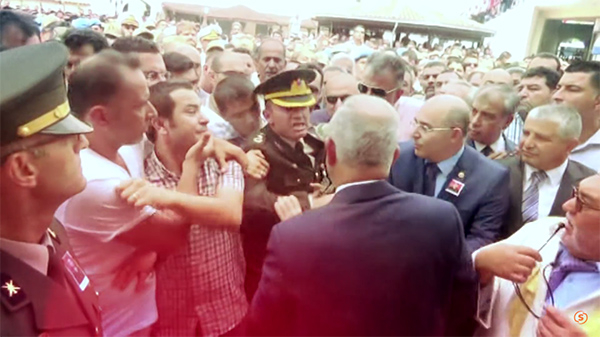
More than 15,000 people participated in the service in Alkan’s hometown, Osmaniye in southern Turkey. Tensions ran high when politicians from the AKP attempted to take a place in the front row during the prayer service. An infuriated mourner shouted at two AKP members of parliament: “You have nothing to do here. Get out.” Protests grew louder and the crowd began to boo the local religious leader, who conducted the ceremony, for making a place for AKP deputies. Such scenes occur almost daily across Turkey.

Mourners, politicians and military officers verbally clash at the funeral of army Captain Ali Alkan in Osmaniye, Turkey, on August 21.

The AKP, preparing for snap elections on Nov. 1 — only five months after parliamentary elections were held on June 7 — must now fight two asymmetrical wars against radical Islamists and Kurdish separatists at the same time and in three theaters of war: Iraq, Syria and Turkey. It is also calculating the damage the renewed wave of violence could inflict on its popularity in the elections.

Erdogan and his AKP are fast becoming the victims of their own ambitious, sectarian, Islamist and badly-calculated regional policies, including toward the country’s own Kurds. It looks like payback time.

Burak Bekdil, based in Ankara, is a Turkish columnist for the Hürriyet Daily and a Fellow at the Middle East Forum.

Turkey: Marry Your Rapist by Burak Bekdil

  • The head of a department of the Supreme Court of Appeals has revealed that nearly 3,000 marriages were registered between the victims of sexual abuse, including rape, and their assailants. The judge mentioned a particular case in which three men kidnapped and raped a girl, then one of them married her and the sentences for all three were lifted.

  • Instead of passing legislation to amend grotesque articles in the penal code, Erdogan keeps doing “family engineering” in line with his Islamist thinking. Most recently Erdogan told a women’s association that “family planning and contraception were not for Muslim families.”
  • Turkey’s First Lady, Emine Erdogan, shocked many people when she said that the Ottoman-era harems were “educational centers that prepared women for life.”

There have been several dramatic aspects of Turkey’s creeping Islamization over the past 15 years. Anti-Semitism, xenophobia, an eroding secular social life and majoritarianism (that the majority in a society is entitled to primacy) are not all. The Islamization of Turkish society has also made life more difficult for women.

In 2015, Turkey ranked 130th in gender equality among a group of 145 countries. But that was hardly surprising. Only a year earlier, President Recep Tayyip Erdogan had objected to equality between men and women. “Women’s equality with men is against nature,” he said.

All this is in contrast to the secular principles Erdogan has long fought to undo. Turkish women won suffrage as early as 1934, 25 years before Swiss women won the same right. Now, 82 years after winning the right to vote, Turkish women had to hear their president, Erdogan, offering them “Turkish-style” women’s rights. “We don’t necessarily have to express, defend and implement women’s rights in the format and style that exists in the West,” Erdogan commented.

Erdogan is not alone in thinking that a woman’s best role should be as a mother. His wife, Turkey’s First Lady, Emine Erdogan, shocked many people when she said that the Ottoman-era harems were “educational centers that prepared women for life.”

That being the mindset of Turkey’s most powerful man, life for modern Turkish women, especially those who dissent about anything, would become harder.

In May a Turkish court sentenced a journalist, Ms. Arzu Yildiz, to 20 months in jail for showing video footage of arms shipments in trucks apparently operated by Turkish intelligence and carrying a cargo of weapons bound for various Islamist groups in Syria. Erdogan has been particularly sensitive about the film and claimed that searching the trucks and some of the media coverage of it were part of a plot by his political enemies to undermine him and embarrass Turkey.

The case against the journalist, Yildiz, however, marked a legal peculiarity in addition to her sentence. In May, Yildiz was sentenced to 20 months in prison and deprived of parental rights over her children for exposing the proceedings of the trial.

President Erdogan has insisted that the vehicles were carrying humanitarian aid and accused the prosecutors of “treason and espionage,” as well as of being agents of his US-based nemesis Fethullah Gulen.

The prosecutors were arrested and put on trial in a closed court session, before being sentenced to prison terms. Yildiz obtained video of the proceedings, however, and posted the prosecutors’ testimonies, which contradicted the government’s claims, on YouTube.

“Nobody can take my children away from me… not even the Sultan himself, let alone the court,” Yildiz told Can Erzincan TV.

The court also stripped Yildiz of legal rights over her children for breaching the confidentiality of the court case. The ruling said the journalist would be deprived of legal guardianship of her children, invoking an article in Turkey’s penal code. The decision meant she would not be able to register her children in school, open bank accounts for them or take them abroad alone, and could only do so in conjunction with their father.
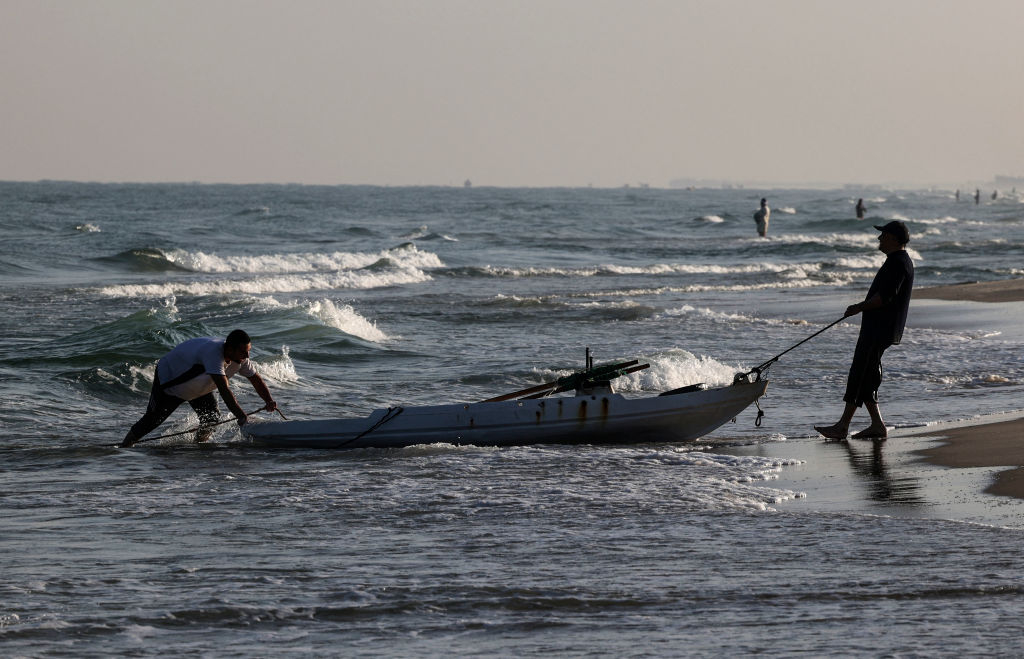
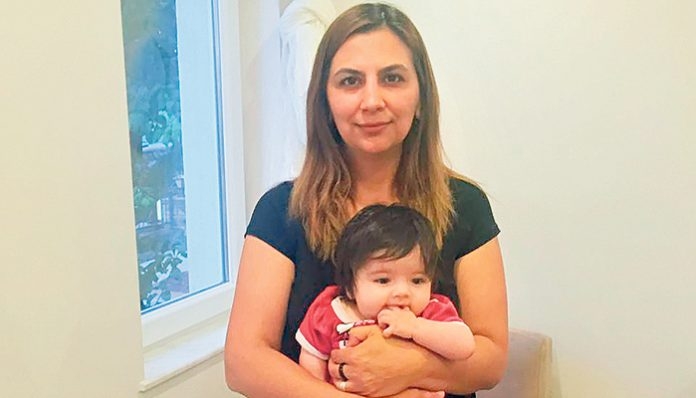
A Turkish court sentenced journalist Arzu Yildiz to 20 months in jail for publishing a video that showed Turkish intelligence agents shipping weapons to Islamist groups in Syria. The court also stripped Yildiz of legal guardianship over her own children, for breaching the confidentiality of the court case.

But — even according to official narrative — women may face worse tragedies in Erdogan’s Turkey. The head of a department of the Supreme Court of Appeals has revealed that nearly 3,000 marriages were registered between the victims of sexual abuse, including rape, and their assailants. Speaking to a parliamentary commission, the senior judge testified that children between the ages of five and 18 could be subjected to sexual abuse in the country, and that girls between the ages of 12 and 15 were more easily tricked by abusers. The judge mentioned a particular case in which three men kidnapped and raped a girl, then one of them married her and the sentences for all three were lifted. Marriage proposals, Turkish style.

Instead of passing legislation to amend grotesque sections of the penal code, Erdogan keeps doing “family engineering” in line with his Islamist thinking. Most recently, Erdogan told a women’s association that childless women were “deficient, incomplete.” He said that “rejecting motherhood was giving up on humanity” and that “family planning and contraception were not for Muslim families.”

Mustafa Kemal Ataturk, the founder of modern Turkey, struggled hard to grant Turkish women what their Western peers enjoyed in more civilized parts of the world. Erdogan is now busy undoing the legacy of Ataturk, which had once produced proud, Western-thinking Turkish women.

Burak Bekdil, based in Ankara, is a Turkish columnist for the Hürriyet Daily and a Fellow at the Middle East Forum.

Turkey: Lies, Cheap Lies and Cheaper Lies by Burak Bekdil

  • In President Recep Tayyip Erdogan’s view, Belarus is decent and peaceful, but Western Europe is not. Merely because Belarus’s dictator, Alexander Lukashenko, agreed to open a mosque to lure some Turkish investment.Back in Turkey, things look very Belarusian — even worse — rather than Western European, a culture Erdogan despises.

  • President Erdogan’s crackdown on dissent goes at full speed. Asli Erdogan, a peace activist and novelist, worked for Ozgur Gundem, a pro-Kurdish newspaper. She has remained in prison since her August arrest. The prosecutors demand an aggravated life sentence plus 17.5 years in jail for her. How did Asli Erdogan, the novelist, “support terror”? This is from the indictment: “… in an understanding of a novelist [the accused] portrayed terrorists as citizens in her columns.”
  • “In the history of the program, there has never been such an extraordinary situation where I think we can say that a democracy is threatening to turn itself into a dictatorship.” — Frank Schwabe, German Social Democratic lawmaker and human rights expert.
  • Europe’s unpleasant game with Turkey should end at once, with Brussels and Ankara admitting that the planned marriage was an awfully bad idea from the beginning.

Reading his public speeches, one may think that Turkish President Recep Tayyip Erdogan must be joking; that he is a celebrity stand-up comedian, the best in his profession. In reality, he is not joking. He believes in what he says. And he does not want to make people laugh. He is just an Islamist strongman.

Visiting Minsk, the capital of Belarus, in the first week of November for the opening of a mosque in a dictatorial country where there are 100,000 Muslims, Erdogan accused Western Europe for “intolerance that spreads like the plague.”

Erdogan described Belarus, which Western countries describe as a dictatorship, as “a country in which people with different roots live in peace.” In Erdogan’s view Belarus is decent and peaceful, but Western Europe is not. Merely because Belarus’s dictator, Alexander Lukashenko, agreed to open a mosque to lure some Turkish investment.

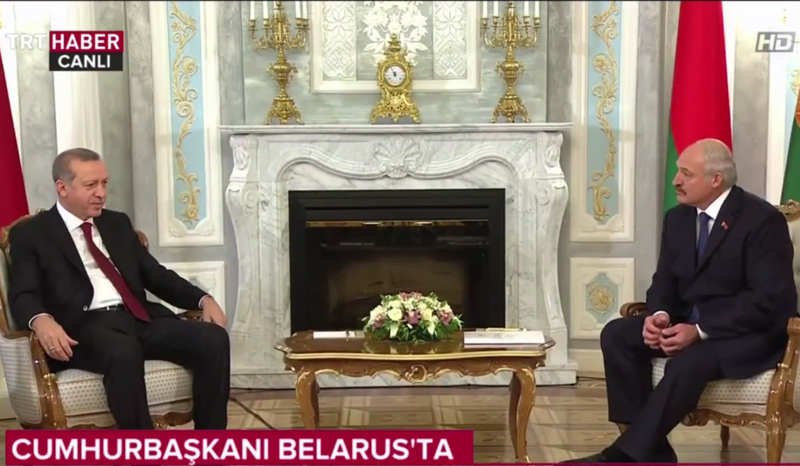
Turkish President Recep Tayyip Erdogan meets with Belarus President Alexander Lukashenko in Minsk on November 11, 2016. (Image source: TRT Haber video screenshot)

Back in Turkey, things look very Belarusian — even worse — rather than Western European, a culture Erdogan despises.

In August, an Istanbul court ordered Asli Erdogan, a prominent author and journalist, arrested on charges of membership in an armed terror organization. Asli Erdogan, a peace activist and novelist, worked for Ozgur Gundem, a pro-Kurdish newspaper. She has remained in prison since her arrest. The prosecutors demand an aggravated life sentence plus 17.5 years in jail for her.

How did Asli Erdogan the novelist “support terror”? This is from the indictment: “… in an understanding of a novelist [the accused] portrayed terrorists as citizens in her columns.” The prosecutor’s “evidence” is four columns by Asli Erdogan. Mehmet Yilmaz, a columnist, suggested that Turkish law faculties, after this indictment, should be closed down and converted into imam schools.

President Recep Tayyip Erdogan’s crackdown on dissent goes at full speed. An opposition, pro-Kurdish party, the Peoples’ Democratic Party, announced that it would suspend its legislative activity after a dozen of its lawmakers, including its co-chairpersons, were arrested on terror charges. Meanwhile Erdogan accuses Europe of abetting terrorism by supporting Kurdish militants as the Turkish government tries to suppress them. He said: “Europe, as a whole, is abetting terrorism.”

German lawmakers, including leading representatives of the Social Democrats, the Greens and the Left Party, announced an initiative to “adopt” their Turkish colleagues after Erdogan’s government rescinded the legal immunity of 53 of 59 Kurdish members of parliament and arrested dozens of lawmakers, party employees and journalists.

“In the history of the program, there has never been such an extraordinary situation where I think we can say that a democracy is threatening to turn itself into a dictatorship,” said German Social Democratic lawmaker and human rights expert Frank Schwabe. “We have a lot of Turkish opposition parliamentarians under threat, so we had to apply the parliamentary sponsorship program in an extraordinary way.”

In another speech, Erdogan said that Turkey was ready to abandon its EU candidacy if “Europe told us they do not want us.” He said he would put EU membership to referendum. It may look amusing if an applicant threatens to withdraw his application to a club he knows and declares he does not belong to. But the incompatibility between the democratic cultures of Western Europe and Turkey are now too visible to ignore or tone down in diplomatic language.

There are signs, albeit weak, in Europe that Islamist Turkey does not belong to the Old Continent. Austria’s defense minister, Hans Peter Doskozil, told the German daily, Bild, that “Turkey is on its way to becoming a dictatorship.” Past perfect tense instead of present may have described Turkey’s case better, but there is a European “awakening” on Turkish affairs.

Austria’s foreign minister, Sebastian Kurz, said: “Over recent years Turkey has moved farther and farther away from the EU, but our policy has remained the same. That can’t work. What we need are clear consequences.” He is right: “That” cannot work.

A tiny EU state was bolder in calling a cat a cat. Speaking of Erdogan’s increasingly savage crackdown on dissidents, particularly after the failed coup of July 15, Luxembourg’s foreign minister, Jean Asselborn, said: “These are methods, one must say this bluntly, that were used during Nazi rule … And there has been a really, really bad evolution in Turkey since July that we as the European Union cannot simply accept.”

Europe’s unpleasant game of pretension with Turkey should end at once, with Brussels and Ankara admitting that the planned marriage was an awfully bad idea from the beginning; that Turkey does not belong to Europe, as its leader proudly says, and that there are better formats to frame diplomatic relationships than lies, cheap lies and cheaper lies. Let Turkey go on its voyage to become another peaceful Belarus.

Burak Bekdil, based in Ankara, is a Turkish columnist for the Hürriyet Daily and a Fellow at the Middle East Forum.
Turkey: Land of Mosques, Prisons and the Uneducated by Burak Bekdil

  • “[I]n spite of dire predictions by secularists, the [ruling] AKP did not introduce conspicuous efforts to Islamize Turkey. But since 2011, this has changed.” — Svante E. Cornell, in “The Islamization of Turkey: Erdogan’s Education Reforms.”

  • In 2014, Turkey’s government introduced a scheme which forcibly enrolled about 40,000 students at Islamic “imam schools,” and granted permission for girls as young as 10 to wear Islamic headscarves in class.
  • A new study by the Organization for Economic Co-operation and Development found that 43% of Turkish women aged between 15 and 29 were neither working nor receiving education.

One way the rise of Islamist authoritarianism in a country can be seen is by the rise in the number of mosques, religious schools and prisons — coupled with a sharp decline in the quality of education. Turkey is no exception.

Most recently, the Turkish government said that it would build 174 new prisons, increasing capacity by 100,000 convicts. This is Turkey’s reply to complaints that six convicts must share a cell built for three. Convicts say they must sleep in turns in their bunk beds.

Before that, Turkey’s government released nearly 40,000 convicted criminals, in order to make space for tens of thousands of suspects, including journalists, businessmen and academics, detained after the failed coup of July 15.

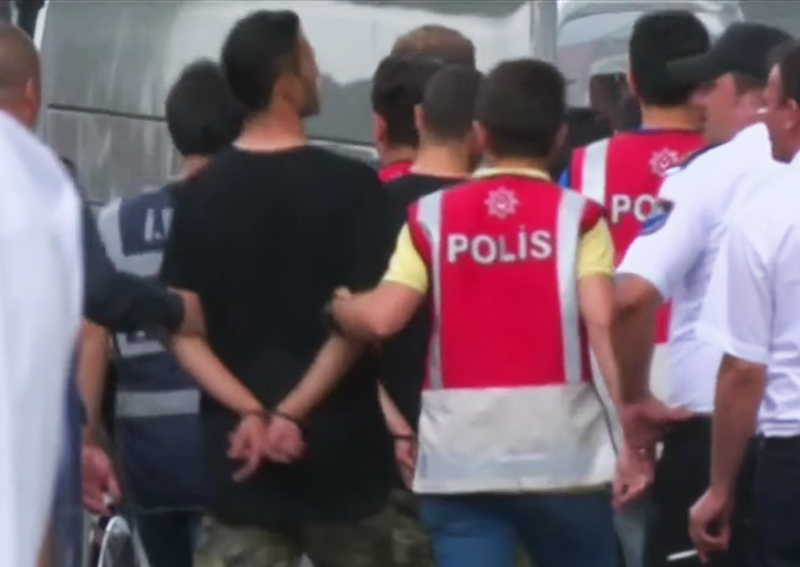
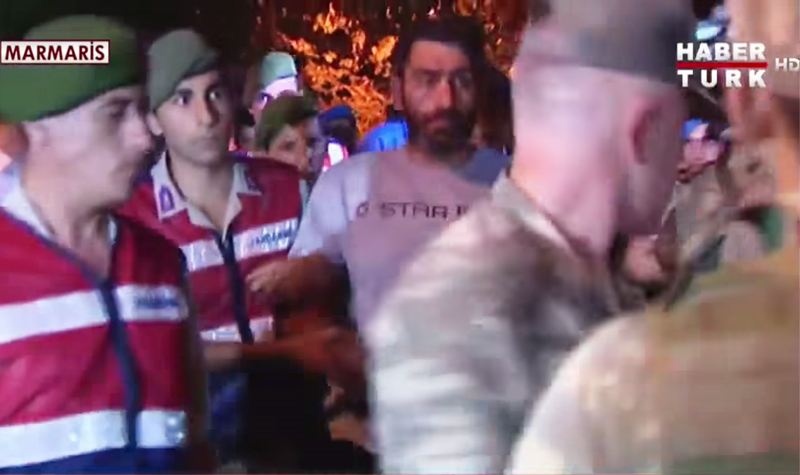
Turkish police and soldiers transport handcuffed military officers, who are accused of participating in the failed July 15 coup d’état. (Image source: Haber Turk video screenshot)

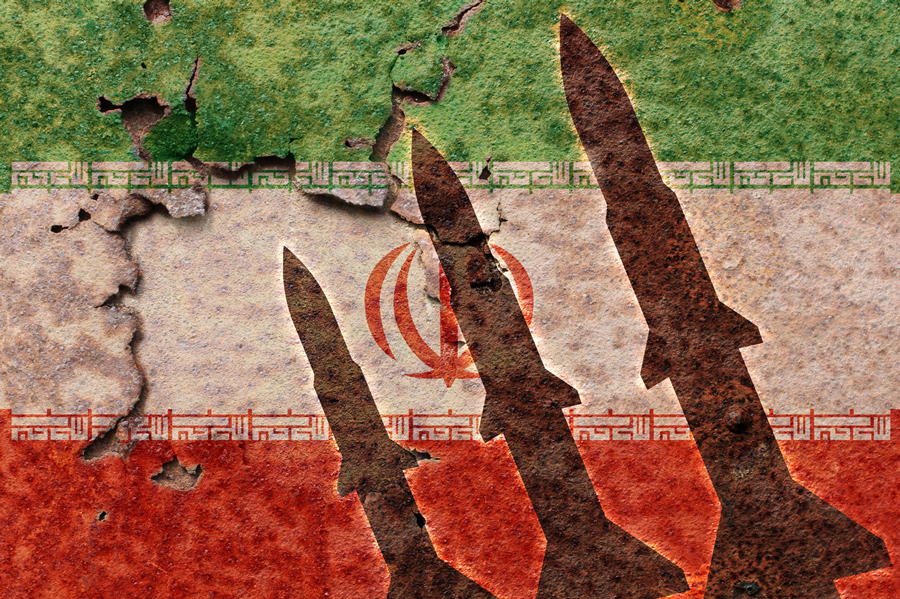
The other type of trendy building in Turkey is the mosque. Turkey’s state-funded Directorate for Religious Affairs (Diyanet) has proudly announced that nearly 9,000 new mosques were built across the country between 2005 and 2015. The number of mosques in Turkey is estimated at around 90,000, or one mosque per 866 people. Iran, with a similar population to Turkey’s [nearly 78 million] boasts just 48,000 mosques. In other words, Turkey has twice as many mosques as the Islamic Republic of Iran, for roughly the same population. Egypt, which has a population — nearly 90 million — bigger than Turkey’s, has 67,000 mosques.

Turkey’s president, Recep Tayyip Erdogan, has not only been building mosques and prisons to further Islamize the country. He has also passionately been building religious schools [from which he once graduated]. He boasts that during his term as prime minister and president (since November 2002), the number of students enrolled at religious schools, officially called “imam schools,” has risen from 60,000 to more than 1.2 million — a 20-fold increase. In his study, “The Islamization of Turkey: Erdogan’s Education Reforms,” Svante E. Cornell wrote that:

“The growing efforts at Islamization of Turkish society have largely gone unnoticed. For many years, Islamization was the dog that did not bark: in spite of dire predictions by secularists, the [ruling] AKP did not introduce conspicuous efforts to Islamize Turkey. But since 2011, this has changed. The main exhibit is the education sector, which President Recep Tayyip Erdoğan has remodeled to instill considerably more Islamic content, in line with his stated purpose to raise “pious generations”. Ultimately, the Islamic overhaul of the education system is bound to have implications for Turkey’s civilizational identity, and on the choices it will make on where it belongs politically.”

In 2012, Erdogan’s government introduced a contentious 12-year compulsory education system, paving the way for religious middle schools. In 2014, it introduced a scheme which forcibly enrolled about 40,000 students at imam schools. In some districts, imam schools were suddenly the only option for parents who could not afford private schooling. Also in 2014, the government granted permission for girls as young as 10 to wear Islamic headscarves in class.

So, where does Turkey’s increasingly Islamist education stand after all those efforts? According to a report released this month by the Organization for Economic Co-operation and Development (OECD), Turkey is one of the countries with the lowest spending per student. Turkey’s public spending for primary and secondary school education, and its spending per university student, were all below the OECD average. The OECD study also found that 43% of Turkish women aged between 15 and 29 were neither working nor receiving education. The OECD average for that group is 17%.

But it is not just about the quantitative findings; qualitative findings also point to an alarming education deficit in Turkey. In 2016, more than two million Turkish high school graduates took the annual national test to enroll at a post-secondary institution. According to the nationwide test results, the students scored an average 4.6 out of 40 questions in mathematics; 7.8 in science and 10.7 in humanities. Ironically, the test results show that the Turkish students do not even have adequate skills in their own language. The average score in Turkish was 19.1 out of 40.

This is the inevitable outcome of systematic Islamization of society in general, and of education in particular, over the past 14 years. The next 14 years will doubtless be far bleaker.

Burak Bekdil, based in Ankara, is a Turkish columnist for the Hürriyet Daily and a Fellow at the Middle East Forum

Turkey: Good News, Bad News by Burak Bekdil

  • Turkish prosecutors are investigating people who allege on social media that the coup attempt was in fact a hoax.
  • In a massive purge, the government sacked more than 60,000 civil servants from the military, judiciary, police, schools and academia, including 1,577 faculty deans who were suspended. More than 10,000 people have been arrested and there are serious allegations of torture.

  • Witnesses told Amnesty International that captured military officers were raped by police, hundreds of soldiers were beaten, some detainees were denied food and water and access to lawyers for days. Turkish authorities also arrested 62 children and accused them of treason.
  • The good news is that the coup attempt failed and Turkey is not a third world dictatorship run by an unpredictable military general who loves to crush dissent. The bad news is that Turkey is run by an unpredictable, elected president who loves to crush dissent.

In 1853, John Russell quoted Tsar Nicholas I of Russia as saying that the Ottoman Empire was “a sick man — a very sick man,” in reference to the ailing empire’s fall into a state of decrepitude. Some 163 years after that, the modern Turkish state follows in the Ottoman steps.

Turkey, under President Recep Tayyip Erdogan’s rule, was staggering between a hybrid democracy and bitter authoritarianism. After the failed putsch of July 15, it is being dragged into worse darkness. The silly attempt gives Erdogan what he wanted: a pretext to go after every dissident Turk. A witch-hunt is badly shattering the democratic foundations of the country.

Taking advantage of the putsch attempt, the Turkish government declared a state of emergency that will run for a period of three months, with an option to extend it for another quarter of a year. Erdogan, declaring the state of emergency, promised to “clean out the cancer viruses like metastasis” in the body called Turkey. With the move for a state of emergency, Turkey also suspended the European Convention on Human Rights, citing Article 15 of the Convention, which stipulates:

“In time of war or other public emergencies threatening the life of the nation, any High Contracting Party may take measures derogating from its obligations under this Convention to the extent strictly required by the exigencies of the situation, provided that such measures are not inconsistent with its other obligations under international law.”

Before July 15, civil liberties in Turkey were de facto in the deep freeze. Now they are de jure in the deep freeze.

On July 27, the Turkish military purged 1,684 officers, including 149 generals, on suspicion that they had links with Fethullah Gulen, a U.S.-based Muslim cleric who once was Erdogan’s staunchest political ally but is now his biggest nemesis and the suspected mastermind of the coup attempt. On the same day, the government closed down three news agencies, 16 television stations, 23 radio stations, 45 newspapers, 15 magazines and 29 publishers on the same charges. Two days before those actions, warrants were issued for 42 journalists, as a part of an investigation against members of the “Fethullah [Gulen] terrorist organization.”

Turkish police escort dozens of handcuffed soldiers, who are accused of participating in the failed July 15 coup d’état. (Image source: Reuters video screenshot)

Under the state of emergency, it is dangerous in Turkey even to question whether July 15 was a fake coup orchestrated or tolerated by Erdogan for longer-term political gains. Turkish prosecutors are investigating people who allege on social media that the coup attempt was in fact a hoax. Justice Minister Bekir Bozdag said that: “Anyone who suggests the coup attempt was staged ‘likely had a role’ in the insurrection.” But there is more.

In a massive purge, the government sacked more than 60,000 civil servants from the military, judiciary, police, schools and academia, including 1,577 faculty deans who were suspended. More than 10,000 people have been arrested, and there are serious allegations of torture. Witnesses told Amnesty International that captured military officers were raped by police, hundreds of soldiers were beaten, and some detainees were denied food, water and access to lawyers for days. Turkish authorities also arrested 62 children and accused them of treason. The youngsters, aged 14 to 17, were from Kuleli Military School in Istanbul. The students have reportedly been thrown in jail and are not allowed to speak to their parents.

The witch-hunt is not in the governmental sector only. Several Turkish companies have fired hundreds of personnel suspected of having links with Gulen. Turkish Airlines, Turkey’s national airline, fired 211 employees, including a vice-general manager and a number of cabin crew members.

Sadly, Turks had to choose between two unpleasant options: military dictatorship and elected dictatorship. The good news is that the coup attempt failed and Turkey is not a third-world dictatorship run by an unpredictable military general who loves to crush dissent. The bad news is that Turkey is run by an unpredictable, elected president who loves to crush dissent.

Burak Bekdil, based in Ankara, is a Turkish columnist for the Hürriyet Daily and a Fellow at the Middle East Forum.
Translate »
Skip to toolbar