Monthly Archives: June 2017
Longtime Belgian Mayor: A Godfather of Jihad? by Stefan Frank
-
“Instead of bombing Raqqah, France should be bombing Molenbeek.” — Eric Zemmour, French journalist.
-
-
No one, at least outside Belgium, is talking about Molenbeek’s long-time anti-Semitic mayor and the alliance with radical Islamists that secured his power.
-
The majority of the terrorists who have appeared in Europe in recent times originated from a single neighborhood, six square-kilometers in size — an astounding concentration.
-
“[T]here are more veiled women here in Molenbeek than in Casablanca.” — Resident interviewed by investigative reporter Gilles Gaetner.
-
The many shops run by Jews suddenly disappeared in 2008 after harassment and threats by local “youths.” How did Mayor Moureaux react? By accusing Belgian Jews of wanting to deny Muslims the “right to diversity.”
-
It is supposed to be Israel’s fault when the Arabs of Belgium — and especially those of Molenbeek — have a bad reputation? This type of anti-Semitic resentment is unfortunately not only typical for Moureaux, but for his entire party.
The Molenbeek district of Brussels is considered Europe’s “terrorist factory.” At least three of the perpetrators of the November terrorist attacks in Paris came from there: Ibrahim Abdeslam, Abdelhamid Abaaoud and the remaining fugitive Salah Abdeslam. The list does not stop there. The Viennese daily newspaper “Die Presse” writes:
“Molenbeek already made headlines for the first time in 2001: Abdessatar Dahmane, the murderer of the Afghan war hero and horror of the Taliban, Ahmed Schah Massoud, was also a regular at the Islamic center at 18 Rue du Manchester, known for its radical views; as well as Hassan El Haski, who was presumed behind the attacks in Casablanca (41 dead in 2003) and Madrid (200 victims in 2004). The weapons that were used in the attacks on the French satirical paper “Charlie Hebdo” in January 2015 came from Molenbeek. The French jihadist Mehdi Nemouche, who caused a bloodbath in the Brussels Jewish Museum the previous year, lived here. In August 2015, Ayoub El Khazzani started out from here on his attempt to attack a train from Amsterdam to Paris.”
The two jihadists killed by Belgian police in January, in Verviers, came from Molenbeek. The terrorist Amedy Coulibaly, who attacked the HyperCacher kosher supermarket in Paris, also spent time in Molenbeek.
The majority of the terrorists who have appeared in Europe in recent times originated from a single neighborhood, six square-kilometers in size — an astounding concentration. Belgium is, in relation to the size of its population, the greatest European exporter of fighters for the Islamic State in Iraq and Syria (ISIS). Most of them — at least 48 — come from Molenbeek. “Instead of bombing Raqqah,” says the French journalist Eric Zemmour, “France should be bombing Molenbeek.”
More than half the population of Molenbeek is Muslim; a quarter come from Morocco — such as the Paris attackers. “You know, there are more veiled women here in Molenbeek than in Casablanca,” says a resident interviewed by investigative reporter Gilles Gaetner of the French news portal “Atlantico.” Gaetner does consider that “surely an exaggeration,” but admits: “When one walks the streets of this Brussels district, with its nearly 96,000 residents, one is overcome by a bizarre impression. Not only would you think you were no longer in the Kingdom of Belgium, but an oppressive atmosphere reigns here.”
Foreign reporters are only now discovering Molenbeek. Those who have to live there have been complaining about the conditions there for a long time. The following excerpt is from a report by the Belgian weekly magazine Le Vif L’Express from 2011:
Buildings in danger of collapsing, street corners that are becoming landfills, a parked car rusts away in a parking lot: Urban renewal would be helpful here. “This is a gangster district. Here you get beat up for five Euros,” says Karim. The shopkeeper is not happy. He talks about how he recently chased a teenager with a knife in his hand, who had stolen cigarettes. This scene took place just steps away from the Ribaucourt subway station. “The Rue Piers is not safe at this hour,” says a young woman, who after 6pm either makes sure she is accompanied home, or else takes a taxi. She has been living with friends in an apartment in the district for three years. The apartment is large, and not too expensive. “But I am always vigilant,” she says. Especially when she is wearing a skirt. “Insults, spitting, groping: I have experienced that.” Other residents are moving out. “My house was burglarized twice within one year,” says a witness. “When I go to the supermarket around the corner, I double-lock the door and turn on the alarm.”
Testimonials to a city in fear. Much of the responsibility for this apparently rests with Philippe Moureaux, member of the Socialist Party (Parti Socialiste), who was mayor of Molenbeek from 1992 until 2012. Confronted with the complaints of his citizens, he regularly denied the unsustainable conditions in his town: “It makes me angry when people pick out tiny details and lie about them,” he said in the quoted report. Molenbeek is “not the Bronx;” the problems with criminality only concern a small number of streets, said Moureaux.
Then Moureaux showed his true colors: “Molenbeek is a symbol that certain people want to destroy. But only over my dead body.” Certain people? Does the mayor actually believe in a conspiracy against his district of misery? One does not have to search for long to realize that Moureaux, on whose initiative Belgium passed an “anti-racism law” in 1981, is an anti-Semite — not exactly common even in Belgium. At the same time, he downplays and supports the violence of young Muslims — also against Jews.
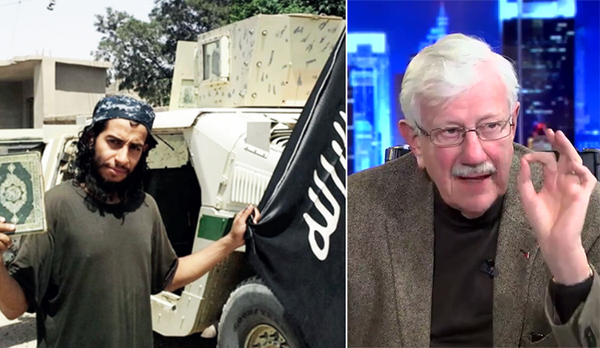
Abdelhamid Abaaoud (left), suspected by French authorities of masterminding this month’s terrorist attacks in Paris, is — like many terrorists in Europe — from Molenbeek, Belgium. Philippe Moureaux (right) was mayor of Molenbeek for 20 years, thanks to his alliance with radical Islamists. |
There was heavy rioting in 2009 during Ramadan in Molenbeek. Muslim youths set up barricades made of burning tires, set cars ablaze, threw rocks at firefighters who came to put out fires and, equipped with rocks and crowbars, looted stores. According to unconfirmedreports, the police received the following order: “Do not provoke them, do not search them, do not intervene, even if dozens of them come together, do not issue warnings for harassment, not even if they throw rocks at you.”
Jewish shop-owners were also harassed other than at Ramadan. In 2008, the Flemish magazine Dag Allemaal reported on “youths” yelling, “The Jews are our worst enemies,” in the streets of Molenbeek. There used be many stores run by Jews on the Rue du Prado and the Chaussée de Grand in Molenbeek, but in 2008, with the exception of one furniture store, they suddenly disappeared. And nobody seemed bothered by this, especially not Mayor Moureaux.
None of the Jews wanted to speak with the Dag Allemaal reporter, out of fear of reprisals. The one exception was a man whom the paper referred to as “René.” René ran a barbershop for over 30 years in the Chaussée de Gand. Then came a series of acts of violence. It began with graffiti on his shop’s windows: “Sale youpin” (“dirty Jew”) and other anti-Semitic slogans. Later on, six Muslim youths stormed into his shop, destroyed the furnishings and punched René in the face. He called the police. An hour later, the youths returned in order to “punish” him; they broke all the mirrors. For more than 35 years, René had built up a large and loyal customer base, but after this attack, most people were afraid to visit his shop. He had no other choice but to close it.
How did Moureaux react? By accusing Belgian Jews of wanting to deny Muslims the “right to diversity.” That is what he said in 2008, in the weekly paper Le Vif L’Express. It was a report with the title: “Enquête Moureaux, Shérif de Molenbeek, drogué du pouvoir – Son islamo-municipalisme” (“The Moureaux Investigation: Sheriff of Molenbeek, addicted to power — His Islamo-municipalism”). That he was “addicted to power” (“drogué du pouvoir”) were his own words. The paper described him as a “soaring intellectual, university professor and brilliant minister, who resides in the beautiful Uccle district.”
But back to Moureaux’s Jews: At 20 years old, Moureaux was a Marxist, he said, and never accepted anybody’s right to diversity; but he “evolved”: “What changed my mind were talks with the representatives of the Jewish community. It saddens me today to see how they deny the Muslims the right to diversity.”
This “right to diversity” was not granted to citizens by Moureaux during Ramadan. In a press release with the title, “Ramadan regulations for everyone,” Moureaux appealed to citizens in August 2011 to stop driving into the center of Molenbeek in the afternoon during the month of Ramadan, because Muslims are doing their shopping there.
In January 2015, after the massacre of the staff of the satirical magazine Charlie Hebdo and the murder of four Jews in Paris’s HyperCacher supermarket, the now-retired mayor gave an interview to Maghreb TV, a channel broadcast via the internet, the target audience for which is North Africans in Belgium. After he made an appeal not to hold all Muslims responsible for the actions of a few terrorists, it got wild:
“Many have an interest in dividing us. … Unfortunately, these people can be found everywhere. There is a contagion of the problems of the Middle East, in the Near East, the Israeli-Palestinian problem, which leads to some having an interest in provoking local disagreements, like a reflex to what happens over there. … It will be said that it is coming from both sides. But it is obvious that they are trying to create hatred for Arabs here in the West, in order to justify the policies of the state of Israel, policies that appear unacceptable to me.”
It is supposed to be Israel’s fault when the Arabs of Belgium — and especially those of Molenbeek — have a bad reputation? This type of anti-Semitic resentment is unfortunately not only typical for Moureaux, but for his entire party. In March 2013, the Socialists of Molenbeek issued an invitation to an event titled: “What if we freely and calmly spoke about Zionism?” On the invitation flyer was an anti-Semitic caricature, drawn in the style of Der Stürmer, by the Arabic neo-Nazi “Zéon.” After loud protests, the Socialists cancelled the event — on the grounds that the aspired-to “calm” discussion was unfortunately no longer possible.
Many examples can be listed to show what an anti-Semitic environment prevails in Molenbeek. In the official town magazine, “Molenbeek Info,” one can find a text in which the Stalinist Party of Work calls for a celebration in honor of Dr. Hanne Bosselaers, who had just returned from Gaza: “Everybody come!” In Molenbeek, you need to know, there is a hospital run by Stalinists under the name “Medicine for the People” (“Medécine pour le peuple”), which in 2013 initiated a “partnership” with Al-Quds Hospital in Gaza. Consequently, Bosselaers had a lot to talk about. For example: “The Palestinians want us to boycott Israel.”
And what did Dr. Bosselaers have to say about Hamas?
“Behind the attempt of some of our politicians to cast the Palestinian resistance organization in a negative light lies a political goal. Certain circles keep pointing out the “Islamic character” of Hamas, in the hope of keeping the population from forming solidarity with the Palestinians…. The Palestinian resistance is much greater than Hamas, and it is completely up to the Palestinians to decide which form of resistance they choose against their oppressors.”
Welcome to Molenbeek. The jurist Etienne Dujardin recently wrote in the news portal Levif.bethat the conditions in Islamist terror districts such as Molenbeek, Verviers or Saint Denis also had something to do with the deliberate efforts of some politicians, who find welcome campaign workers in radical Islamic circles:
“[p]arties have been practicing a form of cronyism based on elections; they all used the same radical mosques as mouthpieces for their election campaigns. Some saw them as a massive pool of easily available votes.”
And that is how it seems Mayor Moureaux observed that he could personally profit from the transformation of Molenbeek into a bastion of jihad. As he himself lives in a wealthy district, he was able to reject with great arrogance citizens who complained about excessive crime. He won elections by catering to radical Islam. Once again, the rule is confirmed: If someone agitates against Israel, it is always a symptom of other serious character flaws in that person. Behind the anti-Israel agitation of Moureaux lay a corrupt mayor, who only cared for his office and his income; who, as he himself said, was “addicted to power.” That his town was transforming into a hell of criminality, anti-Semitism and Sharia, he either did not care about or actually welcomed. Those who fled from Molenbeek could no longer participate; and those who moved there liked what Moureaux was doing: encouraging Islamization and agitating against Israel and Jews. This is how Molenbeek became, during the term in office of just one man, what it is today.
Originally published in German in slightly different form by Audiatur Online.
Links Between Islamism and Executions by Majid Rafizadeh
- People have, it seems, often been arrested or detained on the basis of a rumor; then convicted without trial, counsel or often even the chance to mount a defense.As Amnesty International points out, “In many countries where people were sentenced to death or executed, the proceedings did not meet international fair trial standards. In some cases, this included the extraction of ‘confessions’ through torture or other ill-treatment”.
-
- The laws under which these people are sentenced to death are often not only vague and open to interpretation. Charges that warrant the death penalty, for instance, include being “corrupt on earth”, “enemies of Allah on Earth”, or alleged “crimes against chastity”. What exactly does “corrupt on earth” or “enemies of Allah on Earth” mean?
Just how strict and brutal it is to enforce Islamic law, sharia, has now been https://www.amnesty.org/en/latest/news/2017/04/death-penalty-2016-facts-and-figures/” target=”_blank”>revealed by Amnesty International.
Amnesty’s https://www.amnesty.org/en/latest/news/2017/04/death-penalty-2016-facts-and-figures/” target=”_blank”>study, which details the number of reported executions around the world, clearly maps out the most at-risk populations. Lands ruled predominantly by sharia are apparently the most vulnerable to multitudes of executions without fair trials. At the top of the list, with the most executions, are those nations that enforce Islamic sharia law. Despite many human rights violations, these nations, apparently undeterred, continue to execute their citizens.
Sharia makes those in authority infallible and untouchable. Therefore, whatever the government or those in power deem to be “just” can be carried out without question or consequence. Under sharia law and the Islamic penal code, executions can be carried out in sickening forms. Those convicted may be beheaded, hanged, stoned, or shot to death.
As disturbing as the numbers in the report may be, they do not represent the reality that the citizens in these nations across the world face every day. There is, evidently, a connection between radical Islamist governments and extremist groups. The report does not include the gruesome executions that are carried out on a regular basis by extremist Islamist groups and non-state fundamentalists, such as members of the Islamic State (ISIS) and their affiliated groups.
These executions include, as we have seen, slitting throats, burning alive, drowning alive and crucifixion.
If these acts were included in the Amnesty International report, the total number of executions committed under the authority of Islamist law would be far higher. The Syrian Observatory for Human Rights, for example, pointed out that the Islamic State executed 33 people in the first week of April alone.
The report also did not include the number of Westerners being shot, executed and terrorized by Islamist groups. Many of these, such as ISIS, Asaib Ahl al-Haq (AAH), Kata’ib Hezbollah (KH), the Badr Organization, Or Kata’ib al-Imam Ali (the Imam Ali Battalions), are funded and trained by Islamist governments and oil-rich, unaccountable leaders.
Mass executions are evidently also being carried out by both extremist Islamist governments and Islamist groups. A culture of executions, often extra-judicial, as in Pakistan, seems to run rampant within the borders of these countries. Without any consequences for this horrifying disregard for human life, the numbers will only increase.
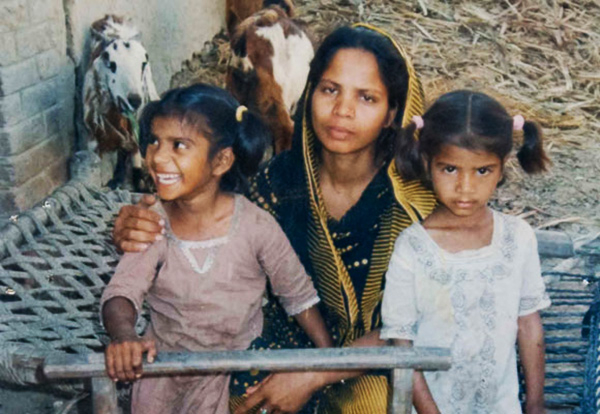
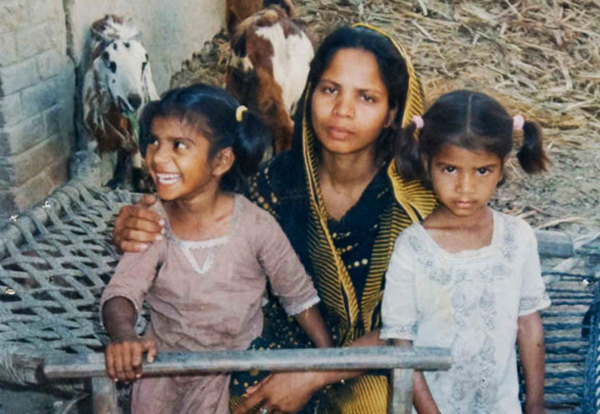
In Pakistan, Asia Bibi (pictured with two of her five children), a Christian, sits on death row for “blasphemy.” Asia’s “crime” was to use the same water glass as her Muslim co-workers. “You defiled our water,” the Muslim women told her. |
Both Islamist governments and Islamist groups justify their brutal acts by referring to the “religious” Islamist legitimacy of their murders. Members of fundamentalist Islamist governments, to legitimize these types of atrocities, also exploit the right of “sovereignty”: they point out that they belong independent state with a fully operating and “legal” judiciary.
In the Amnesty International https://www.amnesty.org/en/latest/news/2017/04/death-penalty-2016-facts-and-figures/” target=”_blank”>report, the Iran ranked number one, per capita, in executing people. It also accounted for 66% of all officially recorded executions in the region. Again, this amount only represents those executions that were officially registered.
It is also critical to point out that the statistics Amnesty International provides were given by the very governments that carried out the executions. This method means that those in power were the ones to calculate and decide what number should officially represent their country. The unofficial number is thought to be even higher. There is nothing to stop governments from simply keeping the true number to themselves.
Executions carried out under the strict governmental laws of sharia and Islamist judicial systems can have even more grotesque characteristics. The high number of executions included children, some convicted before the age of 18. Death sentences may frequently have lacked due process and what many would consider acceptable standards of proof. People have, it seems, often been arrested or detained on the basis of a rumor; then convicted without trial, counsel or often even the chance to mount a defense. As Amnesty International https://www.amnesty.org/en/latest/news/2017/04/death-penalty-2016-facts-and-figures/” target=”_blank”>points out, “In many countries where people were sentenced to death or executed, the proceedings did not meet international fair trial standards. In some cases, this included the extraction of ‘confessions’ through torture or other ill-treatment”.
Prisoners’ vulnerabilities also had no bearing on their executions. Even those seriously ill were executed. Mass executions or stoning could be ordered and then carried out within a very short time, sometimes within days, giving those convicted no time to mount any form of appeal.
The laws under which these people are sentenced to death are often not only vague and open to interpretation. Charges that warrant the death penalty, for instance, include being “corrupt on earth”, “enemies of Allah on Earth”, or alleged “crimes against chastity”. What exactly does “corrupt on earth” or “enemies of Allah on Earth” mean? There are no guidelines to establish guilt or innocence. Those in power are therefore able to decide who has violated what laws on what can only be a capricious basis. Islamist sheikhs, imams, or judges can subjectively interpret charges any way they like. A charge of being “corrupt on earth” can apply to having fun at a party or writing poetry that government decides is critical of it. A charge of being “corrupt on earth” can apply to someone who is homosexual, someone who is claimed to have committed adultery, or who has simply declined to accepted an unwanted advance. It can mean anyone who has done anything that the ruling leaders dislike.
These Islamist laws, moreover, also serve as a perfect tool for exploitation. A woman finding herself accused of breaking a law may be assured that if she https://en.wikipedia.org/wiki/Atefeh_Sahaaleh” target=”_blank”>agrees to sleep with a judge, for instance, he will interpret the law in a lenient way and protect her from the death penalty. After a woman submits to this, she can be executed nevertheless. Sometimes girls are forced into sighah — the Shiite Islamist law of temporary marriage — with a cleric, or a governmental official; after “consummating” it, they can also be put to death.
What does a charge such as “https://en.wikipedia.org/wiki/Atefeh_Sahaaleh” target=”_blank”>crimes against chastity” mean under sharia? This accusation can apply to a girl who has been raped. Instead of the law providing protection for the victim and consequences for the rapist, the victim is accused of the crime of “adultery”, convicted without a fair trial, and swiftly executed.
When Islamist laws enter a land, it seems the number of stonings, beheadings, and executions goes up.
Leaders of these nations can use this flexibility to terrorize and control entire societies, expand their power, export their ideology, and ensure that there is no opportunity to resist. More disturbing is that those numbers are just a portion of the truth.
Libya’s Chaos: Threat to the West by Mohamed Chtatou
- ISIS badly needs Libya for its operations in North Africa: to spread its paramilitary brigades, to organize its terrorist networks and, most importantly, to prepare its political pawns, after the chaos, to take over power.
-
- “Over the last four years, Libya has become a key node in the expansion of Islamic radicalism across North Africa… and into Europe. If events in Libya continue on their current path, they will likely haunt the United States and its Western allies for a decade or more.” — Ethan Chorin, Foreign Policy.
- ISIS taking control of North Africa, the soft underbelly of Europe, would amount to it getting ready to recapture, by terror and force, al-Andalus from the Catholic Christians of Spain.
In 2011 when Libya’s former ruler, Muammar Gaddafi, was murdered by the mob of militiamen, many people believed it was the beginning of a new, free, democratic country. Libya, however, did not become free or democratic. Instead, it became fractured, violent, tribal and divided. Rather than starting a new life, Libya was sliding slowly toward some sort of hell.
Over the years, as violence became a daily casual occurrence, Libya almost became synonymous in the news with disorder, and on its way to becoming yet another failed stated, like Somalia.
In spite of that, hope emerged anew with the attempt of the United Nations to negotiate a national agreement through UNMSIL (United Nations Support Mission in Libya).
In its Resolution 2144 (March 14, 2014), article 6, the UN Security Council tasked the UNMSIL to support Libyan government efforts to:
- Ensure the transition to democracy;
- Promote the rule of law and monitor and protect human rights, in accordance with Libya’s international legal obligations;
- Control unsecured arms and related materiel in Libya and counter their proliferation; and
- Build governance capacity.
Subsequently, on December 17, 2015, under the leadership of UNMSIL, the different protagonists of the Libyan crisis reached a historic agreement in the Moroccan city of Skhirat.
The agreement did not mean the end of the turmoil in Libya: there are still a lot of splinter groups that are not a part of the accord. They have both the means and the will to stand in the way of peace. There is also the lethal Islamic State (ISIS), present throughout the country with proxy organizations, ready to step in, and for which agreements mean nothing.
Martin Kobler, the Special Representative of the Secretary General of the UN and head of UNMSIL, made it clear that:
“Urgent solutions must be found to bolster the Libyan-led fight against terrorism and in particular the threat of Daesh [ISIS]. The dire humanitarian situation in Benghazi and other areas needs to be addressed as a matter of highest priority, including through the establishment of a dedicated reconstruction fund for Benghazi. The concerns of the Eastern and Southern constituencies should be brought to the forefront. This work must start immediately. The signing of the Libyan Political Agreement is the first step on the path of building a democratic Libyan state based on the principles of human rights and the rule of law.”
No sooner was the agreement concluded than, unsurprisingly, the answer “No” came both from the uninvited marginal groups, as well as ISIS.
When a truck bomb was detonated, leaving 65 people dead, on January 7, 2016 outside a police training center in the western city of Zliten, the message was clear: there will be no peace. No group took credit for the attack.
Libya is divided by tribalism. Many of the armed groups that represent the various tribes of the country could not care less about national unity: they would only lose wealth and power to the increased dominance of the federal government. As a result, they would become insignificant and die out. As long as Libya is in chaos, it benefits them to bear arms.
Other Libyans seem to favor the “Caliphate solution.” Hard-core Islamists want a strict and radical Islam to prevail in the Muslim world through the re-Islamization of society. They believe that by countering the influence of the West, Islam can once again become the most important influence on the international scene and regain its long-lost, Golden Age prominence. They aim to make clear that any UN-brokered accord is a Western-imposed subterfuge to halt the inexorable advance of glorious Islam.
From the time of the Ottoman Empire until the overthrow of Gaddafi, Libya was ruled by heavily-centralized governments that delegated minimal power to the regions. This tight rule insured peace and stability to both the people and to the state. Tribes existed, but had only an honorific role and a cultural existence, no more than that. They were used, at times, as auxiliaries to strengthen the power of the state and, in return, were given economic grants.
When Gaddafi toppled King Idris Senussi in 1969, he consolidated the state and made it all-prominent. He subdued the population through generous cash handouts and a wide array of economic concessions. The population did not have to work; if some did, they held senior positions that did not require great effort. This way, Gaddafi guaranteed to himself total control of the state and the legitimacy of “the Revolution” to get rid of recalcitrant or groups or individuals — as he expeditiously did.
In the aftermath of the “Arab Spring” of 2011 and the ensuing uprising of the Cyrenaica region against the rule of Gaddafi, NATO sided with the revolutionaries of Benghazi to topple him. However, NATO conducted its war operations from the skies, and never fielded any ground forces. In a March 2015 article in Foreign Policy, Ethan Chorin wrote:
“The current situation in Libya is the product of a series of significant mistakes, erroneous assumptions, and myths that date back to NATO intervention in 2011. The United States and its NATO allies made a fundamental mistake in not imposing a robust reconstruction plan on Libya and stabilizing the country before radicalism was able to flourish. Even U.S. President Barack Obama understands that this was a mistake: In an interview last year with the New York Times, he cited lack of a plan for “the day after Qaddafi is gone” as potentially one of his biggest foreign-policy regrets. (The Libyans, of course, share much of the blame too.)”
As Gaddafi’s forces withdrew from various regions, religious and tribal groups moved in and helped themselves to the huge arsenals left behind. With that came the temptation to rule and have access to a share of oil reserves. At the fall of Ghaddafi in October 2011, there were over 300 armed groups, all dreaming of leadership and control.
In May 2014, Libyan General Khalifa Haftar, with support from the U.S., Egypt, UAE and Saudi Arabia, led an army from the east to rid the country of the powerful Islamist groups. His secular-oriented movement, dubbed “Operation Dignity,” in spite of a few limited successes, soon faltered miserably.
In reaction to the establishment of Haftar’s movement, the Islamists, supported by Turkey and Qatar, put together their own front, Fajr Libya (“Libya Dawn”), on July 13, 2014. The declared aim of Fajr Libya was to correct the direction of the revolution and set up a stable government; the undeclared objective was to turn Libya into an Islamist country. Fajr Libya was made up of several Islamist militias, all dreaming of power, wealth and religious consecration:
- The Muslim Brotherhood
- Libyan Shield Militia of Misrata with links with the Ikhwane (brotherhood)
- The Tripoli Brigade, of the famous Islamist leader Belhaj, who had opposed Gaddafi openly
- The Libya Revolutionaries Operation Room
The Fajr Libya front was, in addition, allied to a large group of heavily armed brigades, each controlling one tribe or region and reflecting the disintegration of Libya into small emirates reminiscent of the taifas in Arab Spain.[1]
During the era of the Barbary pirates, which lasted from the 16th to the 19th century, North Africa developed a taste for piracy, under the religious justification of Jihad al-Bahr (“jihad at sea”) that protected the Dar al-Islam (“domain of Islam”) from the Dar al-Kufr (“domain of infidels”). This religious justification became especially prominent after the fall of Grenada in 1492, and the ensuing efforts to reconquer al-Andalus (Spain) from the Christians. The Barbary pirates’ raids meant easy gains of goods and slaves.
Today, the tribal piracy instinct again seems strong, for various reasons. Among them are:
- The affirmation of undemocratic tribal and patriarchal power under the cover of Islam;
- The ability to dispose of the riches of the country directly, by selling oil and benefiting from its revenues without having to pay any taxes to a central government;
- Undertaking contraband commerce and, most importantly, organizing, unhindered, immigration traffic to Europe.
Many of the Libyan groups and warlords therefore see a national reconciliation as a threat to their power and lucrative business. Many believe that with the Zliten terrorist attack of January 7, the warlords were sending a message to Libyan politicians that their political agreement would not go farther than Skhirat, the Moroccan city where it was signed.
ISIS badly needs Libya for its operations in North Africa: to spread its paramilitary brigades, to organize its terrorist networks and, most importantly, to prepare its political pawns, after the chaos, to take power.
Its taking control of North Africa, the soft underbelly of Europe, would amount to getting ready to recapture, by terror and force, al-Andalus from the Catholic Christians of Spain.
In his Foreign Policy article, Chorin notes that,
“Over the last four years, Libya has become a key node in the expansion of Islamic radicalism across North Africa, West Africa, across the Sahel, and into Europe. Arms and fighters have crossed Libya’s porous borders, feeding radical organizations from al Qaeda in the Islamic Maghreb to Boko Haram and reinforcing radical trends in the heart of the Middle East. If events in Libya continue on their current path, they will likely haunt the United States and its Western allies for a decade or more.”
If Libya is not stabilized in the near future, the whole world will regret it.
Stabilizing Libya would undoubtedly help to fight religious radicalism in West Africa; cut the lifeline of the lethal Boko Haram, active in the whole of West Africa; and impede al-Qaeda, which is threatening the Sahel countries of Burkina Faso, Mali and Niger.
To insure peace and stability for Libya, the UN’s Skhirat Agreement recommended strengthening UNMSIL to be a peace-keeping force. This peace-keeping force must be of, at least, 10,000 elite soldiers with heavy equipment and NATO air support to undertake the pacification of the country, with obviously the help of government forces sympathetic to the Skhirat accord.
This peace-keeping force could be made of the following countries: Spain, Italy, Morocco, Egypt, Jordan, Turkey, Pakistan and Senegal. The problem with any UN peacekeeping force, as seen, for example, with UNIFIL in South Lebanon, is that when the first shot is fired, they run. There also seems to be a tendency among peacekeepers, especially in Africa, to trade food for sex with children.
The Skhirat Agreement recommended the following actions be implemented as soon as possible. This is what the participants agreed to, but all they seem to do is underscore the sanctimonious grandiosity of the UN:
1 – Disarm militias:
Disarm all paramilitary groups by persuasion, incentive or sheer force and make, by law, bearing arms strictly illegal;
Comment: Who should do that?
2 – Train a national army and a police force:
Offer the militias the possibility to integrate the army and police force and be under the rule of law.
Comment: Why would the militias prefer that to having their own familiar honey-pot?
3 – Undertake a cultural study:
There is an urgent necessity to understand the social and cultural make-up of the Libyan society. The Amazigh and Tuareg people must be granted unconditionally their cultural rights.
Comment: Is anyone expecting the warrior tribesmen willingly to go along with that?
4 – Adopt a federal system of government:
Probably the best government system that could befit the numerous needs and the varied wishes and hopes of the Libyan population in political, cultural and religious terms is undeniably the federal system, with which tribal groupings, cultural minorities and religious lodges can, eventually, all identify.
Comment: ISIS and the other groups would probably fight this to the death.
5 – Help the country set up an open and competitive economy:
International economic institutions will need to help Libya restructure its economy, especially now that the price of oil has fallen steeply. Libya is and has always being an oil-producing country where most of the natives never worked.
Comment: This is the problem of so many oil-producing countries in which whoever is in charge does not want to share the spoils.
The problem always seems to be: Who should be doing the hard and dangerous work — the boots on the ground to mop up.
Libya is on the verge of implosion. The Skhirat Agreement, with its good intentions, is not enough. If the armed groups are left on the loose, Libya will effectively be the newest failed state. At present, Libya is a lethal danger to Europe, Africa and the Middle East.
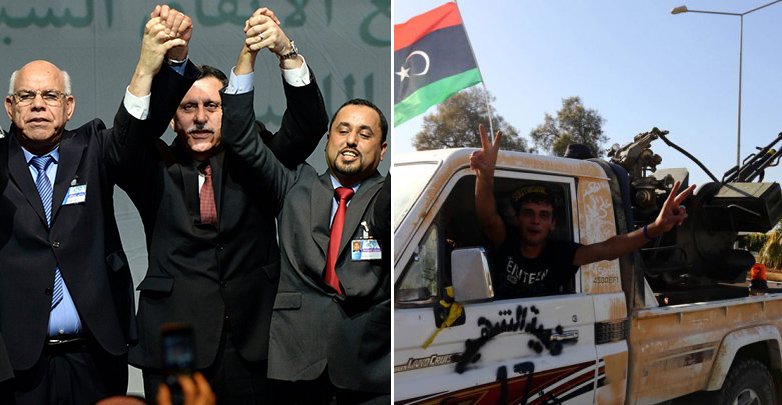
The Skhirat Agreement (left), with its good intentions, is not enough to save Libya from Islamist militias such as Fajr Libya (right). |
Dr. Mohamed Chtatou, an author, is a Professor at the University of Mohammed V in Rabat. He is currently a political analyst with Moroccan, Saudi and British media on politics and culture in the Middle East and Islam.
Leta zunz’ubumwe z’America,nizo Uwiteka azakoresha ibikomeye gukoraho umwwakagara niko Uwiteka avuze!
19th FEB,2016 Ijambo ry’Uhoraho rinzaho maze rirambwira riti,mwana w’umuntu,hanurira abanyagakondorero ubabwire uti,uku niko Uhoraho agize,dore nzakoresha amahanga akomeye arimo igihugu cy’America kuzakuraho umwakagara ku ngoma kugirango ngarure ubwoko bwanjye murusisiro maze bujye kunkorera muri gakondo yabakranutsi uko niko Uwiteka agize.
Leta y’Urwanda yemeye gutanga million $3.000.000 zo kwica Umwami KIGELI WA V NDAHINDURWA
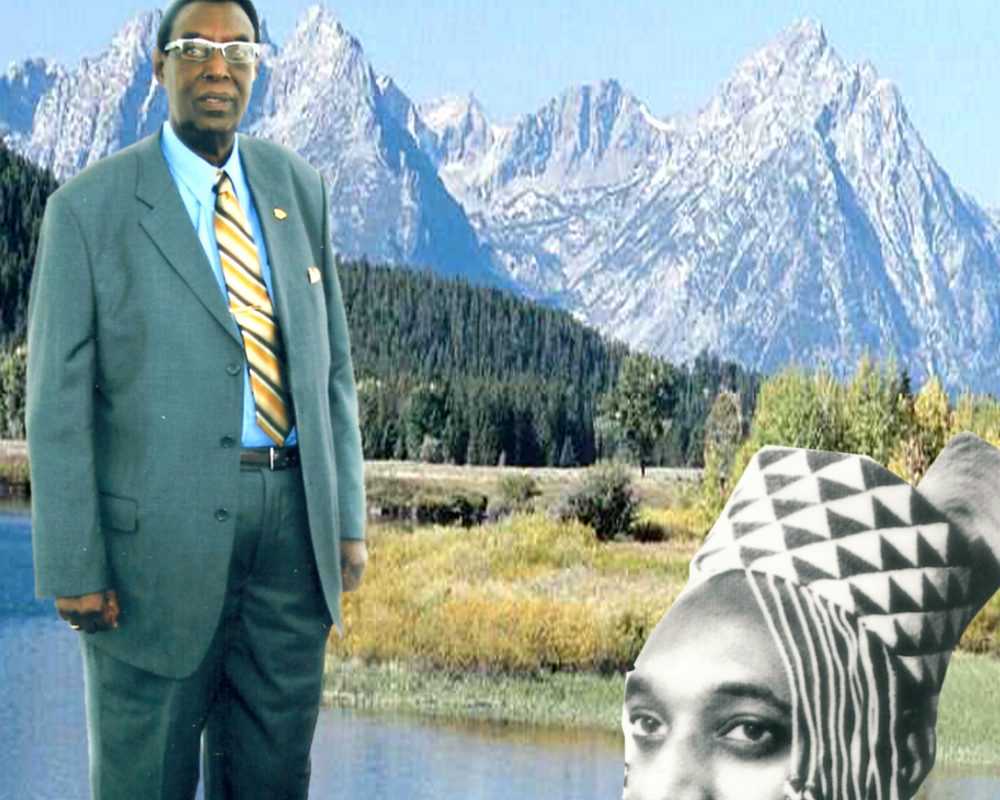
Abega ba b’Akagara,bahuye n’ikibazo cy’Ubuhanuzi.

Amakuru agera ku kinyamakuru inyangenewss.com,aturuka mu nzego zikorana n’Umwami w’Urwanda KIGELI wa V Ndahindurwa,mu murwa mukuru w’America Washington,aratangaza yuko,mucyumweru gishize,Abega ba b’Akagara bibumbiye mu muryango wabega ba b’Abakagara.Bahimbye inkinamico nkuko basanzwe babigenza,bakubita kudeta yogukuraho umuyobozi uyobora RPRK Inyabutatu.
Eugene Nkubito aliasi Munyandinda Mbayiha John,niwe umaze imyaka itanu ayobora iyo baringa yitwa umuryango uharanira kwimika ubwami bw’Abega ba b’Akagara bavanzemo abahutut n’Abatutsi.Amakuru agera ku nyangenews,aravuga yuko uwo Mbayiha aliasi Nkubito Eugene,ngo mucyumweru gishize yahamagaye Nyir’Urwanda,amumenyesha yuko ngo commite yakoranaga nawe y’Abega baharanira ubwami bwa Kega na kagara,ko bamukuyeho bakaba bimitse undi muyobozi.
Amakuru aturuka mu nzego z’Umwami,avuga ko,ngo Umwami w’Urwanda yamubajije icyo yaba yaba yifuza gitumye amugezaho ayo makuru,undi avuga ko ngo bamukuyeho kubera guharanira ubwami bw’Urwanda busanzwe buzwi!Nyamara icyo n’ikinyoma cyambaye ubusa kuko ibi bibaye nyuma yuko baharabitse Umwami w’Urwanda bavuga yuko atigeze arahirira ubwami bugendera ku itegeko nshinga.
Nyamara bakiyibagiza yuko aribo babanje kumwamaza bavuga yuko yarahiriye ubwamo bugendera ku itegeko nshinga,ibi byaje guhinduka mu mwaka wa 22.Nov.2011,aho umuhanuzi Majeshi Leon atahuriye ikinyoma cy’Abega ba b’Akagara,maze agatanga amakuru ku Mwami w’Urwanda bigatuma iryo shyaka rya RPRK risenyuka bahita bahindura izina biyita Inyabutatu RPRK,iyi ikaba imwe mu mpamvu zatumye umuhanuzi Majeshi Leon ashimutwa nabo bagizi ba nabi b’inkoramaraso.
Uyu Muryango wa RPRK,wifashishije umuhutu witwa UTAZI RUBANDA urwanya Umwami KIGELI wa NDAHINDURWA hamwe n’ubwami bw’Urwanda,uyu Utazi rubanda,akaba nawe atuye muri America,akaba akorera leta ya Kagame Paul,ndetse andi makuru atugeraho aremeza yuko nawe ngo yaba ar’umwega w’umwakagara uaharanira yuko hajyaho ubwami bw’Abega maze nawe akazagirwa igikomangoma muri ubwo bwami.
YAMANNYE AMABANGA Y’aBEGA BA B’aKAGARA.

Ibi byose biri kuba mu gihe ubuhanuzi bwa vuba ahangaha,bwasohotse bugaragaraza yuko leta ya FPR,inkotanyi,bari mu mugambi woguhitana Umwami w’Urwanda kuko ariwe batinya gusa wenyine bitewe ni uko ariwe uzoongera kwima ingoma agacyura ubwami n’Umwami uzamusimbura,ubu buhanuzi rero bukaba bubateye impungenge cyane kuburyo ubu barimo gukora ibishoboka byose ngo bahitane umuhanuzi Majeshi Leon hamwe n’umuhanuzi mukuru kugirango baburizemo ibigiye kubabaho.
Ariko bikaba bitazabashobokera kubera yuko ubuhanuzi buvuga ibizaba kandi iyo bwamaze gusohoka,kaba kabaye ntacyo umwana w’umuntu ashobora kubihinduraho usibye gutegereza ibizaba byahanuwe,naho ubundi ntagisubizo bashobora kubona,gusa urebye kure ubona yuko abega bose nibaba abanyabwenge,bazahunga igihugu kubera bahemukiye Urwanda n’Abanyarwanda,ibyo rero ibyahanuwe nibisohora biragaragara ko,bitazabagwa amahoro kubera ingaruka zibyo bakoze zigomba kubageraho.Umugambi Nkubito yahawe na leta y’Urwanda,dushingiye kumakuru aturuka mu nzego z’ubutasi zikorera kagame,ndetse bakorana nawe kuburyo bwahafi cyane biravugwa yuko Umwami w’Urwanda abateye ikibazo gikomeye cyane kuburyo bamaze kwemera gutanga million $ 3.000.000,ku muntu washobora kwica KIGELI wa NDAHINNDURWA,abanyarwanda rero bakwiye kuba maso kuko Rucunshu iragarutse kandi muribuka neza cyane yuko yateguwe n’Abega ba b’Akagara,aribo bishe Rutarindwa kugirango bimike Umwami Musinga wabyawe n’umwega-kazi.

Ababa bavugana n’Umwami w’Urwanda mukwiye kumugira inama yuko akwiye kwirinda bikomeye kuko hasigaye igihe gito cyingana n’;urutoki,kugirango ibyahanuwe bisohore,maze abanyarwanda binjire mu masezerano no mu mahoro arambye azabaho iteka ryose.