Daily Archives: June 19, 2017

Iran to Trump: Death to America Will Live On by Majid Rafizadeh

  • Ayatollah Ali Khamenei made it clear that Trump’s presidency causes “no difference” to Iran-US relationships. He called the Americans’ election “a spectacle for exposing their crimes and debacles.””Thank God, we are prepared to confront any possible incident.” — Iran’s Supreme Leader, Ayatollah Ali Khamenei.

  • From the perspective of Iranian moderates, reformists and hardliners, the US is not a superpower anymore; but a weak actor in the Middle East and on the global stage.
  • Iranian leaders also made it clear that Tehran will continue supporting Hezbollah and other groups that have been designated as terrorist groups by the US Department of State. These groups pursue anti-American and anti-Israeli agendas.

Ideologically speaking, Iran’s hardliners, primarily Supreme Leader Ayatollah Ali Khamenei and senior officials of the Islamic Revolutionary Guard Corps (IRGC) who enjoy the final say in Iran’s domestic and foreign policies, have made it clear that Iran will not change the core pillars of its religious and revolutionary establishment: Anti-Americanism and hatred towards the “Great Satan” and the “Little Satan”, Israel.

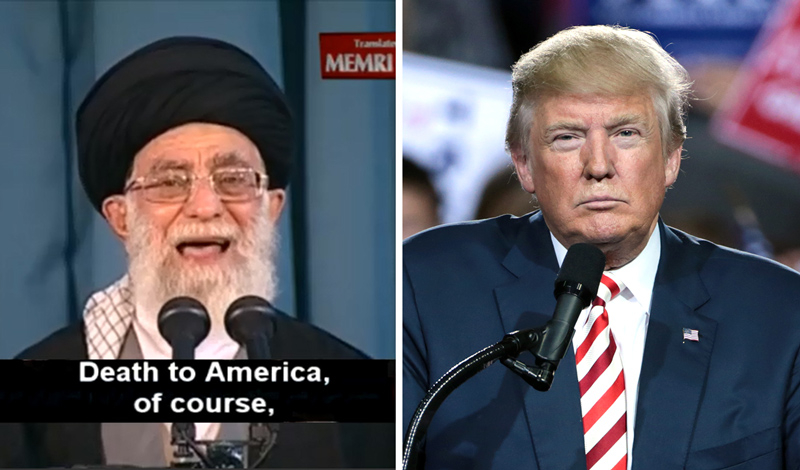
Supporters of Ayatollah Khamenei and the IRGC enthusiastically shouted “Death to America” in response to a recent speech that Khamenei gave, applauding the 1979 hostage-taking and takeover of the US Embassy in Tehran.

Iran’s major state newspapers carried anti-American headlines this week, quoting the Supreme Leader. In his latest public speech to thousands of people, which was televised via Iran’s state TV, Khamenei made it clear that Trump’s presidency will cause “no difference” to Iran-US relationships. Khamenei pointed out that, “We have no judgment on this election because America is the same America”. In his speech, Khamenei attacked President-elect Donald Trump and the American people. The Ayatollah called the US election “a spectacle for exposing their crimes and debacles.”
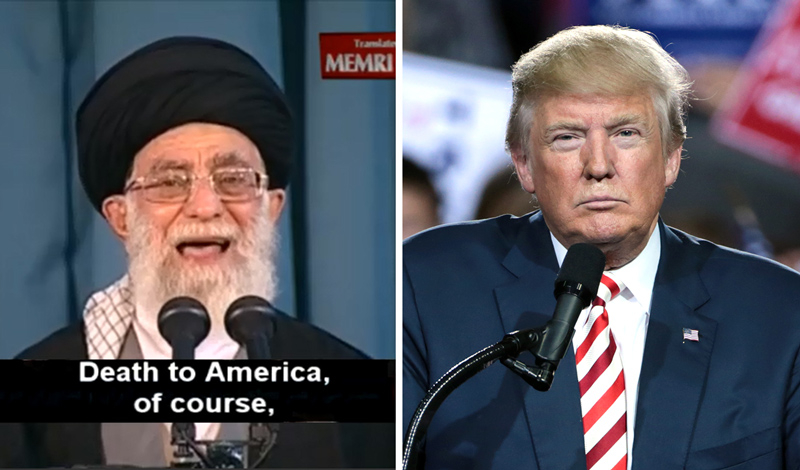
Other hardliners echoed the same message that there would be no change in Iran’s revolutionary principles and ideals against the US and its allies. The deputy commander of the Revolutionary Guards, Hossein Salami, told Iran’s Fars news agency: “When the Republicans were in power, they threatened us and showed their hostility… and when the Democrats were in power, the policies of the United States were the same.”

Khamenei also remarked that the US will remain the evil, or the “Great Satan,” saying:

“In the past 37 years, neither of the two parties who were in charge did us any good and their evil has always been directed toward us….We neither mourn nor celebrate, because it makes no difference to us… We have no concerns. Thank God, we are prepared to confront any possible incident.”

He added that the remarks made by Donald Trump “over the last few weeks on immoral issues — which are, for the most part, not baseless accusations — are enough to disgrace America.”

Militarily, strategically and geopolitically, Tehran’s core pillars of damaging US national interests, and scuttling US foreign policy objectives will remain intact.

Iran’s semi-official Fars news agency reported that Iran’s armed forces chief of staff, General Mohammad Hossein Bagheri, has heavily criticized Donald Trump for stating that the US will confront Iranian boats in the Gulf if they harass US Navy ships. In the last year, Iran has increasingly harassed and provoked US Navy ships, and detained 11 American sailors.

General Bagheri stated out that, “The person [Trump] who has recently achieved power, has talked off the top of his head! Threatening Iran in the Persian Gulf is just a joke.”

In 2016, the number of incidents of boats from Iran’s navy and Revolutionary Guards provoking and harassing the US Navy ships rose significantly to 31 incidents, highlighting that the IRGC evidently feels sufficiently emboldened to damage US national security publicly and on a regular basis. From the perspective of Iranian moderates, reformists and hardliners, the US is not a superpower anymore; but a weak actor in the Middle East and on the global stage.

In addition, Iran, with underlying anti-American objectives, is aggressively expanding its military presence and naval bases in foreign nations and international waters. Major General Mohammad Hossein Baqheri said, as cited by the Iranian Tasnim news agency, that the expanding presence in international waters and naval bases in foreign countries “could be ten times more efficient than nuclear power.” For the first time, the Iranian Navy’s 44th flotilla, comprised of a Bushehr logistic warship and an Alvand destroyer, has now sailed into the Atlantic Ocean as well.

Tehran is also considering having naval bases on the coasts of Yemen and Syria to support the Assad government and the Houthis. As Iran’s Chief of the General Staff told a gathering of senior naval commanders, “One day, we may need bases on the coasts of Yemen and Syria, and we need the necessary infrastructures for them under international maritime law.”

Iran’s naval commander, Rear Admiral Habibollah Sayyari, also told the gathering of senior naval commanders that boosting military presence in international waters reflects Iran’s power.

According to the Tasnim news agency, Iran’s navy has already deployed 49 flotillas to various maritime zones. Sayyari added that the flotillas showcased Iran’s symbol of power.”

Iranian leaders also made it clear that Tehran will continue supporting Hezbollah and other groups that are designated as terrorist groups by the US Department of State.

These groups pursue anti-American and anti-Israel agendas.

Khamenei and IRGC are sending a strong message that Iran will neither alter its core religious and revolutionary pillar of anti-Americanism, nor change its foreign policy and military objectives of damaging US interests. Iran’s policy towards the “Great Satan” will remain as it has been since the establishment of the Islamic Republic of Iran in 1979.

Dr. Majid Rafizadeh, political scientist and Harvard University scholar is president of the International American Council on the Middle East. He can be reached at Dr.rafizadeh@post.harvard.edu.
Iran Taking Over Latin America by Joseph Humire

  • “This is a matter of life or death. I need you to be an intermediary with Argentina to get help for my country’s nuclear program. We need Argentina to share its nuclear technology with us. It will be impossible to advance with our program without Argentina’s cooperation.” – Iran’s former President Mahmoud Ahmadinejad to the late Venezuelan President Hugo Chávez.


  • According to Venezuelan informants, whitewashing Iran’s accused from the AMIA attack was only a secondary objective in its outreach to Argentina. The primary objective was to gain access to Argentina’s nuclear technology and materials — a goal Iran has for more than three decades.

  • During the last 32 years, Iran has achieved a resounding success in promoting an anti-US and anti-Israel message in Latin America. Its state-owned television network, HispanTV, broadcasts in Spanish 24 hours a day, seven days a week in at least 16 countries throughout the region.

  • The lifting of sanctions and influx of billions of dollars as a result of Iran’s nuclear deal will undoubtedly help Iran in Latin America, where many countries face economic turmoil and can use an Iranian “stimulus.”

  • While Latin America is often regarded as a foreign policy backwater for the United States, it is the geopolitical prize for the Islamic Republic of Iran.

During the last couple months, Iran and Saudi Arabia have been playing a political tug of war over Latin America. On November 10, 2015, Iran’s deputy foreign minister held a private meeting with ambassadors from nine Latin American countries to reaffirm the Islamic Republic’s desire to “enhance and deepen ties” with the region. This was followed by similar statements from Iranian President Hassan Rouhani and Supreme Leader Ayatollah Ali Khamenei at the Gas Exporting Countries Forum (GECF) in Tehran later that month.

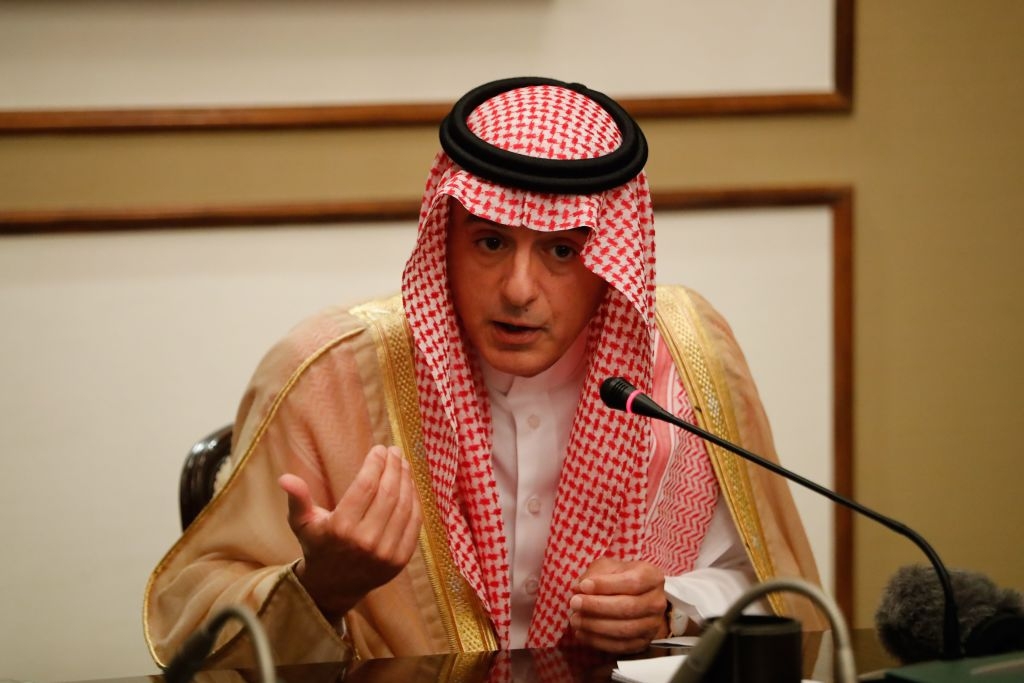
The same day, the Saudi Foreign Minister, Adel al-Jubeir, presided over a South American-Arab world summit in Riyadh. FM al-Jubeir, while Ambassador to the United States in 2011, had himself been the target of an Iranian-Latin American assassination plot.

The message of the Saudi summit was clear: An Arab rapprochement with South American countries will increase Iran’s isolation in the world.

Unfortunately for the House of Saud, in South America, they are more than thirty years behind their Persian rivals.

After the 1979 revolution, the leaders of the newfound Islamic Republic of Iran sought to change their country and the world. In 1982, Iran held an international conference of the Organization of Islamic Movements, bringing together over 380 clerics from some 70 countries around the world, including many from Latin America.[1] The purpose of this conference was to export their revolution abroad.

The next year, in 1983, Iran’s Islamic Revolutionary Guards Corps (IRGC) carried out their first major international terrorist operation: the bombing of the Marine barracks in Beirut. This act led to the withdrawal of multinational forces from Lebanon. That same year, Iran began funding and training Hezbollah in Lebanon. 1983 is also the year the Islamic Republic began its covert operations in Latin America.

On August 27,1983, the first Iranian operative to land in Latin America touched down in Buenos Aires, Argentina. Mohsen Rabbani was not just any operative, but one of Iran’s most highly trained and dedicated intelligence officers.[2] Latin American intelligence officials have since dubbed him “the terrorist professor.”

Rabbani spent more than a decade in Argentina, creating the conditions that would allow one of Hezbollah’s biggest terrorist attacks be carried out with complete impunity: the bombing, on July 18, 1994, of the AMIA (Asociación Mutual Israelita Argentina) Jewish cultural center in Buenos Aires. The attack, by a suicide bomber who drove a truck packed with explosives into the AMIA building, killed 85 people and injured hundreds more. This was not even Argentina’s first encounter with Islamic terrorism; two years earlier, on March 17, 1992, the Israeli Embassy in Buenos Aires was also bombed.

Many of the Iranian officials who helped Rabbani carry out the AMIA attack are still important political players in the Islamic Republic. Ahmad Vahidi, who founded the feared, elite Qods Force of the IRGC and was recently the country’s Defense Minister, was prominently named in the official AMIA indictment by the Investigations Unit of the Office of the Attorney General of Argentina. Mohsen Rezai and Ali Akbar Velayti, both presidential candidates in the 2013 Iranian elections, are also prominently named in the same indictment by Argentine authorities.[3]

During the last 32 years, Iran has achieved a resounding success in promoting an anti-US and anti-Israel message in Latin America. Iran’s state-owned television network, HispanTV, broadcasts in Spanish 24 hours a day, seven days a week, in at least 16 countries throughout the region.

Formally, Iran has also doubled the number of its embassies in Latin America — from six in 2005 to eleven today.

Informally, according to U.S. Southern Command (USSOUTHCOM), Iran has established more than 80 Islamic cultural centers promoting Shi’a Islam throughout Latin America. The number represents more than a 100% increase from 2012 when, according to estimates by USSOUTHCOM, Iran only controlled 36.[4]

Most importantly, however, Iran has established an unprecedented military and intelligence footprint that extends from Tierra del Fuego, at the southern tip of Argentina, up to the Rio Grande, bordering the United States. Iran is active in every country in Latin America.

The lack of transparency, political corruption, high levels of crime and violence — and the growing anti-American and anti-Jewish attitudes in Latin America — enable Iran to enjoy its success. Due to the efforts of a handful of regional governments seeking to revolutionize the region, this trend has only increased in the last decade. Thanks to the legacy of the late Hugo Chávez and his contemporaries such as Nicolás Maduro, Rafael Correa, Evo Morales, Daniel Ortega, Cristina Fernández de Kirchner, Salvador Sánchez Cerén, and others, Iran is now more powerful in Latin America than ever before.

The recent election in Argentina, while providing an opportunity for the new President Mauricio Macri, does not in and of itself weaken Iran’s influence in the continent. The Islamic Republic has, for more than three decades, studied the political patterns and socioeconomic trends in the region. In several countries, Iran has a greater presence and influence than the United States.

Latin America’s importance for Iran was highlighted by a bombshell article published in March of this year in the highly respected Brazilian weekly Veja magazine. Through interviews with high-level Venezuelan informants who are collaborating with U.S. authorities, Veja reported that the Argentine government’s reversal on its decades long policy of freezing diplomatic relations with Iran (because of the 1994 AMIA bombing) did not change in 2013 with a controversialMemorandum of Understanding (MOU) signed between the two countries. The policy also did not change two years prior, in 2011, when Argentina’s former Foreign Minister, Hector Timmerman, met secretly in Syria with his then-Iranian counterpart, Ali Akbar Salehi, to negotiate this MOU — meant to whitewash Iran’s role in the AMIA attack.[5]

Instead, the Veja article revealed that Argentina’s warming of relations with Iran began in 2007 when then-Senator Cristina Fernández de Kirchner became Argentina’s president — in part, thanks to the financial support she received from Iran, courtesy of Venezuela’s Hugo Chávez.[6] The highly controversial MOU between Argentina and Iran was therefore actually a campaign promise that had been made by the outgoing Argentine president, Fernández de Kirchner, six years earlier.

The most noteworthy revelation from the Veja piece, however, is not whom Iran bribed and bought in Latin America, but why Iran bribed them.

According to the Venezuelan informants, whitewashing Iran’s accused from the AMIA attack was only a secondary objective in its clandestine outreach to Argentina. The primary objective was to gain access to Argentina’s nuclear technology and materials — a goal Iran has apparently desired for more than three decades.

According to the late Dr. Alberto Nisman — the special prosecutor who investigated the AMIA attack — the goal of accessing Argentina’s classified nuclear program is the reason Argentina was targeted by Iran and Hezbollah back in the early 1990’s. According to Dr. Nisman, Iran’s motivation for targeting Buenos Aires in the AMIA attack was a direct response to the Argentine government’s cancellation of nuclear cooperation agreements that had been in place between the two countries since the mid-80’s.[7]

There is a telling account in the Veja piece of a private meeting on January 13, 2007, between Iran’s then President, Mahmoud Ahmadinejad, and the late Venezuelan President Hugo Chávez. In the meeting, Ahmadinejad tells Chávez:

“This is a matter of life or death. I need you to be an intermediary with Argentina to get help for my country’s nuclear program. We need Argentina to share its nuclear technology with us. It will be impossible to advance with our program without Argentina’s cooperation.”

“Impossible” is a strong word. If true, this information suggests that Iran needs Latin America to advance its highly ambitious nuclear program. For Iran, Latin America is not just a side project; the region may well be Iran’s top foreign policy priority outside of its immediate interests in the Middle East.

“I need you to be an intermediary with Argentina to get help for my country’s nuclear program. We need Argentina to share its nuclear technology with us. It will be impossible to advance with our program without Argentina’s cooperation.” – Iran’s former President Mahmoud Ahmadinejad (far left) to the late Venezuelan President Hugo Chávez (hugging Ahmadinejad). Shown at right is Chávez with Argentina’s former President Cristina Fernández de Kirchner.

The untimely and mysterious death, for which no one has formally been charged, of Dr. Alberto Nisman — found shot on January 18, 2015, hours before he was to present his most recent findings before the Argentine congress — has essentially cleared the way for even greater Iranian influence in Latin America. The lifting of sanctions and influx of billions of dollars as a result of Iran’s nuclear deal with the P5+1 (the five permanent members of the UN Security Council, plus Germany) will undoubtedly help Iran in its quest for global legitimacy. It is most likely a quest easily achieved in Latin America, where many countries are facing economic turmoil and might appreciate an Iranian “stimulus.”

While Latin America is often regarded as a foreign policy backwater for the United States, it is a geopolitical prize for the Islamic Republic of Iran. Saudi Arabia may have just woken up to this fact. It is high time U.S. policymakers did the same.

Joseph M. Humire is the Executive Director of the Center for a Secure Free Society (SFS) and co-editor of Iran’s Strategic Penetration of Latin America(Lexington Books, 2014)

Iran Steps Up Threats to Israel, U.S. by Majid Rafizadeh

  • “En Sha’a Allah [God willing], there will be no such thing as a Zionist regime in 25 years. Until then, struggling, heroic and jihadi morale will leave no moment of serenity for Zionists.” — Iran’s Supreme Leader, Ayatollah Ali Khamenei, September, 2015.

  • “If the Supreme Leader’s orders [are] to be executed, with the abilities and the equipment at our disposal, we will raze the Zionist regime in less than eight minutes.” — Ahmad Karimpour, a senior adviser to the Iranian Revolutionary Guards’ elite unit, the Quds Force.
  • Iran is also attempting to intimidate Donald Trump from taking a tough stance against Iran. Trump ought to be wary of falling into Iran’s tactical game of fear-mongering. For Iran, US concessions and silence in the face of Iran’s threats mean weakness and fear. On the other hand, when Iran sees that the US is taking a robust stance and that the military option is always on the table, Tehran retreats.
  • As long as Iran’s Supreme Leader is alive and as long as the ruling clerics preserve the political establishment, Iran will maintain the core pillars of its foreign policies and revolutionary principles: these are anchored in anti-Israeli, anti-American and anti-Semitic politics. Iranian politicians across the political spectrum totally agree on these fundamentals.

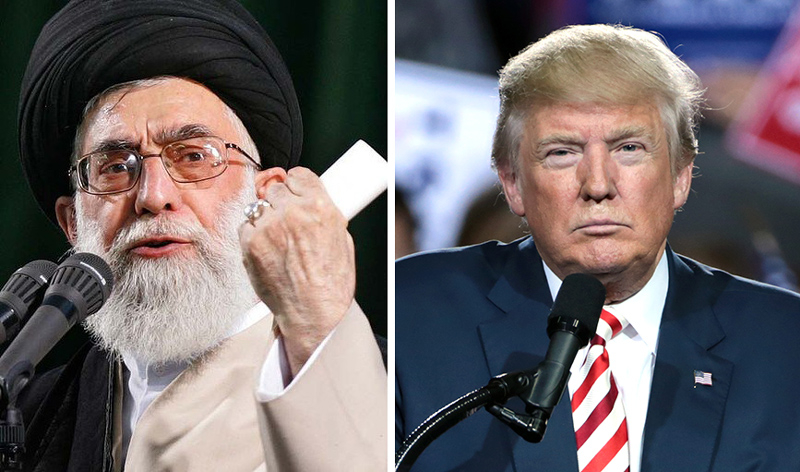
Iran’s threats against Israel and the US are becoming bolder and louder. Iran’s Supreme Leader, Ayatollah Ali Khamenei, is now repeatedly threatening Israel’s annihilation relatively soon.

According to Iran’s Press TV, Khamenei recently stated:

“The Zionist regime — as we have already said — will cease to exist in the next 25 years if there is a collective and united struggle by the Palestinians and the Muslims against the Zionists.”

In addition, Iranian officials are warning President-elect Donald Trump that if he makes any wrong move, it would lead to a World War, wiping Israel from the face of earth and destroying the smaller Gulf states.

Iranian leaders are adopting their classic tactics and strategy of threatening in advance — and frequently — probably to obtain concessions, push the next US administration to pursue policies of appeasement, and, more importantly, to drive the US to abandon Israel.

In addition, through anti-Israeli and incendiary statements, Khamenei and Iran’s Islamic Revolutionary Guards Corps (IRGC) are inciting Palestinians and the Muslim world to use violence against the Israeli nation. As a result, Khamenei heightens even further his anti-Israeli and anti-Semitic sentiments. Many who follow his beliefs consider it their Islamic duty to fulfill his policies, religious doctrines and prophesies.

Ahmad Karimpour, a senior adviser to the Revolutionary Guards’ elite unit, the Quds Force, previously said that Iran is ready to follow Khamenei’s orders once the leader gives the green light. According to the semi-official Fars News Agency, Karimpour said, “If the Supreme Leader’s orders [are] to be executed, with the abilities and the equipment at our disposal, we will raze the Zionist regime in less than eight minutes.”

In order to project himself as the leader of the Muslim world (both Shia and Sunni) and to mobilize opposition to Israel and the US, Khamenei reaffirmed the Islamic Republic’s support for groups that stand against Israel and America:

“Despite being engaged in certain regional issues, the Islamic Republic has always announced explicitly that Palestine is the number one issue in the Muslim world and has fulfilled its obligations in this regard.”

Iran’s leader then went on to lash out at the United States as “the most arrogant [power] and the Great Satan.”

Khamenei is correct that his generals and he have previously threatened Israel’s destruction.

In July 2016, the deputy commander of the (IRGC) warned that Iran possesses tens of thousands of missiles outside Iran to hit Israel. According to Iran’s state-owned news agency Tasnim, General Hossein Salami pointed out:

“Hezbollah has 100,000 missiles ready to hit Israel to liberate the occupied Palestinian territories if the Zionist regime repeats its past mistakes… today, the grounds for the annihilation and collapse of the Zionist regime are (present) more than ever.”

In addition, Khamenei has already published a 9-point plan on how to destroy Israel. In September 2015, he called on violence and jihad against Israel, until it is completely destroyed:

“En Sha’a Allah [God willing], there will be no such thing as a Zionist regime in 25 years. Until then, struggling, heroic and jihadi morale will leave no moment of serenity for Zionists.”

Beside exploiting people’s grievances and inciting violence against Israel, Khamenei primarily relies on Hezbollah, Hamas and the IRGC to pursue his anti-Israel agenda.

Hassan Nasrallah, the leader of Lebanon’s Hezbollah, previously disclosed that Iran is lifeline of Hezbollah. In a speech broadcast by the Shiite party’s Al-Manar TV station, he said:

“We do not have any business projects or investments via banks… We are open about the fact that Hezbollah’s budget, its income, its expenses, everything it eats and drinks, its weapons and rockets, come from the Islamic Republic of Iran. We have no money in Lebanese banks, neither in the past nor now. We do not transfer our money through the Lebanese banking system…. We totally reject this [U.S.] law until the Day of Judgment. … Even if the law is applied, we as a party and an organizational and jihadi movement, will not be hurt or affected”.

Nasrallah also insisted that, “as long as Iran has money, we have money… Just as we receive the rockets that we use to threaten Israel, we are receiving our money. No law will prevent us from receiving it.”

Notably, there are no differences across Iran’s political spectrum when it comes to opposing and threatening Israel. Moderates, reformist, principalists [in Farsi, Osolgarayan: ultra revolutionary and conservatives] and hardliners all pursue the core anti-Israel pillar of the Islamic Republic’s foreign policy.

The so-called moderate Iranian president, Hassan Rouhani, said previously:

“The Zionist regime (Israel) is a regional base for America and the global arrogance … Disunity and discord among Muslim and terrorist groups in the region … have diverted us from the important issue of Palestine… We stand with the dispossessed Palestinian nation.”

Iranian leaders believe that arming groups and people who oppose Israel is critical. Khamenei tweeted that “I announced and it will absolutely happen that, just like #Gaza, the #WestBank must also be armed…”

Iran is also attempting to intimidate Trump from taking a tough stance against Iran. Trump ought to be wary of falling into Iran’s tactical game of fear-mongering. For Iran, US concessions and silence in the face of Iran’s threats mean weakness and fear. The fact is that whenever the US surrenders to Iran’s threats, Iranian leaders become louder and bolder in their threats. On the other hand, when Iran sees that the US is taking a robust stance and that military option is always on the table, Tehran retreats.

Finally, at least as long as Iran’s Supreme Leader is alive, and as long as the ruling clerics preserve the political establishment, the Islamic Republic of Iran will maintain the core pillars of its foreign policies and revolutionary principles: these are anchored in anti-Israel, anti-American and anti-Semitic politics. Iranian politicians across the political spectrum totally agree on these fundamentals.

Iran Infiltrates the West Bank by Khaled Abu Toameh

  • “The Patient Ones,” Al-Sabireen, are seeking Palestinians as a group to become an Iranian proxy in the region, and redoubling efforts to eliminate the “Zionist entity” and replace it with an Islamist empire.

  • Loosed from its sanction-based constrictions, Iran is now free to underwrite terror throughout the region. This is precisely what is happening in Lebanon, Syria, Yemen, Iraq and the West Bank and Gaza Strip.
  • Iran’s infiltration of the West Bank should serve as a red flag not only for Israel, but also for the U.S. and other Western powers. An Israeli pullout, leading to a Hamas takeover of the West Bank, has been a subject of concern. Now, a growing number of Israelis and Palestinians are wondering if such a vacuum will provide an opening for Iran.

Emboldened by its nuclear deal with the world powers, Iran is already seeking to enfold in its embracing wings the Arab and Islamic region.

Iran’s capacity for intrusions having been starved by years of sanctions. Now, with the lifting of sanctions, Tehran’s appetite for encroachment has been newly whetted — and its bull’s-eye is the West Bank.

Iran has, in fact, been meddling for many years in the internal affairs of the greater region. It has been party to the civil wars in Yemen and Syria, and, through the Shiite Muslims living there, continues actively to undermine the stability of many Gulf states, including Saudi Arabia and Bahrain.

The lives of both the Lebanese and the Palestinians are also subject to the ambitions of Iran, which fills the coffers of groups such as Hezbollah and Islamic Jihad.

Until recently, Iran held pride of place as Hamas’s primary patron in the Gaza Strip. It was thanks to Iran’s support that Palestinian Islamist movement, Hamas, held hostage nearly two million Palestinians living in the Strip. Moreover, this backing enabled Hamas to smuggle all manner of weapons into the Gaza Strip, including rockets and missiles that were aimed and fired at Israel.

But the honeymoon between Iran and Hamas ended a few years ago, when Hamas refused to support the regime of Syrian President Bashar Assad — Tehran’s major ally in the Middle East — against the Syrian opposition. Since then, the Iranians, who have lost confidence in their erstwhile Hamas allies, have been searching among the Palestinians for more loyal friends. And they seem to have found them: Al-Sabireen (“the Patient Ones”).

Al-Sabireen, Iran’s new ally, first popped up in the Gaza Strip, where they recruited hundreds of Palestinians, many of them former members of Hamas and Islamic Jihad. Palestinian sources report that Al-Sabireen has also succeeded in enlisting many disgruntled Fatah activists who feel betrayed by the Palestinian Authority (PA) and its president, Mahmoud Abbas. This sense of betrayal is the fruit of the PA’s failure to pay salaries to its former loyalists. In addition, anti-Israel incitement and indoctrination in mosques, social media and public rhetoric has radicalized Fatah members and driven them into the open arms of Islamist groups.

The Iranian-backed Al-Sabireen is already a headache for Hamas. The two terror groups share a radical ideology and both seek to destroy Israel. Nonetheless, Al-Sabireen considers Hamas “soft” on Israel because it does not wage daily terror attacks against its citizens. The “Patient Ones” are seeking Palestinians as a group to become an Iranian proxy in the region.

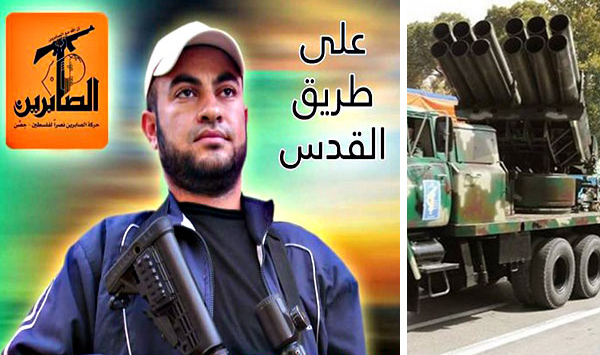
Al-Sabireen’s Gaza commander, Ahmed Sharif Al-Sarhi (left), was responsible for a series of shooting attacks on Israel before he was fatally shot in October 2015 by IDF snipers along the border with the Gaza Strip. The Iranians are also believed to have supplied their new terrorist group in the Gaza Strip with Grad and Fajr missiles (right) that are capable of reaching Tel Aviv.

Buoyed by the nuclear deal and the lifting of sanctions against Tehran, Al-Sabireen members are feeling optimistic. The group recently described these developments as a “victory” for all Muslims and proof of their “pride and strength.” Muslims should now unite, they said, in order to stand up to the “world’s arrogance and remove the Zionist entity from the land of Palestine.”

Indeed, Al-Sabireen appears to be redoubling its efforts to eliminate the “Zionist entity” and replace it with an Islamist empire. Toward that goal, the group is now seeking to extend its control beyond the Gaza Strip. The lifting of the sanctions against Iran coincided with reports that Al-Sabireen has infiltrated the West Bank, where it is working to establish terror cells to launch attacks against Israel.

According to Palestinian Authority security sources, Al-Sabireen has already located some West Bank Palestinians who were more than happy to join the group’s jihad against Jews and Israel.

PA security forces recently uncovered a terror cell belonging to Al-Sabireen in Bethlehem and arrested its five members. The suspects received money from the group’s members in the Gaza Strip in order to purchase weapons to attack Israeli soldiers and settlers in the West Bank.

Al-Sabireen is not the only Iranian proxy whose eye is on the West Bank. Last month, in the West Bank city of Tulkarm, Israeli security forces uncovered and broke up a terrorist cell commanded by Hezbollah, which was planning suicide bombings and shooting attacks. The Palestinian members of the cell had been taught by Jawed Nasrallah, the son of Hezbollah chief Hassan Nasrallah, how to carry out suicide bombings, assemble bomb vests, gather intelligence, and set up training camps.

All of this sounds eerily familiar. As it has spread its wings over Al-Sabireen and Hezbollah, Iran has done much the same with its other proxies such as the Houthis in Yemen and members of the Shiite communities in Saudi Arabia and Bahrain, all the while fomenting instability and gaining bases of local power.

Loosed from its sanction-based constrictions, Iran is now free to underwrite terror throughout the region. This is precisely what is happening in Lebanon, Syria, Yemen, Iraq and the West Bank and Gaza Strip.

Iran’s infiltration of the West Bank should serve as a red flag not only for Israel, but also for the U.S. and other Western powers. At the moment, there is little to be done to combat Iran’s presence in the Gaza Strip. But Iran on Israel’s West Bank doorstep is a flag of a different color.

An Israeli pullout, leading to a Hamas takeover of the West Bank, has been a subject of concern. Now, a growing number of Israelis and Palestinians are wondering if such a vacuum will provide an opening for Iran.

The future of the Middle East and Europe would be shockingly different if any Palestinian state were to fall into the hands of Iran’s Islamic extremists and their allies.

The Palestinians and all interested parties might remember that Al-Sabireen is — if nothing else — patient.

Khaled Abu Toameh is an award winning journalist based in Jerusalem.

Iran in Syria: Russia Took Over by Heshmat Alevi

  • It appears that Iran literally gained nothing from the Moscow conference, meaning that its participation was merely of a ceremonial nature.

  • “The regime in Tehran is the source of crisis in the region and killings in Syria; it has played the greatest role in the expansion and continuation of ISIS. Peace and tranquility in the region can only be achieved by evicting this regime from the region.” — Maryam Rajavi, President of the National Council of Resistance of Iran, and a leader of the opposition to Iran’s regime.

The recent three-party conference held in Moscow with the participation of Russia, Turkey and Iran came to a significant end. With mainstream media emphasizing how the U.S. Administration was completely sidelined in talks that discussed the future of Syria, a different perspective also sheds light on how Iran was sidelined to an unprecedented degree. Considering that this session ended with a document signed by all three parties, one can take a hard look at the results.

This document emphasizes Syria’s independence and territorial integrity as a multi-racial, multi-religious, non-sectarian, democratic and secular state; underscores the necessity of reaching a political solution; welcomes joint efforts in East Aleppo to evacuate civilians and armed rebels; highlights the need to expand a ceasefire across the country and facilitate access to humanitarian aid; supports a possible agreement between the Syrian opposition and the Syrian government; and accentuates continuing joint efforts against terrorism and especially the Islamic State (ISIS/ISIL), differentiating their forces from those of the armed democratic opposition.

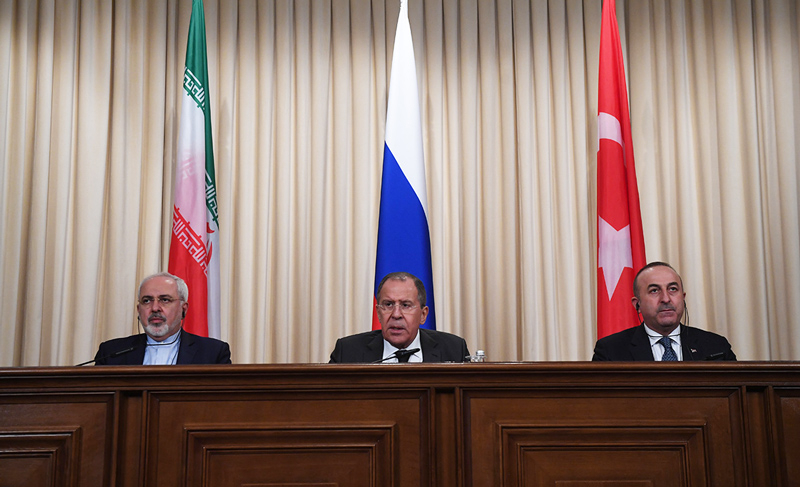
Russian Foreign Minister Sergey Lavrov (center) holds a joint press conference with Iranian Foreign Minister Mohammad Javad Zarif (left) and Turkish Foreign Minister Mevlut Cavusoglu (right) in Moscow, December 20, 2016. (Image source: Russia Ministry of Foreign Affairs)

A closer look brings us to a preliminary conclusion that most of the articles are clash Iran’s interests. For example, Iran was, and remains, fully against the safe evacuation of civilians and rebels from East Aleppo.

Iranian President Hassan Rouhani went so far as saying, “Various Islamic states… are worried about the fate of terrorists and seek their safe exit from Aleppo.”

In this document, there is no mention of the Assad regime or any language discussing its remaining in power. And importantly, while Iran went to great lengths to massacre all dissidents and annihilate the entire Syrian opposition under the pretext of fighting ISIS, this document specifically differentiates and recognizes the separate nature of ISIS and the Free Syrian Army.

The Moscow conference also emphasized the role of the United Nations in resolving the Syrian crisis, highlighting the necessity to abide by UN Security Council Resolution 2254. This resolution emphasizes the Security Council as the reference body, also enjoying support from the United States and Saudi Arabia. There is no reference to Assad’s future role; instead the resolution:

“expressed support for free and fair elections, pursuant to the new constitution, to be held within 18 months and administered under United Nations supervision, ‘to the highest international standards’ of transparency and accountability, with all Syrians — including members of the diaspora — eligible to participate.”

Taking these factors into consideration, it appears that Iran literally gained nothing from the Moscow conference, meaning that its participation was merely of a ceremonial nature.

The conference outcome makes it clear that Russia enjoys hegemony over Iran in Syria, and that Moscow has imposed its interests and road map on Tehran, leaving the mullahs no choice but to submit to the status quo. This setback of its hegemony seems a major reason why Iran needed to parade Revolutionary Guards Quds Force General Qassem Suleimani in Aleppo: perhaps to boost an iota of morale in its dwindling base of support.

On the ground, Iran’s hordes of Shiite militias relied completely on Russian air power to take even one step forward. This provides a clear picture of the road ahead.

To bring an end to Iran backing Assad’s atrocities, the international community and Middle East states need to begin fundamentally to cooperate in establishing a coalition, parallel to implementing economic and political pressures on Tehran. Companies investing in Iran should also recalculate their priorities.

Iranian opposition leader Maryam Rajavi, president of the National Council of Resistance of Iran, went even further to provide a solution for Syria and ISIS:

“The regime in Tehran is the source of crisis in the region and killings in Syria; it has played the greatest role in the expansion and continuation of ISIS. Peace and tranquility in the region can only be achieved by evicting this regime from the region.”

Iran may have enjoyed tactical gains in Aleppo. However, Russia apparently has separate, long-term interests in complete dissimilarity from those of Tehran. Russia has conducted secret direct talks with the Syrian opposition. To add insult to injury, Iran — viewing the Obama presidency as a golden era — is also concerned about the incoming presidency of Donald Trump and his administration, who seem to have strong views against Tehran.

“The fact that Trump has taken very firm positions against Iran, including threatening to rip apart the nuclear deal, has,” according to The Hill, “already terrified Tehran, representing a major contrast to the ‘golden era‘ under Obama.”

Heshmat Alavi is a political and rights activist. His writing focuses on Iran, ranging from human rights violations, social crackdown, the regime’s support for terrorism and meddling in foreign countries, and the controversial nuclear program. He tweets at @HeshmatAlavi & blogs at IranCommentary

Translate »
Skip to toolbar