

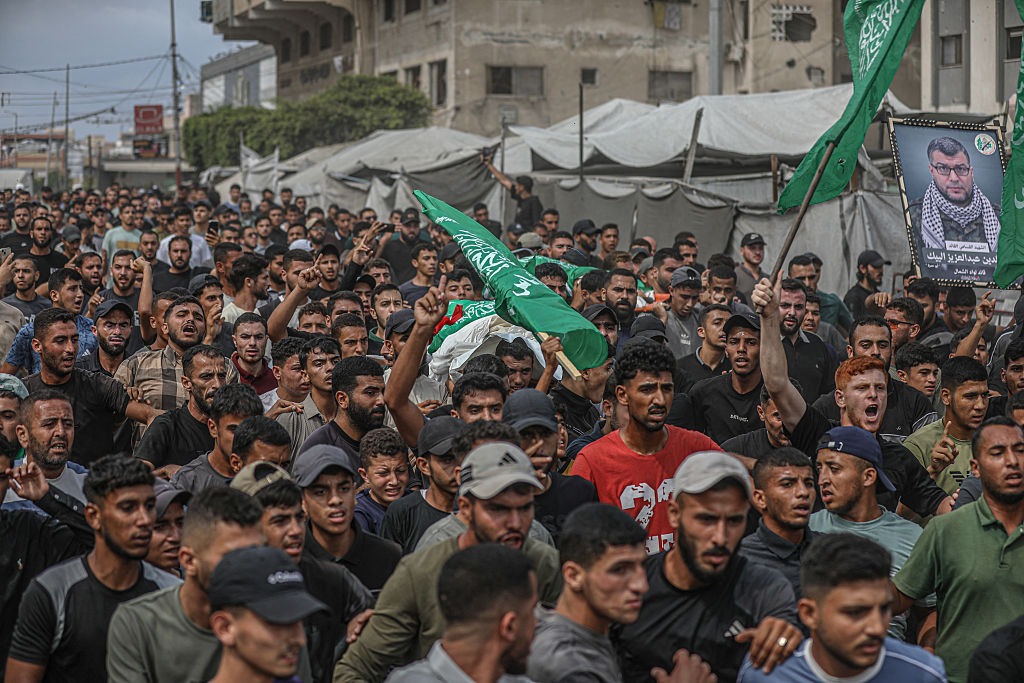
The chants matter because they reveal what speeches about peace and reconstruction conceal. These slogans raise a fundamental question for anyone discussing the future of the Gaza Strip: What exactly has changed?
The answer is particularly important because the international framework for the Gaza Strip explicitly calls for something very different.
US President Donald J. Trump’s 20-point peace plan states that Gaza is to become a “deradicalized terror-free zone” that poses no threat to its neighbors. The plan calls for the decommissioning of weapons, demilitarization and the establishment of an International Stabilization Force. It also envisages a process intended to change Gazan mindsets and narratives by emphasizing tolerance and peaceful coexistence.
On paper, the objective is peaceful coexistence. Public gatherings are proclaiming that Gaza belongs to Hamas and rejecting international forces.
This is the main problem facing any attempt to transform the Gaza Strip.
Reconstruction can rebuild buildings. It cannot dismantle an ideology.
The answer will determine whether Gaza’s reconstruction becomes part of a genuine transition toward stability, or whether reconstruction takes place alongside the reorganization of the same forces that brought the Hamas terrorists to power in the Gaza Strip and the region into war.
Has the ideological and military foundation for another October 7 massacre actually been removed?
On the eve of the October 7 anniversary, the world should pay close attention when people in the Gaza Strip say they want the October 7 massacre to happen again.
It is crucial to remember what senior Hamas official Ghazi Hamad said shortly after the October 7 massacre: “The Al-Aqsa Flood [what Hamas calls the October 7 massacre] is just the first time, and there will be a second, a third, a fourth, because we have the determination, the resolve, and the capabilities to fight.”
Nearly three years after Hamas-led terrorists invaded Israel on October 7, 2023, murdered roughly 1,200 people and abducted 251, some of the voices emerging from the Gaza Strip are sending a disturbing message: October 7 is regarded by Hamas and its supporters as an operation they plan to repeat.
Chants can be heard in the streets of the Gaza Strip during funeral processions for Hamas commanders and members killed by Israel: “October 7 will return! It is coming back!”
Others include: “Eid [holiday] for you, Eid; October 7 is the day of the Eid,” and “Gaza is all Hamas… Gaza is all Hamas.”
At one recent funeral, Hamas supporters chanted: “Listen, listen, all the people, all of Gaza is for Hamas, no international forces, only eternal Hamas.”
At another funeral they chanted:
“Put sword against sword… we are the men of Mohammad Deif!” (Referring to the slain commander-in-chief of the Al-Qassam Brigades).
“O martyr, rest, rest… we will continue the struggle!”
“Say Allah and raise your voices… either we liberate it [Palestine], or we die!”
At another procession, participants chanted: “Khaybar, Khaybar, O Jews… October 7 will return,” referring to the 628 CE Battle of Khaybar, an oasis near Medina inhabited by Jewish tribes who were besieged and defeated by forces under the Islamic Prophet Mohammed.
The chants matter because they reveal what speeches about peace and reconstruction conceal.
These slogans raise a fundamental question for anyone discussing the future of the Gaza Strip: What exactly has changed?
The answer is particularly important because the international framework for the Gaza Strip explicitly calls for something very different.
US President Donald J. Trump’s 20-point peace plan states that Gaza is to become a “deradicalized terror-free zone” that poses no threat to its neighbors. The plan calls for the decommissioning of weapons, demilitarization and the establishment of an International Stabilization Force. It also envisages a process intended to change Gazan mindsets and narratives by emphasizing tolerance and peaceful coexistence.
The Board of Peace’s July 30, 2026 roadmap, goes even further. It calls for the decommissioning of heavy weapons, military production sites, weapons depots and tunnels, and says that at the end of the process only the National Committee for the Administration of Gaza should hold, store, or control weapons in the Gaza Strip. The roadmap explicitly describes its objectives as a Gaza governed without Hamas control and without “rule by the gun,” under the principle of “One Authority, One Weapon, One Law.”
On paper, the international plan speaks about deradicalization. On the streets, the funeral chants coming from parts of the Gaza Strip present a dramatically different picture. Hamas supporters are chanting “October 7 will return.”
On paper, the objective is peaceful coexistence. Public gatherings are proclaiming that Gaza belongs to Hamas and rejecting international forces.
This does not establish that every Palestinian in the Gaza Strip shares these views. Gaza contains many Palestinians with different experiences, opinions, and political loyalties — and some perhaps afraid to express them. The continued public expression of these slogans nevertheless demonstrates that Hamas’s ideological message remains capable of mobilizing thousands of supporters in the Gaza Strip.
It is significant that there has not been a sustained, broad-based public revolt to displace Hamas as the dominant armed and political force in the Gaza Strip. There have been expressions of anger and opposition to Hamas, including calls for protests, but Hamas has demonstrated an ability to mobilize supporters publicly.
The London-based Asharq Al-Awsat newspaper reported that a planned June 26 mobilization against Hamas failed to attract significant participation, while Hamas continued to display flags and organize funerals for its members.
This is the main problem facing any attempt to transform the Gaza Strip.
Reconstruction can rebuild buildings. It cannot dismantle an ideology. New roads, hospitals, schools, housing projects, and economic opportunities cannot guarantee that the next generation will reject the ideology that produced October 7.
The deployment of international personnel cannot substitute for a fundamental change in the status of terrorist organizations such as Iran-backed Hamas and Palestinian Islamic Jihad.
Has the ideological and military foundation for another October 7 massacre actually been removed?
On the eve of the October 7 anniversary, the world should pay close attention when people in the Gaza Strip say they want the October 7 massacre to happen again.
It is crucial to remember what senior Hamas official Ghazi Hamad said shortly after the October 7 massacre:
“The Al-Aqsa Flood [what Hamas calls the October 7 massacre] is just the first time, and there will be a second, a third, a fourth, because we have the determination, the resolve, and the capabilities to fight.”
egretnewseditor@gmail.com