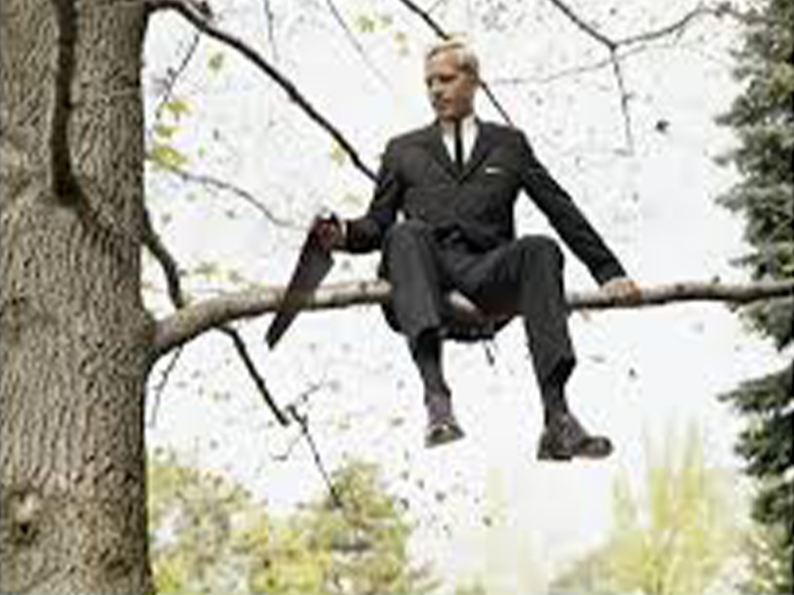

Abega barimo gutema ishami ry’igiti bicayeho

Abega barimo gutema ishami ry’igiti bicayeho

Abega bamaze iminsi barimo kugerageza gukora hacking bakoresheje ibigo bikomeye birimo Microsoft ndetse na bandi ba hackers bakomeye cyane, ariko bigafata ubusa. Email zanjye zose zirinzwe ni bigo 3 kandi byose nda More »

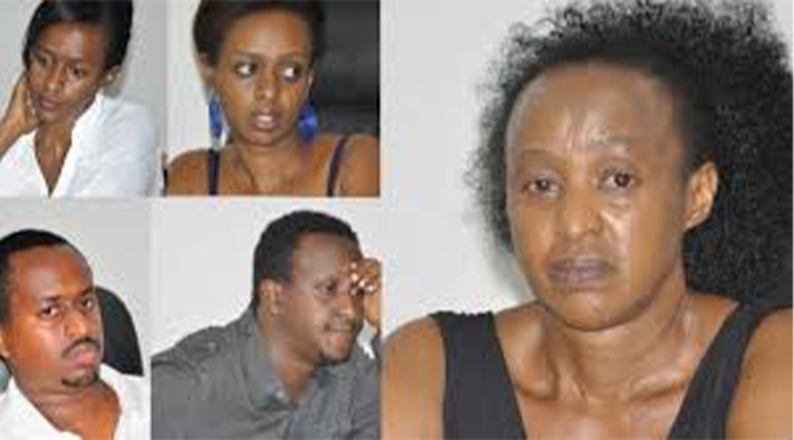
Abahungu 2 ba Rwigara Assinapol bajyanywe mu butayu bugufiya kwigishwa uko bubaha Uhoraho Uwiteka Imana Nyiringabo!!!

Abahungu 2 ba Rwigara Assinapol bajyanywe mu butayu bugufiya kwigishwa uko bubaha Uhoraho Uwiteka Imana Nyiringabo!!!

May 17, 2026 njyanwa mu iyerekwa mbona abahungu ba Rwigara Assinapol bombi bajyanwa mu butayu bugufiya bwa kure cyane mu cyigo cya gisirikare, bamaze ku kigeramo bamburwa imyenda yose basigara bambaye ubusa. More »

Imyigaragambyo iteganijwe mu gihugu cyose ejo ku wa mbere muri Kenya!!!

Imyigaragambyo iteganijwe mu gihugu cyose ejo ku wa mbere muri Kenya!!!

May 15, 2026 Ishyirahamwe rishinzwe ibikomoka kuri petrol EPRA na Leta ya Samuei William Ruto bazamuye ibiciro bya petrol diesel yazamuweho amashillingi 46.29 ksh naho fuel yazamuweho amashillingi 16.65 ksh kuri buri More »

Umuvumo w’inzara ku ngoma y’abega itera mu Rwanda!!!

Umuvumo w’inzara ku ngoma y’abega itera mu Rwanda!!!

Nuko ijambo ry’Uwiteka Imana Nyiringabo rikomeza kunzaho cyane, maze rirambwira riti, mwana w’umuntu, inteko ya bacamanza bo mu ijuru yemeje ko umukuru w’igihugu cy’ u Rwanda Paul Kagame acirwaho iteka rya burundu More »

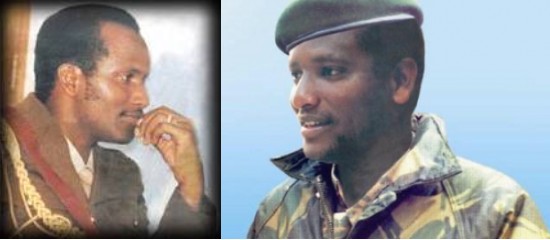
Inama y’inzika y’inzigo z’Abatutsi iyobowe na Gen. Gisa Fred Rwigema, ndetse na Col.Roza Kabuye yarayilimo

Inama y’inzika y’inzigo z’Abatutsi iyobowe na Gen. Gisa Fred Rwigema, ndetse na Col.Roza Kabuye yarayilimo

Aug 4, 2016 ijambo ry’Uhoraho Uwiteka Imana Nyiringabo rikomeza kunzaho cyane, maze rirambaza riti, mwana w’umuntu, genda ujye ahirengeye, maze nkwereke ibikorerwa mw’isi y’umwuka, bidashobora kuboneshwa amaso y’umuntu, ndagenda mpagarara kumusozi, maze uwanyerekaga More »


Turkey’s Fake War on Jihadis by Burak Bekdil

  • Last year, a Turkish pollster found that one in every five Turks thought that the Charlie Hebdo attack in Paris was the natural response to men who insulted Prophet Mohammed.


  • “Infidels who were enemies of Islam thought they buried Islam in the depths of history when they abolished the caliphate on March 3, 1924 … Some 92 years after … we are shouting out that we will re-establish the caliphate, here, right next to the parliament.” — Mahmut Kar, media bureau chief for Hizb ut-Tahrir Turkey.
  • At a March meeting with top U.S. officials, King Abdullah of Jordan accused Turkey of exporting terrorists to Europe. He said: “The fact that terrorists are going to Europe is part of Turkish policy and Turkey keeps on getting a slap on the hand, but they are let off the hook.”
  • And Turkey is the country its Western allies believe will help them fight jihadists? Lots of luck!

In theory, Turkey is part of the international coalition that fights the Islamic State (IS). Since it joined the fight last year, it has arrested scores of IS militants, made some efforts to seal its porous border with Syria and tagged IS as a terrorist organization. Turkish police have raided homes of suspected IS operatives. More recently, Turkey’s Interior Ministry updated its list of “wanted terrorists” to include 23 IS militants, and offered rewards of more than 42 million Turkish liras (more than $14 million) for any information leading to the suspects’ capture. But this is only part of the story.

On March 24, a Turkish court released seven members of IS, including the commander of the jihadists’ operations on Turkish soil. A total of 96 suspects are on trial, including the seven men who were detained but released. All are free now, although the indictment against them claims that they

“engaged in the activities of the terrorist organization called DAESH [Arabic acronym of IS]. The suspects had sent persons to the conflict zones; they applied pressure, force, violence and threats by using the name of the terrorist organization, and they had provided members and logistic support for the group.”

The release of terror suspects came in sharp contrast with another court decision that ruled for a trial, but while under detention, for four academics who had signed a petition calling for peace in Turkey’s Kurdish dispute. Unlike the IS militants, the academics remain behind bars.

The Turkish government, which controls the judiciary almost in its entirety, relies on Islamist grassroots supporters of various flavors — from Islamists and ‘lite jihadists’ to radicals.

Last year the Turkish pollster MetroPOLL found that one in every five Turks thought that the Charlie Hebdo attack in Paris was the natural response to people who insulted Prophet Mohammed [only 16.4% of Turks thought of the incident as an attack on freedom of expression]. Among the ruling Justice and Development Party’s (AKP) voters, the rate of approval of the attack was 26.4%; and only 6.2% viewed it as an attack on free speech. Only 17.8% of AKP voters thought the attack was the work of radical Islamists. Three-quarters of AKP voters thought Muslims were aggrieved by the attack; while as few as 15.4% thought the victims were the cartoonists who were murdered. Two-thirds of AKP voters thought attacks on Islam by Christian Crusaders were continuing.

The fact that key IS suspects are now free because the government may fear looking mean to its Islamist supporters only partly explains the appalling judicial rulings on jihadists and academics. “The suspects may be holding the Turkish government hostage … What if they threatened the authorities that they would reveal the government support for their organization in the past? You normally don’t walk free over such serious legal allegations,” observes one western diplomat in Ankara.

Russia has been claiming that Turkey keeps supporting the Islamic State through trading the jihadists’ oil, their main source of income. A new report claims that total supplies to terrorists in Syria last year was 2,500 tons of ammonium nitrate; 456 tons of potassium nitrate; 75 tons of aluminum powder; sodium nitrate; glycerine; and nitric acid. The report stated:

“In order to pass through the border controls unimpeded, effectively with the complicity of the Turkish authorities, products are processed for companies that are purportedly registered in Jordan and Iraq … Registration and processing of the cargo are organized at customs posts in the [Turkish] cities of Antalya, Gaziantep and Mersin. Once the necessary procedures have been carried out, the goods pass unhindered through the border crossings at Cilvegozu and Oncupinar.”

Turkey keeps playing a fake war on jihadist terrorists. At a March meeting with top U.S. officials, King Abdullah of Jordan accused Turkey of exporting terrorists to Europe. He said: “The fact that terrorists are going to Europe is part of Turkish policy and Turkey keeps on getting a slap on the hand, but they are let off the hook.”

In fact, the Turkish government’s secret love affair with various Islamist groups is not always so secret. In March, thousands of supporters of Hizb ut-Tahrir, a global Islamist group, gathered at a public sports hall in Ankara — courtesy of the Turkish government — to discuss the re-establishment of the Islamic caliphate. In his speech, Mahmut Kar, the media bureau chief of Hizb-ut Tahrir Turkey said:

“Infidels who were enemies of Islam thought they buried Islam in the depths of history when they abolished the caliphate on March 3, 1924 … We are hopeful, enthusiastic and happy. Some 92 years after … we are shouting out that we will re-establish the caliphate, here, right next to the parliament.”

(Hizb ut-Tahrir, viewed by Russia and Kazakhstan as a terrorist group, defines itself as a political organization aiming to “lead the ummah” to the re-establishment of the caliphate and rule with sharia law.)

Guess what else Turkey is doing while pretending to be fighting jihadists? Apparently, President Recep Tayyip Erdogan’s declared political ambition to “raise devout generations” seems to have geared up. Turkey’s Religious Affairs General Directorate (Diyanet), the ultimate official religious authority in the country, recently issued comic books to the nation’s children telling them how marvelous it is to become an Islamic martyr.
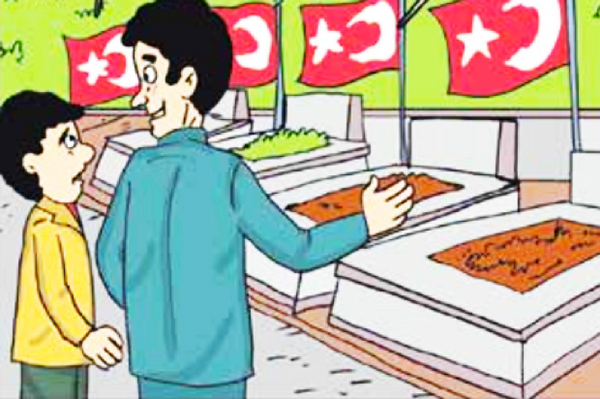
Turkey’s Religious Affairs General Directorate (Diyanet), the ultimate official religious authority in the country, recently issued comic books to the nation’s children telling them how marvelous it is to become an Islamic martyr.

One comic strip is a dialogue between a father and his son. “How marvelous it is to become a martyr,” the father says. Unconvinced, the son asks: “Would anyone want to become a martyr?” And the father replies: “Yes, one would. Who doesn’t want to win heaven?”

And this is the country its Western allies believe will help them fight jihadists? Lots of luck!

Burak Bekdil, based in Ankara, is a Turkish columnist for the Hürriyet Daily and a Fellow at the Middle East Forum.

© 2016 Gatestone Institute. All rights reserved. No part of the Gatestone website or any of its contents may be reproduced, copied or modified, without the prior written consent of Gatestone Institute.

Comment on this item

Name
Email Address
Title of Comments
Comments:

Note: Gatestone Institute greatly appreciates your comments. The editors reserve the right, however, not to publish comments containing: incitement to violence, profanity, or any broad-brush slurring of any race, ethnic group or religion. Gatestone also reserves the right to edit comments for length, clarity and grammar. All thoughtful suggestions and analyses will be gratefully considered. Commenters’ email addresses will not be displayed publicly. Gatestone regrets that, because of the increasingly great volume of traffic, we are not able to publish them all.

AddThis Sharing
321

Turkey’s Exhausting Zigzagging Between East and West by Burak Bekdil

  • “What is the moral of the story? Until a few weeks ago, the West was comfortably day-dreaming that, despite his foibles, Erdogan was a staunch U.S. ally and an eager EU candidate. After all, had he not, only recently, downed a Russian jet? Then, suddenly, what do we see? Putin and Erdogan kissing and making up …” — Fuad Kavur, London.

Turkey has been a republic since 1923, a multi-party democracy since 1946, and a member of NATO since 1952. In 1987, it added another powerful anchor into the Western bay where it wanted it to remain docked: It applied for full membership in the European Union (EU). This imperfect journey toward the West was dramatically replaced by a directionless cruise, with sharp zigzags between the East and West, after President Recep Tayyip Erdogan’s Islamist AKP party came to power in 2002. Zigzagging remains the main Turkish policy feature even at this day.

Until the summer of 2015 Turkey was widely known as the “jihad highway,” because of its systematic tolerance for jihadists crossing through Turkey into neighboring Syria to fight Erdogan’s regional nemesis, Syrian President Bashar al-Assad. Turkey supported various jihadist groups in the hope that they would help Ankara unseat Assad. Then, under pressure from its NATO allies, it decided to join the U.S.-led, international campaign to fight the Islamic State of Iraq and Syria (ISIS) in Syria. Feeling betrayed, ISIS started to blow up Turkish cities.

At the end of 2015, Turkey risked tensions with Russia in order to advance its pro-Sunni Islamist agenda in Syria. Russia, together with Iran, provided the lifeline Assad needed to stay in power while Turkey stepped up its anti-Assad campaign. In November, Turkey once again zigzagged toward the West when it shot down a Russian military aircraft, citing the violation of its airspace along its border with Syria. Turkey also threatened to shoot down any Russian aircraft that might violate its airspace again. It was the first time in modern history that a NATO ally had shot down a Soviet or Russian military airplane.

An angry Vladimir Putin, Russia’s president, imposed punishing economic sanctions, which cost the Turkish economy billions of dollars. Turkey started zigzagging again. In July 2016, Erdogan apologized for downing the Russian plane, and in August he went to Russia to shake hands for normalization. Once again, Russia is trendy for the Turks, and the West looks passé.

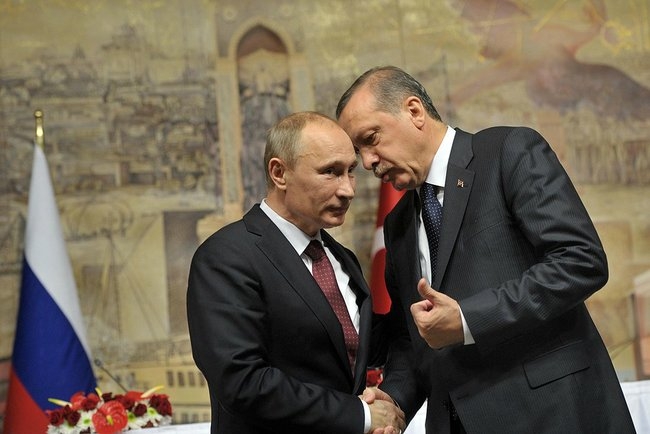
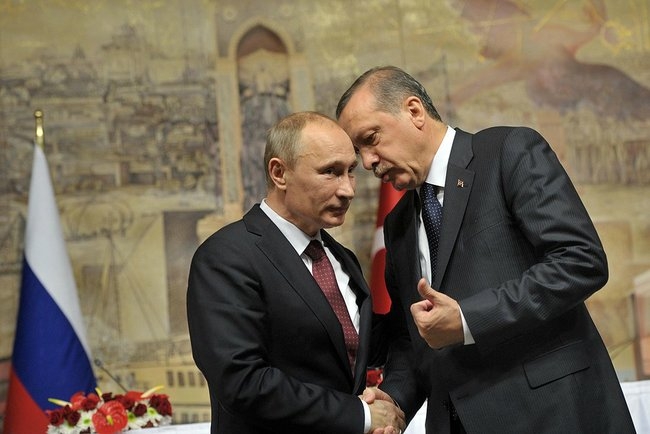
In July 2016, Erdogan apologized for downing the Russian plane, and in August he went to Russia to shake hands for normalization. Once again, Russia is trendy for the Turks, and the West looks passé. Pictured: Russian President Vladimir Putin with Turkey’s then Prime Minister Erdogan, meeting in Istanbul on December 3, 2012. (Image source: kremlin.ru)

Erdogan and his men are now accusing NATO and, in particular, the United States, of roles in the failed July 15 coup, which they claim is linked to a reclusive, U.S.-based Islamic scholar, Fethullah Gulen. According to Turkish Defense Minister Fikri Isik, NATO should sit down and think where it went wrong in response to the coup attempt in Turkey. According to Turkey’s justice minister, Bekir Bozdag, the United States would be sacrificing its alliance with Turkey to “a terrorist” (Gulen) if it refuses to extradite him.

Turkey’s newfound love affair with Russia will inevitably have repercussions in Syria, and that pleases Iran. “Not only will Turkey have to ‘digest’ that [Russian-Iranian-Syrian] line, it will have to join it, entering into a pact with Putin and the ayatollahs. Clearly, this is where Erdogan has decided is the best place to pledge his allegiance,” wrote Meira Svirsky at The Clarion Project. There are already signs.

Turkish Foreign Minister Mevlut Cavusoglu said that Turkey and Russia have similar views on the need for a ceasefire in Syria, the provision of humanitarian aid, and a political solution to end the crisis. That must have caused shy smiles in Moscow: the Turkish John Wayne on his knees begging to work on Syria only months after he threatened to shoot down any Russian aircraft and kick the Russians out of Syria. Now Turkey is calling on Russia to team up and carry out joint military operations in a bid to crush ISIS in Syria.

After the last Turkish zigzag, Turkey and Russia found where they converge: Putin accuses the West of violating agreements by expanding NATO to Russia’s borders and fomenting unrest in nearby Georgia and Ukraine, while in Turkey, the pro-Erdogan media accuses the U.S. of orchestrating the coup. There are more alarming signals from Ankara. Cavusoglu, the foreign minister, said that Turkey may look outside NATO for defense cooperation.

Fuad Kavur, a prominent London-based film director and producer, described the Turkish zigzag in a private letter (quoted with permission):

“Erdogan’s recent manoeuvrings remind me of how Hitler hoodwinked the West. Until four days before he invaded Poland, the West, ever sleepwalking, were utterly convinced Hitler was going to attack USSR, because he had come to power on an anti-Communist ticket. The West had a rude awakening only when, on 23 August 1939, Von Ribbentrop signed the Non-Aggression Pact with Molotov; and on Sept. 1, Hitler took half of Poland. Few days later, Stalin took the other half.

“What is the moral of the story? Until a few weeks ago, the West was comfortably day-dreaming that, despite his foibles, Erdogan was a staunch U.S. ally and an eager EU candidate. After all, had he not, only recently, downed a Russian jet? Then, suddenly, what do we see? Putin and Erdogan kissing and making up … It is a matter of ‘my enemy’s enemy…'”

From the beginning, Russia was too big for Turkey to bite. A few billion dollars of trade losses and friendly reminders from Western allies that Turkey should keep up to better democratic standards were sufficient to get Ankara kneel down — and perform another act of zigzagging. This, in all probability, will not be the last such act.

Burak Bekdil, based in Ankara, is a Turkish columnist for the Hürriyet Daily and a Fellow at the Middle East Forum.
Turkey’s Dangerous Moves in Iraq by Burak Bekdil

  • Turkey’s primary concern is not to drive ISIS out of Mosul but to make it a “Sunni-controlled city” after ISIS has been pushed out. And this ambition jeopardizes the planned assault on ISIS.Turkey’s pretext is that its troops are in Iraq to “fight ISIS.” That does not convince anyone.

In a span of five years Turkey has had serious political and military tensions with several countries in its vicinity: Israel, Syria, Russia, Jordan, Egypt, Cyprus and Greece. Most recently, Iraq has also joined the club of hostilities surrounding Turkey.

Despite the Iraqi government’s vehement requests that Turkey withdraw its troops in Iraq, Ankara shrugs it off and says it will maintain its military presence in the neighboring country for “Iraq’s stability.” What a nice neighborly gesture! Behind the Turkish indifference lies sectarian concerns and ambitions.

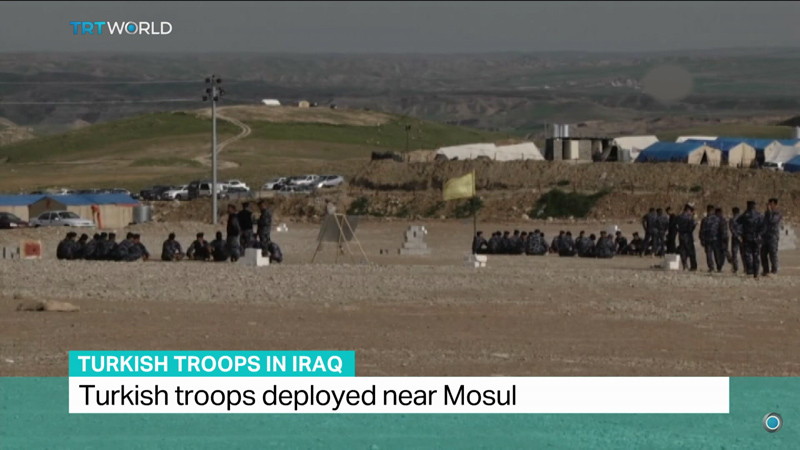
On October 1, Turkey’s parliament extended the mandate of Turkish troops deployed in Iraqi territory by one more year. The troops are stationed near Bashiqa in northern Iraq — as unwanted guests. That sparked a row with Baghdad and may further complicate the cold sectarian war between the Sunnis in the region, supported by Turkey, Saudi Arabia and Qatar, and their Shiite enemies, supported by Iran and the Shiite-controlled government in Baghdad.

(Image source: TRTWorld video screenshot)

Iraqi Prime Minister Haider al-Abadi renewed the call for the withdrawal of Turkish soldiers from his country and warned that Turkey’s military adventurism could trigger another war in the Middle East. He said: “We do not want to enter into a military confrontation with Turkey … The Turkish insistence on [its] presence inside Iraqi territories has no justification.”

The Iraqi parliament said in a statement: “The Iraqi government must consider Turkish troops as hostile occupying forces.”

Baghdad has also requested an emergency meeting of the United Nations Security Council (UNSC) to discuss the issue. The UNSC should “shoulder its responsibility and adopt a resolution to end to the Turkish troops’ violation of Iraq’s sovereignty,” said Ahmad Jamal, spokesman for the Iraqi Foreign Ministry.

The Turkish move does not annoy only Iraq, but also its Western allies. Col. John Dorrian, the spokesman for the US-led coalition of 65 countries that fight the Islamic State (ISIS), said that Turkish troops in Iraq are not acting as part of the alliance. Dorrian said that Turkey is operating “on its own” in Iraq. He added that the coalition position is that every unit “should be here with the coordination or and with the permission of the government of Iraq.”

By October 9, things started to get more annoying. Iraq’s Ambassador to Turkey, Hisham Alawi, said:

“If we do not reach some result, the Iraqi government will be forced to consider other options, and by doing so, Iraq would be practicing its right to defend its sovereignty and Iraq’s interests.”

Ankara remains defiant. Prime Minister Binali Yildirim said that Turkish troops would remain in Iraq. Turkey’s pretext is that its troops are in Iraq to “fight ISIS.” That does not convince anyone. Turkey’s intention is largely sectarian (read: pro-Sunni) and Yildirim admitted that in a not-so-subtle way when he said that the Turkish troops were in Iraq also “to make sure that no change to the region’s ‘demographic structure’ is imposed by force.”

Turkey fears that the aftermath of a planned assault on Mosul, Iraq’s second largest city and ISIS’s Iraqi stronghold, could see a heavy Shiite and Kurdish dominance in the Mosul area. Turkish Foreign Minister Mevlut Cavusoglu said: “Involving Shiite militias in the operation [against IS] will not bring peace to Mosul. On the contrary, it will increase problems.” Unsurprisingly Turkey’s pro-Sunni Islamists want Sunni dominance in a foreign country. This is not the first time they passionately do so.

The problem is that Turkey’s sectarian ambitions come at a time when the coalition is preparing a heavy offensive on ISIS-controlled Mosul. Turkey’s primary concern is not to drive ISIS out of Mosul but to make it a “Sunni-controlled city” after ISIS has been pushed out. And this ambition jeopardizes the planned assault on ISIS.

Iraqis think that the offensive to retake Mosul from ISIS is unlikely to begin as long as Turkish troops remain in Iraq. “I think that as long as these Turkish troops remain around Mosul, the operation to control the city will not start, or there must be a new agreement for the Turkish force not to take part in the offensive,” said Iraqi lawmaker Abdelaziz Hasan, also a member of the defense and security committee at the Iraqi parliament.

Turkey’s sectarian ambitions in neighboring Syria have ended up in total failure and bloodshed. Now Ankara wants to try another sectarian adventure in another neighboring and near-failed state, under the pretext of “bringing stability.” Yildirim said that Turkey “bears responsibility for stability in Iraq.” That is simply funny. You cannot bring stability to a country that looks more like a battleground of multiple religious wars than a country with just a few hundred troops.

Burak Bekdil, based in Ankara, is a Turkish columnist for the Hürriyet Daily and a Fellow at the Middle East Forum.
Turkey’s Dangerous Ambitions

Erdogan repeated on Dec. 11 that Turkey would not pull out its troops out of Iraq. In response, Iraq appealed to the UN Security Council to demand an immediate withdrawal of all Turkish troops from Iraq, calling Turkey’s incursion a “flagrant violation” of international law.


  • “For centuries, and even since the Mongols, sensible Islam has asked: ‘What went wrong? Why has God forsaken us, and allowed others to reach the moon?'” — Professor Norman Stone, prominent expert on Turkish politics.
  • With the inferiority complex and megalomania still gripping the country’s Islamist polity, Erdogan’s Islam is not sensible; it is perilous.

It is the same old Middle East story: The Shiite accuse Sunnis of passionately following sectarian policies; Sunnis accuse the Shiite of passionately following sectarian polices; and they are both right. Except that Turkey’s pro-Sunni sectarian policies are taking an increasingly perilous turn as they push Turkey into new confrontations, adding newcomers to an already big list of hostile countries.

Take President Recep Tayyip Erdogan’s recent remarks on the centuries-old Shiite-Sunni conflict: they amusingly looked more like a confession than an accusation: “Today we are faced with an absolute sectarianism. Who is doing it? Who are they? Iran and Iraq,” Erdogan said.

This is the same Erdogan who once said, “The mosques are our barracks, the domes our helmets, the minarets our bayonets and the faithful our soldiers….” Is that not sectarian?

So, with a straight face, the President of one sectarian country (Sunni Turkey) is accusing another country (Shiite Iran and Shiite-dominated Iraq) of being sectarian.

Erdogan went on: “What about the Sunnis? There are Sunni Arabs, Sunni Turkmen and Sunni Kurds [in Iraq and Syria]. What will happen to their security? They want to feel safe.”

Never realizing that its ambitions to spread Sunni Islam over large swaths of the Middle East, especially Syria and Iraq, were bigger than its ability to do so, Turkey now finds itself confronting a formidable bloc of pro-Shiite countries: Russia, Iran, Syria, Iraq, and (not to mention the much smaller Lebanon).

Even before the crisis with Russia that began on November 24 — over Turkey’s shooting down a Russian SU-24 along the Turkish-Syrian border — has shown any sign of de-escalation, another Turkish move had sparked a major dispute with neighboring Iraq.

Just when Turkey moved to reinforce its hundreds of troops at a military camp in Iraq, the Baghdad government gave an ultimatum to Ankara for the removal of all Turkish soldiers stationed in Iraq since last year. Turkey responded by halting its reinforcements. Not enough, the Iraqis apparently think. Iraq’s prime minister, Haider al-Abadi, said on December 7 that his country might turn to the UN security council if Turkish troops in northern Iraq were not withdrawn within 48 hours. Hadi al-Ameri, the head of the militant Shiite Badr Organization, threatened that his group would fight Turkish forces if Ankara continued its troop deployment.

Badr Brigade spokesman Karim al-Nuri put the Turkish ambitions in quite a realistic way: “We have the right to respond and we do not exclude any type of response until the Turks have learned their lesson … Do they have a dream of restoring Ottoman greatness? This is a great delusion and they will pay dearly for Turkish arrogance.”

Inevitably, Russia came into the picture. Russia’s UN ambassador, Vitaly Churkin, said he told the Security Council that Turkey was acting “recklessly and inexplicably” by sending troops across the border into Iraq without the consent of the Iraqi government. According to Russia, the Turkish move “lacks legality.”

All that fell on deaf ears in Ankara, as Erdogan repeated on Dec. 11 that Turkey would not pull out its troops from Iraq. In response, Iraq appealed to the UN Security Council to demand an immediate and unconditional withdrawal of all Turkish troops from northern Iraq, calling Turkey’s military incursion a “flagrant violation” of international law.

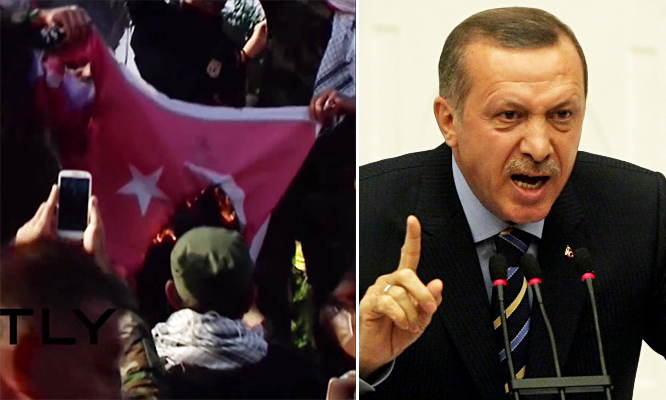
The next day, Shiite militia members gathered in Baghdad’s Tahrir Square to protest against Turkey. Crowds of young men in military fatigues, as well as some Shiite politicians, chanted against Turkish “occupation,” vowing they would fight the Turkish troops themselves if they do not withdraw. Angry protesters also burned Turkish flags.

Supporters of Iraqi Shiite militias burned Turkish flags in Baghdad this month, after Turkish President Recep Tayyip Erdogan refused to withdraw Turkey’s troops from northern Iraq.

Through its efforts to oust Syria’s non-Sunni president, Bashar al-Assad, and build a Muslim Brotherhood-type of Sunni Islamist regime in Damascus, Turkey has become everyone’s foe over its eastern and southern borders — in addition to having to wait anxiously for the next Russian move to hit it — not knowing where the blow will come from.

The confrontation with Russia has given Moscow an excuse to augment its military deployment in Syria and the eastern Mediterranean, and weaken allied air strikes against Islamic State (IS).

Russia has increased its military assets in the region, including deploying S-400 air and anti-missile defense systems, probably ready to shoot down the first Turkish fighter jet flying over Syrian skies.

Waiting for Turkish-Russian tensions to ease, and trying to avoid a clash between NATO member Turkey and Russia, U.S. officials have quietly put on hold a request for Turkey to more actively to join the allied air missions in Syria against IS. After having lost its access to Syrian soil, Turkey also has been declared militarily non grata in Iraq.

As Professor Norman Stone, a prominent expert on Turkish politics, explained in a recent article: “Erdogan’s adventurism has been quite successful so far, but it amounts to an extraordinary departure for Turkish foreign policy, and maybe even risks the destruction of the country. How on earth could this happen? The background is an inferiority complex, and megalomania. For centuries, and even since the Mongols, sensible Islam has asked: ‘What went wrong? Why has God forsaken us, and allowed others to reach the moon?'”

With the inferiority complex and megalomania still gripping the country’s Islamist polity, Erdogan’s Islam is not sensible; it is perilous.

Burak Bekdil, based in Ankara, is a Turkish columnist for the Hürriyet Daily and a Fellow at the Middle East Forum.
Turkey’s Conquest-Fetish Tales from Erdoganistan by Burak Bekdil

  • Turkey’s President Recep Tayyip Erdogan and his fellow Islamists are keen admirers of the idea that Muslim Turks capture lands belonging to other civilizations because, in this mindset, “conquest” means the spread of Islam.

  • “Look, now there is the Islamophobia malady in the West … [Its] aim is to stop [the further spread of Islam]. But they will not be able to succeed.” — Turkish President Recep Tayyip Erdogan, June 4, 2016.
  • In Erdogan’s narrative, Muslim Turks have never invaded foreign lands by the force of the sword. What they did was just conquering hearts. This is not even funny.

1071 is a very special year for Turkish President Recep Tayyip Erdogan — and his Islamist ideologues. Erdogan often speaks about his “2071 targets,” a reference to his vision of “Great Turkey,” on the 1000th anniversary of a battle that paved the Turks’ way into where they still live.

In 1071, the Seljuk Turks did not arrive in Anatolia from their native Central Asian steppes with flowers in their hands. Instead they were in full combat gear, fighting a series of wars against the Christian Byzantine [Eastern Roman] Empire and featuring a newfound Islamic zeal. The Battle of Manzikert in 1071 is widely seen as the moment when the Byzantines lost the war against the Turks: before the end of the century, the Turks were in control of the entire Anatolian peninsula.

Another divine date for Erdogan is May 29, 1453. That day saw the fall of Constantinople, capital of the Byzantine Empire, after an Ottoman army invaded what is today Istanbul, modern Turkey’s biggest city. The conquest of Constantinople was not a peaceful event either. The city’s siege lasted for 53 days and cost thousands of lives. The Byzantine defeat left the Ottoman armies unchecked, clearing the way for their advance into Christian Europe in the centuries to come. The long and violent Ottoman march into Europe came to a halt in 1683, when the Ottomans were defeated during the siege of Vienna. By then the Ottomans were in control of north Africa, most parts of the Middle East and central and eastern Europe, totaling 5.2 million square kilometers of land.

On every May 29, the Turks, proud of being — possibly — the world’s only nation that celebrates the capture by the sword of their biggest city from another civilization, take to the streets for grand ceremonies. The 563th anniversary of the conquest was celebrated with a major event created by a team of 1,200 people. It saw a 563-man Mehter concert [an Ottoman military band], a show by the Turkish Air Force aerobatics team, special conquest celebrations, a fireworks display, live broadcasts in six different languages and the world’s largest 3D mapping stage used to reenact the conquest.

There is more than enough evidence about the Turkish Islamists’ “conquest-fetish.” Turkey’s leaders have too often spoken of “liberating Jerusalem and making the city the capital of an independent Palestine.”

In September, then prime minister Ahmet Davutoglu, another Islamist, said:

“By Allah’s will, Jerusalem belongs to the Kurds, the Turks, the Arabs, and to all Muslims. And as our forefathers fought side by side at Gallipoli, and just as our forefathers went together to liberate Jerusalem with Saladin, we will march together on the same path [to liberate Jerusalem].”

Erdogan and his fellow Islamists are keen admirers of the idea that Muslim Turks capture lands belonging to other civilizations because, in this mindset, “conquest” means the spread of Islam. That is hardly surprising: political Islam typically features a tendency to spread to non-Islamist or non-Muslim parts of the world. But the way Erdogan defends “conquest,” even in the year 2016, looks just too ridiculous.

On June 4 Erdogan was addressing students at a theology faculty. In his speech he said:

“When we look at the way Islam has spread to the world we see that it rather features the conquest of ‘hearts’ rather than conquest by the ‘sword’… Look, now there is the Islamophobia malady in the West … [Its] aim is to stop [the further spread of Islam]. But they will not be able to succeed.”

Then he advised the students:

“Just like our [Turkish] arrival into Anatolia, just like the conquest of Istanbul … I know you will be behaving with the same consciousness … A ‘New Turkey’ will rise on your shoulders … [to succeed] you must reproduce. God [commands] you to have at least three children.”

It is amazing that Erdogan still has the power to shock — in absurdity — even the most seasoned Erdogan observers. In his narrative, Muslim Turks have never invaded foreign lands by the force of the sword. What they did was just conquering hearts. This is not even funny.

And what about God’s commandment for at least three children? There is not a single verse in the Koran about the ideal size of a Muslim family. There is not a single hadith that commands three, four or no children, apart from a dubious source which quotes Prophet Mohammed as advising Muslims that when the day of judgment has arrived, the ummah should be a large tribe.

On June 4, Turkish President Recep Tayyip Erdogan addressed university students, saying, “Just like our [Turkish] arrival into Anatolia, just like the conquest of Istanbul … I know you will be behaving with the same consciousness … A ‘New Turkey’ will rise on your shoulders … You must reproduce. God [commands] you to have at least three children.”

But things in Turkey are not progressing in the way Erdogan wishes. Official figures show that Turkey faces the prospect of an aging population. According to the government’s statistics department, the fertility rate in Turkey fell to 2.14 children per woman in 2015, from 2.37 in 2001. “Turkey is one of the fastest aging countries in the world,” says Didem Danis, an academic. By 2023, 10.2% of the Turkish population will be made up of people aged 65 years and over — compared to 7.7% in 2013.

The Turks have never invaded foreign lands by the sword; Turkish students of theology should prepare to conquer other lands; God commands Muslims to have at least three children; and Turkey will rise to its glorious Ottoman past thanks to a rapidly growing population… these are the fairy tales from Erdoganistan.

Burak Bekdil, based in Ankara, is a Turkish columnist for the Hürriyet Daily and a Fellow at the Middle East Forum.
Translate »
Skip to toolbar