
Broken Britain

Broken Britain

[M]y father did not move to England in the expectation that its denizens were fluent in Muslim culture, or that there would be a mosque on every street. He did not feel More »

Gaza: Can ‘Peacekeepers’ and ‘Monitors’ Succeed Except in Wishful Thinking?

Gaza: Can ‘Peacekeepers’ and ‘Monitors’ Succeed Except in Wishful Thinking?

Hezbollah used UNIFIL’s peacekeepers as “shields” to deter any Israeli military activity and prevent compliance in case a peacekeeper might be hit. Israel was forced to just sit and watch while Hezbollah More »

Ibintu byakomeye cyane,nyuma yo kumva yuko Trump yifuza guhura n’umucamanza uca imanza zitabera z’Uhoraho Uwiteka Imana Nyiringabo kw’isi ya bazima!!!

Ibintu byakomeye cyane,nyuma yo kumva yuko Trump yifuza guhura n’umucamanza uca imanza zitabera z’Uhoraho Uwiteka Imana Nyiringabo kw’isi ya bazima!!!

Dec 15, 2025 njyanwa mu iyerekwa mbona ibitero bya ba za magigiri hamwe na barushimusi (hackers) bahawe ikiraka n’umwana w’umwega Umwakagara Paul Kagame kugirango bashake uko bakubita hasi ikinyamakuru www.inyangenewss.com More »

Adeline Mukangemanyi Rwigara alimo kurindagiza abanyarwanda!!!

Adeline Mukangemanyi Rwigara alimo kurindagiza abanyarwanda!!!

1 Timothy 3:1-12 If anyone wants to provide leadership in the church, good! But there are preconditions: A leader must be well-thought-of, committed to his wife, cool and collected, accessible, and hospitable. More »

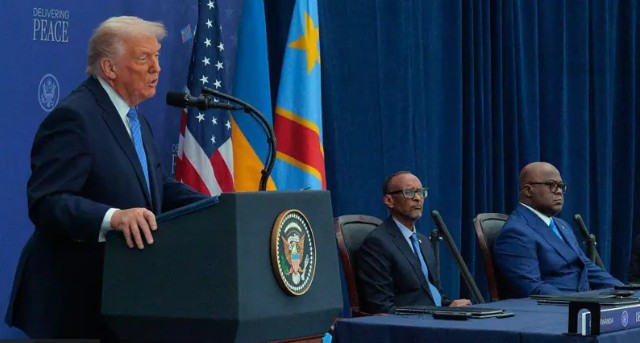
Donald Trump arashaka guhura n’Umwami Kigeli Ndoli uca imanza zitabera kw’isi yabazima!!!

Donald Trump arashaka guhura n’Umwami Kigeli Ndoli uca imanza zitabera kw’isi yabazima!!!

Dec 14, 2025 ijambo ry’Uhoraho Uwiteka Imana Nyiringabo rikomeza kunzaho kandi cyane, maze rirambwira riti, Umwami Kigeli Ndoli, Donald Trump yasabye ko bakwiye kuguhamagara ukaza mukabonana maze ukumusobanurira umurimo ukora ujyanye no More »


Sweden’s Holy War on Children’s Books by Judith Bergman

  • Taken to its extremes, the urge to cleanse a culture of elements that do not live up to the politically correct orthodoxy currently in political vogue unsettlingly echoes the Taliban and ISIS credos of destroying everything that does not accord with their Quranic views. The desire “not to offend,” taken to its logical conclusion, is a totalitarian impulse, which threatens to destroy everything that disagrees with its doctrines. Crucially, who gets to decide what is offensive?

  • The question arises: How much purging and expiation will be needed to render a country’s culture politically correct?
  • “When we have days of carnivals and music the goal is that these days should be experienced as positive by everyone. The Swedish flag is not allowed as part of carnival dress. … Positive and bright feelings must be in focus. … School photos must obviously be free of national symbols.” — Swedish school in Halmstad.
  • Rome covered up its classical nude statues for a visit from Iran’s president, Hassan Rouhani, in January 2016. A decade ago, who would have even imagined such sycophancy?

In 1966, one of Sweden’s most popular children’s writers, Jan Lööf, published Grandpa is a Pirate, an illustrated children’s book, which featured, among other characters, the wicked pirate Omar and the street peddler, Abdullah. The book has been a bestseller ever since, and has been translated into English (as My Grandpa is a Pirate), Spanish, French and other languages. Ten years ago, 100,000 copies of it were even distributed to the Swedish public with McDonald’s Happy Meals, as part of an initiative to support reading among children.

Ah, but those were the days of yesteryear! Now, fifty years later, the book is no longer tolerable. The now 76-year-old author told Swedish news outlets that his publisher recently said that unless he rewrites the book and changes the illustrations, it will be taken off the market. The publisher also threatened to withdraw another of his books unless it is redone: it features an illustration of a black jazz musician who sleeps with his sunglasses on.

Lööf’s publisher, the Swedish publishing giant Bonnier Carlsen, says that it has not yet made a final decision and that it only views the rewriting and re-illustrating of the books as “an option.” There is no doubt, however, that they consider the books in question extremely problematic.

“The books stereotype other cultures, something which is not strange, since all illustrations are created in a context, in their own time, and times change,” said Eva Dahlin, who heads Bonnier Carlsen’s literary department.

“But if you come from the Middle East, for instance, you can get tired from rarely being featured on the good side in literary depictions. Children’s books are special because they are read over a longer period of time and the norms of the past live on in them, unedited. As an adult, one may be wearing one’s nostalgic glasses and miss things that could be seen as problematic by others.”

Dahlin further explained that the publishing house spends a lot of time reviewing older publications, to check if such “problematic” passages occur. She added that the publishing house does not check for only culturally sensitive passages:

“There are many female editors, and therefore we have probably been more naturally aware of gender-biased depictions than these type of questions. But now we have better insights and a greater awareness of these issues.”
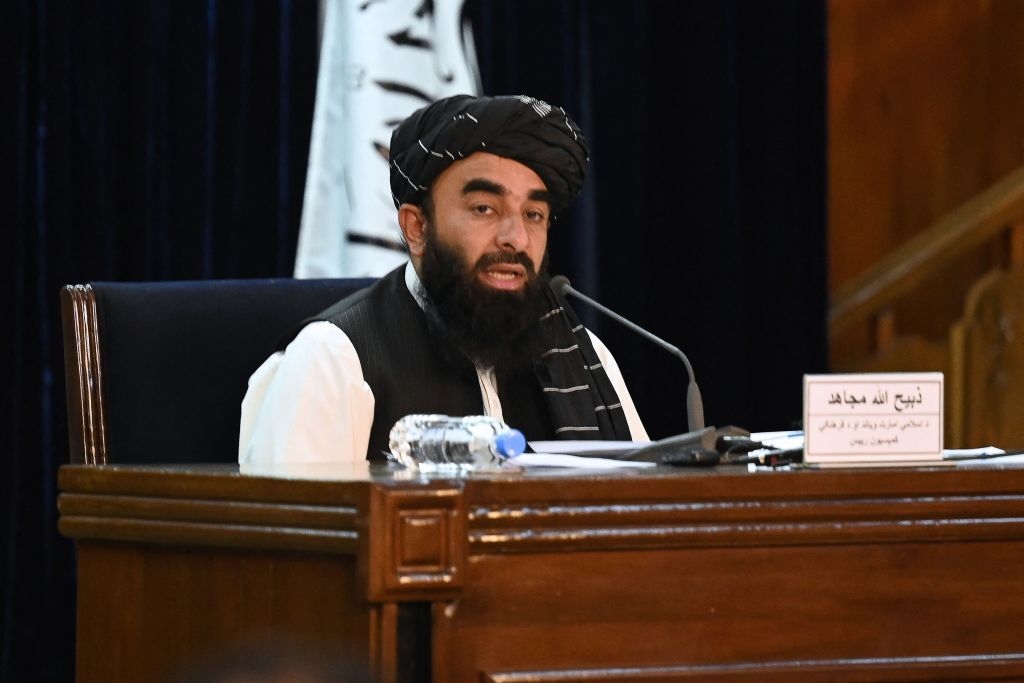
One of Sweden’s most popular children’s writers, Jan Lööf, was recently told by his publisher that unless he makes his bestselling 1966 book, Grandpa is a Pirate, more politically correct by rewriting it and changing the illustrations, it will be taken off the market.

Sweden is no stranger to “literary revisions” of this kind, or other cultural revisions in the name of political correctness. Both Pippi Longstocking and other children’s books have gone through assorted revisions or have even been taken off the market. In the Pippi Longstocking television series, a scene in which Pippi squints her eyes to look Chinese has been edited out altogether, so as not to offend anyone. In 2013, a popular, award-winning Danish children’s book, Mustafa’s Kiosk, by Jakob Martin Strid, was taken off the market in Sweden after complaints on Swedish social media that it was racist and “Islamophobic.” Ironically, the author wrote it in 1998, when he was staying in Indonesia, the world’s most populous Muslim country, as “an anti-racist statement.” Tellingly, the book had been on the Swedish market since 2002 with no complaints. In his response to the criticism, the Danish writer noted that an equal and non-racist society only comes about “when you are allowed to make (loving) fun of everyone.” “I also make fun of Norwegians,” he added.

In 2014, after complaints on Swedish social media that some of its candy was “racist,” the Haribo company decided to change one of its products, “Skipper Mix,” which consisted of candies shaped in the form of a sailor’s souvenirs, including African masks.

The question arises: How much purging and expiation will be needed to render a country’s culture politically correct?

That question raises an even bigger one: How high is the price of political correctness in terms of “cleansing” the past and present of perceived slights, anywhere, to just about anyone?

Taken to its extremes, the urge to cleanse a culture of elements that do not live up to the politically correct orthodoxy currently in political vogue unsettlingly echoes the Taliban and ISIS credos of destroying everything that does not accord with their Quranic views. The desire “not to offend,” taken to its logical conclusion, is a totalitarian impulse, which threatens to destroy everything that disagrees with its doctrines. Crucially, who gets to decide what is offensive?

What begins innocently enough, by taking out passages from books that may hurt someone’s feelings, can end up turning into something far more sinister, as it indeed has in Sweden. Former Swedish Prime Minister Frederik Reinfeldt famously stated in 2014 that Sweden belongs to immigrants, not to the Swedes who have lived there for generations. He thereby communicated that he believes the future of Sweden will be shaped by non-Swedes, showing a curious contempt for his own culture.

This contempt has spread fast throughout official Sweden. In 2014, a Swedish school in Halmstad forbade displaying the Swedish flag, after a student painted his face in the Swedish colors for a carnival. In its new rules, the school specified why:

“Most students look forward to school traditions. When we have days of carnivals and music the goal is that these days should be experienced as positive by everyone. The Swedish flag is not allowed as part of carnival dress. … Positive and bright feelings must be in focus. … School photos must obviously be free of national symbols.”

However, the “precedent” for such rules had already been set ten years prior, in 2004, at a school in Vaargaarda, when two girls had worn printed sweatshirts which happened to display the Swedish flag and the word “Sweden.” They were told that this kind of clothing was not allowed at school. One of the girls told reporters that singing the national anthem had also been forbidden at the school.

In 2012, two members of Sweden’s parliament suggested that statues of the Swedish Kings Carl XII and Gustav II Adolf should be removed, because they represent a time when Sweden was a great military power, “a dark time in our country as well as in other countries, which were affected by Swedish aggression,” as the MPs wrote in the motion. Instead, the MPs suggested, the squares of central Stockholm should be adorned in a way such that they “signal peace, tolerance, diversity, freedom and solidarity.”

In 2013, a Baroque painting of the nude goddess Juno was removed from the restaurant of the Swedish parliament, ostensibly to avoid offense to feminist and Muslim sensibilities.

The above should not be discarded as crazy practices peculiar to Sweden. On the contrary, they present a perfect case-study of the consequences of politically correct culture driven to the extreme.

Indeed, these consequences are already proliferating across the Western world. One particularly noteworthy instance took place when Iranian president Hassan Rouhani visited Rome in January 2016. To prevent Rouhani having “a hormonal shock and ripp[ing] up the freshly signed contracts with our Italian industries,” as one Italian columnist, Massimo Gramellini, wrote, Rome covered up its classical nude statues. Who would have even imagined such sycophancy a decade ago?

In Britain, students have recently campaigned for the removal of symbols of British imperialism, such as a statue of Cecil Rhodes at Oxford University. These students claim the campaign is not only about the statue itself, but that it is “…a campaign against racism at Oxford, of which the Rhodes statue is a small but symbolic part.” Already in 2000, the London Mayor Ken Livingstone suggested that statues of two 19th-century British generals should be removed from Trafalgar Square in London, based on his own ignorance:

“The people on the plinths in the main square of our capital city should be identifiable to the generality of the population. I haven’t a clue who two of the generals there are or what they did. I imagine that not one person in 10,000 going through Trafalgar Square knows any details about the lives of those two generals. It might be time to look at moving them and having figures ordinary Londoners and other people from around the world would know.” The problem with all this, of course, is that most of London’s wealth and greatness in terms of art and architecture is due largely to British colonialism, so the question is just how many buildings would be left standing in the British capital, if one were to take this issue and bring it to its logical conclusion.

The trouble with wanting to scrub the cultural and historical slate clean, as it were, is, of course, that countries cannot just press “delete” on their culture and history. Such a move would entail not just the removal of books, paintings and statues, but a complete purge. Those who truly care for history will know that this experiment has already been attempted, not once but several times over, by the various communist and Nazi movements of the twentieth century. While there is little comparison between those movements and the culture of political correctness, the impulse governing them all nevertheless remains the same: To forge and impose one singular “truth” on everyone, rooting out everything that does not fit the utopian mold. That is neither “diverse” nor “tolerant.”

Judith Bergman is a writer, columnist, lawyer and political analyst.
Sweden’s Afghan “Rapefugees” by Ingrid Carlqvist

  • Some 90 young men — “mostly Afghan refugee kids,” according to police — were apprehended in connection with the mass sexual assaults at the concert.

  • A recurring theme in recent articles by prominent feminists is the assertion that ethnic Swedish men act exactly the same as migrant gang-rapists.
  • One can draw only one conclusion: Feminists would rather protect Muslim men from criticism than protect Swedish women from sexual assaults.
  • None of the women’s shelters would admit that the mass sexual abuse of Swedish women might have anything to do with the perpetrators’ ethnicity or religion. They did not wish to “generalize,” they said — then hung up.
  • What Swedish politicians intend to do about the “Rapefugees” that are now in the country is anyone’s guess.

On New Year’s Eve, the same kind of mass sexual assaults that happened to women in Cologne — in Arabic called the “Taharrush” game — also took place in Sweden, but the police and the media have chosen to bury the information. The men, it turned out, were mainly Afghan, and claiming to be “unaccompanied refugee children.”

In reality, many of them are much older than 18, and are now commonly referred to with the recently coined name, “Rapefugees,” rather than “refugee children.”

It recently emerged that the Immigration Service urged its administrators to accept as a “child” everyone who looked under the age of 40 — apparently without any thought as to how inappropriate it is to place grown men in elementary and secondary schools with teenage girls. As Sweden — until December — kept its doors wide open to the migrants of the world, the country has accepted vastly more asylum seekers than its Nordic neighbors. Statistics for 2012-2015 are available via Eurostat, and provide the following statistics on the number of migrant arrivals:

  • Sweden: 342,635
  • Norway: 63,370
  • Denmark: 41,290
  • Finland: 40,470
  • Iceland: 675

Many who seek asylum in Sweden come from war-torn Syria: 51,338 in 2015. Afghanistan comes in at second place with 41,564 for the last year — an increase of a staggering 1,239% compared to 2014. Most of the Afghans seeking asylum claim to be children, and are therefore fast-tracked to being admitted within six months of the asylum application.

A few days after the story broke on the “Circle of Hell” attacks in Cologne, the alternative media website Nyheter Idag revealed that the respected daily newspaper, Dagens Nyheter, had known about similar attacks at a music festival in Stockholm in August 2015, but had declined to write about it.

Possibly to defend itself against accusations of a cover-up, Dagens Nyheter furiously attacked the Stockholm police. The newspaper claimed that the police had refused to corroborate reports of the attacks, thus tying the publishers’ hands and preventing the newspaper from running the story. Dagens Nyheter even claimed that a high-ranking police officer said, “This is a sore spot. Sometimes we are afraid to tell the truth because that might benefit the Sweden Democrats. The police do need to take responsibility for this.”

The police have accepted the blame — partly. The National Police Chief, Dan Eliasson, has now been tasked with investigating why the information was withheld.

Political decisions are not supposed to be made by the police. The leader of the Sweden Democrats Party, Jimmie Åkesson, reacted strongly to his party even being mentioned in this context, and demanded that National Police Chief Eliasson immediately be removed from office. Eliasson has long been a controversial figure. He started his career as a bass player in the punk rock band Bad Boo Band, best known for the radio hit song “Knulla i Bangkok” (F**king in Bangkok”), released in 1979. After his music career faded, Eliasson pursued a career in politics and public administration, and worked closely with several government ministers of the Social Democrat Party. When the Social Democrats lost the election in 2006, he was appointed Director General of the Immigration Service (2007-2011); then became Director General of the Social Security Service. In January 2015, he was appointed National Police Chief.

Despite such a roaring career, Eliasson has, on several occasions, made a spectacle of himself. In June 2007, the former Chancellor of Justice, Göran Lambertz, revealed that Eliasson, then State Secretary with the Justice Department, tried to get Lambertz to stop criticizing flaws in the Swedish judicial system. Eliasson’s request came after the Chancellor of Justice had initiated a report on the many Swedish men who had been wrongly convicted, mainly of sex crimes.

“I particularly remember meeting Bodström’s [then Minister of Justice] State Secretary in May 2006,” Lambertz said in a radio interview. “Eliasson made it clear that the minister would publicly renounce me if I did not tone down my criticism. I perceived this as undue influence.”

As head of Social Services, Eliasson tweeted in February 2014 that the mere sight on TV of the Sweden Democrats’ party leader, Jimmie Åkesson, made him physically sick. And now Eliasson is supposed to head an investigation into why the police withheld information on how “Rapefugees” attacked Swedish girls at the music festival “We Are Sthlm” [short for Stockholm] in August 2015?

When the news of the mass sexual assaults finally broke in early January, it was clear that the men involved had been so-called “unaccompanied refugee children.” Some 90 young men were apprehended by the police in connection with the sexual assaults. “According to an internal police report,” Dagens Nyheter wrote, “there was a large group of young people, ‘mostly Afghan refugee kids’, who stood out at the concert.”

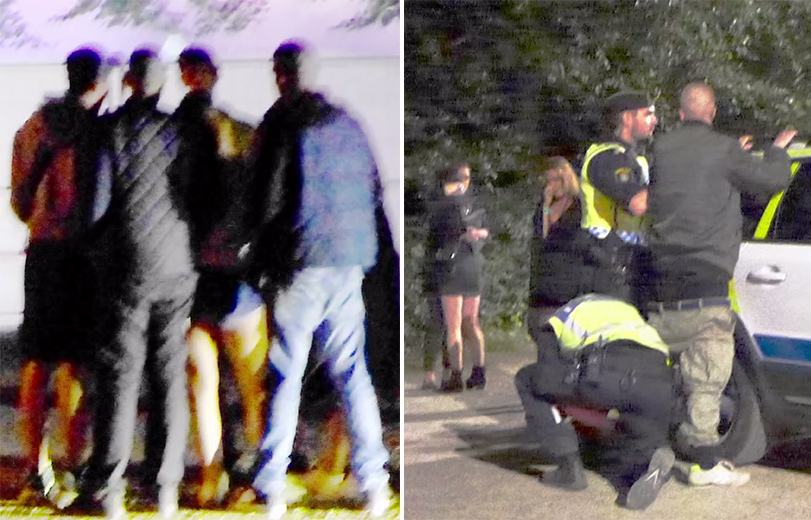
In a similar scandal, it was also recently revealed that Swedish girls were sexually assaulted by groups of young men “of foreign background” in the summer of 2015, during a music festival in Malmö’s Pildammsparken park. The photographer Freddy Mardell told internet radio station Granskning Sverige that he witnessed the chaos, with crying, hysterical girls. Mardell took photographs and offered them to local daily newspaper, Kvällsposten. The newspaper declined to publish them.

Scenes from a Malmö summer music festival… Left: Four young men surround and sexually assault a young woman. Right: Police arrest a suspect, as sexual assault victims cry in the background. The photographer reported that Swedish girls were sexually assaulted by groups of young men “of foreign background.”

It is also now clear that girls were attacked by large groups of Muslim men on New Year’s Eve in the Swedish cities of Kalmar and Malmö as well. The daily newspaper Kvällsposten reported that “gangs of young men surrounded inebriated girls on New Year’s Eve in Malmö.” Incidents happened in several locations in Malmö city, around the King’s Park and Central Station.

One police report read: “Something that stood out compared to earlier years was that a couple of hundred that I perceive as ‘unaccompanieds from Afghanistan’ drifted around the city, causing mayhem. There were several cases of large gangs surrounding mostly intoxicated girls/women and molesting them.” In Kalmar, where people had gathered in the square, Larmtorget, to celebrate, several girls were subjected to sexual molestation. So far, 16-17 complaints have been filed to the police.

“Lisa” told the local paper, Barometern:

“We stood at the edge of the square at first, but we noticed immediately how many men were in the square and when we went out there, things got really unpleasant. These were men who did not speak Swedish, men of all ages. They surrounded us and started groping; they also took hold of people’s heads and forcibly kissed their cheeks and foreheads. When we told them to leave or stop, they just laughed at us and asked ‘What have I done?’ We have all reported this to the police. It is outrageous that one should have to be afraid to go out at night or ride a bus alone in the evening. And we are not the only ones who have had this experience; I have girlfriends in Kalmar who say that they would rather not go out by themselves after dark. One thing is for sure, I will never celebrate New Year’s in Kalmar again, I would rather stay with my parents at home.”

Swedish feminists appear to be the group least upset by the “Rapefugee” attacks. They turn their backs on the victims by refusing to acknowledge that mass sexual abuse such as Taharrush is part of Sweden’s new reality.

During the past week, newspapers have been overflowing with opinion pieces in which various feminists claim that these attacks have nothing to do with religion or ethnicity, but with the bare fact that the perpetrators are men. One can draw only one conclusion: Feminists would rather protect Muslim men from criticism than protect Swedish women from sexual assaults. A recurring theme in the articles is the assertion that ethnic Swedish men act exactly the same as migrant gang-rapists.

Remarks by feminists go:

The last article was written by Gudrun Schyman, an ex-communist and current leader of the Feminist Initiative Party. In an interview with the podcast, “The Feminist Inspection,” Schyman said that mass sexual assaults are “nothing new” but “have been around for a very long time in all of our countries. “That is just how it is,” Schyman claimed, “men take liberties when anonymity and proximity enable them. I do not think it has accelerated, it is just that the propensity to report it has increased.”

Viktor Banke, a (male) feminist and lawyer, lamented in the free daily, Metro, that the attacks “play right into the hands of the Sweden Democrats… If necessary,” he wrote, “we should be able to talk about a perpetrator’s background. But we cannot afford to let the debate on the vulnerability of women be hijacked by people who take an interest in women’s rights only when they smell a perpetrator of another skin color.”

Gatestone Institute called a large number of women’s shelters and asked them what they thought about the mass sexual abuse of Swedish women. None would admit that the abuse might have anything to do with ethnicity or religion. They did not wish to “generalize,” they said; then, as soon as the question of ethnicity or religion was mentioned, they hung up.

In Norway, however, the police are well aware of the differences between Western and Islamic views of women. Eivind Borge, head of the Tactical Intelligence Department of the National Criminal Investigation Service (Kripos), told the daily newspaper Aftenposten that attacks like those in Sweden and Germany have, to his knowledge, not yet taken place in Norway, but that the police are prepared: “A lot of asylum seekers who have come to Norway during the last few months come from countries where the culture is quite different from ours. Many have grown up in cultures where there is a higher acceptance of various kinds of sexual harassment of women in public places.”

Benedicte Bjørnland, Chief of the Norwegian Police Security Service (PST), recently spoke at the “People and Defense” (“Folk och Försvar“) conference in Sweden. “You cannot assume,” she said, “that new arrivals will automatically adapt to the values and rules of Norwegian society. Rapidly increasing immigration, especially from Muslim countries, can also bring other challenges in the long run. When a large number of asylum seekers descend on a local community, it can lead to unfortunate consequences.”

In Denmark, the state is permitted to compile statistics on the ethnicity of criminals, something Sweden stopped doing years ago. During the last ten years in Denmark, 615 people have been convicted of rape — of these, 212 were first- or second-generation immigrants. That number equals more than one third (34.5%) of all convicts, three times higher than the immigrants’ share of the population.

Gatestone Institute contacted one of Sweden’s best known criminologists, Professor Jerzy Sarnecki of Stockholm University. When asked if it were possible to get statistics that show if Muslims were over-represented in Sweden’s rape convictions, Professor Sarnecki replied: “We do not maintain statistics like that in Sweden.”

Sarnecki was asked then if the failure to have reliable statistics did not fuel rumors and prejudice.

“Yes,” he replied, “or it confirms them. I do not mind such knowledge coming to light. You cannot do something about a problem if you do not have the facts. It is of course possible to do studies by going in and reviewing the criminals, and asking them about their religion, but that has not been done in Sweden as far as I know.”

Professor Sarnecki confirmed that immigrants in Sweden convicted for virtually all types of crimes — sex crimes most of all — are represented in a proportion greater than their percentage of the population, as shown in 25 studies conducted between 1974 and 2005. The latest report was called “Crime among persons born in Sweden and abroad” (“Brottslighet bland personer födda i Sverige och i utlandet“). Sarnecki says that because the statistics are unequivocal, he believes further studies would be pointless.

Swedish men are outraged by the current debate. On social media, many say that they have been unfairly singled out — and most definitely do not want to be associated with men who commit gang rape.

From a sampling of social media posts and comments:

Conrad: “It makes me furious that feminists claim that I would behave like these barbarians, simply because we belong to the same gender.”

Fredrik: “I am not easily offended, but I am pissed off, sad and insulted that I am being lumped together with other men as a potential gang rapist. I have almost had a falling out with some of my female friends, after they have urged men on Facebook to ‘talk to each other’ to prevent rapes in the future. WTF? Do women believe that normal men talk to their friends about this? If I knew someone who had committed a rape, that bastard would immediately be reported to the police and then be left without a social network.”

Jan: “I do not want to be compared to these uncivilized ogres. Very offensive that feminist writers point the finger at an entire group for something very few have done. It is called collective punishment…”

Willy: “If one is to believe the arguments of feminist debaters about the rape attacks, there is only one solution: Exterminate all men.”

Lorentz: “The comparison with Swedish men is base and grotesque.”

Johan: “Swedish feminists live in one of the most gender-equal countries in the world. That balance is now tipping over, and Swedish women are no longer safe in the streets. So what are the feminists fighting for? The view of women? No, they are trying to kick the timid, equal Swedish men. Talk about denial and cowardice.”

Tommy: “This is obviously a problem we have had in the past, that good upbringing and gender equality have freed us from. But increased immigration, mostly by Muslim men, puts us back not to square one, but to square -500.”

Mathias: “I have been brought up to respect women. I would never ever lay hand on a woman or rape her. It is ingrained in my soul. It is our task as men to protect our women against the threat that they face.”

What Swedish politicians intend to do about the “Rapefugees” that are now in the country is anyone’s guess. Prime Minister Stefan Löfven’s only comment so far was:

“First, I want to say that I am very angry that young women cannot go to a music festival without being violated, sexually harassed and attacked. This is a very big problem to those affected, but also a democratic problem for our entire country and we should therefore not budge an inch. We should not close our eyes and look away. We should address such a serious problem.”

The Swedish people are still waiting to see where the Prime Minister will look.

Ingrid Carlqvist is a journalist and author based in Sweden, and a Distinguished Senior Fellow of Gatestone Institute.

Sweden Descends into Anarchy by Ingrid Carlqvist

  • “You have to understand that Swedes are really scared when an asylum house opens in their village. They can see what has happened in other places.” — Salesman for alarm systems.


  • Since Parliament decided in 1975 that Sweden should be multicultural and not Swedish, crime has exploded. Violent crime has increased by over 300% and rapes have increased by an unbelievable 1,472%.

  • Many Swedes see the mass immigration as a forced marriage: Sweden is forced to marry a man she did not choose, yet she is expected to love and honor him, even though he beats her and treats her badly. Her parents (the government) tell her to be warm and show solidarity with him.

  • “Are the State and I now in agreement that our mutual contract is being renegotiated?” — Alexandra von Schwerin, whose farm who was robbed three times. Police refused to help.

Once upon a time, there was a safe welfare state called Sweden, where people rarely locked their doors.

Now, this country is a night-watchman state — each man is on his own. When the Minister of Justice, Morgan Johansson, encourages breaking the law, it means opening the gates toanarchy. Mr. and Mrs. Swede have every reason to be worried, with the influx of 190,000 unskilled and unemployed migrants expected this year — equivalent to 2% of Sweden’s current population. The number is as if 6.4 million penniless migrants who did not speak English arrived in U.S. in one year, or 1.3 million in Britain.

And the Swedes are preparing: demand for firearms licenses is increasing; more and more Swedes are joining shooting clubs and starting vigilante groups. After a slight dip in 2014, the number of new gun permits has gone up significantly again this year. According to police statistics, there are 1,901,325 licensed guns, owned by 567,733 people, in Sweden. Add to this an unknown number of illegal weapons. To get a gun permit in Sweden, you need to be at least 18 years old; law-abiding; well-behaved, and have a hunting license or be a member of an approved shooting club. In 2014, 11,000 people got a hunting license: 10% more than the year before. One out of five was a woman.

“There is also a high demand for alarm systems right now,” says a salesman at one of the security companies in an interview with Gatestone.

“It is largely due to the turbulence we are seeing around the country at the moment.” People have lost confidence in the State, he added. “The police will not come anymore. Truck drivers say that when they see a thief emptying the fuel tank of their trucks, they run out with a baseball bat. It is no use calling the police, but if you hit the thief, you can at least prevent him from stealing more diesel. Many homeowners say the same thing: they sleep with a baseball bat under the bed. But this is risky: the police can then say you have been prepared to use force, and that might backfire on you.”

The salesman, who asked to remain anonymous, also spoke of Sweden’s many Facebook groups, in which people in different villages openly discuss how they intend to protect themselves: “Sometimes you get totally freaked out when you see what they are writing. But you have to understand that Swedes are really scared when an asylum house opens in their village. They can see what has happened in other places.”

One blog, detailing the consequences for the local population when an asylum facility opens, is aptly named Asylkaos (“Asylum Chaos”). There is a list of companies the reader is prompted to boycott; the blog claims these businesses encourage the transformation of Sweden to a multicultural society, and are therefore considered “hostile to Swedes.”

At another security company, a salesman said that every time the Immigration Service buys or rents a new housing facility, his firm is swamped with calls. “The next day,” he said, “half the village calls and wants to buy alarm systems.”

Ronny Fredriksson, spokesman of the security company Securitas, said that the demand for home alarm systems first exploded about six years ago, when many local police stations were shut down and police moved to the main towns. This, he said, could result in response times of several hours. “More and more people now employ the services of our security guards. Shopping malls and stores in the city come together and hire guards. We are kind of like the ‘local beat’ cops of old.”

Even though Securitas makes big money from the increased need for home security alarms and security guards, Fredriksson says they also are worried about the effect on society:

“The problem is that we too need the police. When our guards catch a burglar or a violent person, we call the police but the response times are often very long. Sometimes, the detainees get violent and quite rowdy. On occasion, the police have told us to release the person we have apprehended, if we have his identity, because they do not have a patrol nearby.”

Even before the massive influx of migrants in the fall of 2015, Swedes felt a need to protect themselves — and with good reason. Since the Parliament decided in 1975 that Sweden should be multicultural and not Swedish, crime has exploded. Violent crime has increased by more than 300%, and rapes have increased by an unbelievable 1,472%.

The politicians, however, ignore the people’s fear completely. It is never discussed. Instead, the people who express concern about what kind of country Sweden has become are accused of xenophobia and racism. Most likely, that is the reason more and more people are taking matters into their own hands, and protecting themselves and their families to the best of their ability.

All the same, some people do not settle for that. It seems some people are trying to stop mass immigration to Sweden. Almost every day there are reports of fires being set at asylum houses. So far, miraculously, no one has been hurt.

These fires are set not only by Swedes. On October 13, a 36-year-old woman living in Skellefteå was convicted of setting fire to the asylum facility in which she herself resided. The woman claimed she lit a candle and then fell asleep. Yet forensic evidence showed that a combustible fluid had been doused throughout the room, and the court found beyond a reasonable doubt that she herself had ignited the fire.

Left: The burned remains of a home for asylum seekers in Munkedal, Sweden, after it was torched last month. Right: There are nearly 2 million licensed guns, owned by 567,733 people, in Sweden.

The number of violent incidents at Sweden’s Immigration Service facilities is now sky-high. In 2013, according to Dispatch International, at least one incident happened every day. When Gatestone Institute recently acquired the incident list for January 1, 2014 through October 29, 2015, that number had risen to 2,177 incidents of threats, violence and brawls — on average, three per day.

The Swedish government, however, would apparently rather not talk about that. Foreign Minister Margot Wallström conceded, in an interview with the daily Dagens Nyheter that garnered international attention, that Sweden is, in fact, heading for a systemic breakdown:

“Most people seem to think we cannot maintain a system where perhaps 190,000 people will arrive every year. In the long run, our system will collapse. This welcome is not going to receive popular support. We want to give people who come here a worthy reception.”

Symptomatic of Swedish journalists, this statement was tucked away at the end of the article. The headline was about how the political party that is critical of immigration, the Sweden Democrats Party (Sverigedemokraterna), is responsible for the asylum-housing fires. But foreign media, such as The Daily Mail and Russia Today, picked up Wallström’s warning about a systemic collapse and ran it as the urgent news it actually is.

Nevertheless, in official Sweden, the imminent collapse is ignored. Instead, journalists exclusively focus on attacks by supposedly “racist” Swedes on refugee centers. To prevent new fires, the Immigration Service decided on October 28 that from now on, all asylum facilities would have secret addresses. And meager police resources will now be stretched even further — to protect asylum seekers. Police helicopters will even patrol refugee centers. But considering there are only five helicopters available, and that Sweden’s landmass is 407,340 square km (157,274 square miles), this gesture is effectively empty.

At a meeting with the Nordic Council in Reykjavik, Iceland, on October 27, Sweden’s Prime Minister, Stefan Löfven, was questioned by his Nordic colleagues about the situation in Sweden. Löfven had recently said that, “We should have the option of relocating people applying for asylum in Sweden to other EU-countries. Our ability, too, has a limit. We are facing a paradigm shift.” That comment led a representative of Finland’s Finns Party (Sannfinländarna) to wonder, with a hint of irony, how mass immigration to Sweden, which for years Swedish politicians have touted as being so profitable, has now suddenly become a burden.

Another Finns Party representative, Simon Elo, pointed out that the situation in Sweden is out of control. “Sweden has great abilities, but not even the Swedes have abilities that great,” Elo said.

When Löfven was asked how he is dealing with the real concerns and demands of the citizenry, his answer was laconic: “Of course I understand there is concern,” Löfven said. “It is not easy. But at the same time — there are 60 million people on the run. This is also about them being our fellow men, and I hope that viewpoint will prevail.”

The daily tabloid Expressen asked Löfven about the attacks on asylum facilities. He replied, “Our communities should not be characterized by threats and violence, they should be warm and show solidarity.”

As if such behavior can be forced.

Many Swedes see mass immigration as a forced marriage: Sweden is forced to marry a man she did not choose, yet she is expected to love and honor him even though he beats her and treats her badly. And on top of that, her parents (the government) tell her to be warm and show solidarity with him.

More and more Swedish commentators are now drawing the same conclusion: that Sweden is teetering on the brink of collapse. Editorial columnist Ivar Arpi of the daily Svenska Dagbladet,wrote an astonishing article on October 26, about a woman named Alexandra von Schwerin and her husband. The couple lives on the Skarhults Estate farm in Skåne in southern Sweden; they have been robbed three times. Most recently, they were robbed of a quad bike, a van and a car. When the police arrived, von Schwerin asked them what she should do. The police told her that they could not help her. “All our resources are on loan to the asylum reception center in Trelleborg and Malmö,” they said. “We are overloaded right now. So I suggest you get in touch with the vigilante group in Eslöv.”

What the police had called a “vigilante group” turned out to be a group of private business owners. In 2013, after being robbed more or less every night, they had decided to come together and start patrolling the area themselves. Currently, they pay a security firm to watch their facilities.

“On principal, I am totally against it,” von Schwerin said. “What are the people who cannot afford private security to do? They will be unprotected. I’m sure I will join, but very, very reluctantly. For the first time, I feel scared to live here now. Are the State and I now in agreement that our mutual contract is being renegotiated?”

Commenting on the police’s encouraging people to join vigilante groups, social commentator and former Refugee Ombudsman Merit Wager wrote:

“So, the Swedes are supposed to arrange and pay for their own and their families’ security and keep their farms from being subjected to theft, even though that has up to now been included in the social contract — for which we pay high taxes, to have police we can count on to protect us and apprehend criminals?! When did the social contract expire? October 2015? Without any notice of termination, since the tax-consuming party is not fulfilling its part of the deal? This should mean that our part of the deal – to pay taxes for public, joint services — has also become invalid? If the social contract is broken, it is broken. Then it is musical chairs (lawlessness, defenselessness, without protection), and that means that each and every one of us should pay less taxes.”

Ilan Sadé, lawyer and social commentator, wrote about the refugee chaos at Malmö Central Train Station on the blog Det Goda Samhället on October 27: “The authorities no longer honor the social contract.” He described four large signs on display around the station that read “Refugee? Welcome to Malmö!” in four different languages.

“It is unclear who the sender of the message is, or, for that matter, who is in charge of the reception facility — a number of barracks by the old post office in the inner harbor. Everything is utterly confusing. It could be Malmö City or the Immigration Service, but it might as well be ‘Refugees Welcome,’ or possibly a religious community. I think to myself that a government agency could not reasonably write like this, a correct and pertinent sign would say something like: ‘Asylum seekers are referred to the barracks for information and further transport.’ But I am probably wrong; Malmö City is the chief suspect communicant. … The signs in and around the Central Station are symptoms of something incredibly serious: Role confusion and the decay of the constitutional state. And thus, that our authorities no longer honor the social contract.”

In a post called Anarchy, blogger Johan Westerholm, who is a Social Democratic Party member and a critic of the government, wrote that the Minister for Justice and Migration, Morgan Johansson, is now urging authorities to “be pragmatic” about laws and regulations (concerning asylum housing for so-called unaccompanied refugee children). Westerholm stated that this is tantamount to the government “opening the gates to anarchy”:

“Our country is founded on law; Parliament legislates and the courts apply these. Morgan Johansson’s statement and his otherwise passive approach are testimony to how this, our kind of democracy, may fade into a memory very shortly. He now laid the first brick in the building of a state that rests on other principles. Anarchism.”

If anarchy really does break out, it would be good to remember that there are nearly two million licensed firearms in Sweden. Sweden’s shooting clubs have seen a surge in interest; many are welcoming a lot of new members lately.

Sweden Close to Collapse by Ingrid Carlqvist

  • If the wave of migrants keeps coming, in 10-15 years, Swedes will be a minority in their own country. That there is, in fact, an exchange of populations going on, should be clear in any sober assessment.

  • The final consequence of… Sweden’s immigration policy is that the economy will collapse — because who is going to pay for it all? And economic breakdowns, once they happen, always happen very fast.” — Lars Hedegaard.
  • In the last two weeks, more than 1,000 “unaccompanied refugee children” have arrived from Germany via ferry; more than half of them have now vanished and are listed as missing.
  • For the last few weeks, the central train station in Sweden’s third largest city, Malmö, has been overrun with migrants; the volunteers that for the first few days showed up with food, water and clothes now seem to have lost interest.
  • It will not be long until the Swedes realize that the state will not look after them. The country that just 20 years ago was considered one of the safest and most affluent in the world, is now in danger of becoming a failed state.

Sweden is fast approaching a complete collapse. More and more municipalities are raising the alarm that if the migrants keep coming at this pace, the government can no longer guarantee normal service to its citizens. In addition, ominous statements from government officials have left Swedes in fear of what tomorrow may bring. If the migrant wave keeps coming, in 10-15 years, Swedes will be a minority in their own country.

At a press conference October 9, Prime Minister Stefan Löfven said that Sweden is in a state of crisis. However, when asked to clarify what he meant by this, Löfven was unable to produce a single coherent sentence.

Three ministers appeared by the Prime Minister’s side at the hastily summoned press conference, which came on the heels of an extraordinary government meeting. The purpose of the press conference seems to have been to convey two messages:

  1. To explain to the world and the Swedish people that Sweden is facing “one of the largest humanitarian efforts in Swedish history.”
  2. That there is no more housing available, and migrants should be prepared to live in tents.

During the question period after the ministers’ speeches, journalist Tomas Ramberg of Ekot Public Radio asked: “You say that Sweden is preparing for a crisis situation, what do you mean by those dramatic words?”

Stefan Löfven’s reply was incomprehensible:

“Yes, well first of all we, we are in the middle of what I mean seriously when I’m saying, when I express a, a big thank you to all the people doing such a great job, because it is a humanitarian effort, it’s just as the Minister for Justice and Migration just said. What we are actually doing is that we are saving lives when people who come from bombs, from, from killing, from oppression, their lives are shattered. We, we help them and that is a, that is a great humanitarian effort, and of course now that we can see the number of people who need it, that are seeking protection, then it is one of the greatest humanitarian efforts. And that we are facing a crisis situation, that is in part why I, we are outlining today that we are also preparing for a situation where we may need to house people in tents, because we stand up with the humanitarian refugee policy, right of asylum, but we can now also see that we cannot close our eyes to the fact that there are more coming than ever in such a short time, and we need to provide a roof over their heads. Then it is — other things may be required.”

However, the fact that the government is now talking about housing migrants in tents, may be a signal that Sweden, despite everything, may not want to be on the front lines of the “humanitarian” battle anymore, after all. The prospect of spending an ice-cold Swedish winter in a tent may make migrants choose countries other than Sweden. If not, a complete collapse of the Swedish system is imminent.

In 2014, the Danish historian and social commentator Lars Hedegaard prophetically remarked in the book “Farliga ord“(Dangerous Words), that the economic breakdown of a nation always happens quickly and unexpectedly:

“If there is any lesson to be drawn from history, it is that what you do not think will happen, does. Time and again. The final consequence of the West and, above all, Sweden’s immigration policy is that the economy will collapse — because who is going to pay for it all? And economic breakdowns, once they happen, always happen very fast.”

Right now, the Swedish government is borrowing money abroad to pay for immigration. But that amount is not enough. On October 8, the Swedish Association of Local Authorities and Regions (SKL) warned that municipalities need to increase the tax rate by 2%. The average municipal income tax is already 32%, on top of which many Swedes also pay a federal income tax. A 2% rise in the tax rate would mean 15,000 kronor ($1,825) more in taxes each year for the average household.

High-ranking politicians and officials are also saying the situation is extremely grim. On October 1, Minister for Home Affairs Anders Ygeman said that the current wave of immigrants will lead to “huge economic strains;” and a few days later Immigration Service Director General Anders Danielsson explained that “within the framework of the system we all know, we are now approaching the end of the road.” Statements such as these have never been heard before in Sweden, especially in connection with the “sacred” issue of migration. Until now, Swedes have perpetually been told that we live in a rich country that has no problem handling all asylum seekers who want to come here.

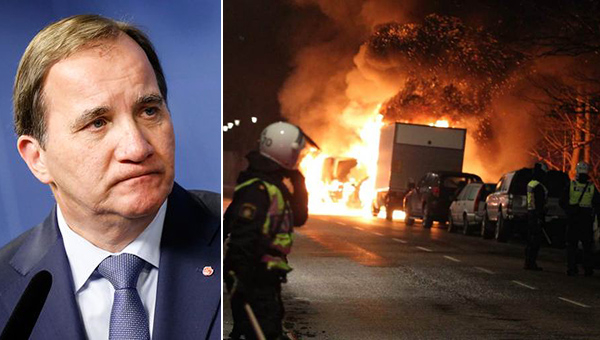
Swedish Prime Minister Stefan Löfven (left) said last week that Sweden is in a state of crisis. Pictured at right, the results of rioting in a Stockholm suburb, December 2014.

In the shadow the 1.5 million migrants expected to arrive this year in Germany, the EU’s largest country (population 81 million), migrants are also pouring into a rather smaller Sweden. Geographically Sweden is large, but consists mainly of forests and wilderness, and fewer than 10 million people live in the country. Until 2010, Sweden took in about 25,000 migrants a year. However, in 2010, then Prime Minister Fredrik Reinfeldt made a deal with pro-immigration Green Party, (Miljöpartiet) — by his own admission to punish voters for allowing the anti-mass-immigration Sweden Democrats party (Sverigedemokraterna) into parliament.

Reinfeldt’s deal opened the immigration floodgates. In 2014, 81,000 people sought asylum in Sweden; and 33,500 were granted asylum. However, as many of the immigrants subsequently brought over their relatives, that figure substantially increased. Last year, 110,000 people were granted residency status in Sweden. One should add to this figure an unknown number of illegal aliens.

There is now talk of 180,000 asylum seekers coming to Sweden in 2015. That number is more than twice as many as the year before. If half of them are granted asylum, and they each bring over three relatives, we are talking about 270,000 new immigrants to Sweden — within one year. Over 8000 people arrived just last week, 1,716 of whom were so-called “unaccompanied refugee children.”

Swedes who only follow the mainstream media get the impression that all the migrants arriving are war refugees from Syria, but the number of Syrians is actually less than half of the total: 2,864 people last week claimed to be from Syria. 1,861 claimed to be from Iraq, and 1,820 from Afghanistan. Clearly, many people from countries that are not at war are taking their chances and applying for asylum in Sweden; but this is something about which the mainstream media does not see fit to inform its followers.

That there is an exchange of populations going on, should be clear in any sober assessment. The Swedish economist Tino Sanandaji (of Iranian-Kurdish descent, and therefore tougher than most Swedes, who, if they criticize the immigration policy, are immediately accused of racism) writes on his blog that Swedes could soon be in the minority in their own country:

“1,000-1,500 asylum seekers a day for 15 years equals 5.5 to 8.2 million asylum seekers. At the end of 2014, the Statistical Central Bureau, SCB, calculated that 21.5% of the Swedish population were of foreign descent: 2.1 million, out of 9.7 million. The number of people of Swedish descent — born in Sweden with two parents born in Sweden — has been stable at about 7.7 million and is expected to remain stable or increase slightly due to birth surplus. If those of foreign descent increase their number by about 5.6 million, they will become the majority.”

One of the municipalities that has been flooded with migrants is Trelleborg (population 43,000), located on Sweden’s southernmost coast. Over 100 “unaccompanied refugee children” arrive from Germany via ferry on a typical day. During the last two weeks, more than 1000 such youths have been registered; more than half of them have now vanished and are listed as missing. No one knows why, or where they have gone. Add to this 13,000 adult asylum seekers.

Impromptu temporary lodgings have been created in sports centers, ice rinks, and at the Sturup airport hotel, to name a few.

Trelleborg has written a desperate letter of appeal for help to the government, just as, a few weeks ago, the Örkelljunga municipality did in vain. The mayor and the Municipal Director of Trelleborg, who signed the letter on October 1, wrote:

“In the past, many asylum seekers have taken the route through Denmark to Malmö, but this changed about two weeks ago. From September 10 until the morning of October 1, 14,100 asylum seekers arrived in Trelleborg by ferry. There is no indication that the pace is slowing; if anything it is continuously increasing. On Tuesday, September 22, Trelleborg received word from the Immigration Service that the municipality where children and young people arrive is by law the authority that is required to provide housing, care and living expenses, until such time as the Immigration Service decides upon a designated municipality. … Trelleborg has quickly ended up in a situation where the regular services to the community are at great risk of being affected. … By writing this letter, we would like to bring to your attention the enormous strain we now find ourselves under.”

Apparently, the Minister for Justice and Migration, Morgan Johansson, has since been in contact with Trelleborg’s mayor via telephone to discuss possible solutions. On October 9, the Immigration Service decided that Trelleborg should be exempt as a designated municipality for unaccompanied children. However, it is unclear how this will alleviate Trelleborg’s plight as far as the new arrivals go. The only concrete help so far has come from some of the neighboring municipalities, who have opened up facilities to house some of the Trelleborg migrants.

Malmö, about 18 miles from Trelleborg, is also in dire straits. For the last few weeks, the central train station in Sweden’s third largest city has been overrun with migrants, and the volunteers that showed up for the first few days with food, water and clothes now seem to have lost interest. The daily Sydsvenska Dagbladet summed up the desperate situation in Malmö, where even the city’s empty jail was considered (and rejected) as possible housing for refugee children. It now looks more like a possibility for adult refugees.

The Social Democratic mayor of Filipstad, Per Gruvberger, also recently raised the alarm that his municipality of 6,000 people will not be able to provide schooling and childcare for the 1,100 asylum seekers now assigned to his municipality.

The reply of the Minister for Justice and Migration, Morgan Johansson, to this cry for help was: “If need be, Filipstad will just have to expand its operations.”

This insensitive statement from Johansson caused the Mayor of neighboring Årjäng, Daniel Schützer, to go ballistic. He wrote about his fellow party member on Facebook:

“Pardon my French, but Morgan Johansson is totally f—ing stupid. ‘Expand,’ he says. It is not f—ing bricks and planks that we are lacking, it is teachers!!!!”

The Immigration Service, which is tasked with reviewing the asylum seekers’ reasons for immigrating, is understandably swamped with work. Even before the latest “refugee crisis” — and despite 1,200 new employees being hired last year — its staff is struggling. The employees’ union is now raising the alarm, concerning more and more incidents of violence, vandalism and suicide attempts — this year (up to August), 1,021 such incidents were reported.

“The work situation for the entire authority is very strained. The pressure is enormous. The work environment has deteriorated severely,” said Sanna Norblad, local chairperson of the ST union, to daily Norrköpings Tidningar.

While all this plays out, large portions of the Swedish people watch in horror from the sidelines and wonder when the unavoidable collapse will occur. At the same time, a surprisingly large portion of the citizenry still overconfidently believe that “Daddy State” will make everything all right. This a very Swedish view, like the wishes of children, that Peter Santesson, head of polling institute Demoskop, wrote about on the website Dagens Opinion. Santesson states that the Swedes have an unusually high level of trust in the social order, and that they are convinced that “somewhere higher up, there is always someone smarter and more informed, taking responsibility and making sure everything works.” If the government officials turn out to be incapable of handling the refugee chaos they themselves have created, it could be disastrous. Santesson continues,

“Responsible decision makers need to ponder the trust the people have now bestowed on them, and they need to handle this trust with care in this difficult crisis. If the people’s confidence is betrayed by them turning out not to be able to handle the situation – if ‘Sweden’ turns out to be insufficient as a miracle cure and the crisis becomes too much to handle — the outcome could be political and social consequences reaching far beyond the issue of immigration.”

The blogger Johan Westerholm, a Social Democrat who is critical of the government, points out in an October 7 titled “System infarction in the Immigration System,” that in addition to those who are already in Sweden, we need to add those who are not granted asylum in Norway and Finland, and will therefore be sent back to the last country they were in — Sweden. Considering that Finland rejects 60% of asylum applications, it is fair to assume that during the coming weeks, the chaos will only escalate.

Westerholm writes that the situation in Malmö is “out of control,” and states that we do not have any idea who those arriving in Sweden are:

“A very large group of administrators [at the Immigration Service] do not even know the designated terror organizations, and then there are the sympathizers — people who, on principal, would never file a report to the Immigration Service security department, for ideological reasons. A large group consists of those who are scared into silence. In an organization characterized by fear and stress, to do nothing is a surefire way to keep your job. If a report of suspicion is filed anyway, typically nothing happens. If the life and health of the terrorist is threatened, as is often the situation, the person gets to stay. Initially he is given a temporary residence permit, but in practice, this turns out to be permanent.”

The 152 asylum seekers reported to the Security Service so far this year as possible threats to national security, are thus most likely just the tip of the iceberg.

The Swedes who have already lost faith in the authorities and the politicians are now preparing for the unthinkable — that their once so secure society is about to collapse. On the website 72timmar.se, the Civil Contingencies Agency informs the public on “our five most basic needs: Water, food, heat, sleep and security.” The readers are told to keep water and canned goods at home, and make sure they can stay warm.

“Prepping” is becoming more common in Sweden. Last summer, the daily Svenska Dagbladet ran a story on the first Swedish online store for preppers, and that interest was huge. According to the polling institute Sifo, until recently, seven out of ten Swedes have been completely unprepared for a crisis that knocks out the power supply and thereby the infrastructure. The owner of the online store, Fredrik Qvarnström, told the paper that, in his estimation, the Swedes are the worlds most poorly prepared for a crisis:

“There is lot of talk about the greenhouse effect and economic crisis. People seem to be aware that there are problems, but I do not think they know how vulnerable we really are. We rely on the state to take care of us, as it has in the past.”

It will not be long until the Swedes realize that the state will not look after them. The country that just 20 years ago was considered one of the safest and most affluent in the world, is now in danger of becoming a failed state.

Strategic Outlook for Saudi Arabia and Iran by Shmuel Bar

  • In Saudi Arabia, Mohammad bin Salman’s “Vision 2030” is totally identified with his leadership. If it succeeds, he will harvest the praise; on the other hand, many in the Saudi elite will latch on to any sign of failure of his policies in order to block his ambitions.

  • Mohammad bin Salman’s social-political agenda to broaden the power base of the regime to include the young and educated — and to a great extent relatively secular or moderate — will certainly be seen by the Wahhabi clerics and the tribal social conservatives as geared towards reducing their control over the populace and hence their weight in the elite.
  • Another serious risk is that the economic plan entails reducing the Saudi welfare state. The economic and social fallout of weaning the Saudis away from entitlements will be exploited by domestic opposition elements and by Iran.
  • In Iran, the electoral process within the Assembly showed what was not evident during the parliamentary elections held in February, namely that even a formal preeminence of moderates does not and cannot influence the decision making of the Iranian regime and that Khamenei succeeds to pull the strings despite seemingly democratic procedures.
  • After having won the chairmanship of the Assembly, Jannati delivered a speech demanding total loyalty to Khamenei, which can be considered as targeting the moderates.

Following the announcement of Saudi Arabia’s “Vision 2030” Economic Plan by Deputy Crown Prince Muhammad bin Salman on April 25, King Salman announced a reshuffling of the government. The reshuffling was clearly orchestrated by the Deputy Crown Prince and reflects his agenda. This shuffle probably is not the last word even in the near term; the changes in the government strengthen the political position of Mohammad bin Salman, because the new ministers owe him their posts, and through them he will strengthen his hold on the levers of government, especially in the economic sphere. His next step may be to move to neutralize Prince Mitab bin Abdullah, the minister in charge of the Saudi Arabian National Guard (SANG) and a close ally of Crown Prince Mohammad bin Nayef. He could do this by absorbing SANG into the Ministry of Defense.

Such a step would probably not sit well with many of the members of the royal family; however, if Mohammad bin Salman takes such a step, it will only be with the consent of his father, King Salman, and none would actively oppose him. Such a step would have significant ripple effects; international influence in Saudi Arabia has focused for decades on acquiring sectorial influence in the various centers of power of the Kingdom – the different factions of the royal family, the business sector, the army, the SANG etc. The continuing concentration of power in the hands of Mohammad bin Salman will reduce the political relevance of many of these assets of international players and they will be obliged to restructure their connections and sources of information on the politics and economic decision making of the Kingdom.

Farther down the road — in our assessment not in the short term — King Salman may appoint his son to the position of Prime Minister – a title that he presently holds himself. Such a promotion would pave the way for Mohammad bin Salman to depose the Crown Prince, Mohammad bin Nayef, to be appointed as the next Crown Prince and to succeed his father. A possibility exists — though in our assessment it is not likely in the near future — that the King will even abdicate and pass the reins of the Kingdom to his son after he has been duly appointed as Crown Prince. These scenarios will be a disappointment to policy-shapers in Washington who prefer — or at least feel more comfortable with Mohammad bin Nayef. This too will call for a significant shift in the international disposition towards the Saudi regime; development of channels of influence with Mohammad bin Salman and his confidantes, adapting to a new and unfamiliar paradigm of decision-making in the Kingdom and coping with Mohammad bin Salman’s not-typically-Saudi regional policies towards Iran and other threats.

Mohammad bin Salman’s “Vision 2030” is totally identified with his leadership. If it succeeds, he will harvest the praise; on the other hand, many in the Saudi elite will latch on to any sign of failure of his policies in order to block his ambitions. However, none of them will actively attempt to disrupt Mohammad bin Salman’s plans; such a power struggle could precipitate the end of the rule of the al-Saud family and the very existence of the Saudi state, and they are aware that either they “hang together or they hang separately”. The risks to the regime from the economic reform process, however, do not necessarily come from proactive efforts to disrupt it. Mohammad bin Salman’s social-political agenda to broaden the power base of the regime to include the young and educated — and to a great extent relatively secular or moderate — will certainly be seen by the Wahhabi clerics and the tribal social conservatives as geared towards reducing their control over the populace and hence their weight in the elite. Another serious risk is that the economic plan entails reducing the Saudi welfare state. The economic and social fallout of weaning the Saudis off entitlements will be exploited by domestic opposition elements and by Iran.

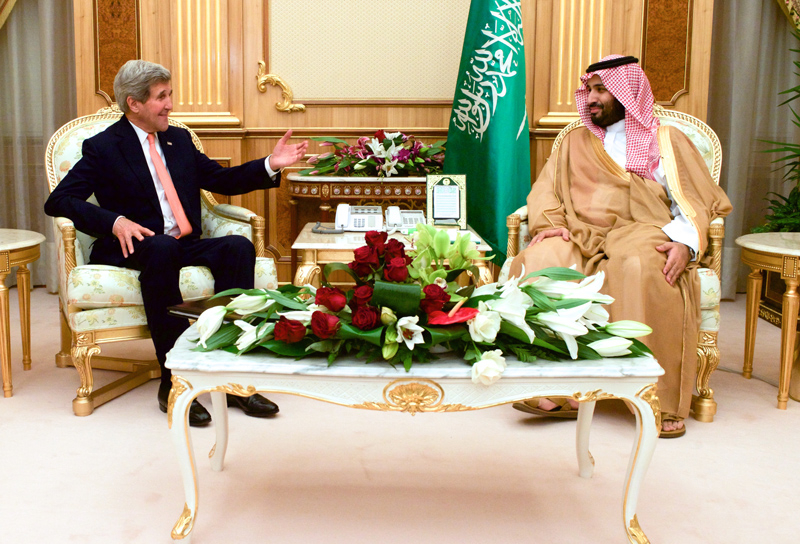
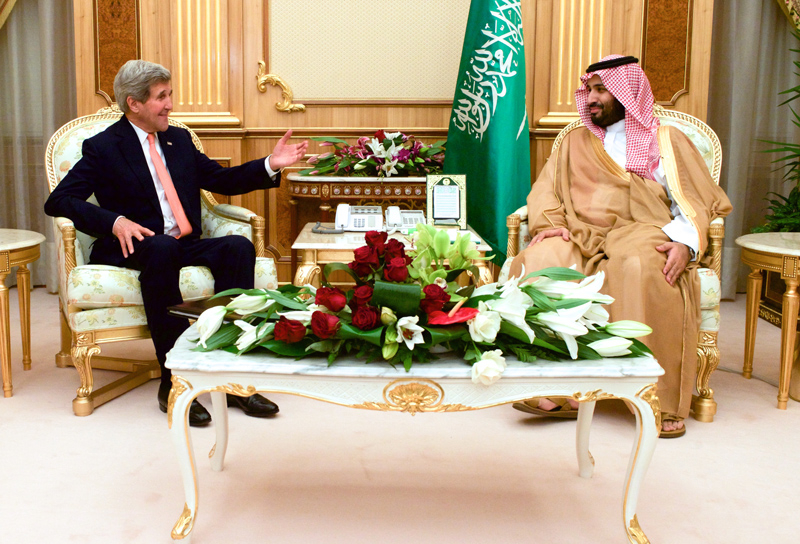
Saudi Prince Mohammed bin Salman meets with U.S. Secretary of State John Kerry in Riyadh, Saudi Arabia, on May 7, 2015. (Image source: U.S. State Department)

The changes in the Saudi Oil Ministry reflect Mohammad bin Salman’s strategic policy of using Saudi oil to minimize Iran’s economic and political profits from the lifting of sanctions, even at the expense of Saudi profit from its oil. This policy has broad support in the Saudi elite, with the possible exception of some of the government oil bureaucracy and the oil-related business community. But the latter do not have the power to derail the regime’s priorities in this regard. Therefore, we are likely to see a continuation of the Saudi policy of high production, willingness to offer attractive deals in order to undercut Iranian overtures to existing Saudi markets, and a high level of sensitivity to any threats to the oil industry. The chances of Iranian retaliation for the Saudi economic warfare are high. These could take the shape of cyber-attacks on installations inside Saudi Arabia, or terrorist attacks (including rocket attacks) against pipelines, refineries and other installations, and even attacks – without taking responsibility — on Saudi oil shipping inside the Persian Gulf or — more likely further away from the theater. Such attacks may normally be seen as providing Iran plausible deniability from the point of view of international law, but they will be attributed to Iran by the Saudi regime, that will see itself as obliged to react. Therefore, in the current state of relations between Saudi Arabia and Iran, and assuming that the chances of rapprochement are slim, the chances of actual limited military conflict between Iran and Saudi Arabia remain.

* * *

The Islamic State has come under increasing military pressure in both Iraq and Syria in recent weeks, and it is likely to lose territory. Yet this will not make Iraq more united or stable, nor will it bring the civil war in Syria any closer to an end. Iran’s influence in Iraq will grow, while the Sunnis will see the US as Iran’s enabler. The Islamic State will try to respond to its losses by launching major terror attacks in the West. The Islamic State lacks the manpower to defend all the Iraqi and Syrian territory it has occupied since 2014. Consequently, its strategy consists first and foremost of defending strategically or symbolically important assets, primarily al-Raqqah, Fallujah and Mosul, as well as key supply routes. In addition, it is compensating for its defeats by carrying out lethal terror attacks in Syria and Iraq in order to demonstrate that while these regimes can, with foreign backing, regain territory, they cannot defend their citizens.

The military successes against the Islamic State will entail a number of long-range problematic political implications: exacerbation of the Sunni-Shiite conflict in Iraq and in the region in general, strengthening Iranian influence on the back of American military power, increased animosity towards the US, and widening the gap between the Baghdad government and the Kurds. The Islamic State will eventually be pushed out of Fallujah, thanks to the American support. Once the Islamic State is pushed out of Fallujah and perhaps out of Mosul, Shiite militias will move in to exact their revenge. Fallujah will again be a fertile ground for Sunni radicalism and a new Sunni insurgency in the area is almost inevitable; the Sunni populace will probably rebel again under some successor of the Islamic State and Fallujah will have to be “liberated” again. Furthermore, the American airstrikes in support of the Shiite ground offensive will strengthen the image of the US as enabler of the Iranian takeover of Iraq and as responsible for Shiite atrocities. Atrocities committed in Fallujah by the Shiite militias under American auspices will give pause to the plans for initiating an offensive on Mosul.

The Iraqi political system which the Americans constructed is on the verge of final collapse. The stalemate over the election of a new cabinet and “popular” demonstrations staged by Muqtada al-Sadr are indicative of the inherent failure of the Iraqi political system. While al-Sadr had proven that he can paralyze the government and the Parliament, he cannot become the solution. He has helped to demolish an already dysfunctional political system, but his sources of political influence draw on the very factors that made that system dysfunctional: sectarianism, a politicized military, use of “popular” violence to challenge democratic procedures, involvement of religious authorities in the democratic process, involvement of external actors (particularly Iran) and the implicit threat of armed militias. Since the current crisis derives from the power struggle within the Shiite community, it will hinge to a great degree on Iran. It may escalate to a Shiite civil war, and such a scenario would probably draw Iran to intervene directly, or to encourage a Shiite military commander to stage a coup and establish military rule, then pledge his allegiance to Iranian Supreme Leader Khamenei. We assess that the US, under the current administration, would probably acquiesce to “Pax Iranica” in Iraq, but the more influence any settlement would accord Iran, the more it would be unacceptable to the Gulf States, and they would use their influence with the Sunnis and the Kurds to block it, inter alia, by increasing support of radical Sunni groups in the country.

The cause of Kurdish independence is gaining momentum; all the Kurdish factions seem to be dedicated to holding a referendum on Kurdish independence before the elections in the US in order to create a fait accompli for the next administration. The issue of independence, however, is linked to the demand of the new PUK-Gorran alliance for parliamentary elections and for the inclusion of mixed Arab-Kurdish areas that the Peshmerga seized from the Islamic State in those elections and in the independence referendum. (Foremost of these areas are the oil-rich area of Kirkuk, the provinces of Nineveh, Diyala, and Salah ad-Din and the regional capital of Mosul that is still in the hands of the Islamic State). If the Kurdish Region succeeds in annexing these areas, it will also signify a watershed event in the process of the breakup of Iraq.

Turkey and Iran will both oppose these plans and the current US administration will not lend its support to a move that, in essence, proves the failure of its Iraq policy and signals the breakup of Iraq. Specifically, the prize of Kirkuk for the Kurdish state would be prodigious; the Baghdad government has halted the export of oil produced by its oil company in Kirkuk to Turkey in retaliation for the KRG’s independent oil exports. If Kirkuk Province joins the Kurdish Region, the KRG would presumably be able to take control of Kirkuk’s oil and resume its export to Turkey or — if the PUK-Gorran alliance comes to power in the KRG — to opt for the Iranian offer of export through Iran to the Persian Gulf.

Turkey views the Raqqa offensive in Syria with great concern. The American connection with the Kurdish YPG, which is viewed in Ankara as an extension of the PKK, is seen as yet another indication of the US inching towards support of an independent Kurdistan — the chronic nightmare of Turkey. Furthermore, if the Islamic State is pushed out of al-Raqqa and surrounding areas by the YPG, these areas will come under the control of Syrian Kurdistan (Rojava). Even before such a scenario emerges, the Islamic State’s priority of defending its regional capital, Raqqa will probably bring it to redeploy its forces now deployed in the Jarablus-Azaz Corridor, the stretch of land along the Syrian-Turkish border which separates the eastern Kurdish territory from the western enclave around the town of Afrin, north of Aleppo. The withdrawal of Islamic State forces from this corridor would tempt the YPG to launch an offensive westward from Jarablus in order to link up with the Afrin enclave. Such a prize would be a far greater achievement for the YPG than the capture of the non-Kurdish Raqqa area, and it would probably prefer it. If the YPG indeed takes such a step, it is likely to precipitate Turkish intervention, turning Turkey — a NATO member — into an active participant in the Syrian civil war against a party that is allied with both the US and Russia.

* * *

In Iran, Despite the hopes of the moderate camp, the hardliner 90-year-old Ayatollah Ahmad Jannati was elected (May 24) as head of the Assembly of Experts, after having gained 55 of 88 votes. This nomination does not bode well for President Rouhani’s future, should he insist on implementing deeper liberalizing reforms.

More than anything else, Ayatollah Jannati’s election highlights the Supreme leader’s grip on power. Ayatollah Khamenei did his best to help Jannati’s election by delivering his directives to some members of the Assembly. The electoral process within the Assembly showed what was not evident during the parliamentary elections held in February, namely that even a formal preeminence of moderates does not and cannot influence the decision making of the Iranian regime, and that Khamenei pulls the strings despite seemingly democratic procedures. The Assembly of Experts is rather formal and ceremonial body, unlike the Majles, however its role might become crucial at some circumstances, should the Assembly be summoned to nominate the following leader in the event of Khamenei’s death.

Ahmad Jannati, is important by virtue of what he epitomizes as a symbol rather than by his current political capacity, which won’t persist long, given his age. He has been serving as secretary of the Guardian Council since 1992, and in this capacity was instrumental in consolidating Khamenei’s power and, in all elections, was responsible for weeding out “undesirable” candidates to the Majles and Assembly of Experts. After having won the chairmanship of the Assembly, Jannati delivered a speech demanding total loyalty to Khamenei, which can be considered as targeting the moderates. Jannati is not alone with this mindset: his respective first and second deputies are hardliners: Mohammad Kermani and Mahmoud Shahroudi. The latter served for many years as the head of the judiciary, is close to Khamenei and is mentioned as a potential successor to Khamenei. This casting of the Assembly of Experts highlights that Khamenei is preparing to guarantee his ideological legacy and the ideological continuity of the regime after his death.

The election of Jannati was even more conspicuous in the light of the corresponding withdrawal of the chief candidate of the moderates, who they had hoped would serve as an ally within the regime — former President Hashemi Rafsanjani. Rafsanjani decided to withdraw from the electoral competition under pressure by the hardliners, including attacks on his children, his daughter, Faezah and his son, Mehdi.

On May 28, Ali Larijani was elected as the speaker of the Majles for the third term. Larijani is considered a hardliner; for over 30 years, he has been a confidant of Supreme Leader Ali Khamenei. His brother Sadeq Larijani is chief of the judiciary, and his other brothers have played important roles in diplomacy and government affairs. A veteran of the Islamic Revolutionary Guard Corps (IRGC), Larijani is also the son of Grand Ayatollah Hashem Amoli and son-in-law to prominent Islamic ideologue Morteza Motahhari. The moderate conservative politician Ali Motahhari is his brother-in-law. Given this multifaceted background, he has been able to establish strong, longstanding ties with both the military and the clergy, and with different factions in the Majles, with the exception of former president Mahmoud Ahmadinejad, who became Larijani’s nemesis. During Ahmadinejad’s second term, Larijani openly confronted him.

By contrast, Larijani is considered close to President Hassan Rouhani. During the nuclear negotiations, Larijani contained anti-Rouhani moves in the legislature and got the Majles to ratify the agreement. However, it must be clear that he did this not because he is Rouhani’s ally, but because he was ordered to carry out this mission by the Supreme Leader. Hence, Larijani will remain supportive of Rouhani, but only on the condition that the latter complies with the wishes of the Supreme Leader. If Larijani decides to stand for office, he may leverage his position in the Majles and his status with the Supreme Leader to whittle away at Rouhani’s popularity.

In the meantime, the Majles will be more supportive of Rouhani. Out of the 80 Majles members who opposed the nuclear agreement, fewer than a dozen remain. None of them is high profile, and their low numbers prevent them from establishing a bloc of their own, as they did in the previous parliament. Instead, they will have to operate within a “Principlists” bloc that is dominated by more moderate “Principlist” figures. This means that the remaining hardliners will be less likely to stage the theatrics that were so successful in challenging the government during the last Majles, particularly through their repeated summoning of various ministers to answer questions; and the impeachment of the minister of science, technology and higher education. Their absence will lead to a calmer parliamentary environment, more focused on addressing the serious economic issues Iran faces such as unemployment, reform of the banking sector, and the steep economic slowdown. This notwithstanding, one should bear in mind that the above scenario is confined to the functioning of the Majles vis-à-vis Rouhani, whereas the real chances of success of his program depend on other foci of power.

Dr. Shmuel Bar is a senior research fellow at the Samuel Neaman Institute for National Policy Studies at the Technion in Haifa, Israel, and a veteran of Israel’s intelligence community.

Translate »
Skip to toolbar