Broken Britain

Broken Britain

[M]y father did not move to England in the expectation that its denizens were fluent in Muslim culture, or that there would be a mosque on every street. He did not feel More »

Gaza: Can ‘Peacekeepers’ and ‘Monitors’ Succeed Except in Wishful Thinking?

Gaza: Can ‘Peacekeepers’ and ‘Monitors’ Succeed Except in Wishful Thinking?

Hezbollah used UNIFIL’s peacekeepers as “shields” to deter any Israeli military activity and prevent compliance in case a peacekeeper might be hit. Israel was forced to just sit and watch while Hezbollah More »

Ibintu byakomeye cyane,nyuma yo kumva yuko Trump yifuza guhura n’umucamanza uca imanza zitabera z’Uhoraho Uwiteka Imana Nyiringabo kw’isi ya bazima!!!

Ibintu byakomeye cyane,nyuma yo kumva yuko Trump yifuza guhura n’umucamanza uca imanza zitabera z’Uhoraho Uwiteka Imana Nyiringabo kw’isi ya bazima!!!

Dec 15, 2025 njyanwa mu iyerekwa mbona ibitero bya ba za magigiri hamwe na barushimusi (hackers) bahawe ikiraka n’umwana w’umwega Umwakagara Paul Kagame kugirango bashake uko bakubita hasi ikinyamakuru www.inyangenewss.com More »

Adeline Mukangemanyi Rwigara alimo kurindagiza abanyarwanda!!!

Adeline Mukangemanyi Rwigara alimo kurindagiza abanyarwanda!!!

1 Timothy 3:1-12 If anyone wants to provide leadership in the church, good! But there are preconditions: A leader must be well-thought-of, committed to his wife, cool and collected, accessible, and hospitable. More »

Donald Trump arashaka guhura n’Umwami Kigeli Ndoli uca imanza zitabera kw’isi yabazima!!!

Donald Trump arashaka guhura n’Umwami Kigeli Ndoli uca imanza zitabera kw’isi yabazima!!!

Dec 14, 2025 ijambo ry’Uhoraho Uwiteka Imana Nyiringabo rikomeza kunzaho kandi cyane, maze rirambwira riti, Umwami Kigeli Ndoli, Donald Trump yasabye ko bakwiye kuguhamagara ukaza mukabonana maze ukumusobanurira umurimo ukora ujyanye no More »


Sweden: A Church with No Conscience by Nima Gholam Ali Pour

The response from the Church of Sweden to the Kairos Palestine document contained no criticism at all against the massive lies, racism and distortions it contains. More sadly, there seems not to have been the slightest attempt to verify if any of the allegations in it were even true.
A church that genuinely believes in love and understanding would long ago have renounced the Kairos Palestine document, which has been pointed out by serious organizations out as anti-Semitic and racist.
The country’s largest religious institution is therefore helping and encouraging people to study a rawly anti-Semitic, racist document.
Attacks against Jews in Sweden have partly originated through such normalization. When the Church of Jesus Christ in Sweden supports an anti-Semitic document, the Jews in Sweden become fair game.
The Church of Sweden[1] has a problem. Its deep involvement in the Israeli-Palestinian issue — and especially its support for the Kairos Palestine document [full English text and annotations in Appendix below] — is something that should be noted and held up for criticism by other churches, and all those who oppose anti-Semitism and all forms of racism.
The Kairos Palestine document can be found in Swedish on the Church of Sweden’s website and is described by the Church of Sweden as follows:
“The Kairos document has been produced by Palestinian Christians and is about their vulnerability under occupation. Since it was published in December 2009, it has spread throughout the world and in some areas has become a movement that believes and fights for peace and justice in Palestine and Israel.”
The Kairos Palestine document, from 2009, is a letter that describes itself as “the Christian Palestinians’ word to the world about what is happening in Palestine.” Israel’s presence in what the document refers to as “Palestinian land” — even though this Biblical region has continuously been home to the Jews for nearly four thousand years — is bizarrely described as “a sin against God and humanity.”
In addition to distortions and unjust descriptions of the Israeli-Palestinian conflict and the state of Israel, the Kairos Palestine document incites Christians to act against Israel. The document also justifies and excuses Palestinian terrorism:
“Yes, there is Palestinian resistance to the occupation. However, if there were no occupation, there would be no resistance, no fear and no insecurity. This is our understanding of the situation.”
The problem with this explanation is that it is simply not true. For nearly a hundred years, long before Israel entered the West Bank and Gaza Strip in the Six Day War of 1967, Jewish/Israeli civilians were being attacked by Palestinian terrorists. Therefore, the content of the Kairos Palestine document claiming “occupation” as a justification for terrorism is simply not accurate. Worse, it was Arab provocation — closing the Strait of Tiran at the mouth of the Suez Canal, a casus belli [legitimate cause for war] according to international law — that preceded and caused the Six Day War in 1967. In other words, the Arabs started a war, and then were irked when they lost it.
Yet the Kairos Palestine document, several times, implicitly (and incorrectly) states Israel’s presence in the “Palestinian territories” as the reason, justification and excuse for Palestinian terrorism against Israel. In the Kairos document, Israel is (incorrectly) accused of launching a “cruel war” against Palestinians, restricting religious liberty, and violating human rights, among other offenses that any decent person would oppose.
The most offensive part of the Kairos Palestine document, however, is the raw anti-Semitism, which expresses itself in the form of “replacement theology” (also known as supersessionism), in which, as its name would suggest, the “newer” Christianity is supposed to replace and completely supplant, the “older,” supposedly-antiquated, Judaism.
The Kairos Palestine document calls on the world’s churches and the international community to make use of boycott and divestment against Israel, a movement which, of course, is code for trying to strangle Israel to death economically. The Kairos document even questions Israel’s right to exist: It says that the Jewish state was to be “a state that practices discrimination and exclusion, preferring one citizen over another” — an odd statement given that the Jewish state of Israel is the only country in the Middle East where all citizens — Jews, Arabs, Christians, Muslims, men, women — have the right to hold all jobs, own property, sit in the parliament [Knesset] and vote in free elections.
The Kairos Palestine document also ignores that in reality, conversely, the charge of “discrimination and exclusion” pertains to many Muslim states: Saudi Arabia has apartheid laws forbidding non-Muslims from even entering Mecca. Human Rights Watch’s World Report 2015: Saudi Arabia states that that “Systematic discrimination against women and religious minorities continued,” and goes on to assault Saudi Arabia’s entire judicial system, its “refusal to register political or human rights groups” and its abysmal treatment of migrants.
The Jewish state of Israel, on the other hand, is the only state in the Middle East that has given Arabs all their human rights. It should be no surprise that a recent poll found that 52% of Palestinians living in Jerusalem would prefer to live in Israel rather than a future Palestinian state.
Due to the content of the Kairos Palestine document, which is filled with staggering distortions, anti-Semitism and racism, you would think that the Church of Sweden would have immediately distanced itself from the document, but what happened was exactly the opposite. For some reason, the Church of Sweden gave both legitimacy and support to this document.
In 2010, the international department of the Church of Sweden sent a response to the Kairos Palestine document in the form of a letter, which inexplicably concluded:
“Finally, we would like to thank you for the document and for its hopeful message that love and mutual trust is possible, as well as peace and final reconciliation, and that justice and security will be attained for all – Palestinians as well as Israelis.”
Sadly, in what appears to be a massive miscarriage of justice, the response from the Church of Sweden to the Kairos Palestine document contained no criticism at all against the massive lies, racism and distortions it contains. More sadly, there seems not to have been the slightest attempt to verify if any of the allegations in it were even true.
To its credit, the Church of Sweden did at least try to distance itself from the replacement theology in the Kairos Palestine document, by writing in its response letter:
“It is our view that the Sinai Covenant with the Jewish people, as well as the covenant in Jesus Christ, are both valid and expresses God’s nature and will, and his ultimate love for all people.”
In 2012, however, the General Synod of the Church of Sweden made some decisions that resulted in the Kairos Palestine document effectively becoming an official document within the Church of Sweden.
Regrettably, these decisions also resulted in the Church of Sweden declaring support for the proposals that were in the Kairos Palestine document. The General Synod decided to:
“Instruct the Church Board [the executive branch] to send the Kairos document and the response of the international department to the members of the General Synod.”
“The General Synod decides to instruct the Church Board to continue its efforts to demand an end to the Israeli occupation of the West Bank, East Jerusalem and Gaza and to recommend the parishes to follow the calls in the Kairos Palestine document to cancel investments, impose sanctions and boycott companies and products of the Israeli settlements in the occupied Palestinian territories, the West Bank and East Jerusalem as well as supporting the forces in the Gaza Strip who work for democracy and human rights and to demand that the ongoing Israeli blockade of Gaza is lifted.”
Today, you can find a tutorial on how to study the Kairos Palestine document on the Church of Sweden website. The Church of Sweden has evidently produced this tutorial to encourage their members to study the Kairos Palestine document, and thus unwittingly promoting the malicious distortions in it. A document that has clear anti-Semitic elements and multiple historical inaccuracies is thus being used by the world’s largest Lutheran church as a way to present the Israel-Palestine conflict.
The tutorial on the Church of Sweden website opens with this:
“Do you find it difficult to understand the conflict in Israel / Palestine? Do you want to know more and be able to influence? Do you believe that the Bible can be an instrument in it? The Church of Sweden wants to stimulate discussion about the conflict and about a document written on this subject: The Kairos Palestine Document (KPD).”
One can be critical of Israel, but what the Church of Sweden does is to spread a wildly inaccurate and racist document to their 6.2 million members.
Anti-Semitism has thereby literally become institutionalized in Sweden. The country’s largest religious institution is helping and encouraging people to study a rawly anti-Semitic, racist document that should be laughed out of town.
It is ironic that the Church of Sweden, which has as its savior a Jewish man from Nazareth, is spreading an anti-Semitic document. It is also important to understand that this is happening in a Europe where anti-Semitism is worsening day by day.
The Church of Sweden is spreading the Kairos Palestine document in a Europe where terrorists have already attacked Jews, synagogues and even Christians. This is happening in a Europe from which Jews already are fleeing.
A church that genuinely believes in love and understanding would long ago have renounced this document, which has been pointed out as racist by serious organizations such as the Anti-Defamation League.
Through its actions, the Church of Sweden is normalizing anti-Semitism in Sweden and Europe. As a church in which the majority of Swedes are members, the Church of Sweden has the power to carry out such normalization. Attacks against Jews in Sweden have partly originated through such normalization. When the Church of Jesus Christ in Sweden supports an anti-Semitic document, Jews in Sweden become fair game.

Footnote
[1] The Church of Sweden is the world’s largest Lutheran church. 6.2 million Swedes, or more than 60% of Sweden’s population, are members of the Church of Sweden — one of many European national churches created during the Protestant Reformation. From the years 1544-2000, the Church of Sweden was the state church of the Kingdom of Sweden and a part of the Swedish state, just as the Anglican Church became the state church of England. Even though Sweden is one of the world’s most secular countries, because of historical and cultural reasons, the Church of Sweden still plays an extremely important role in the Swedish society. The Church is still controlled by the political parties through ecclesiastical political assemblies. In other words, in Sweden, political parties, as opposed to keeping a sharp separation between church and state, have been encouraged to become actively involved with the Church. Political parties represented in the Swedish parliament, as well as other political parties, contend in nationwide church elections, to win seats in different assemblies. These political assemblies then take decisions about church activities and the agenda of the Church of Sweden — locally, regionally and nationally. In the Church of Sweden, there are several hundred such parish assemblies. The highest governing body of the Church of Sweden is the General Synod, with 251 members; it decides on the Church’s common and general issues. These political assemblies are formed after nationwide church elections, which are held every four years. The Social Democratic party has always been the biggest party in the General Synod, and represents the hegemonic role of the party in Swedish politics in general.
Nima Gholam Ali Pour is a member of the board of education in the Swedish city of Malmö and is engaged in several Swedish think tanks concerned with the Middle East. Gholam Ali Pour is also editor for the social conservative website Situation Malmö.
Appendix: Text of the 2009 “Kairos Palestine” Document.
With annotations by Gatestone Institute, in brackets, marked in bold italics.
A moment of truth
A word of faith, hope and love from the heart of Palestinian suffering
Introduction
We, a group of Christian Palestinians, after prayer, reflection and an exchange of opinion, cry out from within the suffering in our country, under the Israeli occupation, with a cry of hope in the absence of all hope, a cry full of prayer and faith in a God ever vigilant, in God’s divine providence for all the inhabitants of this land. Inspired by the mystery of God’s love for all, the mystery of God’s divine presence in the history of all peoples and, in a particular way, in the history of our country, we proclaim our word based on our Christian faith and our sense of Palestinian belonging – a word of faith, hope and love.
Why now? Because today we have reached a dead end in the tragedy of the Palestinian people. The decision-makers content themselves with managing the crisis rather than committing themselves to the serious task of finding a way to resolve it. [Not true. The Israeli government is committed to a two-state solution and the advancement of peace. Hamas, the Palestinian Authority and other radical groups continue to oppose Israeli attempts at reconciliation. And even the Palestinian authority refuses to acknowledge that Israel is the legitimate nation-state of the Jewish people.] The hearts of the faithful are filled with pain and with questioning: What is the international community doing? What are the political leaders in Palestine, in Israel and in the Arab world doing? What is the Church doing? The problem is not just a political one. It is a policy in which human beings are destroyed, and this must be of concern to the Church.
We address ourselves to our brothers and sisters, members of our Churches in this land. We call out as Christians and as Palestinians to our religious and political leaders, to our Palestinian society and to the Israeli society, to the international community, and to our Christian brothers and sisters in the Churches around the world.
1. The reality on the ground
1.1 “They say: ‘Peace, peace’ when there is no peace” (Jer. 6:14). These days, everyone is speaking about peace in the Middle East and the peace process. So far, however, these are simply words; the reality is one of Israeli occupation of Palestinian territories, deprivation of our freedom and all that results from this situation: [There is a continued dispute, even about the territories. The two-state partition plan called for a Jewish state and an Arab state, but the Arabs did not accept the agreement and instead declared war on Israel upon its foundation in May 1948.]
1.1.1 The separation wall erected on Palestinian territory [The barrier was erected in the midst of the Second Intifada as Palestinian terrorists were detonating explosives within Israel on an almost daily basis], a large part of which has been confiscated for this purpose [No land was confiscated. In fact, members of the Israeli right-wing were upset at the move.], has turned our towns and villages into prisons [Palestinian towns and villages are not prisons. The PA has authority over most Palestinian living habitations], separating them from one another, making them dispersed and divided cantons. Gaza, especially after the cruel war Israel launched against it during December 2008 and January 2009 [Hamas was freely elected in 2006. Since that time, Hamas has routinely fired rockets into Israel. Israel was forced to respond in an attempt that any country would take to allow its citizens, Arabs, Christians and Jews in Southern Israel, to live in peace and security. Gaza is geographically not contiguous to the West Bank, through no fault of Israel. Gaza had been part of Egypt, not Jordan.], continues to live in inhuman conditions, under permanent blockade and cut off from the other Palestinian territories. [Yes, they are “cut off” but historically they have never been contiguous. Again, Gaza has been a part of Egypt, while the West Bank is currently under dispute.]
1.1.2 Israeli settlements ravage our land in the name of God and in the name of force, controlling our natural resources, including water and agricultural land, thus depriving hundreds of thousands of Palestinians, and constituting an obstacle to any political solution. [Israel was willing to end the occupation and agree to the creation of a demilitarized Palestinian state in 2000-2001 and again in 2007. But the Palestinian leadership refused to accept the Israeli offers. When Israel in 2005 destroyed all Jewish settlements and ended all military presence in Gaza, there was still no peace. On a basic level, historically Judea and Samara, as is evident from its name, it is not “Palestinian land.” Beyond that, while some Israelis live in Judea and Samaria for religious reasons, a full one-third of all residents are non-religious and are instead seeking inexpensive living. The entire framework is off, because if the Palestinians decided that they wanted to live in peace with Israel, there would be peace.]
1.1.3 Reality is the daily humiliation to which we are subjected at the military checkpoints, as we make our way to jobs, schools or hospitals. [The checkpoints are part of a routine security procedure set in place because to protect Israelis from the high volume of Palestinian terrorists entering Israel and blowing up men, women and children in suicide bombings. Now there are daily stabbing attacks against Jews. The checkpoints are an unfortunate consequence of the brutal actions pursued by groups such as the Palestinian Authority and Hamas.]
1.1.4 Reality is the separation between members of the same family, making family life impossible for thousands of Palestinians, especially where one of the spouses does not have an Israeli identity card. [Israel has permitted family reunification consistent with security needs. But some who have been allowed to live in Israel have turned to terrorism.]
1.1.5 Religious liberty is severely restricted; the freedom of access to the holy places is denied under the pretext of security. Jerusalem and its holy places are out of bounds for many Christians and Muslims from the West Bank and the Gaza strip. [There are no holy places that are restricted. Unfortunately, as many Palestinian terrorists, under the claim of religious observance, have abused their freedom to enter holy places in order to carry out terrorist attacks, the Palestinians now have to go through security checks. As do the Israelis when they go to the Western Wall and the Temple Mount.] Even Jerusalemites face restrictions during the religious feasts. Some of our Arab clergy are regularly barred from entering Jerusalem. [Some of these clergy preach violence and incite terrorism.]
1.1.6 Refugees are also part of our reality. Most of them are still living in camps under difficult circumstances. [Millions of Palestinian “refugees” are living in camps in Syria, Lebanon and Jordan. This would seem to be the fault of Arab leaders who refuse to integrate the Palestinian “refugees” so that they can be used as “victims” to accuse Israel of transgressions. Israel absorbed hundreds of thousands of Jewish refugees who were forced to leave Muslim lands in which they had lived for thousands of years.] They have been waiting for their right of return, generation after generation. What will be their fate?
1.1.7 And the prisoners? The thousands of prisoners languishing in Israeli prisons are part of our reality. The Israelis move heaven and earth to gain the release of one prisoner, and those thousands of Palestinian prisoners, when will they have their freedom? [Typical of this entire document, the postulate is off. The prisoners are detained for terrorist activities; rock-throwing, stabbings, etc., not because they are upstanding citizens who are randomly abducted. Israel, unlike the PA and Hamas, functions under the rule of law. Palestinian prisoners have access to due process and family visits. The “prisoners” that the Israelis seek to release were kidnap victims — not prisoners.]
1.1.8 Jerusalem is the heart of our reality. It is, at the same time, symbol of peace and sign of conflict. While the separation wall divides Palestinian neighbourhoods, Jerusalem continues to be emptied of its Palestinian citizens, Christians and Muslims. [Simply not true. For example, Jerusalem’s Arab population grew by 2.2% in 2014]. Their identity cards are confiscated, which means the loss of their right to reside in Jerusalem. Their homes are demolished or expropriated. Jerusalem, city of reconciliation, has become a city of discrimination and exclusion, a source of struggle rather than peace. [Punishment is administered only under the rule of law.]
1.2 Also part of this reality is the Israeli disregard of international law and international resolutions, as well as the paralysis of the Arab world and the international community in the face of this contempt. Human rights are violated and despite the various reports of local and international human rights’ organizations, the injustice continues. [Israel has by far the best human rights record in the mid-East and one of the best in the world.]
1.2.1 Palestinians within the State of Israel, who have also suffered a historical injustice, although they are citizens and have the rights and obligations of citizenship, still suffer from discriminatory policies. They too are waiting to enjoy full rights and equality like all other citizens in the state. [Israeli Arabs who break the law – such as the Beduin who recently murdered an Israeli soldier in Beersheba – are punished. Every country has some discrimination. Israel has far less than any Muslim country has against Christians and Jews.]
1.3 Emigration is another element in our reality. The absence of any vision or spark of hope for peace and freedom pushes young people, both Muslim and Christian, to emigrate. Thus the land is deprived of its most important and richest resource – educated youth. The shrinking number of Christians, particularly in Palestine, is one of the dangerous consequences, both of this conflict, and of the local and international paralysis and failure to find a comprehensive solution to the problem. [This is a lie. Israel has far less emigration of Christians than any Muslim country in the Middle East. Gaza has lost nearly all of its Christian population.]
1.4 In the face of this reality, Israel justifies its actions as self-defense, including occupation, collective punishment and all other forms of reprisals against the Palestinians. In our opinion, this vision is a reversal of reality. Yes, there is Palestinian resistance to the occupation. However, if there were no occupation, there would be no resistance, no fear and no insecurity. [This is also not true. Arabs and Jews have had ancient battles for generations. The war of 1948, for example, was fought before any new land was supposedly “occupied.”] This is our understanding of the situation. Therefore, we call on the Israelis to end the occupation. Then they will see a new world in which there is no fear, no threat but rather security, justice and peace. [Terrorism is the cause of the occupation, not the result.]
1.5 The Palestinian response to this reality was diverse. Some responded through negotiations: that was the official position of the Palestinian Authority, but it did not advance the peace process. [The Palestinian Authority has, throughout time, subsidized terrorists while paying lip service to the idea that they were seeking “solutions.”] Some political parties followed the way of armed resistance. Israel used this as a pretext to accuse the Palestinians of being terrorists and was able to distort the real nature of the conflict, presenting it as an Israeli war against terror, rather than an Israeli occupation faced by Palestinian legal resistance aiming at ending it. [Israel offered a two state solution twice in recent years. Neither was accepted.]
1.5.1 The tragedy worsened with the internal conflict among Palestinians themselves, and with the separation of Gaza from the rest of the Palestinian territory. [Gaza has always been a separate entity.] It is noteworthy that, even though the division is among Palestinians themselves, the international community bears an important responsibility for it since it refused to deal positively with the will of the Palestinian people expressed in the outcome of democratic and legal elections in 2006. [They freely elected a terrorist organization, Hamas.]
Again, we repeat and proclaim that our Christian word in the midst of all this, in the midst of our catastrophe, is a word of faith, hope and love.
2. A word of faith
We believe in one God, a good and just God
2.1 We believe in God, one God, Creator of the universe and of humanity. We believe in a good and just God, who loves each one of his creatures. We believe that every human being is created in God’s image and likeness and that every one’s dignity is derived from the dignity of the Almighty One. We believe that this dignity is one and the same in each and all of us. This means for us, here and now, in this land in particular, that God created us not so that we might engage in strife and conflict but rather that we might come and know and love one another, and together build up the land in love and mutual respect.
2.1.1 We also believe in God’s eternal Word, His only Son, our Lord Jesus Christ, whom God sent as the Saviour of the world.
2.1.2 We believe in the Holy Spirit, who accompanies the Church and all humanity on its journey. It is the Spirit that helps us to understand Holy Scripture, both Old and New Testaments, showing their unity, here and now. The Spirit makes manifest the revelation of God to humanity, past, present and future.
How do we understand the word of God?
2.2 We believe that God has spoken to humanity, here in our country: “Long ago God spoke to our ancestors in many and various ways by the prophets, but in these last days God has spoken to us by a Son, whom God appointed heir of all things, through whom he also created the worlds” (Heb. 1:1-2)
2.2.1 We, Christian Palestinians, believe, like all Christians throughout the world, that Jesus Christ came in order to fulfill the Law and the Prophets. He is the Alpha and the Omega, the beginning and the end, and in his light and with the guidance of the Holy Spirit, we read the Holy Scriptures. We meditate upon and interpret Scripture just as Jesus Christ did with the two disciples on their way to Emmaus. As it is written in the Gospel according to Saint Luke: “Then beginning with Moses and all the prophets, he interpreted to them the things about himself in all the scriptures” (Lk 24:27)
2.2.2 Our Lord Jesus Christ came, proclaiming that the Kingdom of God was near. He provoked a revolution in the life and faith of all humanity. He came with “a new teaching” (Mk 1:27), casting a new light on the Old Testament, on the themes that relate to our Christian faith and our daily lives, themes such as the promises, the election, the people of God and the land. We believe that the Word of God is a living Word, casting a particular light on each period of history, manifesting to Christian believers what God is saying to us here and now. For this reason, it is unacceptable to transform the Word of God into letters of stone that pervert the love of God and His providence in the life of both peoples and individuals. This is precisely the error in fundamentalist Biblical interpretation that brings us death and destruction when the word of God is petrified and transmitted from generation to generation as a dead letter. This dead letter is used as a weapon in our present history in order to deprive us of our rights in our own land.
Our land has a universal mission
2.3 We believe that our land has a universal mission. In this universality, the meaning of the promises, of the land, of the election, of the people of God open up to include all of humanity, starting from all the peoples of this land. In light of the teachings of the Holy Bible, the promise of the land has never been a political programme, but rather the prelude to complete universal salvation. It was the initiation of the fulfillment of the Kingdom of God on earth.
2.3.1 God sent the patriarchs, the prophets and the apostles to this land so that they might carry forth a universal mission to the world. Today we constitute three religions in this land, Judaism, Christianity and Islam. Our land is God’s land, as is the case with all countries in the world. It is holy inasmuch as God is present in it, for God alone is holy and sanctifier. It is the duty of those of us who live here, to respect the will of God for this land. It is our duty to liberate it from the evil of injustice and war. It is God’s land and therefore it must be a land of reconciliation, peace and love. This is indeed possible. God has put us here as two peoples, and God gives us the capacity, if we have the will, to live together and establish in it justice and peace, making it in reality God’s land: “The earth is the Lord’s and all that is in it, the world, and those who live in it” (Ps. 24:1).
2.3.2 Our presence in this land, as Christian and Muslim Palestinians, is not accidental but rather deeply rooted in the history and geography of this land, resonant with the connectedness of any other people to the land it lives in. It was an injustice when we were driven out. The West sought to make amends for what Jews had endured in the countries of Europe, but it made amends on our account and in our land. They tried to correct an injustice and the result was a new injustice.
2.3.3 Furthermore, we know that certain theologians in the West try to attach a biblical and theological legitimacy to the infringement of our rights. Thus, the promises, according to their interpretation, have become a menace to our very existence. The “good news” in the Gospel itself has become “a harbinger of death” for us. We call on these theologians to deepen their reflection on the Word of God and to rectify their interpretations so that they might see in the Word of God a source of life for all peoples.
2.3.4 Our connectedness to this land is a natural right. It is not an ideological or a theological question only. It is a matter of life and death. There are those who do not agree with us, even defining us as enemies only because we declare that we want to live as free people in our land. We suffer from the occupation of our land because we are Palestinians. And as Christian Palestinians we suffer from the wrong interpretation of some theologians. Faced with this, our task is to safeguard the Word of God as a source of life and not of death, so that “the good news” remains what it is, “good news” for us and for all. In face of those who use the Bible to threaten our existence as Christian and Muslim Palestinians, we renew our faith in God because we know that the word of God can not be the source of our destruction.
2.4 Therefore, we declare that any use of the Bible to legitimize or support political options and positions that are based upon injustice, imposed by one person on another, or by one people on another, transform religion into human ideology and strip the Word of God of its holiness, its universality and truth.
2.5 We also declare that the Israeli occupation of Palestinian land is a sin against God and humanity because it deprives the Palestinians of their basic human rights, bestowed by God. It distorts the image of God in the Israeli who has become an occupier just as it distorts this image in the Palestinian living under occupation. We declare that any theology, seemingly based on the Bible or on faith or on history, that legitimizes the occupation, is far from Christian teachings, because it calls for violence and holy war in the name of God Almighty, subordinating God to temporary human interests, and distorting the divine image in the human beings living under both political and theological injustice.
3. Hope
3.1 Despite the lack of even a glimmer of positive expectation, our hope remains strong. The present situation does not promise any quick solution or the end of the occupation that is imposed on us. Yes, the initiatives, the conferences, visits and negotiations have multiplied, but they have not been followed up by any change in our situation and suffering. Even the new US position that has been announced by President Obama, with a manifest desire to put an end to the tragedy, has not been able to make a change in our reality. The clear Israeli response, refusing any solution, leaves no room for positive expectation. Despite this, our hope remains strong, because it is from God. God alone is good, almighty and loving and His goodness will one day be victorious over the evil in which we find ourselves. As Saint Paul said: “If God is for us, who is against us? (…) Who will separate us from the love of Christ? Will hardship, or distress, or persecution, or famine, or nakedness, or peril, or sword? As it is written, “For your sake we are being killed all day long” (…) For I am convinced that (nothing) in all creation, will be able to separate us from the love of God” (Rom. 8:31, 35, 36, 39).
What is the meaning of hope?
3.2 Hope within us means first and foremost our faith in God and secondly our expectation, despite everything, for a better future. Thirdly, it means not chasing after illusions – we realize that release is not close at hand. Hope is the capacity to see God in the midst of trouble, and to be co-workers with the Holy Spirit who is dwelling in us. From this vision derives the strength to be steadfast, remain firm and work to change the reality in which we find ourselves. Hope means not giving in to evil but rather standing up to it and continuing to resist it. We see nothing in the present or future except ruin and destruction. We see the upper hand of the strong, the growing orientation towards racist separation and the imposition of laws that deny our existence and our dignity. We see confusion and division in the Palestinian position. If, despite all this, we do resist this reality today and work hard, perhaps the destruction that looms on the horizon may not come upon us.
Signs of hope
3.3 The Church in our land, her leaders and her faithful, despite her weakness and her divisions, does show certain signs of hope. Our parish communities are vibrant and most of our young people are active apostles for justice and peace. In addition to the individual commitment, our various Church institutions make our faith active and present in service, love and prayer.
3.3.1 Among the signs of hope are the local centres of theology, with a religious and social character. They are numerous in our different Churches. The ecumenical spirit, even if still hesitant, shows itself more and more in the meetings of our different Church families.
3.3.2 We can add to this the numerous meetings for inter-religious dialogue, Christian–Muslim dialogue, which includes the religious leaders and a part of the people. Admittedly, dialogue is a long process and is perfected through a daily effort as we undergo the same sufferings and have the same expectations. There is also dialogue among the three religions, Judaism, Christianity and Islam, as well as different dialogue meetings on the academic or social level. They all try to breach the walls imposed by the occupation and oppose the distorted perception of human beings in the heart of their brothers or sisters.
3.3.3 One of the most important signs of hope is the steadfastness of the generations, the belief in the justice of their cause and the continuity of memory, which does not forget the “Nakba” (catastrophe) and its significance. Likewise significant is the developing awareness among many Churches throughout the world and their desire to know the truth about what is going on here.
3.3.4 In addition to that, we see a determination among many to overcome the resentments of the past and to be ready for reconciliation once justice has been restored. Public awareness of the need to restore political rights to the Palestinians is increasing and Jewish and Israeli voices, advocating peace and justice, are raised in support of this with the approval of the international community. True, these forces for justice and reconciliation have not yet been able to transform the situation of injustice, but they have their influence and may shorten the time of suffering and hasten the time of reconciliation.
The mission of the Church
3.4 Our Church is a Church of people who pray and serve. This prayer and service is prophetic, bearing the voice of God in the present and future. Everything that happens in our land, everyone who lives there, all the pains and hopes, all the injustice and all the efforts to stop this injustice, are part and parcel of the prayer of our Church and the service of all her institutions. Thanks be to God that our Church raises her voice against injustice despite the fact that some desire her to remain silent, closed in her religious devotions.
3.4.1 The mission of the Church is prophetic, to speak the Word of God courageously, honestly and lovingly in the local context and in the midst of daily events. If she does take sides, it is with the oppressed, to stand alongside them, just as Christ our Lord stood by the side of each poor person and each sinner, calling them to repentance, life, and the restoration of the dignity bestowed on them by God and that no one has the right to strip away.
3.4.2 The mission of the Church is to proclaim the Kingdom of God, a kingdom of justice, peace and dignity. Our vocation as a living Church is to bear witness to the goodness of God and the dignity of human beings. We are called to pray and to make our voice heard when we announce a new society where human beings believe in their own dignity and the dignity of their adversaries.
3.4.3 Our Church points to the Kingdom, which cannot be tied to any earthly kingdom. Jesus said before Pilate that he was indeed a king but “my kingdom is not from this world” (Jn 18:36). Saint Paul says: “The Kingdom of God is not food and drink but righteousness and peace and joy in the Holy Spirit” (Rom.14:17). Therefore, religion cannot favour or support any unjust political regime, but must rather promote justice, truth and human dignity. It must exert every effort to purify regimes where human beings suffer injustice and human dignity is violated. The Kingdom of God on earth is not dependent on any political orientation, for it is greater and more inclusive than any particular political system.
3.4.4 Jesus Christ said: “The Kingdom of God is among you” (Luke 17:21). This Kingdom that is present among us and in us is the extension of the mystery of salvation. It is the presence of God among us and our sense of that presence in everything we do and say. It is in this divine presence that we shall do what we can until justice is achieved in this land.
3.4.5 The cruel circumstances in which the Palestinian Church has lived and continues to live have required the Church to clarify her faith and to identify her vocation better. We have studied our vocation and have come to know it better in the midst of suffering and pain: today, we bear the strength of love rather than that of revenge, a culture of life rather than a culture of death. This is a source of hope for us, for the Church and for the world.
3.5 The Resurrection is the source of our hope .Just as Christ rose in victory over death and evil, so too we are able, as each inhabitant of this land is able, to vanquish the evil of war. We will remain a witnessing, steadfast and active Church in the land of the Resurrection.
4. Love
The commandment of love
4.1 Christ our Lord said: “Just as I have loved you, you also should love one another” (Jn 13:34). He has already showed us how to love and how to treat our enemies. He said: “You have heard that it was said, ‘You shall love your neighbour and hate your enemy.’ But I say to you, Love your enemies and pray for those who persecute you, so that you may be children of your Father in heaven; for he makes his sun rise on the evil and on the good, and sends rain on the righteous and on the unrighteous (…) Be perfect, therefore, as your heavenly Father is perfect” (Matt. 5:45-47).
Saint Paul also said: “Do not repay anyone evil for evil” (Rom. 12:17). And Saint Peter said: “Do not repay evil for evil or abuse for abuse; but on the contrary, repay with a blessing. It is for this that you were called” (1 Pet. 3:9).
Resistance
4.2 This word is clear. Love is the commandment of Christ our Lord to us and it includes both friends and enemies. This must be clear when we find ourselves in circumstances where we must resist evil of whatever kind.
4.2.1 Love is seeing the face of God in every human being. Every person is my brother or my sister. However, seeing the face of God in everyone does not mean accepting evil or aggression on their part. Rather, this love seeks to correct the evil and stop the aggression.
The aggression against the Palestinian people, which is the Israeli occupation, is an evil that must be resisted. It is an evil and a sin that must be resisted and removed. Primary responsibility for this rests with the Palestinians themselves suffering occupation. Christian love invites us to resist it. However, love puts an end to evil by walking in the ways of justice. Responsibility lies also with the international community, because international law regulates relations between peoples today. Finally responsibility lies with the perpetrators of the injustice; they must liberate themselves from the evil that is in them and the injustice they have imposed on others.
4.2.2 When we review the history of the nations, we see many wars and much resistance to war by war, to violence by violence. The Palestinian people have gone the way of the peoples, particularly in the first stages of its struggle with the Israeli occupation. However, it also engaged in peaceful struggle, especially during the first intifada. We recognize that all peoples must find a new way in their relations with each other and the resolution of their conflicts. The ways of force must give way to the ways of justice. This applies above all to the peoples that are militarily strong, mighty enough to impose their injustice on the weaker.
4.2.3 We say that our option as Christians in the face of the Israeli occupation is to resist. Resistance is a right and a duty for the Christian. But it is resistance with love as its logic. It is thus a creative resistance for it must find human ways that engage the humanity of the enemy. Seeing the image of God in the face of the enemy means taking up positions in the light of this vision of active resistance to stop the injustice and oblige the perpetrator to end his aggression and thus achieve the desired goal, which is getting back the land, freedom, dignity and independence.
4.2.4 Christ our Lord has left us an example we must imitate. We must resist evil but he taught us that we cannot resist evil with evil. This is a difficult commandment, particularly when the enemy is determined to impose himself and deny our right to remain here in our land. It is a difficult commandment yet it alone can stand firm in the face of the clear declarations of the occupation authorities that refuse our existence and the many excuses these authorities use to continue imposing occupation upon us.
4.2.5 Resistance to the evil of occupation is integrated, then, within this Christian love that refuses evil and corrects it. It resists evil in all its forms with methods that enter into the logic of love and draw on all energies to make peace. We can resist through civil disobedience. We do not resist with death but rather through respect of life. We respect and have a high esteem for all those who have given their life for our nation. And we affirm that every citizen must be ready to defend his or her life, freedom and land.
4.2.6 Palestinian civil organizations, as well as international organizations, NGOs and certain religious institutions call on individuals, companies and states to engage in divestment and in an economic and commercial boycott of everything produced by the occupation. We understand this to integrate the logic of peaceful resistance. These advocacy campaigns must be carried out with courage, openly sincerely proclaiming that their object is not revenge but rather to put an end to the existing evil, liberating both the perpetrators and the victims of injustice. The aim is to free both peoples from extremist positions of the different Israeli governments, bringing both to justice and reconciliation. In this spirit and with this dedication we will eventually reach the longed-for resolution to our problems, as indeed happened in South Africa and with many other liberation movements in the world.
4.3 Through our love, we will overcome injustices and establish foundations for a new society both for us and for our opponents. Our future and their future are one. Either the cycle of violence that destroys both of us or peace that will benefit both. We call on Israel to give up its injustice towards us, not to twist the truth of reality of the occupation by pretending that it is a battle against terrorism. The roots of “terrorism” are in the human injustice committed and in the evil of the occupation. These must be removed if there be a sincere intention to remove “terrorism”. We call on the people of Israel to be our partners in peace and not in the cycle of interminable violence. Let us resist evil together, the evil of occupation and the infernal cycle of violence.
5. Our word to our brothers and sisters
5.1 We all face, today, a way that is blocked and a future that promises only woe. Our word to all our Christian brothers and sisters is a word of hope, patience, steadfastness and new action for a better future. Our word is that we, as Christians we carry a message, and we will continue to carry it despite the thorns, despite blood and daily difficulties. We place our hope in God, who will grant us relief in His own time. At the same time, we continue to act in concord with God and God’s will, building, resisting evil and bringing closer the day of justice and peace.
5.2 We say to our Christian brothers and sisters: This is a time for repentance. Repentance brings us back into the communion of love with everyone who suffers, the prisoners, the wounded, those afflicted with temporary or permanent handicaps, the children who cannot live their childhood and each one who mourns a dear one. The communion of love says to every believer in spirit and in truth: if my brother is a prisoner I am a prisoner; if his home is destroyed, my home is destroyed; when my brother is killed, then I too am killed. We face the same challenges and share in all that has happened and will happen. Perhaps, as individuals or as heads of Churches, we were silent when we should have raised our voices to condemn the injustice and share in the suffering. This is a time of repentance for our silence, indifference, lack of communion, either because we did not persevere in our mission in this land and abandoned it, or because we did not think and do enough to reach a new and integrated vision and remained divided, contradicting our witness and weakening our word. Repentance for our concern with our institutions, sometimes at the expense of our mission, thus silencing the prophetic voice given by the Spirit to the Churches.
5.3 We call on Christians to remain steadfast in this time of trial, just as we have throughout the centuries, through the changing succession of states and governments. Be patient, steadfast and full of hope so that you might fill the heart of every one of your brothers or sisters who shares in this same trial with hope. “Always be ready to make your defence to anyone who demands from you an accounting for the hope that is in you” (1 Pet. 3:15). Be active and, provided this conforms to love, participate in any sacrifice that resistance asks of you to overcome our present travail..
5.4 Our numbers are few but our message is great and important. Our land is in urgent need of love. Our love is a message to the Muslim and to the Jew, as well as to the world.
5.4.1 Our message to the Muslims is a message of love and of living together and a call to reject fanaticism and extremism. It is also a message to the world that Muslims are neither to be stereotyped as the enemy nor caricatured as terrorists but rather to be lived with in peace and engaged with in dialogue.
5.4.2 Our message to the Jews tells them: Even though we have fought one another in the recent past and still struggle today, we are able to love and live together. We can organize our political life, with all its complexity, according to the logic of this love and its power, after ending the occupation and establishing justice.
5.4.3 The word of faith says to anyone engaged in political activity: human beings were not made for hatred. It is not permitted to hate, neither is it permitted to kill or to be killed. The culture of love is the culture of accepting the other. Through it we perfect ourselves and the foundations of society are established.
6. Our word to the Churches of the world
6.1 Our word to the Churches of the world is firstly a word of gratitude for the solidarity you have shown toward us in word, deed and presence among us. It is a word of praise for the many Churches and Christians who support the right of the Palestinian people for self determination. It is a message of solidarity with those Christians and Churches who have suffered because of their advocacy for law and justice.
However, it is also a call to repentance; to revisit fundamentalist theological positions that support certain unjust political options with regard to the Palestinian people. It is a call to stand alongside the oppressed and preserve the word of God as good news for all rather than to turn it into a weapon with which to slay the oppressed. The word of God is a word of love for all His creation. God is not the ally of one against the other, nor the opponent of one in the face of the other. God is the Lord of all and loves all, demanding justice from all and issuing to all of us the same commandments. We ask our sister Churches not to offer a theological cover-up for the injustice we suffer, for the sin of the occupation imposed upon us. Our question to our brothers and sisters in the Churches today is: Are you able to help us get our freedom back, for this is the only way you can help the two peoples attain justice, peace, security and love?
6.2 In order to understand our reality, we say to the Churches: Come and see. We will fulfill our role to make known to you the truth of our reality, receiving you as pilgrims coming to us to pray, carrying a message of peace, love and reconciliation. You will know the facts and the people of this land, Palestinians and Israelis alike.
6.3 We condemn all forms of racism, whether religious or ethnic, including anti-Semitism and Islamophobia, and we call on you to condemn it and oppose it in all its manifestations. At the same time we call on you to say a word of truth and to take a position of truth with regard to Israel’s occupation of Palestinian land. As we have already said, we see boycott and disinvestment as tools of non violence for justice, peace and security for all.
7. Our word to the international community
7. Our word to the international community is to stop the principle of “double standards” and insist on the international resolutions regarding the Palestinian problem with regard to all parties. Selective application of international law threatens to leave us vulnerable to a law of the jungle. It legitimizes the claims by certain armed groups and states that the international community only understands the logic of force. Therefore, we call for a response to what the civil and religious institutions have proposed, as mentioned earlier: the beginning of a system of economic sanctions and boycott to be applied against Israel. We repeat once again that this is not revenge but rather a serious action in order to reach a just and definitive peace that will put an end to Israeli occupation of Palestinian and other Arab territories and will guarantee security and peace for all.
8. Jewish and Muslim religious leaders
8. Finally, we address an appeal to the religious and spiritual leaders, Jewish and Muslim, with whom we share the same vision that every human being is created by God and has been given equal dignity. Hence the obligation for each of us to defend the oppressed and the dignity God has bestowed on them. Let us together try to rise up above the political positions that have failed so far and continue to lead us on the path of failure and suffering.
9. A call to our Palestinian people and to the Israelis
9.1 This is a call to see the face of God in each one of God’s creatures and overcome the barriers of fear or race in order to establish a constructive dialogue and not remain within the cycle of never-ending manoeuvres that aim to keep the situation as it is. Our appeal is to reach a common vision, built on equality and sharing, not on superiority, negation of the other or aggression, using the pretext of fear and security. We say that love is possible and mutual trust is possible. Thus, peace is possible and definitive reconciliation also. Thus, justice and security will be attained for all.
9.2 Education is important. Educational programs must help us to get to know the other as he or she is rather than through the prism of conflict, hostility or religious fanaticism. The educational programs in place today are infected with this hostility. The time has come to begin a new education that allows one to see the face of God in the other and declares that we are capable of loving each other and building our future together in peace and security.
9.3 Trying to make the state a religious state, Jewish or Islamic, suffocates the state, confines it within narrow limits, and transforms it into a state that practices discrimination and exclusion, preferring one citizen over another. We appeal to both religious Jews and Muslims: let the state be a state for all its citizens, with a vision constructed on respect for religion but also equality, justice, liberty and respect for pluralism and not on domination by a religion or a numerical majority.
9.4 To the leaders of Palestine we say that current divisions weaken all of us and cause more sufferings. Nothing can justify these divisions. For the good of the people, which must outweigh that of the political parties, an end must be put to division. We appeal to the international community to lend its support towards this union and to respect the will of the Palestinian people as expressed freely.
9.5 Jerusalem is the foundation of our vision and our entire life. She is the city to which God gave a particular importance in the history of humanity. She is the city towards which all people are in movement – and where they will meet in friendship and love in the presence of the One Unique God, according to the vision of the prophet Isaiah: “In days to come the mountain of the Lord’s house shall be established as the highest of the mountains, and shall be raised above the hills; all the nations shall stream to it (…) He shall judge between the nations, and shall arbitrate for many peoples; they shall beat their swords into ploughshares, and their spears into pruning hooks; nation shall not lift up sword against nation, neither shall they learn war any more” (Is. 2: 2-5). Today, the city is inhabited by two peoples of three religions; and it is on this prophetic vision and on the international resolutions concerning the totality of Jerusalem that any political solution must be based. This is the first issue that should be negotiated because the recognition of Jerusalem’s sanctity and its message will be a source of inspiration towards finding a solution to the entire problem, which is largely a problem of mutual trust and ability to set in place a new land in this land of God.
10. Hope and faith in God
10. In the absence of all hope, we cry out our cry of hope. We believe in God, good and just. We believe that God’s goodness will finally triumph over the evil of hate and of death that still persist in our land. We will see here “a new land” and “a new human being”, capable of rising up in the spirit to love each one of his or her brothers and sisters.

Sweden: A Beggar on Every Corner by Ingrid Carlqvist

  • For the last few years, Sweden has been overwhelmed with Roma beggars from Romania and Bulgaria. Recently, the government estimated that there are now around 4,000 in Sweden (population 9.5 million).
  • “We do not fool anyone. We just benefit from the opportunity.” — Bulgarian beggar in Sweden who said he “owned” five street corners.

  • “If the begging is profitable, they stay miserable…. [Giving money] improves the acute situation. At the same time, it contributes to making the bigger issue permanent — the misery…. It will not help the Roma, but it gives you a chance to feel like a good person. … The basic concept of racism is precisely that we as westerners and Swedes are far superior (smarter) and that the Roma are inferior (dumber). If this… is not racist then I do not know what is. … One could add that the image is inverted among Roma. They consider themselves superior and smart, while the gadjo (non-gypsies) are stupid, naïve and gullible.” — Karl-Olov Arnstberg, Swedish ethnologist
  • “It is our very strong recommendation not to give money to beggars. It turns the panhandling into an occupation… To give [money] encourages a life with no future; moving from country to country does not solve their problems.” — Florin Ivanovici, director of the Life and Light Foundation, Bucharest, Romania.

Nobody knows exactly how many of them there are, but for the last few years Sweden has been overwhelmed with Roma beggars from Romania and Bulgaria. In 2014, the newspaper Sydsvenskan reported that an estimated 600 Roma beggars lived in the country; a few months ago, the government-appointed “National Coordinator for Vulnerable EU Citizens,” Martin Valfridsson, found that there are now around 4,000.

You see beggars sitting outside virtually every store, not just in the big cities, but also in small rural villages. In the far north of Sweden, at gas stations in the middle of nowhere, patrons are greeted by beggars saying “Hello, hello!” while holding out their paper cups.

Not long ago, begging was considered eradicated in Sweden. In 1964, the law of 1847 against begging for money was abolished — the welfare state was considered so all-encompassing that there were no longer any poor people; therefore the law was obsolete. No one would ever have to beg anymore. The people who, for some reason, could not work and support themselves were taken care of via various social welfare programs. Swedes who grew up in the 1960s, 1970s and 1980s had never seen a street-beggar in Sweden.

Then, suddenly, everything changed. Today, Stockholm, Malmö and Gothenburg are among the cities with the most beggars per-capita in Europe. More and more people feel uneasy about the beggars, who sometimes are even aggressive.

Things started to change in 1995, when a reform of the psychiatric care system led to the closing of psychiatric hospitals and the discharge of patients. People who had been institutionalized for many years were suddenly expected to fend for themselves, with a little help from the government on an outpatient basis. The idea was that it was undignified to keep people locked up in hospitals year after year, but in many instances the alternative turned out to be even worse. Many former psychiatric patients could not manage to cope with daily life outside the hospitals, and ended up as drug-users, homeless and begging on the street.

Ten years later, the real surge of beggars came – Roma people from Romania and Bulgaria flooded into Sweden. Romania and Bulgaria had been granted membership in the European Union, and their citizens could now stay in another EU country for three months. According to the rules, if after three months they have not been able to procure work or begun studying, they are supposed to return home. However, as there are no border controls between Sweden and its immediate neighbors, there is no way of knowing who stays longer than three months.

One of the strongest proponents for granting the Eastern European countries membership in the EU was Sweden’s then Prime Minister Göran Persson. When Sweden held the Presidency of the Council of the European Union for the first time (January-June 2001), Mr. Persson lobbied hard for an expansion of the EU. Sweden had three goals: Enlargement, Employment, Environment. These three E’s guided the Swedish Presidency.

In 2004, Cyprus, Estonia, Latvia, Lithuania, Malta, Poland, Slovakia, Slovenia, the Czech Republic and Hungary joined the EU. Three years later, so did Bulgaria and Romania.

However, in 2003, it seemed Persson had gotten cold feet, when he realized free movement could also lead to what is referred to as “benefit tourism” — the movement of people from new, poorer, EU member states to existing member states, to benefit from their welfare systems rather than to work. Persson therefore suggested transitional rules, before less affluent countries such as Bulgaria and Romania were allowed to partake of the free movement scheme. In a 2003 interview with Dagens Eko public radio, Persson said: “We want free movement of labor, but not benefit tourism. We must not be naïve there.”

Mr. Persson was heavily criticized for this statement, and more or less labeled a racist. In a debate in the Swedish Parliament in early 2004, Agne Hansson of the Center Party (Centerpartiet) said: “Is it not time … to apologize for the rhetoric on benefit tourism and the portrayal of the peoples of the new member states as freeloaders?”

Lars Ohly, then party leader of the Left Party (Vänsterpartiet), said: “We are not going to talk about benefit tourism. We are not going to talk about people in a way that discriminates against them compared to the citizens of the current EU states. That is actually a way of fanning the flames of xenophobia and racism.”

A little over a decade later, Göran Persson’s prediction has come true. Romanian and Bulgarian beggars are now demanding that their children should be allowed to go to school in Sweden. They also take advantage of Sweden’s free healthcare, and some dentists even offer them free dental care. In 2014, an Administrative Court ruled that beggars from Romania are entitled to welfare payments in Sweden.

Still, it is not just the lack of anti-panhandling laws and the abundance of welfare benefits that have made Sweden so popular among Roma beggars — or “vulnerable EU citizens” as they are called in politically-correct Swedish. The Roma soon realized that Swedes feel uneasy when they see poor people, and therefore are very willing to put money in the beggars’ cups. A typical Swedish attitude is: “Of course no one would ever degrade themselves willingly by begging from other people, everyone wants to work and support themselves. It is unfair that we have it so good, when they suffer so much.”

The problem is that this is simply not true. Begging has for centuries been a completely accepted way of “earning a living” among Roma people, and as the Swedes are so generous, beggars can make much more money in Sweden than working in their home countries.

Swedish ethnologist Karl-Olov Arnstberg has done extensive research into the Roma culture. In a blog post in August 2014, he wrote about how Swedes tend to view the Roma as victims:

“The above ‘filter of understanding’ is widespread in Sweden, particularly within the power and cultural elites. As an ethnologist and scientist who have studied the Roma, I object. If you ask me, this is a highly ethnocentric view of things, based not just on ignorance, but also on hostility towards knowledge. If I were to use the power and cultural elites’ moralizing language — it is also deeply racist. The reason is, that it paints a picture of the Roma as victims. And if there are victims, then there must be perpetrators and the perpetrators are, of course, us.

“Maybe not precisely you and I, and not we Swedes, but we are part of a Western civilization that oppresses and discriminates against Roma. Thus, we are served up an image where we (the winners) are far above the Roma down below (the losers). We are better and they are inferior. The basic concept of racism is precisely that we as westerners and Swedes are far superior (smarter) and that the Roma are inferior (dumber). If this train of thought, involving perpetrators and victims, is not racist then I do not know what is. One could add that the image is inverted among Roma. They consider themselves superior and smart, while the gadjo (non-gypsies) are stupid, naïve and gullible.”

Arnstberg’s analysis is pretty much what the Romanians say, as well. In April 2015, the public television broadcaster Sveriges Television interviewed Florin Ivanovici, director of the relief organization Life and Light Foundation, in the Romanian capital of Bucharest. He said:

“It is our very strong recommendation not to give money to beggars. It turns the panhandling into an occupation; the children at home in Romania are abandoned and often miss school when the parents are away. To give [money] encourages a life with no future; moving from country to country does not solve their problems.”

The year before, Ivanovici had visited Stockholm and interviewed his Roma countrymen:

“We interviewed beggars, and almost all of them told us they would rather stay in Romania if they could. Yet many of them claimed that they made about €1,000 (about $1,100) per person a month [from begging in Sweden]. As the average salary in Romania is $450-570 a month, begging in Sweden is more profitable than making a living in Romania.”

Many claim that the begging is organized, that gangs recruit beggars in Romania, send them to Sweden, assign them a street corner and then take most of their money. But Ivanovici does not believe this is common: “The Roma live very close together; if someone succeeds in getting €1,000 a month in Stockholm by begging, the news travels fast to their home village. And that prompts more people to go.”

Sweden’s biggest problem with the begging Roma is where they settle. The Roma park their trailers and put up tents in parks, wooded areas and vacant lots, where they live in utter misery — at least by Swedish standards.

The largest and most talked-about settlement was located in Malmö. In 2013, a group of Roma simply started squatting on a 99,000-square-foot vacant lot in a former industrial area in the center of the city. This was the beginning of a process that would drag on for almost two years, wherein the City of Malmö tried all kinds of measures in order to close down the so-called Sorgenfri Camp.

The lot is owned by a private citizen, who had plans for residential buildings on the property. When the Roma broke into the lot, parked their cars and trailers and built sheds there, the property owner filed a complaint with the police regarding trespassing. In many countries, that would have been the end of the story — the police would simply have removed the squatters, and that would have been that. Not in Sweden.

No matter how illegal a settlement is, in order for people to be evicted, the Enforcement Authority (Kronofogden) needs to know the identity of every person living on the property. As none of the Roma had, or wanted to show, any identification, nothing could be done. To the dismay of many residents of Malmö, the camp grew into a large settlement where more than 200 people lived. There was no running water or sewage system on the property; mountains of garbage and human excrement grew day by day. Finally, these health hazards sealed the camp’s fate. Malmö’s Environmental Board, in the decision that finally led to the demolition of the camp, wrote in November 2015:

“The Environment Department has already prohibited living on the private lot. The sanitary situation at the location entails serious health hazards for the people living there, and affects the surrounding environment by littering and smoke from open fires, among other things.”

At 4 a.m. on November 3, 2015, police entered the camp and, using excavators and boom trucks, tore it down.

By then, many of the Roma had already left, but those who remained marched towards Malmö City Hall to protest the decision. They sat outside for days, camping in front of the building to show their discontent. The Roma protesters were loudly supported by leftist activists, who demanded that the City of Malmö arrange free housing for them. Sanitizing the camp began the day after it was torn down — by municipal staff wearing protective clothing and surgical masks.

“The sanitary conditions have been very poor. It is hard to believe that people actually lived here,” Jeanette Silow, the head of Malmö’s Department of Environmental Health and Safety, told the daily, Kvällsposten.

Martin Valfridsson, Sweden’s “National Coordinator for Vulnerable EU Citizens,” presented a report on the Sorgenfri Camp saga, on February 1, 2016. Among Valfridsson’s conclusions: Sweden should not assign special locations where the Roma can settle:

“If one makes municipal or private property available, in the end, new problems arise. Society contributes to reinstating the slums we have so diligently worked to root out. If someone chooses to come to Sweden, they must live here in a way that is legal.”

Valfridsson also said he did not want to offer schooling for the children of Roma beggars, and urged Swedes not to put money in their cups: “I do not believe that is what helps individuals get out of poverty in the long run. I really do believe that the money is put to better use if you give it to relief organizations in the home countries.”

It may sound heartless not to give people seemingly living in downright misery any money, but according to ethnologist Karl-Olov Arnstberg:

“When you leave a contribution in the Roma’s paper cups, what you are actually doing is sustaining a situation that we do not find fit for human beings. It bears a strong resemblance to urinating your pants because you are cold. It warms you up a little, but only solves the problem for a moment. Furthermore, if you urinate in your pants often enough, this becomes a ‘normal’ way of fighting the cold. Yes, I know I am crossing the line with this metaphor, but this is pretty much how it works with the Roma. They will change their economic income pattern only if it becomes absolutely necessary. Plainly put: If the begging is profitable, they stay miserable. Giving them some coins solves the smaller issue — it improves the acute situation. At the same time, it contributes to making the bigger issue permanent — the misery. If you want to perpetuate the Roma’s living in misery, you give them nickels and dimes. It will not help the Roma, but it gives you a chance to feel like a good person.”

What Valfridsson, the “National Coordinator,” actually wants to do about the situation is not quite clear. He mentioned assigning the Stockholm county government the responsibility for gathering regional data on the situation across the country, and setting up an advisory board. Sweden and Romania actually signed a cooperation agreement back in June 2015, stipulating that Sweden will help Romania financially, so the Roma can have a better life there, and thus refrain from traveling to Sweden to beg. A similar agreement was struck with Bulgaria on February 5, 2016.

A few years ago, the Swedish media conveyed the message that the Roma are grossly discriminated against in their home countries, and therefore are forced to come to Sweden and beg. Is it really true that Romania and Bulgaria discriminate against their Roma minorities?

The truth is that in Romanian, the Roma have the same right to welfare benefits as all other citizens, but the authorities in this post-communist country hold firmly to the principle that welfare benefits should be a temporary aid, not a lifelong livelihood, and therefore make demands on welfare recipients.

Many also claim that the European Union has made the Roma problem worse. As long as the Iron Curtain divided Europe, neither the Roma nor any other citizens could move to the West. During the communist era, in fact, the Roma made some progress. Their children were forced to go to school by governments, they were provided with modern housing, and required to work. When Eastern Europe rid itself of communism, many countries kept some programs to fight crime and vagrancy among Roma. Families were ordered to send their children to school. Police patrolled Roman areas and clamped down on child marriage, a common occurrence in the Roma culture.

Then came the EU with its mighty representatives, who said: Shame on you; you cannot treat people differently — that is called racism. So Romania had to abandon its programs for the Roma, and since then, child marriage has skyrocketed — from only three married children in 2006 (an all-time low), to over 600 married Roma children in recent years.

The EU also forced Romania to implement a kind of “affirmative action,” which gives Roma precedence for jobs, schools, housing and so on. But despite aggressive marketing, the program has not been effective, presumably because of the Roma’s reluctance to join in gadjo (non-Roma) activities.

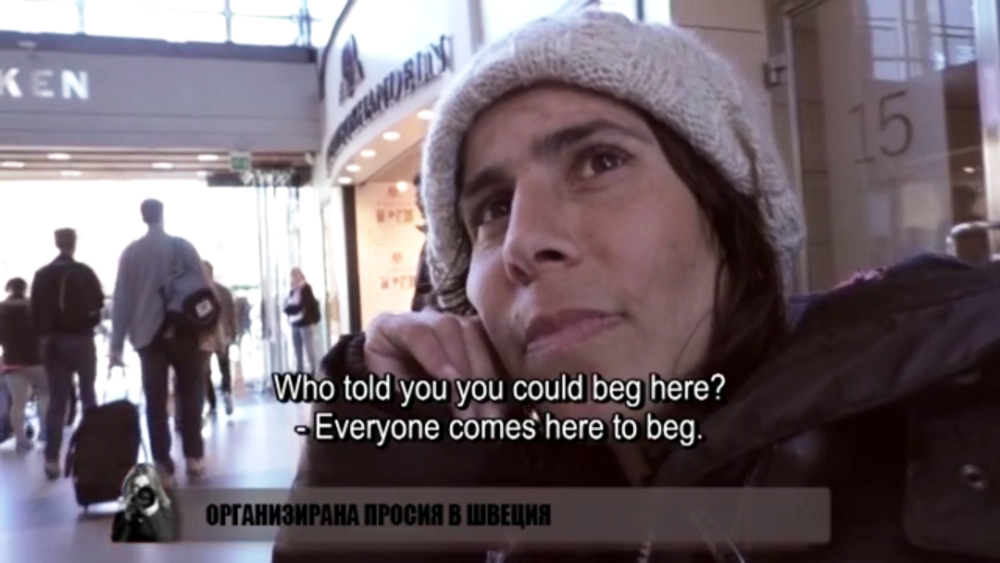
Last year, a Bulgarian news team visited Sweden to film a documentary about the beggars. The footage showed that there are people who actually organize the panhandling; one of them talked openly on camera about being prosecuted for blackmailing a beggar who did not earn him enough money. The man also talked about how he “owned” five street corners in central Gothenburg, and said that the best location was outside Systembolaget (the government-owned liquor store) — where he posted his wife.

Last year, a Bulgarian news team visited Sweden to film a documentary about Roma beggars from Bulgaria and Romania.

The man denied that the beggars themselves worked for him — he claimed they were all part of a Bulgarian team, and split the income between them. His role was just to “protect” them from the Romanian beggars, who, he said, would otherwise “beat up and chase the Bulgarians away.” He said that the beggars make about 400-500 kronor ($50-60) a day, and use the money to buy food, beer and cigarettes.

“Is it not fraud,” the reporter asked, “to pretend that you are destitute, all the while using the money for beer and cigarettes?”

“No,” the man said, “we do not fool anyone. We just benefit from this opportunity.”

The charges against him were dropped.

Ingrid Carlqvist is a journalist and author based in Sweden, and a Distinguished Senior Fellow of Gatestone Institute.

Sweden’s Walking Diplomatic Disaster by Ingrid Carlqvist

  • “It is a shame for Sweden to have a Foreign Minister who creates a diplomatic crisis as soon as she opens her mouth, and who so one-sidedly allies herself with anti-democratic forces against Israel, the only democracy in the Middle East.” — Political analyst Mathias Sundin, in Aftonbladet.

  • “Wallström portrays [Palestinian President Mahmoud] Abbas as a pacifist who has denounced terrorism…. He has not condemned a single one of the murders of 20 Israelis during the last few months. On the contrary … Abbas said in September, regarding the violence against Israelis, that ‘We bless every drop of blood spilled in Jerusalem’, and we know that every Palestinian assassin apprehended by Israel is rewarded by the Palestinian Authority. So how can Wallström claim that he denounces terrorism, when he is actually rewarding it with money from the Swedish taxpayers? … Is Wallström aware of the praising of terrorism? Is Wallström aware of the rewards paid to terrorists? Yes or no?” — Kent Ekeroth, Sweden Democrats Party.

It seems that pretty much everything is going wrong for Sweden’s Foreign Minister these days.

Margot Wallström, of the Social Democratic Party, ascended with much fanfare to the post of Foreign Minister in the fall of 2014. She had introduced a completely new concept: a feminist foreign policy. In the Statement of Foreign Policy of 2015, she asserted that “A feminist foreign policy is now being formulated, the purpose of which is to combat discrimination against women, improve conditions for women and contribute to peace and development.”

One year later, we now know the outcome: “Feminist foreign policy” is not so much about protecting women’s interests, as it is about fawning over the Arab states and the Palestinians — and constantly attacking Israel, the only democracy in the Middle East.

Zvi Mazel, Israel’s ambassador to Sweden from 2002-2004, wrote for the Jerusalem Center for Public Affairs on December 14, that,

“The Swedish Social Democratic Party is not known for its sympathy toward Israel. Its current duo of leaders, however, Prime Minister Stefan Löfven and Foreign Minister Margot Wallström, have gone overboard and are waging a systematic campaign against Israel… Although the recognition of a Palestinian state was a continuation of the Swedish left’s hostile policy toward Israel, it was also aimed at the country’s large Muslim minority — comprising about 700,000 people — with the aim of attracting Muslim voters to the party in the next elections. During my diplomatic tenure in Sweden in the early 2000s, all my efforts to conduct a dialogue with that party fell on deaf ears. … the two countries’ relations have turned into a cycle of altercations.”

Is Ambassador Mazel right? Let us take a look at what the Swedish government, and its current Foreign Minister, have said and done.

On October 30, 2014, there was the unilateral recognition of Palestine as a sovereign state. The same day the government made its decision, the Swedish daily, Dagens Nyheter, published an opinion piece by Wallström:

“Today’s recognition is a contribution to a better future for a region that has too long been characterized by frozen negotiations, destruction and frustration. Through our recognition, firstly, we want to support the moderate forces among the Palestinians: Those that are set to govern the complex formation of a Palestinian state, and those who are about to return to the negotiating table.

“Secondly, we want to facilitate an agreement by making the two parties in these negotiations more equal. The goal is for Israel and Palestine to exist within mutually recognized borders, based on the borders of 1967 and with Jerusalem as the capital of two states, only allowing land swaps if both parties negotiate it.

“Thirdly, we hope to contribute to giving more hope and belief in the future to the young Palestinians and Israelis who otherwise risk radicalization in the belief that there are no alternatives to violence and the status quo.”

The reactions came immediately. As soon as Prime Minister Löfven made his Statement of Government Policy, and made public his new government’s intention of recognizing Palestine, the Israeli Foreign Ministry called in the Swedish ambassador to Israel to protest the decision, and Israel’s then Foreign Minister, Avigdor Lieberman, was openly critical. The same night, word came that Israel called home its current ambassador, Isaac Bachman. Lieberman even said that he was considering removing the Stockholm embassy permanently, thereby downgrading Israel’s diplomatic connections with Sweden. This move, however, did not happen.

Israel demonstrated its opinion of Wallström clearly in January 2015, when she was supposed to travel to Israel for a seminar in remembrance of Raoul Wallenberg, and also to meet with FM Lieberman and Prime Minister Benjamin Netanyahu. The Israeli leaders, however, did not want to see Wallström, and denied her diplomatic credentials.

“A powerful statement by the Israelis,” said Per Jönsson, Middle East expert at Sweden’s Foreign Policy Institute (Utrikespolitiska institutet). “She is not treated as a Foreign Minister from a sovereign government. It is much more than just a symbolic gesture; this is Israel taking action,” Jönsson told the daily Svenska Dagbladet. According to the paper, the Israeli government had conveyed the message that the only way to defrost relations between Sweden and Israel was for Sweden to apologize for recognizing Palestine — or if a new government came to power.

Apparently, the Swedish Foreign Ministry thought the whole affair so embarrassing that it decided to pretend Wallström had to cancel her trip due to time constraints.

The recognition of Palestine also garnered massive criticism inside Sweden. The Committee on European Union Affairs criticized the government for not allowing Parliament to vote on the issue, and the opposition parties called the recognition “hasty, imbalanced and clumsily handled to boot.” Liberal foreign policy spokesperson Birgitta Ohlsson said that the decision was “immature,” as it legitimizes Hamas’ terror. Middle East expert Per Jönsson pointed to the fact that it is not customary to recognize a state that does not fully control its territory.

Of course, Palestinian President Mahmoud Abbas was very happy. He got a call from Prime Minister Stefan Löfven announcing the decision. Abbas told daily tabloid Aftonbladet: “Sweden is a pioneer country, I hope other countries in Europe will follow suit.”

On February 15, 2015, when Abbas visited Sweden, criticism erupted again. Karin Ernström, Vice-Chairman of the Committee on Foreign Affairs, said she believed Sweden should have awaited a joint EU decision before unilaterally deciding to recognize Palestine. She also noted, in an interview during Abbas’s visit, that she “assumes that Sweden takes this opportunity to put pressure on the Palestinian leadership.” No such pressure has been visible so far.

Many people in Sweden now feel that if Sweden can recognize Palestine, why not do the same with Western Sahara, a disputed territory unilaterally annexed by Morocco 40 years ago? Does such a decision not jibe with the “feminist foreign policy?” Or could it be that Morocco is a Muslim country, and that the feminist Wallström does not want to offend countries such as that? Certainly not after a debacle in 2015, when Wallström labeled Saudi Arabia a dictatorship with medieval laws and oppressing women. This statement before Parliament came as a reaction to the sentencing of Saudi blogger Raif Badawi to ten years in prison and 1,000 lashes, on charges of “insulting Islam.”

Many Swedes at the time were pleasantly surprised by Wallström’s statement, and thought that maybe this “feminist foreign policy” thing was not so bad after all. In the Muslim world, however, her statement was met with considerable anger. The Organization of Islamic Cooperation, OIC, wrote on its web page: “In her remarks, Ms. Wallström degraded Saudi Arabia and its social norms, judicial system and political institutions.”

What Wallström apparently failed to grasp when she attacked the Saudi justice system, is that it is based on Sharia law, the Islamic judicial system. And one does not criticize this with impunity, as a Foreign Minister should know. So, instead of sticking to her original arguments, which were, of course, factually correct, wild panic erupted at the government offices. Wallström’s Press Secretary, Erik Boman, hurried to claim that his boss had not meant her statement to be construed as any kind of criticism of Islam. “We have the utmost respect for Islam,” Boman said. “Sweden values its good relations with the Muslim world.”

Wallström herself held an ingratiating speech in Parliament. She praised Saudi Arabia, mentioned that the king is the guardian of the two most important mosques in Islam, and stressed that many Swedes go on pilgrimage there every year. The end of her speech once again made people gasp: “To address some of the claims circulating, I would just like to say: We have the utmost respect for Islam as a world religion and for its contributions to our common civilization. … Sweden values our good relations to the Muslim world. Many Swedes are Muslims, and they of course give valuable contributions to our society.”

Björn Norström, a US-based writer, revealed on the alternative media site, Avpixlat that he had written to the Foreign Ministry asking for “concrete examples of how Islam has contributed to civilization when it comes to human rights, science, industry, democracy and polity since medieval times.” He did not receive any examples, mostly just loose claims and a reference to the oft-refuted “1001 Inventions, the Enduring Legacy of Muslim Civilization.”

The Muslim world was nevertheless still angry with Wallström, despite of her kind words about Islam. Saudi Arabia called home its ambassador from Stockholm and decided to suspend new work visas for Swedish citizens. The Saudis also stopped Wallström from giving a speech at an Arab League meeting in Cairo March 9.

The firestorm did not abate until Sweden’s King Carl XVI Gustaf offered to help mediate on her behalf with Saudi king. On March 28, Wallström held a press conference, and was beaming with joy when she told reporters that Sweden’s relations with Saudi Arabia were now fine: “I am very pleased to announce that we can normalize our relations immediately, and that we are able to welcome the Saudi ambassador back to Sweden. It is deeply satisfying that we have been able to clear the misunderstanding that we insulted the world religion Islam.”

We will never know how exactly relations were “normalized.” What we do know is that the envoy for the Swedish government, Social Democrat Björn von Sydow, was granted an audience with the House of Saud, under the leadership of King Salman bin Abdul Aziz and Prince Mohammed bin Salman Al Saud. Von Sydow delivered two letters, one from the Swedish King and one from Prime Minister Stefan Löfven. Both letters remain classified.

Soon after the recent Paris terror attacks, on November 13, 2015, Wallström felt once again a need to express her disdain for Israel. In an interview with Swedish Public Television, SVT, she was asked: “How worried are you about the radicalization of young people in Sweden who choose to fight for ISIS?” Wallström replied:

“Yes, of course we have a reason to be worried not only here in Sweden but around the world, because there are so many who are being radicalized. Here again, you come back to situations like that in the Middle East, where not least the Palestinians see that there isn’t any future for us [the Palestinians], we either have to accept a desperate situation or resort to violence.”

This strange connecting of the Paris attacks to Israel caused a new diplomatic crisis between Israel and Sweden. Once again, the Swedish ambassador to Israel was called to a meeting at the Israeli Foreign Ministry, and cautioned that the Swedish Foreign Minister’s statement seemed “appallingly impudent.”

The week before, the daily tabloid Expressen had revealed that Swedish diplomats were no longer welcomed in Israel the way Sweden would like. For example, they are refused travel permits to the Gaza strip — papers other countries apparently have no problem obtaining.

A few days after Wallström’s scandalous interview, the linguist Susanne Sznajderman-Rytz posted on her Facebook page:

“‘The Jews are campaigning against me.’ That was the reply I got from Margot Wallström, when I ran into her by coincidence the day after the Paris attacks, and told her that many of my Jewish friends were really offended by what she told [SVT anchorman] Claes Elfsberg earlier that morning.”

Again, Wallström was forced to explain herself. Her Press Secretary claimed outright that Sznajderman-Rytz had made the whole thing up. But Sznajderman-Rytz stuck to her story. She told the alternative media website Nyheter Idag,

“Let me tell you what I do in my everyday working life. She did not know this, but I educate people in communication and writing. Professionally, I work with understanding what people are saying, how they act and everything that happened in that moment is quoted correctly.”

In early December, two members of Parliament, Mathias Sundin of the Liberals and Kent Ekeroth of the Sweden Democrats, had demanded that Wallström explain why she had not condemned the rampant Palestinian knife attacks against civilian Israelis with so much as a syllable. The ensuing debate ended with Wallström saying that she trusts Palestinian Authority President Mahmoud Abbas implicitly, because he told her he wants peace, and she believes him. She also leveled new accusations against Israel, which, according to Wallström, is engaged in “extrajudicial executions.”

Mathias Sundin wrote in an opinion piece in Aftonbladet:

“When I pointed out that the Israeli police handle the knife attacks according to the same principle that the Swedish police used during the Trollhättan school attack, by aiming for the body to stop the assailant quickly, the Foreign Minister shook her head several times. It was in reply to this statement that Wallström said that the response must not be extrajudicial executions.

“Even though it is obvious what she actually means, she and the government refuse to apologize. Their defense tactic — the one about it being a misunderstanding — does not include an apology even for being unclear, but rather, a new attack against Israel. Unfortunately, this is completely in line with the government’s one-sided policy. … It is a shame for Sweden to have a Foreign Minister who creates a diplomatic crisis as soon as she opens her mouth, and who so one-sidedly allies herself with anti-democratic forces against Israel, the only democracy in the Middle East.”

Sweden’s Foreign Minister Margot Wallström (right) called the Israel Police’s actions in stopping deadly stabbing attacks “extrajudicial executions,” even after it was pointed out to her that “Israeli police handle the knife attacks according to the same principle that the Swedish police used…”

Kent Ekeroth wondered how Wallström views President Abbas and his Fatah party. The Foreign Minister replied:

“The government supports moderate forces in Palestine, the government supports the Palestinian Authority and others who recognize Israel’s right to exist and seek a diplomatic solution to the conflict, enabling Israel and Palestine to live side by side with peace and security. I find that President Abbas has made it his life’s goal to replace the way of violence with a diplomatic struggle to end the Israeli occupation of Palestine. I also note that President Abbas, apart from his denunciation of terrorism, has also spoken against cries for violent resistance against the Israeli occupying force.”

Ekeroth retorted:

“Wallström portrays Abbas as a pacifist who has denounced terrorism. He might condemn terrorism when it is French citizens who are killed, but when it is Israelis being killed there are no problems. He has not condemned a single one of the murders of 20 Israelis during the last few months. On the contrary, many of the Palestinian Authority and Fatah leaders have glorified the killers. A member of the Fatah Central Council told Palestinian TV in October that he congratulates all those who have carried out the attacks. He is proud of them, and thought that knife attacks should be taught in Palestinian schools. Your own ‘golden boy’ Mahmoud Abbas said in September, regarding the violence against Israelis, that ‘We bless every drop of blood spilled in Jerusalem’, and we know that every Palestinian assassin apprehended by Israel is rewarded by the Palestinian Authority. So how can Wallström claim that he denounces terrorism, when he is actually rewarding it with money from the Swedish taxpayers?

“Wallström is either ignorant about Abbas’ celebrations of and rewards to murderers, or she is lying. Neither alternative is very flattering. I would therefore like to ask two questions: Is Wallström aware of the praising of terrorism? Is Wallström aware of the rewards paid to terrorists? Yes or no?”

Wallström replied that she certainly condemns “all acts of violence, regardless if they are carried out by Palestinians or Israelis, and I have emphasized the importance of bringing those responsible to justice and not engaging in extrajudicial executions.”

Wallström further thought that one should not attempt to interpret or translate what Abbas says, because there are so many different ways to do this. “I do not think we should do that, the important thing is that we condemn violence and I myself have heard Abbas do this, so I know he renounces violence.”

Ekeroth shot back: “One does not reward terrorists with recognition, and one does not pay them using Swedish taxpayers’ money.” He then proceeded to show a number of printouts of Fatah’s official Facebook page, where murdered Israelis are displayed and the killings celebrated. “You need to understand that Abbas speaks two languages — one to gullible [Western] politicians, where he says he wants peace, and another to Palestinians, where he promotes, glorifies and rewards terror. Wallström needs to stop listening to what Abbas tells her and instead start listening to what he tells his own people.”

On January 11, 2016, did it again. She said in parliament that she wants “a thorough and credible investigation into whether Israel has used extrajudicial killings during the last months of violence, knife attacks and clashes between Israelis and Palestinians.”

The statement provoked strong a reaction in Israel. Its foreign ministry, in an unusually strongly-worded statement, condemned Wallström, saying her “irresponsible and delirious statements are giving support to terrorism and encouraging violence.” Technology and Space Minister Ofir Akunis went farther and suggested that, instead, there should be an investigation on “how a woman who so bluntly hates Israel was elected, and still holds the role of foreign minister of Sweden.”

* * *

Many Swedes had a great sense of secondary shame, when the government, with Wallström in the forefront, presented its military “aid package” to France. Sweden is bound by the Treaty of Lisbon to help other EU nations struck by a terrorist attack. A request for help had come from France a few days after the terror attacks of November 13. Most experts agreed that the most natural thing for Sweden to do, would be to send JAS39 Gripen jets, an advanced Swedish fighter and reconnaissance plane that could be truly useful in, for example, Syria. But this did not happen.

All the government could apparently muster were a few extra flight hours in Africa, a couple of staff officers and a Hercules transport plane. Wallström explained the lack of Gripen planes: “The most important reason is that this is a gray area in international law. That may change, if a clear UN mandate comes. But so far, this is unclear as far as international law goes.”

Sweden’s opposition parties were merciless in their criticism. Christian Democratic Party defense spokesperson Mikael Oscarsson called the offer “futile.” The Conservative Party’s Hans Wallmark called it “insufficient” and warned that if Sweden were attacked in the future, it should not expect a great deal of help. The Liberal Party’s Allan Widman said that he believed this was “a great disappointment to the French.” There were even rumors of disagreements within the government, between Wallström and Defense Minister Peter Hultqvist, who supposedly wanted to send JAS39 Gripen jets, but was overruled by Wallström.

“Today we are ashamed,” wrote columnist Alexandra Ivanov in the daily Svenska Dagbladet. “What has happened is that Sweden has chosen not to take responsibility. One day, we will become aware of what happens to those who just take and take, but never give back.”

On Christmas Day, December 25, Aftonbladet published a list of how the Swedish people grade the government’s ministers. Unsurprisingly, the minister losing most favor with the people was: Margot Wallström.

Sweden’s Muslim Christmas Show by Ingrid Carlqvist

  • What finally seems to be dawning on the Swedes is that while the government puts the right to asylum before the safety of its own people, the country could be filling up with terrorists.


  • “No, ‘Sweden’ has not been naïve. You, your party and your coalition partners have been naïve and you still are.” — Mattias Karlsson, Parliamentary group leader of the Sweden Democrats.

  • The announcement that a person such as Dirawi, who professes to be of the Islamic faith, and who according to Islamic scholars should believe the celebration of the birth of Christ is a heathen tradition, will be Christmas Host, sparked feelings of anger and betrayal.

From the night of the Paris attacks until Tuesday, when Sweden’s government announced it was reversing its open-borders policy, Sweden was in a state of turmoil. No matter what the government said, it accomplished nothing — other than making the Swedes increasingly livid.

When Prime Minister Stefan Löfven accused his people of being naïve about radical Islamism, anger exploded on social media. You could read comments such as: “No. Some of you have been naïve. The rest of us have been labeled fascists and other ugly things.”

The shock and horror of the Paris attacks — in which one Swedish woman was among the 130 dead and another among the 350 wounded — had barely subsided when the Swedish people received another blow. On November 18, a grim Security Service Chief, Anders Thornberg, held a press conference during which he revealed that a combat-trained ISIS terrorist was suspected of having entered Sweden and a warrant was issued for his arrest. Because of this, Thornberg had raised the threat level in Sweden from three to four on a scale of five — meaning the country was now facing the highest “threat level” since the scale was introduced in 2010.

The Security Service Chief, as well as various Ministers, then urged people not to be alarmed. The suggestion had little effect. Rumors ran rampant on Facebook and other social media that police in Stockholm had told their family members to “stay away from the inner city for the next four or five days as the threat was a lot more serious than what had been made public; apparently they are looking for more terrorists, about 20 people; you need to decide for yourselves. In any event, the threat is bigger than what was shown on the news.”

The next day, the Stockholm subway, which normally transports 1.2 million passengers a day, was rather desolate. Then, on November 20, the Security Service confirmed that an attack had indeed been planned to take place in Stockholm.

The day after the nationwide alert, the suspected ISIS terrorist was apprehended. It turned out that he had sought asylum in Sweden under the name Mutar Muthanna Majid, and had been living for several weeks at an asylum seekers’ home in the small mining village of Boliden in northern Sweden.

Only after the arrest did Prime Minister Stefan Löfven speak out in public. During a press conference, he announced stricter anti-terror laws to deal with foreign Islamist extremists, which he now admitted posed the biggest threat to Sweden, and not the only one:

“We know that about 300 Swedish citizens have gone to Syria and Iraq to fight alongside ISIL. We also know that about 120 have returned. The Security Service believes that among them, there are individuals who pose a threat to our society and have also committed crimes against people in other countries. It is unacceptable that people can travel, participate in terrorist acts and come back without being held accountable — and drain the society of large resources.”

Next, the Prime Minister claimed that “Sweden has been naïve,” conveniently forgetting that he had called those who were not naïve — those who had expressed concern about the Islamization of Sweden — “racists” and “Islamophobes.” He also neglected to mention that as far back as May, Security Service chief Anders Thornberg had raised the alarm that Sweden could not handle any more jihadism. At the time, Thornberg had also expressed concern that foreign jihadis would take advantage of the Swedish asylum system — through which more than 90% of applicants lack identification documents but still got permanent residency — by hiding among the refugees.

A few days after Mutar Muthanna Majid, the suspected terrorist, was arrested, the District Attorney dismissed the Security Service’s evidence against him. On November 22, Majid wasreleased and all charges dropped. A columnist from the daily Dagens Nyheter, Lasse Wierup, called the Security Service’s conduct “astonishingly unprofessional.”

Even as the mass immigration of Muslims to Sweden increased at an explosive rate during the last few years, the government kept stubbornly insisting that it did not entail any problems. According to the government, everyone was the same, and it did not matter if Sweden was populated by Swedes or by Muslim Somalis, Iraqis or Afghans. Those who insisted otherwise were ruthlessly branded “racists” and “Islamophobes.”

Finally, last week, Prime Minister Stefan Löfven stood up on live television, and said:

“I must say that Sweden has been naïve in this regard. Maybe it has been hard for us to accept that in our open society, right in our midst, there are people, Swedish citizens, who sympathize with the murderers of ISIL.”

In response to questions from Gatestone Institute about who, exactly, was being called naïve, Mr. Löfven’s press secretary, Dan Lundqvist Dahlin, said that the Prime Minister had in mind “Swedes in general.” When asked if that meant Löfven was blaming the Swedish people for the peril the country was now in, Dahlin replied: “The Prime Minister says that we have been naïve in Sweden. He means me and you and you and you and you!”

When asked if that meant he was accusing the Swedish people of being naïve, Dahlin said:

“But can’t you see what I mean? It is not an accusation. If someone feels accused, that is his problem. I suppose he means politicians and everyone else.”

The Prime Minister’s statement seemed to outrage many Swedes. The hashtag #naiv (“naïve”) immediately started trending on Twitter, and people began posting comments such as:

  • “I haven’t been ‪#naiv so don’t drag me into this.”
  • “‘Sweden has been naïve’? No, you have betrayed your country.”
  • “I have been called many things over the years, but this is the first time I have been called naïve. By the Prime Minister no less. Not bad.”
  • “Why is Löfven saying that ‘Sweden’ has been naïve? Very, very many have warned about exactly the situation we are now in!”

The only political party that warned about the Islamization of Sweden was the Sweden Democrats, and it has consistently been shut out of all consultations. During the press conference, Löfven called for national unity and invited all the opposition parties to talks — except the Sweden Democrats. He even said:

“In moments such as this, it is important that Sweden stands united. There is no room for partisan squabbling or party politics here. That is why I have invited the right wing-bloc for talks on how to fight terrorism.”

The Sweden Democrats’ Parliamentary group leader, Mattias Karlsson, wrote on Facebook:“No, ‘Sweden’ has not been naïve. You, your party and your coalition partners have been naïve and you still are.”

Karlsson reminded the public of the massive criticism of the Sweden Democrats, when its members recently handed out flyers to migrants in southern Europe. The flyers — signed by the Sweden Democrats and “the people of Sweden” — urged asylum seekers not to go to Sweden. Journalists and politicians then attacked the party for speaking on behalf of “the people.”

“Judging by the media storm and the comments of government representatives about our flyer the other week,” Karlsson wrote, “I got the impression that speaking in the name of the Swedish people was utterly terrible, but apparently, that was not the case.”

Löfven, appearing on the newscast TV4 News, was asked if stricter border controls should have been introduced earlier, to prevent terrorists from entering Sweden. Löfven was evasive, but the question was actually inaccurate.

The border controls Sweden had introduced in past, meant, in reality, nothing. The borders were as wide open as ever to anyone claiming to seek asylum. The flow of migrants was as big as before: 10,000 new asylum seekers a week.

While the mainstream media is careful to avoid telling the public about this, Dispatch International recently broke the story that at the Öresund Bridge, which connects Sweden and Denmark, the border police performed only random checks — and only on people not claiming to seek asylum. The people who claimed to seek asylum were not checked at all. They were simply transported to an Immigration Service facility. There, they were fingerprinted and photographed; however, as very few of the asylum seekers actually have passports or other identification documents, it takes months even to get a “probable” identification.

While the identity of the asylum seekers was being investigated, they were not held. On the contrary, although many are actual refugees or honestly seeking better lives, they all were sent to various asylum facilities around the country, where, if some wished, they were free to plan any terrorist acts they liked in peace and quiet. For example, Mutar Muthanna Majid, the man who a few days ago had been suspected of being a terrorist, even had his own apartment in the Boliden village — with his name on the door.

Instead of closing Sweden’s borders, Löfven kept pressing for a redistribution of Sweden’s asylum seekers throughout the EU. He called the EU countries that did not have open borders (all except Sweden, Germany and Austria) “irresponsible.” He apparently did not reflect on the idea that the responsible thing might, in fact, have been to protect your own people, and put their well-being first.

Keeping the country’s borders wide open and calling terrified people “racists” and “Islamophobes,” while claiming “we have been naïve,” did not exactly increase the Prime Minister’s popularity. The daily Metro recently reported that Löfven’s Social Democrats now have only 21.4% of Swedish voters on their side, while the Sweden Democrats reached a new record of 26.7%. Moreover, according to the same survey, despite people tending to rally around their leaders in times of crisis, Löfven has become one of the government’s least popular ministers – in 21st place out of 24. His Deputy Prime Minister, Green Party leader Åsa Romson, is the most unpopular.

The poll also showed that more and more Swedes believe that the most important political issue right now is the migrant problem. Since the last poll a month ago, the number of people believing this has grown to 64%, an increase of 8% since October.

What finally seems to be dawning on the Swedes is that while the government puts the right to asylum before the safety of its own people, the country could be filling up with terrorists.

To add insult to injury, Swedes have just found out that the host of the Christmas Show on Swedish Public Television — a very prestigious role designed mainly to comfort lonely people who do not have anyone with whom to celebrate Christmas — will this year be a young Muslim woman, Gina Dirawi, aged 24. Regrettably, on several occasions she has made anti-semitic remarks, yet she nevertheless keeps getting new TV hosting assignments.

Swedish Public Television’s appointment as Christmas Host of Gina Dirawi, who professes to be of the Islamic faith, and who according to Islamic scholars should believe the celebration of the birth of Christ is a heathen tradition, sparked feelings of anger and betrayal in Swedes. (Image source: Expressen video screenshot)

The Public Service director, Safa Safiyari, who recently introduced Dirawi to a large press gathering, came to Sweden at the age of 14. In newspaper articles, he has spoken about how he does not feel “fancy” enough for the Swedish archipelago; and how, in 2001, when he got to do current affairs shows for young people about “all the injustices in Sweden,” it felt as if it were revenge for all the injustices he said he has experienced in Sweden and that still characterize his life.

The announcement that a person such as Dirawi, who professes to be of the Islamic faith and who according to Islamic scholars should believe that the celebration of the birth of Christ is aheathen tradition, will be Christmas Host, sparked widespread expressions of anger and disappointment on social media. Comments were posted on Twitter, such as: “Public Television has declared war on Christian Sweden by choosing Muslim Gina Dirawi as Christmas Host! It is shameful!” And, “If things continue down this road, by next Christmas, Christmas ham will be banned.”

Safa Safiyari told the daily Göteborgs-Posten, that Swedish Public Television had been prepared for all kinds of reactions: “We have chosen Gina Dirawi as Christmas Host based on her competence, her comedic talents and experience in large television broadcasts. When we hire our Christmas Hosts, religious belief is not something we inquire about.”

Ingrid Carlqvist is a journalist and author based in Sweden, and a Distinguished Senior Fellow of Gatestone Institute.

Sweden’s Migration Industry by Nima Gholam Ali Pour

  • That Sweden is a “humanitarian superpower” is a myth that needs exposing once and for all. The recent migration wave to Sweden has made some people poor and others very, very rich. It is all about money, and it is about winners and losers.

  • If liberal journalists outside Sweden believe that rape is humanitarian, then Sweden has a humanitarian migration policy.
  • Meanwhile, thousands of “unaccompanied refugee children” are disappearing. and no one knows where they are.
  • There is nothing “noble” in Sweden’s migration policy — far from being a good example of how a migration policy should function, it is a disaster, and its final result is chaos, conflict, and corruption.

When you talk to journalists from the U.S. or the UK, they often seem to think that Sweden is a humanitarian superpower that has received refugees because the Swedish government is following some ideology based on doing good deeds.

That Sweden is a humanitarian superpower, eager to lead by example, is a myth that needs exposing once and for all. The recent migration wave to Sweden has made some people poor and others very, very rich.

Every day one reads news in Sweden about the winners and the losers in the migration industry. One of the winners in Sweden’s migration industry is ICA Bank. In November 2015, it invoiced the Swedish Migration Agency $8 million for providing asylum seekers prepaid cards. For every cash withdrawal, ICA Bank takes a $2 fee, and for every prepaid card activated, it takes $21. ICA Bank won the contract without any competition; its contract with the Migration Agency extends to March 2017.

Many asylum accommodations in Sweden are run by private operators and are making huge profits. In 2015, the 30 largest companies that run the asylum accommodations invoiced the Swedish Migration Agency an estimated $109 million. The losers, on the other hand, were the Swedish taxpayers who had to finance these decisions.

In November 2015, it was reported that Sweden’s Migration Agency had paid $174 million during an 11-month period to private sector property owners for asylum seekers’ accommodation.

Many of the companies running the asylum accommodations have a profit margin of over 50%. Defakon Renting AB has a profit margin of 68%. Nordic Humanitarian AB has a profit margin of 58%. Fastigheterna på Kullen AB has a profit margin of 50%.

The biggest private company running asylum accommodations, Jokarjo AB, is owned by Bert Karlsson, known in Sweden primarily as director of a record label. In the early 1990s, Mr. Karlsson was the leader and founder of a political party, New Democracy, that advocated reducing immigration to Sweden. Between 1991 to 1994, as a representative of his party, he sat in the Swedish parliament. In 2015, his company billed the Swedish Migration Agency $23.9 million. Mr. Karlsson explained his business plan for running a home for asylum seekers in a simple sentence: “My idea is to make it cheaper and better than anyone else.”

One method he used to make his business more profitable is that asylum seekers have to buy their own toilet paper, apparently despite having agreed with the Migration Agency to provide asylum seekers with toilet paper, sanitary napkins and diapers. In December 2015, the Swedish media revealed that asylum seekers have to buy all these products themselves.

One can only imagine the situation for asylum accommodations run by minor private operators.

This is what the Swedish “humanitarian superpower” is actually about. It is all about money, and it is about winners and losers.

The companies running the asylum accommodations are becoming rich at the Swedish taxpayers’ expense; at the same time, asylum accommodations are not managed properly.

Here are a few of the violent incidents that happen every day:

On January 25, 2016, the police arrived at an asylum accommodation in Annerstad, southern Sweden, after hearing of a brawl there between Syrians and Afghans. When the police arrived, according to their report, no one — not even the people working there — could speak Swedish.

In January 2016, there were reports that a ten-year old boy at an asylum accommodation in Västerås had been raped repeatedly. In February 2016, there were reports that a boy at an asylum accommodation in Maglarp, in southern Sweden, had been raped by two other boys at the same asylum accommodation.

If liberal journalists outside Sweden believe that rape is humanitarian, then Sweden has a humanitarian migration policy.

What is actually happening in Sweden, however, is that private companies are making millions of dollars at taxpayer expense, while the newly arrived migrants are living a horrible existence in which rape and other abuses are a part of daily life. This is what other European countries will experience if they follow Sweden’s liberal migration policy.

Children who come to Sweden without parents (“unaccompanied refugee children“) must, according to the Swedish law, be assigned a legal guardian. The guardian, instead of the parents, is responsible for the child’s personal relationships and managing daily affairs. In December 2015, it was reported that there are guardians responsible for up to 29 unaccompanied refugee children, and who earn more than $7,000 a month. It is not, of course, possible for one guardian to take care of 29 unaccompanied refugee children. The migration industry in Sweden has created opportunities for people with no conscience to become wealthy. Meanwhile, thousands of unaccompanied refugee children are disappearing and no one knows where they are.

Another part of the migration industry that has grown of late are foster homes for unaccompanied refugee children. In February, reports surfaced that one of the heads of the Swedish Migration Agency also runs the private company, Starkfamn Familjehem AB: a business that provides foster homes to unaccompanied refugee children. It is not only people in the private sector are making money from the migration industry, but also people working inside the state apparatus who want to do well.

The biggest private company running asylum accommodations is owned by Bert Karlsson (left). In 2015, his company billed Swedish taxpayers $23.9 million. His homes require asylum seekers to buy their own toilet paper, apparently despite having agreed with the Migration Agency to provide asylum seekers with toilet paper, sanitary napkins and diapers. Wafa Issa (right) is head of the Migration Agency for the Stockholm region. She also runs a private company that is paid to provide foster homes to unaccompanied refugee children.

One of the losers is the Swedish police. They have reported that they can no longer cope with their jobs because they cannot handle the hundreds of young men in Sweden right now from Morocco and other countries in North Africa.

When you talk with journalists from Britain or the United States who think that Sweden’s migration policy is a role model, you have to think of those journalists who once saw the Soviet Union as a model. Communism did not work; Sweden’s migration policy does not work. That Sweden is a “humanitarian superpower” is truthfully nothing but marketing: the Green Party and some Social Democrats want to export Sweden’s liberal migration policy to the rest of Europe.

Although a small clique in Sweden have become millionaires because of the migration industry, the schools, police, social services and taxpayers in Sweden have lost a lot and have a difficult and uncertain future. There will be major conflicts in Sweden. There is nothing “noble” in Sweden’s migration policy. The Swedish migration model, far from being a good example of how a migration policy should function, is an embarrassment and a disaster, and its final result is chaos, conflict, and corruption.

Nima Gholam Ali Pour is a member of the board of education in the Swedish city of Malmö and is engaged in several Swedish think tanks concerned with the Middle East. He is also editor for the social conservative website Situation Malmö.

Translate »
Skip to toolbar