
Dore amakuru ya NYAMPINGA niba ashaka kwimenya neza uko ateye!

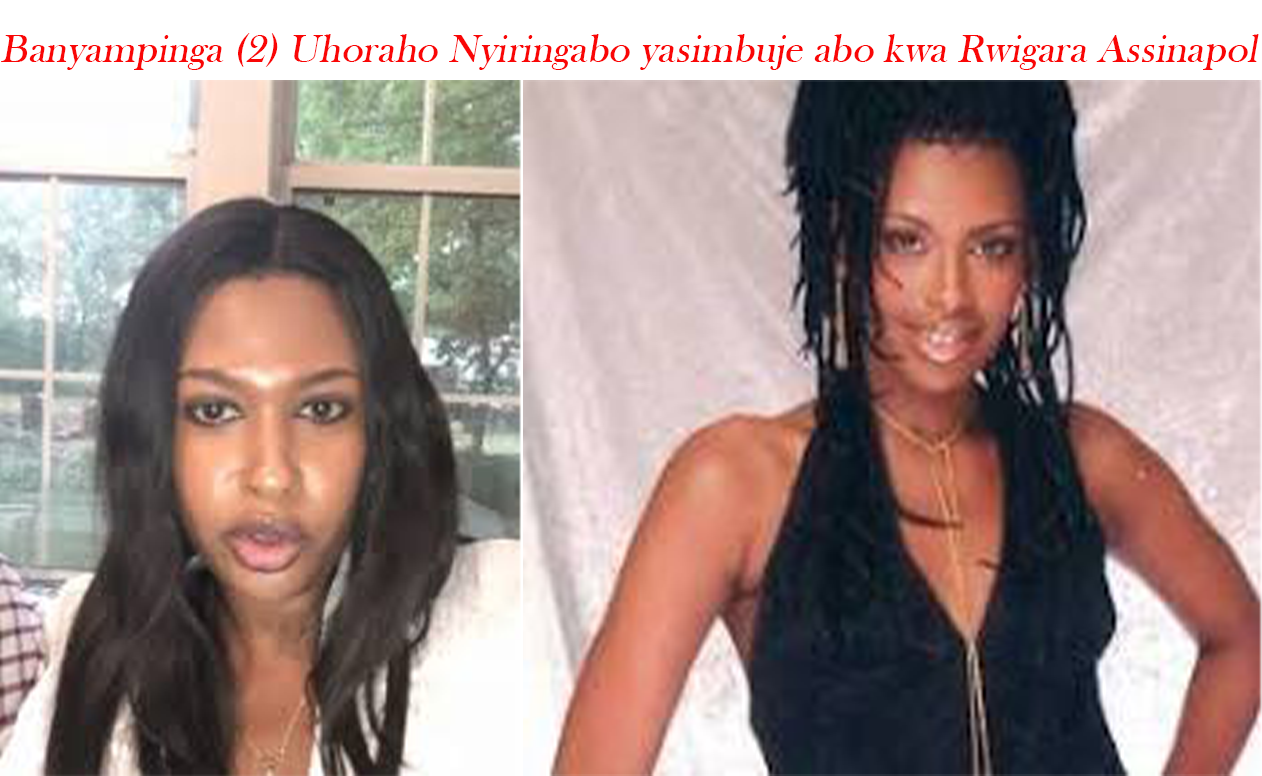
Dore amakuru ya NYAMPINGA niba ashaka kwimenya neza uko ateye!

Uhoraho Uwiteka Imana Nyiringabo akomeje gusaba Umwami Kigeli Ndoli gutanga ibisobanuro bihagije kuri NYAMPINGA wo muri CANADA, yaturutse muri Congo, atuye muri Canada, afite bene wabo mu ngabo za M23, yahawe igihe More »

Ikurwaho rya Evariste Ndayishimiye, rifitanye isano rya hafi nikurwaho ry’Umwakagara Paul Kagame!!!

Ikurwaho rya Evariste Ndayishimiye, rifitanye isano rya hafi nikurwaho ry’Umwakagara Paul Kagame!!!

The rhema word comes from heaven and told me that man of living God of heaven, just sight front you and see what written on the black board the word that I More »

Australia’s Government: ‘Moral Bankruptcy on Parade’

Australia’s Government: ‘Moral Bankruptcy on Parade’

The situation could have been worse but for the actions of Sydney’s police force and the quick work of a very brave unarmed bystander, Ahmed El-Ahmed, a Muslim man who tackled and More »

Itangazo rya NYAMPINGA wo muri Canada

Itangazo rya NYAMPINGA wo muri Canada

Ijambo ry’Uhoraho Uwiteka Imana Nyiringabo rikomeza kunzaho kandi cyane, maze rirambwira riti, Umwami Kigeli Ndoli tangariza NYAMPINGA uri muri CANADA umubwire uti, uwo fiancé witwa JOHN ukubuza kwandikira Umwami Kigeli Ndoli ngo More »

Itangazo rya nyuma k’Umwakagara Paul Kagame!

Itangazo rya nyuma k’Umwakagara Paul Kagame!

Ijambo ry’Uhoraho Uwiteka Imana Nyiringabo rikomeza kunzaho kandi cyane, maze rirambwira riti, Umwami Kigeli Ndoli tangaliza Umwakagara Paul Kagame umwana w’umwega uti, iri nitangazo rya nyuma Uwiteka Imana Nyiringabo aguhaye, nta bwo More »


Turkish Professor: “Those Who Do Not Do Islamic Daily Prayers Are Animals” by Robert Jones

  • “Salah [prayer] is not done by animals. Those who do not do salah are animals.” — Turkish Professor Mustafa Askar, School of Divinity, Ankara University.

  • Intimidation by Muslim extremists against those who do not follow a strict Islamist lifestyle does indeed produce “results.” Physical or verbal attacks against those who do not fast during Ramadan are commonplace all across Turkey. If you happen to find yourself there during Ramadan, stay indoors if you would like to eat, drink or smoke.
  • “If the faith of those who do not do salah is different from that of the professor, murdering them could even bring sawab [reward for Islamic good deeds]. Such are the views that feed the perverse faith and doctrinal background of Muslim terrorists. … Is this professor aware of the fact that with this claim of his, he could cause the murder of so many innocent people?” — Yasin Ceylan, professor of philosophy, Middle East Technical University, Ankara.

Many Muslims claim that the Islamic month of Ramadan is not simply an exercise in fasting during the day. It is, they say, a chance for “a spiritual boost,” “mental peace” or “a moral awakening.”

During Ramadan, however, it often seems as if hate speech and intolerance are as rampant as ever, possibly even more — especially with the “Ramadan TV programs,” which are popular.

With the advent of Ramadan, Turkey has not opened only the season of fasting; it has also opened the season of “Ramadan Intolerance.”

This frequently consists of statements which threaten or dehumanize those who do not fast. During this season, many national television channels and social media users in Turkey disgorge hatred against those who do not carry out the strictest Islamic requirements.

Turkish professor Mustafa Askar, at Ankara University’s School of Divinity, said on the “Joy of Ramadan” program, aired on the state-funded TRT channel: “Those who do not do Islamic daily prayers are animals.”

Askar proclaimed, on June 12, that “no beings other than humans touch the ground with their foreheads [to do sujud, the position of worship in which the forehead, nose, both hands, knees and all toes touch the ground together]. Human beings, he said, were created in a “salah [worship] ergonomic” way, and that is why “humans do sujud.”

“Let me put it straight,” the professor said. “Salah is not done by animals. Those who do not do salah are animals.”

Yasin Ceylan, a professor of philosophy at Ankara’s Middle East Technical University, reacted to Askar’s statements on his social media account:

“If the claim that ‘those who do not do salah are animals’ comes from a professor, that could serve as an excuse for the massacres carried out by a terrorist organization such as ISIS. If killing an animal is not considered murder, those who do not do salah may be killed, too.

“Moreover, if the faith of those who fail to do salah is different from that of the professor, murdering them could even bring sawab [a reward for Islamic good deeds]. Such are the views that feed the perverse faith and doctrinal background of Muslim terrorists. The main source of violence is the judgments of minds. Is this professor aware of the fact that with this claim of his, he could cause the murder of so many innocent people?”

Askar, after being criticized by many for his remarks, told the pro-government daily newspaper, Akit:

“My words have been distorted by the enemies of Islam who almost every day hurl insults at Islam and Muslims. I have not strayed from the views I expressed. I am not taking a step back from my words. This is a scholarly evaluation. … I said what I think is right. But I made a mistake in my choice of words. If there are those offended by my mistake, we apologize.”

When journalists asked Nurettin Canikli, Deputy Prime Minister of Turkey, during a press conference in Ankara on June 13, about his views on Askar’s statements, Canikli said, “I shall pass on this topic.”

Meanwhile, on the June 13 edition of the “Blessing of Ramadan” television program, broadcast on the pro-government Star TV, a viewer asked, “Is it vacip [a religious obligation] to kill those who do not do salah [Islamic daily prayers]?”

“Decrees about giving certain punishments do not rest with individuals,” answered Fatih Citlak, the presenter of the program and also a columnist for the pro-government daily, Haberturk.

Later, on Ahsen TV — an Islamist internet outlet that usually conducts interviews about Islamic issues with the public — broadcast a video clip shows a child become panic-stricken after seeing his cat eat in the kitchen during Ramadan. He leaves home and starts frantically looking for his father. “Dad!” says the child upon finding him, “the cat has broken the fast!”

The father, played by Bulent Yapraklioglu, an Ahsen TV reporter, replies:

“So what is wrong with that? Don’t you know, son? Animals do not fast. Animals do not do salah. Animals do not pay zakat [Islamic religious tax]. Animals do not go on the Hajj [pilgrimage to Mecca] … So now you know.”

Social media, of course, is also used to spread the spirit of Ramadan — and the hatred of non-Muslims and Muslims who may be not-as-observant.

Hakan Arslanbenzer, a Turkish publisher and poet, declared on his Twitter account in June 2015: “There is no religious inconvenience in beating those who do not fast.”

A Twitter user asked him in response: “Did our Prophet beat anyone? Was there such a practice during his lifetime?”

“He is asking me,” Arslanbenzer repeated, “if they beat people who did not fast during the time of Mohammed. First show me the courageous munafiq [hypocrite] who would publicly violate fasting during the time of the Prophet!”

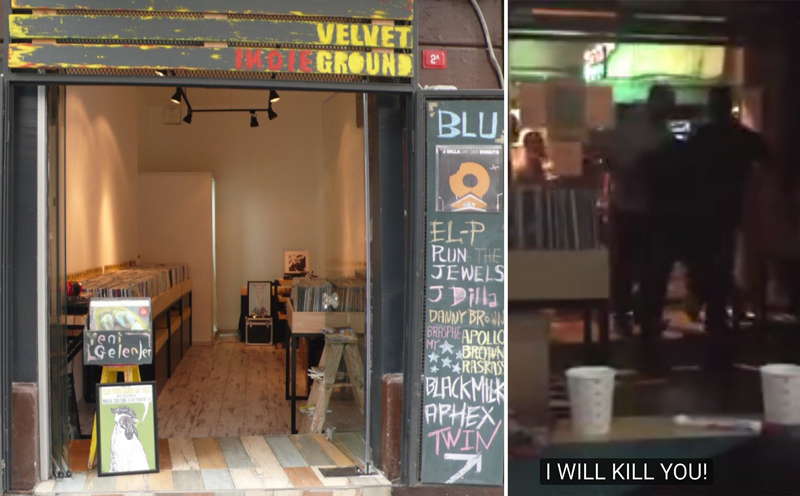
On June 17, Seogu Lee, the Korean owner of an Istanbul record store, Velvet Indieground, invited people to his store for a worldwide “live-streaming” event to celebrate of the release of the latest album of the band Radiohead. They were attacked by a group of men, apparently angry that they had been drinking alcohol during Ramadan — a double sin, as Muslims are not supposed to drink alcohol altogether. It is tantamount to declaring a desire for death. If people learn you are drinking alcohol during Ramadan, they could well threaten, beat or kill you. The men, in fact, raided the store, beat those inside and drove them out. One of the attackers was heard yelling, among other threats, “we will burn you inside!”

Seogu Lee was also beaten by the assailants. The next morning, he was seen in tears, locking the door of his store as he left.

On June 17, a group of men attacked the Velvet Indieground record store in Istanbul, because they were angry that several people in the small shop were drinking alcohol during Ramadan. At right, Seogu Lee, the shop’s Korean owner, is seen being beaten by some of the attackers.

Record stores all over the world had participated in this event, but Muslim assailants did not allow young people in Istanbul to enjoy a few hours of music and drink in the store of a Korean. Apparently it is an attempt to “throw terror into the hearts of those who disbelieve.” (Quran 3:151).

Intimidation by Muslim extremists against those who do not follow a strict Islamist lifestyle does indeed produce “results” — so they keep on doing it. Physical or verbal attacks against those who do not fast during Ramadan are commonplace all across Turkey. If you happen to find yourself there during Ramadan, stay indoors if you would like to eat, drink or smoke.

Turkey is — ironically and unbelievably — a candidate for European Union membership and a member of NATO, as well as other Western institutions. But culturally and sociologically, the impact of religious intolerance seems to have become so institutionalized that no amount of time, or so-called relations with the West or with the rest of the world, seems to change the situation appreciably. Despite all those military, commercial and diplomatic deals Turkey has made with the West, the country still appears to promote the same historical Islamic pressures against non-Muslims — and even secular Muslims — as it always did.

Many Muslims nevertheless claim that other religions are just as violent as theirs, and indeed 600 years ago, during the Inquisition, some were. At present, however, there would seem no other religion that not only promotes, but carries out the violence prescribed in it to the extent of extremist Islam. If, however, one points out a discernible fact such as that, one is accused of Islamophobia, which many extremist Muslims still insist is the main threat, even though the frequency and degrees of violence against Muslims are nowhere near comparable.

Little mention is ever made — dismayingly even in the West — of the justifiable rationality of being alarmed by people mass-slaughtering in the name of religion, and who are promising to continue doing so.

To people who are concerned about protecting freedom, the author Daniel Greenfield asks: “We are learning to be tolerant of Islam. Perhaps, it’s time to ask that rarely asked of questions, when are Muslims going to finally learn to be tolerant of others?”

Robert Jones, an expert on Turkey, is currently based in the UK.
Turkish Professor Suspended over Tweet by Robert Jones

  • Professor Bardakcioglu is under a disciplinary investigation launched by the university’s rector for his tweet, in which he criticized the conquest of Constantinople in 1453.

  • After losing his job and being condemned and ostracized by his community, Bardakcioglu defined his deleted tweet as “an ugly and wrong expression that was not my own view.” The professor, sadly, apologized for telling the truth.
  • Publicly debating historical events recognized by most scholars in free societies is, in Turkey, a criminal offense. You can lose your job, your freedom or even your life.
  • Turkish state officials constantly claim there is nothing in Turkey’s history that they should be ashamed of, so they continue persecuting and jailing journalists or professors who express differing ideas, and slaughtering non-Muslims and non-Turks.

Erbay Bardakcioglu, a professor at Adnan Menderes University (AMU) in Aydin Province in western Turkey, was suspended after posting a tweet, in which he criticized the conquest of Constantinople, present-day Istanbul, in 1453.

Professor Bardakcioglu’s tweet, on May 29, read, “Today is the anniversary of the invasion of Constantinople, the capital of the Eastern Roman Empire, a magnificent civilization, by a barbaric and fanatic tribe.”

After the tweet caused outrage on social media, Bardakcioglu deleted it.

The professor is now under a disciplinary investigation launched by the university’s rector for his tweet. The university’s rector, Cavit Bircan, on his Twitter account, also condemned the professor and declared that he was laid off from his job.

Describing Bardakcioglu’s tweet as “unacceptable,” Bircan wrote:

“After our terrorism-loving academics, we now have Byzantium-loving academics. Let them know that the sons of the Hira Mountain [where Muslims believe Muhammad received his first revelations from Allah] will definitely and once again defeat the sons of the Olympic Mountain.”

The association of veterinary surgeons of the city of Aydin also issued a written statement that “strongly condemned” Bardakcioglu, who used to teach at the school of veterinary medicine. The association’s officials said that “they cannot even call Bardakcioglu their colleague.”

After losing his job and being condemned and ostracized by his community, Bardakcioglu defined his deleted tweet as “an ugly and wrong expression that was not my own view.” He went on to apologize: “Before the great Turkish nation, I apologize to the people whose sentimental values I have offended, and to my university.”

The professor, sadly, apologized for telling the truth.

Byzantium (330-1453 AD) was a great civilization. And the Byzantine ideas on legislation, literature, theology, philosophy, art and architecture, among others, greatly influenced Western civilization.

Constantinople also did witness barbaric and fanatic actions at the hands of the invaders after the city fell.

“They slew everyone that they met in the streets, men, women and children without discrimination,” according to the historian S. Runciman in The Fall of Constantinople 1453.

“The blood ran in rivers down the steep streets from the heights of Petra towards the Golden Horn. But soon the lust for slaughter was assuaged. The soldiers realized that captives and precious objects would bring them greater profit.”

“They looted whatever they considered valuable,” wrote the scholar Constantine Tzanos,

“and they destroyed or burned whatever treasures could not appreciate including valuable library books, icons and mosaics.

“What was the motive of the conquest? It was the lust for power and riches by slaughtering, enslaving and taking the belongings of others.

“Why a people would celebrate today, and with such a passion, an event like the conquest of Constantinople which not only by itself was a great human catastrophe, but it was also the precursor to many such catastrophes up to the very recent past?”

Meanwhile, at a public meeting in Istanbul on May 29, 2016, to celebrate the 563rd anniversary of the fall of Constantinople, Turkey’s President Recep Tayyip Erdogan once again shared with his supporters his admiration for the “conquest”:

“The conquest is to climb over mountains that the West thought were impassable. The conquest is for a 21-year-old Sultan to bring the millennial Byzantium to its knees. The conquest is the peak of military genius and technology of the time. The conquest is to take root in a continent, which was thought that it would not be possible to be permanent there even if one set foot there. The conquest is to escalate the fire of a civilization, which was savagely put out in Al-Andalus [Muslim Spain], on the other side of the continental Europe, in the East again.”

Apparently, the norm in Turkey is to praise the “achievements” of the Ottomans, which included massacres, rapes, plundering and sexual slavery of their victims. But publicly debating historical events recognized by most scholars in free societies is, in Turkey, a criminal offense. You can lose your job, your freedom or even your life.

Discussing these incidents in a way that contradicts the official ideology of the Turkish state is a deadly “taboo.”

As Turkey has never faced its history of bloodshed, ethnic cleanings — and has even excused these crimes — they continue to commit them. Turkish state officials constantly claim there is nothing in Turkey’s history that they should be ashamed of, so they continue persecuting and jailing journalists or professors who express differing ideas, and slaughtering non-Muslims and non-Turks.

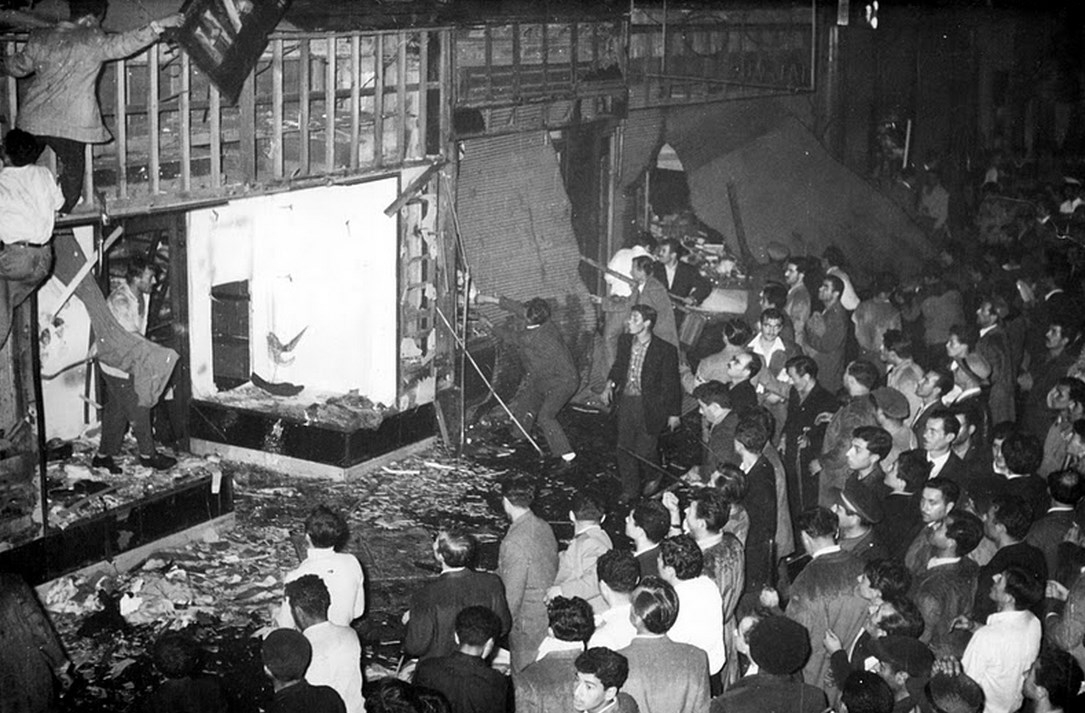
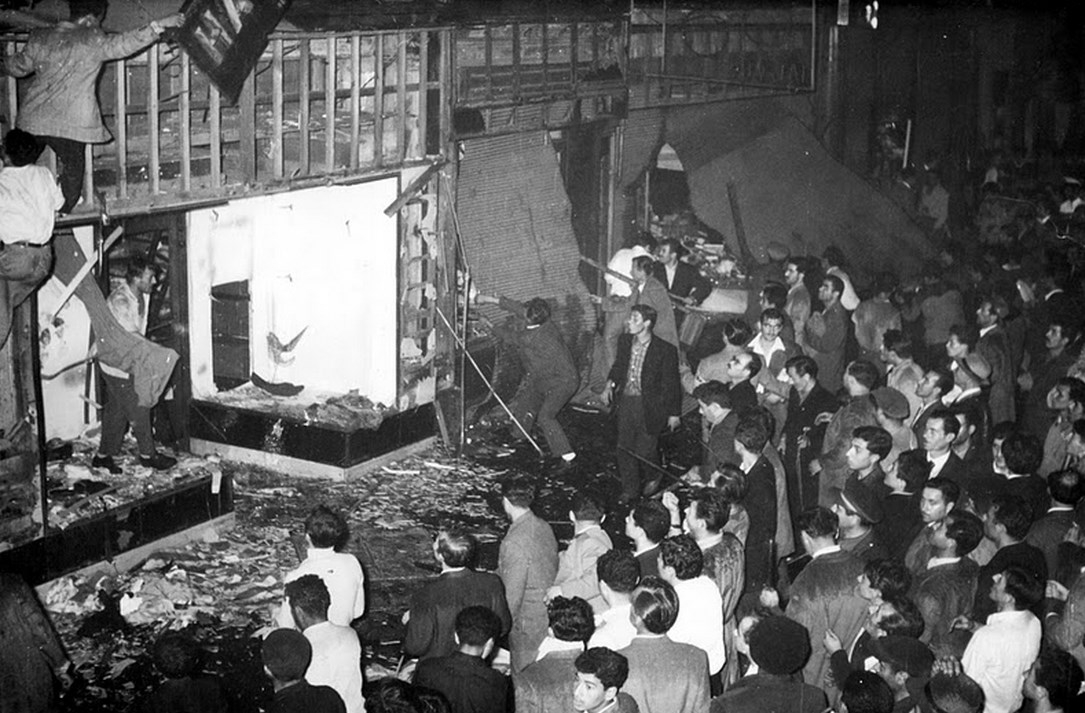
The author Speros Vryonis Jr. described the 1955 Istanbul pogrom against Christians:

“On the evening of September 6, and in the early hours of September 7, 1955, the Turkish government carried out the most destructive pogrom that had been enacted in Europe since the infamous Kristallnacht which Hitler and the Nazis inflicted upon the Jewish communities, businesses and synagogues on the eve of World War II.

“The Turkish government had unleashed the mobs on the Greek community of Istanbul, on its churches, houses, businesses, schools, and newspapers… This resulted in the ultimate destruction of Turkey’s oldest historical community, about 100,000 Greek Orthodox Christians who were the heirs of Byzantium.”

In this photo from September 1955, a government-instigated mob of Muslim Turks in Istanbul is destroying stores owned by Greek Christians.

According to Professor Alfred de Zayas:

“The Istanbul pogrom can be considered a grave crime under both Turkish domestic law and international law. In the historical context of a religion driven eliminationist process accompanied by many pogroms before, during, and after World War I within the territories of the Ottoman Empire, including the destruction of the Greek communities of Pontos and Asia Minor and the atrocities against the Greeks of Smyrna in September 1922, the genocidal character of the Istanbul pogrom becomes apparent.”

What is criminal is murdering and raping people, destroying their neighborhoods, pillaging their property and driving them out of their homes.

Robert Jones, an expert on Turkey, is currently based in the UK.
Turkish Justice: ISIS Walks Free; Peace Activists Jailed by Uzay Bulut

  • Belonging to ISIS or trafficking in slavery evidently do not constitute serious crimes in Turkey. But signing petitions calling for peace and non-violence, or requesting political equality for Kurds, are unspeakable offenses.

  • “We are not shocked that the defendants have been acquitted. This lawsuit has become one of the hundreds of other lawsuits in our country in which the criminals have been protected even though the evidence against them is obvious.” — Association of Progressive Women, on the acquittal of six people charged with having ties with ISIS and trading in Yazidi sex slaves.
  • “Requesting peace has become a crime in this country. The state of Turkey has committed the gravest rights violations against those who struggle for human rights, against the Kurds and against free thought.” — Sebnem Korur Fincanci, President of the Human Rights Foundation of Turkey.
  • Turkish politics has therefore not been able to go beyond a clash between assorted Islamists whose worldviews are foreign to democratic values, and non-Islamist but still extremely oppressive political parties that operate under the shadow of a tyrannical military, whose worldview is also foreign to democratic values.

Turkey’s “fight” against the Islamic State (ISIS) continues. On March 24, Turkey released seven suspects who had been arrested in a case involving the Turkish branch of ISIS.

Halis Bayancuk, alleged to be the “Emir,” or commander-in-chief, of ISIS, is among the suspects. This was the fourth hearing of the trial known as the “Istanbul ISIS trial.” A total of 96 suspects are on trial. Only seven had been jailed; the others had not. Although those seven were released on March 24 at the end of the hearing, their trial is still ongoing; the final verdict has not been given. All of them are now outside jail, free, and living their lives as they wish.

The indictment prepared by the chief public prosecutor’s office of Istanbul stated that the suspects

“engaged in the activities of the terrorist organization called DAESH [Arabic acronym of ISIS]. The suspects had sent persons to the conflict zones; they applied pressure, force, violence and threats by using the name of the terrorist organization, and they had provided members and logistic support for the group. Ilyas Aydin, the leader [of the ISIS cell], gave verdicts at a so-called sharia court about killing people.”

At the end of the hearing, the seven defendants on trial being ISIS members were released. They left the courtroom shouting “Allahu akbar!” [Allah is the Greatest!”]

This means that all 96 defendants in the ongoing case are walking the streets freely.

Unfortunately, this is not the first case in which the Turkish judiciary has turned a blind eye to ISIS or al Qaeda suspects. The indictment prepared by the prosecutors apparently contains serious accusations and ample evidence, including videos and statements by Bayancuk, also known as Abu Hanzala. In 2014, he was arrested for being the head of the al Qaeda network in Turkey. Some of the accusations directed against him and other al Qaeda suspects were “beheading a Christian priest in Syria, kidnapping a Turkish journalist in Syria and planning an assassination of Barack Obama…”

In a video recording from a camp in Syria, Bayancuk was heard saying: “After we conquer Syria, we will conquer Istanbul, insh’allah, [if Allah wills] and then Turkey.”

In 2014, in another video uploaded on YouTube, Bayancuk said:

“They [ISIS] are our Muslim brethren. And we accept any attack against them as an attack against us. … I am, insh’allah, on the side of my Muslim brothers through my prayers and my support. Whoever attacks our brothers, I consider it an attack against me.

“I ask Allah to reward those in Syria and many other places, who are fighting and striving in the name of jihad, with a state ruled by sharia.”

In July 2014, the affiliates of the Islamist magazine “Tawhid” (“Oneness of Allah”) — known to be close to ISIS — organized a public event in Istanbul where they performed salah (Muslim prayer) together to celebrate the Islamic Ramadan festival.

In July 2015, at a public event was held to celebrate the Ramadan festival, the public prayers were led by Halis Bayancuk who afterwards delivered a speech entitled, “A warning to the heads of the regime of the Republic of Turkey.”

“Those who have faith fight for Allah,” he said, “the kafirs [infidels], however, fight for those who engage in taghut [“idolatry”].

Bayancuk also called on Muslims not to vote in elections because “Whoever is the Creator has the right to rule. … “We do not have guns, bombs or action plans to scare you with, but there is Allah with whom we can scare you.”

In December, 2015, the German public television consortium, ARD, produced a show documenting the slave trade being conducted by ISIS through a liaison office in the province of Gaziantep in Turkey, near the Syrian border.

Some human rights groups in the region filed a criminal complaint, calling for the prosecutors to investigate the allegations and hold the perpetrators to account. One of them was the Gaziantep branch of the Association of Progressive Women (IKD).

All six people, who allegedly have ties with ISIS and have engaged in the sexual slavery of Yazidi women in Antep, were acquitted during the first hearing.

The IKD Association issued a written statement about the ruling:

“We learned yesterday that all of defendants were acquitted at one hearing, in a double-quick trial on January 15.

“We are not shocked that the defendants have been acquitted. This lawsuit has become one of the hundreds of other lawsuits in our country in which the criminals have been protected even though the evidence against them is obvious.

“The indictment of the prosecutor stated that the office in the footage has been found, and that all of the evidence in the news reports have been seized. Six people were caught in the process of investigation but were released after a judicial hearing. Despite all of the evidence at hand, the court acquitted the defendants on the grounds that there was no evidence.”

One cannot know if those allegations were true or not, because no state authority has made any effort to refute the allegations or vindicate themselves.

In December, 2015, two members of parliament from the pro-Kurdish Peoples’ Democratic Party (HDP) — Feleknas Uca and Mahmut Togrul — asked Interior Minister Efkan Ala about the office where ISIS members engage in slavery and sex trade.

Neither the interior minister nor any other government official has made a single statement regarding the motions of the MPs, the footage of the German TV channel or the allegations of the region’s human rights groups.

However, when it comes to academics or activists who demand peace with the Kurds and human rights for all in Turkey, the Turkish judiciary takes a completely different stand.

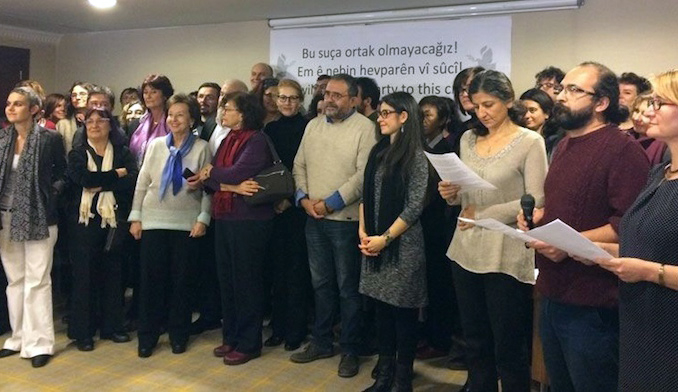
On January 11, 2016, a group of academics and researchers from Turkey and abroad called “Academics for Peace” signed and issued a petition entitled, “We will not be a party to this crime.” In it, they criticized the Turkish government for its recent curfews and massacres in Kurdish districts, and demanded an end to violence against Kurds and a return to peace talks.

Since then the 1128 signatories of the declaration have been subjected to sustained attacks and threats from the Turkish government and nationalist groups. Four of the academics are now under arrest.

The jailed academics are Esra Mungan, a lecturer in psychology at Istanbul Bogazici University; Muzaffer Kaya, a lecturer at the Department of Social Services at Istanbul Nisantasi University (who after signing the petition was fired from his job); Kıvanc Ersoy, a mathematics lecturer at Istanbul Mimar Sinan University; and Meral Camci, a lecturer of translation and interpreting studies at Istanbul Yeni Yuzyıl University.

On March 24, the same day when ISIS suspects were released in Istanbul, Academics for Peace issued an open letter about the situation of the arrested academics:

“Yesterday, Esra Mungan was taken to another cell which is smaller, filthier, and stuffier for no valid reason. Also, Muzaffer Kaya and Kıvanc Ersoy were transferred to the Silivri Prison.

“One of our lawyers visited the Silivri Prison. Muzaffer Kaya and Kıvanc Ersoy say that they are strictly segregated, they stay alone in the cells for three people, they are not allowed to see each other or any others; all their books were taken from them with the promise that they would be given back later, their rooms are completely empty except for a pen and a notebook, they were searched naked when they were first taken to Silivri and kept naked for twenty minutes which is an utterly dishonoring situation, and that their first request is to stay together in the same cell.”

In Turkey, signatories of the “Academics for Peace” petition (pictured above) have been subjected to sustained attacks and threats from the Turkish government and nationalist groups. Four of the signatories were arrested. Meanwhile, 96 suspected terrorists currently standing trial on charges of belonging to an ISIS cell in Istanbul are not under arrest, and walk the streets freely.

The academic Meral Camci was fired from her job after signing the petition. A warrant was also issued against her — along with the three other academics — but she could not be interrogated because she was then outside Turkey. She returned to Turkey on March 30 — and was arrested the next day.

In the meantime, Kurdish lawyer Eren Keskin, who is also the vice-president of the Human Rights Association (IHD) and the executive editor of the pro-Kurdish newspaper Ozgur Gundem, has been investigated and banned from traveling abroad on charges of “terrorism propaganda.”

Dr. Sebnem Korur Fincanci, the President of the Human Rights Foundation of Turkey (TIHV), said that Keskin has been one of the key symbols of the human rights struggle in Turkey. “Requesting peace has become a crime in this country. The state of Turkey has committed the gravest rights violations against those who struggle for human rights, against the Kurds and against free thought,” Fincanci added.

The gravest human rights violations are committed against Kurds. The Kurdish town of Silopi was under military siege and attacks from December 14 to January 19, when the curfew was partly removed. Many people were murdered by state security forces, and the town has largely been destroyed.

The Diyarbakir Bar Association and several human rights groups recently went to the town to observe what is left of it. Sidar Avsar, a lawyer with the Diyarbakir Bar Association, reported that the police threatened them: “You know how Tahir Elci was killed, don’t you?” the police had told him.

Tahir Elci, a leading Kurdish lawyer and the head of the Diyarbakir Bar Association, was murdered in broad daylight in the city of Diyarbakir on November 28, 2015.

So, in Europe’s newest “best friend forever,” Turkey, a candidate country for EU membership, those who rape and sell Yazidi women, or have alleged ties with al-Qaeda or ISIS, are set free to walk around with impunity. Belonging to ISIS or trafficking in slavery evidently do not constitute serious crimes in Turkey. But signing petitions calling for peace and non-violence, or requesting political equality for Kurds, are unspeakable offenses. This also demonstrates the tragic fact that Turkey still prefers the Islamic State (ISIS) to Kurds.

Turkey seems bound by traditional misconceptions of what is terrorism and what is not, or who should enjoy free speech and who should not, or be punished for real crimes and who should not.

Turkish politics has therefore not been able to go beyond a clash between assorted Islamists whose worldviews are foreign to democratic values, and non-Islamist but still extremely oppressive political parties that operate under the shadow of a tyrannical military, whose worldview is also foreign to democratic values.

Recent political and judicial developments are further indicators that a third alternative — a Turkish pro-democracy movement to transform Turkey into a diverse, tolerant and pluralistic society — is not on the horizon.

Uzay Bulut, a Turkish journalist, is currently based in Washington D.C.

Turkish Hatred: When the Truth Slips Out by Burak Bekdil

  • Before the bodies of Israeli victims were carried to their homeland, the Turkish make-up showed signs of falling apart and the ugly reality emerged.

  • “Let the Israeli citizens be worse, I wish they all died.” — Irem Aktas, head of the women’s and media division of the AKP party branch in Istanbul’s Eyup district.
  • Aktas’s mistake was probably to express publicly what millions of Turks only thought, but did not say, in the face of a suicide bomb attack.

The bomb attack in Istanbul on the morning of March 19 was the fifth similar act of terror targeting two of Turkey’s biggest — Istanbul and Ankara — since October.

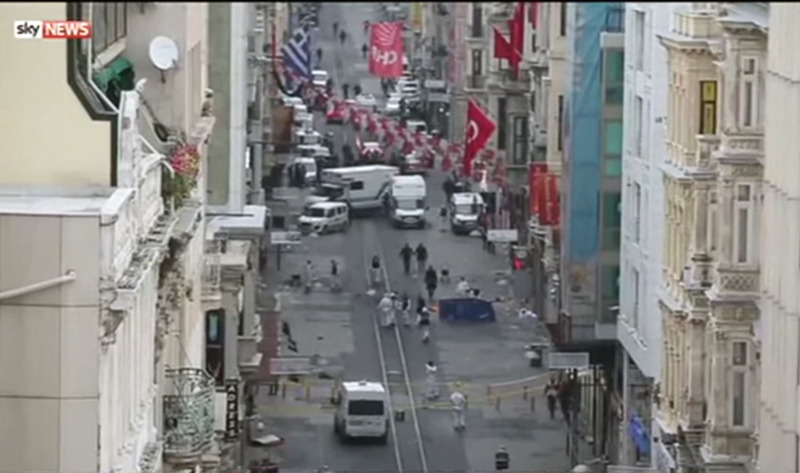
The suicide bomber, a 24-year-old with links to the Islamic State of Iraq and Syria (ISIS), detonated his explosives on Istiklal Avenue, one of Istanbul’s busiest streets and a popular tourist attraction. Three Israeli tourists (two of them also carrying U.S. passports) and one Iranian were killed. Dozens of wounded people were rushed to nearby hospitals. The death toll since October was now at nearly 200, including 14 tourists.

Istanbul’s Istiklal Avenue, in the aftermath of the March 19 suicide bombing. (Image source: Sky News video screenshot)

At first this author thought that his initial instinct to expect something “out of line” because the victims were now Israeli citizens was wrong. The official, diplomatic way Turkey and Israel were handling the tragedy looked impressively civilized. Even before the bomb attack, there were unusually nice Turkish gestures. A few days before the Istanbul bombing, a senior Turkish official, Ahmet Aydin, deputy speaker of parliament (from the ruling AKP party), had praised historical ties between the peoples of Turkey and Jewish citizens of the country. He described their relationship as “a unity of destiny,” and underlined “Jewish citizens’ contribution in founding the Republic of Turkey.” Such language is too rare in Turkey, and even more rare when it comes from an official from the ruling [Islamist] Justice and Development Party (AKP).

After the suicide bombing in Istanbul, President Recep Tayyip Erdogan — surprisingly — did what any other president of a country hosting a terrorist attack would do. He conveyed his messages of condolences to Turkey’s Jewish community and religious leaders. In a similar gesture, Prime Minister Ahmet Davutoglu sent a letter to Israeli Prime Minister Benjamin Netanyahu, “expressing his condolences to the people of Israel on behalf of the Turkish people.”

In return, Israel hailed the “sincere and very helpful cooperation it has received from Turkish officials in the immediate aftermath of the deadly Istanbul attack in which its three citizens have been killed and envisaged this good as a way to help talks for the normalization of relations.”

Dore Gold, Director-General of the Israeli Foreign Ministry, arrived in Istanbul to meet with Istanbul’s governor, Vasip Sahin, for talks on the details of the bombing; and then with his Turkish counterpart, Feridun Sinirlioglu, possibly for talks on the normalization of diplomatic ties between Ankara and Jerusalem.

So far, so good. It is not unusual in diplomacy to use tragic events as a pretext to bolster problematic ties and as an excuse to further refine any effort for reconciliation. The Turkish niceties were the “make-up,” partly driven by pragmatism and designed to hide the anti-Semitic sentiments the AKP has worked hard to cultivate in the Turkish society. Before the bodies of Israeli victims were carried to their homeland, the Turkish make-up showed signs of falling apart and the ugly reality emerged.

Irem Aktas, head of the women’s and media division of the AKP branch in Istanbul’s Eyup district, commented on social media that: “Let the Israeli citizens be worse, I wish they all died.” When she wrote that in her Twitter account, at least 11 Israeli citizens injured by the bomb were being treated at Turkish hospitals.

Aktas quickly deleted her comments and shut down her social media accounts. A party official said that disciplinary proceedings against Aktas had been initiated. But the Turkish Islamist reflex found a face-saving formula for the “heroine.” Aktas would resign, instead of being expelled from the party.

Also unsurprisingly, Aktas in her Facebook account describes herself as “a fan of Erdogan” and “an Ottoman lover.”

Her mistake was probably to express publicly what millions of Turks only thought, but did not say, in the face of a suicide bomb attack.

Burak Bekdil, based in Ankara, is a Turkish columnist for the Hürriyet Daily and a Fellow at the Middle East Forum.

Turkey? In the EU? by Uzay Bulut

  • “What is the conquest?” Turkey’s President Recep Tayyip Erdogan asked his audience. “The conquest is Hijrah [expansion of Islam through emigration, following the example of Muhammad, the founder of Islam, and his followers from Mecca to Medina]. The conquest is Al-Andalus [Muslim Spain]. … The conquest is Salah al-Din al-Ayubbi [Saladin]. … It is to hoist the flag of Islam in Jerusalem again. … The conquest is to have the courage, tenacity and sagacity to defy the entire world even at the hardest times.”

  • “The EU needs Turkey more than Turkey needs the EU. Let everyone know it like that.” — Turkey’s President Recep Tayyip Erdogan.

On April 25, Deputy Prime Minister Mehmet Simsek, while speaking at the High-Level EU-Turkey Economic Dialogue meeting in Istanbul, said that the full membership process to the European Union was Turkey’s most crucial strategic target.

Simsek noted that Turkey will increase the quality of its institutions, strengthen the rule of law and complete the approximation process with Europe by running a reform process.

Turkey’s President Recep Tayyip Erdogan, however, has made affectionate statements expressing his admiration not for the European Union, but for the last Islamic caliphate — the Ottoman Empire, an expansionist Islamic realm that committed massacres, rapes, and sexual slavery of people in the lands it invaded.

In Istanbul on May 30, 2015, in a public meeting celebrating the 562nd anniversary of the fall of Constantinople, Erdogan, sounded more like an Ottoman sultan than the leader of a NATO member nation.

He praised “hoisting the flag of Islam in Jerusalem again” and “stamping the seal of Islam on Al-Aqsa Mosque.” According to some media outlets, two million people attended the event and cheered him.

“What is the conquest?” Erdogan asked his audience.

“The conquest is Hijrah [expansion of Islam through emigration, following the example of Muhammad, the founder of Islam, and his followers from Mecca to Medina]. The conquest is Mecca. It is to cleanse the Kaaba, the house of Allah on earth, of all the icons. The conquest is Jerusalem. It is when the prophet Omar stamped the seal of Islam on Al-Aqsa Mosque, our first Qibla [the direction to face when a Muslim prays during the five times daily prayers] while respecting all faiths including [those of] Christians and Jews.

“The conquest is Al-Andalus [Muslim Spain]. It is to build the most beautiful architecture, literature and culture of the world such as in Córdoba and Granada.

“The conquest is Samarkand [a city in present-day Uzbekistan and once a capital of the ancient Sogdian civilization whose main religion was Zoroastrianism.]

“The conquest is Bukhara [also in present-day Uzbekistan. It was a diverse city with Zoroastrian, Buddhist, Jewish and Nestorian Christian communities]. It is to establish one of the greatest civilizations of history in the steppes of Central Asia.

“The conquest is Salah al-Din al-Ayubbi [Saladin, who in 1187 invaded Jerusalem]. It is to hoist the flag of Islam in Jerusalem again.

“The conquest is Alp Arslan [the second Sultan of the medieval Muslim Seljuk Empire, who conquered Anatolia].”

“The conquest is to open the doors of Anatolia up to Vienna for this blessed nation. The conquest is Osman Ghazi [the first Ottoman Sultan]. It is to make the sycamore [the Ottoman Empire] meet with the ground that would cover three continents and seven climates through the enlightenment inspired by Sheikh Edebali who said, ‘Make the human live so that the state can live’.

“The conquest is preparation. The conquest is when the Sultan Murad II abdicated the throne to his 12-year-old son, Mehmed II. And of course, the conquest is the Sultan Mehmed the Conqueror. It is, at age 21, to embrace Istanbul, the most favorite city of the world, after destroying the millennial Byzantium.

“Mehmed the Conqueror conquered Istanbul in 1453. But the conquests always continued before and after that. They continued with Sultan Selim I the Grim, Sultan Suleiman the Lawgiver, Sultan Murad IV, and Sultan Abdul Hamid II.

“The conquest is to have the courage, tenacity and sagacity to defy the entire world even at the hardest times.

“The conquest is 1994 [when Erdogan was elected mayor of Istanbul]. It is to serve Istanbul and the legacy of the Sultan Mehmed the Conqueror. The conquest is to make Turkey stand up on its feet again.”

The crowd shouted, “Here is the army, here is the commander.”

On April 14, the European Parliament sent a stern warning to Turkey, accusing the ruling Justice and Development Party (AKP) government of “backsliding” on democracy and the rule of law.

Kati Piri, rapporteur for Turkey at the European Parliament, said the regression in areas such as freedom of expression and the independence of the judiciary was “particularly worrying.”

Ankara rejected the report, which cited references that the mass killings of Armenians under the Ottoman Empire constituted genocide, Turkish EU Affairs Minister Volkan Bozkir said.

“We will consider this report as null and void,” Bozkir was quoted as saying by the state-run Anadolu Agency. “There is no moment in our history that we feel ashamed of. All of our archives are open. We believe this is an issue that should be decided by historians. Politicians should not write history.”

On April 19, 2016 Erdogan’s response to the EU report, according to the pro-government newspaper Yeni Akit, was loud and clear:

“The EU needs Turkey.

“That they presented such a report to us at a time when our relations with the European Union are going positively in many fields, such as immigrants, opening some chapters and visa liberalization, is simply a provocative approach, a provocative act. I guess Europeans will see that.

“They have not been able to see that since 1963. But I do not know what will happen from now on. The EU needs Turkey more than Turkey needs the EU. Let everyone know it like that. There is no need to go to further places to understand that. It is enough to look at the latest developments.

“The report has a crippled perspective on the issues of Cyprus and the Aegean Sea, the independence of judiciary, and the freedom of expression, press and assembly. These people [EU officials] do what their nature (disposition) requires them to. [In the report], there is also the part about the 1915 events which is utterly farcical.”

Erdogan glorifies the Ottoman armies that reached the gates of Vienna, talks about the “good old times” when the Islamic flag was hoisted in Jerusalem, and aggrandizes Ottoman Sultans who were also caliphs.

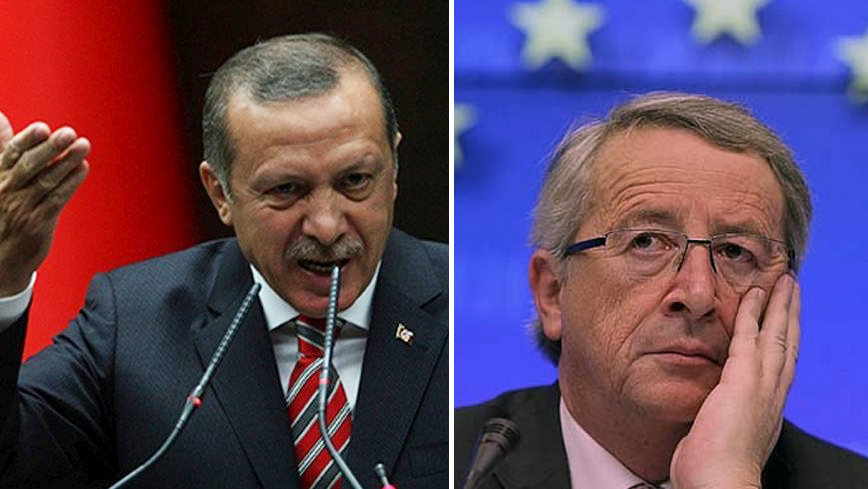
Turkey’s President Recep Tayyip Erdogan (left) recently made affectionate statements expressing admiration not for the European Union, but for the last Islamic caliphate — the Ottoman Empire, an expansionist Islamic realm that committed massacres, rapes, and sexual slavery of people in the lands it invaded. The question is when the EU will start acting like a self-respecting institution, and consider Turkey according to what it actually says and does? Pictured right: European Commission President Jean-Claude Juncker.

Unfortunately the Turkish public’s opinion of the EU is not that different from the Turkish government’s. According to a 2014 PEW poll, around two-thirds of the Turks (66 %) expressed unfavorable views of the European Union. Turkish distaste for the West was not only about the EU. Nearly three-quarters (73%) also shared a dislike of their NATO ally, the U.S. In addition, 70% of the people of Turkey dislike NATO.

The question is when the EU will stop playing ostrich and start acting like a self-respecting institution. And when will the EU authorities take Turkey not according to their own wishful thinking, but according to what Turkey actually says and does?

Uzay Bulut, a journalist born and raised a Muslim in Turkey, is currently based in Washington D.C.

Translate »
Skip to toolbar