Category Archives: Uncategorized

Secularism: Everyone Wants to Get Rid of It by Yves Mamou

  • Now, after more than a century of separation of powers between church and state, an intolerant and extremist Islam is disrupting the rules of the game, invading public spaces, schools, universities and companies with the veil, halal food and open violence.

  • “By making the public space empty of everything that brings us together… Islamists are eager to fill it, especially in disillusioned, brainless and uprooted young heads”. — François Fillon, a former Prime Minister of France, who is running for president in the 2017 election.
  • “Secularism is just becoming a religion opposed to all other religions”, said Tariq Ramadan, a prominent figure of the Muslim Brotherhood in Switzerland and France. He congratulated mayors on Christmas nativity scenes probably because he sees it as an opening for Islamic opportunities in the public sphere. “We need a Republic authorizing the visibility of diversity and not a Republic of neutrality,” he said.

Can a French municipality erect a statue of the Virgin Mary in a public park? The answer is No. France’s Administrative Court has given the mayor of Publier, in eastern France (population 6500), three months to comply with the ban on religious symbols in public spaces and to remove the statue. If the municipality fails to do so, it will be fined €100 ($105) a day. Mayor Gaston Lacroix said he will try to relocate the marble statue on private land.

France’s 1905 Law on the Separation of the Churches and the State (Article 2) states that “The Republic does not recognize, pay or subsidize any religious sect”; article 28 prohibits any religious symbol on public monuments.

The Virgin May statue in Publier, on the bottom of which is inscribed “Our Lady of Geneva Lake watch over your children”, has a long story. It was installed in the town park in August 2011, without debate. The statue was acquired with taxpayer money: €23,700 (USD $26,000). Acknowledging at the time that he had “joked a little with the 1905 law” on the separation of church and the state, the mayor had to sell the statue to a local religious association.

Now, the mayor has to remove the statue from the public park. He tried to privatize the piece of land where the statue is erected, but the land-sale project was rejected by the court.

This story of a statue of the Virgin Mary illustrates the difficulties of secularism, the defense of French identity, the fight against Islamism, and the contradictory interests of different political parties in France.

Originally, secularism in France was established to push religion out of the public sphere. An authentic war was conducted at the end of 19th century and beginning of 20th to push a very obscurantist Catholic Church out of all public spaces. According to historian Jacques Julliard:

“Mgr de Quélen, Archbishop of Paris, remains famous for having said ‘not only was Jesus the son of God, but his mother came from a very good family’. For the Republic, fighting the church was a fight for the liberation of the minds, for the construction of a school for knowledge (against belief) liberated from priests, the building of an open society…”

Now, after more than a century of separation of powers between church and state, an intolerant and extremist Islam is disrupting the rules of the game, invading public spaces, schools, universities and companies with the veil, halal food and open violence. But instead of uniting against this troublemaker, French society today is openly divided.

French state institutions and the political class (left and right) are fully responsible for this division, which is also the result of confusion. Instead of naming Islamism the enemy, all governments, left and right, have chosen the wrong path of appeasement and increasing concessions — refusing to name Islamism as solely responsible for terrorism, refusing to consider the Islamic veil as a tool of separatism, and letting Salafist mosques multiply — in the vain hope of calming what is claimed to be the legitimate anger of Muslims against “discrimination”.

Because the state refused or was unable to elaborate a strategy for a renewed secularism, actors on the ground (especially mayors of the 35,000 municipalities of France) were left alone. In 2014 and 2015, some of them (no one knows how many) chose to install or subsidize nativity scenes in the lobbies of their city halls. Immediately, French political passions burst into the debate.

Free thinkers, all parties of the left and the extreme left, green parties and partisans of multiculturalism went to court to fight the Christ child’s cribs. On the opposite side, some on the right and the extreme right supported the Christ child’s crib. In the middle, some supporters of secularism tried to calm everyone down, but without great success.

On November 14, 2014, the Administrative Court of Nantes decided on appeal to strike down the initial prohibition of a Christmas nativity scene in the Departmental Hall of Vendée. In another case, on October 8, 2015, the Administrative Court of Paris struck down on appeal an initial judgement authorizing the mayor of Melun to display a nativity crib.

On December 1, 2016, the Lille Administrative Court cancelled the decision of the municipality of Henin-Beaumont (affiliated with the “far right” Front National) to install a Christmas nativity crib in the lobby of City Hall.

In November 2015, just before the Islamic terrorist attacks in Paris, in which 130 people were murdered, the powerful Association of Mayors of France (AMF) relaunched the controversy by recommending, in the name of secularism, not to install Christmas nativity scenes. Immediately, three mayors from the Front National, and some others from the opposition party, Les Republicains, left the AMF. Marion Maréchal-Le Pen of the National Front, and the granddaughter of the party’s founder, stated:

“This recommendation is a provocation. Secularism is the neutrality of public authorities regarding religions, separation of Church and State, and refusal to finance any sect, but secularism does not mean the disappearance of our folk traditions that may have a religious connotation. Catholic in particular.”

Nicolas Dupont-Aignan, president of Debout La France (“Stand Up France”), said AMF’s decision is “silly”. He added:

“French people cherish their culture. Some mayors put Christmas cribs in their town halls, others do not. If French people love Christmas trees, find it convenient to call Easter holidays “Easter holidays,” and have Christian cribs in city halls, let them do it. Do not cut the roots of the French, stop denying our people the right to be themselves.”

On the left, most leaders refused to comment because they were afraid to engage in a debate with the Front National.

On November 9, 2016, the Conseil d’État (Council of State), the highest administrative court in France, edited guidelines for local administrative courts to allow Christmas nativity scenes in city halls, but under strict conditions (no proselytizing). In others words, a Christian display is authorized if all elements of Christianity are removed from it. A nativity scene must be “folklore” to be authorized, and nativity cribs that belong to a religious organization remain prohibited in city halls.

If nativity scenes are an extremely ancient Christian tradition, the installation of Christmas nativity scenes in city halls is very recent. One of the oldest was inaugurated in 1989. In most instances, displaying nativity scenes was a reaction to try to preserve French culture, and a claim to preserve the Christian roots of France — mostly, and without saying it — against Islam.

François Fillon, a former Prime Minister of France, who is running for president in the 2017 election as the candidate of the main center-right party, welcomed the decision of the Council of State. In Valeurs Actuelles, he said:

“Christmas has long since left the only sectarian domain, the one of religion, to get into the cultural universe, that of civilization… By making the public space empty of everything that brings us together, by sucking everything that makes the thickness and depth of the collective being French, secularism is, paradoxically, the useful idiot of sectarianism: all the space it empties, Islamists are eager to fill it, especially in disillusioned, brainless and uprooted young heads”.

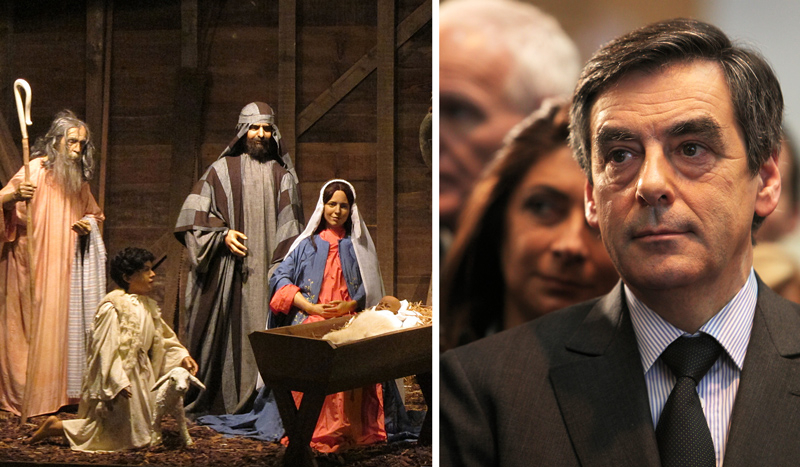
In France, François Fillon (right), a former Prime Minister who is running for president in the 2017 election, welcomed a recent court decision to allow Christmas nativity scenes in city halls.

This argument, of “secularism as a vacuum”, was also developed by Philippe de Villiers, a prominent figure of the right and founder of Movement for France (MPF). In the weeks before the Council of State’s decision, Villiers gave an interview to Le Figaro entitled, “Yes to nativity cribs, No to djallabas“. He explained:

“I expect the Council of State to make the choice, not of a secular vacuum, which would be an in-draft to Islam, but to make the choice of a living secularism, which is consistent with our traditions…. The Council of State said “yes” to the burkini. If they say “no” to Christmas nativity scenes, (they) will no longer be the Council of State of France that protects us. They will become the Council of Islamic State”.

The debate seems booby-trapped. Because the left has been unable to renew and impose secularism, today the “right” and Islamists have agreed to get rid of it.

“Secularism is just becoming a religion opposed to all other religions”, said Tariq Ramadan, a prominent figure of the Muslim Brotherhood in Switzerland and France, in 2014. He congratulated mayors on Christmas nativity scenes probably because he sees it as an opening for Islamic opportunities in the public sphere. “We need a Republic authorizing the visibility of diversity, and not a Republic of neutrality,” Ramadan said.

Yves Mamou is a journalist and author based in France. He worked for two decades for the daily, Le Monde, before his retirement.
Second Blog Post

Lorem Ipsum is text that is traditionally used by designers when working on a site before the content is ready.
Pellentesque bibendum metus ut dolor fermentum ut pulvinar tortor hendrerit. Nam vel odio vel diam tempus iaculis in non urna. Curabitur scelerisque, nunc id interdum vestibulum, felis elit luctus dui, ac dapibus tellus mauris tempus augue. Duis congue facilisis lobortis. Phasellus neque erat, tincidunt non lacinia sit amet, rutrum vitae nunc. Sed placerat lacinia fermentum. Integer justo sem, cursus id tristique eget, accumsan vel sapien. Curabitur ipsum neque, elementum vel vestibulum ut, lobortis a nisl. Fusce malesuada mollis purus consectetur auctor. Morbi tellus nunc, dapibus sit amet rutrum vel, laoreet quis mauris. Aenean nec sem nec purus bibendum venenatis. Mauris auctor commodo libero, in adipiscing dui adipiscing eu. Praesent eget orci ac nunc sodales varius.
Nam eget venenatis lorem. Vestibulum a interdum sapien. Suspendisse potenti. Quisque auctor purus nec sapien venenatis vehicula malesuada velit vehicula. Fusce vel diam dolor, quis facilisis tortor. Class aptent taciti sociosqu ad litora torquent per conubia nostra, per inceptos himenaeos. Pellentesque libero nisi, pellentesque quis cursus sit amet, vehicula vitae nisl. Curabitur nec nunc ac sem tincidunt auctor. Phasellus in mattis magna. Donec consequat orci eget tortor ultricies rutrum. Mauris luctus vulputate molestie. Proin tincidunt vehicula euismod. Nam congue leo non erat cursus a adipiscing ipsum congue. Nulla iaculis purus sit amet turpis aliquam sit amet dapibus odio tincidunt. Ut augue diam, congue ut commodo pellentesque, fermentum mattis leo. Sed iaculis urna id enim dignissim sodales at a ipsum. Quisque varius lobortis mollis. Nunc purus magna, pellentesque pellentesque convallis sed, varius id ipsum. Etiam commodo mi mollis erat scelerisque fringilla. Nullam bibendum massa sagittis diam ornare rutrum.
Praesent convallis metus ut elit faucibus tempus in quis dui. Donec fringilla imperdiet nibh, sit amet fringilla velit congue et. Quisque commodo luctus ligula, vitae porttitor eros venenatis in. Praesent aliquet commodo orci id varius. Nulla nulla nibh, varius id volutpat nec, sagittis nec eros. Cras et dui justo. Curabitur malesuada facilisis neque, sed tempus massa tincidunt ut. Sed suscipit odio in lacus auctor vehicula non ut lacus. In hac habitasse platea dictumst. Sed nulla nisi, lacinia in viverra at, blandit vel tellus. Nulla metus erat, ultrices non pretium vel, varius nec sem. Morbi sollicitudin mattis lacus quis pharetra. Donec tincidunt mollis pretium. Proin non libero justo, vitae mattis diam. Integer vel elit in enim varius posuere sed vitae magna. Duis blandit tempor elementum. Vestibulum molestie dui nisi.
Curabitur volutpat interdum lorem sed tempus. Sed placerat quam non ligula lacinia sodales. Cras ultrices justo at nisi luctus hendrerit. Quisque sit amet placerat justo. In id sapien eu neque varius pharetra sed in sapien. Etiam nisl nunc, suscipit sed gravida sed, scelerisque ut nisl. Mauris quis massa nisl, aliquet posuere ligula. Etiam eget tortor mauris. Sed pellentesque vestibulum commodo. Mauris vitae est a libero dapibus dictum fringilla vitae magna.
Nulla facilisi. Praesent eget elit et mauris gravida lobortis ac nec risus. Ut vulputate ullamcorper est, volutpat feugiat lacus convallis non. Maecenas quis sem odio, et aliquam libero. Integer vel tortor eget orci tincidunt pulvinar interdum at erat. Integer ullamcorper consequat eros a pellentesque. Cras sagittis interdum enim in malesuada. Etiam non nunc neque. Fusce non ligula at tellus porta venenatis. Praesent tortor orci, fermentum sed tincidunt vel, varius vel dui. Duis pulvinar luctus odio, eget porta justo vulputate ac. Nulla varius feugiat lorem sed tempor. Phasellus pulvinar dapibus magna eget egestas. In malesuada lectus at justo pellentesque vitae rhoncus nulla ultrices. Proin ut sem sem. Donec eu suscipit ipsum. Cras eu arcu porttitor massa feugiat aliquet at quis nisl.

Saudi Arabia: World’s Human Rights Sewer by Douglas Murray

Ali Mohammed al-Nimr, sentenced to be crucified, was accused of participating in banned protests and firearms offenses — despite a complete lack of evidence on the latter charge, and he was denied access to lawyers. Al-Nimr is also alleged by human rights groups to have been tortured and then forced into signing a confession while in custody.
Not only are the Saudi authorities preparing to crucify someone — in 2015 — whom they tortured into making a confession; they are preparing to crucify someone who was a minor at the time of arrest.
Alas not a week goes by without Saudi Arabia demonstrating to the world why they retain their reputation as one of the world’s foremost human rights sewers.
Crucifixion is a punishment which, it would appear, is not only Sharia-compliant but also — we must assume — Geneva-compliant.
The United Nations Human Rights Council (UNHRC) in Geneva is an organization that may be easy to critique, but it is very hard to satirize. Ordinarily, if you told anyone that there was a place in Switzerland where Sudan, Iran and others of the world’s worst dictatorships and human rights abusers have their views on human rights treated with respect and deference, you would assume the script was written by Monty Python. Idi Amin would make an appearance at some point to share his views on how to improve equal conditions for women in the workplace. Pol Pot would crop up in order to castigate those countries where living standards had not been sufficiently raised in accordance with global averages.
Everything that happens in Geneva is beyond satire. But last week provides a demonstration, outrageous even by the standards of the UN. For this week, it came out – thanks to the excellent organization UN Watch — that Saudi Arabia has been appointed as the head of a key UNHRC panel. This panel selects the top officials who shape international standards in human rights; it is intended to report on human rights violations around the world. The five-member group of ambassadors, which Saudi Arabia will now head, is known as the Consultative Group and has the power to select applicants to fill more than 77 positions worldwide that deal with human rights issues. It appears that the appointment of Saudi Arabia’s envoy to the UNHRC, Faisal Trad, was made before the summer, but that diplomats in Geneva have kept silent on the matter since then.
That this appointment had to leak out months after the event raises the possibility that the UNHRC, contrary to popular perception, actually does have some sense of shame. Otherwise, why not shout from the rooftops that Saudi Arabia has won this prestigious position? Why not distribute a press release? After all, Saudi Arabia — and by extension the UNHRC — have nothing to be ashamed of, do they?
Alas not a week goes by without Saudi Arabia demonstrating to the world why they retain their reputation as one of the world’s foremost human rights sewers. Saudi Arabia may have beheaded more people in the last year than ISIS, but only rarely do any of these cases get more than a flicker of international attention. Occasionally a case breaks above the waves of public opinion. One such case is that of the jailed blogger Raif Badawi, sentenced last year to 10 years in jail and 1000 lashes for “insulting Islam.” The plight of Raif Badawi, who has already been served the first 50 lashes, and is being held in prison while awaiting the rest, has garnered international attention and condemnations of Saudi Arabia. The kingdom’s response has been strongly to denounce “the media campaign around the case.”
But the glare of international opinion clearly disturbs the Saudi authorities — a fact well worth keeping in mind. And it is not as though they have nothing to hide. This week brings a case that should get at least as much attention as that of Raif Badawi.
Ali Mohammed al-Nimr was just 17 when he was arrested by the Saudi authorities in 2012, during a crackdown on anti-government protests in the Shia province of Qatif. He was accused of participating in banned protests and firearms offenses — despite a complete lack of evidence on the latter charge. Denied access to lawyers, al-Nimr is alleged by human rights groups to have been tortured and then forced into signing a confession while in custody. Campaigners say that it seems he has been targeted by authorities because of his family association with Sheikh Nimr al-Nimr, the 53-year-old critic of the Saudi regime who is his uncle. The Sheikh has also been convicted and sentenced to death. After the confession and “trial,” his nephew was convicted at Saudi’s Specialized Criminal Court and sentenced to death. The trial itself failed to meet any international standards. Al-Nimr appealed against his sentence, but this week that appeal was dismissed. It now seems likely that he and his uncle will now be executed. Because charges include crimes involving the Saudi King and the state itself, it seems likely that the method of death will be crucifixion.

Imprisoned Saudi dissidents Raif Badawi (left) and Ali Mohammed al-Nimr (right).
If this were in any way to cause a flicker of concern among other participants in the UNHRC farce going on Geneva, they have at least some consolation. For in Saudi Arabia crucifixion is not what it used to be. Indeed, in Saudi Arabia crucifixion begins with the beheading of the victim and only then the mounting of the beheaded body onto a crucifix, to make it available for public viewing. This is a punishment which it would appear is not only Sharia-compliant but also — we must assume — Geneva-compliant.
Of course, Ali Mohammed al-Nimr counts as having been a juvenile at the time of his arrest, so not only are the Saudi authorities preparing to crucify someone — in 2015 — whom they tortured into making a confession – they are preparing to crucify someone who was a minor at the time of arrest. Perhaps the authorities at the UNHRC in Geneva do indeed blush when they appoint Saudi officials to head their human rights panels. But it does not seem to affect their behaviour. Just as Saudi authorities think it is “international attention” rather than flogging people to death or crucifying them after beheading that is the problem, so the UNHRC in Geneva seems to think it is public awareness of their grotesque appointments rather than the appointments themselves that are the problem.
The international attention paid to the case of Raif Badawi has not yet seen him released, but it seems to have delayed the next rounds of lashes. Which suggests the Saudi authorities have the capacity to feel some shame. This should in turn be a cause for some hope among everyone who cares about human rights. It should also provide a reminder to everyone to increase global attention on the case of Ali Mohammed al-Nimr and the many others like him who suffer under a government and judicial system that should utterly shame the world outside Geneva, even if it cannot shame the UN.

Saudi Arabia: The Region’s New Superpower by Con Coughlin

The Saudis are planning to establish themselves as the Arab world’s undisputed military superpower…. At this rate Saudi Arabia will soon replace Egypt as the Arab world’s most significant military power.
The Saudi royal family is determined to secure the overthrow of the regime of Syrian President Bashar al-Assad, one of Iran’s most important regional allies, and any attempt by Riyadh to deepen its involvement in the Syrian conflict is likely to result in direct military confrontation with Iran.
The tragedy of all this for the Obama administration is that, had it not been for its obsession with doing a deal with Iran, Washington could have formed a useful strategic alliance with Riyadh to defeat common foes, such as Islamic State (ISIS,Isil) in Syria and Iraq.
President Barack Obama may have hailed his deal with Iran as an historic breakthrough, but this is not how it is being viewed in Saudi Arabia, where the kingdom has responded to Washington’s attempted rapprochement with Tehran by embarking on a massive military build up.
Saudi Arabia is Iran’s fiercest regional rival, with enmity between the two countries dating back at least to Iran’s 1979 Islamic Revolution, and the Saudi royal family has voiced deep scepticism about the Obama administration’s foreign policy tilt towards Iran. Mr Obama will hear these views most forcefully expressed himself with King Salman bin Abdulaziz al Saud, the Saudi monarch visits Washington this weekend.
In the past, the late Saudi foreign minister, Prince Saud al-Faisal, consistently spoke out against the dangers of a U.S.-Iran deal, while other senior Saudi security officials have warned that the kingdom would strike out on its own if its interests were threatened by an unsatisfactory nuclear agreement. The most public demonstration of the Saudis’ displeasure came in May when King Salman declined to attend a Camp David summit at which Mr. Obama hoped to reassure Gulf leaders that the Iran protected their interests.
So no one should be surprised that, now that Mr. Obama has signed off his deal with the ayatollahs, the Saudis have embarked on a massive arms build up, one that promises dramatic changes to the military balance of power in the region.
Institutional concerns in Riyadh’s defense establishment over the threat posed by Iran have already resulted in Saudi Arabia having the world’s fourth largest defence budget.A recent study by London’s International Institute for Strategic Studies think tank conservatively estimated Riyadh’s defence spend for 2014 at $59.6 billion, although other assessments have suggested it rose by 17 percent to $80.8 billion. Either way this places Saudi spending above that of Britain, at $57 billion and France’s £52.4 billion (nearly $80 billion).
Now the Saudis are planning to establish themselves as the Arab world’s undisputed military superpower by embarking on a $150 billion defense spending spree that will see the country’s Armed Forces double in size over the course of the next five years.
The new Saudi defense doctrine drawn up by senior military officers in Riyadh proposes a doubling in the size of the air force from its current strength of around 250 combat warplanes to 500. Increases of a similar scale are envisaged for the kingdom’s other armed forces, with the Navy set to see the size of its surface fleet more than double, as well as acquiring its first submarine fleet. Saudi Arabia also wants to acquire a range of sophisticated ballistic missile systems, air defence systems and battle tanks, while the total number of combat ready personnel will rise above the 500,000 mark.
At this rate Saudi Arabia will soon replace Egypt as the Arab world’s most significant military power.
Nor is Saudi Arabia’s huge arms build up confined to conventional weaponry. In a recent interview with the Daily Telegraph in London, Prince Mohammed bin Nawwaf bin Abdulaziz al-Saud, Saudi Arabia’s Ambassador to Britain, warned that Riyadh would not rule out acquiring nuclear weapons if Washington failed to provide proper safeguards about Iran’s nuclear ambitions.
“We hope we receive the assurances that guarantee Iran will not pursue this kind of weapon,” explained Prince Mohammed “But if this does not happen, then all options will be on the table for Saudi Arabia.” Nawaf Obaid, a Saudi defence expert and visiting fellow at the Harvard Kennedy School’s Belfer Center, said: “Saudi Arabia is preparing itself in case Iran develops nuclear weapons.”
Saudi Arabia is known to have close links with Pakistan, where Dr A.Q. Khan, the “father” of Pakistan’s nuclear weapons arsenal, is believed to have received Saudi funding for his research into building an atom bomb. Senior U.S. officials have warned Saudi Arabia has recently taken a “strategic decision” to acquire “off-the-shelf” nuclear weapons from Pakistan.
Saudi Arabia’s new arms build-up is being undertaken as a direct response to what many Saudis believe is the Obama administration’s capitulation to Tehran over its nuclear program. The defense doctrine identifies a nuclear-armed Iran as one of the three main threats the kingdom is likely to face in the future, together with terrorism and regional instability.
The new doctrine threatens to change dramatically the military balance of power in the Arab world, a change that is likely to be viewed with deep concern by Israel. Shortly before Mr. Obama announced the nuclear deal with Tehran the Saudis announced they had concluded a $12 billion arms deal with France, including helicopters and naval patrol vessels.
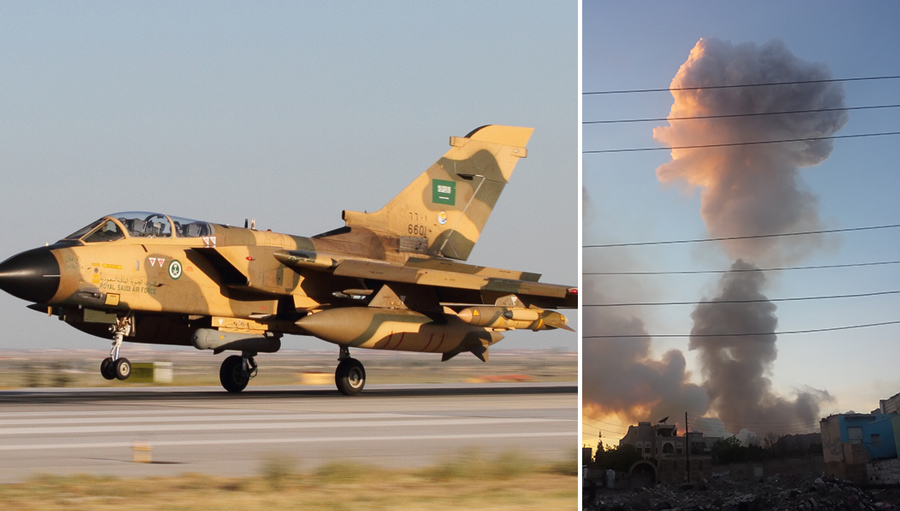
Saudi Arabia’s new policy of military assertiveness was recently demonstrated in the Yemen conflict, where the Saudi military played a decisive role in recapturing the strategically important port of Aden after it was overrun by Iranian-back Houthi rebels. As a result exiled Yemeni Prime Minister Khaled Balah has been able to return to his home country.
After their success in Yemen, the Saudis now intend to focus on Syria, where they are again likely to find themselves in direct conflict with Iranian-backed forces. The Saudi royal family is determined to secure the overthrow of the regime of Syrian President Bashar al-Assad, one of Iran’s most important regional allies, and any attempt by Riyadh to deepen its involvement in the Syrian conflict is likely to result in direct military confrontation with Iran.
The tragedy of all this for the Obama administration is that, had it not been for its obsession with doing a deal with Iran, Washington could have formed a useful strategic alliance with Riyadh to defeat common foes, such as Islamic State (ISIS, Isil) in Syria and Iraq.
But after the Iran deal, the Saudis now appear determined to go it alone, which means they are likely to pursue aggressive policies in the region that will not necessarily be to Washington’s liking, and over which the Obama administration will be able to exercise precious little influence.
Con Coughlin is Defense Editor of London’s Daily Telegraph and author of “Khomeini’s Ghost: Iran since 1979” (Macmillan)​

Saudi Arabia, Yemen and the Politicized UN by Richard Kemp and Jasper Reid

  • The UN’s assertion that the Saudi-led coalition has committed war crimes in Yemen is unlikely to be true. UN experts have not been to Yemen, depending instead on hearsay evidence and analysis of photographs.

  • The UN has a pattern of unsubstantiated allegations of war crimes against the armed forces of sovereign states. Without any military expertise, and never having visited Gaza, a UN commission convicted the Israel Defense Force of deliberately targeting Palestinian civilians in the 2014 conflict. It was an assessment roundly rejected by America’s most senior military officer, General Martin Dempsey, and an independent commission.
  • The Houthis have learned many lessons from Hamas and Islamic Jihad in Gaza, groups also supported by Iran. Those lessons include the falsification of civilian casualty figures and their causes. The UN swallowed the fake Gaza figures hook, line and sinker, and are now making the same error in Yemen.
  • The Houthis exploit gullible or compliant reporters and human rights groups to facilitate their propaganda, including false testimony and fabrication of imagery.
  • Forensic analysis shows that rather than deliberately targeting civilians, the Saudis and their allies have taken remarkable steps to minimize civilian casualties.

The United Nations, Amnesty International and other groups have accused the Saudi-led coalition of war crimes in Yemen. A leaked UN report claims the bombing campaign against Iranian-supported Houthi insurgents seeking violently to topple the legitimate government of Yemen has conducted deliberate, widespread and systematic attacks on civilian targets.

If the UN’s assertion is true, and the coalition is deliberately and disproportionately killing thousands of innocent civilians, it is a war crime. But it is unlikely to be true. The UN has produced no actual evidence of war crimes. None of their allegations is based on investigation on the ground. Their experts have not been to Yemen, depending instead on hearsay evidence and analysis of photographs.

The UN has a pattern of unsubstantiated allegations of war crimes against the armed forces of sovereign states. Only last year, without any military expertise, and never having visited Gaza, a UN commission convicted the Israel Defense Force of deliberately targeting innocent Palestinian civilians in the 2014 conflict. It was an assessment roundly rejected by America’s most senior military officer, General Martin Dempsey, the Chairman of the Joint Chiefs of Staff.

Dempsey’s own findings were confirmed by an independent commission of experienced senior military officers and officials from nine countries. The High Level Military Group found that Israel had not committed war crimes, but had in fact set a bar for avoiding civilian casualties so high that other armed forces would struggle to reach it.

Moreover, last September the UN said that a US airstrike against a hospital in Kunduz, Afghanistan, was “inexcusable” and “possibly a war crime.” Few military forces in the world take greater precautions to prevent civilian casualties on the battlefield than the US. Anyone who has actually experienced combat knows that while such incidents are tragic, when carried out by Western forces, they are far more likely to be the result of human error or the chaos of battle than deliberate war crimes.

There is every reason to believe that the UN is again crying wolf. There is no doubt that thousands are dying in Yemen in horrific circumstances. But we cannot just accept the UN’s figures and its attribution of the proportion of deaths being inflicted by the Saudi coalition. Most of the data comes from the Houthi insurgents, either directly or via non-governmental organizations (NGOs), and is simply accepted as fact. The Houthis have learned many lessons from Hamas and Palestinian Islamic Jihad in Gaza, groups also supported by Iran. Those lessons include the falsification and distortion of civilian casualty figures and their causes. The UN swallowed the fake Gaza figures hook, line and sinker, and are now making the same error in Yemen.

As with Israel’s defensive campaign in Gaza in 2014, and the continued U.S. military support to the Afghan regime, the Saudis’ war to defend the government of Yemen and curb Iranian aggression in the region is lawful and legitimate. Therefore, the illegality of civilian deaths must be assessed according to the laws of armed conflict, in particular whether adequate precautions were taken to avoid them, whether they were proportionate to the military objectives and whether they were necessary to achieve legitimate military goals. The UN cannot possibly make such judgements without a more far-reaching and thorough investigation, and especially not on the basis of information provided by Saudi Arabia’s enemies and by interpreting photographs.

Most of us do not like the way that the Saudi regime runs their country according to the strict application of Islamic Sharia law, and we abhor their record on human rights. But the Saudi military ethos is well known and understood by Western military leaders, including from the U.S. and UK, who have worked closely with them for many years. The reality is, as our officers currently serving alongside them will attest, that the Saudis and their allies are not deliberately trying to kill innocent civilians. Indeed, they are doing their best to minimize civilian casualties. The question is whether their best is good enough.

Saudi Arabia and its coalition allies have the most sophisticated Western combat equipment, including planes, attack helicopters, drones and precision-guided munitions. But they lack battle experience. The exception to this is the Emirati forces within the coalition. They have had many years of combat experience alongside Western militaries, including in Somalia, Kosovo, Libya and Afghanistan. Because of that, they have acquitted themselves in Yemen with great professionalism and effectiveness at sea, on the ground and in the air.

But the lack of experience of the other coalition members puts them many years behind our own forces in wielding the highly complex 21st century capabilities of intelligence, surveillance, reconnaissance, communication and targeting.

Yet the coalition faces the same tough challenges that we face on battlefields everywhere. Their Houthi adversaries fight according to the well-developed doctrine of their backers, the Iranian Quds Force. Like Hizballah, Hamas, the Taliban, Al Qaeda and the Islamic State, their techniques include deliberately killing civilians, fighting from within the population and forcing innocents to become human shields.

Completely ignoring the laws of war, they exploit their enemies’ adherence to them. They lure their opponents to attack and kill civilians. They exploit gullible or compliant reporters, international organizations and human rights groups to facilitate their propaganda, including false testimony and systematic fabrication of imagery. The aim is to instigate international condemnation in order to constrain their militarily superior enemies.

We have seen credible forensic analysis of strikes in Yemen that directly contradict the findings of the UN. Forensic analysis shows that rather than deliberately targeting civilians, the Saudis and their allies have taken remarkable steps to minimize civilian deaths. Of note, they have learned much from Israel’s conduct of operations in Gaza. This has included the use of inert munitions to conduct precision attacks against insurgents while seeking to reduce collateral damage.

Why would coalition forces spend vast amounts of money in a cripplingly expensive conflict firing precision strike munitions, and put their valuable pilots at risk, if they wanted to massacre civilians? Why not use much cheaper unguided munitions or Assad’s indiscriminate barrel-bombs?

The overwhelming majority of civilian deaths caused by the Saudi-led coalition have been due not to deliberate targeting, but to inexperienced pilots and unsophisticated intelligence and targeting capabilities in the face of an enemy that fights from within the civilian population. And to the friction, confusion, stress and fog of war that leads even the most sophisticated, experienced and restrained military forces, such as American, British and Israeli, to sometimes kill civilians unintentionally. Contrary to the UN’s claim, this is unlikely to amount to war crimes.

Like every conflict in the Middle East, the war in Yemen is almost intractable, takes a heavy toll on innocent civilians, and is unlikely to end in anything approaching a perfect solution. But Saudi Arabia and its allies are making considerable efforts to restore stability to the country and its legitimate government.

Instability in Yemen undermines Western interests, including oil supplies. Instability also allows Al Qaeda and the Islamic State — proven and lethal threats to the US and the West — to flourish there.

By confronting the Houthis in Yemen, Saudi Arabia is also confronting Iran, which represents an even greater threat to the region and to the world. Emboldened by U.S. President Barack Obama’s nuclear deal, enriched by the release of billions of dollars of previously frozen funds, encouraged by the imminent boost in oil revenues, Iranian imperial aggression is today rampant in Iraq, Syria, Lebanon and Yemen.

However unpalatable to many, Saudi Arabia is and will remain a vital ally of the West. We must continue to support them in the fight in Yemen. We must not allow the false, ill-informed and increasingly shrill condemnations by the UN, human rights groups and the media to undermine Saudi’s fighting effectiveness as they have sought to do against other legitimate government forces fighting lawless insurgents in so many other places.

Colonel Richard Kemp was Commander of British Forces in Afghanistan. He served in Iraq, Saudi Arabia, the Balkans and Northern Ireland and was head of the international terrorism team for the UK Joint Intelligence Committee. Jasper Reid is a British analyst specializing in politics, defense and international security.

Translate »
Skip to toolbar