Category Archives: Uncategorized

Sweden: A Beggar on Every Corner by Ingrid Carlqvist

  • For the last few years, Sweden has been overwhelmed with Roma beggars from Romania and Bulgaria. Recently, the government estimated that there are now around 4,000 in Sweden (population 9.5 million).
  • “We do not fool anyone. We just benefit from the opportunity.” — Bulgarian beggar in Sweden who said he “owned” five street corners.

  • “If the begging is profitable, they stay miserable…. [Giving money] improves the acute situation. At the same time, it contributes to making the bigger issue permanent — the misery…. It will not help the Roma, but it gives you a chance to feel like a good person. … The basic concept of racism is precisely that we as westerners and Swedes are far superior (smarter) and that the Roma are inferior (dumber). If this… is not racist then I do not know what is. … One could add that the image is inverted among Roma. They consider themselves superior and smart, while the gadjo (non-gypsies) are stupid, naïve and gullible.” — Karl-Olov Arnstberg, Swedish ethnologist
  • “It is our very strong recommendation not to give money to beggars. It turns the panhandling into an occupation… To give [money] encourages a life with no future; moving from country to country does not solve their problems.” — Florin Ivanovici, director of the Life and Light Foundation, Bucharest, Romania.

Nobody knows exactly how many of them there are, but for the last few years Sweden has been overwhelmed with Roma beggars from Romania and Bulgaria. In 2014, the newspaper Sydsvenskan reported that an estimated 600 Roma beggars lived in the country; a few months ago, the government-appointed “National Coordinator for Vulnerable EU Citizens,” Martin Valfridsson, found that there are now around 4,000.

You see beggars sitting outside virtually every store, not just in the big cities, but also in small rural villages. In the far north of Sweden, at gas stations in the middle of nowhere, patrons are greeted by beggars saying “Hello, hello!” while holding out their paper cups.

Not long ago, begging was considered eradicated in Sweden. In 1964, the law of 1847 against begging for money was abolished — the welfare state was considered so all-encompassing that there were no longer any poor people; therefore the law was obsolete. No one would ever have to beg anymore. The people who, for some reason, could not work and support themselves were taken care of via various social welfare programs. Swedes who grew up in the 1960s, 1970s and 1980s had never seen a street-beggar in Sweden.

Then, suddenly, everything changed. Today, Stockholm, Malmö and Gothenburg are among the cities with the most beggars per-capita in Europe. More and more people feel uneasy about the beggars, who sometimes are even aggressive.

Things started to change in 1995, when a reform of the psychiatric care system led to the closing of psychiatric hospitals and the discharge of patients. People who had been institutionalized for many years were suddenly expected to fend for themselves, with a little help from the government on an outpatient basis. The idea was that it was undignified to keep people locked up in hospitals year after year, but in many instances the alternative turned out to be even worse. Many former psychiatric patients could not manage to cope with daily life outside the hospitals, and ended up as drug-users, homeless and begging on the street.

Ten years later, the real surge of beggars came – Roma people from Romania and Bulgaria flooded into Sweden. Romania and Bulgaria had been granted membership in the European Union, and their citizens could now stay in another EU country for three months. According to the rules, if after three months they have not been able to procure work or begun studying, they are supposed to return home. However, as there are no border controls between Sweden and its immediate neighbors, there is no way of knowing who stays longer than three months.

One of the strongest proponents for granting the Eastern European countries membership in the EU was Sweden’s then Prime Minister Göran Persson. When Sweden held the Presidency of the Council of the European Union for the first time (January-June 2001), Mr. Persson lobbied hard for an expansion of the EU. Sweden had three goals: Enlargement, Employment, Environment. These three E’s guided the Swedish Presidency.

In 2004, Cyprus, Estonia, Latvia, Lithuania, Malta, Poland, Slovakia, Slovenia, the Czech Republic and Hungary joined the EU. Three years later, so did Bulgaria and Romania.

However, in 2003, it seemed Persson had gotten cold feet, when he realized free movement could also lead to what is referred to as “benefit tourism” — the movement of people from new, poorer, EU member states to existing member states, to benefit from their welfare systems rather than to work. Persson therefore suggested transitional rules, before less affluent countries such as Bulgaria and Romania were allowed to partake of the free movement scheme. In a 2003 interview with Dagens Eko public radio, Persson said: “We want free movement of labor, but not benefit tourism. We must not be naïve there.”

Mr. Persson was heavily criticized for this statement, and more or less labeled a racist. In a debate in the Swedish Parliament in early 2004, Agne Hansson of the Center Party (Centerpartiet) said: “Is it not time … to apologize for the rhetoric on benefit tourism and the portrayal of the peoples of the new member states as freeloaders?”

Lars Ohly, then party leader of the Left Party (Vänsterpartiet), said: “We are not going to talk about benefit tourism. We are not going to talk about people in a way that discriminates against them compared to the citizens of the current EU states. That is actually a way of fanning the flames of xenophobia and racism.”

A little over a decade later, Göran Persson’s prediction has come true. Romanian and Bulgarian beggars are now demanding that their children should be allowed to go to school in Sweden. They also take advantage of Sweden’s free healthcare, and some dentists even offer them free dental care. In 2014, an Administrative Court ruled that beggars from Romania are entitled to welfare payments in Sweden.

Still, it is not just the lack of anti-panhandling laws and the abundance of welfare benefits that have made Sweden so popular among Roma beggars — or “vulnerable EU citizens” as they are called in politically-correct Swedish. The Roma soon realized that Swedes feel uneasy when they see poor people, and therefore are very willing to put money in the beggars’ cups. A typical Swedish attitude is: “Of course no one would ever degrade themselves willingly by begging from other people, everyone wants to work and support themselves. It is unfair that we have it so good, when they suffer so much.”

The problem is that this is simply not true. Begging has for centuries been a completely accepted way of “earning a living” among Roma people, and as the Swedes are so generous, beggars can make much more money in Sweden than working in their home countries.

Swedish ethnologist Karl-Olov Arnstberg has done extensive research into the Roma culture. In a blog post in August 2014, he wrote about how Swedes tend to view the Roma as victims:

“The above ‘filter of understanding’ is widespread in Sweden, particularly within the power and cultural elites. As an ethnologist and scientist who have studied the Roma, I object. If you ask me, this is a highly ethnocentric view of things, based not just on ignorance, but also on hostility towards knowledge. If I were to use the power and cultural elites’ moralizing language — it is also deeply racist. The reason is, that it paints a picture of the Roma as victims. And if there are victims, then there must be perpetrators and the perpetrators are, of course, us.

“Maybe not precisely you and I, and not we Swedes, but we are part of a Western civilization that oppresses and discriminates against Roma. Thus, we are served up an image where we (the winners) are far above the Roma down below (the losers). We are better and they are inferior. The basic concept of racism is precisely that we as westerners and Swedes are far superior (smarter) and that the Roma are inferior (dumber). If this train of thought, involving perpetrators and victims, is not racist then I do not know what is. One could add that the image is inverted among Roma. They consider themselves superior and smart, while the gadjo (non-gypsies) are stupid, naïve and gullible.”

Arnstberg’s analysis is pretty much what the Romanians say, as well. In April 2015, the public television broadcaster Sveriges Television interviewed Florin Ivanovici, director of the relief organization Life and Light Foundation, in the Romanian capital of Bucharest. He said:

“It is our very strong recommendation not to give money to beggars. It turns the panhandling into an occupation; the children at home in Romania are abandoned and often miss school when the parents are away. To give [money] encourages a life with no future; moving from country to country does not solve their problems.”

The year before, Ivanovici had visited Stockholm and interviewed his Roma countrymen:

“We interviewed beggars, and almost all of them told us they would rather stay in Romania if they could. Yet many of them claimed that they made about €1,000 (about $1,100) per person a month [from begging in Sweden]. As the average salary in Romania is $450-570 a month, begging in Sweden is more profitable than making a living in Romania.”

Many claim that the begging is organized, that gangs recruit beggars in Romania, send them to Sweden, assign them a street corner and then take most of their money. But Ivanovici does not believe this is common: “The Roma live very close together; if someone succeeds in getting €1,000 a month in Stockholm by begging, the news travels fast to their home village. And that prompts more people to go.”

Sweden’s biggest problem with the begging Roma is where they settle. The Roma park their trailers and put up tents in parks, wooded areas and vacant lots, where they live in utter misery — at least by Swedish standards.

The largest and most talked-about settlement was located in Malmö. In 2013, a group of Roma simply started squatting on a 99,000-square-foot vacant lot in a former industrial area in the center of the city. This was the beginning of a process that would drag on for almost two years, wherein the City of Malmö tried all kinds of measures in order to close down the so-called Sorgenfri Camp.

The lot is owned by a private citizen, who had plans for residential buildings on the property. When the Roma broke into the lot, parked their cars and trailers and built sheds there, the property owner filed a complaint with the police regarding trespassing. In many countries, that would have been the end of the story — the police would simply have removed the squatters, and that would have been that. Not in Sweden.

No matter how illegal a settlement is, in order for people to be evicted, the Enforcement Authority (Kronofogden) needs to know the identity of every person living on the property. As none of the Roma had, or wanted to show, any identification, nothing could be done. To the dismay of many residents of Malmö, the camp grew into a large settlement where more than 200 people lived. There was no running water or sewage system on the property; mountains of garbage and human excrement grew day by day. Finally, these health hazards sealed the camp’s fate. Malmö’s Environmental Board, in the decision that finally led to the demolition of the camp, wrote in November 2015:

“The Environment Department has already prohibited living on the private lot. The sanitary situation at the location entails serious health hazards for the people living there, and affects the surrounding environment by littering and smoke from open fires, among other things.”

At 4 a.m. on November 3, 2015, police entered the camp and, using excavators and boom trucks, tore it down.

By then, many of the Roma had already left, but those who remained marched towards Malmö City Hall to protest the decision. They sat outside for days, camping in front of the building to show their discontent. The Roma protesters were loudly supported by leftist activists, who demanded that the City of Malmö arrange free housing for them. Sanitizing the camp began the day after it was torn down — by municipal staff wearing protective clothing and surgical masks.

“The sanitary conditions have been very poor. It is hard to believe that people actually lived here,” Jeanette Silow, the head of Malmö’s Department of Environmental Health and Safety, told the daily, Kvällsposten.

Martin Valfridsson, Sweden’s “National Coordinator for Vulnerable EU Citizens,” presented a report on the Sorgenfri Camp saga, on February 1, 2016. Among Valfridsson’s conclusions: Sweden should not assign special locations where the Roma can settle:

“If one makes municipal or private property available, in the end, new problems arise. Society contributes to reinstating the slums we have so diligently worked to root out. If someone chooses to come to Sweden, they must live here in a way that is legal.”

Valfridsson also said he did not want to offer schooling for the children of Roma beggars, and urged Swedes not to put money in their cups: “I do not believe that is what helps individuals get out of poverty in the long run. I really do believe that the money is put to better use if you give it to relief organizations in the home countries.”

It may sound heartless not to give people seemingly living in downright misery any money, but according to ethnologist Karl-Olov Arnstberg:

“When you leave a contribution in the Roma’s paper cups, what you are actually doing is sustaining a situation that we do not find fit for human beings. It bears a strong resemblance to urinating your pants because you are cold. It warms you up a little, but only solves the problem for a moment. Furthermore, if you urinate in your pants often enough, this becomes a ‘normal’ way of fighting the cold. Yes, I know I am crossing the line with this metaphor, but this is pretty much how it works with the Roma. They will change their economic income pattern only if it becomes absolutely necessary. Plainly put: If the begging is profitable, they stay miserable. Giving them some coins solves the smaller issue — it improves the acute situation. At the same time, it contributes to making the bigger issue permanent — the misery. If you want to perpetuate the Roma’s living in misery, you give them nickels and dimes. It will not help the Roma, but it gives you a chance to feel like a good person.”

What Valfridsson, the “National Coordinator,” actually wants to do about the situation is not quite clear. He mentioned assigning the Stockholm county government the responsibility for gathering regional data on the situation across the country, and setting up an advisory board. Sweden and Romania actually signed a cooperation agreement back in June 2015, stipulating that Sweden will help Romania financially, so the Roma can have a better life there, and thus refrain from traveling to Sweden to beg. A similar agreement was struck with Bulgaria on February 5, 2016.

A few years ago, the Swedish media conveyed the message that the Roma are grossly discriminated against in their home countries, and therefore are forced to come to Sweden and beg. Is it really true that Romania and Bulgaria discriminate against their Roma minorities?

The truth is that in Romanian, the Roma have the same right to welfare benefits as all other citizens, but the authorities in this post-communist country hold firmly to the principle that welfare benefits should be a temporary aid, not a lifelong livelihood, and therefore make demands on welfare recipients.

Many also claim that the European Union has made the Roma problem worse. As long as the Iron Curtain divided Europe, neither the Roma nor any other citizens could move to the West. During the communist era, in fact, the Roma made some progress. Their children were forced to go to school by governments, they were provided with modern housing, and required to work. When Eastern Europe rid itself of communism, many countries kept some programs to fight crime and vagrancy among Roma. Families were ordered to send their children to school. Police patrolled Roman areas and clamped down on child marriage, a common occurrence in the Roma culture.

Then came the EU with its mighty representatives, who said: Shame on you; you cannot treat people differently — that is called racism. So Romania had to abandon its programs for the Roma, and since then, child marriage has skyrocketed — from only three married children in 2006 (an all-time low), to over 600 married Roma children in recent years.

The EU also forced Romania to implement a kind of “affirmative action,” which gives Roma precedence for jobs, schools, housing and so on. But despite aggressive marketing, the program has not been effective, presumably because of the Roma’s reluctance to join in gadjo (non-Roma) activities.

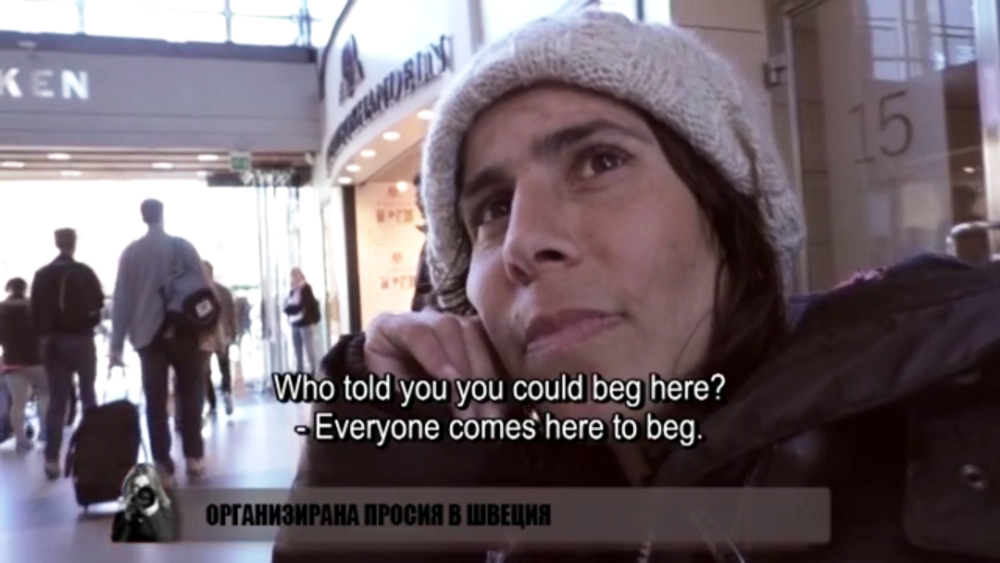
Last year, a Bulgarian news team visited Sweden to film a documentary about the beggars. The footage showed that there are people who actually organize the panhandling; one of them talked openly on camera about being prosecuted for blackmailing a beggar who did not earn him enough money. The man also talked about how he “owned” five street corners in central Gothenburg, and said that the best location was outside Systembolaget (the government-owned liquor store) — where he posted his wife.
Last year, a Bulgarian news team visited Sweden to film a documentary about Roma beggars from Bulgaria and Romania.

The man denied that the beggars themselves worked for him — he claimed they were all part of a Bulgarian team, and split the income between them. His role was just to “protect” them from the Romanian beggars, who, he said, would otherwise “beat up and chase the Bulgarians away.” He said that the beggars make about 400-500 kronor ($50-60) a day, and use the money to buy food, beer and cigarettes.

“Is it not fraud,” the reporter asked, “to pretend that you are destitute, all the while using the money for beer and cigarettes?”

“No,” the man said, “we do not fool anyone. We just benefit from this opportunity.”

The charges against him were dropped.

Ingrid Carlqvist is a journalist and author based in Sweden, and a Distinguished Senior Fellow of Gatestone Institute.

Sweden’s Walking Diplomatic Disaster by Ingrid Carlqvist

  • “It is a shame for Sweden to have a Foreign Minister who creates a diplomatic crisis as soon as she opens her mouth, and who so one-sidedly allies herself with anti-democratic forces against Israel, the only democracy in the Middle East.” — Political analyst Mathias Sundin, in Aftonbladet.

  • “Wallström portrays [Palestinian President Mahmoud] Abbas as a pacifist who has denounced terrorism…. He has not condemned a single one of the murders of 20 Israelis during the last few months. On the contrary … Abbas said in September, regarding the violence against Israelis, that ‘We bless every drop of blood spilled in Jerusalem’, and we know that every Palestinian assassin apprehended by Israel is rewarded by the Palestinian Authority. So how can Wallström claim that he denounces terrorism, when he is actually rewarding it with money from the Swedish taxpayers? … Is Wallström aware of the praising of terrorism? Is Wallström aware of the rewards paid to terrorists? Yes or no?” — Kent Ekeroth, Sweden Democrats Party.

It seems that pretty much everything is going wrong for Sweden’s Foreign Minister these days.

Margot Wallström, of the Social Democratic Party, ascended with much fanfare to the post of Foreign Minister in the fall of 2014. She had introduced a completely new concept: a feminist foreign policy. In the Statement of Foreign Policy of 2015, she asserted that “A feminist foreign policy is now being formulated, the purpose of which is to combat discrimination against women, improve conditions for women and contribute to peace and development.”

One year later, we now know the outcome: “Feminist foreign policy” is not so much about protecting women’s interests, as it is about fawning over the Arab states and the Palestinians — and constantly attacking Israel, the only democracy in the Middle East.

Zvi Mazel, Israel’s ambassador to Sweden from 2002-2004, wrote for the Jerusalem Center for Public Affairs on December 14, that,

“The Swedish Social Democratic Party is not known for its sympathy toward Israel. Its current duo of leaders, however, Prime Minister Stefan Löfven and Foreign Minister Margot Wallström, have gone overboard and are waging a systematic campaign against Israel… Although the recognition of a Palestinian state was a continuation of the Swedish left’s hostile policy toward Israel, it was also aimed at the country’s large Muslim minority — comprising about 700,000 people — with the aim of attracting Muslim voters to the party in the next elections. During my diplomatic tenure in Sweden in the early 2000s, all my efforts to conduct a dialogue with that party fell on deaf ears. … the two countries’ relations have turned into a cycle of altercations.”

Is Ambassador Mazel right? Let us take a look at what the Swedish government, and its current Foreign Minister, have said and done.

On October 30, 2014, there was the unilateral recognition of Palestine as a sovereign state. The same day the government made its decision, the Swedish daily, Dagens Nyheter, published an opinion piece by Wallström:

“Today’s recognition is a contribution to a better future for a region that has too long been characterized by frozen negotiations, destruction and frustration. Through our recognition, firstly, we want to support the moderate forces among the Palestinians: Those that are set to govern the complex formation of a Palestinian state, and those who are about to return to the negotiating table.

“Secondly, we want to facilitate an agreement by making the two parties in these negotiations more equal. The goal is for Israel and Palestine to exist within mutually recognized borders, based on the borders of 1967 and with Jerusalem as the capital of two states, only allowing land swaps if both parties negotiate it.

“Thirdly, we hope to contribute to giving more hope and belief in the future to the young Palestinians and Israelis who otherwise risk radicalization in the belief that there are no alternatives to violence and the status quo.”

The reactions came immediately. As soon as Prime Minister Löfven made his Statement of Government Policy, and made public his new government’s intention of recognizing Palestine, the Israeli Foreign Ministry called in the Swedish ambassador to Israel to protest the decision, and Israel’s then Foreign Minister, Avigdor Lieberman, was openly critical. The same night, word came that Israel called home its current ambassador, Isaac Bachman. Lieberman even said that he was considering removing the Stockholm embassy permanently, thereby downgrading Israel’s diplomatic connections with Sweden. This move, however, did not happen.

Israel demonstrated its opinion of Wallström clearly in January 2015, when she was supposed to travel to Israel for a seminar in remembrance of Raoul Wallenberg, and also to meet with FM Lieberman and Prime Minister Benjamin Netanyahu. The Israeli leaders, however, did not want to see Wallström, and denied her diplomatic credentials.

“A powerful statement by the Israelis,” said Per Jönsson, Middle East expert at Sweden’s Foreign Policy Institute (Utrikespolitiska institutet). “She is not treated as a Foreign Minister from a sovereign government. It is much more than just a symbolic gesture; this is Israel taking action,” Jönsson told the daily Svenska Dagbladet. According to the paper, the Israeli government had conveyed the message that the only way to defrost relations between Sweden and Israel was for Sweden to apologize for recognizing Palestine — or if a new government came to power.

Apparently, the Swedish Foreign Ministry thought the whole affair so embarrassing that it decided to pretend Wallström had to cancel her trip due to time constraints.

The recognition of Palestine also garnered massive criticism inside Sweden. The Committee on European Union Affairs criticized the government for not allowing Parliament to vote on the issue, and the opposition parties called the recognition “hasty, imbalanced and clumsily handled to boot.” Liberal foreign policy spokesperson Birgitta Ohlsson said that the decision was “immature,” as it legitimizes Hamas’ terror. Middle East expert Per Jönsson pointed to the fact that it is not customary to recognize a state that does not fully control its territory.

Of course, Palestinian President Mahmoud Abbas was very happy. He got a call from Prime Minister Stefan Löfven announcing the decision. Abbas told daily tabloid Aftonbladet: “Sweden is a pioneer country, I hope other countries in Europe will follow suit.”

On February 15, 2015, when Abbas visited Sweden, criticism erupted again. Karin Ernström, Vice-Chairman of the Committee on Foreign Affairs, said she believed Sweden should have awaited a joint EU decision before unilaterally deciding to recognize Palestine. She also noted, in an interview during Abbas’s visit, that she “assumes that Sweden takes this opportunity to put pressure on the Palestinian leadership.” No such pressure has been visible so far.

Many people in Sweden now feel that if Sweden can recognize Palestine, why not do the same with Western Sahara, a disputed territory unilaterally annexed by Morocco 40 years ago? Does such a decision not jibe with the “feminist foreign policy?” Or could it be that Morocco is a Muslim country, and that the feminist Wallström does not want to offend countries such as that? Certainly not after a debacle in 2015, when Wallström labeled Saudi Arabia a dictatorship with medieval laws and oppressing women. This statement before Parliament came as a reaction to the sentencing of Saudi blogger Raif Badawi to ten years in prison and 1,000 lashes, on charges of “insulting Islam.”

Many Swedes at the time were pleasantly surprised by Wallström’s statement, and thought that maybe this “feminist foreign policy” thing was not so bad after all. In the Muslim world, however, her statement was met with considerable anger. The Organization of Islamic Cooperation, OIC, wrote on its web page: “In her remarks, Ms. Wallström degraded Saudi Arabia and its social norms, judicial system and political institutions.”

What Wallström apparently failed to grasp when she attacked the Saudi justice system, is that it is based on Sharia law, the Islamic judicial system. And one does not criticize this with impunity, as a Foreign Minister should know. So, instead of sticking to her original arguments, which were, of course, factually correct, wild panic erupted at the government offices. Wallström’s Press Secretary, Erik Boman, hurried to claim that his boss had not meant her statement to be construed as any kind of criticism of Islam. “We have the utmost respect for Islam,” Boman said. “Sweden values its good relations with the Muslim world.”

Wallström herself held an ingratiating speech in Parliament. She praised Saudi Arabia, mentioned that the king is the guardian of the two most important mosques in Islam, and stressed that many Swedes go on pilgrimage there every year. The end of her speech once again made people gasp: “To address some of the claims circulating, I would just like to say: We have the utmost respect for Islam as a world religion and for its contributions to our common civilization. … Sweden values our good relations to the Muslim world. Many Swedes are Muslims, and they of course give valuable contributions to our society.”

Björn Norström, a US-based writer, revealed on the alternative media site, Avpixlat that he had written to the Foreign Ministry asking for “concrete examples of how Islam has contributed to civilization when it comes to human rights, science, industry, democracy and polity since medieval times.” He did not receive any examples, mostly just loose claims and a reference to the oft-refuted “1001 Inventions, the Enduring Legacy of Muslim Civilization.”

The Muslim world was nevertheless still angry with Wallström, despite of her kind words about Islam. Saudi Arabia called home its ambassador from Stockholm and decided to suspend new work visas for Swedish citizens. The Saudis also stopped Wallström from giving a speech at an Arab League meeting in Cairo March 9.

The firestorm did not abate until Sweden’s King Carl XVI Gustaf offered to help mediate on her behalf with Saudi king. On March 28, Wallström held a press conference, and was beaming with joy when she told reporters that Sweden’s relations with Saudi Arabia were now fine: “I am very pleased to announce that we can normalize our relations immediately, and that we are able to welcome the Saudi ambassador back to Sweden. It is deeply satisfying that we have been able to clear the misunderstanding that we insulted the world religion Islam.”

We will never know how exactly relations were “normalized.” What we do know is that the envoy for the Swedish government, Social Democrat Björn von Sydow, was granted an audience with the House of Saud, under the leadership of King Salman bin Abdul Aziz and Prince Mohammed bin Salman Al Saud. Von Sydow delivered two letters, one from the Swedish King and one from Prime Minister Stefan Löfven. Both letters remain classified.

Soon after the recent Paris terror attacks, on November 13, 2015, Wallström felt once again a need to express her disdain for Israel. In an interview with Swedish Public Television, SVT, she was asked: “How worried are you about the radicalization of young people in Sweden who choose to fight for ISIS?” Wallström replied:

“Yes, of course we have a reason to be worried not only here in Sweden but around the world, because there are so many who are being radicalized. Here again, you come back to situations like that in the Middle East, where not least the Palestinians see that there isn’t any future for us [the Palestinians], we either have to accept a desperate situation or resort to violence.”

This strange connecting of the Paris attacks to Israel caused a new diplomatic crisis between Israel and Sweden. Once again, the Swedish ambassador to Israel was called to a meeting at the Israeli Foreign Ministry, and cautioned that the Swedish Foreign Minister’s statement seemed “appallingly impudent.”

The week before, the daily tabloid Expressen had revealed that Swedish diplomats were no longer welcomed in Israel the way Sweden would like. For example, they are refused travel permits to the Gaza strip — papers other countries apparently have no problem obtaining.

A few days after Wallström’s scandalous interview, the linguist Susanne Sznajderman-Rytz posted on her Facebook page:

“‘The Jews are campaigning against me.’ That was the reply I got from Margot Wallström, when I ran into her by coincidence the day after the Paris attacks, and told her that many of my Jewish friends were really offended by what she told [SVT anchorman] Claes Elfsberg earlier that morning.”

Again, Wallström was forced to explain herself. Her Press Secretary claimed outright that Sznajderman-Rytz had made the whole thing up. But Sznajderman-Rytz stuck to her story. She told the alternative media website Nyheter Idag,

“Let me tell you what I do in my everyday working life. She did not know this, but I educate people in communication and writing. Professionally, I work with understanding what people are saying, how they act and everything that happened in that moment is quoted correctly.”

In early December, two members of Parliament, Mathias Sundin of the Liberals and Kent Ekeroth of the Sweden Democrats, had demanded that Wallström explain why she had not condemned the rampant Palestinian knife attacks against civilian Israelis with so much as a syllable. The ensuing debate ended with Wallström saying that she trusts Palestinian Authority President Mahmoud Abbas implicitly, because he told her he wants peace, and she believes him. She also leveled new accusations against Israel, which, according to Wallström, is engaged in “extrajudicial executions.”

Mathias Sundin wrote in an opinion piece in Aftonbladet:

“When I pointed out that the Israeli police handle the knife attacks according to the same principle that the Swedish police used during the Trollhättan school attack, by aiming for the body to stop the assailant quickly, the Foreign Minister shook her head several times. It was in reply to this statement that Wallström said that the response must not be extrajudicial executions.

“Even though it is obvious what she actually means, she and the government refuse to apologize. Their defense tactic — the one about it being a misunderstanding — does not include an apology even for being unclear, but rather, a new attack against Israel. Unfortunately, this is completely in line with the government’s one-sided policy. … It is a shame for Sweden to have a Foreign Minister who creates a diplomatic crisis as soon as she opens her mouth, and who so one-sidedly allies herself with anti-democratic forces against Israel, the only democracy in the Middle East.”

Sweden’s Foreign Minister Margot Wallström (right) called the Israel Police’s actions in stopping deadly stabbing attacks “extrajudicial executions,” even after it was pointed out to her that “Israeli police handle the knife attacks according to the same principle that the Swedish police used…”

Kent Ekeroth wondered how Wallström views President Abbas and his Fatah party. The Foreign Minister replied:

“The government supports moderate forces in Palestine, the government supports the Palestinian Authority and others who recognize Israel’s right to exist and seek a diplomatic solution to the conflict, enabling Israel and Palestine to live side by side with peace and security. I find that President Abbas has made it his life’s goal to replace the way of violence with a diplomatic struggle to end the Israeli occupation of Palestine. I also note that President Abbas, apart from his denunciation of terrorism, has also spoken against cries for violent resistance against the Israeli occupying force.”

Ekeroth retorted:

“Wallström portrays Abbas as a pacifist who has denounced terrorism. He might condemn terrorism when it is French citizens who are killed, but when it is Israelis being killed there are no problems. He has not condemned a single one of the murders of 20 Israelis during the last few months. On the contrary, many of the Palestinian Authority and Fatah leaders have glorified the killers. A member of the Fatah Central Council told Palestinian TV in October that he congratulates all those who have carried out the attacks. He is proud of them, and thought that knife attacks should be taught in Palestinian schools. Your own ‘golden boy’ Mahmoud Abbas said in September, regarding the violence against Israelis, that ‘We bless every drop of blood spilled in Jerusalem’, and we know that every Palestinian assassin apprehended by Israel is rewarded by the Palestinian Authority. So how can Wallström claim that he denounces terrorism, when he is actually rewarding it with money from the Swedish taxpayers?

“Wallström is either ignorant about Abbas’ celebrations of and rewards to murderers, or she is lying. Neither alternative is very flattering. I would therefore like to ask two questions: Is Wallström aware of the praising of terrorism? Is Wallström aware of the rewards paid to terrorists? Yes or no?”

Wallström replied that she certainly condemns “all acts of violence, regardless if they are carried out by Palestinians or Israelis, and I have emphasized the importance of bringing those responsible to justice and not engaging in extrajudicial executions.”

Wallström further thought that one should not attempt to interpret or translate what Abbas says, because there are so many different ways to do this. “I do not think we should do that, the important thing is that we condemn violence and I myself have heard Abbas do this, so I know he renounces violence.”

Ekeroth shot back: “One does not reward terrorists with recognition, and one does not pay them using Swedish taxpayers’ money.” He then proceeded to show a number of printouts of Fatah’s official Facebook page, where murdered Israelis are displayed and the killings celebrated. “You need to understand that Abbas speaks two languages — one to gullible [Western] politicians, where he says he wants peace, and another to Palestinians, where he promotes, glorifies and rewards terror. Wallström needs to stop listening to what Abbas tells her and instead start listening to what he tells his own people.”

On January 11, 2016, did it again. She said in parliament that she wants “a thorough and credible investigation into whether Israel has used extrajudicial killings during the last months of violence, knife attacks and clashes between Israelis and Palestinians.”

The statement provoked strong a reaction in Israel. Its foreign ministry, in an unusually strongly-worded statement, condemned Wallström, saying her “irresponsible and delirious statements are giving support to terrorism and encouraging violence.” Technology and Space Minister Ofir Akunis went farther and suggested that, instead, there should be an investigation on “how a woman who so bluntly hates Israel was elected, and still holds the role of foreign minister of Sweden.”

* * *

Many Swedes had a great sense of secondary shame, when the government, with Wallström in the forefront, presented its military “aid package” to France. Sweden is bound by the Treaty of Lisbon to help other EU nations struck by a terrorist attack. A request for help had come from France a few days after the terror attacks of November 13. Most experts agreed that the most natural thing for Sweden to do, would be to send JAS39 Gripen jets, an advanced Swedish fighter and reconnaissance plane that could be truly useful in, for example, Syria. But this did not happen.

All the government could apparently muster were a few extra flight hours in Africa, a couple of staff officers and a Hercules transport plane. Wallström explained the lack of Gripen planes: “The most important reason is that this is a gray area in international law. That may change, if a clear UN mandate comes. But so far, this is unclear as far as international law goes.”

Sweden’s opposition parties were merciless in their criticism. Christian Democratic Party defense spokesperson Mikael Oscarsson called the offer “futile.” The Conservative Party’s Hans Wallmark called it “insufficient” and warned that if Sweden were attacked in the future, it should not expect a great deal of help. The Liberal Party’s Allan Widman said that he believed this was “a great disappointment to the French.” There were even rumors of disagreements within the government, between Wallström and Defense Minister Peter Hultqvist, who supposedly wanted to send JAS39 Gripen jets, but was overruled by Wallström.

“Today we are ashamed,” wrote columnist Alexandra Ivanov in the daily Svenska Dagbladet. “What has happened is that Sweden has chosen not to take responsibility. One day, we will become aware of what happens to those who just take and take, but never give back.”

On Christmas Day, December 25, Aftonbladet published a list of how the Swedish people grade the government’s ministers. Unsurprisingly, the minister losing most favor with the people was: Margot Wallström.

Sweden’s Muslim Christmas Show by Ingrid Carlqvist

  • What finally seems to be dawning on the Swedes is that while the government puts the right to asylum before the safety of its own people, the country could be filling up with terrorists.


  • “No, ‘Sweden’ has not been naïve. You, your party and your coalition partners have been naïve and you still are.” — Mattias Karlsson, Parliamentary group leader of the Sweden Democrats.

  • The announcement that a person such as Dirawi, who professes to be of the Islamic faith, and who according to Islamic scholars should believe the celebration of the birth of Christ is a heathen tradition, will be Christmas Host, sparked feelings of anger and betrayal.

From the night of the Paris attacks until Tuesday, when Sweden’s government announced it was reversing its open-borders policy, Sweden was in a state of turmoil. No matter what the government said, it accomplished nothing — other than making the Swedes increasingly livid.

When Prime Minister Stefan Löfven accused his people of being naïve about radical Islamism, anger exploded on social media. You could read comments such as: “No. Some of you have been naïve. The rest of us have been labeled fascists and other ugly things.”

The shock and horror of the Paris attacks — in which one Swedish woman was among the 130 dead and another among the 350 wounded — had barely subsided when the Swedish people received another blow. On November 18, a grim Security Service Chief, Anders Thornberg, held a press conference during which he revealed that a combat-trained ISIS terrorist was suspected of having entered Sweden and a warrant was issued for his arrest. Because of this, Thornberg had raised the threat level in Sweden from three to four on a scale of five — meaning the country was now facing the highest “threat level” since the scale was introduced in 2010.

The Security Service Chief, as well as various Ministers, then urged people not to be alarmed. The suggestion had little effect. Rumors ran rampant on Facebook and other social media that police in Stockholm had told their family members to “stay away from the inner city for the next four or five days as the threat was a lot more serious than what had been made public; apparently they are looking for more terrorists, about 20 people; you need to decide for yourselves. In any event, the threat is bigger than what was shown on the news.”

The next day, the Stockholm subway, which normally transports 1.2 million passengers a day, was rather desolate. Then, on November 20, the Security Service confirmed that an attack had indeed been planned to take place in Stockholm.

The day after the nationwide alert, the suspected ISIS terrorist was apprehended. It turned out that he had sought asylum in Sweden under the name Mutar Muthanna Majid, and had been living for several weeks at an asylum seekers’ home in the small mining village of Boliden in northern Sweden.

Only after the arrest did Prime Minister Stefan Löfven speak out in public. During a press conference, he announced stricter anti-terror laws to deal with foreign Islamist extremists, which he now admitted posed the biggest threat to Sweden, and not the only one:

“We know that about 300 Swedish citizens have gone to Syria and Iraq to fight alongside ISIL. We also know that about 120 have returned. The Security Service believes that among them, there are individuals who pose a threat to our society and have also committed crimes against people in other countries. It is unacceptable that people can travel, participate in terrorist acts and come back without being held accountable — and drain the society of large resources.”

Next, the Prime Minister claimed that “Sweden has been naïve,” conveniently forgetting that he had called those who were not naïve — those who had expressed concern about the Islamization of Sweden — “racists” and “Islamophobes.” He also neglected to mention that as far back as May, Security Service chief Anders Thornberg had raised the alarm that Sweden could not handle any more jihadism. At the time, Thornberg had also expressed concern that foreign jihadis would take advantage of the Swedish asylum system — through which more than 90% of applicants lack identification documents but still got permanent residency — by hiding among the refugees.

A few days after Mutar Muthanna Majid, the suspected terrorist, was arrested, the District Attorney dismissed the Security Service’s evidence against him. On November 22, Majid wasreleased and all charges dropped. A columnist from the daily Dagens Nyheter, Lasse Wierup, called the Security Service’s conduct “astonishingly unprofessional.”

Even as the mass immigration of Muslims to Sweden increased at an explosive rate during the last few years, the government kept stubbornly insisting that it did not entail any problems. According to the government, everyone was the same, and it did not matter if Sweden was populated by Swedes or by Muslim Somalis, Iraqis or Afghans. Those who insisted otherwise were ruthlessly branded “racists” and “Islamophobes.”

Finally, last week, Prime Minister Stefan Löfven stood up on live television, and said:

“I must say that Sweden has been naïve in this regard. Maybe it has been hard for us to accept that in our open society, right in our midst, there are people, Swedish citizens, who sympathize with the murderers of ISIL.”

In response to questions from Gatestone Institute about who, exactly, was being called naïve, Mr. Löfven’s press secretary, Dan Lundqvist Dahlin, said that the Prime Minister had in mind “Swedes in general.” When asked if that meant Löfven was blaming the Swedish people for the peril the country was now in, Dahlin replied: “The Prime Minister says that we have been naïve in Sweden. He means me and you and you and you and you!”

When asked if that meant he was accusing the Swedish people of being naïve, Dahlin said:

“But can’t you see what I mean? It is not an accusation. If someone feels accused, that is his problem. I suppose he means politicians and everyone else.”

The Prime Minister’s statement seemed to outrage many Swedes. The hashtag #naiv (“naïve”) immediately started trending on Twitter, and people began posting comments such as:

  • “I haven’t been ‪#naiv so don’t drag me into this.”
  • “‘Sweden has been naïve’? No, you have betrayed your country.”
  • “I have been called many things over the years, but this is the first time I have been called naïve. By the Prime Minister no less. Not bad.”
  • “Why is Löfven saying that ‘Sweden’ has been naïve? Very, very many have warned about exactly the situation we are now in!”

The only political party that warned about the Islamization of Sweden was the Sweden Democrats, and it has consistently been shut out of all consultations. During the press conference, Löfven called for national unity and invited all the opposition parties to talks — except the Sweden Democrats. He even said:

“In moments such as this, it is important that Sweden stands united. There is no room for partisan squabbling or party politics here. That is why I have invited the right wing-bloc for talks on how to fight terrorism.”

The Sweden Democrats’ Parliamentary group leader, Mattias Karlsson, wrote on Facebook:“No, ‘Sweden’ has not been naïve. You, your party and your coalition partners have been naïve and you still are.”

Karlsson reminded the public of the massive criticism of the Sweden Democrats, when its members recently handed out flyers to migrants in southern Europe. The flyers — signed by the Sweden Democrats and “the people of Sweden” — urged asylum seekers not to go to Sweden. Journalists and politicians then attacked the party for speaking on behalf of “the people.”

“Judging by the media storm and the comments of government representatives about our flyer the other week,” Karlsson wrote, “I got the impression that speaking in the name of the Swedish people was utterly terrible, but apparently, that was not the case.”

Löfven, appearing on the newscast TV4 News, was asked if stricter border controls should have been introduced earlier, to prevent terrorists from entering Sweden. Löfven was evasive, but the question was actually inaccurate.

The border controls Sweden had introduced in past, meant, in reality, nothing. The borders were as wide open as ever to anyone claiming to seek asylum. The flow of migrants was as big as before: 10,000 new asylum seekers a week.

While the mainstream media is careful to avoid telling the public about this, Dispatch International recently broke the story that at the Öresund Bridge, which connects Sweden and Denmark, the border police performed only random checks — and only on people not claiming to seek asylum. The people who claimed to seek asylum were not checked at all. They were simply transported to an Immigration Service facility. There, they were fingerprinted and photographed; however, as very few of the asylum seekers actually have passports or other identification documents, it takes months even to get a “probable” identification.

While the identity of the asylum seekers was being investigated, they were not held. On the contrary, although many are actual refugees or honestly seeking better lives, they all were sent to various asylum facilities around the country, where, if some wished, they were free to plan any terrorist acts they liked in peace and quiet. For example, Mutar Muthanna Majid, the man who a few days ago had been suspected of being a terrorist, even had his own apartment in the Boliden village — with his name on the door.

Instead of closing Sweden’s borders, Löfven kept pressing for a redistribution of Sweden’s asylum seekers throughout the EU. He called the EU countries that did not have open borders (all except Sweden, Germany and Austria) “irresponsible.” He apparently did not reflect on the idea that the responsible thing might, in fact, have been to protect your own people, and put their well-being first.

Keeping the country’s borders wide open and calling terrified people “racists” and “Islamophobes,” while claiming “we have been naïve,” did not exactly increase the Prime Minister’s popularity. The daily Metro recently reported that Löfven’s Social Democrats now have only 21.4% of Swedish voters on their side, while the Sweden Democrats reached a new record of 26.7%. Moreover, according to the same survey, despite people tending to rally around their leaders in times of crisis, Löfven has become one of the government’s least popular ministers – in 21st place out of 24. His Deputy Prime Minister, Green Party leader Åsa Romson, is the most unpopular.

The poll also showed that more and more Swedes believe that the most important political issue right now is the migrant problem. Since the last poll a month ago, the number of people believing this has grown to 64%, an increase of 8% since October.

What finally seems to be dawning on the Swedes is that while the government puts the right to asylum before the safety of its own people, the country could be filling up with terrorists.

To add insult to injury, Swedes have just found out that the host of the Christmas Show on Swedish Public Television — a very prestigious role designed mainly to comfort lonely people who do not have anyone with whom to celebrate Christmas — will this year be a young Muslim woman, Gina Dirawi, aged 24. Regrettably, on several occasions she has made anti-semitic remarks, yet she nevertheless keeps getting new TV hosting assignments.

Swedish Public Television’s appointment as Christmas Host of Gina Dirawi, who professes to be of the Islamic faith, and who according to Islamic scholars should believe the celebration of the birth of Christ is a heathen tradition, sparked feelings of anger and betrayal in Swedes. (Image source: Expressen video screenshot)

The Public Service director, Safa Safiyari, who recently introduced Dirawi to a large press gathering, came to Sweden at the age of 14. In newspaper articles, he has spoken about how he does not feel “fancy” enough for the Swedish archipelago; and how, in 2001, when he got to do current affairs shows for young people about “all the injustices in Sweden,” it felt as if it were revenge for all the injustices he said he has experienced in Sweden and that still characterize his life.

The announcement that a person such as Dirawi, who professes to be of the Islamic faith and who according to Islamic scholars should believe that the celebration of the birth of Christ is aheathen tradition, will be Christmas Host, sparked widespread expressions of anger and disappointment on social media. Comments were posted on Twitter, such as: “Public Television has declared war on Christian Sweden by choosing Muslim Gina Dirawi as Christmas Host! It is shameful!” And, “If things continue down this road, by next Christmas, Christmas ham will be banned.”

Safa Safiyari told the daily Göteborgs-Posten, that Swedish Public Television had been prepared for all kinds of reactions: “We have chosen Gina Dirawi as Christmas Host based on her competence, her comedic talents and experience in large television broadcasts. When we hire our Christmas Hosts, religious belief is not something we inquire about.”

Ingrid Carlqvist is a journalist and author based in Sweden, and a Distinguished Senior Fellow of Gatestone Institute.

Sweden’s Migration Industry by Nima Gholam Ali Pour

  • That Sweden is a “humanitarian superpower” is a myth that needs exposing once and for all. The recent migration wave to Sweden has made some people poor and others very, very rich. It is all about money, and it is about winners and losers.

  • If liberal journalists outside Sweden believe that rape is humanitarian, then Sweden has a humanitarian migration policy.
  • Meanwhile, thousands of “unaccompanied refugee children” are disappearing. and no one knows where they are.
  • There is nothing “noble” in Sweden’s migration policy — far from being a good example of how a migration policy should function, it is a disaster, and its final result is chaos, conflict, and corruption.

When you talk to journalists from the U.S. or the UK, they often seem to think that Sweden is a humanitarian superpower that has received refugees because the Swedish government is following some ideology based on doing good deeds.

That Sweden is a humanitarian superpower, eager to lead by example, is a myth that needs exposing once and for all. The recent migration wave to Sweden has made some people poor and others very, very rich.

Every day one reads news in Sweden about the winners and the losers in the migration industry. One of the winners in Sweden’s migration industry is ICA Bank. In November 2015, it invoiced the Swedish Migration Agency $8 million for providing asylum seekers prepaid cards. For every cash withdrawal, ICA Bank takes a $2 fee, and for every prepaid card activated, it takes $21. ICA Bank won the contract without any competition; its contract with the Migration Agency extends to March 2017.

Many asylum accommodations in Sweden are run by private operators and are making huge profits. In 2015, the 30 largest companies that run the asylum accommodations invoiced the Swedish Migration Agency an estimated $109 million. The losers, on the other hand, were the Swedish taxpayers who had to finance these decisions.

In November 2015, it was reported that Sweden’s Migration Agency had paid $174 million during an 11-month period to private sector property owners for asylum seekers’ accommodation.

Many of the companies running the asylum accommodations have a profit margin of over 50%. Defakon Renting AB has a profit margin of 68%. Nordic Humanitarian AB has a profit margin of 58%. Fastigheterna på Kullen AB has a profit margin of 50%.

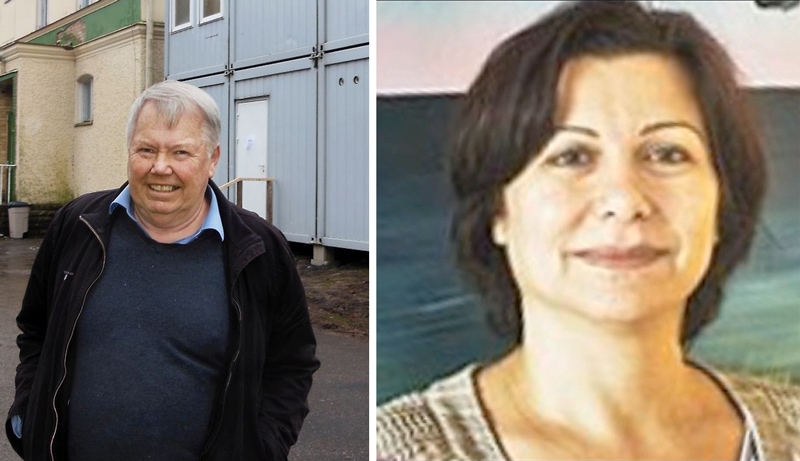
The biggest private company running asylum accommodations, Jokarjo AB, is owned by Bert Karlsson, known in Sweden primarily as director of a record label. In the early 1990s, Mr. Karlsson was the leader and founder of a political party, New Democracy, that advocated reducing immigration to Sweden. Between 1991 to 1994, as a representative of his party, he sat in the Swedish parliament. In 2015, his company billed the Swedish Migration Agency $23.9 million. Mr. Karlsson explained his business plan for running a home for asylum seekers in a simple sentence: “My idea is to make it cheaper and better than anyone else.”

One method he used to make his business more profitable is that asylum seekers have to buy their own toilet paper, apparently despite having agreed with the Migration Agency to provide asylum seekers with toilet paper, sanitary napkins and diapers. In December 2015, the Swedish media revealed that asylum seekers have to buy all these products themselves.

One can only imagine the situation for asylum accommodations run by minor private operators.

This is what the Swedish “humanitarian superpower” is actually about. It is all about money, and it is about winners and losers.

The companies running the asylum accommodations are becoming rich at the Swedish taxpayers’ expense; at the same time, asylum accommodations are not managed properly.

Here are a few of the violent incidents that happen every day:

On January 25, 2016, the police arrived at an asylum accommodation in Annerstad, southern Sweden, after hearing of a brawl there between Syrians and Afghans. When the police arrived, according to their report, no one — not even the people working there — could speak Swedish.

In January 2016, there were reports that a ten-year old boy at an asylum accommodation in Västerås had been raped repeatedly. In February 2016, there were reports that a boy at an asylum accommodation in Maglarp, in southern Sweden, had been raped by two other boys at the same asylum accommodation.

If liberal journalists outside Sweden believe that rape is humanitarian, then Sweden has a humanitarian migration policy.

What is actually happening in Sweden, however, is that private companies are making millions of dollars at taxpayer expense, while the newly arrived migrants are living a horrible existence in which rape and other abuses are a part of daily life. This is what other European countries will experience if they follow Sweden’s liberal migration policy.

Children who come to Sweden without parents (“unaccompanied refugee children“) must, according to the Swedish law, be assigned a legal guardian. The guardian, instead of the parents, is responsible for the child’s personal relationships and managing daily affairs. In December 2015, it was reported that there are guardians responsible for up to 29 unaccompanied refugee children, and who earn more than $7,000 a month. It is not, of course, possible for one guardian to take care of 29 unaccompanied refugee children. The migration industry in Sweden has created opportunities for people with no conscience to become wealthy. Meanwhile, thousands of unaccompanied refugee children are disappearing and no one knows where they are.

Another part of the migration industry that has grown of late are foster homes for unaccompanied refugee children. In February, reports surfaced that one of the heads of the Swedish Migration Agency also runs the private company, Starkfamn Familjehem AB: a business that provides foster homes to unaccompanied refugee children. It is not only people in the private sector are making money from the migration industry, but also people working inside the state apparatus who want to do well.

The biggest private company running asylum accommodations is owned by Bert Karlsson (left). In 2015, his company billed Swedish taxpayers $23.9 million. His homes require asylum seekers to buy their own toilet paper, apparently despite having agreed with the Migration Agency to provide asylum seekers with toilet paper, sanitary napkins and diapers. Wafa Issa (right) is head of the Migration Agency for the Stockholm region. She also runs a private company that is paid to provide foster homes to unaccompanied refugee children.

One of the losers is the Swedish police. They have reported that they can no longer cope with their jobs because they cannot handle the hundreds of young men in Sweden right now from Morocco and other countries in North Africa.

When you talk with journalists from Britain or the United States who think that Sweden’s migration policy is a role model, you have to think of those journalists who once saw the Soviet Union as a model. Communism did not work; Sweden’s migration policy does not work. That Sweden is a “humanitarian superpower” is truthfully nothing but marketing: the Green Party and some Social Democrats want to export Sweden’s liberal migration policy to the rest of Europe.

Although a small clique in Sweden have become millionaires because of the migration industry, the schools, police, social services and taxpayers in Sweden have lost a lot and have a difficult and uncertain future. There will be major conflicts in Sweden. There is nothing “noble” in Sweden’s migration policy. The Swedish migration model, far from being a good example of how a migration policy should function, is an embarrassment and a disaster, and its final result is chaos, conflict, and corruption.

Nima Gholam Ali Pour is a member of the board of education in the Swedish city of Malmö and is engaged in several Swedish think tanks concerned with the Middle East. He is also editor for the social conservative website Situation Malmö.

Sweden’s Holy War on Children’s Books by Judith Bergman

  • Taken to its extremes, the urge to cleanse a culture of elements that do not live up to the politically correct orthodoxy currently in political vogue unsettlingly echoes the Taliban and ISIS credos of destroying everything that does not accord with their Quranic views. The desire “not to offend,” taken to its logical conclusion, is a totalitarian impulse, which threatens to destroy everything that disagrees with its doctrines. Crucially, who gets to decide what is offensive?

  • The question arises: How much purging and expiation will be needed to render a country’s culture politically correct?
  • “When we have days of carnivals and music the goal is that these days should be experienced as positive by everyone. The Swedish flag is not allowed as part of carnival dress. … Positive and bright feelings must be in focus. … School photos must obviously be free of national symbols.” — Swedish school in Halmstad.
  • Rome covered up its classical nude statues for a visit from Iran’s president, Hassan Rouhani, in January 2016. A decade ago, who would have even imagined such sycophancy?

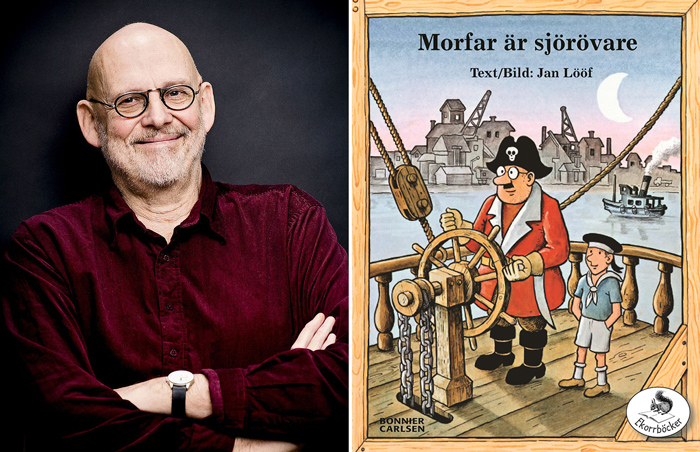
In 1966, one of Sweden’s most popular children’s writers, Jan Lööf, published Grandpa is a Pirate, an illustrated children’s book, which featured, among other characters, the wicked pirate Omar and the street peddler, Abdullah. The book has been a bestseller ever since, and has been translated into English (as My Grandpa is a Pirate), Spanish, French and other languages. Ten years ago, 100,000 copies of it were even distributed to the Swedish public with McDonald’s Happy Meals, as part of an initiative to support reading among children.

Ah, but those were the days of yesteryear! Now, fifty years later, the book is no longer tolerable. The now 76-year-old author told Swedish news outlets that his publisher recently said that unless he rewrites the book and changes the illustrations, it will be taken off the market. The publisher also threatened to withdraw another of his books unless it is redone: it features an illustration of a black jazz musician who sleeps with his sunglasses on.

Lööf’s publisher, the Swedish publishing giant Bonnier Carlsen, says that it has not yet made a final decision and that it only views the rewriting and re-illustrating of the books as “an option.” There is no doubt, however, that they consider the books in question extremely problematic.

“The books stereotype other cultures, something which is not strange, since all illustrations are created in a context, in their own time, and times change,” said Eva Dahlin, who heads Bonnier Carlsen’s literary department.

“But if you come from the Middle East, for instance, you can get tired from rarely being featured on the good side in literary depictions. Children’s books are special because they are read over a longer period of time and the norms of the past live on in them, unedited. As an adult, one may be wearing one’s nostalgic glasses and miss things that could be seen as problematic by others.”

Dahlin further explained that the publishing house spends a lot of time reviewing older publications, to check if such “problematic” passages occur. She added that the publishing house does not check for only culturally sensitive passages:

“There are many female editors, and therefore we have probably been more naturally aware of gender-biased depictions than these type of questions. But now we have better insights and a greater awareness of these issues.”

One of Sweden’s most popular children’s writers, Jan Lööf, was recently told by his publisher that unless he makes his bestselling 1966 book, Grandpa is a Pirate, more politically correct by rewriting it and changing the illustrations, it will be taken off the market.

Sweden is no stranger to “literary revisions” of this kind, or other cultural revisions in the name of political correctness. Both Pippi Longstocking and other children’s books have gone through assorted revisions or have even been taken off the market. In the Pippi Longstocking television series, a scene in which Pippi squints her eyes to look Chinese has been edited out altogether, so as not to offend anyone. In 2013, a popular, award-winning Danish children’s book, Mustafa’s Kiosk, by Jakob Martin Strid, was taken off the market in Sweden after complaints on Swedish social media that it was racist and “Islamophobic.” Ironically, the author wrote it in 1998, when he was staying in Indonesia, the world’s most populous Muslim country, as “an anti-racist statement.” Tellingly, the book had been on the Swedish market since 2002 with no complaints. In his response to the criticism, the Danish writer noted that an equal and non-racist society only comes about “when you are allowed to make (loving) fun of everyone.” “I also make fun of Norwegians,” he added.

In 2014, after complaints on Swedish social media that some of its candy was “racist,” the Haribo company decided to change one of its products, “Skipper Mix,” which consisted of candies shaped in the form of a sailor’s souvenirs, including African masks.

The question arises: How much purging and expiation will be needed to render a country’s culture politically correct?

That question raises an even bigger one: How high is the price of political correctness in terms of “cleansing” the past and present of perceived slights, anywhere, to just about anyone?

Taken to its extremes, the urge to cleanse a culture of elements that do not live up to the politically correct orthodoxy currently in political vogue unsettlingly echoes the Taliban and ISIS credos of destroying everything that does not accord with their Quranic views. The desire “not to offend,” taken to its logical conclusion, is a totalitarian impulse, which threatens to destroy everything that disagrees with its doctrines. Crucially, who gets to decide what is offensive?

What begins innocently enough, by taking out passages from books that may hurt someone’s feelings, can end up turning into something far more sinister, as it indeed has in Sweden. Former Swedish Prime Minister Frederik Reinfeldt famously stated in 2014 that Sweden belongs to immigrants, not to the Swedes who have lived there for generations. He thereby communicated that he believes the future of Sweden will be shaped by non-Swedes, showing a curious contempt for his own culture.

This contempt has spread fast throughout official Sweden. In 2014, a Swedish school in Halmstad forbade displaying the Swedish flag, after a student painted his face in the Swedish colors for a carnival. In its new rules, the school specified why:

“Most students look forward to school traditions. When we have days of carnivals and music the goal is that these days should be experienced as positive by everyone. The Swedish flag is not allowed as part of carnival dress. … Positive and bright feelings must be in focus. … School photos must obviously be free of national symbols.”

However, the “precedent” for such rules had already been set ten years prior, in 2004, at a school in Vaargaarda, when two girls had worn printed sweatshirts which happened to display the Swedish flag and the word “Sweden.” They were told that this kind of clothing was not allowed at school. One of the girls told reporters that singing the national anthem had also been forbidden at the school.

In 2012, two members of Sweden’s parliament suggested that statues of the Swedish Kings Carl XII and Gustav II Adolf should be removed, because they represent a time when Sweden was a great military power, “a dark time in our country as well as in other countries, which were affected by Swedish aggression,” as the MPs wrote in the motion. Instead, the MPs suggested, the squares of central Stockholm should be adorned in a way such that they “signal peace, tolerance, diversity, freedom and solidarity.”

In 2013, a Baroque painting of the nude goddess Juno was removed from the restaurant of the Swedish parliament, ostensibly to avoid offense to feminist and Muslim sensibilities.

The above should not be discarded as crazy practices peculiar to Sweden. On the contrary, they present a perfect case-study of the consequences of politically correct culture driven to the extreme.

Indeed, these consequences are already proliferating across the Western world. One particularly noteworthy instance took place when Iranian president Hassan Rouhani visited Rome in January 2016. To prevent Rouhani having “a hormonal shock and ripp[ing] up the freshly signed contracts with our Italian industries,” as one Italian columnist, Massimo Gramellini, wrote, Rome covered up its classical nude statues. Who would have even imagined such sycophancy a decade ago?

In Britain, students have recently campaigned for the removal of symbols of British imperialism, such as a statue of Cecil Rhodes at Oxford University. These students claim the campaign is not only about the statue itself, but that it is “…a campaign against racism at Oxford, of which the Rhodes statue is a small but symbolic part.” Already in 2000, the London Mayor Ken Livingstone suggested that statues of two 19th-century British generals should be removed from Trafalgar Square in London, based on his own ignorance:

“The people on the plinths in the main square of our capital city should be identifiable to the generality of the population. I haven’t a clue who two of the generals there are or what they did. I imagine that not one person in 10,000 going through Trafalgar Square knows any details about the lives of those two generals. It might be time to look at moving them and having figures ordinary Londoners and other people from around the world would know.” The problem with all this, of course, is that most of London’s wealth and greatness in terms of art and architecture is due largely to British colonialism, so the question is just how many buildings would be left standing in the British capital, if one were to take this issue and bring it to its logical conclusion.

The trouble with wanting to scrub the cultural and historical slate clean, as it were, is, of course, that countries cannot just press “delete” on their culture and history. Such a move would entail not just the removal of books, paintings and statues, but a complete purge. Those who truly care for history will know that this experiment has already been attempted, not once but several times over, by the various communist and Nazi movements of the twentieth century. While there is little comparison between those movements and the culture of political correctness, the impulse governing them all nevertheless remains the same: To forge and impose one singular “truth” on everyone, rooting out everything that does not fit the utopian mold. That is neither “diverse” nor “tolerant.”

Judith Bergman is a writer, columnist, lawyer and political analyst.

Translate »
Skip to toolbar