Category Archives: Uncategorized

The Failure of the Swedish Establishment by Nima Gholam Ali Pour

  • In Sweden’s third largest city, Malmö, the children of illegal migrants receive income support payments from the government, and the unemployment rate among foreign-born men aged 18-24 years is at 41%. In Sweden, those who do not have jobs receive generous welfare payments from the local authorities, and families in the country illegally have their rent paid by the taxpayers. It is an open invitation to more migrants to come to Sweden.

  • The Swedish establishment tells Swedes that the more immigrants come to Sweden, the richer Sweden will become — no matter which country these immigrants come from.
  • The Swedish establishment is characterized by incompetence combined with an extreme left-wing ideology and a hillbilly-like mentality that refuses to see the rest of the world and the risks involved in it. The Swedish establishment has not dealt with Sweden as if it were a country, but as if it were a village.
  • By gross miscalculations, the Swedish establishment has eroded its own legitimacy. Today, fewer than one in four Swedes have confidence in their government. Meanwhile, the Swedish media is a major threat to Sweden’s security today: it downplays the migration crisis with ridiculous arguments.

A major threat to Sweden’s security today is the Swedish journalistic establishment: it downplays the migration crisis with ridiculous arguments.

As migrants flooded into Sweden in December 2015, Fredrik Virtanen, a writer for Sweden’s largest newspaper, Aftonbladet, wrote an article entitled, “Have refugees forced you to buy worse red wine?” It is not really dangerous, Virtanen argues, that that Sweden was accepting 160,000 migrants; such migratory movements, he wrote, do not really impact anyone’s life.

Today, however, we know that many people’s lives have been affected by the influx of migrants and that the problems are about more than wine. They are, for example, about sexual assault, the murder of staff in asylum accommodations and chaos in the Swedish school system. But Virtanen was right: red wine is still here.

Another of Aftonbladet’s editorial writers, Linnea Swedenmark, writes about a village in the Swedish province of Jämtland. The village she writes, is an example of how migrants are ensuring that the consumption of goods is increasing in the rural areas of Sweden.

What she did not write is that in Jämtland’s largest city, Östersund, many women have been assaulted by men who speak “Swedish with an accent.” The police have warned women not to go out alone. Swedenmark is right when she writes that “the grocery store sells three times as many eggs” — but the women of Jämtland feel less secure in the public domain.

In the magazine, Café, the journalist Andrev Walden wrote in December 2015, that “no nation has perished from too much goodness.” The pictures for his article compared Sweden’s new restrictive immigration laws with the Holocaust.

When the migration crisis started last year in Sweden, the Swedish comedian Henrik Schyffert calculated and wrote on Facebook that it costs each Swede “two Quattro Stagionis (a popular local pizza), a large Fanta soda and a Netflix subscription to save the lives of 80,000 people this year.”

His Facebook post was praised by all major media outlets in Sweden. They were apparently looking to a comedian who counted the counted the cost of immigration in pizza and soda currencies for the solution to Sweden’s migration crisis.

Since Schyffert made his statement, those amazing pizzas that would finance the mass influx of migrants are nowhere to be found, and Sweden has to borrow more money for the migration crisis on its hands.

These quotes are from the mainstream media in Sweden, and it is how large parts of the Swedish establishment sound every day. This is the level at which the debate on immigration in Sweden is being conducted.

While 800,000 migrants in Libya are waiting to invade Europe, Sweden has a refugee policy whereby only by obtaining livelihoods will those migrants with a refugee status and a temporary residence permit get permanent residence permits. So if you get a job, you get to stay in Sweden permanently. It is a strange refugee policy, because those who actually are refugees and not economic migrants are often traumatized and have difficulties finding a job. So Sweden’s refugee policy is tailored to economic migrants.

In Sweden’s third largest city, Malmö, the children of illegal migrants receive income support payments from the government, and families that are in Sweden illegally have their rent paid by the taxpayers. For some reason, the Swedish authorities want to pay people who should not even be in Sweden. It is an open invitation to more migrants to come to Sweden.

Tens of thousands of migrants have passed through Denmark to enter Sweden during 2015 and 2016, attracted by Sweden’s generous welfare payments and free housing.

What the established Swedish media does not tell people about are the threats and risks that come with increased migration. When the European Union’s border agency, Frontex, recognized that it could not control the migrants coming to Europe, and that many Europeans who had joined terrorist organizations outside Europe were coming back to Europe among the migrants, this was not major news in the Swedish media. This is strange, since Sweden is one of the countries in Europe from where many citizens have traveled from to the Middle East to fight in jihadi terrorist organizations.

Such news does not fit in the narrative that the Swedish media is trying to tell the Swedish people. The narrative that the Swedish establishment wants to tell the Swedes is that the more immigrants come to Sweden, the richer Sweden will become. It does not matter which country these immigrants come from. If they just come to Sweden, then Sweden will become a richer country.

A month before the migration crisis started making waves in the media, the think tank Arena Idé — which has close ties to the Social Democrats, the governing party — published a report that was mentioned in all the major Swedish media outlets.

According to the report, Sweden, between 1950 and 2014, had made a “profit” of $110 billion on immigration. The report also said that without immigration, an $8 billion tax increase would be needed to sustain Sweden’s defense, infrastructure and research. That there could be a conflict between a welfare state and immigration was called a “myth.” As expected, the established Swedish media rejoiced over these “facts.”

When the report went public in June 2015, the Swedish media celebrated it. Today, when the Swedish welfare state is under severe pressure because of immigration, the authors refuse to answer any questions about it. Last June, it was treated as a confirmation of the pro-immigration ideology of the Swedish establishment. With 9.5 million people in Sweden and its many universities, only a few economists protested the report. The loudest criticism came from the economist Tino Sanandaji. Needless to say, Sanandaji, despite being an immigrant from Iran with a Ph.D. in public policy from the University of Chicago, was depicted by some in the established Swedish media as a right-wing extremist.

No, Sweden is not the Soviet Union, but the way large parts of the Swedish establishment turn ideology into “facts” through “reports,” and smear those who have different opinions, undermines debates that are of such critical importance in a democracy.

Not only the media and think tanks connected to the government advocate a liberal immigration policy. There is also loud support for it in academic circles. “Immigrants are a profit for Sweden,” Dick Harrison, professor of history at Lund University, wrote in a December 2014 article for the Swedish newspaper Svenska Dagbladet. In the article, he states:

“Sweden is not in any way unique. The same logic — that immigration strengthens the country politically, economically and culturally – can be said of all peacetime immigrations through the ages, whether it has been about refugees or labor immigration. The more immigrants, the stronger [the] state. The prime example is the United States. There is not a single historical example of immigration in the long term being negative for the host country. At this point, our historical experience is crystal clear — the only form of immigration that has been, and is, directly harmful is comprised of warlike invasions.”

While Harrison gives the United States as an example, he forgets to mention that while immigrants to the U.S. often come from countries such as Mexico, China and India, the three countries from which Sweden received the highest number of asylum seekers in 2015 were Iraq, Afghanistan and Syria. They have also delivered most asylum seekers to Sweden during the first four months of 2016. As most people know, these three countries house large numbers of jihadi terrorists.

In Sweden, moreover, it is difficult for people without a high level of education to get a job. In Malmö, the unemployment rate among foreign-born men aged 18-24 years is at 41%. In Sweden, those who do not have jobs receive generous welfare payments from the local authorities.

Sweden also has a welfare system in which municipalities are obligated to ensure that everyone has housing. Sweden’s homeless people live in hostels or hotels paid for by taxpayers. These immigration policies have therefore have therefore saddled Swedish taxpayers with huge expenses.

Without the establishment’s campaign to convince the Swedish people that immigration will make Sweden rich, Sweden would not have the liberal immigration policies they do, eroding the country’s safety and welfare. Even though the Swedish establishment campaigns in every way possible for a liberal immigration policy, and despite the fact that a few months ago anyone advocating for a restrictive immigration policy was called a “racist,” resistance among Swedes against immigration has increased.

The Swedish people have defied their establishment and recently forced liberal politicians to support a more restrictive immigration policy. The Swedish people, despite having an ideologically blind establishment, have been smart enough to use their common sense.

As for the Swedish establishment, there is no word to describe them other than dangerous.

The Swedish establishment is characterized by incompetence combined with an extreme left-wing ideology and a hillbilly-like mentality that refuses to see the rest of the world and the risks involved in it. The Swedish establishment has not dealt with Sweden as if it were a country, but as if it were a village.

What is happening in Sweden right now is a cultural and political revolution. The Swedes have trusted their establishment for a long time. This trust has been a part of the political culture in Sweden. But now that culture is changing — to be anti-establishment in Sweden today is not marginalized anymore. Sweden is developing a powerful anti-establishment movement, dominating the political debate.

By gross miscalculations, the Swedish establishment has eroded its own legitimacy. Today, fewer than one in four Swedes have confidence in their government. The damage that the Swedish establishment’s liberal immigration policies inflicted on Sweden during the migration crisis of 2015 — and is about to inflict during the coming migration crisis of 2016 — is likely to cause a tectonic political shift in Sweden.

The Swedish media has failed in its journalistic obligation to report objectively about the problem, and Swedish politicians have not acted in the best interest of Sweden. While Sweden faces its biggest crisis since World War II, the Swedish establishment has clearly failed to lead.

The average Swede needs to be tougher to cope with the challenges facing Sweden today and in the years to come. The problems that will face Sweden after it has received 160,000 asylum seekers in 2015 and the 150,000 asylum seekers expected in 2016 will create a political, cultural and social environment in which there is no place for political naivety and ideological blindness. To survive as a stable and civilized country where the rule of law and democracy will prevail, Sweden will be forced to recognize the threats and risks that come with massive immigration — and to respond.

Nima Gholam Ali Pour is a member of the board of education in the Swedish city of Malmö and is engaged in several Swedish think tanks concerned with the Middle East. He is also editor for the social conservative website Situation Malmö.

The Experiment that Exposed Facebook’s Anti-Israel Bias

An Israeli experiment proves what many suspected for a long time. Facebook’s anti-Israel policy has now been exposed!


The Israel Law Center recently conducted an investigation into Facebook’s policy regarding the incitement of racial hatred.

They decided to run an experiment and set up two Facebook pages, “Stop Israelis” and “Stop Palestinians”, both on the same day, both inciting hatred.

Both pages simultaneously posted equally vile posts spewing hatred, intolerance and violence against the “enemy.”

After two days, the organization reported each page and asked Facebook to take them down. Guess which one Facebook considered to be violating its Community Standards and which one didn’t?

Watch this video – you won’t believe what you are about to see!


Shurat Hadin said in a statement that it plans to use the results of this entertaining experiment as part of the lawsuit it has filed against Facebook in a New York court, in which the organization accuses Facebook of allowing Islamist radicals to openly recruit and train terrorists and plan terror attacks on its pages.

Nitsana Darshan-Leitner, head of Shurat Hadin, said in a statement, “Facebook’s management is required to act immediately against the blatant incitement being waged for years against Jews and Israelis in the social network it owns and manages. The in-depth investigation we conducted proves beyond any shadow of a doubt that [Facebook’s] claims of equality in the face of its conduct against any individual or group of people are at best erroneous and false in the worst case.”

She added: “The investigation we conducted proves that indeed there is bias in favor of one political party and against Israelis and Jews in particular. Jews and Israelis around the world should be very concerned over the results of the investigation and understand that the most famous social network in the world is working actively in favor of the Palestinians.”

(With files from JNi.Media)

The EU’s Kiss of Death by Judith Bergman

  • The European Union may yet come to realize that this latest ill-concealed jab at the Central- and Eastern European members of the European Union may signal the beginning of the unraveling of the European Union, an event which, considering the authoritarian structure of the organization, might be a good thing. The EU’s authority comes, undemocratically, from the top down, rather than from the bottom up; it is non-transparent, unaccountable and there is no mechanism for removing European Commission representatives.

  • “We especially do not like it when people who have never lived in Hungary try to give us lectures on how we should cope with our own problems. Calling us racists or xenophobes is the cheapest argument. It’s used just to dodge the issues.” — Zoltán Kovács, spokesman for Hungary’s Prime Minister Viktor Orban.
  • By persisting in pushing their agendas on European Union member states that still consider themselves sovereign and not merely provinces of the EU, Timmermans and his European Commission bureaucrats may just have given the European Union its kiss of death.

The European Union is hell-bent on forcing member states to take “their share” of migrants. To this end, the European Commission has proposed reforms to EU asylum rules that would see enormous financial penalties imposed on members refusing to take in what it deems a sufficient number of asylum seekers, apparently even if this means placing those states at a severe financial disadvantage.

The European Commission is planning sanctions of an incredible $290,000 for every migrant that recalcitrant EU member states refuse to receive. Given that EU countries such as Hungary, Poland, the Czech Republic, Slovakia and Austria have closed their borders to migrants or are in the process of doing so, it is not difficult to discern at whom the EU is aiming its planned penalties.

The EU may yet come to realize, however, that this latest ill-concealed jab at the Central- and Eastern European members of the European Union — if it passes muster by most member states and members of the European parliament — may just signal the beginning of the unraveling of the European Union, an event which, considering the authoritarian structure of the organization, might be a good thing. The EU’s authority comes, undemocratically, from the top down, rather than from the bottom up; it is non-transparent, unaccountable and there is no mechanism for removing European Commission representatives.

The migrant crisis has revealed a deep and seemingly irreconcilable rift between those countries that roughly two decades ago still found themselves on the wrong side of the Iron Curtain and have not forgotten it, and Western European countries spared from a merciless Soviet totalitarianism. The soft Western Europeans, instead, developed politically correct credos of “diversity” and “multiculturalism,” which they intractably push down the throats of those recently released from captivity, refusing to show the tolerance of which they themselves purport to be high priests.

In September, European Commission Vice President Frans Timmermans said,

“We should know more about Central European history. Knowing that they were isolated for generations, that they were under oppression by Moscow for so long, that they have no experience with diversity in their society, and it creates fear in the society.

“Any society, anywhere in the world, will be diverse in the future — that’s the future of the world. So [Central European countries] will have to get used to that. They need political leaders who have the courage to explain that to their population instead of playing into the fears as I’ve seen Mr Orbán doing in the last couple of months.”

Exactly because central Europeans were subjected to a totalitarian ideology for half a century, they are rather unenthusiastic about submitting to a new, increasingly totalitarian ideology, especially one which seeks to impose itself as the “only truth,” and in its intolerance is averse to any nonconformity — as Timmermans’ comments make condescendingly clear.

The European Union’s vision of an ideal “multicultural” and “diverse” society seems to be viewed by the central Europeans as humbug, perhaps because they have correctly observed that the “multiculturalism” on display in Western Europe is largely a monoculture of the Islamic variety.

If there is anything at which the Central Europeans became experts during their Soviet internment, it was deciphering the doublespeak of communist apparatchiks, which may account for their adeptness at deciphering the doublespeak coming from Eurocrats such as Timmermans. As the Hungarian Prime Minister’s spokesman, Zoltán Kovács, said in September, “… multi-culturalism in Western Europe has not been a success in our view. We want to avoid making the same mistakes ourselves.”

The magic that the European Union once held for Central European countries, which rushed to join the organization after the demise of communism — believing it to be the very antithesis of what they had just experienced under communist rule — is fast evaporating.

In February, Czech Prime Minister Bohuslav Sobotka said that, “If Britain leaves the EU, we can expect debates about leaving the EU in a few years too.” Three-fifths of Czechs say that they are unhappy with EU membership, and according to an October 2015 poll by the STEM agency, 62% said they would vote against it in a referendum.

In March, after the Brussels terrorist attacks, Polish Prime Minister Beata Szydło said, “I see no possibility at this time of immigrants coming to Poland.”

“Until procedures to verify the refugees are put in action, we cannot accept them,” Rafał Bochenek, a government spokesman, told reporters.

“The priority of the government is the safety of Poles … We understand the previous government … signed commitments which bind our country. We cannot allow a situation in which events taking place in the countries of Western Europe are carried over to the territory of Poland.”

In Poland, 64 percent of Poles want the country’s borders closed to migrants.
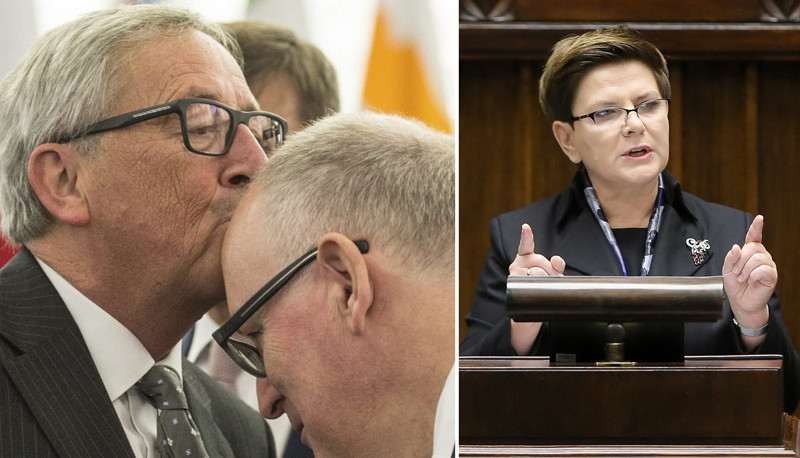
The European Commission, led by Jean-Claude Juncker and Frans Timmermans (left), is hell-bent on forcing member states to take “their share” of migrants. In March, Polish Prime Minister Beata Szydło (right) bluntly stated: “I see no possibility at this time of immigrants coming to Poland.”

In Hungary, Prime Minister Viktor Orban’s spokesman, Zoltán Kovács, stated:

“Mr. Timmermans is right that we have not had the same experience as Western Europe, where countries such as Holland, Britain and France have had mass immigration as a result of their colonial legacies. But we would like to deal with our problems in a way that suits us. And we especially do not like it when people who have never lived in Hungary try to give us lectures on how we should cope with our own problems. Calling us racists or xenophobes is the cheapest argument. It’s used just to dodge the issues.”

Even among those Eastern European countries still waiting to be admitted to the EU, the enthusiasm for the EU seems to have dwindled. “The EU that all of us are aspiring to, it has lost its magic power,” Serbian Prime Minister, Aleksander Vucic said in February, “Yes we all want to join, but it is no longer the big dream it was in the past.”

The reactions of countries such as Poland and Hungary are the normal, healthy reactions of nations who wish to remain prosperous, sovereign and safe for the sake of their own citizens. In addition, entertaining no illusions about “multiculturalism,” they appear to have a justifiable apprehension about the detrimental effects of the current migration crisis on national security and finances.

It is not only the newest members of the EU that have begun to realize that is a bad idea to defer decisions about borders and national security to an unelected supranational entity, which appears completely oblivious to the concerns of its member states.

In Norway, the government announced that it will not accommodate any more migrants beyond the 1500 that the country has already agreed to take during the next two years, as part of the EU’s refugee relocation scheme. “We have set a quota for refugees from the EU. Increasing it is not of current interest,” Immigration Minister Sylvi Listhaug said in April. Norway, in fact, has begun paying asylum seekers to return to their own countries.

In Austria, the government is imposing border controls at the Brenner Pass, the main Alpine crossing into Italy, and erecting a barrier between the two countries.

In the face of such resistance from member states, the European Commission’s plan to penalize them for not accepting “their share” of migrants could not possibly be more ill-timed and out of touch. It comes across as a desperate attempt by the EU’s executive body to force its way of handling the migrant crisis onto disobedient EU member states, like an authoritarian parent disciplining its unruly children. There is, however, such a thing as bending something until it snaps. By persisting in pushing their agendas on EU member states that still consider themselves sovereign and not merely provinces of the European Union, Timmermans and his European Commission bureaucrats may just have given the European Union its kiss of death.

Judith Bergman is a writer, columnist, lawyer and political analyst.
The EU is Coming to Close Down Your Free Speech by Douglas Murray

  • The German Chancellor was not interested in the reinforcement of Europe’s external borders, the re-erection of its internal borders, the institution of a workable asylum vetting system and the repatriation of people who had lied to gain entry into Europe. Instead, Chancellor Merkel wanted to know how Facebook’s founder could help her restrict the free speech of Europeans, on Facebook and on other social media.

  • Then, on May 31, the European Union announced a new online speech code to be enforced by four major tech companies, including Facebook and YouTube.
  • It was clear from the outset that Facebook has a definitional problem as well as a political bias in deciding on these targets. What is Facebook’s definition of ‘racism’? What is its definition of ‘xenophobia’? What, come to that, is its definition of ‘hate speech’?
  • Of course the EU is a government — and an unelected government at that — so its desire not just to avoid replying to its critics — but to criminalise their views and ban their contrary expressions — is as bad as the government of any country banning or criminalising the expression of opinion which is not adulatory of the government.
  • People must speak up — must speak up now, and must speak up fast — in support of freedom of speech before it is taken away from them. It is, sadly, not an overstatement to say that our entire future depends on it.

It is nine months since Angela Merkel and Mark Zuckerberg tried to solve Europe’s migrant crisis. Of course having caused the migrant crisis by announcing the doors of Europe as open to the entire third-world, Angela Merkel particularly would have been in a good position actually to try to solve this crisis.

But the German Chancellor was not interested in the reinforcement of Europe’s external borders, the re-erection of its internal borders, the institution of a workable asylum vetting system and the repatriation of people who had lied to gain entry into Europe. Instead, Chancellor Merkel was interested in Facebook.

When seated with Mark Zuckerberg, Frau Merkel wanted to know how the Facebook founder could help her restrict the free speech of Europeans, on Facebook and on other social media. Speaking to Zuckerberg at a UN summit last September (and not aware that the microphones were picking her up) she asked what could be done to restrict people writing things on Facebook which were critical of her migration policy. ‘Are you working on this?’ she asked him. ‘Yeah’, Zuckerberg replied.

In the months that followed, we learned that this was not idle chatter over lunch. In January of this year, Facebook launched its ‘Initiative for civil courage online’, committing a million Euros to fund non-governmental organisations in its work to counter ‘racist’ and ‘xenophobic’ posts online. It also promised to remove ‘hate speech’ and expressions of ‘xenophobia’ from the Facebook website.

It was clear from the outset that Facebook has a definitional problem as well as a political bias in deciding on these targets. What is Facebook’s definition of ‘racism’? What is its definition of ‘xenophobia’? What, come to that, is its definition of ‘hate speech’? As for the political bias, why had Facebook not previously considered how, for instance, to stifle expressions of open-borders sentiments on Facebook? There are many people in Europe who have argued that the world should have no borders and that Europe in particular should be able to be lived in by anyone who so wishes. Why have people expressing such views on Facebook (and there are many) not found their views censored and their posts removed? Are such views not ‘extreme’?

One problem with this whole area — and a problem which has clearly not occurred to Facebook — is that these are questions which do not even have the same answer from country to country. Any informed thinker on politics knows that there are laws that apply in some countries that do not — and often should not — apply in others. Contrary to the views of many transnational ‘progressives’, the world does not have one set of universal laws and certainly does not have universal customs. Hate-speech laws are to a very great extent an enforcement of the realm of customs.

As such it is unwise to enforce policies on one country from another country without at least a very deep understanding of that countries traditions and laws. Societies have their own histories and their own attitudes towards their most sensitive matters. For instance in Germany, France, the Netherlands and some other European countries there are laws on the statute books relating to the publication of Nazi materials and the propagation of material praising (or even representing) Adolf Hitler or denying the Holocaust. The German laws forbidding large-scale photographic representations of Hitler may look ridiculous from London, but may look less ridiculous from Berlin. Certainly it would take an enormously self-confident Londoner unilaterally to prescribe a policy to change this German law.

To understand things which are forbidden, or able to be forbidden, in a society, you would have to have an enormous confidence in your understanding of that country’s taboos and history, as well as its speech codes and speech laws. A ban on the veneration of communist idols, for instance, may seem sensible, tasteful or even desirable in one of the many countries which suffered under communism, wish to minimise the suffering of the victims and prevent the resurrection of such an ideology. Yet a universal ban on images or texts which extolled the communist murderers of tens of millions of people would also make criminals of the thousands of Westerners — notably Americans — who enjoy wearing Che Guevara T-shirts or continue their adolescent fantasy that Fidel Castro is an icon of freedom. Free societies generally have to permit the widest possible array of opinion. But they will have different ideas of where legitimate expression ends and where incitement begins.

So for Facebook and others to draw up their own attempt at a unilateral policy of what constitutes hate-speech would be presumptuous even if it were not — as it is — clearly politically biased from the outset. So it is especially lamentable that this movement to an enforced hate-speech code gained additional force on May 31, when the European Union announced a new online speech code to be enforced by four major tech companies, including Facebook and YouTube. Of course, the EU is a government — and an unelected government at that — so its desire not just to avoid replying to its critics — but to criminalise their views and ban their contrary expressions — is as bad as the government of any country banning or criminalising the expression of opinion which is not adulatory of the government.

That these are not abstract issues but ones exceedingly close to home has been proven – as though it needed proving – by the decision of Facebook to suspend the account of Gatestone’s Swedish expert, Ingrid Carlqvist. In the last year Sweden took in between 1 and 2% additional people to its population. Similar numbers are expected this year. As anyone who has studied the situation will know, this is a society heading towards a breakdown of its own creation, caused (at the most benign interpretation) by its own ‘open-hearted’ liberalism.

Countries with welfare models such as Sweden’s cannot take in such numbers of people without major financial challenges. And societies with a poor integration history cannot possibly integrate such vast numbers of people when they come at such speed. As anyone who has travelled around there can tell, Sweden is a country under enormous and growing strain.

There is a phase in waking up to such change which constitutes denial. The EU, the Swedish government and a vast majority of the Swedish press have no desire to hear critiques of a policy which they have created or applauded; the consequences will one day be laid at their door and they wish to postpone that day, even indefinitely. So instead of tackling the fire they started, they have decided to attack those who are pointing to the fact that they have set the building they are standing in on fire. In such a situation it becomes not just a right but a duty of free people to point out facts even if other people might not want to hear them. Only a country sliding towards autocracy and chaos, with a governing class intent on avoiding blame, could possibly allow the silencing of the few people pointing out what they can clearly see in front of them.

People must speak up — and speak up now, and speak up fast — in support of freedom of speech before it is taken away from them, and in support of journalists such as Carlqvist, and against the authorities who would silence all of us. It is, sadly, not an overstatement to say that our entire future depends on it.

Douglas Murray is a current events analyst and commentator based in London.

The Dutch Death Spiral From Paradise to Bolshevik Thought Police by Giulio Meotti

  • “It would have been better if the Dutch state had sent a clear signal [to terrorists] via a Dutch court that we foster a broad notion of the freedom of expression in the Netherlands.” — Paul Cliteur, Professor of Jurisprudence, Leiden University.

  • The historic dimension of Wilders’s conviction is related not only to the terrible injustice done to this MP, but that it was the Netherlands that, for the first time in Europe, criminalized dissenting opinions about Islam.
  • “I will never be silent. You will not be able to stop me… And that is what we stand for. For freedom and for our beautiful Netherlands.” — Geert Wilders, Dutch MP and leader of the Party for Freedom (PVV).
  • “We have a lot of guests who are trying to take over the house.” — Pym Fortuyn, later shot to death to “defend Dutch Muslims from persecution.”
  • Before being slaughtered, clinging to a basket, Theo van Gogh begged his assassin: “Can we talk about this?” But can we talk?

A country whose most outspoken filmmaker was slaughtered by an Islamist; whose bravest refugee, hunted by a fatwa, fled to the U.S.; whose https://www.google.it/&referrer=https://www.google.it/” target=”_blank”>cartoonists must live under protection, had better think twice before condemning a Member of Parliament, whose comments about Islam have forced him to live under 24-hour protection for more than a decade, for “hate speech.” Poor Erasmus! The Netherlands is no longer a safe haven for free thinkers. It is the Nightmare for Free Speech.

The most prominent politician in the Netherlands, MP Geert Wilders, has just been convicted of “inciting discrimination and insulting a minority group,” for asking at a really if there should be fewer Moroccans in the Netherlands. Many newly-arrived Moroccans in the Netherlands seem to have been responsible for a disproportionate amount of crime there.

Paul Cliteur, Professor of Jurisprudence at Leiden University, who was called as an expert witness, summed up the message coming from the court: “It would have been better if the Dutch state had sent a clear signal [to terrorists] via a Dutch court that we foster a broad notion of the freedom of expression in the Netherlands.”

Here are just a few details to help understand what Wilders experiences every day because of his ideas: No visitors are allowed into his office except after a long wait to be checked. The Dutch airline KLM refused to board him on a flight to Moscow for reasons of “security.” His entourage is largely anonymous. When a warning level rises, he does not know where he will spend the night. For months, he was able to see his wife only twice a week, in a secure apartment, and then only when the police allowed it. The Parliament had to place him in the less visible part of the building, in order better to protect him. He often wears a bulletproof vest to speak in public. When he goes to a restaurant, his security detail must first check the place out.

Wilders’s life is a nightmare. “I am in jail,” he has said; “they are walking around free.”

The historic dimension of Wilders’s conviction is related not only to the terrible injustice done to this MP, but that it was the Netherlands that, for the first time in Europe, criminalized dissenting opinions about Islam.

The Netherlands is a very small country; whatever happens to this enclave is seen in the rest of Europe. The Netherlands refused to surrender to the Spanish invasion. It was from Rotterdam, the second-largest Dutch city, that the Founding Fathers left to create the United States of America. It was to the Netherlands that some of the most brave, original European philosophers and writers — Descartes, Rousseau, Locke, Sade, Molière, Hugo, Swift and Spinoza — had to flee to publish their books. It is also the only corner of Europe where there were no pogroms against Jews, and where Rembrandt painted Jesus with the physical traits of Jews.

Take Leiden: “Praesidium Libertatis” (“Bastion of Freedom”) is the motto of the Netherlands’ most ancient university. Leiden was the university of Johan Huizinga, the great historian who opposed the Nazis and died in a concentration camp. Leiden was also the university of Anton Pannekoek, the mentor of Martinus Van der Lubbe, the Dutch hero who torched the Nazi Parliament in 1933.

In Leiden today, you meet brave intellectuals such as Afshin Ellian, an Iranian jurist who fled Khomeini’s Revolution in Iran and who also now lives under police protection for his observations on Islam. Ellian’s office is close to the former office of Rudolph Cleveringa. When the Nazis invaded the Netherlands and called on Dutch public officials to fill out a form in which they had to declare whether they were “Aryans” or “Jews”, everyone but Cleveringa capitulated. He understood the consequences of such commands.

Twelve years ago, the Netherlands was again plunged into fear for the first time since World War II. In Linnaeusstraat, a district of Amsterdam, Mohammed Bouyeri, a Muslim extremist, ambushed the filmmaker Theo van Gogh and slaughtered him, then pinned on his chest a letter threatening the lives of Geert Wilders and Ayaan Hirsi Ali. Before that murder, Pim Fortuyn, a professor who had formed his own party to save the country from Islamization, was shot to death to “defend Dutch Muslims from persecution.”

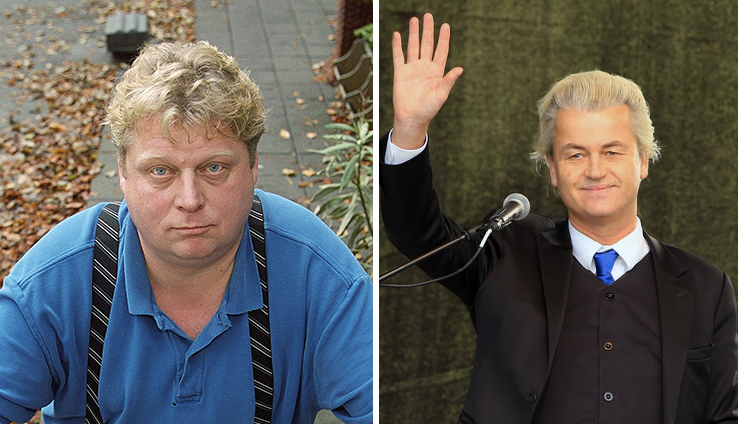
Twelve years ago, Dutch filmmaker Theo van Gogh (left) was assassinated by an Islamist who pinned on van Gogh’s chest a letter threatening the life of Geert Wilders (right). Today Wilders, the most prominent politician in the Netherlands, lives in hiding under round-the-clock protection.

Fortuyn had said, “We have a lot of guests who are trying to take over the house.”

Since then, many Dutch artists have capitulated to fear.

Sooreh Hera, from Iran, submitted her photos to the Gemeentemuseum Museum in The Hague. One of these works depicted Mohammed and Ali. After many threats, the museum proposed that it would acquire the photos without publishing them and that one day, perhaps, when the situation was calmer, they might show them then. Hera refused: it would have been self-censorship, a sad day for the West. Rants Tjan, director of Museum Gouda, bravely offered to exhibit her censored images, but that event was later cancelled, too. Hera was forced to go into hiding.

Paul Cliteur, a critic of multiculturalism, announced that he would no longer write for Dutch newspapers about Islam, for fear of reprisals: “With the murder of van Gogh, everyone who writes takes a certain risk. That is a scary development. What I am doing do is self-censorship, absolutely….”

Then a columnist, Hasna el Maroudi, from the newspaper NRC Handelsblad, stopped writing, after receiving threats.

The Dutch artist Rachid Ben Ali, irreverent about Islam, no longer satirizes Muslims.

Amsterdam, a city famous for its exuberant cultural life, had already lived through threats to artists: the occupation by the Nazis during World War II.

Several artists still refuse to mention Theo Van Gogh, so as not to “contribute to… divisions”, according to the New York Times. Translation: They are afraid. Who would not be?

In the Oosterpark, a steel sculpture by the artist Jeroen Henneman, dedicated to Van Gogh, is entitled “De Schreeuw” (“The Scream”). But it is a scream you hardly hear in the Dutch society.

What you do hear is the defiant protest after the conviction of a brave MP, Geert Wilders: “I will never be silent. You will not be able to stop me… And that is what we stand for. For freedom and for our beautiful Netherlands.”

Before being slaughtered, clinging to a basket, Theo van Gogh begged his assassin: “Can we talk about this?

But can we talk?

Ask Geert Wilders, just the latest brave victim of Europe’s Bolshevik thought police.

Giulio Meotti, Cultural Editor for Il Foglio, is an Italian journalist and author.

Translate »
Skip to toolbar