Category Archives: Uncategorized

When Will Obama and the West Listen to Hamas? by Khaled Abu Toameh

    • What senior Hamas figure Musa Abu Marzouk and other Hamas leaders are saying is very clear: Even if a Palestinian state is established in the West Bank, Gaza Strip and east Jerusalem, Hamas and other Palestinians will continue to fight until Israel is completely destroyed.

    • Hamas is openly stating that it will use any future Palestinian state as a launching pad to attack and eliminate Israel.

    • Hamas is not a small opposition party in the Palestinian territories that can be dismissed as a minor player. Hamas is a large Islamist movement, an offshoot of the Muslim Brotherhood that controls the entire Gaza Strip with its popu of the Muslim Brotherhood that controls the entire Gaza Strip with its population of 1.8 million Palestinians. Hamas, not much different from Islamic State and Al-Qaeda, has its own security forces, militias, weapons and government institutions.


  • The Obama Administration and Western governments can talk as much as they like about the two-state solution. Even if President Abbas agrees to a Palestinian state, he will never be able to persuade Hamas, Islamic Jihad and many other Palestinians to recognize Israel’s right to exist.

  • Under the current circumstances, where Hamas and other Palestinians continue to dream about the destruction of Israel, any talk about a two-state solution is nothing but a joke.

As President Barack Obama and Israeli Prime Minister Benjamin Netanyahu were talking about the two-state solution during their meeting in the White House yesterday, the Palestinian Hamas movement reiterated its intention to destroy Israel.

Hamas’s announcement shows that the two-state solution is not a recipe for peace between Israel and the Palestinians. The announcement also shows that all those who have been talking about a change in Hamas’s position towards Israel continue to live in an illusion.

As the Obama-Netanyahu meeting was underway, senior Hamas figure Musa Abu Marzouk issued a statement in which he declared: “We will never negotiate with the Zionist entity and we will never recognize its right to exist. We will continue to resist the Zionist entity until it vanishes, whether they like it or not. The soldiers of the Qassam [Hamas’s armed wing] were founded to liberate Palestine, even if some have recognized Israel. We want a state from the (Jordan) river to the [Mediterranean] sea.”

As U.S. President Barack Obama met with Israeli Prime Minister Benjamin Netanyahu yesterday (left), senior Hamas official Musa Abu Marzouk (at far right, holding rifle) reiterated his organization’s commitment to eliminate Israel.

Abu Marzouk’s remarks came in response to statements made by Palestinian Authority (PA) President Mahmoud Abbas during a meeting with Egyptian journalists in Cairo on Sunday night.

Abbas was quoted as telling the Egyptian journalists that Hamas and Israel were conducting “direct negotiations” to establish a Palestinian state in the Gaza Strip and parts of the Egypt’s Sinai Peninsula. Abbas claimed that ousted Egyptian President Mohamed Morsi had offered to annex 1000 square kilometers of Sinai to the Gaza Strip – an offer he (Abbas) had categorically rejected.

Abu Marzouk’s latest threats to eliminate Israel are not only directed against Abbas, but also towards President Obama and those in the international community who continue to support the idea of establishing a Palestinian state alongside Israel. What he and other Hamas leaders are saying is very clear: Even if a Palestinian state is established in the West Bank, Gaza Strip and east Jerusalem, Hamas and other Palestinians will continue to fight until Israel is completely destroyed.

In other words, Hamas is openly stating that it will use any future Palestinian state as a launching pad to attack and eliminate Israel. But Hamas’s message has obviously not reached the White House and other Western governments, where decision-makers continue to bury their heads in the sand, refusing to see or hear what some Palestinians are saying.

Hamas and many other Palestinians are completely opposed to a two-state solution: they believe that Israel has no right to exist — period — in this part of the world. The only solution they are prepared to accept is one that sees Israel wiped off the face of the earth.

Hamas is not a small opposition party in the Palestinian territories that could be dismissed as a minor player. Hamas is a large Islamist movement, an offshoot of the Muslim Brotherhood that controls the entire Gaza Strip with its population of 1.8 million Palestinians. Hamas has its own security forces, militias, weapons and government institutions.

Since its violent takeover of the Gaza Strip in 2007, Hamas and its political allies have turned the coastal area into a semi-independent Islamist emirate.

Since then, Hamas has used the Gaza Strip as a launching pad to attack Israel with tens of thousands of rockets and missiles. And Hamas leaders have repeatedly stated that their chief goal is to “liberate” not only the West Bank and east Jerusalem, but “all of Palestine.” In short, Hamas wants to replace Israel with an Islamist empire where non-Muslims would be permitted to live as a minority.

Hamas considers all Jews as “settlers” and “colonialists” who live in “settlements” such as Beersheba, Rishon Lezion, Ashdod and Bat Yam. Hamas does not differentiate between a Jew living in Ma’aleh Adumim or Gush Etzion (on the West Bank) and Tel Aviv, Haifa and Ramat Gan. That is why the Hamas media and leaders refer to Beersheba and Ra’anana, well within the “pre-1967 borders,” as “occupied” cities.

The Obama Administration and Western governments can talk as much as they like about the two-state solution. But so long as they refuse to listen to what Hamas and other Palestinians are saying, they will continue to engage in self-deception and hallucination. Even if President Abbas agrees to a Palestinian state on the pre-1967 lines, he will never be able to persuade Hamas, Islamic Jihad and many other Palestinians to recognize Israel’s right to exist.

Under the current circumstances, where Hamas and other Palestinians continue to dream about the destruction of Israel, any talk about a two-state solution is nothing but a joke.

The Obama Administration and the rest of the international community also need to understand that that the two-state solution has already been realized. In the end, the Palestinians got two states of their own: one in the Gaza Strip and another in the West Bank. The one in the Gaza Strip is run by folks are not much different from Islamic State and Al-Qaeda, while that in the West Bank is controlled by a president who has entered the 11th year of his four-year-term in office and as such is not even seen by his people as a “rightful” leader. This is a reality that the world, including Israel, will have to live with for many years to come.

It is time for the world to stop listening only to President Abbas and Saeb Erekat, and start paying attention to what many other Palestinians such as Hamas are saying, day and night, regarding their commitment to destroy Israel.


When the Law Opposes the Truth Rather Than Protects It by Douglas Murray

  • Would we be allowed to ask who ISIS are inspired by?Would they be allowed to say that the perpetrator was a Muslim?
  • they be allowed to say that there is a tradition of violence within the Islamic religion which has sadly permitted just such actions for a rather long time. Or would they have to lie?

The Canadian government suffers from many things. Among them is bad timing.On Thursday of last week, the Canadian Parliament voted through a blasphemy law specifically designed to protect Islam. As Al-Jazeera was happy to report on Friday, the previous day’s vote condemned “Islamophobia and all forms of systemic racism and religious discrimination.” The non-binding motion that the Parliament passed also requested that a Parliamentary committee should launch a study to look at how to “develop a whole-of-government approach to reducing or eliminating systemic racism and religious discrimination, including Islamophobia”. The motion passed by 201 votes to 91.

It is just as well for those 201 Canadian legislators that they were debating all this in their distinguished national Parliament rather than the mother of all Parliaments. For had these legislators been in the House of Commons in Westminster, their thoughts may have taken on a sharper focus.

For one day earlier, the British House of Commons lived through an example of rampant Islamism rather than “Islamophobia”. And although nobody in Westminster decided to turn into a crazy Muslim-hating bigot, they did manage to see what a hateful Muslim bigot could do when armed with the simple weapons of a knife and a motor vehicle.

The Canadian Liberal MP Iqra Khalid, who introduced the motion in Canada, proclaimed that the introduction of a de facto Islamic blasphemy law in Canada was needed because “We need to continue to build those bridges among Canadians, and this is just one way that we can do this.” Hours before she said that, one of Khalid’s co-religionists was using a bridge built more than a hundred and fifty years earlier for a very different purpose.

Khalid Masood of Birmingham chose to use an older bridge to drive at high speed into crowds of Londoners and tourists. On his rampage, he managed to injure people from 11 countries. He succeeded in killing Kurt Cochran, an American on holiday in London with his wife to celebrate their 25th wedding anniversary. He also killed Aysha Frade, a British national of Spanish and Cypriot descent who had been walking across Westminster Bridge to pick up her two young daughters from school. He also killed Leslie Rhodes, a 75-year old retired window-cleaner, described by a neighbour, who sat at his bedside in hospital as he died, as “the nicest man you ever met.”

After this carnage, so similar to the vehicle attacks in recent years in Germany, Israel and France, the 52-year old Khalid Masood ran at the Houses of Parliament and stabbed to death Police Constable Keith Palmer, 48. As all this unfolded, the Houses of Parliament in Westminster were put into lockdown. As with the Islamist attack on the Parliament building at Ottawa in 2014, the assailant got disturbingly close to the very centre of power in the land before being shot dead.

After deliberately driving a car into crowds of people in London last week, Khalid Masood crashed the vehicle into the fence surrounding Parliament, and stabbed a police officer to death. (Image source: Sky News video screenshot)

So, we come to the central problem of what the Canadian Parliament did at the same time that the British Parliament was being assaulted. What are we allowed to say about this? Or at least what would we be allowed to say in Canada?

So far, we know that the perpetrator of the London attack was a 52-year old convert to Islam who appeared to have been influenced by Wahhabism, but whose particular aims or intentions remain, for the time-being, unknown. Unlike the murderers of British soldier Lee Rigby in 2013 (one of whom carried on his person a note to his children with numerous Quranic references explaining why he was doing what he was doing, and why it was right) Khalid Masood appears to have left no note. Nor has any suicide-video yet emerged.

But it is not unreasonable to speculate that he was motivated or inspired by ISIS. The group has claimed his attack for their side of the terror ledger and the style of the attack certainly conforms to the type called for by the group. But beyond this, what are we allowed to say? Or what would we be allowed to say in Canada?

Would we be allowed to ask who ISIS are inspired by? The question must linger. It must be hovering over the mind of many a Canadian journalist as they ponder the terrorist attacks that have previously taken place in their country and wonder how they would go about reporting an attack such as that in Westminster last week.

Would they be allowed to say that the perpetrator was a Muslim? Would they be allowed to say that he was a convert? Would they be allowed to mention the Wahhabi point? Or would this tread into the realm of the “Islamophobia”. Let us assume that they would be allowed to mention these things in print. Would they be allowed to go any farther? Would they be allowed to ponder in opinion columns or quote people in reportage who said that Masood and indeed ISIS had not got their ideas from nowhere? Would they be allowed to say that there is a tradition of violence within the Islamic religion, which has sadly permitted just such actions for a rather long time. Or would they have to lie?

History suggests that when the law makes it illegal to tell the truth, a reliable portion of people can be called upon to lie. So it has been in the past. And so it will be with Canada. So it would be anywhere once the law became an opponent of truth rather than the protector of it.

Thanks to the Canadian Parliament and their lack of curiosity about a deeply opaque but ambitious word (“Islamophobia”), the Canadian press and public will have to stop certain inquiries into the truth about the events of our time. Who — apart from the good legislators of Canada — could possibly believe that the world will benefit from such censoring? And at such a time as this? To adopt a well-known expression: those whom the gods would destroy they first make ignorant.

Douglas Murray, British author, commentator and public affairs analyst, is based in London, England.

When Hate is Promoted by Religious Leaders, Why Blame the Followers? by Raheel Raza

  • Imam Abdullah Hakim Quick then goes on to connect being gay with Zionism — his anti-Semitic sentiments at their best. All this while standing at a pulpit. If this is not a crime of hate, then what is? Does this imam have nothing positive to speak about in his sermon, besides spreading the Islamist agenda of hate and bigotry?

  • For years we have warned of the messages of hate emanating from the pulpit. We have spoken of the two different messages being given — one to the public and one in private.
  • Why then do we act surprised when the Omar Mateens of the world take up arms and ruthlessly gun down an entire group of gays? This is what they are being taught by the likes of Imam Quick. They are acting out the hate that has been instilled in their minds and hearts.

In the aftermath of the bloodbath created by Omar Mateen at the Pulse nightclub in Orlando, Florida, a plethora of opinions, ideas and causes have been spoken about. At the same time, a very disturbing picture about a specific aspect of this hateful ideology of Islamists has emerged. In my opinion, there is no doubt that Mateen was an Islamist influenced by the jihadist agenda of fanatic hate for the gay communities.

For those of us reform-minded Muslims who have been battling the rise in radical Islamist agendas for the past decade, this development is no surprise. In our declaration, we say right at the top:

“We reject bigotry, oppression and violence against all people based on any prejudice, including ethnicity, gender, language, belief, religion, sexual orientation and gender expression.”

Why did we include this line in our message? Because we know of the hate that is directed towards the LGBTQ communities in Muslim lands. In Iran, thousands of gays have been executed; in Afghanistan, the Taliban bury them alive; in Saudi Arabia they are liable for death, and in other Muslim countries they are persecuted and abused if they admit to the preference.

One can always say that this is happening out there someplace else. We in North American pride ourselves on freedom of expression and tolerance towards those following a different lifestyle. We would never expect hate against others to be promoted in a liberal democracy.

However, not everyone in Canada thinks as we do. In our own hometown of pluralistic Toronto, hate against the LQBTQ community is alive and well.

Abdullah Hakim Quick is a Toronto imam who writes on his website:

“I have always stood against racism and ethnocentrism. I have been a lifelong advocate of women’s rights and for decades have encouraged the empowerment of young people. I pioneered the first social service agency for Muslims in Toronto, Canada (I.S.S.R.A.) whose doors were open to all — rich and poor, Muslim and non-Muslim, gay or straight. As a counselor I learned first-hand of the terrible violence inflicted upon gay people by bullies and I publicly spoke out against it….”

Yet in a YouTube video, the same Imam Quick says:

“… they said ‘What is the position of Islam on homosexuality?’ — they asked me this. This is a newspaper, right. So I said ‘Put my name in the paper. The position is death.’ And we cannot change Islam.”

Furthermore, Quick goes on openly to ridicule the Toronto gay community known as Salaam Canada. Many of them are my friends and I respect them. They have suffered at the hands of Islamists and felt they were safe in a city like Toronto. Not so anymore, and my heart goes out to them.

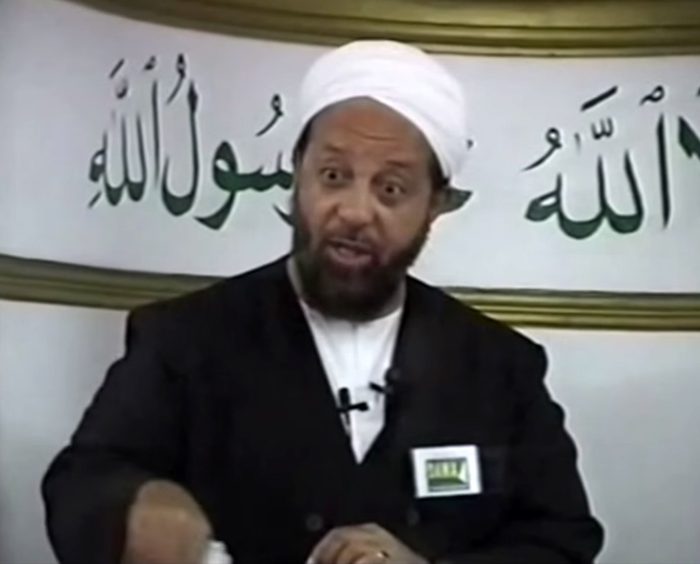
Abdullah Hakim Quick, a Toronto imam, makes a speech where he gives his answer to the position of Islam on homosexuality: “The position is death.” (Image source: TIFRIB video screenshot)

Mr. Quick then goes on to connect being gay with Zionism — his anti-Semitic sentiments at their best. All this while standing at a pulpit. If this is not a crime of hate, then what is? Does this imam have nothing positive to speak about in his sermon?

The point is that not only is he lying on his website, but he is spreading the Islamist agenda of hate and bigotry. He is also spouting an opinion that is not in the Quran. While the Quran (like other Abrahamic scriptures) does not condone homosexuality, there is no injunction to kill gays. However, because he is an imam and an imam is supposed to be knowledgeable, no one challenges him. Therefore, his opinion on gays (derived from sharia and concocted hadeeth perhaps) is that death is the solution for gays.

He’s not the only one. Not long ago, Florida religious scholar Shaykh Farrokh said gently but with conviction in a speech “death is the sentence. There’s nothing to be embarrassed about. Death is the sentence.” He goes on to explain that killing gays is an act of compassion.

Why then do we act surprised when the Omar Mateens of the world take up arms and ruthlessly gun down an entire group of gays? This is what they are being taught by the likes of Imam Abdullah Hakim Quick. They are acting out the hate that has been instilled in their minds and hearts.

For years, we have warned of the messages of hate emanating from the pulpit. We have spoken of the two different messages being given — one to the public and one in private. Well, we live in a world where the two are meshed and the culprits need to be exposed. It is time Muslims knew what their religious leaders are saying and promoting from the pulpit.

Is this what we want our youth to hear? If not, what are we doing about it?

Raheel Raza is President of The Council for Muslims Facing Tomorrow, and co-founder of the Muslim Reform Movement.

What We Could Learn from Israel by Vijeta Uniyal

  • To become a successful nation, India realizes that we have to emulate the Jewish quest for spiritual and worldly learning. We need a nation of empowered men and women, free and fearless to develop social, technological, entrepreneurial and humanitarian creativity, even while under constant attack.

  • When we see the restoration of Jewish State and revival of Judaism in its ancient lands, we Hindus see ourselves. If Judaism is incomplete without the Jewish homeland, the essence of Hinduism is indivisible with the geography of India. Just as Jews were forced out and in exile for millennia, Hindus too suffered a millennium of Islamic and later European subjugation in their own homeland.
  • Recent terrorist attacks in Brussels, Mumbai, Paris, Istanbul and Ankara are simply what Israel has been living with for decades — and India, France, Belgium and Turkey do not have “settlements.” The conflict is not about “settlements”. It is about one group of people trying imposing its will, culture, religion and way of life on another group. With Israel, the “settlements” are only the pretext. If you look at any map of “Palestine,” it has the exact outlines of Israel.

For most Indians, it is hard not to feel a deep sense of historic gratitude towards Israel and the Jewish people. The State of Israel came to our military aid in just about every war India fought as an independent nation since 1947. Our elected leaders, in their vanity, polished their statesmanlike credentials denouncing Israel at every possible international gathering, even as they kept on turning to the Jewish State for help in times of dire need, whether civilian or military. From Golda Meir to Ariel Sharon, Israel never turned down any request.

Getting nothing in return, the tiny and beleaguered nation paid a price for its support for India. At times, adversely affecting its relations with China or annoying its most vital ally, the United States, by extending support to a “socialist” country at the height of the Cold War.

If there ever was a true sign of goodwill extended from one nation to another, Israel had shown it toward India and so many other nations, from Zaire to Haiti and elsewhere.

Despite this, it took India more than four decades just to treat Israel as an equal partner on the world stage — when India established full diplomatic relations with Israel in January 1991.

India, however, had one redeeming quality. Although our political leaders hitched their wagon to the Soviet Union and the Pan-Arab nationalism in the early days of the Cold War, the Hindus of India, who constitute an 80% majority of the country’s population, have been steadfast and consistent in their support for the State of Israel and the Jewish people. An international survey conducted by Israel’s Ministry of Foreign Affairs in 2009 found Indians having the most favorable opinion of Israel, even ahead of U.S. respondents by a small margin. In August 2014, at the height of Gaza conflict, the city of Calcutta staged a 20,000-strong rally in support of the Jewish State, making it probably the largest pro-Israel rally that Asia ever witnessed.

Finally, with the election of Prime Minister Narendra Modi in May 2014, the India’s official policies have begun to reflect the desires and aspirations of the majority Hindu population of the nation.

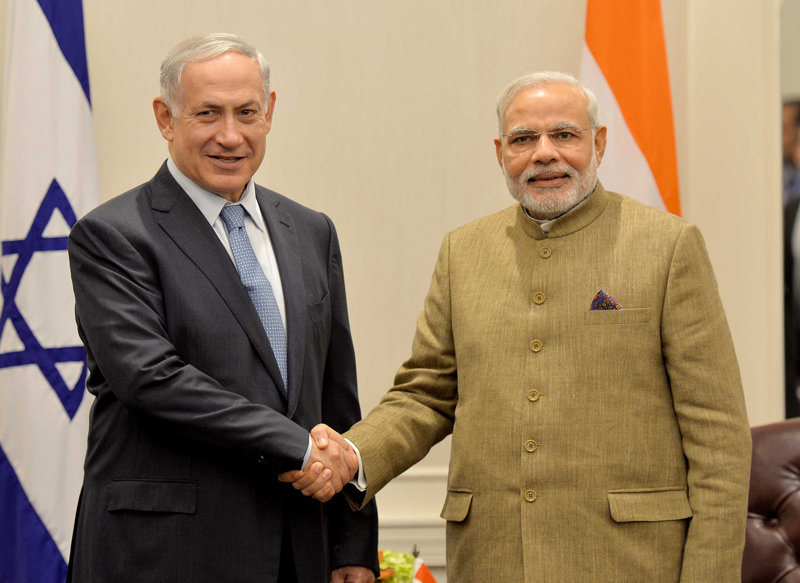
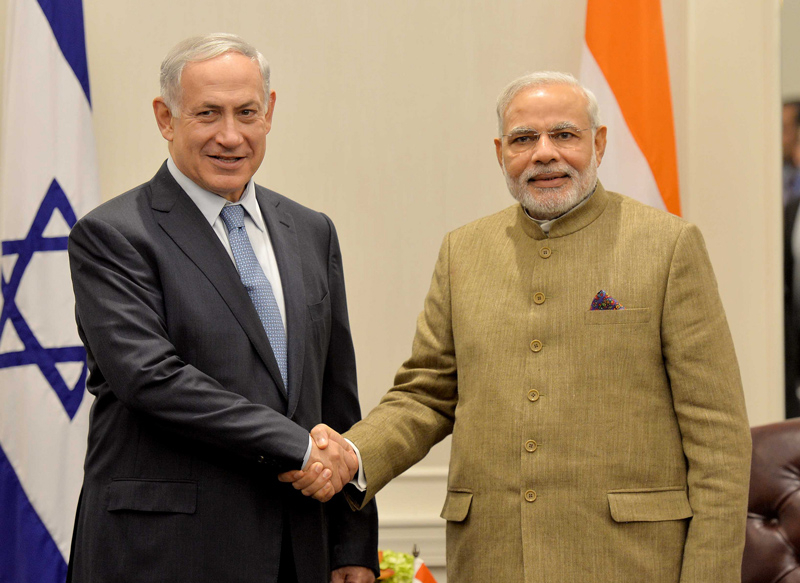
Israel’s Prime Minister Benjamin Netanyahu meets with Indian Prime Minister Narendra Modi in New York, on September 29, 2014. (Image source: Israel Government Press Office)

To become a successful nation, we realize that we have to emulate the Jewish quest for spiritual and worldly learning. We need a nation of empowered men and women, free and fearless to develop social, technological, entrepreneurial and humanitarian creativity, even while under constant attack.

The homecoming of the Jews and restoration of the Jewish State in its historic land has been a source of great hope for us Hindus. When we see the restoration of Jewish State and revival of Judaism in its ancient land, we Hindus see ourselves.

If Judaism is incomplete without the Jewish homeland, the essence of Hinduism is indivisible with the geography of India. Just as Jews were forced out and in exile for millennia, Hindus too suffered a millennium of Islamic and later European subjugation in their own homeland.

After surviving the most vicious genocide in human history — a brutal and systematic attempt by Nazi Germany to annihilate the entire Jewish population of Europe, claiming six million Jewish lives, the Jewish people worked to create a nation based on democracy, freedom, equality for people of all religions and ethnicities — the only democracy in the Middle East.

Today, over a million Arabs enjoy equal citizenship rights in Israel, and a level of religious liberty and rule of law never seen before in the Middle East. Arab Israelis are present in all walks of Israeli life; holding top positions in business, academia, media, government as well as military leadership.

The tiny nation of Israel absorbed wave after wave of immigration, including a million Jews driven out of the Arab lands soon after the creation of Jewish State in 1948, Ethiopian Jews, and Russians escaping communism. Today, Israel is home to over 80,000 Jews of Indian origin. They have been fully integrated, and have excelled in all areas of society. They serve gallantly in the Israel Defense Force and bring glory to the country in sports. An IDF soldier of Indian origin, Barak Refael Degorker, was killed by Hamas during the Gaza conflict of 2014. Mumbai-born Sarah Avraham became Israel’s 2012 women’s Thai boxing champion.

As the nation-states of Europe drive toward an impending disaster in failing to assert their spiritual and national identity in the face of the massive influx of Muslim migrants, only the example of Israel offers us hope.

We must admit the failures, based on European liberalism, in our nation-building project. Western-style “affirmative-action” has failed to rid the country of caste-based discrimination, and all that the European style of hyper-sensitivity towards “Muslim sentiments” has done is stifle cultural freedoms in the country. India became the first nation to ban Salman Rushdie’s novel The Satanic Verses, before even Iran, Saudi Arabia and other theocratic Islamic regimes announced their fatwas and bans. For decades, India shied away from technological and academic cooperation with Israel. India seemed to have been trying to act even more Arab than the Arabs themselves.

Only an enlightened nation, built on a strong bedrock of Hindu unity, can ensure a secure and prosperous future for India. We cannot build a nation on foundations of an unjust and immoral caste system.

Just as the resurgence of Judaism in its historic and ancestral homeland means no threat to the Muslim faith, Hindu resurgence and unity should cause no harm to religious minorities of other faiths. Countries that would like to succeed and thrive would do well to follow the example of Israel.

The terrorism originating from neighboring Muslim lands must not only be countered militarily, but also with a renewed assertion of our on spiritual and national identity.

Arabs and Muslims might surely realize that they themselves have been the biggest losers of the wars of fanaticism they have waged, and turn their attention to rebuilding their societies and facing the real issues of violence, bigotry, ignorance and poverty — to name just a few.

Until then, we all have a nation to build and a home to defend.

Recent terrorist attacks in Brussels, Mumbai, Paris, Istanbul and Ankara are simply what Israel has been living with for decades — and India, France, Belgium and Turkey do not have “settlements.” The conflict is not about “settlements”. It is about one group of people trying imposing its will, culture, religion and way of life on another group. With Israel, the “settlements” are only the pretext. If you look at any map of “Palestine,” it has the exact outlines of Israel.

It is beyond our scope, as Indians, to heal the pathologies of the Muslim world. We can only limit the damage by defending our home and securing our national borders.

Until that day comes, we would all do well to stand with Israel.

Vijeta Uniyal is an Indian current affairs analyst based in Europe.

What to Expect in Iran by Jagdish N. Singh

  • “The destruction of Israel is non-negotiable.” — Mohammad Neza Naghdi, Commander of Iran’s Basij paramilitary force.

  • Sanctions relief will mainly benefit Ayatollah Khamenei and members of the Revolutionary Guards: they control up to one-third of Iran’s economy.
  • Part of the Iranian regime’s grand strategy is to inflict “death to America” and replace it with its own radical version of Islamic governance. Ayatollah Khamenei himself called for America’s destruction amid nuclear negotiations.
  • Officials also believe Iran is indirectly funding the Islamic State (IS) in the Sinai. “Suitcases of cash” are sent directly to Hamas officials in the Gaza Strip; part of the money is then transferred to IS.
  • Iran now poses an even greater threat. If democracies today continue their present policies towards Iran, it will only embolden Iran’s regime to continue its quest to obtain nuclear weapons as well as its terrorism and human rights violations.

Humanity seldom seems to learn its lessons. The governments of the world’s leading democracies appear to be suffering from this predicament in their nuclear dealings with the Islamic Republic of Iran. To avoid catastrophe, democracies need quickly to correct their course.

One of the fatal blunders of Western democracies is their repeated commitment to appeasing and delaying action against aggressive regimes. Between the two World Wars, despite plenty of evidence of the widely-declared global racist agenda of Germany’s Adolf Hitler, democratic powers waited to take action until it was too late. Hitler was able to carry out a genocide that continues to haunt many nations.

Today, Western democratic governments, with their Eastern counterparts such as India, seem on a similar course in dealing with the Islamic Republic of Iran.

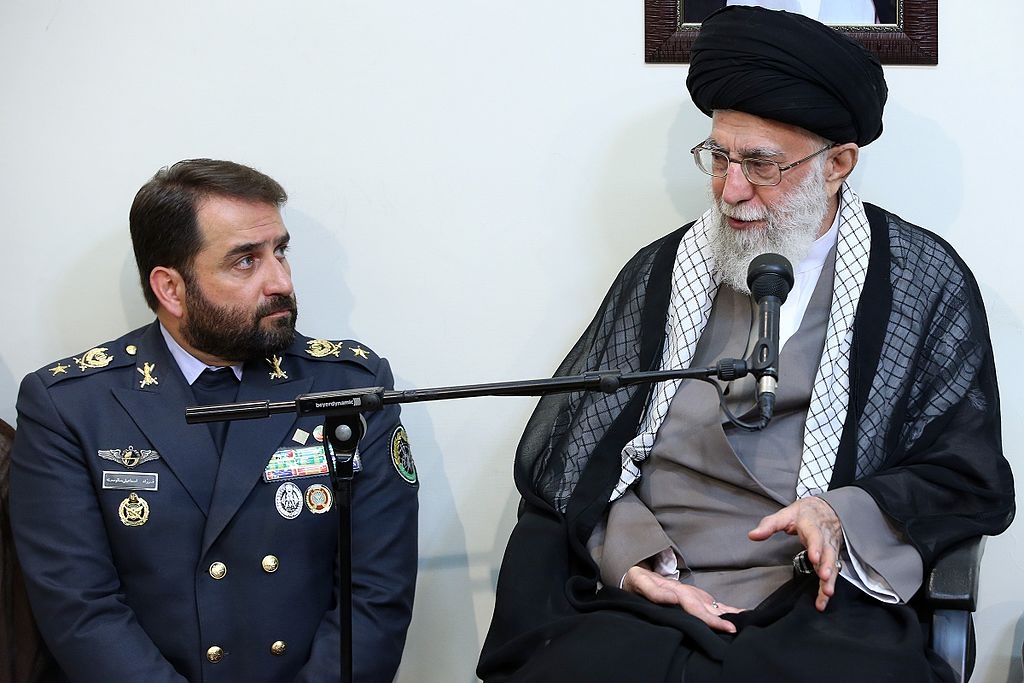
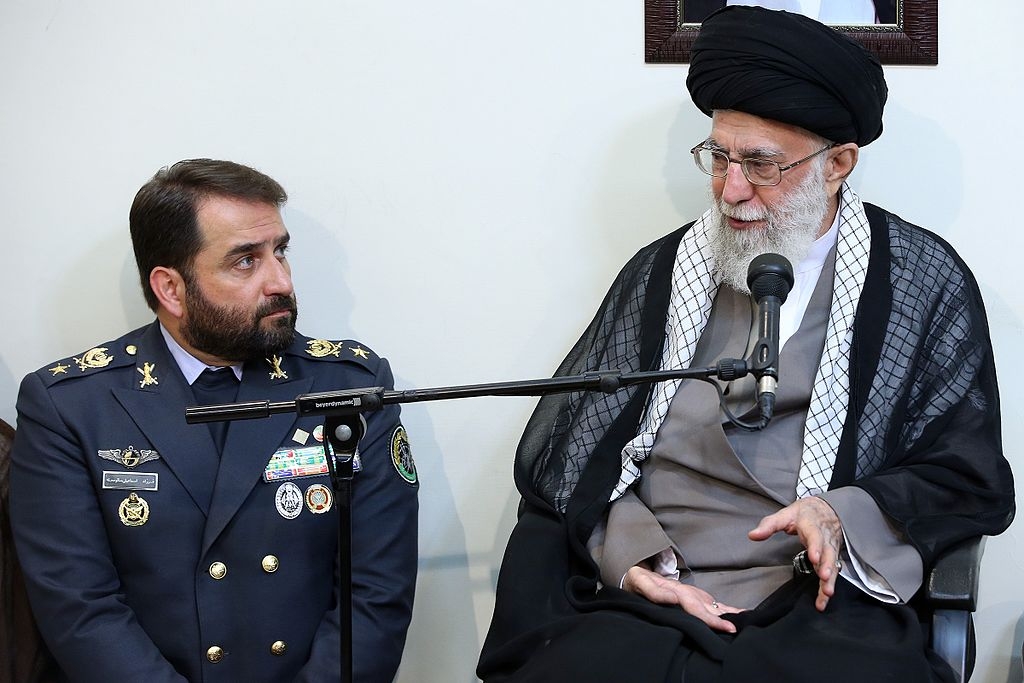
The domestic and international agenda of the Khomeinist government is publicly documented. Since the Iranian Revolution of 1979, part of the regime’s open grand strategy is to inflict “death to America,” the leader of the free world, and replace it with its own radical version of Islamic governance. Under the current Supreme Leader Ayatollah Ali Khamenei and his Islamic Revolutionary Guards Corps (IRGC), Iran has been gaining influence across the Middle East, Latin America, the Caribbean and South Asia. Despite nuclear talks with the West, Iran’s goal of “death to America” remains. The Ayatollah himself even called for America’s destruction amid nuclear negotiations.

Currently, Iran is a major player in aiding the autocratic regime of Basher al-Assad in Syria, the Houthis in Yemen, Hezbollah in Lebanon, Palestinian Islamic Jihad and Hamas in the West Bank and Gaza and the Islamic State (IS) in Egypt’s Sinai Peninsula.

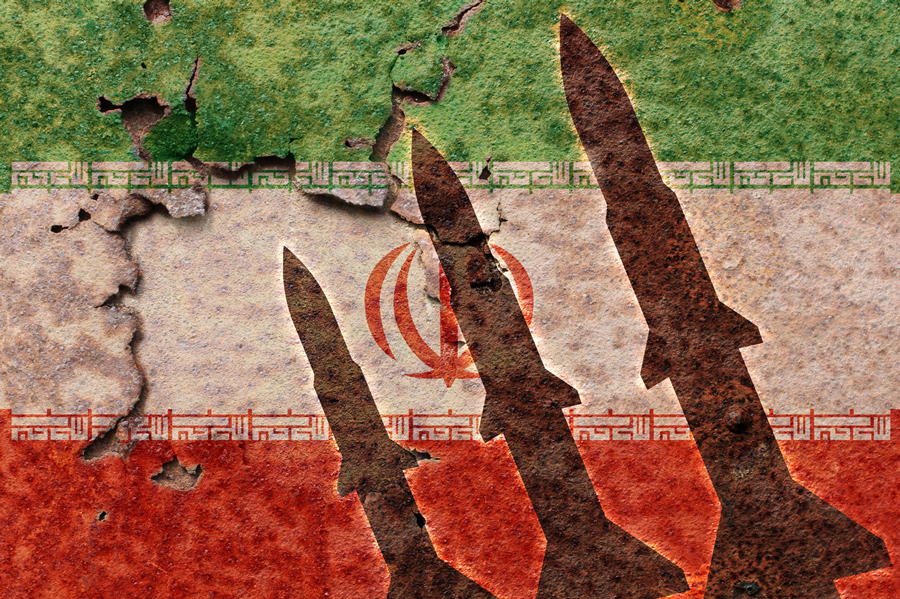
To advance its imperial agenda, Iran has proceeded to develop its conventional and nuclear ballistic missile program. According to Director of National Intelligence James Clapper, Iran has “one of the largest inventories of ballistic missiles in the Middle East.”

In line with Iran’s missile development program, Iran’s Revolutionary Guard Navy Rear Commander, Ali Fadavi, announced: “Based on the fifth five-year plan, we should materialize our objective of mass-producing military speedboats with the speed of 80 knots per hour… and are equipped with missiles with a range of 100km; the vessels no one can catch.”

Aside from its military aspirations, since the fall of the Shah in 1979, successive Iranian governments have voiced their plans to annihilate the State of Israel, the only pluralist democracy in the Middle East, and an effective military deterrent to Iran’s designs in the region.

Hostile messages have been pouring forth from Iran. Mohammad Neza Naghdi, Commander of the Basij paramilitary force, stated in clear terms in April 2015, that, “The destruction of Israel is non-negotiable.”

Major General Yahya Rahim Safavi, a former IRGC commander and a top military aide to Khamenei, warned in May 2015, that “More than 80,000 missiles are ready to rain down on Tel Aviv and Haifa.”

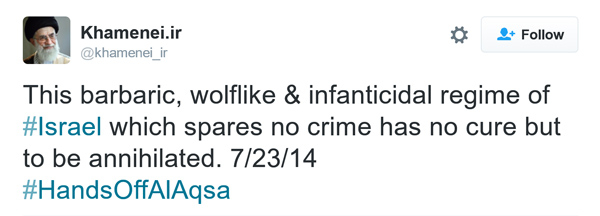
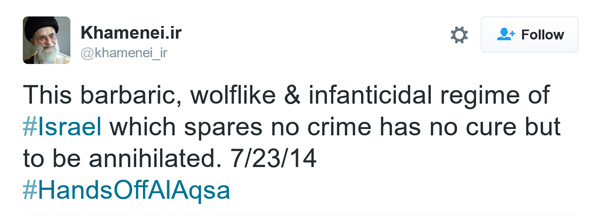
As late as November, Iran’s Supreme Leader Khamenei himself tweeted, “This barbaric, wolflike & infanticidal regime of #Israel which spares no crime has no cure but to be annihilated.”

Bewilderingly, Western democracies have chosen to overlook Iran’s speeches and actions. They chose instead to appease the regime. Last July, despite genuinely serious reservations expressed by international strategic and military experts (including retired American military officers), the United States, United Kingdom, France and Germany – the four democracies in the P5+1 — concluded a nuclear deal with themselves that they proposed to Iran. Iran so far has not signed the deal, and apparently even if it did, according to the U.S. Department of State, the deal would not be legally binding.

Tehran will greatly benefit financially from the terms of the nuclear agreement in the months to come. Under the administration of President Barack Obama, nuclear sanctions against Iran have been lifted. To advance the deal and make it more appealing to Iran, the president has also agreed to pay Iran a $1.7 billion settlement for $400 million in “frozen” assets held in the United States since 1981.

The Society for Worldwide Interbank Financial Telecommunication (SWIFT), “the electronic bloodstream of the global financial system,” had disconnected 15 Iranian banks from its system in 2012. after coming under pressure from both the United States and the European Union at the height of efforts to curb Iran’s nuclear ambitions. Today, SWIFT is ready to let those banned banks, including the Central Bank of Iran, use its system once again. Iran now has an even greater ability to fund its terrorist proxies around the world.

European political and business leaders have been rushing to Tehran to sign new agreements. On January 28, in Paris, Iran’s President Hassan Rouhani and France’s President Francois Hollande signed major business deals, including a joint venture between car-makers PSA Peugeot Citroen and Iran’s Khodro. Iran is in the process of buying 118 Airbus passenger planes to update its aging fleet. The construction group Bouygues and the French airport operator ADP are now set to build an extension for Tehran’s airport, while Vinci, another construction firm, has been commissioned to design, build and operate new terminals for the Mashhad and Isfahan airports. The French oil company Total has agreed to buy Iranian crude oil, and agreements in shipping, health, agriculture and water provision have also been signed.

Democratic India is also cultivating relations with Iran. In a meeting in May, India’s Minister of Road Transport and Highways, Nitin Gadkari, and Iranian Transport and Urban Development Minister, Abbas Ahmad Akhoundi signed a Memorandum of Understanding on India’s participation in the development of the Chabahar Port in Iran.

The Chabahar project will impart strategic leverage to India and its access to Afghanistan and energy-rich Central Asia by bypassing Pakistan. The distance between the Chabahar Port and Gujarat – India’s westernmost state, located near the Persian Gulf, is less than the distance between Delhi and Mumbai. Transit times are estimated to be reduced by a third. Indian firms have already agreed to lease two existing berths at the port and operate them as container and multi-purpose cargo terminals.

The Chabahar project, New Delhi calculates, will be highly beneficial. As India has invested over $2 billion in Afghanistan, the Indian government plans to link the Chabahar port with the Zaranj-Delaram road it built in Afghanistan, thereby opening alternative routes to Afghanistan and enhancing access to regional and global markets.

Russia and China, permanent members of the UN Security Council, are also strengthening their cooperation with Iran. Both Russia and China adopted a policy of ambivalence towards Iran and saw to it that sanctions imposed by the West were not too tough. They also repeatedly blocked attempts at sanctioning Iran’s ally, the current Syrian regime, out of concern over financial ties in the region.

China is also capitalizing on the lifting of sanctions against Iran. Chinese President Xi Jinping rushed to Iran after the so-called nuclear agreement to discuss a 25-year strategic cooperation plan. In a landmark deal worth up to $600 billion, Xi committed to increase trade between the two nations during the next decade. Beijing and Tehran also agreed to enhance security cooperation through intelligence-sharing, counter-terror measures, military exchanges and coordination. Incidentally, despite international sanctions, China-Iran trade increased from $3 billion in 2001 to more than $50 billion in 2014.

Given its fanatical and sectarian ideological agenda, Iran is likely to use the new funds to boost its armament program and ongoing clandestine terror acts. Sanctions relief will mainly benefit Khamenei and members of the IRGC: they control up to one-third of Iran’s economy.

Iran now poses an even greater threat to the entire civilized world. The pattern of Tehran’s behavior shows the government can never be trusted on any promises it makes not to advance its nuclear weapons program. Khamenei has made an open declaration that Tehran will not allow effective inspections of its military sites or interviews with its nuclear scientists.

The links of the IRGC’s Qods Force with Hezbollah, Hamas, Palestinian Islamic Jihad, the Houthis and other terror militias pose a major threat to peace and stability in the Middle East.

Hezbollah’s networks have expanded over the years, infiltrating Latin America and the Caribbean through Shiite cultural centers in the region. According to an official Argentine report, Tehran has established its terrorist, intelligence and operational networks throughout Latin America as far back as the 1980s. Iran’s intelligence activities in the region are being conducted directly by Iranian officials or through its proxy, Hezbollah. Criminal activity may already be underway in Brazil, Colombia, Chile, Paraguay, Uruguay, Suriname and Trinidad and Tobago. Iran’s involvement in the cocaine trade has bolstered the regimes regional access and strengthened ties with its allies in Venezuela, Ecuador, Bolivia and elsewhere.

According to senior Western intelligence officials, the IRGC has transferred tens of millions of dollars to Hamas to be used for weapons, military equipment and training, and that Iran also delivers arms and funds to Hamas through the Red Sea and the Sinai. Officials also believe Iran is indirectly funding the Islamic State (IS) in the Sinai. “Suitcases of cash” are sent directly to Hamas officials in the Gaza Strip; part of the money is then transferred to IS.

Tehran’s links with Hamas and IS are part of a grander strategy of using proxy forces to gain hegemony over the Middle East and undermining American allies such as Egypt and Israel. In Lebanon, Iraq and Syria, Iran seeks to preserve its influence. By fighting IS, Iran strengthens existing pro-Iran regimes and maintains its relevance in the region.

While Iran does support IS indirectly in the Sinai, the government’s goal is to weaken the current Egyptian regime and the Sunni Arab alliance between Egypt, Saudi Arabia and Jordan. It has no problem with IS gaining strength in the Sinai right now. If IS does gain more power in the Sinai, Iran can use it to impose its own agenda in the future. Tehran evidently wants to use IS victories against Sunni states as an opportunity to take over.

Iran also supports the Gaza-based terror group al-Sabireen [“The Patient Ones”], established in the wake of previous tensions between Iran, Hamas and Islamic Jihad. The group has about 400 followers and its emblem is identical to that of Hezbollah. Each member receives a monthly salary of $250-$300, while senior members receive at least $700. Annually, the terror group receives a budget of $10 million from Iran, smuggled in suitcases through tunnels along the border with Egypt. Potential members are wooed by al-Sabireen through familiar channels of philanthropy and education. The group’s publications refer to the United States as “the source of superpower terrorism,” and its slogan is, “The road to the liberation of Palestinian goes through Karbala” — a Shiite holy city in Iraq.

Al-Sabireen has extended its operations from the Gaza Strip to the West Bank and Jerusalem with Iran’s backing. Hisham Salim, the founder of al-Sabireen, admitted that his group is directly financed by Iran. “We have an armed branch whose goal is to wage war on the Israeli occupation everywhere,” Salim said. “Within this framework we have members in the West Bank and Jerusalem.”

The Obama administration has forged ahead with its Iran policies despite knowing the regime’s support of global terrorism. U.S. President Barack Obama himself spoke about Iran’s terror activities in a press conference last year. “Now, we’ll still have problems with Iran’s sponsorship of terrorism; its funding of proxies like Hezbollah that threaten Israel and threaten the region; the destabilizing activities that they’re engaging in, including place like Yemen,” he said, adding that the nuclear “deal is not contingent on Iran changing its behavior. Its not contingent on Iran suddenly operating like a liberal democracy.”

History urges those living in democracies today to rein in their governments and correct their fatal Iran policies. The world cannot afford to overlook the damage of these governments. If democracies today continue their present policies towards Iran, it will only embolden Iran’s regime to continue its quest to obtain nuclear weapons as well as its terrorism and human rights violations.

Jagdish N. Singh is a leading journalist based in New Delhi, India.

Translate »
Skip to toolbar