

Why is Fatah treating Hamas as a legitimate political partner before the group has demonstrated a willingness to abandon terrorism, surrender its weapons, and relinquish its independent military forces?
The question is particularly urgent as the international community seeks to establish a different future for the Gaza Strip, one that would prevent Hamas from restoring its military capabilities and ensure that the territory is no longer controlled by an armed organization.
What happens when Hamas refuses to surrender its weapons and accept the authority if a single Palestinian government?
The issue… is whether the terrorist organization Hamas should be permitted to retain the weapons and military infrastructure that enable it to impose its will on Palestinians and launch more attacks against Israel, not to mention its own civilians.
A general commitment to national dialogue does not establish that Hamas is prepared to disarm, dismantle its military infrastructure, or accept the binding authority of a unified government.
Hamas’s own account of the Cairo meetings… emphasized the need for elections, which Hamas would no doubt win, and a unified strategy combining political and “field action” against Israel.
The phrase “field action” requires clarification. Does “field action” mean peaceful political activity, or does it leave room for armed operations by factions that retain their own weapons and military chains of command?
The Palestinians do not need another agreement filled with general declarations whose meaning each faction can interpret according to its own interests. They need clear, verifiable commitments that establish who exercises authority, who controls weapons, and who is responsible for security.
A government cannot exercise sovereignty if another organization retains the power to undermine its decisions by force.
The Palestinians… do not need another agreement that allows Hamas, an armed Islamist group committed to the destruction of Israel, to retain its weapons while acquiring renewed political legitimacy.
The Trump Administration’s 20-point Gaza initiative and the Board of Peace have placed questions of security, demilitarization, and Gaza’s future governance at the center of the debate. Fatah’s negotiations with Hamas should be judged against those objectives, not simply by whether Palestinian factions can reach another “unity” agreement.
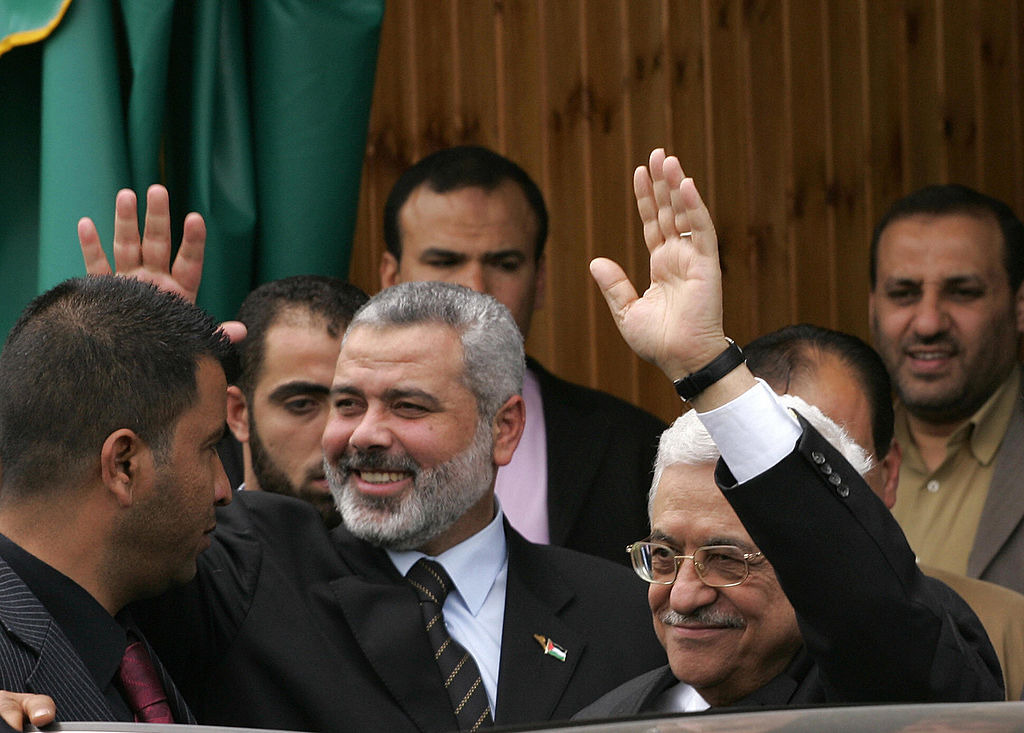
More than three years after the October 7 massacre, Palestinian Authority President Mahmoud Abbas and his ruling Fatah faction are still pursuing reconciliation with Hamas, the Iran-backed terrorist group that led the assault on Israel.
Instead of making Hamas’s disarmament and the dismantling of its military infrastructure prerequisites for Palestinian political unity, Fatah officials are traveling to Cairo to negotiate ways of incorporating the terrorist group into a unified Palestinian political system.
The latest round of talks, sponsored by Egypt, once again raises a fundamental question: Why is Fatah treating Hamas as a legitimate political partner before the group has demonstrated a willingness to abandon terrorism, surrender its weapons, and relinquish its independent military forces?
The question is particularly urgent as the international community seeks to establish a different future for the Gaza Strip, one that would prevent Hamas from restoring its military capabilities and ensure that the territory is no longer controlled by an armed organization.
Fatah, however, appears determined to pursue reconciliation with Hamas, even as the fundamental disagreements that have divided the Palestinian political system for nearly two decades remain unresolved.
In an interview with the Palestinian newspaper Al-Quds, Jibril Rajoub, secretary of Fatah’s Central Committee, described the recent meetings with Hamas as taking place in a “highly positive atmosphere.” He said the discussions were intended to establish common ground on the Palestinian political program, the nature of the struggle against Israel, and the future structure of the Palestinian political system.
Rajoub also announced that Egypt was evaluating previous rounds of Palestinian national dialogue before inviting the Palestinian factions to another conference in Cairo. He portrayed the initiative as an opportunity to overcome what he called the “strategic paralysis” of the Palestinian political system through political and judicial reform, elections, and the establishment of a Palestinian state based on the rule of law.
These objectives might sound reasonable: A political system based on the rule of law, democratic elections, and a single authority responsible for security is exactly what Palestinians need.
The problem is that such promises have been made repeatedly over the years, while the underlying question remains unanswered: What happens when Hamas refuses to surrender its weapons and accept the authority if a single Palestinian government?
According to Rajoub, the recent discussions with Hamas focused on developing a common political, national, and organizational framework.
Hamas, however, has maintained its own armed wing and has rejected the political framework associated with the Oslo Accords that were signed between the Palestine Liberation Organization (PLO) and Israel in 1993 and 1995. Its participation in Palestinian political institutions cannot, by itself, resolve the contradiction between a political system based on a single authority and an armed terrorist organization that retains the capacity to act independently of that authority.
If Abbas’s Fatah genuinely believes in one authority and one armed force, it should insist that Hamas disarm and dismantle its military infrastructure before being admitted into a new political arrangement.
Otherwise, “unity” risks becoming a formula for legitimizing the continued existence of a terrorist group that can challenge any Palestinian governing authority that disagrees with its decisions.
The issue is not whether Hamas representatives should be allowed to attend meetings. It is whether the terrorist organization Hamas should be permitted to retain the weapons and military infrastructure that enable it to impose its will on Palestinians and launch more attacks against Israel, not to mention its own civilians (here, here, here and here) .
The distinction is essential. Political participation without enforceable conditions could give Hamas a route back into Palestinian institutions without requiring it to abandon the means through which it has exercised coercive power.
Rajoub’s interview contains another apparent contradiction. He said that, in the aftermath of October 7 and its consequences for international opinion, peaceful and nonviolent struggle had become a strategic necessity for the Palestinians. He declared that continued bloodshed was no longer an acceptable option and called for political and diplomatic engagement with the international community. He also described a future Palestinian state as one governed by the rule of law, with a single authority and a single armed force.
These statements raise an important question: Have Hamas and other Palestinian terrorist factions participating in the Cairo discussions explicitly accepted this approach, including the practical consequences of abandoning terrorism?
Rajoub described Hamas as showing openness and a willingness to develop a common political and national platform. The atmosphere in a meeting room, however, is not evidence that the parties have resolved their fundamental disagreements.
A general commitment to national dialogue does not establish that Hamas is prepared to disarm, dismantle its military infrastructure, or accept the binding authority of a unified government.
Hamas’s own account of the Cairo meetings reinforces the need for clarity. The terrorist group presented the talks as an effort to reform the Palestinian Authority political system so that it would encompass all Palestinian factions and provide them with a role in national decision-making. It also emphasized the need for elections, which Hamas would no doubt win, and a unified strategy combining political and “field action” against Israel.
The phrase “field action” requires clarification. Does “field action” mean peaceful political activity, or does it leave room for armed operations by factions that retain their own weapons and military chains of command?
The Palestinians do not need another agreement filled with general declarations whose meaning each faction can interpret according to its own interests. They need clear, verifiable commitments that establish who exercises authority, who controls weapons, and who is responsible for security.
A government cannot exercise sovereignty if another organization retains the power to undermine its decisions by force.
Hamas seems to be hoping to copy the Hezbollah model, where the Iran-backed Shiite militia in Lebanon operates as a state-within-a-state.
Hamas should not be allowed to use participation in Palestinian institutions as a means of acquiring political legitimacy.
The focus on reconciliation also raises questions about the Palestinian Authority’s own responsibilities. Rajoub acknowledged that the Palestinian political system suffers from “strategic paralysis” and requires structural reform and elections. Yet the pursuit of unity with Hamas should not distract from the Palestinian Authority’s longstanding governance problems, its lack of democratic legitimacy, and the need for accountability and transparency.
The Palestinians need accountable institutions and a government that exercises real authority and refrains from glorifying violence and terrorism. They do not need another agreement that allows Hamas, an armed Islamist group committed to the destruction of Israel, to retain its weapons while acquiring renewed political legitimacy.
The Trump Administration’s 20-point Gaza initiative and the Board of Peace have placed questions of security, demilitarization, and Gaza’s future governance at the center of the debate. Fatah’s negotiations with Hamas should be judged against those objectives, not simply by whether Palestinian factions can reach another “unity” agreement.
egretnewseditor@gmail.com