

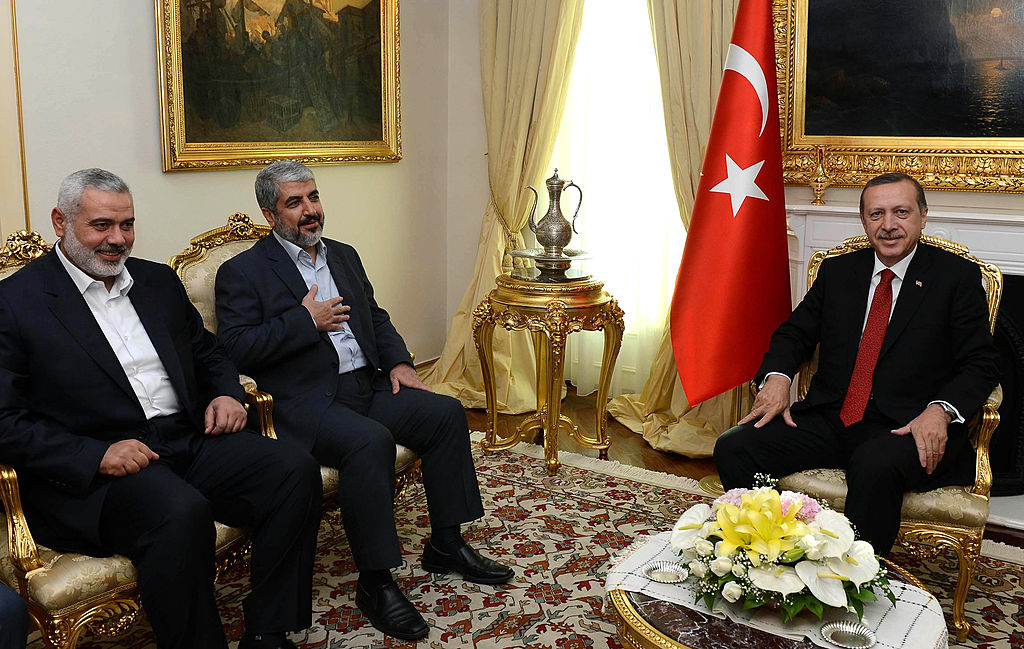
Every peace agreement rests on an assumption that the powers charged with enforcing it want it enforced. The current roadmap for the future of Gaza is organized around the principle of one authority, one law and one weapon. Its purpose is to strip armed factions such as Hamas of their weapons, install a single Palestinian administration and prevent Hamas from reconstituting its military machine. Whether these goals can be achieved depends less on the drafting than on those who will certify compliance.
A guarantor inside that architecture is effectively a judge who confirms or denies compliance, arbitrates disputes and applies pressure to whichever party breaks its word. The relevant question is what pressure Turkey and Qatar are likely to apply to Hamas.
“Qatar is at the top of funding terrorism worldwide…. Even more than Iran.” — Udi Levy, former senior official of Israel’s Mossad spy agency who dealt with economic warfare against terrorist organizations, YNet, April 18, 2024.
“Qatar has adopted an extremely smart strategy based on the Muslim Brotherhood doctrine, which believes in gaining influence initially through financial means in order to create sympathy for them and alignment with their views… With Israel, the strategy was to develop economic, intelligence, and political relations without evolving into full diplomatic relations… It is easy to be captivated by the money, the grandeur, and the charm.” — Udi Levy, YNet, April 2, 2025.
Supporters of Turkey’s inclusion as a guarantor on the Board of Peace appear to regard its closeness to Hamas as an asset. They argue that a government able to speak directly to Hamas is better placed to extract concessions from it. The argument holds only if one chooses not to look at what Erdogan has built at home.
Since 2016, Turkey’s government has closed more than 1,500 foundations and associations and replaced thousands of judges and prosecutors with loyalists. Ekrem Imamoglu, the mayor of Istanbul and Erdogan’s most plausible challenger, was arrested in March 2025, days before his nomination as the opposition’s presidential candidate, and was later charged with 142 offenses carrying a possible sentence of more than two thousand years in prison. A government that runs its own courts this way is an odd candidate for a supposedly disinterested judgment of somebody else’s compliance.
Erdogan — who has also threatened Greece and Cyprus by announcing that “Turkey will not allow violations of its rights or what belongs to it” — has never condemned the Hamas massacre.
People who support terrorism rather than prosecute it are not likely to conclude that violence does not pay.
Verification is worth exactly as much as the verifier, and Ankara has already demonstrated what it prefers to leave out. On March 22, 2026, [Ibrahim Kalin, director of Turkey’s National Intelligence Organization] hosted a delegation from Hamas’s political bureau in Istanbul. The published summaries of that meeting covered Israeli military operations and the rejection of any “deal” in Gaza. Disarming Hamas, the central provision of the American framework, went unmentioned. The omission is the entire problem in miniature.
What the Gaza roadmap requires goes well beyond photographs of surrendered rifles and staged ceremonies before cameras of the international media. The roadmap requires the dismantling of a complete military ecosystem: command structures, logistics, financing, recruitment, weapons manufacturing, intelligence networks and the tunnels beneath Gaza’s neighborhoods, schools and hospitals. Washington estimates seven to eight months for a process that will generate a dispute at every stage.
When inspectors disagree over concealed weapons or continued terrorist activity, someone has to make the decision. When Hamas declares itself compliant and Israeli intelligence concludes otherwise, someone has to choose which account to certify. Turkey has spent years demonstrating which way it leans.
Israel has also told the Board of Peace that it objects to Qatari and Turkish participation in verifying the roadmap’s stages. An American official answered that both countries have been essential partners in holding the ceasefire together. That is a defensible claim about mediation, but quite a different claim from the one the roadmap actually advances, which is that Turkey can be trusted to certify the disarmament of a terrorist organization it has spent 15 years protecting.
The plan’s drafters have insisted that the framework will rest on verification rather than trust. Applied to at least two of the proposed verifiers, Turkey and Qatar, this standard should be sufficient to remove them from the panel. The first contested phase will reveal whether either country even intends to comply with the requirement, or if they see their positions as outlasting the Trump Administration to make sure that Hamas will not disarm.
Every peace agreement rests on an assumption that the powers charged with enforcing it want it enforced. The 15-point roadmap announced on July 30 by the US-led Board of Peace asks the world to extend that assumption to four guarantor states — Egypt, Qatar, the United States and Turkey — which together are to supervise the transfer of civilian and security authority in Gaza from Hamas to a committee of Palestinian technocrats.
Turkey’s and Qatar’s presence on that list is unfathomable. For over 20 years, the governments of Turkish President (and former Prime Minister) Recep Tayyip Erdogan have functioned as Hamas’s principal political protectors. Their records have drawn less scrutiny than the plan their countries are now expected to police.
The current roadmap for the future of Gaza is organized around the principle of one authority, one law and one weapon. Its purpose is to strip armed factions such as Hamas of their weapons, install a single Palestinian administration and prevent Hamas from reconstituting its military machine. Whether these goals can be achieved depends less on the drafting than on those who will certify compliance.
Under the plan, an International Verification Committee composed of Board of Peace representatives, the guarantor states and the stabilization force will determine, phase by phase, whether each side has met its obligations. Israeli withdrawals from Gaza are conditional against certified stages of decommissioning. A guarantor inside that architecture is effectively a judge who confirms or denies compliance, arbitrates disputes and applies pressure to whichever party breaks its word. The relevant question is what pressure Turkey and Qatar are likely to apply to Hamas.
Qatar, the longtime benefactor not just of Hamas but of virtually every Islamic terror organization — from al-Qaeda to the Islamic State, to the Muslim Brotherhood’s Arab Spring attempted takeover of the Middle East, to the Taliban — through financing as well as through its Al Jazeera media empire. Qatar has already spent more than $400 billion in recent years on efforts to further the Muslim Brotherhood’s openly stated objectives:
“That Islam and its Movement become a part of the homeland it lives in… their work in America is a kind of grand Jihad in eliminating and destroying the Western civilization from within and ‘sabotaging’ its miserable house by their hands and the hands of the believers….”
“Qatar is at the top of funding terrorism worldwide… Even more than Iran,”
according to Udi Levy, a former senior official of Israel’s Mossad spy agency who dealt with economic warfare against terrorist organizations.
Also, according to Levy,
“Qatar has adopted an extremely smart strategy based on the Muslim Brotherhood doctrine, which believes in gaining influence initially through financial means in order to create sympathy for them and alignment with their views… With Israel, the strategy was to develop economic, intelligence, and political relations without evolving into full diplomatic relations… It is easy to be captivated by the money, the grandeur, and the charm.”
As for Turkey, recent months supply an answer. Khalil al-Hayya was elected head of Hamas’s political bureau on July 20. Within a day, Ibrahim Kalin, director of Turkey’s National Intelligence Organization, telephoned to congratulate him and to reiterate Turkey’s support for the Palestinian people. Nine days later, Foreign Minister Hakan Fidan hosted al-Hayya and his delegation in Ankara, congratulated him on his election and expressed appreciation for the role Hamas has played in the peace process. Neither exchange was discreet. Both were publicized through Turkey’s state news agency — which apparently was the point. The relationship survived October 7 and would survive the negotiations over Gaza’s future. Fidan himself sits on the “executive committee” created by the Trump administration to implement its plan.
This pattern for Turkey predates the war. Hamas, at the direct invitation of the Turkish government, established a presence in Turkey in 2011, and the group’s senior figures have found a warm shelter there ever since. The late Hamas leader Ismail Haniyeh was granted Turkish citizenship in 2020; his deputy, Saleh al-Arouri, received a Turkish passport. Turkey has never designated Hamas as a terrorist organization, which the United States and the European Union have done; instead, the Turkish government claims that Hamas is a Palestinian constituency whose leaders must be spoken to.
Hospitality is only part of the record. The US Treasury has imposed three rounds of sanctions on Hamas financial networks operating from Turkish soil in under two years, the most recent on July 23, when it designated a Turkey-based money exchange, as well as its owners, for moving hundreds of thousands of dollars for Hamas while running underground banking services for a Swedish organized-crime network. In March, the US Treasury blocked three Turkish charities channeling funds to Hamas-controlled organizations in Gaza.
Supporters of Turkey’s inclusion as a guarantor on the Board of Peace appear to regard its closeness to Hamas as an asset. They argue that a government able to speak directly to Hamas is better placed to extract concessions from it. The argument holds only if one chooses not to look at what Erdogan has built at home. Freedom House now rates Turkey “not free,” with a score of 32 out of 100.
Since 2016, Turkey’s government has closed more than 1,500 foundations and associations and replaced thousands of judges and prosecutors with loyalists. Ekrem Imamoglu, the mayor of Istanbul and Erdogan’s most plausible challenger, was arrested in March 2025, days before his nomination as the opposition’s presidential candidate, and was later charged with 142 offenses carrying a possible sentence of more than two thousand years in prison. A government that runs its own courts this way is an odd candidate for a supposedly disinterested judgment of somebody else’s compliance.
Turkey’s foreign policy has followed the domestic one. Erdogan presents Turkey as the natural leader of the Sunni world and invokes the Ottoman past as its title deed. To a standing ovation, and evidently referring to the Ottoman Empire’s rule over Jerusalem from 1516 to 1917, Erdogan told the Turkish parliament in 2020 that Jerusalem is “our city, a city from us.”
Days after the October 7, 2023 massacre, he told his parliamentary group that Hamas is “a group of mujahideen defending their lands.” He has since placed Israel’s prime minister alongside Hitler and Mussolini. Erdogan — who has also threatened Greece and Cyprus by announcing that “Turkey will not allow violations of its rights or what belongs to it” — has never condemned the Hamas massacre.
People who support terrorism rather than prosecute it are not likely to conclude that violence does not pay.
The consequences are operational, not rhetorical. Verification is worth exactly as much as the verifier, and Ankara has already demonstrated what it prefers to leave out. On March 22, 2026, Kalin hosted a delegation from Hamas’s political bureau in Istanbul. The published summaries of that meeting covered Israeli military operations and the rejection of any “deal” in Gaza. Disarming Hamas, the central provision of the American framework, went unmentioned. The omission is the entire problem in miniature.
What the Gaza roadmap requires goes well beyond photographs of surrendered rifles and staged ceremonies before cameras of the international media. The roadmap requires the dismantling of a complete military ecosystem: command structures, logistics, financing, recruitment, weapons manufacturing, intelligence networks and the tunnels beneath Gaza’s neighborhoods, schools and hospitals. Washington estimates seven to eight months for a process that will generate a dispute at every stage.
When inspectors disagree over concealed weapons or continued terrorist activity, someone has to make the decision. When Hamas declares itself compliant and Israeli intelligence concludes otherwise, someone has to choose which account to certify. Turkey has spent years demonstrating which way it leans.
Israel has said as much — repeatedly and without effect. Jerusalem refused Turkish troops in the International Stabilization Force in October 2025, and the initial deployment approved by the security cabinet in July plans to draw instead on Kosovo, Albania and Morocco. Israel has also told the Board of Peace that it objects to Qatari and Turkish participation in verifying the roadmap’s stages. An American official answered that both countries have been essential partners in holding the ceasefire together. That is a defensible claim about mediation, but quite a different claim from the one the roadmap actually advances, which is that Turkey can be trusted to certify the disarmament of a terrorist organization it has spent 15 years protecting.
Regional participation and regional neutrality are separate things, but the plan treats them as one. No settlement in Gaza can be imposed by Israel and the United States alone, and the presence of Arab and Muslim states, such as the United Arab Emirates or Bahrain, in the architecture is a genuine strength. Turkey’s influence over Hamas is real. The open question is its standing to sit in judgment on Hamas — and nothing in the past two years has done anything to settle that.
The plan’s drafters have insisted that the framework will rest on verification rather than trust. Applied to at least two of the proposed verifiers, Turkey and Qatar, this standard should be sufficient to remove them from the panel. The first contested phase will reveal whether either country even intends to comply with the requirement, or if they see their positions as outlasting the Trump Administration to make sure that Hamas will not disarm.
egretnewseditor@gmail.com