

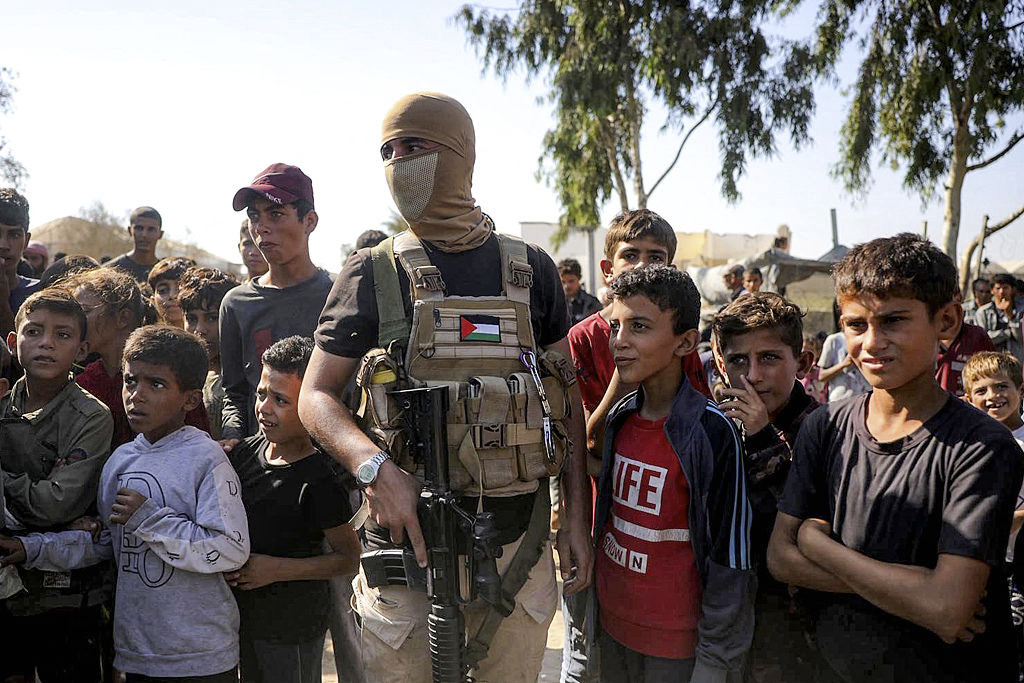
Dr. Fadel Ashour, a [Palestinian] psychiatrist, behavioral-science professor and political analyst, has described in unusually blunt terms the psychological, social and political damage caused by Hamas and its ideology, which is rooted in Islamist principles, rejection of Israel’s existence, armed struggle and the establishment of an Islamic Palestinian state in its place.
His message is urgent: Gaza cannot be rebuilt merely by putting up new buildings, repairing roads, or providing humanitarian assistance. The Palestinians’ entire mindset must be rebuilt.
“Over 20-25 years [of Hamas rule], a culture was established that normalized violence, legalized it, and glorified death as if it were a means of survival. This is extremely dangerous for an entire generation that grew up saturated with this culture.” — Dr. Fadel Ashour, Palestinian psychiatrist, interview, Jusoor News, September 13, 2026.
“A society that wants to win achieves victory through building, not through death and violence… When you open a school or a university, that is a victory. When you build a prosperous society that doesn’t push its youth to flee, that is a victory. Making their lives a hell that everyone wants to escape from is a defeat.” — Dr. Fadel Ashour, interview, Jusoor News, September 13, 2026.
If Hamas is merely regarded as another political faction, then the international community will continue to accommodate a terrorist group, negotiate with a terrorist group, and incorporate a terrorist group into Gaza’s political system.
If Hamas, however, is understood from the outset as an Islamist armed organization that created a parallel society and subordinated Gaza’s interests to its ideology and military objectives, the policy implications will be entirely different.
“They [Hamas’s leaders] took complete control of Gaza’s economy. They crushed the commercial class, became the merchants, the importers, and the tax collectors themselves… They exploited society in a parasitic manner.” — Dr. Fadel Ashour, interview, Jusoor News, September 13, 2026.
“Hamas controlled the incoming external aid, taking it and selling it to fund itself… In the very midst of death and extreme poverty, they were looking to fund themselves from the begging done on behalf of the people…. Fundamentalist groups like this, are obsessed with two things: gaining access to money and getting that television shot for their media.” — Dr. Fadel Ashour, interview, Jusoor News, September 13, 2026.
What is important is the broad picture Ashour presents: an Islamist terrorist group that claims to exist for the Palestinian people has instead become an instrument for controlling, exploiting, and indoctrinating them.
His assessment should be required viewing for anyone negotiating with Hamas. The question is not whether Hamas will hand over some weapons or accept a temporary political arrangement. The question is whether Gaza can ever develop a fundamentally different political and social culture while Hamas’s ideology remains embedded in its society and institutions.
Ashour is warning the international community not to make the mistake of believing that Gaza’s problem can be solved simply by reaching an agreement with Hamas’s leaders.
A society cannot simultaneously teach its children that martyrdom and violence are heroic and expect these same children to build peaceful institutions, prosperous businesses, universities, and a functioning political system.
That is why allowing Hamas to retain a political and military role — particularly by including Hamas-affiliated political figures in future elections — would only perpetuate the problem Ashour is describing.
The members of the Board of Peace and the international community need to ask themselves a basic question: Hamas’s ideology has helped produce a culture of violence, death, and destruction, so can Gaza really be successfully rebuilt while that ideology — along with its institutional machinery for perpetuating it — remains intact?
The answer, it would seem, is unfortunately not.
For years, politicians, activists, journalists and organizations around the world have claimed to speak on behalf of the Palestinians. Many have blamed Israel for virtually every Palestinian problem while treating the Palestinian Authority (PA) and Hamas as legitimate “resistance” movements whose political and military role should be preserved.
Now, a Palestinian psychiatrist who has lived and worked in the Gaza Strip is offering a rather different diagnosis.
Dr. Fadel Ashour, a psychiatrist, behavioral-science professor and political analyst, has described in unusually blunt terms the psychological, social and political damage caused by Hamas and its ideology, which is rooted in Islamist principles, rejection of Israel’s existence, armed struggle and the establishment of an Islamic Palestinian state in its place.
His recent interview with the Arabic-language outlet Jusoor News deserves to be watched and studied by everyone involved in trying to determine the future of Gaza.
Ashour’s testimony is not coming from an Israeli or Western analyst. It is coming from a Palestinian professional with firsthand experience of life in Gaza.
His message is urgent: Gaza cannot be rebuilt merely by putting up new buildings, repairing roads, or providing humanitarian assistance. The Palestinians’ entire mindset must be rebuilt.
This means finally, actually confronting the ideology that has shaped at least two generations.
Ashour warns that for the past two decades, Gaza has experienced a process of social conditioning in which violence and death are universally acclaimed and celebrated:
“Over 20-25 years [of Hamas rule], a culture was established that normalized violence, legalized it, and glorified death as if it were a means of survival. This is extremely dangerous for an entire generation that grew up saturated with this culture.”
The observation is exceptionally important.
For years, many Western governments and so-called pro-Palestinian organizations have spoken almost exclusively about the physical destruction in Gaza. Ashour, however, is drawing attention to another form of destruction: the destruction of social values, institutions, and aspirations.
Palestinian society, he states, has been taught to associate victory with death rather than with construction and development:
“A society that wants to win achieves victory through building, not through death and violence… When you open a school or a university, that is a victory. When you build a prosperous society that doesn’t push its youth to flee, that is a victory. Making their lives a hell that everyone wants to escape from is a defeat.”
These are not the words of an Israeli government spokesman. They are the words of a prominent Palestinian physician describing what he has seen.
Ashour is equally blunt about rejecting the notion that Hamas should be treated simply as another political party representing the Palestinian people. “These groups are not political parties or political movements,” he states, referring to Hamas and other Islamist organizations:
“They create a closed parallel society – marrying among themselves, conducting their own businesses, and running a private economic cycle. They view the rest of society with a sense of superiority, as if they are the chosen ones and the rest are just commoners.”
Gaza, Ashour continues, was not home to a normal government, but something quite different:
“What existed was not a state authority; it was the rule of the oppressive, terrifying militias… In Gaza, the public found itself facing ghosts and tunnel militias. About 300,000 youths fled the Gaza Strip.”
If Hamas is merely regarded as another political faction, then the international community will continue to accommodate a terrorist group, negotiate with a terrorist group, and incorporate a terrorist group into Gaza’s political system.
If Hamas, however, is understood from the outset as an Islamist armed organization that created a parallel society and subordinated Gaza’s interests to its ideology and military objectives, the policy implications will be entirely different. Ashour goes on to describe Hamas’s economic domination of Gaza:
“They took complete control of Gaza’s economy. They crushed the commercial class, became the merchants, the importers, and the tax collectors themselves… They exploited society in a parasitic manner.”
Discussing humanitarian aid he discloses that Hamas controlled the incoming external aid, taking it and selling it to fund itself:
“In the very midst of death and extreme poverty, they were looking to fund themselves from the begging done on behalf of the people…. Fundamentalist groups like this are obsessed with two things: gaining access to money and getting that television shot for their media.”
What is important is the broad picture Ashour presents: an Islamist terrorist group that claims to exist for the Palestinian people has instead become an instrument for controlling, exploiting, and indoctrinating them.
Ashour’s analysis of Hamas’s leadership is equally revealing. Hamas leaders, he states, “are very skilled at small details…”
“When they execute an operation like October 7, they plan the minute details very meticulously and successfully. But their problem is that they cannot see the forest as a whole. They do not understand the broader strategic, regional, and international environment.”
He describes what happens when this strategic blindness meets ideology:
“Because of their ignorance of the big picture, gaps emerge that they fill with magical, childish, and mystical thinking – expecting unseen forces to intervene on their behalf to alter international politics.”
His assessment should be required viewing for anyone negotiating with Hamas. The question is not whether Hamas will hand over some weapons or accept a temporary political arrangement. The question is whether Gaza can ever develop a fundamentally different political and social culture while Hamas’s ideology remains embedded in its society and institutions.
This is especially relevant now that the Trump administration’s Board of Peace announced in July that it had reached an agreement with Hamas and other terrorist groups concerning their complete disarmament — a process to be completed in stages. The announced framework envisages a new Palestinian administration for Gaza and an international stabilization mechanism.
Palestinian parliamentary elections are also scheduled for November 28, 2026.
Both developments make his assessment particularly timely. Ashour is warning the international community not to make the mistake of believing that Gaza’s problem can be solved simply by reaching an agreement with Hamas’s leaders.
The physical reconstruction of Gaza, according to Ashour, is the least part of the challenge. What is required is “rebuilding the human being,” as he calls it, through deradicalization, mental health care, restoration of social trust, and the development of a life-affirming, forward-looking culture.
Above all, a new Gaza cannot be built on the same ideological foundations of the old Gaza.
A society cannot simultaneously teach its children that martyrdom and violence are heroic and expect these same children to build peaceful institutions, prosperous businesses, universities, and a functioning political system.
That is why allowing Hamas to retain a political and military role — particularly by including Hamas-affiliated political figures in future elections — would only perpetuate the problem Ashour is describing.
The members of the Board of Peace and the international community need to ask themselves a basic question: Hamas’s ideology has helped produce a culture of violence, death, and destruction, so can Gaza really be successfully rebuilt while that ideology — along with its institutional machinery for perpetuating it — remains intact?
The answer, it would seem, is unfortunately not.
egretnewseditor@gmail.com