

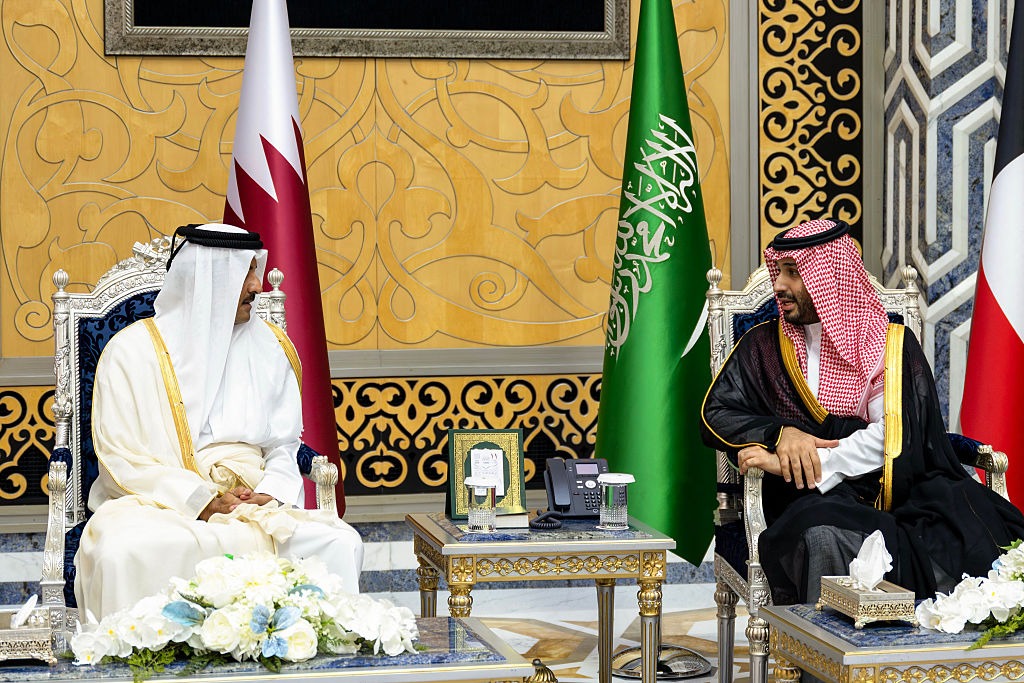
The Abraham Accords, once touted as a breakthrough, have quietly moved, in Saudi political conversation, into the deep freeze. In September 1967, the Arab League, at its summit in Khartoum, delivered the famous three “no’s”: no peace with Israel, no recognition of Israel, no negotiations with Israel. Notably, the declaration made no mention of a Palestinian state, which the late senior PLO official Zuheir Mohsen significantly pointed out in 1977, had not yet been invented:
“The Palestinian people does not exist. The creation of a Palestinian state is only a means for continuing our struggle against the state of Israel for our Arab unity. In reality, today there is no difference between Jordanians, Palestinians, Syrians and Lebanese. Only for political and tactical reasons do we speak today about the existence of a Palestinian people, since Arab national interests demand that we posit the existence of a distinct Palestinian people to oppose Zionism.” — Zuheir Mohsen, Trouw, March 31, 1977.
Once US President Donald J. Trump, without Saudi Arabia lifting a finger, relieved the kingdom of its foremost adversary, Iran, and removed the major threat to the kingdom, what would Saudi Arabia need Israel for anyway? To the Saudis, the Abraham Accords doubtless look like an agreement signed by others, but never embraced by the one Arab power that truly mattered.
The Arab League’s Khartoum resolution was never truly about borders. It expressed a fundamental rejection of Jewish sovereignty on land the Arab world, guided by religious doctrine, considered permanently to be held in trust (waqf, endowment) for Allah.
The late Abba Eban, serving as Israel’s foreign minister, had called the pre-1967 “border” — merely an armistice line where the fighting had stopped in 1949 — “the Auschwitz lines.” Riyadh appears to understand this perfectly, which is precisely why its condition was framed as it was.
The Arab League’s response to the 1948 UN partition plan was a genocidal invasion of the newly born Jewish state by the armies of five Arab states. Khartoum repeated this rejection in 1967. Saudi Arabia continues the same refusal today in language carefully tailored for Western chancelleries.
Qatar, meanwhile, plays an even more institutionalized double game: hosting America’s largest regional military base while protecting Hamas commanders, financing Muslim Brotherhood networks, and deploying Al Jazeera TV network as the ideological megaphone for the entire project.
Israeli security cannot rest any hope on a recognition that will not come. It will depend instead on the determined elimination of the Iranian regime and its terrorist proxies when the opportunity arises, and the fight for power that might well define the Sunni world once the Shia threat no longer binds it together.
Riyadh has chosen its words with care, yet the meaning could hardly be more clear. Saudi Arabia will not recognize the State of Israel — not under the present Israeli government and — here comes the poison pill — not before the creation of an independent Palestinian state along the 1949 “Auschwitz” armistice lines, with East Jerusalem as its capital.
The Saudi foreign minister has framed this stance as a strategic principle rather than a negotiating position. A 2025 survey conducted by the Washington Institute for Near East Policy revealed that 99% of Saudi citizens view normalization with Israel as a negative development. The Abraham Accords, once touted as a breakthrough, have quietly moved, in Saudi political conversation, into the deep freeze.
Once US President Donald J. Trump, without Saudi Arabia lifting a finger, relieved the kingdom of its foremost adversary, Iran, and removed the major threat to the kingdom, what would Saudi Arabia need Israel for anyway? To the Saudis, the Abraham Accords doubtless look like an agreement signed by others, but never embraced by the one Arab power that truly mattered.
Only the packaging has changed. After the UN adopted the 1947 partition plan, the Arab League and the Arab states rejected it and opposed any form of Jewish sovereignty on any part of the land, and chose war instead of the two-state solution on offer from the international community.
In September 1967, the Arab League, at its summit in Khartoum, delivered the famous three “no’s”: no peace with Israel, no recognition of Israel, no negotiations with Israel. Notably, the declaration made no mention of a Palestinian state, which the late senior PLO official Zuheir Mohsen significantly pointed out in 1977, had not yet been invented:
“The Palestinian people does not exist. The creation of a Palestinian state is only a means for continuing our struggle against the state of Israel for our Arab unity. In reality, today there is no difference between Jordanians, Palestinians, Syrians and Lebanese. Only for political and tactical reasons do we speak today about the existence of a Palestinian people, since Arab national interests demand that we posit the existence of a distinct Palestinian people to oppose Zionism.”
Judea and Samaria were wrested in 1967 from Jordan, which had controlled those territories since 1948 without ever suggesting a Palestinian entity there, either. The Arab League’s Khartoum resolution was never truly about borders. It expressed a fundamental rejection of Jewish sovereignty on land the Arab world, guided by religious doctrine, considered permanently to be held in trust (waqf, endowment) for Allah. What has evolved since then is not the refusal itself, but the language used to express it.
Today’s Saudi position, cloaked in the vocabulary of international law and Palestinian self-determination, serves the same purpose: to make any recognition of Israel conditional on terms Riyadh knows Jerusalem cannot accept. Where Khartoum was blunt and openly hostile, the contemporary version is polished, presentable and “politically correct” in Western foreign ministries — and therefore more potent.
The kingdom no longer conceals its antisemitic undertones that accompany this repositioning. In January 2026, the Anti-Defamation League took the unusual step of issuing a public statement highlighting its alarm over the sharp rise in antisemitic rhetoric in Saudi Arabia and the growing public attacks on the Abraham Accords by prominent Saudi figures. Two weeks later, the front page of the Saudi daily Al-Jazirah labeled the United Arab Emirates a “Zionist Trojan horse” in the Arab world. Such commentary appears in outlets operating under close royal supervision, signaling what the leadership wishes to be heard.
The diplomatic record aligns with the rhetorical shift. In September 2025, Saudi Arabia and France co-hosted a high-profile conference at the UN General Assembly, where multiple countries announced their recognition of a non-existent Palestinian state. The initiative explicitly endorsed the “right of return” and sought to reinforce the legitimacy of UNRWA — the UN agency whose long-documented role in employing Hamas operatives in Gaza has raised serious questions for decades. A country genuinely interested in narrowing the gap with Israel would not spearhead an international campaign promoting outcomes that would be an existential threat to Israel. Saudi Arabia has chosen what side it is on.
Israel’s response is shaped not by ideology but by hard-won experience. The results of creating an independent Palestinian entity are already known: the experiment has already been conducted. In 2005, Israel unilaterally withdrew from the Gaza Strip — every Jewish civilian was expelled, every IDF soldier pulled out, and complete territorial control handed over to the Palestinian Authority. What followed was the emergence of a jihadist emirate, the firing of tens of thousands of rockets at civilians in Israel — a country smaller than the state of New Jersey (roughly 22,000 sq.km.) — and the horrors of October 7, 2023.
The Saudi demand is essentially that Israel repeat that same failed experiment on the hills of Judea and Samaria, overlooking Ben-Gurion International Airport and Tel Aviv, and surrounding Jerusalem on three sides. No Israeli government, regardless of its political makeup, can agree to such terms. The late Abba Eban, serving as Israel’s foreign minister, had called the pre-1967 “border” — merely an armistice line where the fighting had stopped in 1949 — “the Auschwitz lines.” Riyadh appears to understand this perfectly, which is precisely why its condition was framed as it was.
At its core, Saudi Arabia’s reluctance to recognize Israel is theological as well as a political power grab, lest Israel gain too much stature in the neighborhood. The Saudi monarch carries the title of Custodian of the Two Holy Mosques, conferring a unique religious legitimacy unmatched by any other Sunni capital. Granting formal recognition to a sovereign Jewish state in the heart of Dar al-Islam — territory historically conquered for the Muslim nation (umma) — would require conceding a doctrinal point that strikes at the very foundation of the Saudi monarchy.
The kingdom’s “Vision 2030” has modernized the surface — introducing movie theaters, allowing women to drive, and launching futuristic projects such as NEOM. It has not, however, rewritten the religious basis of the throne’s legitimacy. Saudi Crown Prince Mohammed bin Salman, whose dependence on this religious legitimacy has only grown since the Khashoggi murder, is unlikely to risk it for a normalization with a country that, since defeating Saudi Arabia’s main enemy, Iran, may now be more of a problem than a benefit. Israel’s strategic value is simply not needed anymore.
Israel, for its part, can extract a certain short-term strategic benefit from a weakened but still surviving Iranian regime. As long as Tehran continues to threaten Sunni capitals, Israel remains an indispensable regional player, and the broader architecture of the Abraham Accords retains some rationale. Yet no Israeli government will base its long-term security on such a calculation, not to mention what a betrayal it is of the Iranian people, whom Trump encouraged to give up so much in the hope of real freedom.
What comes after in Iran may prove more consequential. The Sunni world has never been monolithic. The Muslim Brotherhood, officially designated a terrorist organization by Saudi Arabia, Egypt, the United Arab Emirates, Bahrain and even Austria, continues to enjoy sponsorship and amplification from Qatar and Turkey. In January 2026, the Trump administration formally labeled the Egyptian, Jordanian, and Lebanese branches of the Muslim Brotherhood as terrorist entities, sharpening a fault line long obscured by the shared priority of containing Iran.
Turkey under President Recep Tayyip Erdoğan, although not in open conflict with Israel, currently poses a more organized threat to Jerusalem than at any point in modern history: neo-Ottoman ambitions, active military and political support for the Syria’s HTS regime, sheltering Hamas leadership, and promoting jihadist fatwas from the Qatar-based International Union of Muslim Scholars.
Qatar, meanwhile, plays an even more institutionalized double game: hosting America’s largest regional military base while protecting Hamas commanders, financing Muslim Brotherhood networks, and deploying Al Jazeera TV network as the ideological megaphone for the entire project.
Should the Iranian regime eventually collapse — whether through internal revolt or popular uprising, the longstanding rivalry between the anti-Muslim Brotherhood bloc (UAE, Morocco, Bahrain) and the Qatar-Ankara axis would inherit the central role long played by Iran. Saudi Arabia, Egypt and the UAE would then face that confrontation having lost the one common enemy that had justified their alignment. In such a landscape, they would need a capable partner possessing the technological and military edge they cannot readily develop themselves. Israel is that partner, whether or not formal recognition ever materializes.
No Arab state is prepared to recognize Israel as a Jewish state rooted in Jewish faith and history: doing so would mean accepting permanent Jewish sovereignty over land that Islamic tradition regards as territory conquered to be held in perpetuity for Islam. The Arab League’s response to the 1948 UN partition plan was a genocidal invasion of the newly born Jewish state by the armies of five Arab states. Khartoum repeated this rejection in 1967. Saudi Arabia continues the same refusal today in language carefully tailored for Western chancelleries.
October 7, 2023 showed, in the most brutal terms, what the Saudi formula produces when implemented. Israeli security cannot rest any hope on a recognition that will not come. It will depend instead on the determined elimination of the Iranian regime and its terrorist proxies when the opportunity arises, and the fight for power that might well define the Sunni world once the Shia threat no longer binds it together.
egretnewseditor@gmail.com