Yearly Archives: 2017

ISIS strikes in Indonesia’s capital, killing 2 and wounding scores

By: AP
ISIS attack jakarta

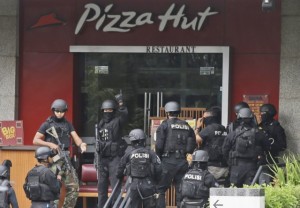
Indonesian forces at the site of the attack. (AP/Achmad Ibrahim)

Islamic terrorists set off suicide bombs and exchanged gunfire outside a Starbucks cafe in Indonesia’s capital in a brazen assault Thursday that police said “imitated” the recent Paris attacks and was probably linked to the Islamic State (ISIS) terror group.


All five terrorists and a Canadian and an Indonesian died in the mid-morning explosions and gunfire that were watched by office workers from high-rise buildings on Thamarin Street in Jakarta, not far from the presidential palace and the US Embassy, police said. Another 19 people were injured.

When the area was finally secured a few hours later, bodies were sprawled on sidewalks. But given the firepower the attackers carried — handguns, grenades and homemade bombs — and the soft targets they picked in a bustling, crowded area, the casualties were relatively few compared to the mayhem and carnage caused by the Paris attacks.

“We have identified all attackers… we can say that the attackers were affiliated with the ISIS group,” national police spokesman Maj. Gen. Anton Charilyan told reporters.

No one immediately claimed responsibility for the attacks. But the Aamaq news agency, which is affiliated with the Islamic State group, quoted an unnamed source as saying the group carried out the violence.

The news agency has been used as a source on the ISIS terrorist in the past. However, according to SITE, which tracks militant websites, the Islamic group has not yet issued a communique claiming responsibility for the attack.

The report in Arabic said that a source told Aamaq that “fighters from the Islamic State carried out this morning an armed attack that targeted foreigners and the security forces tasked with protecting them in the Indonesian capital, Jakarta.”

Jakarta police chief Maj. Gen. Tito Karnavian told a news conference that the first suicide bombing happened at a Starbucks restaurant, causing customers to run out. Outside, two gunmen opened fire, killing a Canadian and wounding an Indonesian, he said.

A Dutch Foreign Ministry spokeswoman in the Netherlands said a Dutch man was seriously injured and was undergoing surgery.

At about the same time two other suicide bombers attacked a nearby traffic police booth, killing themselves and an Indonesian man. Karnavian said that minutes later a group of policemen was attacked by the remaining two gunmen, using homemade bombs. This led to a 15-minute gunfight in which both attackers were killed, he said.

Police then combed the building housing the Starbucks and another nearby building where they discovered six homemade bombs — five small ones and a big one.

“So we think … their plan was to attack people and follow it up with a larger explosion when more people gathered. But thank God it didn’t happen,” Charilyan said.

He said the attackers imitated the recent “terror acts” in Paris and were likely from the Islamic State group, but gave no evidence.

Karnavian also said the attackers had links with ISIS and were part of a group led by Bahrum Naim, an Indonesian terrorist who is now in Syria.

Indonesia Reencounters Islamic Terror

It was the first major attack in Indonesia’s capital since the 2009 bombings of two hotels that killed seven people and injured more than 50. Before that, bombings at nightclubs on the resort island of Bali in 2002 killed 202 people, mostly foreigners.

ISIS attack jakarta

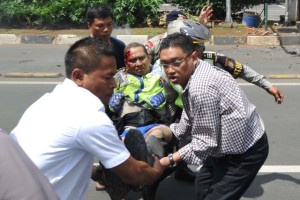
A victim of the attack is taken to treatment. (AP)

Thursday’s attack prompted a security lockdown in central Jakarta and enhanced checks all over the crowded city of 10 million. Thamarin Street is home to many luxury hotels, high-rise office buildings and embassies, including the French.

Eliaz Warre, who witnessed the attack, said he was riding on a motorbike when the explosion went off at the police post. “I saw people running away and two people lying on the ground bleeding,” he said.

Charilyan said police had received information in late November about a warning from the Islamic State group that “there will be a concert” in Indonesia, meaning an attack.

“This act is clearly aimed at disturbing public order and spreading terror among people,” President Joko “Jokowi” Widodo said in a statement on television.

“The state, the nation and the people should not be afraid of, and be defeated by, such terror acts,” he said.

The country had been on high alert after authorities said they foiled a plot by Islamic terrorists to attack government officials, foreigners and others. About 150,000 police officers and soldiers were deployed on New Year’s Eve to guard churches, airports and other public places.

More than 9,000 police were also deployed in Bali.

Last month, anti-terror police arrested nine suspected terrorists and said they had planned attacks “to attract international news coverage of their existence here.”

Indonesia, the world’s most populous Muslim nation, has suffered a spate of deadly attacks blamed on the Jemaah Islamiyah network in the past. But terrorist strikes in recent years have been smaller and less deadly, and have targeted government authorities, mainly police and anti-terrorism forces.

ISIS Slaughtering Christians “In Their Beds”

“People are even killed inside the camps, and the refugees are afraid to say if they saw somebody get killed. … they’re buying and selling ladies and even girls.”— Former ISIS operative.


  • “We will not stop hunting Christians and burning churches. Christians are Allah’s enemies!” — Extremist Islamic leaders, Indonesia.
  • “My family members and I have been marked for death, and everyone in the community denied ever knowing my family or me…” — A convert to Christianity, Nigeria.
  • “In Bangladesh, Christians are a weak minority and this is why Muslims are attacking us.” — Nirmal Rozario, general secretary of the Bangladesh Christian Association.

Teams of trained killers disguised as refugees were sent by the Islamic State (IS) into U.N. refugee camps to kill Christians, including “in their beds,” and to kidnap young girls to sell or use as slaves. This was revealed on October 24, according to a report, soon after an IS operative “got cold feet and renounced jihad after witnessing Christians helping out other refugees within the camp. He then revealed that he had been sent with an Islamist hit squad to eliminate Christians as part of the hate group’s ideological drive to wipe the religion off the map.” The report also quoted an aid worker saying:

They’re like a mafia. People are even killed inside the camps, and the refugees are afraid to say if they saw somebody get killed. If you ask them, they’ll say, “I don’t know, I was asleep.”… The camps are dangerous because they have IS, Iraqi militias and Syrian militias. It’s another place for gangs…. They’re killing inside the camps, and they’re buying and selling ladies and even girls.

The rest of October’s roundup of Muslim persecution of Christians around the world includes, but is not limited to, the following:

Islamic State Slaughter of Christians

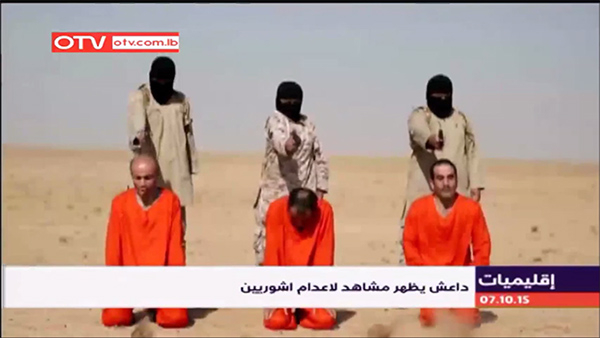
Syria: The Islamic State executed three Christian men who, along with 250-300 other Christians, were abducted in an earlier raid on an Assyrian Christian village. In the video of the execution, the three Christians appeared on their knees, dressed in the usual orange jumpsuits; they were then shot dead by three masked executioners. Before being killed, each of the Christians identified himself by name and village of origin. The president of the Alliance church in Syria described one of the slain as “a great man of God who took a risk by staying in his village to take care of his people and to encourage them in the Lord.” In the same video, IS threatened to execute the remaining Christian hostages unless a ransom — as much as $100,000 USD per hostage — was met.
Islamic State jihadists execute three Assyrian Christian men in Syria, on September 23, 2015.

Libya: A group claiming affiliation with the Islamic State announced the beheading of a Christian man of South Sudanese origin who had been living and working in Libya since 1989. It is unclear when the execution took place. A masked IS figure appears in the video and accuses South Sudan of mistreating Muslims. He does this despite South Sudan having an interim constitution that defines itself as a secular state — unlike Sudan, which rules according to Sharia and oppresses non-Muslims: “Oh Christians in South … no safety or shelter for you except that of the Islamic State,” the masked jihadi says. The Christian is then forced down to his knees, his throat slit and his head cut off.

Muslim Attacks on Christian Churches

Indonesia: Several churches were destroyed by Muslim rioters and local authorities in Aceh. On October 9, hundreds of Muslims marched to the local authority’s office and demanded that all unregistered churches in Aceh be closed. Even though the authorities agreed, on October 13, a mob of approximately 700 Muslims, some armed with axes and machetes, torched a local church. When the mob moved to a second church, they engaged in violently clashes with Christians trying to protect their church. One person, believed to be a Christian, was killed and several injured. About 8,000 Christians were displaced. Extremist Islamic leaders afterwards issued messages: “We will not stop hunting Christians and burning churches. Christians are Allah’s enemies!” In response, local authorities demolished three churches (one Catholic, two Protestant) on October 19, and vowed to destroy many more in the months to come.

Sudan: Two churches were destroyed in separate incidents. On October 17, a Lutheran church was burned down in Gadaref. The building was completely destroyed, including the furniture and Bibles inside. On October 22, in Omdurman, after giving the congregation only 72 hours’ notice and citing “redevelopment,” authorities demolished the Evangelical Lutheran Church of Sudan. The church had stood on the same location for over 30 years. According to local sources, Muslims set fire to the building before officials ordered bulldozers to tear down the rest of it. “The strange thing is that the church was destroyed but the mosque was still standing in its place! This shows us many things… We were asking them, ‘Where are our rights?'” a Lutheran church leader said.

Syria: On the night of October 25, a mortar shell hit the Latin church of Aleppo, dedicated to Saint Francis, as mass was being celebrated. Launched from areas held by anti-Assad forces, the shell hit the roof and exploded outside. Seven people were injured. According to Bishop Georges, the apostolic vicar of Aleppo, “It was around 10 before six in the evening, there were about 400 people in church and the time had come for communion… If the grenade had exploded inside there would have been a massacre. Instead, only seven worshippers were injured, not in a serious way, when rubble fell down and the roof was damaged.”

Iraq: At least eight historic and ancient Christian churches in Mosul were used as animal slaughterhouses by the Islamic State during Bakr-Eid, the Islamic Festival of Sacrifice. The St. Ephrem Syriac Orthodox Church, which was seized by the Islamic State (IS) a year ago, was one of them. In June, IS had announced that the church would be reopened as a “mosque of the mujahideen,” even though the ancient church was later apparently deemed suitable only for slaughtering animals.

Germany: On October 20 in Cologne, eight young men appeared in court and were charged with robbing churches and schools to finance the Islamic State’s jihad in Syria. The central figure in the gang, of Moroccan background, had also uploaded a YouTube video encouraging Muslims to join IS. When the eight young men had earlier broken into churches, they had stolen collection boxes, crosses, and other objects “dedicated to church services and religious veneration,” the prosecutors alleged.

Slaughter and Persecution of Muslim Converts to Christianity

Uganda: Muslims, angry at a former Muslim for converting to Christianity, killed his wife, a mother of eight children. On October 19, men had come knocking on the family’s door looking for the apostate. His wife told them he was away, according to her children who were present. One of the men said, “Your husband has followed the religion of his brother [Christianity], and we had warned you people to stop these activities, but our message has landed on deaf ears.” Next, “[t]he attackers dragged our mother outside the house as she screamed and cried for help,” said her 13-year-old. The Christian woman was later found in a pool of her own blood 100 meters away. Rushed to a hospital, she was declared dead on arrival. A few weeks earlier, her husband’s brother had also been killed after a religious debate with Islamic scholars.

Nigeria: A former Muslim who converted to Christianity revealed his all-too-typical experiences — including how the jihadi organization Boko Haram tried to kill him, burned his stores and his father’s home, and slaughtered one of his cousins, a college student:

A few months after my conversion to Christianity, I received several threats and warnings from the insurgents, telling me to revert to my former religion or face dire consequences. I received written threats saying I could only run but could not hide, which I took to the Police and they told me they would do something about it, but nothing was done… I conducted my own investigations. One of my neighbors whose brother received the same notes because of his conversion a few years ago was killed by an unknown killer…. My family members and I have been marked for death, and everyone in the community denied ever knowing me or my family…

Kazakhstan: On October 9, a court began hearing a case against a Muslim convert to Christianity, facing as much as ten years in jail on charges of “inciting religious hatred.” A member of the Seventh-Day Adventist Church, the 54-year-old man was led to the courtroom in handcuffs. Several witnesses in the case reportedly testified that during Bible study sessions he had expressed ideas that sounded “insulting to Muslims and the Prophet Muhammad.” His case is part of what Christian advocacy groups view as a pretext to persecute Christians minorities, especially converts, or “apostates,” in the Muslim majority nation.

Dhimmitude in Egypt

An Egyptian teacher of Arabic whipped a 10-year-old Coptic Christian boy with 40 lashes in a Cairo school. The doctors who later examined the boy’s wounds “could not believe that a teacher could do this,” said the boy’s father. On October 21, during the Coptic student’s last class of the day, Arabic, the teacher told the pupils to remain silent until they had copied all the Arabic phrases on the board, which were likely derived from the Koran. When Babawi, the Christian boy, asked the student in front of him to move his head so he could see the blackboard, the teacher proceeded to lock the door and flog him 40 times with a large electrical cord all over his body. The boy passed out and was found drenched in his own blood. Later he was found to have severe damage to his bones and kidney. The boy’s father filed a police report and spoke to school authorities, but, he said, “Until now, no legal steps have been taken against the teacher.”

In late October, a Christian man was abducted and tortured for refusing to convert to Islam. Fayiz Fouad, a Christian, was kidnapped as he was returning from a visit to the St. George Coptic Orthodox Monastery in Qena. He was held hostage for three days. During that time, he was tortured in an “ugly manner,” according to a rights activist: “The story isn’t merely about kidnapping; it has an ISIS component to it.” His family managed to release him with the help of an influential village elder — and the payment of 50,000 Egyptian pounds, or $6,225 USD. According to the rights activist, “The issue of kidnapped Copts continues in Nag Hammadi, despite the fact that Egyptian Security knows where these kidnappers are situated and their identities, and yet remains silent about their crimes.”

In Minya, a group, still unknown, broke into a Christian household on October 21 and snatched a five-year-old child from his bed. They threatened to slaughter him unless a 200,000 Egyptian pound ransom (more than $25,000) was received. The child’s father went to police but they refused to help: “Although I gave the police all the details of the call, the cellphone number which called me, but they still didn’t help us, they didn’t even follow up the phone call, try to identify the caller or arrest the kidnappers.” Unable to raise the large amount they asked, he pleaded with the kidnappers and they agreed to release the child for 45,000 Egyptian pounds (nearly $6,000).

On October 5, after a Christian student stood up to a Muslim bully, around 200 Muslims rioted in the town of Samalout, in the Minya Governorate. At least ten Christians were hospitalized; several shops and homes were attacked and destroyed. The attacks continued until police arrived and forced the Muslim rioters to retreat. Even though the identities of many of the assailants were known to police, no arrests were made.

Dhimmitude in Bangladesh

A Christian priest survived an attempt on his life by three Muslims who had pretended to be interested in Christianity to gain entrance to his house. Luke Sarker, the 52-year-old pastor of Faith Bible Church, suffered injuries when the men, aged between 25-30, tried to slit his throat with a knife at his home in the district of Pabna. The story had begun a month earlier, when one of the attackers contacted the pastor and said he wanted to convert. “I cannot convert you,” Sarker had said, “but you can come to me to know about Christianity.” The following day two men came and he preached the Gospel to them as his wife served them tea. “They said they liked whatever I shared with them. When they left my home, they said they would like to come again to my house. I appreciated and welcomed their forthcoming visit, because telling about Jesus is my work.” Soon the two plus another came unannounced. The pastor took them in: “I spent around half an hour with them discussing about Christianity. Suddenly, one of them grabbed my neck just under the chin. I tried to shout but could not. I was groaning and tried to bite the fingers of the grabber. The other two persons tried to slit my throat with a knife.” Sarker’s family rushed in to help their father fight off the Muslims; his wife shouted for help, and when a neighbor came in, the assassins fled the scene.

Separately, on October 15, about 100 Muslims attacked a Christian family in Dhaka and forced them to abandon their three-room house. “They wanted to shoot me. They told us that they would kill us if we had opposed the expropriation of our house,” one of them said. The intruders were accompanied by police, “who witnessed the expropriation and did nothing to stop it. We lost our possessions, money, and we’re out of the house.”

“I visited the place occupied by Muslims,” said Nirmal Rozario, general secretary of the Bangladesh Christian Association: “They are committing a grave injustice against the Christian community. In Bangladesh, Christians are a weak minority and this is why Muslims are attacking us.”

ISIS Sets Its Sights on the East by Vijeta Uniyal

  • This month’s ISIS manifesto claims India as part of Islamic Caliphate and, referring to the recent resurgence of Hindus in the country, states: “a movement of Hindus is growing who kill Muslims who eat beef.”


  • ISIS flags and insignia are regularly displayed at protest rallies and religious gatherings in the Muslim-majority province of Kashmir.

  • Indian officials seem just as afraid of calling Islamist terror by its rightful name as their Western counterparts. Instead, they appear to be trying to distract the public by throwing money at ineffective social welfare programs. Perhaps these officials hope the public will think that at least “something” is being done.

The Islamic State (ISIS) is apparently planning to subjugate and conquer the ancient civilizations of the East as part of its worldwide jihad.

The Islamic State’s newly-released manifesto contains, among the ideological positions and strategic objectives of the self-proclaimed Islamic Caliphate, direct threats to Hindus and Indian Prime Minister Narendra Modi.

The 130-page English-language manifesto, entitled “Black Flags from the Islamic State (2016),” was uploaded in early December on various online forums sympathetic to the Islamic State. Previously, in July 2015, ISIS had circulated another document declaring its ambitions of expanding its Jihad into India.

This month’s ISIS manifesto claims India as part of Islamic Caliphate and, referring to the recent resurgence of Hindus in the country, states: “a movement of Hindus is growing who kill Muslims who eat beef.”

Hindu groups have lately been campaigning for a national ban on the slaughter cows, in keeping with the religious sentiments attached to the animal, which most Hindus consider sacred.

The social and political movement of reviving Hinduism in India was also strengthened by the historic election, 18 months ago, of Prime Minister Narendra Modi and his nationalist BJP party.

The ISIS manifesto mentions India’s Prime Minister Modi as a “right-wing Hindu nationalist who worships weapons and is preparing his people for a future war against Muslims.”

Modi’s government wants to reduce India’s dependence on foreign defense suppliers by encouraging foreign firms to set up manufacturing operations in the country. Encouraged by the deregulation of the defense sector, several foreign companies have set up production lines and set up joint ventures with local partners.

Undeterred by the current losses on the ground in Syria and Iraq, ISIS propaganda on social media has repeatedly proclaimed the group’s dream of an Islamic Caliphate or theocratic empire ruling the entire Indian subcontinent, parts of East Asia, the Middle Eastern and North and Central Africa.

The new manifesto recognizes the Mumbai 2008 massacre, which targeted tourist, commercial and cultural targets in the city — including a Jewish synagogue — as the blueprint for the Paris attacks. “In the centre of Paris,” the booklet states, “some Mujahideen holding AK-47s copied the Mumbai attacks’ style of shooting through the window of a Cafe bar (where alcohol and food was served), then the people fell on the floor, so they threw a grenade into the building.”

After last month’s Paris attacks, India issued a nation-wide alert.

Seeking to broaden the ‘intellectual’ horizon of its sympathetic readers, the manifesto recommends earlier texts published by ISIS such as; “Black Flags from the East,” “Black Flags from Rome” and “Black Flags from Palestine.”

According to India’s intelligence agencies, which monitor ISIS activities, at least 20 Indians have joined the ranks of the Islamic State as fighters in Iraq and Syria, and an additional 150 people are being monitored because of suspected involvement in activities related to ISIS. Since 2005, India has lost over 7,400 civilians and 3,200 security personnel to terrorism.

Support for ISIS is not, however, limited to a handful of identifiable operatives. ISIS flags and insignia are regularly displayed at protest rallies and religious gatherings in the Muslim-majority province of Kashmir. In July, the Muslim festival of Eid-al-Fitr was marked by widespread vandalism and stone-throwing, carried out by rioters waving Pakistani, Palestinian and ISIS flags.

The Islamic State’s social media operation also bears at least one Indian signature. Last year, police in southern Indian city of Bangalore arrested a 24-year-old engineer who operated one of the main Twitter accounts associated with ISIS. The India-based Twitter account had 17,700 followers and circulated ISIS propaganda, including beheading videos.

The stated ambitions of ISIS to make India part of Muslim empire are not based on the historic Islamic conquest of India, mainly from the twelfth to the sixteenth centuries, but are rooted in established, mainstream Islamic theology, central to an Islamic end-of-time prophecy in thehadith. Those reports of the sayings and actions Islam’s prophet Mohammad — collectively called Ghazwa-e-Hind — predict a final battle with India, and resulting in victory over the Hindus by the invading Muslim armies.

Instead of tackling the problem head-on, Indian Muslim organizations continue to deny the presence of the Islamic State and its affiliates in the country. On December 9, 2015, the umbrella body of Muslim organizations, the All India Muslim Majlis-e Mushawarat (AIMMM), issued a press release calling the reports of ISIS’s penetration into India “baseless and misleading.”

In 2014, this photo of Muslim ISIS supporters in India’s Tamil Nadu state went viral on Twitter.

Despite regular video footage broadcast by Indian news channels, showing Muslims regularly carrying ISIS flags during religious gatherings and protests in the Muslim majority region of Kashmir, Muslim leaders maintained their claim that “ISIS does not exist in Kashmir.” Instead, they portray themselves as victims of an elaborate conspiracy hatched by the Indian security forces to “pave the way for their large-scale arrests.”

Prime Minister Modi’s government has reacted to the heightened security threat posed by ISIS with a new counter-terrorism strategy. The measures could best be described as an attempt at “social engineering,” with the government pledging more spending on education and employment programs in the hope of keeping Muslim youths away from the influence of radical Islamists. The problem with this approach is that it addresses a problem that is not relevant. Most of the Indian Muslims known to have joined the ranks of ISIS seem to come from affluent families and hold professional degrees. All of them had the means to travel abroad to join ISIS — in a country where majority of people earn less than 3 dollars a day. Poor people are too busy just trying to exist.

If poverty were driving people to commit acts of terrorism, why are Indian’s Hindus not lining up to join their version of “jihadi” outfits?

Indian lawmakers and officials are trapped in the same politically correct — if in every other way incorrect — assumption as their Western counterparts. They also seem just as scared of calling Islamist terror by its rightful name. Instead, they appear to be trying to distract the public by throwing taxpayer money at ineffective social welfare programs. Perhaps these officials hope the public will think that at least “something” is being done and fail to see that, instead of countering ISIS, in they are really just fleeing from the problem.

Vijeta Uniyal is an Indian current affairs analyst based in Europe

ISIS Selling Yazidi Women and Children in Turkey by Uzay Bulut

  • This month’s ISIS manifesto claims India as part of Islamic Caliphate and, referring to the recent resurgence of Hindus in the country, states: “a movement of Hindus is growing who kill Muslims who eat beef.”


  • ISIS flags and insignia are regularly displayed at protest rallies and religious gatherings in the Muslim-majority province of Kashmir.

  • Indian officials seem just as afraid of calling Islamist terror by its rightful name as their Western counterparts. Instead, they appear to be trying to distract the public by throwing money at ineffective social welfare programs. Perhaps these officials hope the public will think that at least “something” is being done.

The Islamic State (ISIS) is apparently planning to subjugate and conquer the ancient civilizations of the East as part of its worldwide jihad.

The Islamic State’s newly-released manifesto contains, among the ideological positions and strategic objectives of the self-proclaimed Islamic Caliphate, direct threats to Hindus and Indian Prime Minister Narendra Modi.

The 130-page English-language manifesto, entitled “Black Flags from the Islamic State (2016),” was uploaded in early December on various online forums sympathetic to the Islamic State. Previously, in July 2015, ISIS had circulated another document declaring its ambitions of expanding its Jihad into India.

This month’s ISIS manifesto claims India as part of Islamic Caliphate and, referring to the recent resurgence of Hindus in the country, states: “a movement of Hindus is growing who kill Muslims who eat beef.”

Hindu groups have lately been campaigning for a national ban on the slaughter cows, in keeping with the religious sentiments attached to the animal, which most Hindus consider sacred.

The social and political movement of reviving Hinduism in India was also strengthened by the historic election, 18 months ago, of Prime Minister Narendra Modi and his nationalist BJP party.

The ISIS manifesto mentions India’s Prime Minister Modi as a “right-wing Hindu nationalist who worships weapons and is preparing his people for a future war against Muslims.”

Modi’s government wants to reduce India’s dependence on foreign defense suppliers by encouraging foreign firms to set up manufacturing operations in the country. Encouraged by the deregulation of the defense sector, several foreign companies have set up production lines and set up joint ventures with local partners.

Undeterred by the current losses on the ground in Syria and Iraq, ISIS propaganda on social media has repeatedly proclaimed the group’s dream of an Islamic Caliphate or theocratic empire ruling the entire Indian subcontinent, parts of East Asia, the Middle Eastern and North and Central Africa.

The new manifesto recognizes the Mumbai 2008 massacre, which targeted tourist, commercial and cultural targets in the city — including a Jewish synagogue — as the blueprint for the Paris attacks. “In the centre of Paris,” the booklet states, “some Mujahideen holding AK-47s copied the Mumbai attacks’ style of shooting through the window of a Cafe bar (where alcohol and food was served), then the people fell on the floor, so they threw a grenade into the building.”

After last month’s Paris attacks, India issued a nation-wide alert.

Seeking to broaden the ‘intellectual’ horizon of its sympathetic readers, the manifesto recommends earlier texts published by ISIS such as; “Black Flags from the East,” “Black Flags from Rome” and “Black Flags from Palestine.”

According to India’s intelligence agencies, which monitor ISIS activities, at least 20 Indians have joined the ranks of the Islamic State as fighters in Iraq and Syria, and an additional 150 people are being monitored because of suspected involvement in activities related to ISIS. Since 2005, India has lost over 7,400 civilians and 3,200 security personnel to terrorism.

Support for ISIS is not, however, limited to a handful of identifiable operatives. ISIS flags and insignia are regularly displayed at protest rallies and religious gatherings in the Muslim-majority province of Kashmir. In July, the Muslim festival of Eid-al-Fitr was marked by widespread vandalism and stone-throwing, carried out by rioters waving Pakistani, Palestinian and ISIS flags.

The Islamic State’s social media operation also bears at least one Indian signature. Last year, police in southern Indian city of Bangalore arrested a 24-year-old engineer who operated one of the main Twitter accounts associated with ISIS. The India-based Twitter account had 17,700 followers and circulated ISIS propaganda, including beheading videos.

The stated ambitions of ISIS to make India part of Muslim empire are not based on the historic Islamic conquest of India, mainly from the twelfth to the sixteenth centuries, but are rooted in established, mainstream Islamic theology, central to an Islamic end-of-time prophecy in the hadith. Those reports of the sayings and actions Islam’s prophet Mohammad — collectively called Ghazwa-e-Hind — predict a final battle with India, and resulting in victory over the Hindus by the invading Muslim armies.

Instead of tackling the problem head-on, Indian Muslim organizations continue to deny the presence of the Islamic State and its affiliates in the country. On December 9, 2015, the umbrella body of Muslim organizations, the All India Muslim Majlis-e Mushawarat (AIMMM), issued a press release calling the reports of ISIS’s penetration into India “baseless and misleading.”

In 2014, this photo of Muslim ISIS supporters in India’s Tamil Nadu state went viral on Twitter.

Despite regular video footage broadcast by Indian news channels, showing Muslims regularly carrying ISIS flags during religious gatherings and protests in the Muslim majority region of Kashmir, Muslim leaders maintained their claim that “ISIS does not exist in Kashmir.” Instead, they portray themselves as victims of an elaborate conspiracy hatched by the Indian security forces to “pave the way for their large-scale arrests.”

Prime Minister Modi’s government has reacted to the heightened security threat posed by ISIS with a new counter-terrorism strategy. The measures could best be described as an attempt at “social engineering,” with the government pledging more spending on education and employment programs in the hope of keeping Muslim youths away from the influence of radical Islamists. The problem with this approach is that it addresses a problem that is not relevant. Most of the Indian Muslims known to have joined the ranks of ISIS seem to come from affluent families and hold professional degrees. All of them had the means to travel abroad to join ISIS — in a country where majority of people earn less than 3 dollars a day. Poor people are too busy just trying to exist.

If poverty were driving people to commit acts of terrorism, why are Indian’s Hindus not lining up to join their version of “jihadi” outfits?

Indian lawmakers and officials are trapped in the same politically correct — if in every other way incorrect — assumption as their Western counterparts. They also seem just as scared of calling Islamist terror by its rightful name. Instead, they appear to be trying to distract the public by throwing taxpayer money at ineffective social welfare programs. Perhaps these officials hope the public will think that at least “something” is being done and fail to see that, instead of countering ISIS, in they are really just fleeing from the problem.

Vijeta Uniyal is an Indian current affairs analyst based in Europe.

ISIS in Europe: How Deep is the “Gray Zone”? by Giulio Meotti

  • Among young European Muslims, support for suicide bombings range from 22% in Germany to 29% in Spain, 35% in Britain and 42% in France, according to a Pew poll. In the UK, one in five Muslims have sympathy for the Caliphate. Today more British Muslims join ISIS than the British army. In the Netherlands, a survey shows that the 80% of Dutch Turks see “nothing wrong” in ISIS.

  • Even if these polls and surveys must be taken with some caution, they all indicate a deep and vibrant “gray zone,” which is feeding the Islamic jihad in Europe and the Middle East. We are talking about millions of Muslims who show sympathy, understanding and affinity with the ideology and goals of ISIS.
  • How many Muslims will this ISIS virus be able to infect in the vast European “gray zone”? The answer will determine our future.

In the 1970s and ’80s, Europe was terrorized by a war declared by Communist armed groups, such as the Germany’s Baader Meinhof or Italy’s Red Brigades. Terrorists seemed determined to undermine democracy and capitalism. They targeted dozens of journalists, public officials, professors, economists and politicians, and in Italy in 1978, even kidnapped and executed Italy’s former prime minister, Aldo Moro.

The big question then was: “How deep is the ‘gray zone’?” — the sympathizers of terrorism in the industrial factories, labor unions and universities.

In the last year, the Islamic State’s henchmen slaughtered hundreds of Europeans and Westerners. Their last assault, in Brussels, struck at the heart of the West: the postmodern mecca of NATO and the European Union.

We should now answer the same question: How deep is the “gray zone” of the Islamic State in Europe?

Peggy Noonan recently tried to give an answer in the Wall Street Journal:

“There are said to be 1.6 billion Muslims in the world. … Let’s say only 10% of the 1.6 billion harbor feelings of grievance toward ‘the West’, or desire to expunge the infidel, or hope to re-establish the caliphate. That 10% is 160 million people. Let’s say of that group only 10% would be inclined toward jihad. That’s 16 million. Assume that of that group only 10% really means it — would really become jihadis or give them aid and sustenance. That’s 1.6 million.”

That is a lot.

According to a ComRes report commissioned by the BBC, 27% of British Muslims have sympathy for the terrorists who attacked the Charlie Hebdo office in Paris (12 killed). An ICM poll, released by Newsweek, revealed that 16% of French Muslims support ISIS. The number rises to 27% percent for those aged 18-24. In dozens of French schools, the “minute of silence” to commemorate the murdered Charlie Hebdo’s journalists was interrupted by Muslim pupils who protested it.

How deep is ISIS’s popularity in Belgium? Very deep. The most accurate study is a report from Voices From the Blogs, which highlights the high degree of pro-ISIS sympathy in Belgium. The report monitored and analyzed more than two million Arabic messages around the world via Twitter, Facebook and blogs regarding ISIS’s actions in the Middle East.

The most enthusiastic comments about ISIS come from Qatar at 47%; then Pakistan, at 35%; third overall is Belgium, where 31% of tweets in Arabic on the Islamic State are positive — more than Libya (24%), Oman (25%), Jordan (19%), Saudi Arabia (20%) and Iraq (20%). This shocking data exposes the success of the network and its easy pro-ISIS recruitment in Belgium.

In other European countries, after Belgium, Britain is at 24%, Spain 21%, France 20%.

In the UK, one in five Muslims have sympathy for the Caliphate. Today more British Muslims join ISIS than the British army.

In the Netherlands, a survey conducted by Motivaction shows that the 80% of Dutch Turks see “nothing wrong” in ISIS.

Among young European Muslims, support for suicide bombings range from 22% in Germany to 29% in Spain, 35% in Britain and 42% in France, according to a Pew poll.

The level of ISIS’s popularity in the Arab world has been exposed by many surveys: the Clarion Project published a report based on multiple sources a March 2015 poll by the Iraqi Independent Institute for Administration and Civil Society Studies, a November 2014 poll by Zogby Research Services, a November 2014 poll by the Arab Center for Research and Policy Studies, and an October 2014 poll by the Fikra Forum. The result: 42 million people in the Arab world sympathize with ISIS.

After the massacre at Charlie Hebdo, Al-Jazeera conducted a survey asking, “Do you support Isis’s victories?” 81% of respondents voted “yes.”

Even if these polls and surveys must be taken with some caution, they all indicate a deep and vibrant “gray zone,” which is feeding the Islamic jihad in Europe and the Middle East. We are talking about millions of Muslims who show sympathy, understanding and affinity with the ideology and goals of ISIS.

Anthony Glees, an English scholar of political radicalism, revealed the “gray zone” of Germany’s Baader-Meinhof terror group: “By 1977, the West German Federal Criminal Agency had a terrorist index which contained the names of some 4.7 million suspects and sympathisers, many of them university students.”

The terrorist leaders at that time all came from good German families: Andreas Baader was the son of a professor of history, Ulrike Meinhof was the daughter of a museum director and a famous journalist, Gudrun Ensslin was the daughter of an evangelical pastor, Horst Mahler was the son of a judge.

The Islamic State today has a much deeper gray zone of sympathizers in the Muslim communities of Europe.

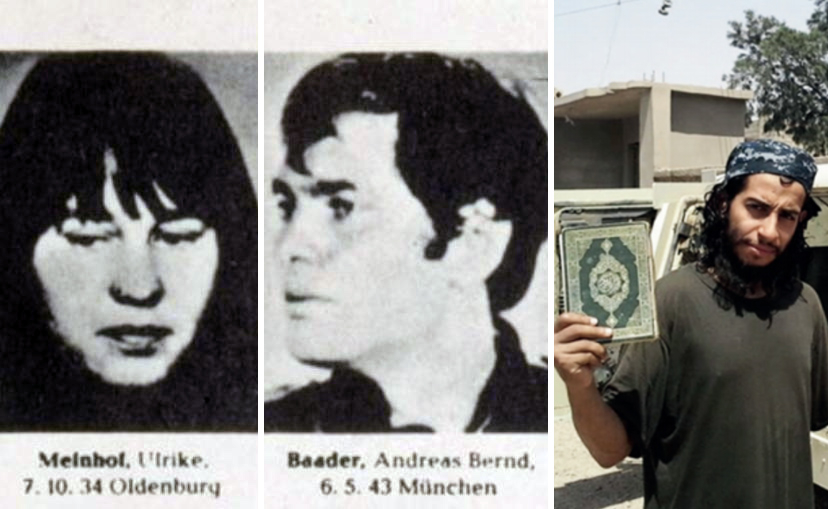
In the 1970s and ’80s, Europe was terrorized by Communist armed groups, such as the Germany’s Baader Meinhof (pictured in black and white), which had a “gray zone” of millions of suspected sympathizers. Today’s European jihadists, such the late Paris attack mastermind Abdelhamid Abaaoud (right), have a much deeper “gray zone” of sympathizers in the Muslim communities of Europe.

If Baader-Meinhof was at war with the “schweine” (bourgeois “pigs”) and targeted specific political figures, the Caliphate’s volunteers are at war with all the “kuffar” (unbelievers). ISIS loyalists target the patrons of restaurants, theaters and stadiums in Paris; a café in Copenhagen which held a debate on freedom of expression and Islam; Western tourists at a resort in Tunisia; commuters at the Maelbeek metro station and passengers at the Brussels airport.

For ISIS, it is an eternal war in the name of the prophet. As Graeme Wood explained in “What ISIS Really Wants,” ISIS “hungers for genocide … and it considers itself a harbinger of — and headline player in — the imminent end of the world.”

A book just published in French by Ivan Rioufol, a journalist for the newspaper Le Figaro, eloquently titled “The Coming Civil War,” details the dangers posed by the “apocalyptic ideology” of radical Islam in Europe. How many Muslims will this ISIS virus be able to infect in the vast European “gray zone”? The answer will determine our future.

Giulio Meotti, Cultural Editor for Il Foglio, is an Italian journalist and author.

Translate »
Skip to toolbar