Yearly Archives: 2017

Rwanda : Sa Majesté Kigeli V, roi sans royaume.

Rwanda : Sa Majesté Kigeli V, roi sans royaume.

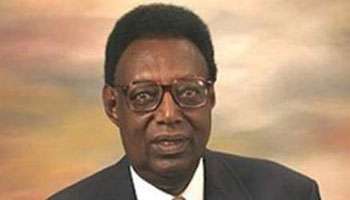
Il est le dernier monarque du pays des Mille Collines. En exil depuis plus de cinquante ans, Sa Majesté Kigeli V n’a toujours pas renoncé à revenir un jour sur sa terre natale.


C’est un lotissement typique des banlieues américaines dans la lointaine périphérie de Washington. Les maisons n’y sont pas misérables, mais pas luxueuses non plus. Rien, en tout cas, ne laisse penser que le dernier monarque d’une dynastie multiséculaire habite ici. La petite ville d’Oakton, en Virginie, où réside Kigeli V, l’ancien roi du Rwanda, est l’étape finale d’une longue errance commencée il y a un demi-siècle.

Mais impossible pour nous de pénétrer dans sa demeure. “Le roi n’accorde plus d’audiences aux journalistes jusqu’à nouvel ordre.” L’homme qui nous oppose une fin de non-recevoir, dans ce lobby de l’hôtel Marriott d’une zone commerciale peu fréquentée, en cette moite journée d’août, est son “chancelier”, Boniface Benzinge. Ce colosse, bien portant malgré son âge avancé (80 ans), a laissé au Kenya femme et enfant pour suivre et servir son souverain.

Sur les raisons du refus royal, Benzinge restera évasif. Le roi, un homme de 78 ans à la taille hors norme, a-t-il une santé fragile ? “Non. Il est parfois fatigué, bien sûr, mais il se maintient, répond le chancelier. Il continue de faire de l’exercice physique. C’est qu’il est trop occupé avec sa fondation.”

Il n’empêche, en 2013, Kigeli V s’était longuement confié au journaliste américain Ariel Sabar. Mais l’article, paru dans le Washingtonian Magazine, détaillait sa passion pour les retransmissions de catch à la télévision, ou encore les dialyses qu’il devait subir régulièrement. Il a fortement déplu au monarque. D’où, peut-être, sa méfiance à l’égard de la presse. “Le journaliste n’a pas respecté la vie privée du roi, s’indigne Benzinge. Il a écrit des choses qu’on ne doit pas publier !” L’autorité du mwami a décidément perdu de sa superbe.

En réalité, le souverain n’a jamais véritablement connu d’heure de gloire. Le trône du Rwanda, dont il a hérité en 1959, n’était déjà plus la monarchie absolue au territoire impénétrable telle que décrite par les premiers explorateurs de la région. Pour administrer le pays, les colonisateurs (allemands, puis belges) se sont appuyés sur l’aristocratie tutsie tout en affaiblissant son emprise. Et Kigeli V n’a eu le temps ni de se préparer à la fonction, ni de laisser sa trace dans le pays des Mille Collines.

Persona non grata dans son propre pays

Son demi-frère Mutara III meurt mystérieusement en juillet 1959 à l’âge de 47 ans (il aurait été victime d’un empoisonnement commandité par les Belges, selon de nombreux Rwandais) sans laisser d’héritier. Conformément à la tradition en pareil cas, les Birus, un groupe secret possédant le pouvoir de nommer un nouveau roi, désignent Jean-Baptiste Ndahindurwa (son nom de baptême) pour lui succéder. Fonctionnaire de l’administration belge, celui-ci n’a alors que 23 ans. “Cela a été un choc pour lui, affirme Benzinge. Il ne s’y attendait pas du tout.” Sur certaines vieilles photos en noir et blanc, on peut voir le jeune souverain aux côtés du roi Baudouin de Belgique – et le dépassant de plus d’une tête.

À cette époque, la révolte hutue gronde déjà et Bruxelles, agacé par la prétention de l’aristocratie tutsie à diriger le pays, ne fait rien pour la calmer. Le règne de Kigeli V commençait sous le signe de la précarité.

En janvier 1961, Kigeli décide de se rendre à Léopoldville (aujourd’hui Kinshasa), la capitale du Congo nouvellement indépendant, pour solliciter l’aide du Suédois Dag Hammarskjöld, alors secrétaire général de l’ONU et anticolonialiste viscéral. Les colons belges acceptent de lui donner un passeport. Mais à peine arrivé, il apprend à la radio qu’il est persona non grata dans son propre pays, après à peine plus d’un an de règne.

Kigeli V plaide sa cause en écrivant au Conseil de sécurité de l’ONU. En vain. Le Rwanda est sur le point de devenir indépendant. Il y rentre clandestinement, caché à l’arrière d’une voiture, mais les Belges le placent en résidence surveillée avant de le renvoyer vers la Tanzanie de Julius Nyerere. Il avait foulé sa terre natale pour la dernière fois.

Pendant les trois décennies suivantes, Kigeli errera en Afrique de l’Est, dépendant de la générosité des Tutsis (qui s’exilent en vagues successives, fuyant les pogroms du régime hutu de Grégoire Kayibanda) et des chefs d’État qui veulent bien l’accueillir, comme le Kényan Jomo Kenyatta ou l’Ougandais Idi Amin Dada. Aujourd’hui encore, le roi déchu vit des maigres aides sociales américaines et des dons d’une partie de la diaspora. Il ne peut d’ailleurs pas subvenir aux besoins de son chancelier, qui travaille encore comme vendeur au rayon ameublement de l’enseigne Sears, en attendant la retraite.

Dans les années 1980, Kigeli a toujours l’espoir d’un retour. Surtout quand, en 1986, Kampala est pris par Yoweri Museveni, le chef du Mouvement national de la résistance (MNR), une guérilla marxiste puissamment soutenue par les réfugiés tutsis rwandais. Parmi eux : Paul Kagamé. Mais Kigeli n’ira pas s’installer auprès de ses compatriotes, qui se fixent en Ouganda. “Museveni n’était pas en faveur de la royauté”, explique Benzinge.

Révolutionnaires marxistes contre monarchistes… Ce clivage idéologique divise profondément la diaspora ­tutsie depuis des décennies. Mais le Front patriotique rwandais (FPR), fondé l’année suivante dans la clandestinité, réussit à former une union sacrée contre le régime de Juvénal Habyarimana, le président hutu au pouvoir à Kigali. Cette rébellion fera le choix de mettre la querelle idéologique de côté pour s’ouvrir au recrutement des monarchistes, encore nombreux.

“Les Rwandais étaient déjà suffisamment divisés comme ça, explique Tito Rutaremara, un des fondateurs du FPR et toujours membre de ses plus hautes instances dirigeantes. À titre personnel, j’ai toujours été républicain. Mais nous disions aux monarchistes : “La forme du gouvernement nous importe peu. Ce qui compte, c’est d’installer la démocratie. Si ensuite vous mobilisez les Rwandais et gagnez un référendum, nous n’aurons aucun problème avec une monarchie, du moment qu’elle est démocratique et progressiste.””

“Fred Rwigema [le premier chef du FPR, tué au front en 1990] et le roi avaient de bonnes relations, affirme de son côté Benzinge. Il est même venu voir Sa Majesté plusieurs fois à Nairobi, où celle-ci avait trouvé refuge.”

Kagamé n’a aucun intérêt à s’embarrasser d’un ancien roi

Le 4 juillet 1994, le FPR, avec Paul Kagamé à sa tête, finit par faire tomber le régime hutu et met fin à l’effroyable génocide des Tutsis. Kigeli V croit l’heure de son retour proche. Une rencontre est organisée deux ans plus tard à Washington avec Kagamé, alors vice-président – mais véritable chef du FPR et du pays. “Kagamé lui a dit qu’il pouvait rentrer au pays comme simple citoyen, soutient Benzinge, qui était présent lors de cet entretien. Le roi voulait que Kagamé demande aux Rwandais s’ils voulaient de lui comme monarque.”

Vainqueur incontesté de la guerre, Kagamé n’a alors aucun intérêt à s’embarrasser d’un ancien roi en prenant le risque de raviver les vieilles divisions de son camp. Ce sera non. Et cela n’a pas changé depuis. “Le président ne veut plus entendre parler de lui”, tranche un proche du président.

Que représentent encore les monarchistes dans le Rwanda d’aujourd’hui ? Difficile de le savoir : ils ne disposent d’aucun parti légal. L’activisme de certains les a d’ailleurs conduits à la prison ou à l’exil. En tout état de cause, dans un pays où la majorité des habitants a moins de 20 ans, rares sont ceux qui ont connu Kigeli. Mais celui-ci affirme qu’il s’entretient régulièrement avec ses partisans, même à l’intérieur du pays… et n’a pas tout à fait renoncé à revenir un jour.

Il consulte, y compris des membres du Congrès national rwandais (RNC), ce mouvement d’opposition fondé par des dissidents du FPR en exil, que le pouvoir soupçonne de vouloir fomenter un coup d’État. “Le roi est le père de tous les Rwandais, justifie Benzinge. Il n’est membre d’aucun parti et ne peut refuser de s’entretenir avec eux, quelle que soit leur appartenance politique.”

Il n’empêche, à son âge, ses chances de revoir un jour le Rwanda paraissent bien minces. Il n’a pas d’enfants et l’idée même de monarchie pourrait bien disparaître avec lui. À moins que les Birus se réunissent de nouveau à sa mort pour lui désigner un successeur. Ces derniers existent-ils encore et, si oui, où se trouvent-ils ? “Je ne le sais pas moi-même, lâche Benzinge. Personne n’a le droit de le savoir.”

Russian President Vladimir Putin has warned that new biting sanctions against his country over its actions in Ukraine will boomerang and hit back at US national interests.

Russian President Vladimir Putin has warned that new biting sanctions against his country over its actions in Ukraine will boomerang and hit back at US national interests.


The US and European Union dramatically strengthened sanctions on Moscow over Ukraine on Wednesday, with Washington for the first time directly targeting Russia’s banking, military and energy sectors.

“Without any doubt in this case [sanctions] are driving Russian-US relations towards a dead end, [and] are inflicting very serious damage on them,” the state news agency ITAR TASS quoted Putin as saying while on a visit to Brasilia.


“And I am convinced that this will harm the national long-term interests of the American state, the American people,” Putin told reporters on Thursday.


The latest measures against Russia deepened the most serious standoff between Moscow and the West since the end of the Cold War, as fighting between the Kiev government forces and pro-Russian separatists threatened to escalate into all-out civil war.


Russian Imperialism Meets Illusions of Ottoman Grandeur

Earlier in 2015, President Recep Tayyip Erdogan said that he found it difficult to understand what Russia was doing in Syria, since “it does not even border Syria.”


  • By that logic, Turkey should not be “doing anything” in the Palestinian territories, Somalia, Egypt, Pakistan, Afghanistan or any of the non-bordering lands into which its neo-Ottoman impulses have pushed it.

In a 2012 speech, Turkish Prime Minister Ahmet Davutoglu, then foreign minister, predicted that Syrian President Bashar al-Assad’s days in power were numbered and that he would depart “within months or weeks.” Almost three and a half years have passed, with Assad still in power, and Davutoglu keeps on making one passionate speech after another about the fate of Syria.

Turkey’s failure to devise a credible policy on Syria has made the country’s leaders nervous. Both Davutoglu and President Recep Tayyip Erdogan have lately resorted to more aggressive, but less convincing, rhetoric on Syria. The new rhetoric features many aspects of a Sunni Islamist thinking blended with illusions of Ottoman grandeur.

On December 22, Davutoglu said, “Syrian soil is not, and will not be, part of Russia’s imperialistic goals.” That was a relief to know! All the same, Davutoglu could have been more direct and honest if he said that: “Syrian soil will not be part of Russia’s imperialistic goals because we want it to be part of Turkey’s pro-Sunni, neo-Ottoman imperialistic goals.”

It is obvious that Davutoglu’s concern is not about a neighboring territory becoming a theater of war before it serves any foreign nation’s imperialistic goals. His concern, rather, is that neighboring soil will become a theater of war and serve a pro-Shiite’s imperialist goals. Hardly surprising.

“What,” Davutoglu asked Russia, “is the basis of your presence in Syria?” The Russians could unconvincingly reply to this unconvincing question: “Fighting terror, in general, and ISIL in particular.”

But then Davutoglu claims that the Russian military hits more “moderates” (read: merely jihadist killers, not to be mixed with jihadist barbarians who behead people and cheerfully release their videos). Translation: more Islamist targets and fewer ISIL targets.

A legitimate question to ask the Turkish prime minister might be: What is the basis of “moderate” Islamists’ presence in Syria — especially when we know that a clear majority of the “moderate” fighters are not even Syrians. According to Turkish police records, they are mainly Chinese Uighurs, several Europeans and even one from Trinidad and Tobago.

Could the basis be the religious bond? Could Prime Minister Davutoglu have politely reminded the Russians that the “moderate” fighters are Muslim whereas Russia is not? But then, one should ask, using Davutoglu’s logic, “What is the basis of the U.S.-led Western coalition’s airstrikes in Syria?” Since when are the Americans, British, Germans and French Muslims?

In Turkish thinking, there is just one difference between non-Muslim Russia’s presence in Syria and non-Muslim allies’ presence: The non-Muslim Russians seriously threaten the advancement of our pro-Sunni sectarian war in the Levant, whereas the non-Muslim allies can be instrumental in favor of it. Hence Turkey’s selective objection to some of the non-Muslim players in Syria.

Earlier in 2015, President Recep Tayyip Erdogan said that he found it difficult to understand what Russia was doing in Syria, since “it does not even border Syria.” By that logic, Turkey should not be “doing anything” in the Palestinian territories, Somalia, Egypt, Pakistan, Afghanistan or any of the non-bordering lands into which its neo-Ottoman impulses have pushed it over the past several years. By the same logic, also, Turkey should be objecting to any allied (non-Muslim) intervention in Syria, or to any Qatari or Saudi (non-bordering) intervention in the Syrian theater.

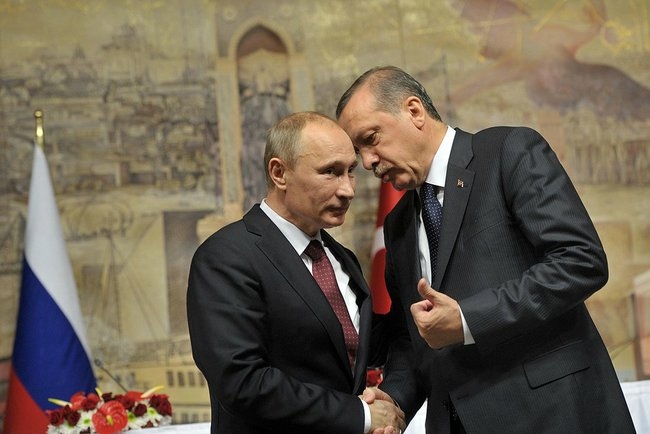
Turkish President Recep Tayyip Erdogan has said that he found it difficult to understand what Russia was doing in Syria, since “it does not even border Syria.” Pictured: Russian President Vladimir Putin (left) with then Prime Minister Erdogan, meeting in Istanbul on December 3, 2012. (Image source: kremlin.ru)

In the unrealistic imperial Turkish psyche, only Turkey and the countries that pursue regional ambitions convergent with Turkey’s can have any legitimate right to design or re-design the former Ottoman lands.

Such self-righteous and assertive thinking can hardly comply with international law. The Turks and their imperial ambitions have already been declared unwelcome in Libya, Tunisia, Egypt, Lebanon, Syria and Iraq. Nor would such ambitions be welcomed in any former Ottoman land to Turkey’s west. But if, as Turkey’s Islamists are programmed to believe, “historical and geographical bonds” give a foreign nation the right to design a polity in another nation, what better justification could the Russians have had for their post-imperial designs in Crimea?

When they have a moment of distraction from their wars against Western values, the West, Israel, Jews or infidels, the Sunni and Shiite Islamists in the Middle East fight subtle-looking (but less subtle than they think) and cunning (but less cunning than they think) wars and proxy wars, and accuse each other of pursuing sectarian policies. Turkey’s rulers are no exception.

Burak Bekdil, based in Ankara, is a Turkish columnist for the Hürriyet Daily and a Fellow at the Middle East Forum.

Russia: Rubber Ducks and Green Paint by Shoshana Bryen

  • How the United States responds to these protests abroad can determine not only the future of those protesting, but also the future of the governments that find themselves under pressure.

  • Russia seeks superpower status in the Middle East and Europe, but real superpower status has always required the ability to shoulder burdens abroad without fear of upheaval at home.
  • Ignoring the Green Movement in Iran was a missed opportunity for the West and a tragedy for the people of Iran. It is not America’s job to create or foment unrest in Russia or anywhere else. But it is in the interest of the West to support and hearten those who have the courage to take on a corrupt and aggressive government.

For all the hyperbole in Washington about Russian hacking, Russian disinformation, Russian influence, and Russian espionage, the really remarkable events in Russia over the weekend appear barely to have registered.

One hundred years after the assassination of the last Czar, and two-and-a-half decades after the fall of the communist regime, Russian people have taken to the streets.

In early March, anti-corruption activist Alexei Navalny posted a report on YouTube detailing the corruption of Prime Minister Dmitry Medvedev. After more than 13 million views in roughly three weeks, people, including a large number of teenagers, answered Navalny’s call for public protest. They flooded the streets of 95 Russian cities, as well as London, Prague, Basel, and Bonn. Many carried rubber ducks — or real ducks — referring to reports of a luxury duck farm on one of Medvedev’s properties.

Navalny is now in jail.
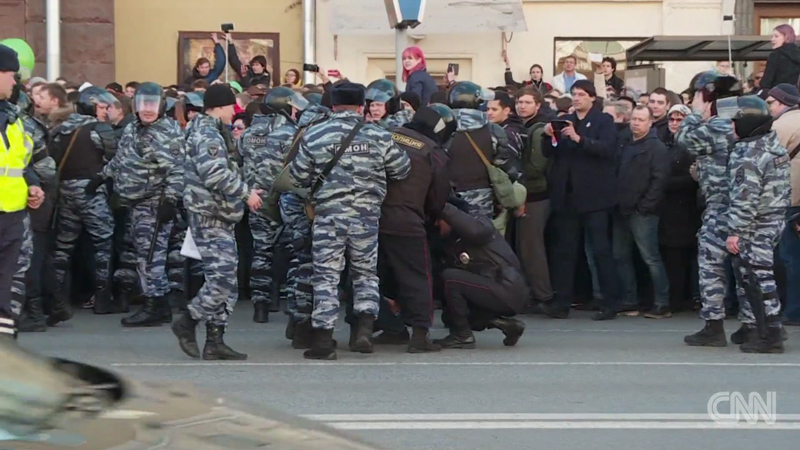
Police in Moscow arrest an anti-corruption protestor on March 26, 2017. (Image source: CNN video screenshot)

Depending on the source, 7,000-8,000 (Russia’s Interior Ministry) or 25,000-30,000 (Navalny’s Anti-Corruption Foundation) people turned out in Moscow, and hundreds — or thousands — were arrested. The Anti-Corruption Foundation claims there were more than 150,000 protesters across the country.

Navalny himself was doused with bright green dye by an opponent in an eerie parallel to the poisoning that disfigured the face of Ukrainian politician Victor Yushchenko. Navalny’s supporters, in solidarity, have taken to green face paint.

These courageous protests may call to mind the 2015 “Sunflower” movement in Taiwan or the “Umbrella” movement in Hong Kong. The former opposed Taiwanese trade with China, a plan that could have made the island dependent on the mainland for its economic future. The latter demanded the “full autonomy,” promised by Britain and agreed to by China, when the British departed in 1999. Both were notable for the number of students in the forefront. The protests also call to mind the Arab Spring demonstrations of 2011, grounded in the belief by Arab citizens that their governments were hopelessly corrupt; also Iran’s massive 2009 Green Movement protests, in which citizens believed the government had conducted a fraudulent election.

For the Trump administration, this moment is immensely important.

How the United States responds to these protests abroad can determine not only the future of those protesting, but also the future of the governments that find themselves under pressure.

Taiwan, a fully functioning democracy, saw a change of government in its latest election. Hong Kong’s change of government, however, was fully controlled by Beijing. The Arab Spring opened the way for power vacuums that allowed the rise of ISIS and al Qaeda. And Iran’s government smashed the nascent rebellion so thoroughly that no large-scale protest has been able to take place there since.

It has been said that Vladimir Putin personally has a high favorability ratings in Russia because he restored predictability and stability after the turbulent Gorbachev-through-Yeltsin period and because he is a nationalist. Corruption, however, is endemic — and Putin has been ruthless in wiping out politicians and journalists who poke too closely into it.

Putin critic and lawmaker Denis Voronenkov (2017), Boris Nemtsov (2015), human rights lawyer Stanislav Markelov (2009), journalists Anastasia Baburova (2009) Natalia Estemirova (2009), Anna Politkovskaya (2005) and Paul Klebnikov (2004), and politician Sergei Yushenkov (2003) were all shot. Boris Berezovsky (2013) died after falling out with Putin; the cause of his death has not yet been established. Alexander Litvinenko was poisoned in 2006. The lawyer Sergei Magnitsky (2009) died in police custody. Last week, his family’s lawyer, Nicolai Gorokhov, was said to have fallen out of a fourth floor window “while installing a hot tub.”

Vladimir Kara-Murza, leader of the Russian political opposition, directly accused the Kremlin of assassinating political enemies. Earlier this month, Kara-Murza was in a life-threatening coma with elevated levels of heavy metal in his blood; it was the second time he was poisoned. Partially recovered now and not in Russia, Kara-Murza called it retaliation for his work with American lawmakers on the Magnitsky Act, designed to prevent human rights abusers in Russia from keeping their wealth in Western countries.

Perhaps Navalny’s call to the public is grounded in the understanding that, one by one, brave people can be eliminated, but thousands at a time in the streets are harder to target. The outpouring of support by young people who have never known any government other than that of Putin or Medvedev is an indication of how deeply they understand.

The usual method of tamping down widespread unhappiness is with money. But the Russian economy has been in a recession for two years, in part due to the decline in oil prices, and its “rainy day” fund has declined from $91.7 billion in September 2014 to $32.2 billion two years later, according to the Russian Finance Ministry. Defense spending is slated to drop by 27% in the draft 2017 budget.

On the nationalist side, the Russian public historically does not like losing soldiers in foreign wars — think “Afghanistan.” Losses in Ukraine, never officially enumerated by the Russian government, were accepted grudgingly as part of the price for restoring Crimea. But casualties in Syria cannot be dealt with so easily. The number remains small — according official counts just over 100, including both soldiers and military contractors — but there seems to be widespread unease. More than a few (small) anti-war demonstrations have been seen in Moscow and St. Petersburg. The public is aware of the scale of Russian and Syrian bombing and the resulting casualties of a war that are not understood to be of importance in the homeland. They may be important to us — and to the Russian government, but the Russian people have never liked wars unrelated to Russian territory. That is probably why they could accept Stalingrad, but balked at Afghanistan.

Russia seeks superpower status in the Middle East and Europe, but real superpower status has always required the ability to shoulder burdens abroad without fear of upheaval at home. World War II is a clear example of American success, but when the domestic situation was turbulent in the late 1960s, the U.S. withdrew from Vietnam and spent decades restoring its international credibility. A shaky domestic situation in Russia may force Putin to consider spending more resources at home than abroad.

Ignoring the Green Movement in Iran was a missed opportunity for the West and a tragedy for the people of Iran. It is not America’s job to create or foment unrest in Russia or anywhere else. But it is in the interest of the West to support and hearten those who have the courage to take on a corrupt and aggressive government. President Trump can take a page from Ronald Reagan, who spoke out for the rights of the people, especially Soviet refuseniks, even as he worked to negotiate arms-control with Gorbachev.

If we ignore the rubber ducks and green paint, it will be at our peril.

Shoshana Bryen is Senior Director of the Jewish Policy Center.

Russia’s Trap: Luring Sunnis into War by Burak Bekdil

  • Washington should think more than twice about allowing Turkey and Saudi Arabia, its Sunni allies, militarily to engage their Shiite enemies in Syria. Allowing Sunni supremacists into a deeper sectarian war is not a rational way to block Russian expansion in the eastern Mediterranean. And it certainly will not serve America’s interests.

  • Turkey and Saudi Arabia are too weak militarily to damage Russia’s interests. It is a Russian trap — and precisely what the Russians are hoping their enemies will fall into.

After Russia’s increasingly bold military engagement in war-torn Syria in favor of President Bashar al-Assad and the Shiite bloc, the regional Sunni powers — Turkey and its ally, Saudi Arabia — have felt nervous and incapable of influencing the civil war in favor of the many Islamist groups fighting Assad’s forces.

Most recently, the Turks and Saudis, after weeks of negotiations, decided to flex their muscles and join forces to engage a higher-intensity war in the Syrian theater. This is dangerous for the West. It risks provoking further Russian and Iranian involvement in Syria, and sparking a NATO-Russia confrontation.

After Turkey, citing violation of its airspace, shot down a Russian Su-24 military jet on Nov. 24, Russia has used the incident as a pretext to reinforce its military deployments in Syria and bomb the “moderate Islamists.” Those are the Islamists who fight Assad’s forces and are supported by Turkey, Saudi Arabia and Qatar. The Russian move included installing the advanced S-400 long-range air and anti-missile defense systems.
Fearing that the new player in the game could vitally damage their plans to install a Sunni regime in Damascus, Turkey and Saudi Arabia now say they are ready to challenge the bloc consisting of Assad’s forces, Russia, and Shiite militants from Iran and Lebanon.

As always, Turkish Prime Minister Ahmet Davutoglu spoke in a way that forcefully reminded Turkey-watchers of the well-known phrase: Turkey’s bark is worse than its bite. “No one,” he said on Feb. 9, “should forget how the Soviet forces, which were a mighty, super force during the Cold War and entered Afghanistan, then left Afghanistan in a servile situation. Those who entered Syria today will also leave Syria in a servile way.” In other words, Davutoglu was telling the Russians: Get out of Syria; we are coming in. The Russians did not even reply. They just kept on bombing.

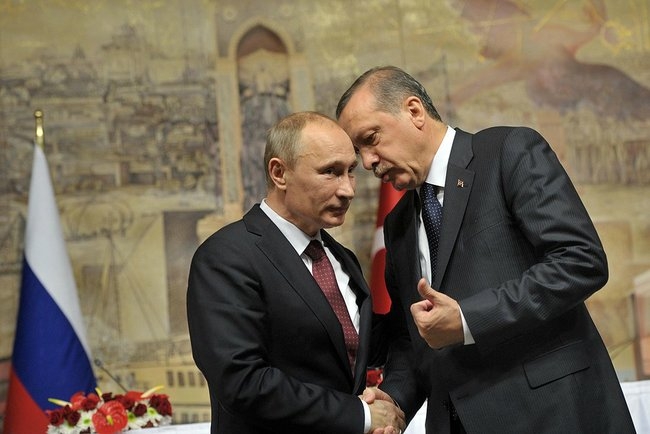
Will direct military involvement in Syria by Turkey and Saudi Arabia spark a NATO-Russia confrontation? Pictured: Russian President Vladimir Putin with Turkish President Recep Tayyip Erdogan (then prime minister), meeting in Istanbul on December 3, 2012. (Image source:kremlin.ru)

Turkey keeps threatening to increase its military role in Syria. Deputy Prime Minister Yalcin Akdogan pledged that Turkey will no longer be in a “defensive position” over maintaining its national security interests amid developments in Syria. “Can any team,” he said, “play defensively at all times but still win a match? … You can win nothing by playing defensively and you can lose whatever you have. There is a very dynamic situation in the region and one has to read this situation properly. One should end up withdrawn because of concerns and fears.”

Is NATO member Turkey going to war in order to fulfill its Sunni sectarian objectives? And are its Saudi allies joining in? If the Sunni allies are not bluffing, they are already giving signals of what may eventually turn into a new bloody chapter in the sectarian proxy war in Syria.

First, Saudi Arabia announced that it was sending fighter jets to the Incirlik air base in southern Turkey, where U.S. and other allied aircraft have been hitting Islamic State strongholds inside Syria. Saudi military officials said that their warplanes would intensify aerial operations in Syria.

Second, and more worryingly, Turkish Foreign Minister Mevlut Cavusoglu said that Turkey and Saudi Arabia could engage in ground operations inside Syria. He also said that the two countries had long been weighing a cross-border operation into Syria — with the pretext of fighting Islamic State, but in fact hoping to bolster the Sunni groups fighting against the Shiite bloc — but they have not yet made a decision.

In contrast, Saudi officials look more certain about a military intervention. A Saudi brigadier-general said that a joint Turkish-Saudi ground operation in Syria was being planned. He even said that Turkish and Saudi military experts would meet in the coming days to finalize “the details, the task force and the role to be played by each country.”

In Damascus, the Syrian regime said that any ground operation inside Syria’s sovereign borders would “amount to aggression that must be resisted.”

It should be alarming for the West if Turkey and Saudi Arabia, two important U.S. allies, have decided to fight a strange cocktail of enemies on Syrian territory, including Syrian forces, radical jihadists, various Shiite forces and, most critically, Russia — all in order to support “moderate” Islamists. That may be the opening of a worse disaster in Syria, possibly spanning over the next 10 to 15 years.

The new Sunni adventurism will likely force Iran to augment its military engagement in Syria. It will create new tensions between Turkey-Saudi Arabia and Iraq’s Shiite-dominated government. It may also spread and destabilize other Middle Eastern theaters, where the Sunni bloc, consisting of Turkey, Saudi Arabia and Qatar, may have to engage in new proxy wars with the Shiite bloc plus Russia.

Washington should think more than twice about allowing its Sunni allies militarily to engage their Shiite enemies. This may be a war with no winners but plenty of casualties and collateral damage. Allowing Sunni supremacists into a deeper sectarian war is not a rational way to block Russian expansion in the eastern Mediterranean. And it certainly will not serve America’s interests.

Turkey with Saudi Arabia are too weak militarily to damage Russia’s interests. It is a Russian trap — and precisely what the Russians are hoping their enemies will fall into.

Burak Bekdil, based in Ankara, is a Turkish columnist for the Hürriyet Daily and a Fellow at the Middle East Forum.

Translate »
Skip to toolbar