
Yearly Archives: 2017

Sentenced to Death for “Insulting Islam” by Majid Rafizadeh

  • Can you imagine making a joke and facing death as a result?”During his interrogation, Sina was told that if he signed a confession and repented, he would be pardoned and let go,” said the source in an interview with CHRI on March 21, 2017. “Unfortunately, he made a childish decision and accepted the charges. Then they sentenced him to death.” “Later he admitted that he signed the confession hoping to get freed,” said the source. “Apparently the authorities also got him to confess in front of a camera as well.” — Center for Human Rights in Iran (CHRI).

  • When the Islamists gain power, they immediately create their own “judiciary system” in order to “legitimize” their implementation of sharia law. In fact, the judiciary system is used less as a tool for bringing people to justice, and more as a tool to suppress freedom of speech and of the press.

To radical Islamist groups, Islam is not a religion which all are free to pursue; it is a weapon. It is the most powerful tool that can be wielded with manipulative skill to control entire populations. Beneath their fierce rule, every aspect of daily life is dictated. What is worn, what is eaten, what you say and what you write are all scrutinized; violations of these stringent laws are met with extreme punishments. Can you imagine making a joke and facing death as a result? Can you imagine the constant fear of doing the wrong thing, saying the wrong thing, when you have seen people beaten, stoned, or killed in the street for nothing more than a mild transgression?

Freedom of speech and press are the Islamists’ top enemies. They are targeted on a regular basis, making it difficult or impossible for the truth to be revealed to the world. While others may take their privacy for granted, the people living under this kind of tyranny must think about everything they say and do. Sometimes even the bravest of souls turn away in the face of such intimidation. Can it really be as restrictive as described? Yes, and far worse than you can imagine.

Sina Dehghan, 21, for example, was arrested by Iran’s Islamic Revolutionary Guard Corps (IRGC) when he was 19 for “insulting Islam”. Charges were brought against him for insulting the Prophet Muhammad on the messaging app LINE.

According to the Center for Human Rights in Iran (CHRI):

“During his interrogation, Sina was told that if he signed a confession and repented, he would be pardoned and let go,” said the source in an interview with CHRI on March 21, 2017. “Unfortunately, he made a childish decision and accepted the charges. Then they sentenced him to death.” “Later he admitted that he signed the confession hoping to get freed,” said the source. “Apparently the authorities also got him to confess in front of a camera as well.”

Such a sentence may seem like madness, but in fact there is a cold and calculated pattern to these actions. When extremist Muslims gain power, they immediately create their own “judiciary system” in order to “legitimize” their implementation of sharia law. This judiciary system is, in fact, used less as a tool for bringing people to justice, and more as a tool to suppress freedom of speech and freedom of the press. Once this silence is ensured, they are able to oppress the entire society, restrain any budding opposition, imprison and torture innocent people and sentence thousands to death.

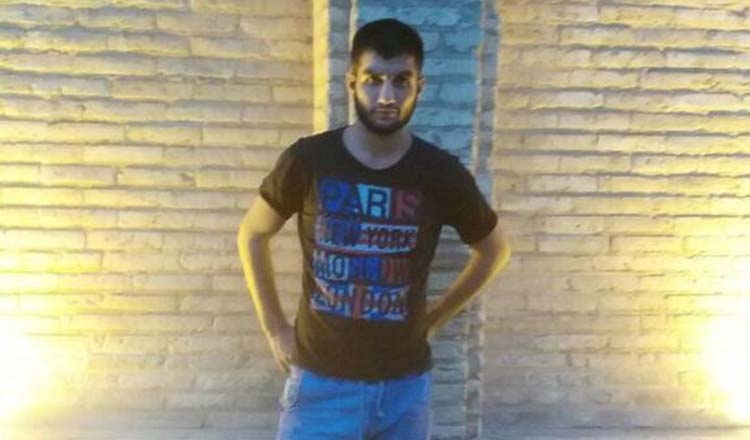
Sina Dehghan, 21, has been sentenced to death in Iran for “insulting Islam”. There are many people like him in Iran who are currently imprisoned, tortured on a daily basis, or awaiting their execution for “insulting Islam”, “insulting the prophet”, “insulting the Supreme Leader” — the examples are endless. (Image source: Center for Human Rights in Iran)

By imprisoning, torturing and hanging idealistic and rebellious young people, the ruling politicians and the Islamist judiciary system are using them as an example to send a message to millions of people that they will not tolerate anyone who opposes their religious or political view.

Radical Islamist groups have been using the same tactic in other nations to impose fear and shock in the public. They aim at silencing people and making them subservient. Once they have control, they will stop at nothing to keep it.

For the Islamists, once you submit to their religion, your freedom of speech and of the press belong to Allah. Your only job is to exercise silence and obedience, and follow your religious leader, imam, sheikh, or velayat-e faqih (“guardianship of the Islamic jurist”).

As the Center for Human Rights in Iran pointed out:

“Security and judicial authorities promised Sina’s family that if they didn’t make any noise about his case, he would have a better chance of being freed, and that talking about it to the media would work against him,” added the source. “Unfortunately, the family believed those words and stopped sharing information about his case and discouraged others from sharing it as well.” “Sina is not feeling well,” continued the source. “He’s depressed and cries constantly. He’s being held in a ward with drug convicts and murderers who broke his jaw a while ago.”

For the ruling Islamists, it does not matter if you have been a loyalist all your life. If you speak up or oppose them just once, you will be eliminated. As CHRI quoted one source: “He was a 19-year-old boy at the time (of his arrest) and had never done anything wrong in his life.”

One of Dehghan’s co-defendants, Mohammad Nouri, was also sentenced to death for posting anti-Islamic comments on social media. Another co-defendant, Sahar Eliasi, was sentenced to seven years, and later the sentence was reduced to three years.

What does the term “anti-Islamic” mean exactly in an Islamist judiciary system? If it carries a death sentence, you might assume that the parameters of the law would be well outlined. However, that is not the case. For the ruling Islamists, the term “anti-Islamic” is completely ambiguous and subjective, and can relate to anything that opposes their view or their power. What might seem like an innocent remark, could change a life forever.

If they are such violent and oppressive people, you might wonder how they are ever able to gain power. They do this through manipulation, charm and countless false promises.

Some radical Islamists, before they gain power, promise people equality, justice, peace, and a far better life. They appeal to the young, to the traditional, and to the hopeful. But once they seize power, they close an iron grip around any and all freedoms, available to their people — in particular freedom of speech.

Once radical Islam has gained power, established its own judiciary system, or infiltrated the legal system with its sharia law, no one is capable of criticizing the government or the political establishment. In a social order ruled by radical Islam, the government is Islam; the government is the representative of Allah and the Prophet Muhammad. Ruling politicians who decide the laws are “divine” figures supposedly appointed by God. They are not to be questioned.

There are many people like Sina Dehghan who are currently imprisoned, tortured on a daily basis, or awaiting their execution for “insulting Islam”, “insulting the prophet”, “insulting the Supreme Leader” — the examples are endless. The issue is that we do not hear about these cases. Some media outlets refuse to report on them in order to appease the Islamic Republic of Iran — just further proof of how coercive their power can be. The only way to reduce it — and the oppression and slaughter of so many people — is to bring attention to the human rights abuses conducted under the Islamic banner of religious “legitimacy ” and “authenticity”.

This type of tyranny is a danger, not just for those enduring it, but for the world.

Selling Out Pentecost to Islam by Geert Wilders

  • The Dutch have officially been enjoying the feast of Pentecost since 1815, but the church wants it replaced by an official holiday on Eid-al-Fitr, the day marking the end of the Islamic holy month of Ramadan.
  • We are too tolerant to intolerance. We think that by allowing freedom to the enemies of freedom we prove to the world that we stand for freedom. But in reality, by refusing to draw boundaries to our tolerance, we are handing away our freedom.

  • If we want to remain the free and tolerant society which we used to be, we must realize that the West has a concrete identity. Our identity is not Islamic, but based on Judaism, Christianity and humanism. Our freedoms result from this identity.

Next Sunday, Christians are celebrating the feast of Pentecost. A Protestant church in the Netherlands is using the occasion to propose the abolishment of the public holiday for the second day of Pentecost. The Dutch have officially been enjoying this holiday since 1815, but the church wants it replaced by an official holiday on Eid-al-Fitr, the day marking the end of the Islamic holy month of Ramadan.

With its proposal, the Christian group says, it wants “to do justice to diversity in religion.” That is politically-correct claptrap. Browsing through today’s papers, I can, however, understand why many Dutch are in a festive mood once Ramadan is over! These days, the headlines are full of incidents, which De Telegraaf, the leading newspaper in the Netherlands, describes as Ramadan rellen (Ramadan riots).

Suppose Christians would, on an annual basis, start to riot after leaving church on Pentecost and demolish property, arson cars, attack police, throw stones through the neighbor’s windows. Suppose the police would feel obliged to mark the Christian Lent in the calendar as days of heightened tensions. Would we not begin to wonder whether there was something wrong with Christianity?

Or suppose Jewish gangs would terrorize entire town districts on Yom Kippur day. Would we not beginning to wonder what they were being taught in their synagogues? Or would we just accept it, celebrate it even, as indications of the cultural “diversity” of our society?

I am writing these lines in my office in the Dutch Parliament in The Hague, barely a few minutes away from the house where the great 17th century Dutch and Jewish philosopher Baruch Spinoza lived and died. Spinoza gave the world a philosophy of tolerance and freedom.

However, what we must never do is be tolerant to intolerance. Because if tolerance becomes a snake devouring its own tail, soon there will be no freedom left and the intolerant will rule the world. Indeed, we are almost there. Three and a half centuries after Spinoza, in the city where he lived, I am writing these lines in a heavily protected sector of the parliament building. The windows are blinded, the doors are armored, and police officers are standing watch outside. They are there to protect me against the intolerance which has in recent decades entered our country – an intolerance that is neither Christian nor Jewish or secular, but Islamic. I am not an extremist if I say that. I am telling the truth. And that is my duty.

For here is the crux of the matter: If we want to remain the free and tolerant society which we used to be, we must realize that the West has a concrete identity. Our identity is not Islamic, but based on Judaism, Christianity and humanism. Our freedoms result from this identity. By depriving Islam of the means to destroy our identity, we are not violating freedom; we are preserving our identity and guaranteeing freedom.

The terrible situation we are in today is caused by our tolerance of evil. We are too tolerant to intolerance, we are too tolerant to Islam. We think that by allowing freedom to the enemies of freedom we prove to the world that we stand for freedom. But in reality, by refusing to draw boundaries to our tolerance, we are handing away our freedom.

We live in an age where people like the idea of rights, so long as they do not have to pay a price for it. The political and media elites are all in favor of speaking the truth, so long as the “truth” is a cliché. But when duty and honor command them to stand athwart history and yell “Stop!” they flee. And those who do their duty are called extremists, dragged to court, silenced.

Earlier today, I learned that the Dutch Public Prosecutor in The Hague is investigating a speech which, two years ago, I gave in Vienna, Austria. He is doing this at the request of his colleague, the Public Prosecutor in Vienna, who accuses me of Verhetzung (incitement). The latter is a criminal offense in Austria and is comparable to incitement.

I find this truly unbelievable. Let them catch bandits and terrorists instead of prosecuting a politician for speaking about Islam. It is a disgrace that this is happening in the city of Spinoza, who was not only a great defender of tolerance but also of freedom of thought and speech. Spinoza’s face used to adorn one of our bank notes in the time when we still had our own currency. Too bad that this is no longer the case today.

Unbelievable also because it would be the third time in a few years that I would be prosecuted for saying things the elites do not want to hear. It is a legal jihad. While the elites are to blame for the existential crisis we are currently in. With their open border-policies and unprecedented love for Islam and their cultural relativism, they sell us out completely and put our freedom and security at stake. They have abandoned the legacy of Spinoza and introduced the totalitarianism of Mohammedanism in our nations. I say: no more. It is time to do our duty and defend our freedom and the freedom of our children.
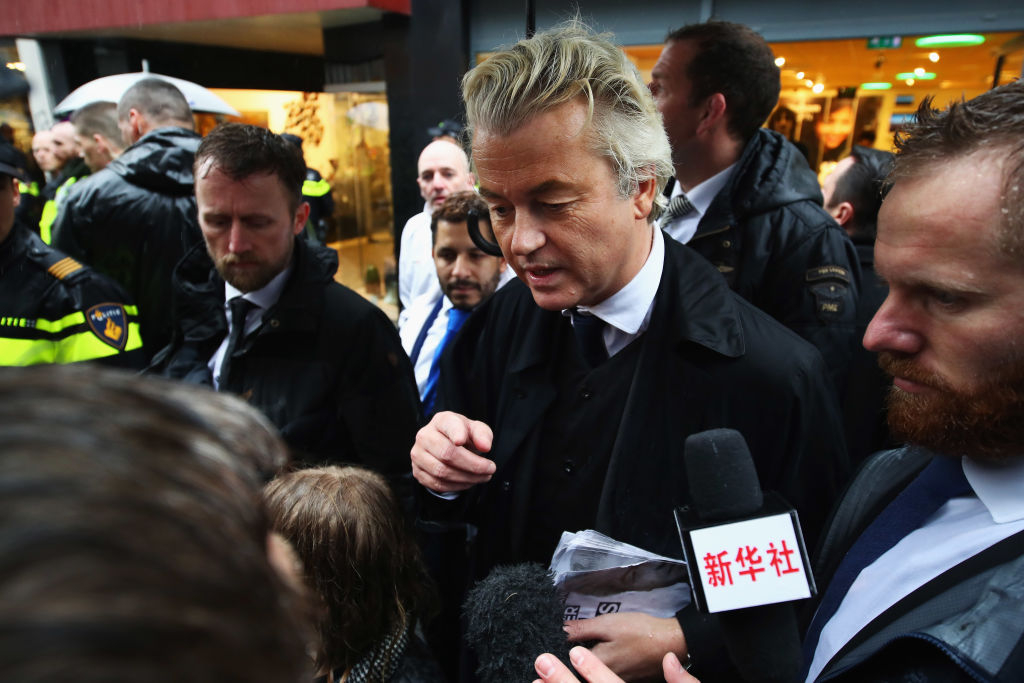
Geert Wilders on March 8, 2017 in Breda, Netherlands. (Photo by Dean Mouhtaropoulos/Getty Images)

Geert Wilders MP is leader of the Party for Freedom (PVV) in The Netherlands.
Self-Censorship: Free Society vs. Fear Society by Giulio Meotti

  • “The drama and the tragedy is that the only ones to win are the jihadists.” — Flemming Rose, who published the Mohammed cartoons in 2005, as cultural editor of JyllandsPosten newspaper.

  • “Why the f*ck did you say yes to appear on stage with this terrorist target, are you stupid? Do you have a secret death wish? You have grandchildren now. Are you completely out of your mind? It’s okay if you want to die yourself, but why are you taking the company though all this?” — The managers of Jyllands-Posten, to Flemming Rose.
  • “We are also aware that we therefore bow to violence and intimidation.” — Editorial, Jyllands-Posten.
  • “I do not blame them that they care about the safety of employees. I have bodyguards 24 hours a day. However, I believe that we must stand firm. If Flemming shuts his mouth, democracy will be lost.” — Naser Khader, a liberal Muslim of Syrian origin who lives in Denmark.

In the summer of 2005, the Danish artist Kåre Bluitgen, when he met a journalist from the Ritzaus Bureau news agency, said he was unable to find anyone willing to illustrate his book on Mohammed, the prophet of Islam. Three illustrators he contacted, Bluitgen said, were too scared. A few months later, Bluitgen reported that he had found someone willing to illustrate his book, but only on the condition of anonymity.

Like most Danish newspapers, Jyllands-Posten decided to publish an article about Bluitgen’s case. To test the state of freedom of expression, Flemming Rose, JyllandsPosten’s cultural editor at the time, called twelve cartoonists, and offered them $160 each to draw a caricature of Mohammed. What then happened is a well-known, chilling story.

In the wave of Islamist violence against the cartoons, at least two hundred people were killed. Danish products vanished from shelves in Bahrain, Qatar, Yemen, Oman, the UAE and Lebanon. Masked gunmen stormed the offices of the European Union in Gaza and warned Danes and Norwegians to leave within 48 hours. In the Libyan city of Benghazi, protesters set fire to the Italian consulate. Political Islam understood what was being achieved and raised the stakes; the West did not.

An Islamic fatwa also forever changed Flemming Rose’s life. In an Islamic caricature, his head was put on a pike. The Taliban offered a bounty to anyone who would kill him. Rose’s office at the newspaper was repeatedly evacuated for bomb threats. And Rose’s name and face entered ISIS’s blacklist, along with that of the murdered editor of Charlie Hebdo, Stéphane Charbonnier.

Less known is the “white fatwa” that the journalistic class imposed on Rose. This brave Danish journalist reveals it in a recently published book, “De Besatte” (“The Obsessed“). “It is the story of how fear devours souls, friendships and the professional community,” says Rose. The book reveals how his own newspaper forced Rose to surrender.

“The drama and the tragedy is that the only ones to win are the jihadists,” Flemming Rose told the Danish newspaper Weekendavisen.

The CEO of JyllandsPosten, Jørgen Ejbøl, summoned Rose to his office, and asked, “You have grandchildren, do not you think about them?”

The company that publishes his newspaper, JP/Politikens Hus, said: “It’s not about Rose, but the safety of two thousand employees.”

Jorn Mikkelsen, Rose’s former director, and the newspaper’s business heads, obliged him to sign a nine-point diktat, in which the Danish journalist accepted, among other demands, “not participating in radio and television programs”, “not attending conferences”, “not commenting on religious issues”, “not writing about the Organization of the Islamic Conference” and “not commenting on the cartoons”.

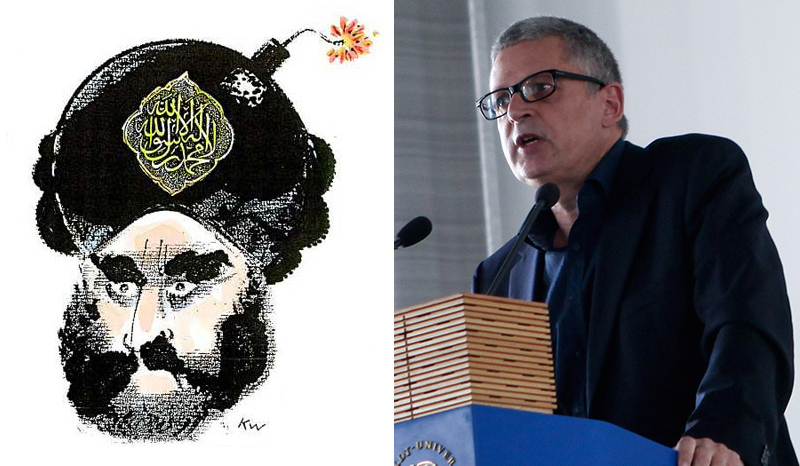
Rose signed this letter of surrender during the harshest time for the newspaper, when, in 2010-2011, there were countless attempts on his life by terrorists, and also attempts on the life of Kurt Westergaard, illustrator of a cartoon (Mohammed with a bomb in his turban) that was burned in public squares across the Arab world. Westergaard was then placed on “indefinite leave” by Jyllands-Posten “for security reasons.”

Is democracy lost? Eleven years after Jyllands-Posten published the Mohammed cartoons, the newspaper has a barbed-wire fence two meters high and one kilometer long. Kurt Westergaard, the illustrator who drew one of the cartoons (left), lives in hiding in a fortress, and Flemming Rose (right), the editor who commissioned the cartoons, has fled to the United States.

In his book, Rose also reveals that two articles were censored by his newspaper, along with an outburst from the CEO of the company, Lars Munch: “You have to stop, you’re obsessed, on the fourth floor there are people who ask ‘can’t he stop?'”.

Rose then drew more wrath from his managers when he agreed to participate in a conference with the equally targeted Dutch parliamentarian, Geert Wilders, who at this moment is on trial in the Netherlands for “hate speech.” Rose writes:

He starts yelling at me, “Why the f*ck did you say yes to appear on stage with this terrorist target, are you stupid? Do you have a secret death wish? You have grandchildren now. Are you completely out of your mind? It’s okay if you want to die yourself, but why are you taking the company though all this?”

Jyllands-Posten also pressured Rose when he decided to write a book about the cartoons, “Hymne til Friheden” (“Hymn to Freedom“). His editor told him that the newspaper would “curb the harmful effects” of the book by keeping its publication as low-key as possible. Rose was then threatened with dismissal if he did not cancel two debates for the tenth anniversary of the Mohammed cartoons (Rose, in fact, did not show up that day at a conference in Copenhagen).

After the 2015 massacre at Charlie Hebdo, Rose, no longer willing to abide by the “diktat” he was ordered to sign, resigned as the head of the foreign desk of Jyllands-Posten, and now works in the U.S. for the Cato Institute think-tank. The former editor of Jyllands-Posten, Carsten Juste, who was also blacklisted by ISIS, confirmed Rose’s allegations.

Rose writes in the conclusion of his book: “I’m not obsessed with anything. The fanatics are those who want to attack us, and the possessed are my former bosses at Jyllands-Posten.”

Rose’s revelations confirm another familiar story: Jyllands-Posten‘s surrender to fear. Since 2006, each time its editors and publishers were asked if they still would have published the drawings of Mohammed, the answer has always been “no.” This response means that the editors had effectively tasked Rose with writing the newspaper for fanatics and terrorists thousands of kilometers away. Even after the January 7, 2015 massacre at the weekly Charlie Hebdo in Paris, targeted precisely because it had republished the Danish cartoons, Jyllands-Posten announced that, out of fear, it would not republish the cartoons:

“We have lived with the fear of a terrorist attack for nine years, and yes, that is the explanation why we do not reprint the cartoons, whether it be our own or Charlie Hebdo’s. We are also aware that we therefore bow to violence and intimidation.”

A Danish comedian, Anders Matthesen, said that the newspaper and the cartoons were to blame for the Islamist violence — the same official position as the entire European political and journalistic mainstream.

A year ago, for the 10th anniversary of the affair, instead of the cartoons, Jyllands-Posten came out with twelve white spaces. These white spaces represent what Rose, in his previous book, called “Tavshedens tiranni” (“The Tyranny of Silence“). Naser Khader, a liberal Muslim of Syrian origin who lives in Denmark, wrote:

“I do not blame them that they care about the safety of employees. I have bodyguards 24 hours a day. However, I believe that we must stand firm. If Flemming shuts his mouth, democracy will be lost.”

Is democracy lost? The headquarters of Jyllands-Posten today has a barbed-wire fence two meters high and one kilometer long, a door with double lock (as in banks), and employees can only enter one at a time by typing in a personal code (a measure that did not protect Charlie Hebdo). Meanwhile, the former editor, Carsten Juste, has withdrawn from journalism; Kurt Westergaard lives in hiding in a fortress, and Flemming Rose, like Ayaan Hirsi Ali, fled to the United States.

Much, certainly, looks lost. “We are not living in a ‘free society’ anymore, but in a ‘fear society'”, Rose has said.

Giulio Meotti, Cultural Editor for Il Foglio, is an Italian journalist and author.

Selective Outrage on Campus by Alan M. Dershowitz

Following the forced resignations of the President and Provost of the University of Missouri, demonstrations against campus administrators has spread across the country. Students — many of whom are Black, gay, transgender and Muslim — claim that they feel “unsafe” as the result of what they call “white privilege” or sometimes simply privilege.


“Check your privilege” has become the put-down du jour. Students insist on being protected by campus administrators from “micro-aggressions,” meaning unintended statements inside and outside the classroom that demonstrate subtle insensitivities towards minority students. They insist on being safe from hostile or politically incorrect ideas. They demand “trigger warnings” before sensitive issues are discussed or assigned. They want to own the narrative and keep other points of view from upsetting them or making them feel unsafe.

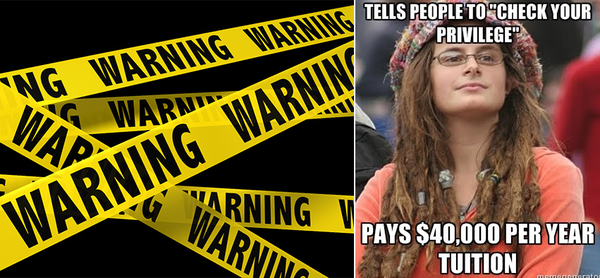
Many university students, manifesting a widespread culture of victimization and grievance, claim that they feel “unsafe” as the result of what they call “white privilege”. “Check your privilege” has become the put-down du jour.

These current manifestations of a widespread culture of victimization and grievance are only the most recent iterations of a dangerous long-term trend on campuses both in the United States and in Europe. The ultimate victims are freedom of expression, academic freedom and the free exchange of ideas. Many faculty members, administrators and students are fearful of the consequences if they express politically incorrect or dissident views that may upset some students. So they engage in self-censorship. They have seen what had happened to those who have expressed unpopular views, and it is not a pretty picture.

I know, because I repeatedly experienced this backlash when I speak on campuses. Most recently, I was invited to deliver the Milton Eisenhower lecture at Johns Hopkins University. As soon as the lecture was announced, several student groups demanded that the invitation must be rescinded. The petition objected to my mere “presence” on campus, stating that my views on certain issues “are not matters of opinion, and cannot be debated” and that they are “not issues that are open to debate of any kind.” These non-debatable issues include some of the most controversial concerns that are roiling campus today: sexual assault, academic integrity and the Israel-Palestine conflict. The protesting students simply didn’t want my view on these and other issues expressed on their campus, because my lecture would make them feel unsafe or uncomfortable.

The groups demanding censorship of my lecture included Hopkins Feminists, Black Student Union, Diverse Sexuality and General Alliance, Sexual Assault Resource Unit and Voice for Choice. I have been told that two faculty members urged these students, who had never heard of me, to organize the protests, but the cowardly faculty members would not themselves sign the petition. The petition contained blatant lies about me and my views, but that is beside the point. I responded to the lies in my lecture and invited the protesting students to engage me during the Q and A. But instead, they walked out in the middle of my presentation, while I was discussing the prospects for peace in the Middle East.

According to the Johns Hopkins News-Letter, another petition claimed that “by denying Israel’s alleged war crimes against Palestinians,” I violated the university’s “anti-harassment policy” and its “statement of ethical standards.” In other words, by expressing my reasonable views on a controversial subject, I harassed students.

Some of the posters advertising my lecture were defaced with Hitler mustaches drawn on my face. Imagine the outcry if comparably insensitive images had been drawn on the faces of invited minority lecturers.

I must add that the Johns Hopkins administration and the student group that invited me responded admirably to the protests, fully defending my right to express my views and the right of the student group to invite me. The lecture went off without any hitches and I answered all the questions — some quite critical, but all polite — for the large audience that came to hear the presentation.

The same cannot be said of several other lectures I have given on other campuses, which were disrupted by efforts to shout me down, especially by anti-Israel groups that are committed to preventing pro-Israel speakers from expressing their views.

The point is not only that some students care less about freedom of expression in general than about protecting all students from “micro-aggressions.” It is that many of these same students are perfectly willing to make other students with whom they disagree with feel unsafe and offended by their own micro- and macro-aggressions. Consider, for example, a recent protest at the City University of New York by Students for Justice in Palestine that blamed high tuition on “the Zionist Administration [of the University that] invests in Israeli companies, companies that support the Israeli occupation, hosts birthright programs and study abroad programs in occupied Palestine [meaning Israel proper] and reproduces settler-colonial ideology throughout CUNY though Zionist content of education.”

Let’s be clear what they mean by “Zionist”: they mean “Jew”. There are many Jewish administrators at City University. Some are probably Zionists. Others are probably not. Blaming Zionists for high tuition is out and out anti-Semitism. It is not micro-aggression. It is in-your-face macro-aggression against City University Jews.

Yet those who protest micro-aggressions against other minorities are silent when it comes to Jews. This is not to engage in comparative victimization, but rather to expose the double standard, the selective outrage and the overt hypocrisy of many of those who would sacrifice free speech on the altar of political correctness, whose content they seek to dictate.

Alan M. Dershowitz is the Felix Frankfurter Emeritus Professor at Harvard Law School and the author of two new books: “The Case Against the Iran Deal: How Can We Now Stop Iran from Getting Nukes?, ” available on Kindle and other e-book sites and Abraham: The World’s First (But Certainly Not Last) Jewish Lawyer, available on Amazon.

Secularism: Everyone Wants to Get Rid of It by Yves Mamou

  • Now, after more than a century of separation of powers between church and state, an intolerant and extremist Islam is disrupting the rules of the game, invading public spaces, schools, universities and companies with the veil, halal food and open violence.

  • “By making the public space empty of everything that brings us together… Islamists are eager to fill it, especially in disillusioned, brainless and uprooted young heads”. — François Fillon, a former Prime Minister of France, who is running for president in the 2017 election.
  • “Secularism is just becoming a religion opposed to all other religions”, said Tariq Ramadan, a prominent figure of the Muslim Brotherhood in Switzerland and France. He congratulated mayors on Christmas nativity scenes probably because he sees it as an opening for Islamic opportunities in the public sphere. “We need a Republic authorizing the visibility of diversity and not a Republic of neutrality,” he said.

Can a French municipality erect a statue of the Virgin Mary in a public park? The answer is No. France’s Administrative Court has given the mayor of Publier, in eastern France (population 6500), three months to comply with the ban on religious symbols in public spaces and to remove the statue. If the municipality fails to do so, it will be fined €100 ($105) a day. Mayor Gaston Lacroix said he will try to relocate the marble statue on private land.

France’s 1905 Law on the Separation of the Churches and the State (Article 2) states that “The Republic does not recognize, pay or subsidize any religious sect”; article 28 prohibits any religious symbol on public monuments.

The Virgin May statue in Publier, on the bottom of which is inscribed “Our Lady of Geneva Lake watch over your children”, has a long story. It was installed in the town park in August 2011, without debate. The statue was acquired with taxpayer money: €23,700 (USD $26,000). Acknowledging at the time that he had “joked a little with the 1905 law” on the separation of church and the state, the mayor had to sell the statue to a local religious association.

Now, the mayor has to remove the statue from the public park. He tried to privatize the piece of land where the statue is erected, but the land-sale project was rejected by the court.

This story of a statue of the Virgin Mary illustrates the difficulties of secularism, the defense of French identity, the fight against Islamism, and the contradictory interests of different political parties in France.

Originally, secularism in France was established to push religion out of the public sphere. An authentic war was conducted at the end of 19th century and beginning of 20th to push a very obscurantist Catholic Church out of all public spaces. According to historian Jacques Julliard:

“Mgr de Quélen, Archbishop of Paris, remains famous for having said ‘not only was Jesus the son of God, but his mother came from a very good family’. For the Republic, fighting the church was a fight for the liberation of the minds, for the construction of a school for knowledge (against belief) liberated from priests, the building of an open society…”

Now, after more than a century of separation of powers between church and state, an intolerant and extremist Islam is disrupting the rules of the game, invading public spaces, schools, universities and companies with the veil, halal food and open violence. But instead of uniting against this troublemaker, French society today is openly divided.

French state institutions and the political class (left and right) are fully responsible for this division, which is also the result of confusion. Instead of naming Islamism the enemy, all governments, left and right, have chosen the wrong path of appeasement and increasing concessions — refusing to name Islamism as solely responsible for terrorism, refusing to consider the Islamic veil as a tool of separatism, and letting Salafist mosques multiply — in the vain hope of calming what is claimed to be the legitimate anger of Muslims against “discrimination”.

Because the state refused or was unable to elaborate a strategy for a renewed secularism, actors on the ground (especially mayors of the 35,000 municipalities of France) were left alone. In 2014 and 2015, some of them (no one knows how many) chose to install or subsidize nativity scenes in the lobbies of their city halls. Immediately, French political passions burst into the debate.

Free thinkers, all parties of the left and the extreme left, green parties and partisans of multiculturalism went to court to fight the Christ child’s cribs. On the opposite side, some on the right and the extreme right supported the Christ child’s crib. In the middle, some supporters of secularism tried to calm everyone down, but without great success.

On November 14, 2014, the Administrative Court of Nantes decided on appeal to strike down the initial prohibition of a Christmas nativity scene in the Departmental Hall of Vendée. In another case, on October 8, 2015, the Administrative Court of Paris struck down on appeal an initial judgement authorizing the mayor of Melun to display a nativity crib.

On December 1, 2016, the Lille Administrative Court cancelled the decision of the municipality of Henin-Beaumont (affiliated with the “far right” Front National) to install a Christmas nativity crib in the lobby of City Hall.

In November 2015, just before the Islamic terrorist attacks in Paris, in which 130 people were murdered, the powerful Association of Mayors of France (AMF) relaunched the controversy by recommending, in the name of secularism, not to install Christmas nativity scenes. Immediately, three mayors from the Front National, and some others from the opposition party, Les Republicains, left the AMF. Marion Maréchal-Le Pen of the National Front, and the granddaughter of the party’s founder, stated:

“This recommendation is a provocation. Secularism is the neutrality of public authorities regarding religions, separation of Church and State, and refusal to finance any sect, but secularism does not mean the disappearance of our folk traditions that may have a religious connotation. Catholic in particular.”

Nicolas Dupont-Aignan, president of Debout La France (“Stand Up France”), said AMF’s decision is “silly”. He added:

“French people cherish their culture. Some mayors put Christmas cribs in their town halls, others do not. If French people love Christmas trees, find it convenient to call Easter holidays “Easter holidays,” and have Christian cribs in city halls, let them do it. Do not cut the roots of the French, stop denying our people the right to be themselves.”

On the left, most leaders refused to comment because they were afraid to engage in a debate with the Front National.

On November 9, 2016, the Conseil d’État (Council of State), the highest administrative court in France, edited guidelines for local administrative courts to allow Christmas nativity scenes in city halls, but under strict conditions (no proselytizing). In others words, a Christian display is authorized if all elements of Christianity are removed from it. A nativity scene must be “folklore” to be authorized, and nativity cribs that belong to a religious organization remain prohibited in city halls.

If nativity scenes are an extremely ancient Christian tradition, the installation of Christmas nativity scenes in city halls is very recent. One of the oldest was inaugurated in 1989. In most instances, displaying nativity scenes was a reaction to try to preserve French culture, and a claim to preserve the Christian roots of France — mostly, and without saying it — against Islam.

François Fillon, a former Prime Minister of France, who is running for president in the 2017 election as the candidate of the main center-right party, welcomed the decision of the Council of State. In Valeurs Actuelles, he said:

“Christmas has long since left the only sectarian domain, the one of religion, to get into the cultural universe, that of civilization… By making the public space empty of everything that brings us together, by sucking everything that makes the thickness and depth of the collective being French, secularism is, paradoxically, the useful idiot of sectarianism: all the space it empties, Islamists are eager to fill it, especially in disillusioned, brainless and uprooted young heads”.

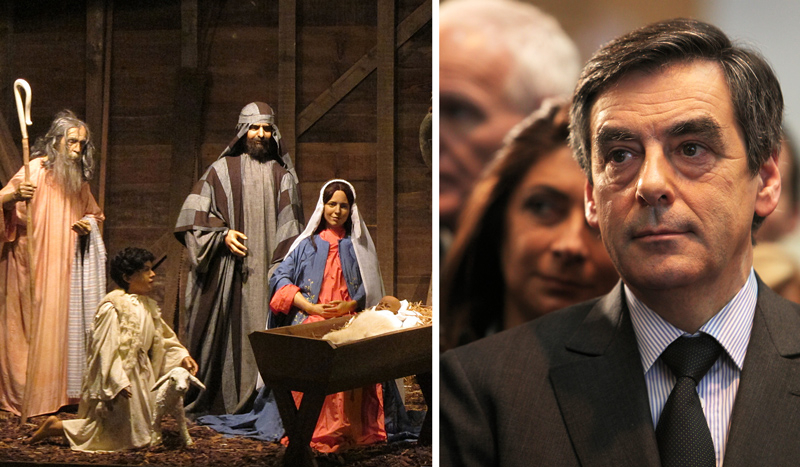
In France, François Fillon (right), a former Prime Minister who is running for president in the 2017 election, welcomed a recent court decision to allow Christmas nativity scenes in city halls.

This argument, of “secularism as a vacuum”, was also developed by Philippe de Villiers, a prominent figure of the right and founder of Movement for France (MPF). In the weeks before the Council of State’s decision, Villiers gave an interview to Le Figaro entitled, “Yes to nativity cribs, No to djallabas“. He explained:

“I expect the Council of State to make the choice, not of a secular vacuum, which would be an in-draft to Islam, but to make the choice of a living secularism, which is consistent with our traditions…. The Council of State said “yes” to the burkini. If they say “no” to Christmas nativity scenes, (they) will no longer be the Council of State of France that protects us. They will become the Council of Islamic State”.

The debate seems booby-trapped. Because the left has been unable to renew and impose secularism, today the “right” and Islamists have agreed to get rid of it.

“Secularism is just becoming a religion opposed to all other religions”, said Tariq Ramadan, a prominent figure of the Muslim Brotherhood in Switzerland and France, in 2014. He congratulated mayors on Christmas nativity scenes probably because he sees it as an opening for Islamic opportunities in the public sphere. “We need a Republic authorizing the visibility of diversity, and not a Republic of neutrality,” Ramadan said.

Yves Mamou is a journalist and author based in France. He worked for two decades for the daily, Le Monde, before his retirement.

Translate »
Skip to toolbar