Monthly Archives: June 2017

Ramadan: “A Month of Great Conquests” by Judith Bergman

  • “Ramadan has been not only a month of worship and of growing close to Allah the Almighty, but also a month of action and jihad aimed at spreading this great religion… throughout [Muslim] history, Ramadan has been a month of great conquests….”. — ‘Ali Gum’a, then Grand mufti of Egypt, Al-Ahram in July 2012.

  • “According to Islamic practice, sacrifice during Ramadan can be considered more valuable than that made at other times, so a call to martyrdom during the month may hold a special allure to some.” — Report by the U.S. State Department-led Overseas Security Advisory Council, The Independent, June 9, 2016.
  • “Jihad in the Arabic language… means: …striving… where the cause/objective is goodness & justice…Holy war [is] not an expression in the Qur’an: War is NEVER holy.” — Anna Cole, ‘inclusion specialist’ for the UK Association of School and College Leaders (ASCL), which represents more than 18,000 head teachers and college leaders.

“Our fight is Jihad and an obligatory worship. And every obligatory act of worship has 70 times more reward in Ramadan,” said Zabihullah Mujahid, spokesman for the Taliban, rejecting U.N.-led calls for halting hostilities during Ramadan.

ISIS also just released a YouTube message — quoting the Quran — urging its supporters to attack the “infidels… in their homes, their markets, their roads and their forums…”

“double your efforts and intensify your operations… Do not despise the work. Your targeting of the so-called innocents and civilians is beloved by us and the most effective, so go forth and may you get a great reward or martyrdom in Ramadan”.

An article in the Ramadan issue of ISIS’ Rumiyah magazine told readers to use the month of Ramadan to “maximise the benefit you receive on the day of judgement”.

ISIS’s call for increased jihad during the month of Ramadan is now a yearly occurrence. Last year, after an audio message by the ISIS spokesman at the time, Abu Mohammad al-Adnani, calling on jihadists to “get prepared, be ready … to make it a month of calamity everywhere for nonbelievers…especially for the fighters and supporters of the caliphate in Europe and America”, the U.S. government warned citizens at home and abroad of an increased terrorist risk:

“According to Islamic practice, sacrifice during Ramadan can be considered more valuable than that made at other times, so a call to martyrdom during the month may hold a special allure to some.”

This year, the day the Ramadan began, Friday, May 26, 2017, jihadists attacked a bus filled with Coptic Christians travelling to a monastery in Egypt, and murdered 29 of them. Ten of the victims were children; one, only two years old. A few days earlier, jihadists in the Philippines warmed up for Ramadan by murdering 14 Christians and wounding more than 50. The Muslim Abu Sayyaf group, linked to Al Qaeda, claimed responsibility. The day after the beginning of Ramadan, May 27, a Taliban suicide bomber murdered 18 people in Afghanistan, two of them children.
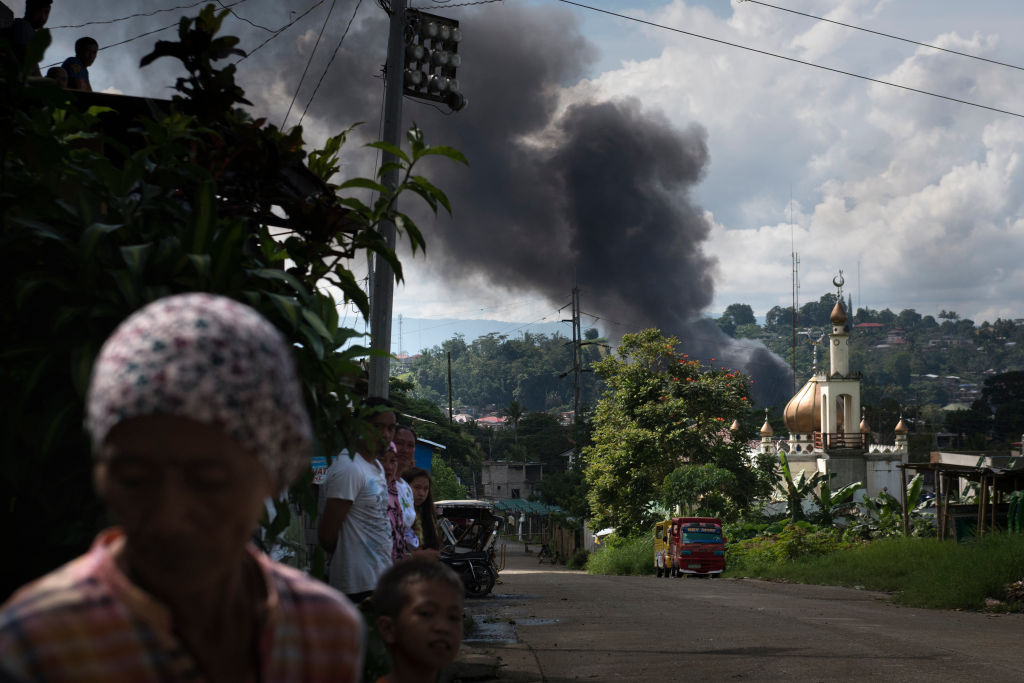
Smoke rises from the scene of fighting in Marawi city, southern Philippines, on May 30. The Philippine Army is fighting the Islamic Abu Sayyaf terrorist group in the streets of the city. Abu Sayyaf murdered 14 Christians and wounded more than 50 in bombing attacks since Ramadan began on May 26. (Image source: Jes Aznar/Getty Images)

Ramadan in 2016 was one of the bloodiest in recent times. Estimates that at least 421 people were killed and 729 wounded in nearly 15 countries during that month alone. ISIS alone claimed to have killed or wounded more than 5,000 people, including the 49 people killed at a nightclub in Orlando, and 300 murdered in Baghdad.

Ramadan, evidently, is not only about religious spirituality and devotion. It appears to be also a month of jihad. In an article published in the Egyptian daily Al-Ahram in July 2012, then-Grand mufti of Egypt ‘Ali Gum’a wrote:

“[Throughout the history of] Islamic civilization, Ramadan has been not only a month of worship and of growing close to Allah the Almighty, but also a month of action and jihad aimed at spreading this great religion… throughout [Muslim] history, Ramadan has been a month of great conquests, which were an important factor in spreading Islam, [with] its righteousness and tolerance, across the world…”

Gum’a then lists a number of battles that occurred during the month of Ramadan from the battle of Badr in 624 up until the 1973 Yom Kippur war, known in the Arab world as the Ramadan War.

In 2001, Egyptian cleric and Al-Azhar lecturer Dr. Fuad Mukheimar wrote, “The nation’s fasting is [itself] education for jihad, and as long as the nation fasts it will continue to be a jihad fighter.”

In 2012, a Muslim Brotherhood member, Hussein Shehata, a lecturer at Al-Azhar University — considered the world’s leading center for Sunni Islamic learning — wrote:

“Fasting [during Ramadan] is one of the most powerful means to educate the human spirit for jihad. Fasting involves a spiritual effort to act in a way contrary to what is accepted, and to completely abandon desires… It also schools the Muslim in patience, resilience, endurance, and sacrifice, which are all traits of the jihad fighter… Ramadan is the month of victory for those who wage jihad for Allah. Ramadan has seen the following battles, conquests, and victories: the great Battle of Badr [624 CE],… the conquest of Mecca [630 CE]… We call upon those who fast… to remember their brothers, those who wage jihad for the sake of Allah: in Palestine, against the Jews, the descendants of apes and pigs; in Iraq, against the Americans; in Bosnia-Herzegovina, against the crusader Serbians; in Chechnya, against the Russians; in Kashmir, against the idolatrous Indians… everywhere in [the lands of] the Islamic ummah [community], against those who fight the Muslims”.

Muslim Brotherhood General Guide Muhammad Badi’ wrote on the movement’s website in August 2012:

“Allah the Almighty wanted the [Ramadan] fast to coincide with fighting, so that the Muslims would win and deal their enemies a crushing blow… Allah did not mandate [the fast] of Ramadan so that [we] sit idly and avoid jihad, action, and da’wa for the sake of Allah… it is a month of action and movement, of conquests and victories — the month in which most of the defeats of the nation’s enemies occurred…”

In an unprecedented move, after the attack on Coptic Christians, Egypt cancelled its annual celebrations marking the beginning of Ramadan.

While jihadists wage war on the West during Ramadan, the West pretends that Ramadan is just another religious holiday of purely spiritual significance. Some in the West eagerly seek to accommodate the Ramadan. In the UK, for example, the Association of School and College Leaders (ASCL), which represents more than 18,000 head teachers and college leaders, has recommended that schools accommodate students who observe Ramadan; guidelines were issued in a paper authored by the ASCL’s ‘inclusion specialist’ Anna Cole.

The ASCL urges schools to move revision classes and to consider rescheduling sports days to accommodate the needs of Muslim pupils fasting for Ramadan. It also urges that schools “show sensitivity” when organizing graduation celebrations, and change physical exercise lesson plans to make sure that activities are “less strenuous”. Schools are also asked to provide prayer rooms. Last year, efforts to move school exams because of Ramadan were stopped by British education authorities.

It needs to be noted that the ACSL has authored another pamphlet, also written by Anna Cole, ‘Safeguarding children from extremism and radicalisation’, which posits that, “ISIS is a “political ideology, which falsely portrays itself as being authentic Islam, which can be confusing to pupils whose understanding of Islam may be weak”. According to the ACSL, jihad and holy wars are ‘myths’:

“Jihad in the Arabic language… means: …striving… where the cause/objective is goodness & justice…Holy war [is] not an expression in the Qur’an: War is NEVER holy. In Islam war is either justified or not”.

Accommodating Ramadan is nothing new in certain Swedish schools, where this has been a reality for years. In the Swedish city of Jönköping, an agreement between education officials in the municipality and local Muslim groups, ensuring special treatment for Muslim children, was allegedly in place already in 1994. In 2011, it was revised to include how schools should deal with Ramadan. The municipality was later reported to the national education authorities in Sweden; the charge was that the agreement legitimizes oppression and control over Muslim children.

Swedish diplomats are also eager to accommodate Ramadan. In May, they caused a small Facebook storm among Swedish users when they announced that they had moved the national holiday celebrations at their general consulate in Jerusalem, scheduled for June 6, forward to May in order to avoid a ‘clash’ with the Ramadan.

How many more people will be murdered in the name of jihad this Ramadan, while the West refuses even to know what it means?

Judith Bergman is a writer, columnist, lawyer and political analyst.
Radical Islamists Gaining Strength in Kashmir by Jagdish N. Singh

  • The separatist leaders in Kashmir, as often happens with opponents (such as the Palestinians or Iran) seem to take any willingness to negotiate as sign of weakness, and start pursuing their own agendas with even more aggression.
  • Their agenda of the separatists has consistently been one of radical Islamist rule in Kashmir.

  • “They [the separatists] are not ready for it [a political solution]. They are not ready even to open their doors. They enjoy fuelling violence and getting innocents killed,” said Ram Madhav, General Secretary of India’s ruling Bharatiya Janata party.

The refusal of Kashmiri separatist leaders to meet an all-party Indian parliamentary delegation led by India’s Home Minister, Rajnath Singh, that visited Kashmir on September 4-5 to strike a political solution for the strife-torn state, was hardly surprising. The separatist leaders in Kashmir, as often happens with opponents (such as the Palestinians or Iran) seem to take any willingness to negotiate as sign of weakness, and start pursuing their own agendas with even more aggression.

“They [the separatists] are not ready for it [a political solution]. They are not ready even to open their doors. They enjoy fuelling violence and getting innocents killed,” said Ram Madhav, General Secretary of the ruling Bharatiya Janata party.

If New Delhi is serious about establishing peace in the Kashmir Valley, it is futile to waste any more time with separatist leaders belonging to the All Parties Hurriyat Conference (APHC), a united front of 26 political, social and religious organizations all committed to the cause of Kashmiri independence from India. It would be naïve to entertain any hope of a positive response from them.

The history of the behaviour of APHC leaders and similar groups shows that they evidently have little interest in the values of peace, secularism and development, which are dear to India and all democratic societies. Their agenda has consistently been one of radical Islamist rule in Kashmir. Their approach during the current crisis there merely confirms this pattern. They continue to spread a message of hatred and violence against the Indian authorities by portraying them as “anti-people.”

These separatists are allegedly aligned with the establishment in Islamabad, Pakistan, to foment unrest in Kashmir. APHC leader Ali Shah Geelani holds an Indian passport, only to indulge in an anti-India rhetoric . On August 14, 2015, another separatist, Asiya Andrabi, hoisted the Pakistani flag in Jammu and Kashmir. Both Geelani and Andrabi addressed a Jama’at-ud-Da’wah rally in Pakistan, led by Hafiz Saeed, a co-founder of Lashkar-e-Toiba and chief of Jama’at-ud-Da’wah, which has had sanctions placed against it by the United Nations as a terrorist outfit promoting an anti-India agenda.

These leaders also seem to have financial interests in being close to Pakistan. Recently, the separatist Syed Ali Shah Geelani’s son, Nayeem Geelani, has come to the attention of India’s National Intelligence Agency, for having transferred a large amount of money into the bank account of reported terrorist, Syed Salahuddin, based in Pakistan-occupied Kashmir.

The government of Pakistan, which provides scholarships for the “deserving students” from the Kashmir Valley in the fields of medicine and engineering, seems to have given a free hand in selecting the recipients to APHC leaders, who have apparently been selling the scholarships for personal gain, for Rs 10-15 lakh each (USD $15,000-$22,500).

As most of the APHC leaders are now old, control of the “resistance movement” has, over the years, slipped into the hands of “educated young men from well-to-do families who have chosen the path of violence under the influence of radical Islam.”

These younger separatists have a greater penetration in their communities. At the funeral prayers of the Hizbul Mujahideen militant Burhan Wani, killed by Indian security forces in July, there was a massive crowd with some estimates putting it at 200,000.

The younger separatists also seem under the influence of Islamabad: the green flag of Pakistan has become “ubiquitous” at their protests in the Valley.

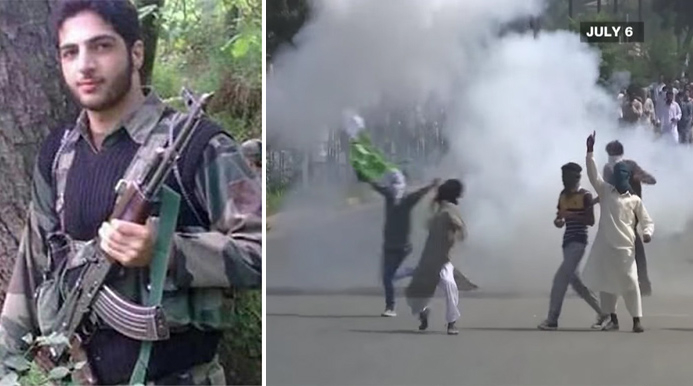
Kashmir has recently been the scene of much rioting, which became extremely violent since Indian security forces killed the terrorist, Burhan Wani (left), on July 8.

It is reassuring to hear that New Delhi has recently decided to crack down on the separatist elements in the Valley. The government has decided to stop security arrangements, foreign trips and medical treatment that have long been provided to separatists.

New Delhi has also judiciously put several Army reserve units on alert “to crack down on those instigating violence and choreographing, stone pelting mobs in Jammu and Kashmir.”

The regional government in Srinagar has also finally begun to deal with unrest in the Valley, and has instructed the police and the Central Reserve Police Force on crowd- and riot-control in the troubled region .

One hopes that New Delhi and Srinagar will continue to implement these policies to restore normalcy to the region.

Jagdish N. Singh is a senior journalist based in New Delhi

Rabbi and Priest Sing Hallelujah in Jerusalem

Here is something you would only see on the streets of Jerusalem – a rabbi and a priest singing Hallelujah while a woman plays the violin.


Is there anywhere else in the Middle East where you would see such a thing? How about in the world? In Jerusalem, this is not such a strange sight. The rabbi with the guitar and the woman playing violin are often seen on Jaffa Street, usually with big crowds forming to hear their wonderful music.

What you are seeing here in the real Israel. One day, hopefully soon, there will be peace.

Qatar: The World’s Wealthiest Family-Run Gas Station by Burak Bekdil

  • Many people describe Qatar’s treatment of expatriate laborers on World Cup sites as “modern day slavery.” Some 1,200 workers have already died and, according to warnings, up to 4,000 could perish before World Cup begins.

  • “The fact that thousands must die to build 12 fine stadiums for us has nothing to do with football,” said William Kvist of the Danish national team.
  • “We are committed to helping the destitute,” said Hamad bin Nasser al-Thani of Qatar’s royal family, who is chairman of the Doha-based Qatar Charity. How nice!
  • Why not promote “Islamic values” by taking in even just a few thousand Syrian refugees, instead of praising Turkey for taking in nearly three million Syrian Muslim refugees and praising it for promoting “Islamic values?”

The proud Gulf state of Qatar boasts human habitation dating back to 50,000 years ago. It may not be the only country across the world with such an impressive historical habitation story. But what makes it unique is its skillfully planned preservation tradition, particularly its persistent touch on medieval, not ancient, history.

Qatar is the world’s wealthiest country, or more of a family-run gas station. It boasts abiding by various aspects of the sharia (Islamic religious law), which, according to its constitution, it considers the main source of its legislation. In Qatar, flogging and stoning are legal forms of punishment. Apostasy (leaving Islam) is a crime punishable by the death penalty.

The Qataris, not knowing that their grandchildren would one day be the best strategic allies of their Ottoman colonialists’ grandchildren, fought the Ottomans to gain their independence in 1915, ending the 44-year-long Ottoman rule in the peninsula. Independence came at last, and lasted for about a year — until 1916, when Qatar became a British protectorate, retaining that status until 1971.

Apparently Qatar, along with England, is the cradle of football, as evinced by the fact that it will host the 2022 World Cup at dazzling stadiums, one of which some people tend to liken to a vagina.

“Modern day slavery” is the way many people describe Qatar’s treatment of expatriate laborers on World Cup sites. “The fact that thousands must die to build 12 fine stadiums for us has nothing to do with football,” said William Kvist of the Danish national team. Some 1,200 workers have already died and, according to warnings, up to 4,000 could perish before World Cup begins.

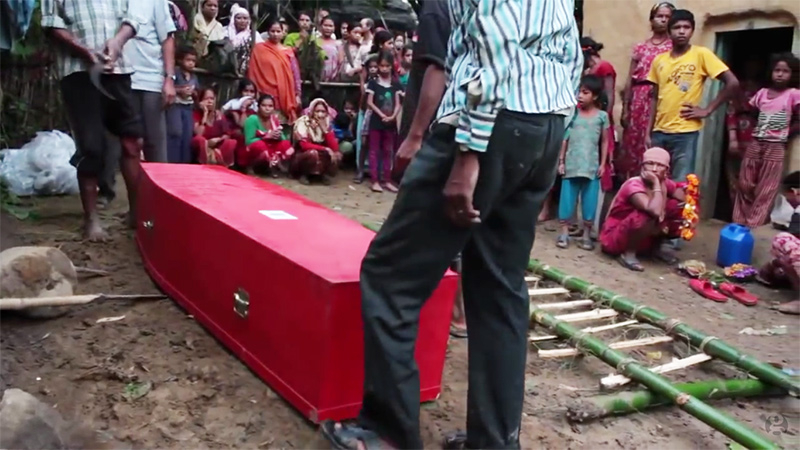
The family of a Nepalese worker, who died in Qatar while working on a football stadium site, prepares to bury him in Nepal. Foreign laborers in Qatar work in dangerous conditions, and Nepalese laborers alone die at the rate of one every two days. (Image source: Guardian video screenshot)

But there is something phenomenally weird about the world’s wealthiest country — and its Turkish allies. And it is not just about the fact that this Sharia-ruled Sheikdom has been trying to bring “democracy” to Egypt and Syria, nor about the fact that Qatar’s best regional allies, Islamist Turks, recently built a military base in the Gulf state, hoping to bolster a Sunni war against the “heretic” Shiite.

Recently, Hamad bin Nasser al-Thani — apparently a lucky chap from the royal family, as his name might attest (Hamad means Praised One, Nasser means Victory) — chairman of the Doha-based Qatar Charity, praised Turkey for taking in millions of refugees from across the region — he must have meant the Syrians; Turkey has not taken in millions of refugees from other countries in the region. Al-Thani also praised Turkey’s “promotion of Islamic values,” adding that “We [Qatar] are committed to helping the destitute.”

How nice!

According to a 2013 census, Qatar’s total population is 1.8 million, of which 278,000, or barely 15% are “Qataris.” What a colorful, heterogeneous and cosmopolitan life the world’s wealthiest country should be offering to its inhabitants. Right?

According to the 2013 census, the largest number of expatriates living in Qatar are Indians (543,000), followed by the Nepalese (341,000), Filipinos (185,000), Bangladeshis (137,000), Sri Lankans (100,000) and Pakistanis (90,000).

By that account, Muslim expatriates roughly account for 15% of all expatriates allowed as residents with working permits in Qatar, or slightly more than 12% of the entire population of the world’s wealthiest country.

How many Syrians among them? The statistics do not tell: there are just too few to mention. All the same, the Qataris praise Turkey’s promotion of “Islamic values” — whatever those are. Why not promote “Islamic values” by taking in even just a few thousand — forget hundreds of thousands — of Syrian refugees, instead of praising Turkey for taking in nearly three million Syrian Muslim refugees and praising it for promoting “Islamic values?”

Burak Bekdil, based in Ankara, is a Turkish columnist for the Hürriyet Daily and a Fellow at the Middle East Forum.

Putin’s Puritan Piety: The Ideological War against the West by Giulio Meotti

  • Russia is one of the few countries in the Western world in which religion is becoming increasingly important and not less.To establish his authority on the Russian society, President Vladimir Putin has shaped a doctrine mobilizing the entire Russian society against a perceived Western “decadence”. He has declared that Russian traditional family values are a bulwark against the West’s “so-called tolerance — genderless and infertile.”

  • The first Cold War was a clash between Western democracy and the Soviet dictatorship of the proletariat. The new Cold War is a one between Western liberalism and Russian conservatism.

During the Cold War, American conservatives used to label the Soviet Union “the godless nation” on the verge of collapse because it had purged religion from the Russian society. Two decades later, the Kremlin is occupied by a former officer of the KGB, secretly baptized, who launches the same accusation of atheism at the United States and the West.

Welcome to “Putin’s covert war on Western decadence“, as The Spectator defined it:

“Putin’s Russia is fast becoming a very puritan place. Ever since returning to the presidency in 2012, Putin has pursued an increasingly religious-conservative ideology both at home and abroad, defining Russia as a moral fortress against sexual licence and decadence, porn and gay rights”.

Recently, Russian officials censored porn websites. When the largest pornography site on the internet, PornHub, offered the Russia’s official communications and media watchdog a premium account in exchange for lifting the ban, Russian officials replied: “Sorry, we are not in the market and the demography is not a commodity.”

Russian President Vladimir Putin’s ideological war against the West is getting cocky and self-confident. In a televised speech from a Kremlin hall, Putin declared that Russian traditional family values are a bulwark against the West’s “so-called tolerance — genderless and infertile.”

“Many Euro-Atlantic countries have abandoned their roots, including Christian values,” said Putin. The patriarch of the Orthodox Church, Kirill, echoed Putin by charging the West of being engaged in a “spiritual disarmament” of the Russian people, and by criticizing the European laws that prevent wearing religious symbols in public. “We have experienced an era of atheism and we know what it means to live without God”, Kirill said.

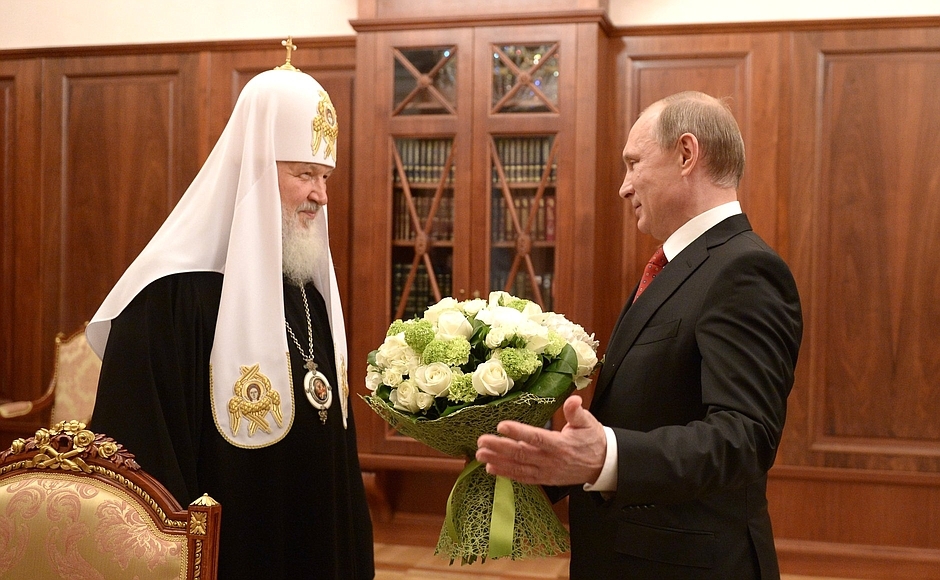
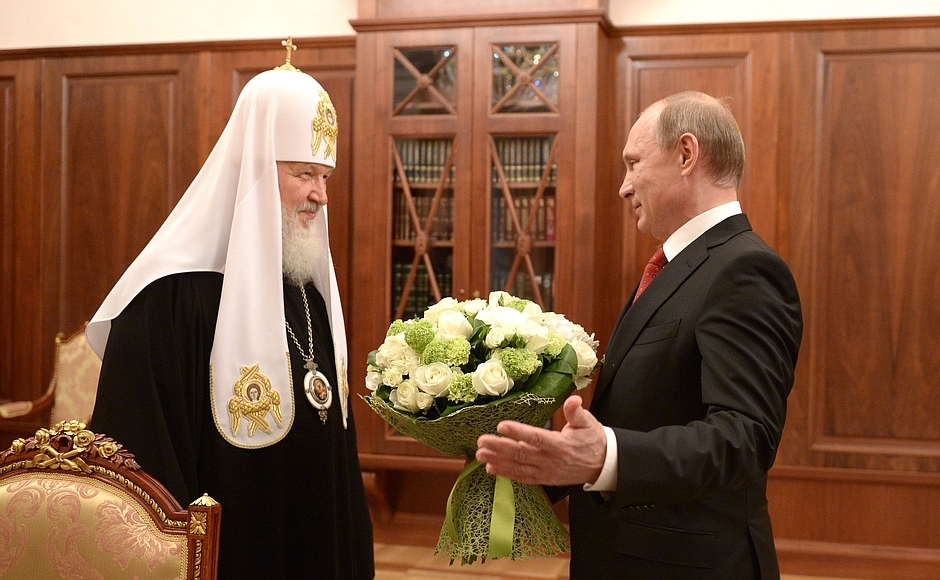
Russian President Vladimir Putin meets with Patriarch Kirill of the Russian Orthodox Church, May 24, 2015. (Image source: The Kremlin)

The first ten years of Putin’s dominance were devoid of any religious and cultural reference. Putin and his circle never mentioned any “values”, and did not try to teach any moral lessons to the West. The second Putin decade has been marked by a “conservative revolution” based on the revival of an isolated Russian Orthodox culture, separated for centuries from European civilization. “Putin wants to make Russia into the traditional values capital of the world,” said Masha Gessen, author of a Putin biography, entitled The Man Without a Face: The Unlikely Rise of Vladimir Putin. In the Russian media, Putin is now called “the savior of the decadent West.”

Putin is now focused on a church in the heart of Paris. The Sainte-Trinité Cathedral, often referred to as “Moscow on the Seine,” is under construction near the Eiffel Tower, in the Quai Branly, and will be the largest Orthodox cathedral in France. “This church is an outpost of the other Europe, conservative and anti-modern, in the heart of the country of libertinism and secularism”, said Michel Eltchaninoff, a French scholar and author of the book, Dans la tête de Vladimir Poutine (“Inside the Head of Vladimir Putin“), on the thoughts of the Russian president.

Are France, the United States and Ireland open to gay marriage? Putin’s Russia bans “gay propaganda“. Does Western Europe allow quick divorce? Putin’s Russia https://www.google.it/&referrer=https://www.google.it/” target=”_blank”>taxes divorce. Does the West legalize abortion on demand? Putin’s Russia is trying to restrict it. Russia’s leading clerics have just urged Putin to ban abortion. A new Russian law also targets “foreign religions.”

“Western values, from liberalism to the recognition of the rights of sexual minorities, from Protestantism to comfortable prisons for murderers, arouse in us suspicion, wonder and alienation”, said Yevgeny Bazhanov, one of Putin’s “intellectuals”. Putin has apparently even managed to win the support of the most renowned Russian musicians, such as the conductor Valery Gergiev, superintendent at the St. Petersburg Marjinskij theater.

Even in foreign policy, Putin often justifies its decisions with references to Christianity. The New York Times explained that, in addition to strategic and economic interests, a major reason to explain Russian support for Assad’s regime in Syria is the uncompromising position of the Orthodox Church. The Russian Patriarch Kirill evoked, in fact, the Bolshevik Revolution of 1917, with its endless “carcasses of defiled churches.”

Before that, there was the historical role of Russia in defense of Armenian Christians against Turkish pro-Western Muslims, and Christian Serbs against Bosnian Muslims supported by the U.S. To try to justify the invasion of the Crimea, Putin said that is “our Temple Mount,” a reference to Judaism’s holiest site in Jerusalem.

Vladimir Putin has presided for years over the great revival of Orthodox Christianity. On the eve of the Bolshevik Revolution, the Russian church had 50,000 parishes and 60 schools. By 1941, Stalin had eliminated the church as a public institution. Every monastery and seminary had been closed. With the fall of communism in 1991, the church began to rebuild its devastated institutional life. Putin’s Russia is returning to the concept of Byzantine symphonia — an approach in which church and state work together.

The church apparently aspires to achieve the “re-Christianization of the Russian nation.” Although as much as 70% of Russians call themselves Orthodox and are baptized, only 4% take part in the liturgy. But Russia is also one of the few countries in the Western world in which religion is becoming increasingly important and not less.

To establish his authority over the Russian society, Putin has shaped a doctrine mobilizing the entire Russian society against a perceived Western “decadence.” The Kremlin has closely followed the opposition to gay marriage in France and tensions over migrants in the European Union. Putin then launched a conservative offensive aimed at both Russians and Europeans. As the Wall Street Journal wrote, “Putin Depicts Russia as a Bulwark Against European Decadence.”

Against a perceived Western amnesia about its own Christian past, moral relativism and political correctness, Putin affirmed the Christian roots of Russia, traditional family values, patriotism and obedience to hierarchy.

“According to him, in essence, Europe has entered a phase of decadence, while Russia is in an ascending phase of its history”, Michel Eltchaninoff says of Putin.

“He relies on the pseudo-scientific model of Konstantin Leontiev, one of whose most famous concepts Vladimir Putin is fond of quoting: that of ‘flourishing complexity’. According to the Russian philosopher, who took a fervently anti-European and anti-bourgeois position, any civilisation, after a period of original simplicity, reaches its apex in an era of flourishing complexity, before declining into a period of simplification and confusion. For Leontiev, ever since the Renaissance, Europe has ceased to give birth to saints and geniuses, and only engenders engineers, parliamentarians and ethics professors. It makes everything uniform, through its mode of development and its conformism. But it is also confused. Its inhabitants are lost, and no longer know how to give meaning to their lives. They show themselves to be incapable of perceiving an inspiring superior principle.”

The first Cold War was a clash between Western democracy and the Soviet dictatorship of the proletariat. Western freedom crushed the Soviet gulags. The new Cold War is a one between Western liberalism and Russian conservatism.

As happened during the first Cold War, when the Soviets depicted capitalism as a Western fault, avaricious and amoral, the burden is presumably again on the West to prove it has better way of life and that its society is not just a “decadent” stereotype. Meanwhile, against the West’s visible lack of self-confidence and the deterioration of Europe’s élite, Putin’s geopolitical and ideological hegemony is getting stronger.

Giulio Meotti, Cultural Editor for Il Foglio, is an Italian journalist and author.

Translate »
Skip to toolbar