Monthly Archives: June 2017

Turkey’s Conquest-Fetish Tales from Erdoganistan by Burak Bekdil

  • Turkey’s President Recep Tayyip Erdogan and his fellow Islamists are keen admirers of the idea that Muslim Turks capture lands belonging to other civilizations because, in this mindset, “conquest” means the spread of Islam.

  • “Look, now there is the Islamophobia malady in the West … [Its] aim is to stop [the further spread of Islam]. But they will not be able to succeed.” — Turkish President Recep Tayyip Erdogan, June 4, 2016.
  • In Erdogan’s narrative, Muslim Turks have never invaded foreign lands by the force of the sword. What they did was just conquering hearts. This is not even funny.

1071 is a very special year for Turkish President Recep Tayyip Erdogan — and his Islamist ideologues. Erdogan often speaks about his “2071 targets,” a reference to his vision of “Great Turkey,” on the 1000th anniversary of a battle that paved the Turks’ way into where they still live.

In 1071, the Seljuk Turks did not arrive in Anatolia from their native Central Asian steppes with flowers in their hands. Instead they were in full combat gear, fighting a series of wars against the Christian Byzantine [Eastern Roman] Empire and featuring a newfound Islamic zeal. The Battle of Manzikert in 1071 is widely seen as the moment when the Byzantines lost the war against the Turks: before the end of the century, the Turks were in control of the entire Anatolian peninsula.

Another divine date for Erdogan is May 29, 1453. That day saw the fall of Constantinople, capital of the Byzantine Empire, after an Ottoman army invaded what is today Istanbul, modern Turkey’s biggest city. The conquest of Constantinople was not a peaceful event either. The city’s siege lasted for 53 days and cost thousands of lives. The Byzantine defeat left the Ottoman armies unchecked, clearing the way for their advance into Christian Europe in the centuries to come. The long and violent Ottoman march into Europe came to a halt in 1683, when the Ottomans were defeated during the siege of Vienna. By then the Ottomans were in control of north Africa, most parts of the Middle East and central and eastern Europe, totaling 5.2 million square kilometers of land.

On every May 29, the Turks, proud of being — possibly — the world’s only nation that celebrates the capture by the sword of their biggest city from another civilization, take to the streets for grand ceremonies. The 563th anniversary of the conquest was celebrated with a major event created by a team of 1,200 people. It saw a 563-man Mehter concert [an Ottoman military band], a show by the Turkish Air Force aerobatics team, special conquest celebrations, a fireworks display, live broadcasts in six different languages and the world’s largest 3D mapping stage used to reenact the conquest.

There is more than enough evidence about the Turkish Islamists’ “conquest-fetish.” Turkey’s leaders have too often spoken of “liberating Jerusalem and making the city the capital of an independent Palestine.”

In September, then prime minister Ahmet Davutoglu, another Islamist, said:

“By Allah’s will, Jerusalem belongs to the Kurds, the Turks, the Arabs, and to all Muslims. And as our forefathers fought side by side at Gallipoli, and just as our forefathers went together to liberate Jerusalem with Saladin, we will march together on the same path [to liberate Jerusalem].”

Erdogan and his fellow Islamists are keen admirers of the idea that Muslim Turks capture lands belonging to other civilizations because, in this mindset, “conquest” means the spread of Islam. That is hardly surprising: political Islam typically features a tendency to spread to non-Islamist or non-Muslim parts of the world. But the way Erdogan defends “conquest,” even in the year 2016, looks just too ridiculous.

On June 4 Erdogan was addressing students at a theology faculty. In his speech he said:

“When we look at the way Islam has spread to the world we see that it rather features the conquest of ‘hearts’ rather than conquest by the ‘sword’… Look, now there is the Islamophobia malady in the West … [Its] aim is to stop [the further spread of Islam]. But they will not be able to succeed.”

Then he advised the students:

“Just like our [Turkish] arrival into Anatolia, just like the conquest of Istanbul … I know you will be behaving with the same consciousness … A ‘New Turkey’ will rise on your shoulders … [to succeed] you must reproduce. God [commands] you to have at least three children.”

It is amazing that Erdogan still has the power to shock — in absurdity — even the most seasoned Erdogan observers. In his narrative, Muslim Turks have never invaded foreign lands by the force of the sword. What they did was just conquering hearts. This is not even funny.

And what about God’s commandment for at least three children? There is not a single verse in the Koran about the ideal size of a Muslim family. There is not a single hadith that commands three, four or no children, apart from a dubious source which quotes Prophet Mohammed as advising Muslims that when the day of judgment has arrived, the ummah should be a large tribe.

On June 4, Turkish President Recep Tayyip Erdogan addressed university students, saying, “Just like our [Turkish] arrival into Anatolia, just like the conquest of Istanbul … I know you will be behaving with the same consciousness … A ‘New Turkey’ will rise on your shoulders … You must reproduce. God [commands] you to have at least three children.”

But things in Turkey are not progressing in the way Erdogan wishes. Official figures show that Turkey faces the prospect of an aging population. According to the government’s statistics department, the fertility rate in Turkey fell to 2.14 children per woman in 2015, from 2.37 in 2001. “Turkey is one of the fastest aging countries in the world,” says Didem Danis, an academic. By 2023, 10.2% of the Turkish population will be made up of people aged 65 years and over — compared to 7.7% in 2013.

The Turks have never invaded foreign lands by the sword; Turkish students of theology should prepare to conquer other lands; God commands Muslims to have at least three children; and Turkey will rise to its glorious Ottoman past thanks to a rapidly growing population… these are the fairy tales from Erdoganistan.

Burak Bekdil, based in Ankara, is a Turkish columnist for the Hürriyet Daily and a Fellow at the Middle East Forum.

Turkey’s Barks and Bites by Burak Bekdil

  • This is the first time that Erdogan is openly challenging a concerted European stand.Turkey’s foreign policy and the rhetoric that presumably went to support it, has, during the past several years, aimed less at achieving foreign policy goals and more at consolidating voters’ support for the Ankara government.Self-aggrandizing behavior has predominantly shaped policy and functioned to please the Turks’ passion for a return to their glorious Ottoman past.

Assertive and confrontational diplomatic language and playing the tough guy of the neighborhood may have helped garner popular support for President Recep Tayyip Erdogan and his Justice and Development Party (AKP), but after years of “loud barking and no biting”, Turkey has effectively become the victim of its own narrative.

In 2010, Turkey froze diplomatic relations with Israel and promised “internationally to isolate the Jewish state”, and never to restore ties unless, along with two other conditions, Jerusalem removed its naval blockade of Gaza to prevent weapons from being brought in that would be used to attack Israel. Turkey’s prime minister at the time, Ahmet Davutoglu, said Israel would “kneel down to us”.

In 2016, after rounds of diplomatic contacts, Turkey and Israel agreed to normalize their relations. The blockade of Gaza, to prevent shipments of weaponry to be used by Gazans in terror attacks remains in effect.

In 2012, Davutoglu claimed that Syrian President Bashar al-Assad’s days in power were numbered, “not by years but by weeks or months”. In 2016, Davutoglu had to step down as prime minister, but Erdogan’s and his worst regional nemesis, Assad, is in power to this day, enjoying increased Russian and Iranian backing. In 2012, Erdogan said that “we will soon go to Damascus to pray at the Umayyad mosque” — a political symbol of Assad’s downfall and his replacement by pro-Turkey Sunni groups. That prayer remains to be performed.

In November 2015, shortly after Turkey shot down a Russian Su-24 military jet and cited violation of its airspace, Erdogan warned Russia “not to play with fire.” As for the Russian demands for an apology, Erdogan said it was Turkey that deserved an apology because its airspace had been violated, and that Turkey would not apologize to Russia.

In June 2016, just half a year after Russia imposed a slew of economic sanctions on Turkey, Erdogan apologized to Russian President Vladimir Putin.

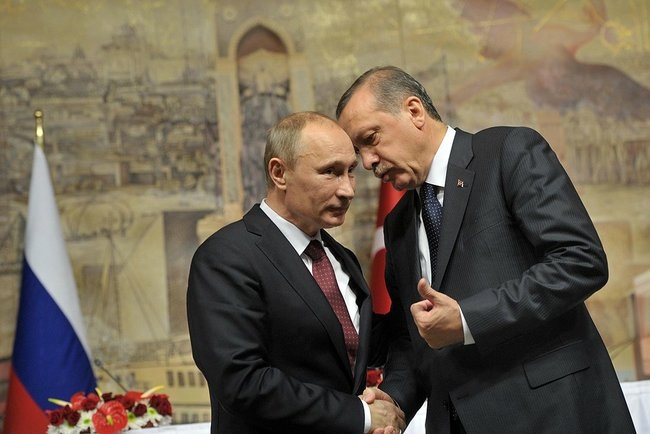
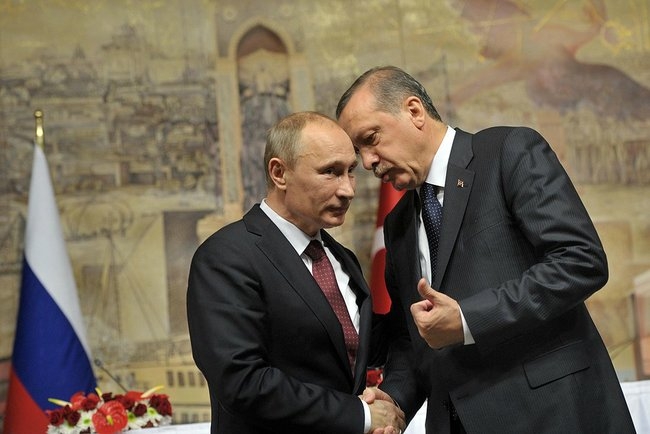
In July 2016, Erdogan apologized for downing a Russian plane, and in August he went to Russia to shake hands for normalization. Pictured: Russian President Vladimir Putin with Turkey’s then Prime Minister Erdogan, meeting in Istanbul on December 3, 2012. (Image source: kremlin.ru)

Erdogan and his government have countless times warned the United States not to side with the Syrian Kurds –whom Turkey views as a terrorist group– in the allied fight against radical jihadists of ISIL’s Islamic State. In March 2017, Washington denied that Syrian Kurds were a terrorist group and pledged continued support for them.

Erdogan’s Turkey has done more than enough to show that its bark is worse than its bite. Yet it keeps barking badly. This time, the enemy to bark at, not bite, is Europe. This is the first time that Erdogan is openly challenging a concerted European stand.

In a recent row between several European capitals and Ankara over Erdogan’s ambitions to hold political rallies across Europe to address millions of Turkish expatriates, the Turkish president said he would ignore that he was unwelcome in Germany and would go there to speak to his Turkish fans.

In response, the Dutch government deported one of Erdogan’s ministers who had gone uninvited to the Netherlands to speak to the Turkish community there.

Germany launched two investigations into alleged Turkish spying on German soil.

Similarly, Switzerland opened a criminal investigation into allegations that Erdogan’s government had spied on expatriate Turks.

In Copenhagen, the Danish government summoned the Turkish ambassador over claims that Danish-Turkish citizens were being denounced over views critical of Erdogan.

The barking kept on. In Turkey, Erdogan warned that Europeans would not be able to walk the streets safely if European nations persist in what he called “arrogant conduct.” That comment caused the EU to summon the Turkish ambassador in Brussels to explain Erdogan’s threatening language.

Farther east, in the rich European bloc, several hundred Bulgarians blocked the three main checkpoints at the Bulgarian-Turkish border to prevent Turks with Bulgarian passports, but who were living in Turkey, from voting in Bulgarian elections. The protesters claimed that Turkish officials were forcing expatriate voters to support a pro-Ankara party.

Meanwhile, at the EU’s southeast flank, Greece said that its armed forces were ready to respond to any Turkish threat to the country’s sovereignty and territorial integrity.

What happened to Erdogan’s promised “bite” that he could go to Germany to speak to the Turkish community despite repeated German warnings that he would not be welcome? “I will not go to Germany,” he said on March 23.

Erdogan may be winning hearts and minds in Turkey with his neo-Ottoman Turkey “barks.” But too few foreign capitals find his threats serious, too few politicians think that he is convincing and too many people tend to believe Turkey’s bark is worse than its bite.

The recent wave of European constraints against Erdogan shows that, for the first time in recent years, Europe does not seem to fear Erdogan’s bluffing and thuggishness.

At the moment, Erdogan’s priority is to win the referendum on April 16 that he hopes will change the constitution so that he can be Sultan-for-life. Picking fights with “infidel” Europeans might help him garner more support from conservative and nationalist Turks.

When the voting is done, however, he will have to face the reality that an alliance cannot function forever with one party constantly blackmailing the other.

Burak Bekdil, one of Turkey’s leading journalists, was just fired from Turkey’s leading newspaper after 29 years, for writing what was taking place in Turkey for Gatestone. He is a Fellow at the Middle East Forum.

Turkey’s All-Out War on Kurds and Media by Uzay Bulut

  • On January 20, Turkish police opened fire at a group of civilians who were holding up white flags as they tried to remove the dead and wounded from the street in Cizre, one of the Kurdish towns under Turkish military siege. The Turkish police murdered two people from the group and wounded 12 others.
  • As the military siege and attacks in Turkey’s Kurdistan intensify with each passing day, the Kurdish media are under a new wave of repression — through arbitrary arrests, psychical violence or blocks on their website content.
  • “Our only aim today was to share what had happened in Van with the public in a healthy way. Today it was not us, but the people’s right to information that was taken into custody. We will not be silent.” — Reporter Bekir Gunes (from IMC TV), on Twitter. He was taken into custody for trying to report on the murders, but later released.

Since August, Turkey has been bombing and destroying its Kurdistan region in the same pattern: The Turkish government first declares curfews on Kurdish districts; then Turkish armed forces, with heavy weaponry, attack Kurdish neighborhoods and everyone living there. Much of this slaughter is presumably due to the Kurds having gained a large number of seats the latest elections — thereby preventing Turkey’s President Recep Tayyip Erdogan from attaining the super-majority he sought in order to change the Constitution and become “Sultan” for life, to rule as an autocrat. Kurds are also now asking for their right to rule themselves in their native lands, where they have lived for centuries.

Curfews in 19 Kurdish towns (from August 10, 2015 to the present) have penned Kurds in and enabled Turks to murder them more easily. So far, according to the Diyarbakir Branch of the Human Rights Association (IHD), in the past few months, 170 civilian Kurds have been killed. Of these, 29 were children, 39 were women and 102 were men. At least 140 people were wounded; some have lost eyes, legs or arms; others are the victims of brain trauma.

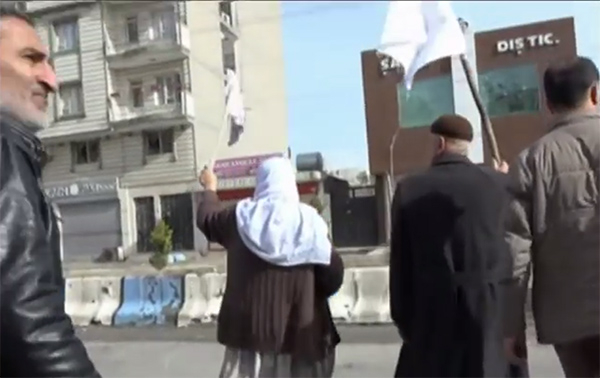
On January 20, Turkish police opened fire at a group of civilians who were holding up white flags as they tried to remove the dead and wounded from the street in Cizre, one of the Kurdish towns under Turkish military siege. The Turkish police murdered two people from the group and wounded 12 others.

On Jan. 20, Turkish police in Cizre opened fire at a group of Kurdish civilians who were holding up white flags as they tried to remove the dead and wounded from the street. The Turkish police murdered two people from the group and wounded 12 others.

Refik Tekin, a cameraman of IMC TV and an award-winning journalist, was among the wounded but kept filming the attack even after he was shot. He is now in a hospital.

“The state implements a policy of subjugation on the Kurdish demand for a political status. It has become clear once again that this problem is not about ditches [which some Kurdish youths have dug, over objections by officials, to try to stop the progress of the Turkish troops]. The state attempts to annihilate the Kurdish demand for political status by using the ditches as an excuse,” said Raci Bilici, the head of the Diyarbakir branch of the Human Rights Association.

As the military siege and attacks in Turkey’s Kurdistan intensify with each passing day, the Kurdish media are under a new wave of repression — through arbitrary arrests, psychical violence or blocks on their website content.

On January 1, police used water cannons and tear gas against local people marching from central Diyarbakir to the district of Sur to protest the curfews. Meanwhile, masked Turkish police detained Baran Ok, a cameraman of Kurdsat News Channel. Ferat Mehmetoglu, the local representative of Kurdsat, kept trying to explain to the police that Baran Ok was his cameraman. Disregarding Mehmetoglu’s pleas, the masked police drove off at high speed. At one point, after Mehmetoglu had gotten in front of the police vehicle, he barely avoided being run over when the officers drove off with his cameraman.

Meanwhile, the Dicle News Agency (DIHA) alleged that it obtained a restricted and official document, signed by the local Tank Battalion Command (part of the Turkish armed forces). The document instructs the Turkish armed forces operating in Kurdish towns and offers impunity: “No personnel shall forget not even for a moment that any personnel’s restraint from using arms for fear of prosecution might have very grave consequences, result in martyrs on our side; endanger the survival of the state and nation, [and] help traitors, terrorists and enemies of the state feel more powerful,” it said in part.

A day after DIHA covered this alleged document; its website was blocked for the 28th time by the Turkish Telecommunications Authority (TIB).

On January 5, Peoples’ Democratic Party (HDP) MP Ferhat Encu, in a parliamentary motion, asked Turkish Prime Minister Ahmet Davutoglu about the document. He has not yet received a reply. No Turkish authority has so far either confirmed or denied the existence of such a document.

Kurdish journalists are also exposed to physical violence. On January 5, the special operations police forcibly gathered 37 people from their homes and took them to an indoor sports hall. One of them was Nedim Oruc, a journalist who had extensively covered the military assaults against the Kurdish town Silopi.

At first, no information could be obtained about Oruc who, according to DIHA news agency, had been battered, dragged on the ground and kidnapped by police in an armored vehicle. As a result of the public pressure brought to bear by the Twitter hashtag #NedimOrucNerede Where is Nedim Oruc), Silopi Security Directorate admitted that Oruc was in custody. He is now in Sirnak Prison.

The same day, the police raided a student dormitory and houses in the province of Van. The all-female, pro-Kurdish Jin (Women’s) News Agency reporter and university student Rojda Oguz and many other students were arrested. Rojda is now in Van prison.

“The Turkish public has a right to information from a variety of sources and perspectives, but the government is clearly trying to stifle pro-Kurdish news outlets with these arrests,” said Nina Ognianova, Europe and Central Asia Program Coordinator of Committee to Protect Journalists. “We call on Turkish authorities to release Nedim Oruç and Rojda Oğuz without delay and to stop harassing and obstructing journalists.”

On January 9, the “Women for Peace” group staged a demonstration in Izmir’s Bornova district to protest the recent military siege and attacks against Kurdish districts. Police detained the Evrensel reporter Eda Aktas, along with 12 others, while she was reporting on the protest — on the grounds that the press statement of the protesters violated the article 301 of the penal code, which makes it illegal “to insult Turkey, the Turkish nation, or Turkish government institutions.”

On January 5, in Silopi, three female Kurdish politicians — Sêvê Demir, Pakize Nayir, and Fatma Uyar — were murdered by state forces.

On January 10, in Izmir, when the Kurdish Congress of Free Women (KJA) organized a protest to commemorate the slain politicians, the police attacked the protestors, and detained 35 — including Dilek Aykan, the co-head of the Izmir branch of the Peoples’ Democratic Party (HDP).

The police also prevented Serfiraz Gezgin, a reporter from the Kurdish DIHA agency, and Hatice Erhan, a reporter from the left-wing magazine Kizil Bayrak, from filming the police crackdown. Other journalists just barely stopped police from detaining Gezgin and Erhan.

For months, the Turkish armed forces have been using hospitals and schools as military quarters, threatening, and even murdering medical personnel, and forcing thousands of Kurds to flee their native lands.

The state violence in Turkish Kurdistan escalates daily: On January 10, Turkish soldiers murdered 12 Kurds at close range in the province of Van. The office of the governor of Van announced that 12 PKK members were killed in the province. Photos of the slain Kurds were shared on the social media, apparently by Turkish security forces. A YouTube account called “Special Operations Team,” for instance, published a video entitled “The carcasses of the PKK – Van/Edremit” showing the bodies of slain Kurds, with upbeat music playing in the background.

Reporter Bekir Gunes, and cameraman Mehmet Dursun, working for IMC TV, were trying to follow up on news concerning the murders, but were prevented from doing so by the police. Both were taken into custody and released 11 hours later. “Our only aim today was to share what had happened in Van with the public in a healthy way,” Gunes wrote on his Twitter account. “Today it was not us, but the people’s right to information that was taken into custody. We will not be silent.”[1]

According to the 2015 World Press Freedom Index of Reporters without Borders, Turkey, out of 180 states, ranked 149.[2] “Turkey’s ‘underlying situation’ score,” it wrote, “covering such areas as cyber-censorship, lawsuits, dismissals of critical journalists and gag orders — actually worsened, showing that freedom of information continues to decline.” [3]

Lately, pressures on free speech and free press have been gaining new momentum in Turkey. The latest victim was a Turkish comedian and television host, Beyazit Ozturk (“Beyaz”) known for being apolitical and pro-establishment.

Beyaz found himself in the midst of violent threats after a teacher from Diyarbakir phoned into his popular live chat show and called for an end to violence in the region. She said: “Children are dying here. All of these bomb sounds, bullet sounds… People — especially babies and children — are struggling with a lack of water, with starvation. Please show some sensitivity. See us, hear our voice, extend your hand to us. Please let no more people die. Let no more children die.”

Beyaz thanked the caller, said that he too supported her message of peace and asked the audience to applaud her.

Kanal D [Channel D], the mainstream TV channel broadcasting the show, issued a statement saying they were tricked into allowing the caller on. The television channel’s officials added: “Dogan TV and Kanal D have always been on the side of the state from day one.”

The Turkish ministry of national education started an exhaustive hunt to find the caller. They said that no teacher with that name admitted to having called the show.

The teacher on the phone had not even said who killers were, but for some unfathomable reason, the Turkish nationalists, including state authorities, appear to have taken the remark personally, and interpreted it as an “insult to Turkish security forces” and “terrorist propaganda.”

Beyaz thereupon received a negative reaction from Turkish nationalists, and even death threats on social media. Many Twitter users and pro-government media outlets accused him “of allowing PKK propaganda on his show” and “not showing the required reaction to the caller.”

A popular hashtag said: “Beyaz! Apologize from the Turkish Police!”

A masked individual, allegedly a special operations police officer, posted on YouTube a video entitled, “We will not forget,” threatening Beyaz for allowing a caller from Diyarbakir to say on his show that children are dying.

In the end, Beyaz appeared on Kanal D again, apologizing:

“I am a son of a police officer. Whatever the entire Turkish nation thinks about that place [Turkey’s predominantly Kurdish southeast], I also have the same thoughts. Of course, with all our hearts and souls, we want the terrorist organization to lay down its arms and this issue to be resolved as soon as possible. May Allah make it easy for all of our security forces in the southeast. We are on the side of our state and our nation.”

Finally, the police found the “criminal.” Ayse Celik, the art teacher who phoned in, is now being prosecuted for “making propaganda for the terrorist organization”. Eleven lawyers in the province of Antep who declared their support for the Celik’s message are also being prosecuted for “terrorist propaganda.”

This is the level of political and social pressure that a TV personality — who has had nothing to do with political activism throughout his entire career — is exposed to, in response to the most innocent and humanitarian wishes for peace uttered by a caller on his show. Imagine the enormity of the pressure on Kurds and journalists who try to expose the real crimes Turkey is committing against its Kurdish minority.

Uzay Bulut, born and raised a Muslim, is a Turkish journalist based in Ankara


[1] On January 10, which marks the Working Journalists Day in Turkey, Murat Verim, a Kurdish reporter of Dicle News Agency (DIHA), was detained following a police raid on his home in Mardin’s Dargecit district. On January 12, gendarmerie special operations forces attacked Mursel Coban, a journalist and photographer, as he was reporting on the funeral of the youths murdered in the Sur district of Diyarbakir. Coban said that the police beat him and tried to detain him, while threatening him with “disappearance.”

[2] In 2014, Turkey ranked 154 in the list. “Turkey’s rise in the index must be put in context,” wrote Reporters Without Borders. “It was due above all to the conditional release in 2014 of around 40 imprisoned journalists who nonetheless continue to face prosecution and could be detained again at any time.

[3] In another mass arrest on December 20, 2011, 58 people (many of whom were Kurdish journalists) were taken into custody in a police raid on their offices or houses in 8 provinces.

Turkey’s ‘Good’ and ‘Bad’ Terrorists by Burak Bekdil

  • “This is jihad tourism, and people do not understand this is a one-way tour. You cannot say ‘IS is terrorist but Hamas and Hizballah are not.’ Hizballah is the Shia version of IS. Hamas, IS and others are the Sunni branches of the same tree.” – High-level foreign diplomat.


In a high-level meeting about fifteen years ago, a young official accompanied the visiting Turkish land forces commander and his wife. The official, now a high-level foreign diplomat, still recalls the good memories from that visit, including the Turkish coffee cup they brought as a gift — a fine coffee cup still used every morning. “Daesh [Islamic State] will commit more and more acts of terror against Turkey and the West,” the diplomat says today. “Salafist ideology lures people — people with a worm in their brains. It offers adventures for young people. This is jihad tourism, and people do not understand this is a one-way tour.”

We recently met again, a month after an Islamic State (IS) suicide bomber killed 33 pro-Kurdish activists in a small Turkish town on Turkey’s border with Syria. “IS’s war is not about Israel or anything else,” said the diplomat. “All suicide bombings combined in the Middle East are smaller in number than those in Iraq only. It’s all about the Sunni-Shia divide.”

Anyone honest can only agree with what came next: “You cannot say ‘IS is terrorist but Hamas and Hizballah are not.’ Hizballah is the Shia version of IS. Hamas, IS and others are the Sunni branches of the same tree.”

Those words forcefully remind one of the gigantic Western hypocrisy that justifies Hamas.

“They will understand Hamas better when they will see jihadist bombs exploding in their cities,” the diplomat went on. “The terrorists are already targeting Jews on Saturdays, and the differing Islamist sects and on Fridays. Soon they will start coming on Sundays for everyone else.”

Coincidentally, about a week after our meeting, Turkey joined the anti-IS coalition forces and started to bomb IS targets in Syria. Too little, too late…

Meanwhile Turkish security forces are hastily trying to crack down on potential Islamic State terror cells inside Turkey; they fear bomb attacks in their own country, and especially at a time when the country goes to renewed parliamentary elections (on November 1).

After several months of reluctance, Turkey parted ways with IS because “they are terrorists.” But it remains loyal, though less supportive, to “the other, Sunni, branch of the same tree,” Hamas. Turkey’s Islamists, who now view IS’s Islamists as terrorists, view Hamas’s Islamists as perfectly legitimate ideological allies.

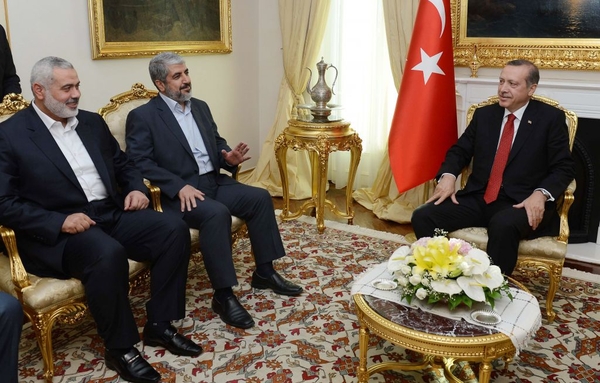
Turkish President (then Prime Minister) Recep Tayyip Erdogan, right, meeting with Hamas leaders Khaled Mashaal (center) and Ismail Haniyeh on June 18, 2013, in Ankara, Turkey. (Image source: Turkey Prime Minister’s Press Office)

Recently, Turkish President Recep Tayyip Erdogan scolded the leader of a pro-Kurdish political party because the Kurdish man would not label the Kurdistan Workers’ Party (PKK) a terrorist organization, “although they are on EU’s and U.S. terror list.”

It sounded as if Erdogan was not even aware of what he was saying: Hamas, which he supports, is on the same EU and U.S. terror lists as is the PKK.

Erdogan is trying to cut one branch of the tree while trying to grow the other — knowing all too well that they belong to the same tree.

Burak Bekdil, based in Ankara, is a Turkish columnist for the Hürriyet Daily and a Fellow at the Middle East Forum.


Turkey’s “Spies,” EU’s “Human Rights” by Burak Bekdil

  • “He who ran this story will pay heavily for it.” — Recep Tayyip Erdogan, President of Turkey.


  • The two journalists, Dundar and Gul, are being charged with being members of a terrorist organization; espionage, and revealing state secrets. The prosecution has asked for life sentence for both journalists.

  • Really, why would a spy publish secret material in a newspaper instead of handing it over to his foreign controllers?

  • As Dundar and Gul completed their 11th day in solitary confinement, that human rights champion, the European Union, committed to push forward the process towards Turkish EU membership and open five accession chapters.

  • Dr. Bilgin Ciftci posted photos on Twitter juxtaposing the fictional character Gollum with Erdogan. He was fired from the hospital where he worked, then brought to court for insulting Erdogan, an offense punishable by up to four years in prison.

On January 19, 2014, the Turkish Gendarmerie command in southern Turkey searched three trucks heading for Syria. Accompanying the trucks were Turkish intelligence officers; the trucks had a bizarre cargo: In the first container, were 25-30 missiles or rockets and 10-15 crates loaded with ammunition; in the second, 20-25 missiles or rockets, 20-25 crates of mortar rounds and anti-aircraft ammunition in five or six sacks. The crates had markings in the Cyrillic alphabet. One of the drivers testified that the cargo had been loaded onto the trucks from a foreign airplane at Ankara’s Esenboga Airport and that, “We carried similar loads several times before.”

It was evident that the arms were bound for jihadists fighting against Turkish President Recep Tayyip Erdogan’s regional nemesis, Syrian President Bashar al-Assad. Nearly two years later, Erdogan would nearly confess to the arms shipments. “What does it matter if it [the cargo] was arms or not,” he said on November 24. The incident still has grave consequences for some Turks.

In May 2015, the secular daily newspaper Cumhuriyet published on its front page video and photographic evidence of arms deliveries by the Turkish intelligence services to Islamist groups in Syria. A month later, President Erdogan himself filed a criminal complaint againstCumhuriyet’s editor-in-chief, the prominent journalist, Can Dundar, and the newspaper’s Ankara bureau chief, Erdem Gul. In a public speech, Erdogan said: “He who ran this story will pay heavily for it.”

On November 26, the journalists Dundar and Gul went to an Istanbul prosecutor to testify. On the same day, they were arrested under a court order. Their lawyers’ two appeals for their release were rejected.

They are being charged with being members of a terrorist organization; espionage, and revealing state secrets. The prosecution has asked for life sentences for both journalists. Still having nerves that remained cool, Dundar mocked the judiciary by calling himself “an inexperienced spy.” Really, why would a spy publish secret material in a newspaper instead of handing it over to his foreign controllers?

The journalists’ arrest left the entire world speechless. Several Western publications and institutions condemned their arrest. PEN International called for the immediate and unconditional release of both journalists and “once again called on the Turkish authorities to drop any other charges brought against Dundar for his legitimate expression as a journalist and political commentator.”

Turkey keeps on ridiculing itself while persecuting intellectuals and journalists whom the ruling Islamists passionately wish would not exist — or think, or write. In the past, the European Union (EU) had some leverage on member candidate Turkey, but in recent years, relations between Ankara and Brussels have grown largely transactional.

As Dundar and Gul completed their 11th day in solitary confinement, that human rights champion, the European Union, committed to push forward the process towards Turkish EU membership and open five accession chapters. To add insult to injury, the photo accompanying that news shows European Commission President Jean-Claude Juncker hugging Turkish Prime Minister Ahmet Davutoglu. Was the European President congratulating the Turkish prime minister for catching and locking up two spies?

The EU, however, apparently does not give up on bolstering human rights and civil liberties in candidate Turkey — mostly, it ridicules itself as Turkey does.

On December 6, the EU said it will mark this year’s Human Rights Day with movies addressing individual rights, human dignity and the experiences of a varied group of people, bringing 33 documentaries to audiences in Ankara. That was not even a joke.

“In order to jointly reflect on these themes and highlight all the values which form the foundation of the European Union, we bring you the European Union Human Rights Film Days,” reads an introductory catalogue from the EU’s Turkey Delegation. Perhaps the European Commission’s ambassador to Ankara should consider organizing a private screening in the prison cells hosting journalists Dundar and Gul?

Apart from arresting its most prominent journalists for being “spies” because they had run a scoop, Turkey, these days, has the attention of the international community also for tasking a court with determining if the former Hobbit Gollum (from The Lord of the Rings) is good or evil.

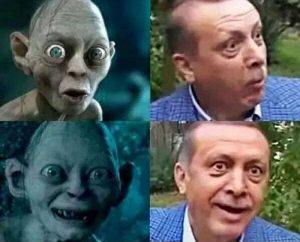
Turkish doctor Bilgin Ciftci posted photos on Twitter juxtaposing Gollum with Erdogan. He was immediately fired from the hospital where he worked. Then he was brought to court for insulting Erdogan, an offense punishable by up to four years in prison. His lawyers made a point about Gollum not necessarily being evil. And then events took an even more tragicomic turn.

Part of the Gollum/Erdogan image for which Dr. Bilgin Ciftci is on trial in Turkey.

The makers the Lord of the Rings films, Peter Jackson, Fran Walsh and Philippa Boyens, stated:

“If the images are in fact the ones forming the basis of this Turkish lawsuit, we can state categorically: None of them feature the character known as Gollum. All of them are images of the character called Smeagol … Smeagol is a joyful, sweet character. Smeagol does not lie, deceive, or attempt to manipulate others. He is not evil, conniving, or malicious — these personality traits belong to Gollum, who should never be confused with Smeagol. Smeagol would never dream of wielding power over those weaker than himself. He is not a bully. In fact he’s very loveable. This is why audiences all over the world have warmed to his character.”

Dr. Ciftci’s trial has been adjourned until February 23, when his and Gollum’s fate will be decided.

All of that may sound surreal in saner parts of the world. In [EU candidate!] Turkey, they are just bitter facts of life.

Burak Bekdil, based in Ankara, is a Turkish columnist for the Hürriyet Daily and a Fellow at the Middle East Forum.

Translate »
Skip to toolbar