Monthly Archives: June 2017

Members of US Congress Call for Shutdown of PLO’s US Office

Standing with Israel during a time of crisis, US lawmakers have demanded that the Obama administration close the PLO embassy in Washington while Palestinian incitement and terror attacks against Israelis continue. 


Members of Congress sent a letter to Secretary of State John Kerry calling for the shutdown of the Palestinian Liberation Organization (PLO) semi-official embassy in Washington, in wake of continued Palestinian terror attacks in Israel that have killed 21 victims and wounded over 250.

Senators Ted Cruz (R, Tx) and Congressman Mark Meadows (R, NC) co-authored the letter which was signed by 30 other members of Congress, who demanded that the administration revoke the PLO’s waiver permitting it to maintain an office in the US capital.

In the letter, the senators accuse the PLO of inciting to terror, funding terrorism and paying imprisoned Palestinian terrorists a salary as an award for acts of terrorism, and bring materials provided by the Palestinian Media Watch (PMW) to substantiate their assertions.

Israel has been facing a wave of attacks, and “the spike in violence in Israel is directly connected to the Palestinian government’s teaching of hate and glorification of terrorism,” the letter stated.

Ted Cruz

Sen. Ted Cruz. (AP/Charlie Neibergall)

“Shockingly, despite being complicit in spreading hatred and terror, the PLO retains an office in Washington, D.C.,” the lawmakers wrote. “We ask that the State Department revoke the Palestinian Liberation Organization’s waiver to maintain an office in the United States.”

“Closing the PLO office in Washington, D.C., would send a clear statement that the kind of incitement to violence perpetrated by the PLO and its leaders will not be tolerated,” they stressed in the letter. “The United States government has an obligation to publicly denounce the PLO’s actions and should immediately revoke its waiver. Allowing the PLO to maintain an office in Washington, D.C. provides no benefit to the United States or the peace process.”

Meet the Western Charlatans Justifying Jihad by Giulio Meotti

  • Why has the philosopher, Michel Onfray, become so popular among the French jihadists fighting in Syria and Iraq? Journalist David Thomson, a specialist in jihadi movements, explained that “Onfray is translated into Arabic and shared on all pro-ISIS sites.”

  • Onfray recognizes that we are at war. But this war, to him, was started by George W. Bush. He “forgets” that 3,000 Americans were killed on September 11, 2001. If you remind him that “ISIS kills innocent people”, Onfray will reply: “We have also killed innocent people.” It is the perfect moral equivalence between ISIS and the West. Barbarians against barbarians! With his moral relativism, Onfray opens the door to Islamist cutthroats.
  • The French intellectual Thomas Piketty, after the massacres in Paris, pointed at “inequality” as the root of ISIS’s success. Another well-known German philosopher, Peter Sloterdijk, claimed that the September 11 attacks were attacks were just “small incidents”.
  • Famous representatives of European culture also embraced Adolf Hitler’s dream. Their heirs now justify jihad as the ultimate punishment for Western freedoms and democracy.

After September 11, 2001, the cream of European intellectuals immediately started to find justifications for jihad. They evidently were fascinated by the Kalashnikov assault rifle, “the weapon of the poor”. For them, what we had seen in New York was a chimera, an illusion. The mass killings were supposedly the suicide of the capitalist democracy, and terrorism was the wrath of the unemployed, the desperate weapon of a lumpenproletariat offended by the arrogance of Western globalization.

These intellectuals have sown seeds of despair in a large Western echo-chamber. From 9/11 to the recent massacres on European soil, the murdered Westerners are portrayed as just collateral victims in a war between “the system” and the damned of the earth, who are only claiming a place at the table.

One of these intellectuals is Michel Onfray. It has been a while since we heard the expression: “Useful idiot.” The cynical expression is often attributed to Lenin, and was used to designate Western sympathizers who justified the horrors of Communism. The French magazine L’Express used it for Onfray: “the useful idiot of Islamism“.

When his “Atheist Manifesto” was published in 2005, Onfray could never have imagined that ten years later, he would become the darling of the jihadist group, Islamic State (ISIS). Yet, on November 21, 2015, a week after the massacres in Paris, Onfray appeared in a propaganda video of the Islamic State. A few days later, Onfray, this idol of the reflexive European middle class, said that a “truce could be signed between ISIS and France“.

Onfray just gave another interview to the magazine Famille Chrétienne, where he explained that there is no moral difference between “killing innocent lives of women, children and elderly” and “state terrorism” — between ISIS and the Western war on terror.

Onfray is the most widely read French philosopher in the world and has dethroned Michel Serres, Michel Foucault and Jean-Paul Sartre. This philosopher, drunk with the Enlightenment, has written 80 books, translated into nearly 30 languages. He is not a Marxist, but a libertarian hedonist. According to Onfray, the entire Judeo-Christian heritage prevents free, loving enjoyment. Hence his insistence, ultimately, that the Western civilization is “dead.”

How did this great hedonist, the theorist of materialism and atheism, become the darling of Islamist cutthroats? Prime Minister Manuel Valls accused him of having “lost his bearings.”

When Onfray calls for a truce with the Islamic State, it is because he believes that France is responsible for what happened to itself. In his recent book Penser l’islam (“Thinking Islam“), Onfray wrote: “If we look at the historical facts and not at the emotions, the West attacked first.” France is supposedly reaping what it has sown. Of course Islamists kill and massacre, but it is not their fault, as the West, in his view, previously attacked them.

Onfray also gave the impression of finding more excuses for ISIS by speaking a French “Islamophobia.” Why has Onfray has become so popular among the French jihadists fighting in Syria and Iraq? Journalist David Thomson, a specialist in jihadi movements, explained that “Onfray is translated into Arabic and shared on all pro-ISIS sites.” Talking to Jean-Jacques Bourdin in 2013, Onfray even defended the right of Islamists to apply Islamic sharia law in Mali.

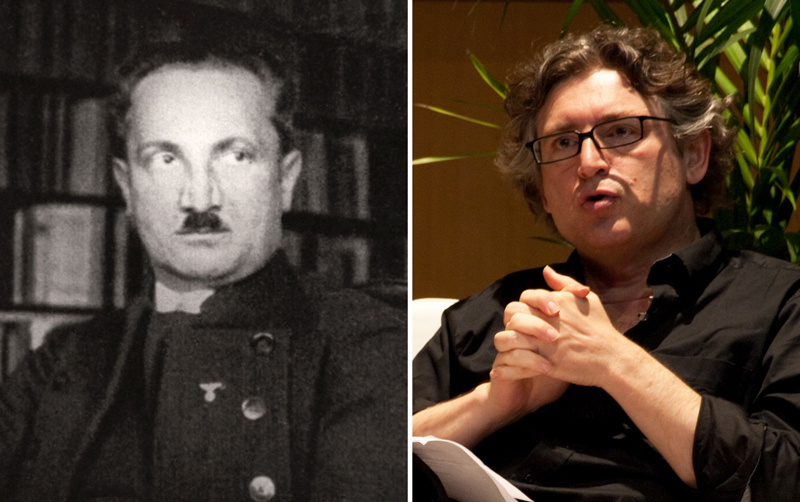
The German philosopher Martin Heidegger (left) was one of many European intellectuals and artists who embraced Adolf Hitler’s dream. Today, French philosopher Michel Onfray (right) has become the darling of the jihadist group, Islamic State, with his view that, while Islamists kill and massacre, it is not their fault; he blames the victims, because “the West attacked first.”

Onfray recognizes that we are at war. But this war, to him, was started by George W. Bush. He “forgets” that 3,000 Americans were killed on September 11, 2001. If you remind him that “ISIS kills innocent people”, Onfray will reply: “We have also killed innocent people.” It is the perfect moral equivalence between ISIS and the West. Barbarians against barbarians! The 130 French people killed on November 13, 2015 are just puppets of the West. With his moral relativism, Onfray opens the door to Islamist cutthroats.

Onfray belongs to a long list of charlatans who abound among Europe’s intellectuals. Writing for Le Monde, the most famous living German philosopher, Jürgen Habermas, claimed that “jihadism is a modern form of reaction to the living conditions characterized by uprooting.” Someone should have explained to him that all the terrorists were well integrated into the French and Belgian democracies, and living with welfare subsidies.

Another celebrity-philosopher, the Slovenian neo-Marxist guru Slavoj Zizek, argued that Islamism may seem reactionary, but “in a curious inversion religion is one of the possible places from which one can deploy critical doubts about today’s society. It has become one of the sites of resistance.” Zizek also claimed that “Islamo-Fascists” and “European anti-immigrant racists” are “the two sides of the same coin.”

The French intellectual Thomas Piketty, after the massacres in Paris, pointed at “inequality” as the root of ISIS’s success. Another well-known German philosopher, Peter Sloterdijk, claimed that the September 11 attacks were attacks were just “small incidents“.

José Saramago, a Nobel laureate for literature, claimed that flying two planes into the Twin Towers was “revenge against the humiliation”.

There were also those, like the French thinker Jean Baudrillard, who said that the attacks on the Twin Towers were actually desired by the United States. In short, Islamic terrorists did it, but we had really wanted it. Or to quote from the famous German composer Karlheinz Stockhausen, the attack on the World Trade Center was “the greatest work of art that is possible in the whole cosmos.”

The peak of cynicism was reached by Dario Fo, the winner of the 1997 Nobel Prize for literature, who said after 9/11:

“The great speculators wallow in an economy that every year kills tens of millions of people with poverty — so what is 20,000 dead in New York? Regardless of who carried out the massacre [of 9-11], this violence is the legitimate daughter of the culture of violence, hunger and inhumane exploitation”.

It has happened before. Philosophers such as Martin Heidegger and Carl Schmitt, writers such as Knut Hamsun and Louis Ferdinand Céline, musicians such as Wilhelm Furtwangler and Ernst von Karajan, are just some of the most famous representatives of European culture who embraced Adolf Hitler’s dream. Their heirs now justify jihad as the ultimate punishment for the Western freedoms and democracy.

Giulio Meotti, Cultural Editor for Il Foglio, is an Italian journalist and author.

Meet the First Muslim Mayor of London by Soeren Kern

  • Conservative Party candidate Zac Goldsmith accused Khan of giving “platform, oxygen and cover” to Islamic extremists. He also accused Khan of “hiding behind Britain’s Muslims” by branding as “Islamophobes” those who shed light on his past.

  • “The questions are genuine, they are serious. They are about his willingness to share platforms with people who want to ‘drown every Israeli Jew in the sea.’ It’s about his having employed someone who believed the Lee Rigby murder was fabricated. It’s about his career before being an MP, coaching people in how to sue the police.” — Conservative Party candidate Zac Goldsmith.
  • In 2008, Khan gave a speech at the Global Peace and Unity Conference, an event organized by the Islam Channel, which has been censured repeatedly by British media regulators for extremism. Members of the audience were filmed flying the black flag of jihad while Khan was speaking.
  • “I regret giving the impression I subscribed to their views and I’ve been quite clear I find their views abhorrent.” — Sadiq Khan.
  • “A Muslim man with way too many extremist links to be entirely coincidental is now the Mayor of London. I suppose this is hardly a shock, though. The native English are a demographic minority (and a rapidly dwindling one) in London, whilst Muslims from Pakistan and Bangladesh are a rapidly expanding demographic.” — British politician Paul Weston.

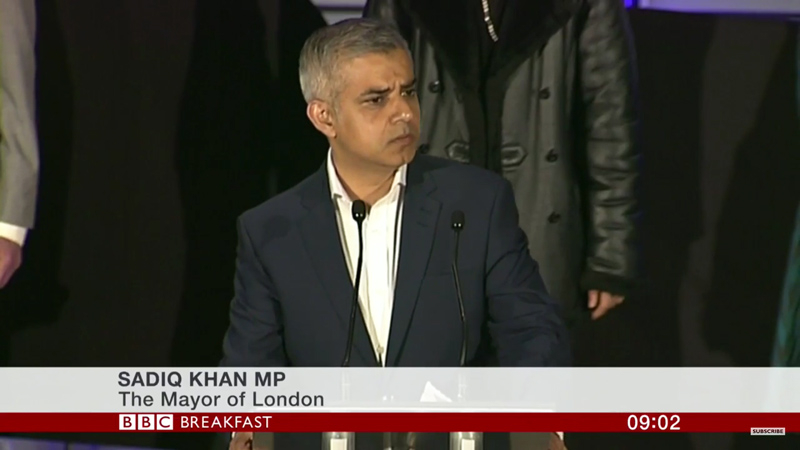
Labour Party politician Sadiq Khan has been sworn in as mayor of London. He is the first Muslim to lead a major European capital.

Khan, 45, is the London-born son of Pakistani immigrants. His father was a bus driver and he grew up with seven siblings in a government-subsidized apartment. He studied law, became a university professor and served as chairman of the civil liberties pressure group Liberty. He was elected to Parliament in 2005. Khan’s supporters say he is the epitome the Muslim immigrant success story.

Khan — who won 57% of the ballot, or 1.3 million votes, a number which happens to be roughly equal to Muslim population of London — has promised to be “the British Muslim who takes the fight to the extremists.” Others are not so sure. During the election campaign, Khan faced a steady stream of allegations about his past dealings with Muslim extremists and anti-Semites.

has promised to be “the British Muslim who takes the fight to the extremists.” Others are not so sure. During the election campaign, Khan faced a steady stream of allegations about his past dealings with Muslim extremists and anti-Semites.

Khan’s opponent, Conservative Party politician Zac Goldsmith, drew attention to Khan’s past career as a human rights lawyer that included repeated public appearances alongside radical Muslims.

Goldsmith accused Khan of giving “platform, oxygen and cover” to Islamic extremists. He also accused Khan of “hiding behind Britain’s Muslims” by branding as “Islamophobes” those who shed light on his past.

In an interview with the London Evening Standard, Goldsmith said:

“To be clear, I have never suggested he [Khan] is an extremist but without a shadow of doubt he has given platform, oxygen and cover to people who are extremists.

“I think he is playing with fire. The questions are genuine, they are serious. They are about his willingness to share platforms with people who want to ‘drown every Israeli Jew in the sea.’

“It’s about his having employed someone who believed the Lee Rigby murder was fabricated. It’s about his career before being an MP, coaching people in how to sue the police.

“It just goes on and on and on. To pretend those are not legitimate questions, to pretend that by asking those questions newspapers, Londoners or my campaign are engaging in Islamophobia is unbelievably irresponsible.

“It is just obscene that somebody who wants to be the mayor of the world’s greatest city, to be in charge of our police and security, should behave not only with such bad judgment but in a way that is totally shameless.”

Goldsmith also drew attention to Khan’s ties with Suliman Gani, a Muslim cleric in Tooting, the constituency in South London where Khan is an MP. “To share a platform nine times with Suliman Gani, one of the most repellent figures in this country, you don’t do it by accident,” Goldsmith said.

Goldsmith was referring to a Sunday Times exposé, which revealed that between 2004 and 2013, Khan had spoken alongside Gani on at least nine occasions, “even though Gani has called women ‘subservient’ to men and condemned homosexuality, gay marriage, and even organ transplants.”

Gani — who has ties to the extremist Islamist group Hizb-ut-Tahrir, and has rallied in support of Shaker Aamer, an al-Qaeda terrorist who was detained at Guantanamo Bay — is also linked to the London-based Tayyibun Institute, which the British government says “tolerates or promotes non-violent extremism.”

According to the Times, on the night of the Paris attacks in November 2015, Gani appeared at an “Islamic question time” event in Bedford, where speakers reportedly told British Muslims to “struggle” for an “Islamic state.”

Khan and Gani first shared a platform in August 2004 at an event organized by Stop Political Terror, a group supported by Anwar al-Awlaki, a radical American imam who was killed in 2011 by a CIA-led drone strike in Yemen. According to the Times, Khan spoke at least four times at events organized by Stop Political Terror, which has since merged with CAGE, a group that called the Islamic State butcher Jihadi John a “beautiful young man.”

In an interview with the Times, Davis Lewin, deputy director of the Henry Jackson Society, an anti-extremism think tank, said:

“Gani has campaigned on behalf of convicted terrorists, appeared at events designed to undermine government counter-radicalization strategies, including sharing platforms with a pro-terrorist organization such as CAGE, and is said to hold repugnant views about women and the lesbian, gay, bisexual, trans community.

“Given that the UK, and London in particular, is a major target for Islamist-inspired terrorist attacks, it is intolerable to see any politician, much less one seeking such a vitally important office as mayor of London, associate with an individual such as this.

“Mr Khan’s reportedly repeatedly sharing a platform with this man, whose views are widely available, is deeply alarming.”

Khan also spent years campaigning to prevent Babar Ahmad from being extradited to the United States on charges of providing material support to terrorism. Ahmad, who admitted his guilt, later said that his support for the Taliban was “naïve.”

In 2002, Khan represented the leader of the Nation of Islam, Louis Farrakhan. Khan tried to reverse a decision by the Home Office, which had banned Farrakhan from entering the UK due to fears that his anti-Semitic views would stir up racial hatred. Farrakhan has called Jews “bloodsuckers” and referred to Judaism as “a gutter religion.”

At the time, Khan said: “Mr. Farrakhan is not anti-Semitic and does not preach a message of racial hatred and antagonism.” Khan added:

“Farrakhan is preaching a message of self-discipline, self-reliance, atonement and responsibility. He’s trying to address the issues and problems we have in the UK, black on black crime and problems in the black community. It’s outrageous and astonishing that the British Government is trying to exclude this man.”

Khan now says: “Even the worst people deserve a legal defense.”

In 2004, Khan was the chief legal advisor to the Muslim Council of Britain, a group linked to the Muslim Brotherhood. Khan defended Yusuf al-Qaradawi, an Egyptian-born Islamist who has been banned from entering the UK. Al-Qaradawi has expressed support for Hamas suicide bombings against Israel: “It’s not suicide, it is martyrdom in the name of Allah.” According to Khan, however, “Quotes attributed to this man may or may not be true.”

Also in 2004, Khan shared a platform with a half-dozen Islamic extremists in London at a political meeting where women were told to use a separate entrance. One of the speakers was Azzam Tamimi, who has said he wants Israel destroyed and replaced with an Islamic state. Another speaker was Daud Abdullah, who has led boycotts of Holocaust Memorial Day. Yet another speaker was Ibrahim Hewitt, a Muslim hardliner who believes that adulterers should be “stoned to death.”

In 2006, Khan attended a mass rally in Trafalgar Square to protest the publication of cartoons of Mohammed by Western newspapers. One of those present at the rally was Tamimi, who told Sky News: “The publication of these cartoons will cause the world to tremble. Fire will be throughout the world if they don’t stop.” Khan defended Tamimi: “Speakers can get carried away but they are just flowery words.”

In 2008, Khan gave a speech at the Global Peace and Unity Conference, an event organized by the Islam Channel, which has been censured repeatedly by British media regulators for extremism. Members of the audience were filmed flying the black flag of jihad while Khan was speaking.

Also in 2008, Khan wrote that Turkey should be allowed to join the European Union in order to prove that the bloc is not a “Christian Club” that discriminates against Muslims:

“Muslims across Europe will see the question for Turkish admission to the EU as a clear test of European inclusion. If the door is slammed shut it will be understood by 20 million Muslim citizens of the EU that the basis of the decision to treat Turkey differently to new members like Bulgaria or Romania has been made on the basis that Europe is a ‘Christian Club.’

“Some will see this as a clear indication that Muslims can never be a part of the story of Europe or the West. That will undermine everybody working to say that of course one can be British, European and Muslim, or French, European and Muslim.”

In 2009, when Khan was the Minister for Community Cohesion in charge of government efforts to eradicate extremism, he gave an interview to the Iran-backed Press TV. He described moderate Muslims as “Uncle Toms,” a racial slur used against blacks to imply that they are too eager to please whites.

In the same interview, Khan expressed support for boycotts of Israeli products: “You know, there’s nothing wrong, and I encourage people to protest, to demonstrate, to complain, to write into newspapers and TV, to, if you want to boycott certain goods, boycott certain goods — all lawful means open in a democratic society.”

In 2012, Khan addressed and praised the Federation of Student Islamic Societies (FOSIS), an umbrella group founded by activists from the Muslim Brotherhood. The British government has criticized FOSIS for promoting Islamic extremism.

In 2014, Khan expressed support for Baroness Warsi, who resigned from Prime Minister David Cameron’s cabinet because she felt that Cameron was insufficiently critical of Israel. In an essay for the Guardian, (which has now been removed from the Guardian’s website) Khan wrote:

“Warsi must be listened to when she says, ‘our response to [Gaza] is becoming a basis for radicalization that could have consequences for us for years to come’ […] The government’s failure to criticise Israel’s incursion is not just a moral failure — it goes directly against Britain’s interests in the world and risks making our citizens less safe as a result.”

Commentator Anthony Posner wrote:

“Although Khan has assured Londoners that he would not use the mayoral office as ‘a pulpit to pronounce on foreign affairs,’ one wonders if he would really be able to remain neutral if London was once again dealing with large anti-Israel demos. On the basis of his response to Warsi’s resignation, it seems unlikely that he would show restraint.”

In March 2016, Khan was pressured to fire a top aide, Shueb Salar, after the Daily Mail revealed that Salar was sending misogynistic messages on social media: “Along with homophobic and sexist comments, Salar jokes about rape and murder, claims Bengali people ‘smell’ and said he thought the slaying of soldier Lee Rigby by extremists in 2013 may have been fabricated.”

In May, a close ally of Khan, Labour politician Muhammed Butt, apologized for sharing a Facebook post which compared Israel with Islamic State.

In an election debate aired by the BBC on April 18, Khan said he had “never hidden” the fact that he had represented “some pretty unsavory characters.” When asked if he regretted sharing a platform with extremists, he said: “I regret giving the impression I subscribed to their views and I’ve been quite clear I find their views abhorrent.”

Former Labour Party manager Rob Marchant said he was worried about Khan’s links to extremists, but that he should be given the benefit of the doubt:

“While this dabbling with Islamist politics may well have been more to do with a streak of ruthless populism in Khan in building political support, than a genuine meeting of minds with the Islamists, it does cast some doubt upon both his judgement and his values.”

By contrast, British politician Paul Weston, who has long cautioned about the Islamization of Britain, warned that Khan’s rise is a harbinger of things to come:

“The previously unthinkable has become the present reality. A Muslim man with way too many extremist links to be entirely coincidental is now the Mayor of London. I suppose this is hardly a shock, though. The native English are a demographic minority (and a rapidly dwindling one) in London, whilst Muslims from Pakistan and Bangladesh are a rapidly expanding demographic…..

“In a couple more decades Britain may well have its first Muslim Prime Minister, and I think we can safely assume he will be of the same ideological stock as Sadiq Khan…. Reality cannot argue with demographics, so the realistic future for Britain is Islamic.”

Soeren Kern is a Senior Fellow at the New York-based Gatestone Institute. He is also Senior Fellow for European Politics at the Madrid-based Grupo de Estudios Estratégicos / Strategic Studies Group. Follow him on Facebook and on Twitter. His first book, Global Fire, will be out in 2016.

Massoud Day, September 9 America’s Best Ally in Afghanistan by A.J. Caschetta

  • Unfortunately, Afghanistan’s neighbors were not about to let a democratic government with Western influences flourish on their borders, so war broke out.”[I]t was Massoud and his followers who struggled to uphold human rights, and his enemies who abused them.” — John Jennings, Associated Press.

  • In 1998, the same year Osama bin Laden released his Declaration of War Against Americans with its “ruling to kill the Americans,” Massoud wrote that Afghanistan had become “occupied by fanatics, extremists, terrorists, mercenaries, drug Mafias and professional murderers.” Citing a “duty to defend humanity against the scourge of intolerance, violence and fanaticism,” he pleaded for American assistance, to no avail.
  • In 2012, Afghanistan’s National Assembly declared September 9 “Massoud Day. It should be “Massoud Day” in America too.

Before the 15th commemoration of the 9/11 attacks this Sunday, America might also do well to pause on Friday, September 9, to reflect on the 15th anniversary of the assassination of Ahmad Shah Massoud, an Afghan of Tajik ancestry from the Panshjir Valley, who was our best ally in the fight against Al-Qaeda and the Taliban.

Massoud’s detractors say he was just another warlord, but this is not correct. True, the Lion of the Panjshir, as he was known, was a commander of forces. But in a land of warlords, he stood out as a humanist who by all accounts practiced a tolerant, egalitarian version of Islam. He played chess, read poetry, and traveled with hundreds of books. Some called him the “warrior monk.”

Massoud opposed forced marriages, child marriages, and other kinds of widely-approved abuses of women. He signed and promoted the Declaration of the Essential Rights of Afghan Women. That alone makes him more than “just another warlord.”

He once said, “I am against killing anyone because they believe in communism, liberalism, or any other ‘ism.'”[1] But Massoud did kill. He was a key member of the mujahideen who, with American weapons, ousted the Soviet Union from Afghanistan. He then fought the Soviet puppet-government led by a Moscow-educated Afghan, Dr. Mohammad Najibullah.

In 1992, when Kabul fell to the mujahideen, the communist generals surrendered to Massoud rather than to the warlords. Working in Afghanistan with Medecins du Monde at the time, Michael Barry observed that “the way he extended amnesty to the entire communist bureaucracy in Kabul meant that the city paid allegiance to him intact.”[2] Massoud even granted his defeated enemy, Najibullah, sanctuary in the UN compound.

After the defeat of Najibullah’s government, a pivotal moment in Afghan history, Massoud again proved that he was not just another warlord. Many had urged him to enter Kabul with his forces and take control of the country, but he refused. Like George Washington, who might have become king of America after defeating the British but instead launched an ambitious project of shared governance, Massoud chose not to be another warlord dictator. Instead he helped form, and served as defense minister in, a coalition government in which Berhanuddin Rabbani served as president.

Recognizing that “the cultural environment of the country suffocates women,” Massoud made changes. One of his top commanders, Bismallah Khan, recalls that he “appointed a woman doctor as chief of the medical academy to send a message that we supported women and that we wanted women to have a role in the reconstruction efforts.”[3] When Massoud’s wife was interviewed by Marie-Francoise Colombani for Elle magazine, she wore high-heeled shoes revealing her painted toenails, railed against the chadri [burqa] and looked forward to an Afghanistan where women had access to birth control in place of the barbaric practice of “perform[ing] abortions by putting huge stones on the womb.”[4]

Unfortunately, Afghanistan’s neighbors were not about to let a democratic government with Western influences flourish on their borders, so war broke out. It is often erroneously called a “civil war.” In reality it was a proxy invasion of newly-freed Afghanistan by its neighboring, Iran-backed Shiite militias and Uzbekistan-backed Sunni militias, both often under the command of Abdul Rashid Dostum. They attacked Kabul from one side, while Pakistan-backed militias commanded by Gulbuddin Hekmatyar, attacked from the other.[5] In 1994, the Taliban came into existence, also supported by Pakistan, to become Afghanistan’s most potent foe.

Massoud is sometimes blamed for civilian deaths in this war, but these false narratives are Pakistani propaganda. The truth is that Hekmatyar’s Hezb-i-Islami forces shelled Kabul and killed thousands of civilians. So too did Dostum’s Hazara militia, the Hezb-Wahdet-Islami, which specifically targeted Kabul’s northwestern residential neighborhoods.

After Massoud drove the Hazara from their positions, some of the Afghan fighters took revenge on the retreating militia members. Radio Iran called it a massacre, and many since have repeated the claim. But this false charge applies to Massoud the same unrealistic standard applied to Ariel Sharon, convicted in some circles not of committing a massacre but failing to prevent one.

John Jennings, who covered Kabul for the Associated Press from1991 to 1994, called it an “invented massacre that never, in fact, occurred.” Jennings wrote of “savagery I had witnessed the Hazara militia inflict on noncombatants” and refuted the Radio Iran account: “it was Massoud and his followers who struggled to uphold human rights, and his enemies who abused them.”[6]

In 1996 the Taliban, with the support of Pakistan’s Inter-Services Intelligence (ISI), overthrew the Rabbani government. Upon taking Kabul, they searched for Najibullah, still, thanks to Massoud’s largesse, living in the UN building. But the Taliban fighters showed him no mercy. They castrated and killed him, and then they hung his corpse from a pole.

The Taliban soon controlled 80% of Afghanistan, and for the next five years, the only opposition came from the “United Front,” known in the West as the “Northern Alliance”. Massoud, its de facto leader, spent his remaining days fighting Al-Qaeda and the Taliban and asking the world for help.

In 1998, the same year Osama bin Laden released his Declaration of War Against Americans with its “ruling to kill the Americans,” Massoud wrote a Letter to the People of the United States of America, explaining that Afghanistan had become “occupied by fanatics, extremists, terrorists, mercenaries, drug Mafias and professional murderers.” Citing a “duty to defend humanity against the scourge of intolerance, violence and fanaticism,” he pleaded for American assistance, to no avail. He even traveled to Europe to state his case. In Brussels to address the European Parliament, he admonished all that “it’s not just my war; it’s the war of the world! Be careful, because these are dangerous people.”[7]

Massoud also regularly warned the US not to trust Pakistan and its ISI. Declassified CIA documents indicate that he even warned the US that Al-Qaeda was preparing “to perform a terrorist act against the U.S. on a scale larger than the 1998 bombing of the U.S. embassies in Kenya and Tanzania.” But no one listened to his warnings.

Massoud was killed on September 9, 2001 by Tunisian Al-Qaeda operatives posing as Belgian journalists, who pretended they were taking his picture. Bin Laden and Taliban leader Mullah Omar knew that the 9/11 attacks would bring reprisal, and they believed that eliminating the charismatic leader of the Northern Alliance would cause it to fall into disarray and make any invasion of Afghanistan unsuccessful. His murder has been described as the “go” signal for the September 11 attack and bin Laden’s “gift” to Mullah Omar.

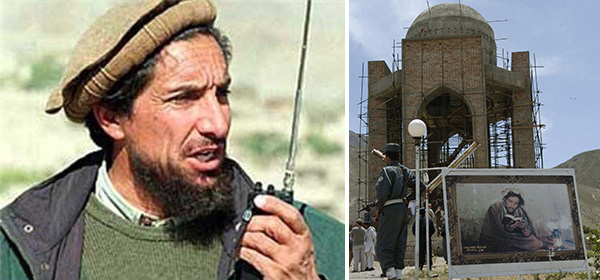
Left: Ahmad Shah Massoud in an undated photo. Right: The tomb of Massoud in the Panjshir province of Afghanistan, under construction in 2007.

Eulogizing Massoud from the floor of the U.S. House of Representatives on September 17, 2001, Rep. Dana Rohrabacher (R-CA) said that with a little help “the Northern Alliance could easily have dealt a knock-out punch to the Taliban.”

In death, Ahmad Shah Massoud has become a legend in Afghanistan, where his image endures printed on posters, painted in murals, and woven into rugs, an important index of “fame” in Afghan society. In 2012, Afghanistan’s National Assembly declared September 9 “Massoud Day. It should be “Massoud Day” in America too.

A.J. Caschetta is a Shillman-Ginsburg fellow at the Middle East Forum and a senior lecturer at the Rochester Institute of Technology.

Massachusetts Islamism by Samuel Westrop

  • The response of “non-violent” Islamists to counter-extremism programs displays a master class in deception. The greatest mistake made by the Obama administration is to treat groups such as CAIR and the Islamic Society of Boston (ISB) as genuine representatives of the Muslim community.

  • Very few American Muslims believe that CAIR is a legitimate voice of American Islam. A 2011 Gallup poll revealed that around 88% of American Muslims said CAIR does not represent them.
  • It is little wonder that groups such as CAIR disparage genuine moderates. They perceive moderates as a threat to their self-styled reputations as representatives of American Islam. Many in them have learned to speak the language of liberalism and democracy in their pursuit of an ultimately illiberal and anti-democratic ideal.
  • Counter-extremism work is best achieved by marginalizing such groups — by freeing American Muslims from their self-appointed Islamist spokesmen, and by working instead with the genuine moderates.

A number of Massachusetts Muslim groups, led by Cambridge city councilor Nadeem Mazen, are currently spearheading a campaign against the Obama administration’s program, Countering Violent Extremism (CVE), which has designated Boston as one of its pilot cities.

From the government’s perspective, Boston was an obvious choice. The city has a long, unfortunate history of producing internationally-recognized terrorists, including the Tsarnaev brothers, who bombed the Boston marathon; Aafia Siddiqui, whom FBI Director Robert S. Mueller describes as “an al-Qaeda operative and facilitator;” Abdulrahman Alamoudi, the founder of the Islamic Society of Boston, and named by the federal government as an Al Qaeda fundraiser, and Ahmad Abousamra, a key official within Islamic State, whose father is vice-president of the Muslim American Society’s Boston branch.

During the past decade, in fact, twelve congregants, supporters, officials and donors of the Islamic Society of Boston alone have been imprisoned, deported, killed or are on the run in connection with terrorism offenses.

Despite these alumnae, a number of extremist Islamic organizations, such as the Council on American Islamic Relations (CAIR), have claimed that the government’s attempt to combat radicalization “targets American Muslims” and “undermines our national ideals.”

Cambridge city councilor Nadeem Mazen, who is also a director of CAIR’s Massachusetts branch, has spoken at a number of anti-CVE rallies, condemning the government’s approach as “authoritarian” because it included “violent practices like surveillance and racial profiling.”

In response, Robert Trestan, the Massachusetts director of the Anti-Defamation League (ADL), points out that the CVE program “is relatively new in this country. It’s not fair to judge it yet and be overly critical.” He added: “Nothing I’ve seen or participated in has gone anywhere near proposing or suggesting anything close to surveillance, crossing the line of people’s civil rights or profiling.”

What, then, is the basis for this opposition?

Critics of Nadeem Mazen look with concern at his opposition to policing that protects Americans from terrorist attacks. In May, Mazen voted against the Cambridge Police Department budget. He argued that the funding for SWAT teams and the police’s participation in CVE programs only served to “alienate the Muslim community.” The Cambridge SWAT team, however, played a crucial part in the arrest of Boston Marathon bomber Dzhokhar Tsarnaev just hours after he and his brother murdered three spectators and injured hundreds at the Boston marathon.

Mazen has also taken part in protests against Boston police departments. Addressing a crowd of activists from a group named Restore the Fourth, Mazen claimed that police counter-terrorism units are part of a larger conspiracy to suppress free speech: “They are working very hard…in the background….but really, there’s never any need. … Some of the research is looking at free speech activists…like me. … It is that type of government operation, it’s that that is the best and the most evident hallmark of tyranny.”

Are Mazen and CAIR, then, simply free speech campaigners?

CAIR does not exactly have a reputation for liberal activism. It was founded in 1994 by three officials of the Islamic Association of Palestine, which, the 2008 Holy Land Foundation terror financing trial would later determine, was a front for the terrorist group, Hamas. During the same trial, the prosecutors designated CAIR as an “unindicted co-conspirator.” U.S. District Court Judge Jorge Solis concluded that, “The government has produced ample evidence to establish the associations of CAIR… with the Islamic Association for Palestine, and with Hamas.”

One of CAIR’s original Islamic Association of Palestine founders, Nihad Awad, is today CAIR’s Executive Director. Awad peddles conspiracy theories that the U.S Congress is controlled by Israel, and has stated that U.S. foreign policy was propelled by Clinton administration officials of a particular “ethnic background.”

The Anti-Defamation League (ADL) notes that CAIR has long expressed anti-Semitic and pro-terror rhetoric. The ADL adds that, “[CAIR’s] public statements cast Jews and Israelis as corrupt agents who control both foreign and domestic U.S. policy and are responsible for the persecution of Muslims in the U.S.”
In November 2015, CAIR, which in the Holy Land Foundation terror financing trial was determined to be a front for the terrorist group Hamas, organized a “lobbying day” at the Massachusetts State House.

Not all of Massachusetts’s Muslim groups have opposed involvement in the CVE program. In February, the Islamic Society of Boston (ISB), which is partly run by the Muslim American Society, took part in the White House’s summit on Countering Violent Extremism.

The ISB’s Director, Yusufi Vali, however, would later criticize the CVE program on the grounds that by focusing on radicalization rather than violence, the authorities were unfairly targeting Muslim-Americans simply because of their faith.

Instead, Vali has urged, the government should deputize responsibility for combatting extremism to groups such as his. Boston is a pilot city for the CVE program, he claimed, because of the “strong relationship” between law enforcement and institutions such as the ISB. Only the ISB’s version of Islam, Vali proposed, can “appeal to young people” and “win in the marketplace of ideas.”

But the ideology underpinning the Islamic Society of Boston itself is cause for some concern. In 2008, the Muslim American Society (MAS), which runs the ISB’s Cultural Center, of which Vali is also a board member, was labelled by federal prosecutors “as the overt arm of the Muslim Brotherhood in America.”

Religious leaders of the Muslim American Society have included Hafiz Masood, the brother of Pakistani terrorist Hafiz Saeed, who masterminded the 2008 Mumbai Massacre in which 164 people were murdered. While he was living in the Boston area, according to a Times of India report, Masood was raising money and trying to recruit people for his brother’s terrorist group. After being deported by the government for filing a fraudulent visa application, Masood has since become a spokesperson for Jamaat-ud-Dawa, a branch of his brother’s terrorist group, Lashkar-i-Taiba.[1]

The ISB itself was founded by the Al Qaeda operative Abdulrahman Alamoudi, who was jailed in 2004 for participating in a Libyan plot to assassinate Saudi Crown Prince Abdullah. The ISB’s other trustees have included prominent Islamist operatives, including Yusuf Al Qaradawi, the spiritual leader of the global Muslim Brotherhood.

In October, an event hosted by the ISB featured a number of extremist preachers. One of them, Hussain Kamani has cited Quranic verse and commentary to warn Muslims, “do not resemble the Jews” and has advised parents to “beat” their children “if they do not [pray].” In a talk titled ‘Sex, Masturbation and Islam,’ Kamani explains that a Muslim man must only fulfil his sexual desires “with his spouse…[or] with a female slave that belongs to him.” Those who commit adultery or have sex outside of marriage, Kamani further declares, must be “stoned to death.”

If one looks to European experiences with counter-extremism programs, some of which have been in place for over a decade, Yusufi Vali and the ISB have good reasons to lobby against a focus on radicalization. In Britain, under Prime Minister David Cameron, the government has come to the realization that some of the Islamic groups entrusted with counter-extremism initiatives are, in fact, part of the problem.

In a speech delivered in Munich in 2011, Cameron stated:

“As evidence emerges about the backgrounds of those convicted of terrorist offences, it is clear that many of them were initially influenced by what some have called ‘non-violent extremists’, and they then took those radical beliefs to the next level by embracing violence. … Some organisations that seek to present themselves as a gateway to the Muslim community are showered with public money despite doing little to combat extremism. As others have observed, this is like turning to a right-wing fascist party to fight a violent white supremacist movement.”

Groups similar to the ISB and CAIR, the Conservative government reasons, represent the “non-violent extremists.” These are likely the first stop on the “conveyor belt” path to radicalization: a young is Muslim exposed to anti-Semitism, excuses for terrorism and claims of victimhood and gradually becomes open to committing violent acts.

This insight was not without foundation. The previous Labour government, under both Tony Blair and Gordon Brown, partnered with British Muslim groups such as the Muslim Council of Britain (MCB), Britain’s most prominent Muslim group — similar in ideology to CAIR and the ISB — to counteract extremist ideas in the Muslim community. In 2008, however, the Labour government severed all relations with the Muslim Council of Britain after it emerged that the group’s deputy secretary general, Daud Abdullah, had signed a declaration supporting attacks against Jewish communities and the British armed forces.

By seeking the partnership of groups such as the ISB, the Obama administration risks making the same mistakes of Britain’s last Labour government. And, in time, the U.S. government will arrive at the same realization as the British government — that non-violent extremists do not offer an alternative to violent extremism; in fact, they make the problem worse.

But all this invites the question: why do some Islamist groups oppose CVE programs while others join in? Although the ISB backed out of the Boston CVE initiative, the Islamic Council of New England (ICNE) remains a key partner. As with CAIR and the ISB, the ICNE is part of the “soft Islamist” network — groups that emerged from Muslim Brotherhood ideology and which have learned to speak the language of liberalism and democracy in their pursuit of an ultimately illiberal and anti-democratic ideal.

In 2002, the ICNE hosted a conference with the Muslim Brotherhood academic, Tariq Ramadan, and the British Salafist, Abdur Raheem Green, a former jihadist who warns Muslims of a Jewish “stench,” encourages the death penalty as a “suitable and effective” punishment for homosexuality and adultery, and has ruled that wife-beating “is allowed.”

The ICNE has announced its continued involvement in CVE programs because “rather than obsessing about the insidious erosion of our ‘civil rights’, Muslims should focus on the more immediate risk of being blind-sided by the overwhelming tsunami of Islamophobia.”

While CAIR protests against CVE, the ICNE believes it can work with counter-extremism programs to its advantage. The ISB lies somewhere in the middle. And yet all these Islamist groups are key partners, mostly founded and managed by the same network of Islamist operatives.

Has the CVE program really caused such discord?

Again, the European experience offers some answers. Daud Abdullah, the former deputy secretary general of the Muslim Council of Britain, had his group work closely with the British government’s counter-extremism program, before later hosting an event with his other group, Middle East Monitor, which denounced the scheme as a “Cold War on British Muslims.” Similarly, the Cordoba Foundation, a prominent Muslim Brotherhood think tank, procured counter-extremism grants in 2008 only to run events condemning counter-extremism programs in 2009.

Non-violent extremists learn both to exploit and criticize counter-extremism initiatives to their benefit. By working in tandem, some Islamist voices accept government funds that legitimize them as leaders of the Muslim community and portray them as responsible Muslims concerned with extremism; while other Islamist groups oppose counter-extremism efforts in an effort to style themselves as civil rights champions and gain the support of libertarians on both the Left and Right.

The response of “non-violent” Islamists to counter-extremism programs displays a master class in deception. The greatest mistake, if it is one, made by the Obama administration is to treat groups such as CAIR and ISB as genuine representatives of the Muslim community. Very few American Muslims, it seems, actually believe that CAIR is a legitimate voice of American Islam. According to a 2011 Gallup poll, around 88% of American Muslims said CAIR does not represent them.

As for the ISB, it operates under the aegis of the Muslim American Society, which claims to be a national group for American Muslims. A 2011 report produced by CAIR itself, however, demonstrates that a mere 3% of American mosques are affiliated with the Muslim American Society. 62% of mosques claimed that they were not affiliated with any organization.

It is little wonder that groups such as CAIR disparage genuine moderates. They perceive moderates as a threat to their self-styled reputations as representatives of American Islam. CAIR Massachusetts Director Nadeem Mazen has denounced counter-Islamist Muslim groups that “foist secular attitudes on Muslims” and promote ideas that “are being projected, imperialist-style on to our population.”

American Islam is diverse. No group can claim to represent either Massachusetts Muslims or American Muslims. Islamist bodies have imposed their leadership on American Muslims. As inherently political movements, they were best organized to style themselves as community leaders. When politicians in D.C ask to speak to the “Muslim community,” groups such as CAIR and the ISB step forward.

Counter-extremism work is best achieved, in fact, by the government marginalizing such groups — by freeing American Muslims from their self-appointed Islamist spokesmen, by working instead with the genuine moderates among American Muslims, and by recognizing the link between non-violent and violent extremism. European governments have finally understood this reality, but far too late. For the sake of moderate Muslims everywhere, let us hope American politicians are quicker on the uptake.

Samuel Westrop is Research Director for Americans for Peace and Tolerance.

Translate »
Skip to toolbar