Saudi Arabia
Approval of the National Transformation Plan
The Saudi Cabinet approved (June 6) the National Transformation Program (NTP), part of Saudi Vision 2030, led by Deputy Crown Prince Muhammad bin Salman. The NTP is supposed to be the basis for laying out targets to be met by government ministries and departments. The NTP was well received not only be the Saudi mainstream media (to be expected) but by the Saudi social media that represents to a great degree the public opinion of the younger Saudi generation. It may be expected that Prince Mohammad bin Salman will continue to take steps in the framework of his initiative that will, at least, preserve the sense of momentum and the public support he is enjoying.
Saudi-US Relations
In this framework, Mohammad bin Salman visited Washington DC in a bid to sell his project and himself as the future Saudi leader. During the visit, and especially in the meetings with officials from Congress and the security and intelligence Community, he also sought to build his own stature as future king and as the leader who must be at the helm throughout the period of implementation of his “Vision 2030” plan and beyond. His goal therefore was also to usurp Crown Prince Mohammad bin Nayef’s status as the favorite of the Washington officialdom as the successor to King Salman. This status derived not only from Washington’s respect of the Saudi rules of succession, but also from his years-long and tight cooperation with US agencies on security and counter-terrorism issues. Therefore, Mohammad bin Salman made an effort to project himself as a preferred effective interlocutor on those issues. The fact that Mohammad bin Salman was accorded meetings with President Obama, an honor usually reserved for heads of state, and the red-carpet reception he received, indicates that the administration now considers him as a likely future king and therefore seeks to establish a dialog with him and influence him.
Iraq
The War against the Islamic State
The liberation of Fallujah from the “Islamic State” after a month-long campaign (23 May-26 June) may be an important milestone is not the “beginning of the end” and it will certainly not lead to a stronger and more unified Iraqi state. The campaign and its anticipated aftermath will only exacerbate the sectarian divide in the country and encourage further conflict, whether in the name of the “Islamic State” or its successor under another name
The overt American support for the Iranian involvement[1] will also serve to rally Sunnis to an anti-American position. By backing a military campaign against Sunnis in which Shiite militias and Iran played a direct role, the US-led international coalition was fighting against the symptom — the Islamic State — while actually exacerbating the main problem: the sectarian divide in Iraq. Therefore, the American involvement in the Fallujah campaign will not buy it Sunni gratitude. The view of the US as pro-Shiite and pro-Iranian must have been enhanced by Secretary of State John Kerry’s statement (28 June) that Iran’s presence in Iraq is helpful to American attempts to beat back the threat of the Islamic State, and the praise heaped on the Shiite militias by the US special envoy tasked with defeating the Islamic State, Brent McGurk[2].
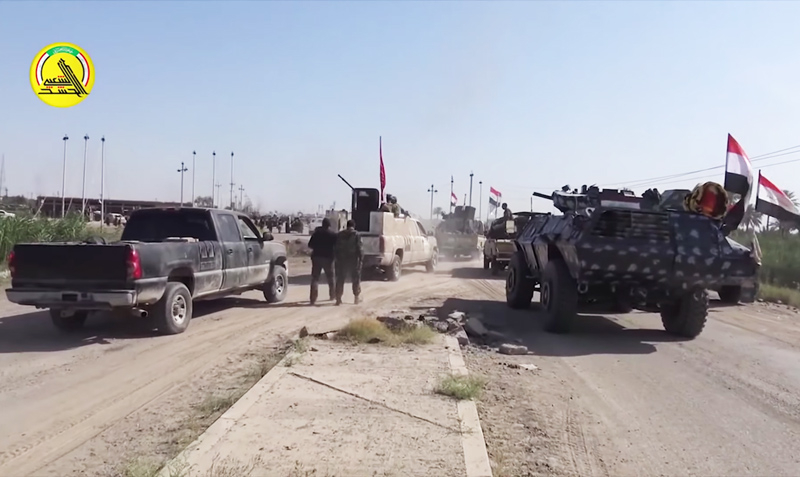
Iraqi army units and Shiite militias during the assault on Fallujah, June 2016. |
Many Sunnis — in Fallujah and elsewhere in Anbar Province — view the Fallujah campaign as part of a strategic Iranian plan to take control, through its Iraqi proxies, of central and western Iraq, from the Diala Governorate on the Iraq-Iran border to the Iraqi-Syrian border, in order to create a safe land-bridge from Iran through Syria to Lebanon. To achieve this objective, the Sunnis of western Iraq have to be weakened and denied the ability to stage a meaningful resistance[3].
No End to the Political Stalemate Expected
The paralysis of the Iraqi Parliament further complicates the situation. The parliament cannot reach agreement on the composition of a new cabinet, and cannot pass the 2016 budget. While Iraq can continue to muddle along with a caretaker government under al-‘Abadi (just as Lebanon “survives” without electing a president), passing a reduced 2016 budget is a sine qua non for execution of the agreement that that the government reached in May with the International Monetary Fund (IMF) for a low-interest loan of $5.4 billion and for loans from other international institutions.
Iran’s interest is to maintain its control over the government in Baghdad, On one hand, this calls for a relatively stable and cohesive Shiite establishment. On the other hand, Iran enhances its position in Baghdad by playing one party against the other and positioning itself as the only acceptable broker between the different Shiite factions. In the eyes of Tehran, Muqtada al-Sadr is a loose cannon, and al-‘Abadi is too close to the West and therefore must be held in check. By maintaining the innate instability of the Shiite political system, Iran attempts to preserve the Iraqi Shiites’ dependency on it to bridge the differences between the different factions.
Therefore, the Shiite infighting will continue as long as al-Sadr is around. This is clear to Iran and to al-Sadr’s rivals and increases the possibility that an attempt will be made to assassinate him. In such a case, the reaction of those elements in the Shiite community who currently support him will be violent and extreme, possibly ultimately leading to the total breakdown of the Shiite political establishment that Iran is trying to prevent.
Iran and Hezbollah in Syria and Iraq
In contrast to its singular status as power-broker in Iraq, the situation in Syria and Lebanon does not bode well for the Iranian strategy. Since these two theaters are critical for Iran’s regional designs, it has no options for an exit strategy, disengagement or even reduction of its footprint. Its primary agent, Hezbollah is suffering setbacks on all the fronts. Without massive Russian military support in Syria, Hezbollah has had to resort to repeated tactical withdrawals and it and the Iranian forces are suffering increasingly heavy fatalities, wounded and fighters taken as prisoners by the Syrian Sunni rebels. In addition to that, the rebels know their own turf better, limiting Hezbollah’s ability to deploy more troops in the more sensitive areas of the theater. Nevertheless, Hezbollah is committed to increase its footprint in the Syrian theater and cannot back down — even as its growing casualties cause increasing discontent within its Shiite Lebanese constituency[4].
Iran is entering a new stage of war in Syria which evokes the situation that the Soviet Union found itself in in Afghanistan in 1985. Until that year, the Soviet Union achieved no decisive victory over the mujahedeen, but also did not lose any battle on the ground. Like the Soviet Union in that stage of the Afghan war, Iran has achieved no decisive victory, but has incurred significant domestic opposition to the war and has no additional resources that could tip the scales. In light of this, our forecast is that the current situation in Syria will become a stalemate for all the parties at least in the months to come.
Israel-Syria-Lebanon
In these circumstances, a conflict with Israel does not serve the interests of either Iran, Hezbollah or Syria. Therefore, all four parties (and Russia) have adapted themselves to a routine of tolerance towards Israeli attacks on Syrian and Hezbollah targets that endanger Israel directly or threaten Israel’s “strategic edge” in the Syrian-Lebanese theater. In a series of actions directed towards enhancing Israel’s deterrence, the IDF held an extensive war game (12-14 June) based on a scenario of confrontation with Hezbollah. Subsequently, Israeli aircraft hit a Syrian military target near the Israeli border and uncharacteristically released a communiqué that the target had indeed belonged to the Syrian regime and had been hit in response to shelling by the Syrians near the border fence.
Hezbollah seems to be losing its predominance even within the Lebanese theater itself, where it had been almost unchallenged for decades. The attrition of Hezbollah in Lebanon is weakening it within the Shiite community. At the same time, the large (1.4 million) Syrian Sunni refugee population has effectively changed the demographic status quo in Lebanon and created a large restive population for whom Iran, Shiites and particularly Hezbollah are the prime enemy.
Syria
Bashar Assad is defiant, but not delusional
On June 7, Bashar Assad delivered a speech to the newly “elected” Syrian Parliament. This was his first major speech since the collapse of the peace talks sponsored by the International Syria Support Group (ISSG) in Geneva in April. Assad vowed to retake every inch of the country from his enemies, and effectively dismissed the concept of a peaceful transition of power, which is at the heart of the ISSG’s approach to the resolution of the crisis.
Assad is not — as the US State Department implied — “delusional”. He clearly perceives no military or political threat to his rule. He may rationally asses that Secretary Kerry’s reported “Plan B” that called for escalated military action if Assad continued his defiance will not receive support of President Obama, who will be reluctant to increase the American military involvement in Syria and to risk damaging Iranian-American relations and the nuclear agreement, which is the centerpiece of Obama’s foreign policy legacy.
Assad also most probably assesses that neither Hillary Clinton, whose Libyan experience will discourage her from intervention, nor Donald Trump, who has laid out a non-interventionist foreign policy approach, would undertake a more active involvement in Syria than that of President Obama. Assad therefore felt free to obstruct the international efforts to transport emergency aid to civilians trapped in rebel-held areas, and to reject in his speech the August 1 deadline set by the US for developing a transition plan leading to his stepping down.
Assad’s attitude, the limits of the American, Iranian and Russian interventions and the absence of any additional forces that could appear in the theater and tip the scales means that the war will grind on. It may be expected, therefore, that in the coming months, the Syrian efforts to implement “ethnic cleansing” of Sunnis in the north will continue and even escalate, resulting in a growing stream of refugees into Turkey, Lebanon and Jordan. This will continue to destabilize these countries and to pose a challenge to a weakened Europe.
Iran
New Political Appointments
It may be assumed that the Iranian leadership understands that restoring full control by the Assad regime over all of Syria is unrealistic and it has an undeclared “Plan B”. This would entail defining “useful Syria” as the stretch of land from Damascus along Lebanon’s border through Homs to Aleppo and along the Syrian coast that would be essential for the above objectives. This “useful Syria,” however, does not correspond territorially with the “useful Syria” that Russia envisions. Russia’s “useful Syria” focuses on maintaining a viable “Alawistan” that would enable Russia to maintain a beachhead on the Mediterranean and a presence on the Turkish border.
There has been disagreement inside the Iranian power elite since the Syrian uprising began to deteriorate into a full-fledged civil war. The disagreement focused on the extent of the Iranian investment of resources to support Assad’s objective of restoring the regime’s control over the entire country.
The Islamic Revolutionary Guards Corps (IRGC), which dominated the policy on Syria and was the key executor of the policy through the Qods Force and Hezbollah, has supported these objectives. Other Iranian power-brokers — notably those associated with the Rouhani camp — have warned against a Syrian quagmire and have opposed tying Iran to Assad’s fate. They argue that while it is of strategic importance to prevent Syria from falling into the hands of radical Sunni groups, it is not prudent to insist on Assad remaining in office, particularly in view of his use of chemical weapons against his own population. (The use of chemical weapons is a sensitive issue in Iran since their use by Saddam Hussain against the Iranians in the Iran-Iraq war.)
The recent appointment of Rear Admiral Ali Shamkhani as military and security coordinator of the Iran-Syria-Russia joint cooperation group, and the reshuffle in the Foreign Ministry, may indicate a move towards willingness to project more flexibility vis-à-vis the Syrian peace process even before the anti-Assad forces have been crushed militarily, and a formal willingness to consider the possibility of a post-war Syria without Assad personally.
This was implied in the statement by Iranian Foreign Minister Javad Zarif after his meeting with US Secretary of State John Kerry, that “there will be no solution if we focus on any individual [i.e. Bashar Assad],” and that the process must “focus on institutional dispersion of power and the future form of governance, through which it will be possible to reduce or even eliminate the centrality of the role of any individual or ethnicity.”
If Iran no longer insists on Bashar Assad staying in power, it could open the road to some procedural progress in the peace talks, which have been blocked by the dispute regarding his future, with Western powers and the Sunni Arab states insisting on his departure. However, the damage done by the civil war is irreversible. Even if some formula is found that would facilitate negotiations, the crux of the crisis is whether Syria will return to be dominated or even co-ruled by an Alawite minority. The Assad regime and Iran (and even Russia) cannot accept a Sunni-dominated Syria that would inevitably take revenge on the Alawites and destroy all the assets that Iran has built up over the last thirty years.
The Financial Sanctions Issue
The US administration is continuing in its determined efforts to convince the Western business community to invest in Iran. In May, John Kerry and US Treasury Department officials met with European bankers in London to tell them “legitimate business” is available to them in Iran and to “dispel any rumors” regarding future American sanctions on Iran. The administration’s message was that as long as the banks do their normal due diligence, “they are not going to be held to some undefined and inappropriate standard.”
Nevertheless, the international banking system continues to view Iran as high-risk and is likely to continue to do so for the foreseeable future. Regardless of the credibility of the guarantees of the current American administration, which will not be in office after January 2017, the reluctance of the international financial community to approach Iran derives from real risk assessment. Iran ranks 130th (out of 168) on Transparency International’s “Corruption Perception Index” and 118th on the World Bank’s “Ease of Doing Business” list.
Given the current state of affairs, these goals are far from achievable. The approval of the Iran Petroleum Contract (IPC) model does not guarantee its implementation, given the opaque and informal character of the Iranian economy. The goals of the regime’s Five Year Plan are also not clearly detailed and it is difficult to see how they can be achieved. Furthermore, Iran cannot comply with the Financial Action Task Force (FATF) rules without a fundamental transformation of its economic structure and the very essence and worldview of the regime. Taking into consideration the leadership structure, the predominance of the Supreme Leader and the position of the IRGC in economy, such a move is impossible.
The Kurdish Factor
The alliance between the Patriotic Union of Kurdistan (PUK) and the Movement for Change (Gorran) is openly challenging the Barzani clan’s dominance of Kurdish politics and raises the pressure on Massoud Barzani. To consolidate his popularity among the Iraqi Kurdistan Region’s population, Massoud Barzani might therefore resort to “patriotic” acts, like holding his promised referendum on Kurdish independence soon, which PUK-Gorran will not be able to oppose. This could lead to “Kurexit” (Kurdish exit from Iraq), which would be the result not of well-thought-out strategic planning but of Kurdish political infighting.
Israeli-Turkish “Reconciliation”
The Israeli-Turkish reconciliation is a formal step that will certainly not revive the golden age of Israeli-Turkish relations. Turkey will continue to support Hamas and to incite against Israel in international fora, though it will stick to the letter of the agreement and will take advantage of the economic opportunities afforded by the reconciliation.
The French Peace Initiative
The chances that the French peace initiative will succeed in relaunching the Israeli-Palestinian peace process are very slim. The Israeli position remains that negotiations must take place directly between Israel and the Palestinians, and not through international fora. The French initiative, however, will encourage the Palestinian Authority to reject alternative proposals for direct negotiations, pending the international conference.
Terrorism
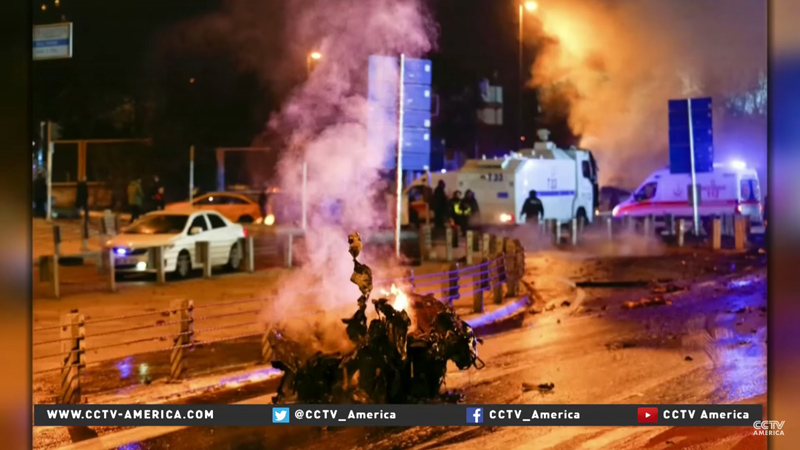
The spate of terrorist attacks by the Islamic State during the period of this report highlights the disconnect between the situation on the ground in Syria and Iraq and the threat of Islamic State or al-Qaeda inspired jihadi terrorism in susceptible countries. Most the latest attacks took place in Muslim countries (Istanbul, Turkey in June; Dhaka, Bangladesh in June; Baghdad, Iraq in June, and Mecca, Qatif and Medina in Saudi Arabia on July 4) in which the ability to “profile” potential attackers is limited and security measures are weak.
The explanation put forward by the American administration that the attacks reflect the Islamic State’s “despair” in the face of its defeats in Syria and Iraq over the last months is specious. International terrorism “to strike fear in the hearts of Allah’s enemies” has been a hallmark of the Islamic State since its beginning and it does not need the excuse of military defeat in Syria and Iraq to continue to carry out such attacks. Furthermore, these attacks were obviously planned many weeks or even months in advance. The Islamic State will continue to attempt to carry out such attacks according to its strategy to project its jihad into the heartland of its enemies — into Europe and in the territory of its enemies in the Middle East.
Spotlight on the Saudi Economic Transformation Plan
Deputy Crown Prince Muhammad bin Salman’s economic plan represents far more than economic change: it calls for no less than a transformation of the nature of the Saudi state and political order through creation of an economically independent citizenry. The developments in the level of education of the Saudi population and particularly the potential of Saudi women entering the upper levels of the workforce, coupled with the high level of unemployment among those parts of the society, are among the unspoken drivers of the Vision 2030 plan. The goal of this process is to gradually replace the waning traditional tribal and clerical power base of the regime with a young professional economic power base out of concern that the high percentage of (unemployed) youth in the country would be a recipe for social unrest that, along with the loss of the influence of the traditional Wahhabi power base to more radical anti-establishment Salafi clerics, may destabilize the country.
Mohammad bin Salman seeks therefore to mobilize their support by making Saudi society advanced technologically and by creating a large number of jobs in technology. Monitoring of social media shows significant support for Mohammad bin Salman and his plans among the younger Saudi population, including high expectations that the economic initiatives will be followed by social change — loosening religious controls and social restrictions, expanding women’s rights and increasing social mobility. The Saudi leadership, however, is on the horns of a dilemma; accelerated change will raise the ire of the conservative elements in the elite, whereas a sense among the younger population that change is too slow will give rise to a crisis of expectations and subsequent instability.
Dr. Shmuel Bar is a senior research fellow at the Samuel Neaman Institute for National Policy Studies at the Technion in Haifa, Israel, and a veteran of Israel’s intelligence community.
[1] Secretary of State, John Kerry, declared that Iran has been very “helpful” in Iraq.
[2] McGurk said that Iran-backed Shiite militias are mostly helpful in Iraq, though some go rogue: Most of them do operate under the control of the Iraqi state, but about 15-20% of them actually do not, “and those groups are a fundamental problem”.
[3] This Sunni suspicion finds support in statements of senior Shiite Iraqi leaders like former PM Nouri al-Maliki, whose hard-handed policies towards the Sunnis in Anbar Province fed the rise of the “Islamic State”, and who now praises the role of Iran and the Shiite militias, and accuses Iraq’s Sunni political leaders of supporting terrorism.
[4] Hassan Nasrallah (26 June): “The defense of Aleppo is the defense of the rest of Syria, it is the defense of Damascus, it is also the defense of Lebanon, and of Iraq. … It was necessary for us to be in Aleppo and we will stay in Aleppo. We will increase our presence in Aleppo…”.