Daily Archives: June 20, 2017

Sweden: The Silence of the Jews Part IV of a Series: The Islamization of Sweden by Ingrid Carlqvist

  • “It pains me to have to admit this but anti-Semitism is not just tolerated in some sections of the British Muslim community; it is routine and commonplace. Any Muslims reading this article – if they are honest with themselves – will know instantly what I am referring to. It is our dirty little secret. You could call it the banality of Muslim anti-Semitism.”  Mehdi Hasan, The New Statesman.

  •  

  • “There isn’t much of a desire to do anything about it [the problem of antisemitism]. It should also be said that the so-called interfaith outreach work… achieves almost nothing. A couple of old bearded men get together and agree on some dietary thing they’ve got in common, but it doesn’t solve the fact that anti-Semitism mainly comes from Muslim communities these days. … that that’s taught in many mosques and many Muslim schools…” — Douglas Murray, British commentator.
  • The question that arises is, are the elites of Sweden in general suffering from a case of Stockholm syndrome? Are we encouraging our adversaries to Islamize Sweden, which in the long run, might result in the abolition of freedom of religion, forcing Jews and Christians to live as dhimmis [subjugated citizens] in humiliation?
  • If by allowing hundreds of thousands of Muslims to settle here — people much more hateful of Jews than the average German during the Nazi era — are we not in fact paving the way for another Holocaust?

One of the most visible effects of Muslim mass immigration into Sweden is that anti-Semitism is very much on the rise in the country. Swedish Jews are being harassed and threatened, mainly in the Muslim-dense city of Malmö, where in January 2009, the friction deepened during a peaceful pro-Israel demonstration. Demonstrators were attacked by pro-Palestinian counter demonstrators, who threw eggs and bottles at the supporters of Israel. The mayor of Malmö at the time, Ilmar Reepalu, failed to take a clear stance against the violence, and was accused of preferring the approval of the city’s large Muslim population to protecting Jews. He remarked, among other things, that “of course the conflict in Gaza has spilled over into Malmö.”
In January 2009, an Arab mob in Malmö pelted a peaceful Jewish demonstration with bottles, eggs and smoke bombs. The police pushed the Jews, who had a permit for their gathering, into an alley.

The situation in Malmö has twice been deemed so alarming that U.S. President Barack Obama sent Special Representatives to the city: Hanna Rosenthal visited in 2012, and Ira Forman came in 2015. “We are keeping an eye on Malmö,” Forman told the media.

The harassment of Malmö’s Jews was, for a long time, a mystery to the general public; Were neo-Nazis really walking the streets of Sweden’s third largest city? Many believed that to be the case, until the local daily paper Skånska Dagbladet published a series of articles, in which the Jewish community finally pointed out the elephant in the room: Malmö’s growing Muslim population.

Fredrik Sieradzki of Malmö’s Jewish community explained that when he grew up, Jews could still wear a kippa (skullcap) without anyone bothering them: “Nobody dares do that now,” he said.

Malmö Rabbi Shneur Kesselman, one of very few Orthodox Jews in Sweden who wears a traditional Hassidic black hat and frock-coat, has, in the last few years, filed more than 50 complaints with the police about various kinds of harassment. On May 31, 2016, an 18-year-old Muslim by the name of Amir Ali Mohammed was finally convicted of shouting “Jewish bastard” at Kesselman. The media, however, chose not to publish any information about Mohammed’s name or religion.

In June 2016, a report with a special focus on Sweden was published, entitled “Different Antisemitisms: On three distinct forms of antisemitism in contemporary Europe.” Its authors, Swedish researchers Lars Dencik and Karl Marosi, based the report on two studies, conducted by the Anti-Defamation League (ADL) and the EU’s Fundamental Rights Agency (FRA).

The report states that the Swedish anti-Semitism, leading mostly to verbal attacks on Jews, comes from Muslims. The ADL study, encompassing eight European countries (Belgium, France, Germany, Hungary, Italy, Latvia, Sweden and Britain), showed that Sweden has the least anti-Semitic population. Only 4% of Swedes are classified as anti-Semites, compared to 41% of Hungarians. Sweden, in fact, came in number 100 out of 102 countries studied, followed only by Laos and the Philippines.

The FRA study asked Jews in various countries what group of people had attacked or threatened them: Far-right extremists, far-left extremists, Christian extremists or Muslim extremists. In Sweden, out of 81 Jews asked, 51 stated they had been attacked by Muslims, 25 by far-left extremists, 5 by far-right extremists, and none by Christian extremists.

There can be little doubt, therefore, that ethnic Swedes do not have a problem with Jews, and that the rampant anti-Semitism in Sweden is apparently due to Muslims from the Middle East, who now make up 10% of the population.

The British current events analyst and commentator, Douglas Murray, said in a recent interview, that Muslims in Europe have big problems with anti-Semitism. He referred to an article in the New Statesman, in which Muslim Mehdi Hasan wrote:

“It pains me to have to admit this but anti-Semitism is not just tolerated in some sections of the British Muslim community; it is routine and commonplace. Any Muslims reading this article — if they are honest with themselves — will know instantly what I am referring to. It is our dirty little secret. You could call it the banality of Muslim anti-Semitism.”

Murray points out that anti-Semitism is a widespread sentiment among Muslims, even among those who have lived for decades in Europe. When asked what the West can do about the problem, Murray said:

“We may not be able to [do anything]. I wouldn’t have thought France would be able to, I cannot see any particular long-term future for Jews in France. … There will be some countries, when Muslim anti-Semitism grows, say it is not the Jews who should leave, but the people who would make the Jews leave. There are some countries where that may happen, but other countries where it will fail.

“There isn’t much of a desire to do anything about it. … it should also be said that the so-called interfaith outreach work, which the Jewish community places a lot of hope in, achieves almost nothing… A couple of old bearded men get together and agree on some dietary thing they’ve got in common, but it doesn’t solve the fact that anti-Semitism mainly comes from Muslim communities these days; it doesn’t solve the problem, the fact that that’s taught in many mosques and many Muslim schools, and it doesn’t address the fact that now, if you go to, if Israel does anything anywhere in the world, anywhere in its region, there will immediately be a protest of very angry young Muslims in the center of London and other British cities. You can have an old rabbi and an old mullah, you know, sitting around having tea, agreeing on dietary stuff, but that doesn’t solve why the hatred is being taught. And that’s something the rabbi and the Jewish leadership in this country, among other places, just don’t want to admit to. Perhaps it’s too bad to confront?”

The question that arises is, are the elites of Sweden in general suffering from a case of Stockholm syndrome? Are we encouraging our adversaries to Islamize Sweden, which in the long run, might result in the abolition of freedom of religion, forcing Jews and Christians to live as dhimmis [subjugated citizens] in humiliation?

Many of the Swedish elite seem to feel that it is the duty of the Swedes to take in anyone and everyone claiming to be a refugee, regardless of that person’s attitude towards democracy, freedom of speech and the right of non-Muslims to live in this country.

That a majority of Swedes welcome mass immigration is actually a myth, cultivated over the last few years, mainly because critics of immigration are sometimes branded “racists”. In 1993, the general mood was quite different: the daily newspaper, Expressen, published an opinion poll which showed that 63% of Swedes wanted immigrants to return home. The poll, which caused quite a stir, was presented under the headline, “THROW THEM OUT”. The editor-in-chief, Erik Månsson, wrote:

“How long are we Swedes going to pretend that we welcome immigrants and refugees? Because we do not. The Swedish people have a firm opinion on immigration and refugee policies. Those in power have the opposite opinion. It does not add up. It is an opinion bomb about to go off. That is why we are writing about this, starting today. Telling it just like it is. In black and white. Before the bomb goes off.”

Instead of listening to the people, the paper’s owners fired their editor-in-chief, and journalists and politicians started raising the Swedes not to speak their minds on immigration.

To their credit, many Swedes certainly do not want to repeat the mistake we made in the 1930s, when Sweden only allowed about 3,000 German Jews, fleeing from the Nazis, into the country. Once World War II broke out, Sweden changed its course, and saved, for example, almost all of Denmark’s Jews. In a huge rescue operation, orchestrated by the Danish resistance, 7,000 Jews crossed the Öresund sea in fishing boats, bound for the Swedish coast, where they received a warm welcome and avoided deportation to the Nazi death camps.

Swedish Jews are a small community. About 20,000 Jews live here, while the number of Muslims, according to some calculations, is approaching one million and rising fast. The other looming question is: If by allowing hundreds of thousands of Muslims to settle here — people much more hateful of Jews than the average German during the Nazi era — are we not in fact paving the way for another Holocaust?

The historian Ingrid Lomfors, head of the Swedish public authority The Living History Forum (created for the very purpose of informing about the Holocaust), caused a stir last fall, when she gave a speech at the event “Sweden Together” (Sverige tillsammans), arranged by the government in support of unlimited asylum immigration. (Two months later, the government completely reversed this policy and implemented border controls.) Virtually the whole Swedish establishment was present, even the King and Queen.

Lomfors stated that:

  1. Immigration [to Sweden] is nothing new;
  2. We are all products of immigration;
  3. There is no such thing as a native Swedish culture.

Despite many politicians and historians attempting to change the narrative on Swedish history in recent years, most Swedes are aware that the country was one of the most ethnically homogenous in the world, until the late 1960s.

Moreover, in general, Swedes are extremely proud of Swedish culture. Thus, many quickly realized that what Lomfors said was simply not true. Swedes expressed their fury on social media, and Conservative (Moderaterna) Member of Parliament Hanif Bali (who is himself of Iranian descent) thought it an “absurd claim” that there is no Swedish culture. Bali told the online newspaper, Nyheter Idag that there seemed to be a contradiction in saying we will integrate people who come here, while claiming there is nothing Swedish to integrate them into.

Lomfors was forced to recant her assertion that there is no Swedish culture:

“Of course there is a Swedish culture. Right now, I am writing in the language that is Swedish and a part of this culture. A culture I value and appreciate very much, it is a part of me, and I of it.”

Sadly, Lomfors’s original statement is not unique. Many in Sweden seem reluctant to acknowledge the vast differences between Swedish and Muslim cultures, and completely deny that Muslim anti-Semitism exists, or that it is particularly prevalent in Muslim-dominated cities such as Malmö.

In February 2016, for example, the Danish-Jewish actor, Kim Bodnia, said in an interview with Israeli television, that the real reason he left the international hit television show, The Bridge (Bron), was the rampant anti-Semitism in Malmö, where much of the show is filmed.

Daniel Jonas, Administrative Director of the Jewish Congregation in Gothenburg, when asked the same question Gatestone asked Swedish politicians and the clergy, if Islam is compatible with democracy, replied:

“Absolutely! But then, that depends on what era you are talking about. One of Judaism’s periods of great prosperity was under the Muslim rule of Spain, the Moor era. While the rest of Europe was trapped in the dark ages, in Spain there was a rule that wholly accepted everybody – not because of who you were, but based on how capable you were.”

Many in Sweden also seem to believe that the best period in world history for Jews was Al-Andalus, that is, the Muslim occupation of Spain 750-1492.

This statement makes Andrew G. Bostom, a physician and author of The Legacy of Jihad, explode in anger:

“What Daniel Jonas said is idiotic rubbish. Muslim Spain was a rigid Sharia state. Period. The devastating Muslim jihad conquest of Spain during the 8th century imposed a rigorous system of Islamic Law — the Sharia — on those non-Muslim Christians and Jews who survived the mass murder and pillage. Brutal enslavement — agricultural, construction, military, harem, and eunuch (forced human castration), with over a 90% mortality rate — took place on an enormous scale. Those indigenous, vanquished Christians and Jews who were not enslaved, were subjected to the humiliating discrimination inherent in the Sharia, and always at risk for collective punishment, and renewed full-blown jihad campaigns waged against them, if they failed to accept these discriminatory Sharia mandates.

“Jews suffered from both the chronic, grinding Jew-hatred intrinsic to Islamic theology, and paroxysms of mass killings in the 11th and 12th centuries, in particular. The 1066 C.E. Jew-hating pogrom in Granada — ‘inspired’ by popular Muslim preachers exhorting Jew-hating themes from the Koran — Jews as apes, or apes and pigs (Koran 2;65, 5:60, and 7:166), meriting permanent contempt and humiliation (Koran 2:61, 3:112), and “dhimmi” status (Koran 9:29), only — resulted in the slaughter of some 4,000 Jews, more than the entire sum of Jews killed in the Crusader ravages of the Rhineland villages some 30 years later, and fully liquidated Granadan Jewry.”

Bostom’s The Legacy of Jihad is a historical look back at global Islamic jihad during the last 1,400 years. It clearly shows how non-Muslims have time and again been persecuted and oppressed by Muslim rulers.

In the book, Bostom describes the dress code imposed on Jews and Christians in the marketplaces of ninth-century Muslim Spain. Non-Muslims had to wear a visible label on their clothing — a monkey for Jews, a pig for the Christians. To be sure, this is reminiscent of how the Nazis forced the Jews to wear visible Stars of David on their clothing, making Daniel Jonas’s praise of Muslim Spain difficult to accept.

Being forced to wear a label on your clothing, however, was not the worst part for non-Muslims during this period. Bostom relates how the Muslim legal scholar Ahmed ibn Said ibn Hazm wrote about the freedom of the “unbelievers” being always in peril. The dhimmi (inferior, non-Muslim) who refused or was unable to the pay special tax, the jizya, could be sold off as a slave or executed. If one or more dhimmis in a village refused or were unable to pay the jizya tax, the Muslim authorities had the right to repeal the village’s autonomy. From one day to the next, Christians and Jews in a city could lose their status as protected “People of the Book,” because one person had done something wrong. Another crime that was considered very serious, was “public outrage against the Islamic faith,” for example, displaying objects such as crosses, wine or pigs in public so that Muslims could see them.

If a person chose to convert to Islam, full amnesty was immediately given, even if he had been sentenced to death. Bostom writes:

“A legal opinion given by a mufti from al-Andalus in the ninth century is very instructive: a Christian dhimmi kidnapped and violated a Moslem woman; when he was arrested and condemned to death, he immediately converted to Islam; he was automatically pardoned, while being constrained to marry the woman and to provide for her a dowry in keeping with her status. The mufti who was consulted about the affair, perhaps by a brother of the woman, found that the court decision was perfectly legal, but specified that if that convert did not become a Moslem in good faith and secretly remained a Christian, he should be flogged, slaughtered and crucified…”

Thomas Wolff, of the magazine Jewish Chronicle (Judisk krönika), commented on fear and how it makes many Jews stay silent: “We live behind locked gates with armed guards. Because of this, we lay low,” Wolff told us. ” You cannot tar all of Islam with the same brush. People do not flee because it amuses them, but because they are in danger.”

Kent Ekeroth, a Jewish Member of Parliament for the Sweden Democrats, has long been aware of the reluctance among Swedish Jews to criticize the Islamization — even though it might be their own undoing:

“It is very difficult to understand,” Ekeroth told Gatestone. “In part, it has to do with Jews seeing themselves as a minority, thus thinking they have to side with other minorities, a naïve liberalism that does not serve them. The talk about Jews hating the Sweden Democrats is not altogether true. Many say that in public, but in private, they admit to voting for us.”

Ekeroth simply laughs at being called a sick Muslim-hater and person with ADHD [attention deficit hyperactivity disorder] who might as well be a criminal.

“That is actually a first! Seriously, I am sure they too will wake up one day, but as usual, by then it will be too late. They will realize what they have done, but it will be too late. Here we have all these nationalist movements in Europe who have realized what Islam is doing to our communities, and are friends of Israel… This is really the same mechanism that is at work among all Swedes who want mass immigration. I do not know why they do it and I cannot explain it. There is no logic to it and nothing to suggest it will do anybody any good.”

Many Swedish Jews who have realized the dangers of Islamization have emigrated — or are planning to emigrate — to Israel.

The final question is, when Sweden has been completely Islamized, where will the non-Jewish Swedes go? We do not have another homeland to run to.

Ingrid Carlqvist is a journalist and author based in Sweden, and a Distinguished Senior Fellow of Gatestone Institute.
Sweden: The Defense that Disappeared by Ingrid Carlqvist

  • According to a 2013 statement by Sweden’s Supreme Commander Sverker Göransson, Sweden can, at best and in five years, defend itself in one place for one week.

  • “One needs to always be prepared to defend the nation’s capital, vital infrastructure, power supply and telecommunications, important airports, import of basic necessities and military reinforcements. … [Sweden] today does not have that capability. … The consensus had been that no state in Europe would ever attack another state. But someone just had, and it wasn’t just anybody. It was Russia.” — Wilhelm Agrell, military historian.

  • “The idea of defending Sweden as the most important thing was lost.” — Owe Wictorin, former Supreme Commander.

  • “As far as the Russians are concerned, it would be a great advantage to ‘borrow’ Gotland. … it’s quick and easy and they can say: ‘We mean you no harm, you’ll get Gotland back in two-to-three months, we just need to get the Baltic states to do what we want.'” — Karlis Neretnieks, former head of the National Defense College.

  • Parliament demanded many things, but has never given the Armed Forces enough money to do them.


A couple of decades ago, Sweden had a strong military. Its air force was one of the capable in the world, its navy had dozens of ships and submarines, and artillery guarded the coastlines from a multitude of secret mountain hideaways.

Now, after a number of fatal decisions, based on the belief that wars in Europe were a thing of the past, most of its military is gone and Sweden has virtually no means of protecting itself.

According to Sweden’s Supreme Commander Sverker Göransson, we can, at best and in five years, defend ourselves in one place for one week.

Sweden is a large country: with 447,435 square kilometers, it is the fifth largest in Europe. It also has one of the longest coastlines in Europe (3,200 kilometers), which not easily defensible.

Four days before the Second World War broke out, then Prime Minister Per Albin Hansson declared that “Sweden’s preparedness is good.” But that statement was a lie. Sweden’sfinancial preparedness may have been good, but its military preparedness was abysmal. The Swedish Army was outdated. Since the 1920s, Sweden’s military had been cut almost in half. Sweden could perhaps have resisted Hitler’s Germany for a few hours.

By declaring itself neutral — and allowing Germany to use the Swedish railway system to transport weapons and personnel to and from Norway — Sweden was able to avoid the fate of Denmark and Norway, which were occupied by the Germans. During that war, however, Sweden did start mobilizing substantially. By 1943, it had achieved a respectable military strength.

The clever things about Sweden’s military doctrine were the draft and the “mobilization repositories.” The draft meant that all young men were required to do military service — a tradition going back to the Viking Age, then known as ledungen, a native army at the king’s disposal.

The mobilization repositories were a Swedish innovation. Instead of having a standing military force in centralized bases as in other countries, Sweden went for a military that could be quickly mobilized — with weapons and other equipment hidden in many small secret stashes out in the woods. According to some sources, there were as many as 6,000-8,000 repositories. Everybody who had served in the military regularly underwent refresher training exercises, and knew exactly where to go in the event of war. If an enemy were suddenly to attack Sweden, hundreds of thousands of fully armed soldiers could be deployed within hours.

This strong Swedish military endured until the mid-1980s. At that time, there were 100,000 active-duty soldiers in Army combat units; and counting local defense units and Home Guardsmen, another 350,000 men were available. The Air Force had over 300 airplanes; the Navy had some 40 warships and 12 submarines, and the Coastal Artillery had 28 battalions.

On April 16, 2015, Swedish public television (SVT) broadcast the documentary, “What Happened to Defense?” It was a complete review of the military that had disappeared.

“Sweden had a home defense, manned by conscripts who could be called upon when needed,” Wilhelm Agrell, a military historian, says in the documentary. “You could enhance preparedness and mobilize step-by-step. The potential was huge if you went full throttle, which we never did.”

But the upkeep was expensive. When the Cold War ended and the Berlin wall came down in 1989, and when the Soviet Union collapsed shortly thereafter, the quality of the Swedish military began to wane. Why care, the thinking went? The Russian Bear was at peace.

That was when a strange thing happened — the leaders of the Armed Forces decided to take a “time out.” The highest military leaders in the country were convinced that the threat of invasion was all in the past, and that the country’s defenses could therefore be shut down. They convinced the politicians that a complete military makeover was the right thing to do; they wanted a “pause” and to come back in ten years — more modern and stronger than ever.

We now know what happened. “Half of the transformation went very well,” Wilhelm Agrell states. “The dismantling of the old structure.”

One of the advocates for the military transformation was Army Lieutenant General Johan Kihl. He became Chief Strategy Officer at military headquarters in 1996, and was amazed to find that so many things in the Swedish military were outdated. “For example,” Kihl says in the documentary,” we had 850,000 flyswatters in stock. We had loads of cars from the 1960s, trucks that ran for only a couple of miles. This wasn’t sustainable; we needed to phase that out.”

But what should replace it? Ideas flowed. Maybe the wars of the future would be completely different — maybe fast, agile forces were the way to go? Maybe forces that could use this internet everybody was talking about — what if everything could just be connected?

In 1994, Kihl spoke of “hacker platoons,” sensors that could monitor all of Sweden, unmanned airplanes and balloons that could report on everything that moved.

General Owe Wictorin, Supreme Commander of the military during that period, was just as enthusiastic. In a television interview, he said: “Maybe a future Supreme Commander can use the phone to stave off an attack, instead of bullets and gunpowder. Maybe say: ‘I see what you are doing. Stop or we will fight you.'”

In the same period, a severe recession hit Sweden. In 1992, interest rates were raised to a staggering 500%, and politicians were searching everywhere for possible budget cuts. When General Wictorin suggested defense cuts and reform in favor of modern and flexible armed forces, the idea sounded as if it were a Christmas present.

In the fall of 1998, General Wictorin had his plan for the historical transformation all worked out. But his big mistake was that he had not grasped that the politicians had now identified defense as an area ripe for major budget cuts. When the state budget was presented, two days after General Wictorin proposed his plan, the defense budget was 15 billion kronor short (about $1.9 billion USD in 1998 dollars). In the documentary, General Wictorin says: “It demanded magic tricks we could not perform. Our plan went straight in the trash; with these cuts, it was not possible to implement it.”

Then everything just unraveled. In 2000, the Swedish Parliament made a new decision on defense — to cut the budget by half. Compared to 1985, there was now only:

  • Fifteen percent as many Army combat units
  • One tenth as many local defense units
  • Half as many Home Guardsmen
  • Half of the Air Force
  • One quarter of the Navy

The modern Swedish military, built up over a hundred years, was scrapped in ten or eleven years. According to the military historian Wilhelm Agrell, the dismantling process was inconceivably vast. Every last item stored in the mobilization repositories was hauled away to central storage bases. The process quickly got out of control, and before long, no one knew where anything was. The whole maneuver also turned out to be quite a bit more costly than expected. Nothing went according to plan, and then it was time for the next big decision on how the military should be handled.

In 2004, more units were scrapped and 5,000 military personnel (25% of the total) were let go.

“The new defense,” said Agrell, “was supposed to be in place in 2004, but at this time, everything was a screaming mess. There was no new defense and not enough money. What to do? Well, the politicians once again ordered more cutbacks.”

This was what was left:

  • Six percent of the combat units
  • No local defense
  • The Home Guard was once again cut in half
  • 100 airplanes instead of 200
  • A navy cut in half, with only seven surface vessels and four submarines

The focus of the Swedish military now turned to international operations. Troops were sent to Afghanistan on a mission that dragged on for 13 years. However, conscripts could not be ordered to serve abroad; that mission required professional soldiers. Therefore, in 2010, national service was repealed and professional armed forces were introduced.

Meanwhile, in 2008, the unthinkable happened: Russia invaded Georgia, and a five-day war took place. The Russian bear had awakened.

“Now,” according to Agrell, “there was a stone in our shoe. The consensus had been that no state in Europe would ever attack another state. But someone just had, and it wasn’t just anybody. It was Russia. It was not supposed to happen, but it had. Suddenly Swedish politicians understood that we need to have some kind of ability to defend ourselves, if we against all odds were to be threatened again.”

Armed Forces brass, which until then had pretty much kept quiet, suddenly came to life. In 2011, Russian military aircraft once again started to fly close to Swedish airspace (which was a common practice during the Cold war but had ceased during the 1990s), and there were new reports on foreign submarines sighted along the coasts. In 2013, General Sverker Göransson, Supreme Commander of Sweden’s military, made a statement that scared the wits out of the Swedes — and made the politicians furious. Asked how good the Swedish military was, General Göransson answered, “We can defend ourselves against an attack against a localized target. We’re talking about a week on our own.”

Was Göransson really allowed to say that, or was this classified information? The Supreme Commander was accused of breaching national security, but he did not waver.

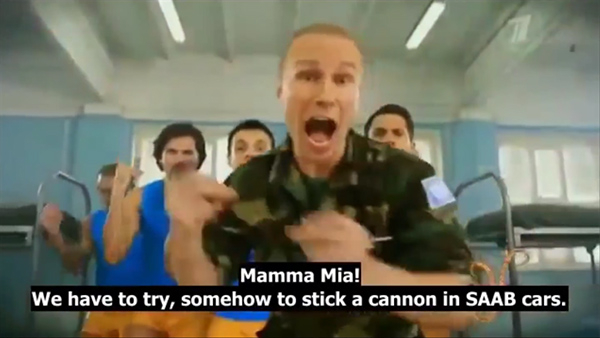
A Russian television news-parody show, joking about Sweden only being able to hold out for a week, aired a parody of the ABBA song “Mamma Mia,” mocking Sweden and its female Minister of Defense: “Mamma Mia, Russians coming here, on foot — oh my God it’s scary! … Defense Minister wears a dress…”

Russian TV mocks Sweden’s military capabilities. (Image source: Yesterday Live video screenshot)

Strangely, even though very little remains of the Swedish military, it still costs huge amounts of money. The defense budget has only been cut about 20%. The savings are so meager mainly because professional soldiers are paid more then draftees, but there are other explanations as well.

Alyson J.K. Bailes, a high-ranking British diplomat to several Nordic countries, and former head of the Stockholm International Peace Research Institute (SIPRI), stated in the documentary “What Happened to Defense?”:

“Sweden has cut its manpower very, very drastically in recent years, so that it now has almost the smallest forces and smallest army of any Nordic state — despite being twice as big as any other. I think that when people do see that, they become quite surprised, and I think any external defense expert looking closely at that, would conclude that Sweden does not have the resources to defend itself.

Sweden has such a large defense industry, it has been proud of having heavily mechanized forces. But if you look at how much money it has been spending on equipment and research, for each man in the Armed Forces, that figure turns out to be the highest in Europe. It is four times as high as what Germany pays for the equipment for one soldier. And then you have to ask yourself — has some of this been about protecting the industry rather than achieving a balanced and effective defense?”

Dazed and confused in the face of the new threats close to Sweden, most political parties now want more money for defense. But they are asking for peanuts. In April, Parliament decided to raise the defense budget by 10.2 billion kronor ($1.2 billion USD) from 2016 to 2020, and appointed a new security policy inquiry into the pros and cons of Sweden’s international collaborations such as the UN, OSSE, EU and NATO. That sum is far below what the Supreme Commander requested just to be able to implement what Parliament had ordered five years earlier. Parliament demanded many things, but has never given the mil enough money to do them.

Only the Sweden Democrats demanded a return to the level of defense spending Sweden had in 1999, which would require an additional 40 billion kronor (around $4.6 billion USD) from 2016 to 2020.

Mikael Jansson, defense policy spokesperson for the Sweden Democrats, told Gatestone Institute that after the Cold War ended, it was natural to make defense cutbacks, but he feels that the politicians responsible went much too far:

“If the defense cutbacks had ended in 1999, we would have had a more reasonable situation today. The goal today is to build a tiny military organization, but even though it is minuscule, it is still under-financed. We are about 50 billion kronor short (around $5.8 billion USD). So, even if the defense budget is significantly increased, it is going to take time before Sweden reaches a reasonable defense capability once again. It is easy to see why the defense budget needs to be doubled to achieve the reality the politicians speak of so beautifully: To be able to defend Sweden. We urgently need to order new submarines, to prevent the total number from dropping below eight. It is also important to order a new, modern, long-range air defense system so we can defend Stockholm, Gotland and all our bases. The order for new SAAB 39 Gripen E should be increased to 100 planes. The old Gripen airplanes should be saved for us to increase the number of military aircraft divisions.”

So how do Swedish politicians imagine defending the country if the Russians get it into their heads to, say, invade Gotland?

The island in the Baltic Sea is a strategically important outpost, close to the Baltic countries, which are all members of NATO. Joining NATO never appealed to Swedish politicians, but in 2009, the Swedish Parliament suddenly announced a “declaration of solidarity” with the EU. It reads:

“Sweden will not remain passive if a disaster or attack should hit another member state, or Nordic country. We expect other countries to act the same way if Sweden is hit. Our country will thus give and receive support, civilian as well as military.”

Estonian president Toomas Hendrik Ilves was not impressed by the declaration. “The problem with the declaration of solidarity,” he says, “is that it doesn’t contain anything concrete. You could send 10,000 bottles of olive oil and meet the demands of solidarity.”

Instead, he puts his faith in NATO, which regularly patrols Estonia’s airspace. U.S. President Barack Obama has said that, “the defense of Riga, Vilnius and Tallinn is as important as the defense of Paris, Berlin and London.”

NATO is well aware that Swedish territory is important. A NATO drill in the fall of 2014 played out a scenario in which Russia had occupied southern Sweden. This exercise was not at all surprising to Karlis Neretnieks, former headmaster at the National Defense College.

“There will be a race over Swedish territory if a serious crisis should emerge in our close proximity. As far as the Russians are concerned, it would be a great advantage to ‘borrow’ Gotland. It doesn’t cost anything, it’s quick and easy and they can say: ‘You’ll get the island back. We mean you no harm, you’ll get Gotland back in 2-3 months, we just need to get the Baltic states to do what we want.’ Why would the Russians abstain from this?”

But surely, Sweden has at least made sure that Gotland is well defended? Actually no. The total defense of Gotland now consists of 14 tanks tucked away in a storehouse. The tanks are among the best in the world, and the Swedish Armed Forces have bought 120 of them; but as there are only three tank companies (none of which is stationed on Gotland), there is only enough staff to man 42 tanks — or about a third of them.

Today, the architects of the lost military are sorry for what they did. Johan Kihl says that due to lack of resources, the Armed Forces are unable to defend the country in any sensible way. In the documentary, Former Supreme Commander Owe Wictorin looks devastated. He says that the direction was right, but the ambition, quantity and pace at which the changes were implemented were wrong. “And the idea of defending Sweden as the most important thing was lost. I still think so.”

Military historian Wilhelm Agrell notes that there are several obvious needs that have to be met: “One needs to always be prepared to defend the nation’s capital, vital infrastructure, power supply and telecommunications, important airports, import of basic necessities and military reinforcements. … [Sweden] today does not have that capability.”

Sweden: Shambles in Asylum Heaven by Ingrid Carlqvist

  • In Sweden, only the people who say they are not applying for asylum are checked.


  • To avoid having to show any papers, a terrorist going to Sweden to commit acts of terror only has to tell the border police that he is seeking asylum. He will immediately be driven to the closest Immigration Service facility. And while the Immigration Service tries to figure out who he is, he can plan his attacks in the peace and quiet of the Swedish countryside.

  • The truth is that persons with evil intent know exactly what to do when they come here. That information spreads like wildfire. These new border controls are there for the sole purpose of reassuring the public. They have absolutely no effect on the influx of migrants.” — Border policeman at the Öresund Bridge (between Denmark and Sweden).

  • Despite many Swedes drawing a sigh of relief when the government announced that immigration was to be limited, the new policy does not really entail any difference at all.

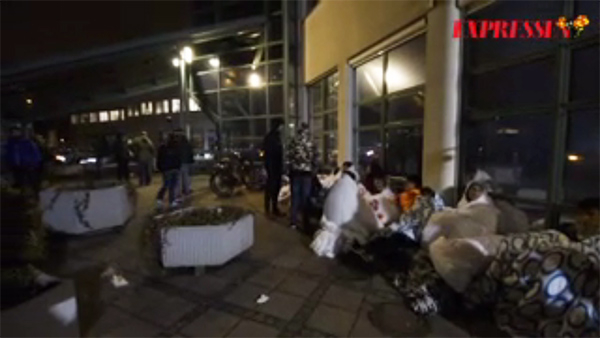
In spite of the supposedly tighter asylum rules announced November 24, chaos rules in Sweden. So far, in 2015, 150,000 asylum seekers have been registered; but as there is nowhere to house them, people are sleeping in tents, on cardboard boxes in exhibition halls, and even on the street. Many run away from the Immigration Service facilities. More than22,000 people are supposed to be deported but refuse to leave. Swedes are understandablyterrified that terrorists might be hiding among the refugees. The police are busy with pointless border controls and cannot attend to their normal work. It is not an exaggeration to say that in this situation, Sweden has lost track of pretty much everything.

Some homeless migrants now sleep on the street in Sweden. (Image source: Expressen video screenshot)

Even the asylum seekers are complaining. On a Swedish public television program, Uppdrag Granskning, aired on December 2, Salwa, a mother of young children, told the reporter how she is forced to live in an asylum house along with men she called “bad people.” When the reporter explained to Salwa that 10,000 new asylum seekers arrive every week, and this was why everything was topsy-turvy, she replied: “Then close the borders. Stop taking in more people. If you have ten guests in your house and there is not enough room, would you still take in ten more?”

Sweden’s Social Democrat Prime Minister, Stefan Löfven, said in an interview last April with the daily Sydsvenskan,

“There is no limit [to the number of refugees Sweden can accept]. We will accept refugees according to the conventions that bind us. We have done it before. In the early 1990s, many came from the former Republic of Yugoslavia. Today, they are a natural part of the Swedish society. They contribute a lot.”

So, when Prime Minister Löfven and Vice Prime Minister, Åsa Romson (Green Party) presentedtheir new, tougher immigration policy on November 24, it sent shockwaves through the Swedish establishment. Journalists, who never asked the governing politicians a single critical question about their affinity for open borders, now appeared stunned — despite one authorityafter another, during the last few months, having warned of an imminent systemic collapse. When Romson started crying during the live press conference because, she said, she was “forced” to be a part of the tightening of the world’s most generous immigration policy, everyone believed that these new immigration rules must be for real.

The message conveyed to the Swedish people on November 24 was that the borders were now essentially being shut; that Löfven had discovered there was a limit. The political party most critical of immigration policy, the Sweden Democrats (Sverigedemokraterna), declaredvictory. Its party leader, Jimmie Åkesson, immediately reached out to the Conservatives (Moderaterna) and the Christian Democrats (Kristdemokraterna), offering to bring down the government and form a new one together with them. This invitation was immediately declined. The reply should probably be viewed in the light of all seven parties in Parliament having vowednever to co-operate with the “xenophobic” Sweden Democrats.

It does not matter, therefore, that the other parties have now adopted much of the Sweden Democrats’ policies, or that many Conservatives actually want to take them even further and could easily get them through Parliament by forming a government with the Sweden Democrats.

An outsider may get the impression that every party in Sweden is now competing over who can suggest harsher austerity measures. The Conservatives say they want, among other things, to stop people who are coming from other EU countries from applying for asylum in Sweden. The Conservatives also say they want new measures for deporting those who have had their application rejected. The government is already negotiating with Afghanistan to try to persuade it to take back some of the many Afghans (36,261 in total; 20,947 supposedly “children”) who applied for asylum in Sweden this year.

So far, no journalist in the mainstream media seems to have discovered that the new border controls — implemented because the government evidently decided there is “a serious threat to public order and safety in the country” — have had no discernible effect. The media still give the public the impression that asylum seekers are actually stopped at the border, and that, as the Minister for Justice and Migration, Morgan Johansson, announced, all border crossings will be controlled before Christmas.

As noted last month, however, to avoid having to show any papers, a terrorist going to Sweden to commit acts of terror only has to tell the border police he is seeking asylum. He will immediately be driven to the closest Immigration Service facility. While the Immigration Service tries to figure out who he is, he can plan his attacks in the peace and quiet of the Swedish countryside. And as it takes the Immigration Service 222 days, on average, to establish a plausible identity, he need not be in any hurry.

One person who has grown tired of this whole charade is actually one of the Border Police at the Öresund Bridge (between Denmark and Sweden). He told Gatestone Institute that every day, the new controls cause a number of people — many of whom had planned on passing through Sweden to seek asylum in Finland or Norway — to return to Denmark of their own volition. But, he said, it is rare that someone refuses to show identification or apply for asylum, and thus be turned down.

“The truth is that persons with evil intent know exactly what to do when they come here,” he said.

“That information spreads like wildfire. These new border controls are there for the sole purpose of reassuring the public. They have absolutely no effect on the influx of migrants. The public is given a completely erroneous picture of what we are doing. They do not understand that we spend enormous amounts of time checking Swedish and Danish commuters. If we do not, the press goes crazy and starts screaming about discrimination.

“It seems as if those in power do not want the people who are here illegally to be deported. They give them free health care, free dental care, and schooling for their children. It is mixed messages all the time. I think they need to make up their minds about what they want. These controls mean nothing. They are just a formality to make everything look good and avoid discriminating against anyone. We should put our time and effort where they are needed.”

When asked by Gatestone why the police were allocating enormous resources to border controls that in fact do not amount to anything, the Press Officer at the Swedish National Police Agency (Rikspolisstyrelsen), Stephan Ray, stated that he did not have time to discuss it because he needed to go to the bathroom; then hung up the phone.

An expert on international law, who asked to remain anonymous, told Gatestone that he could no longer understand what the government was thinking by allowing potentially dangerous people into Sweden. Nowhere in any international conventions, he said, does it say that the right of asylum takes precedence over the security of a country’s own population. The most reasonable thing to do, he said, would be to establish fenced-in refugee camps near the borders and not let the asylum seekers out until it was determined that they were not terrorists or war criminals: “According to the Refugee Convention of 1951,” he said, even if people are war criminals and risk facing the death penalty at home, a country has the right to send them back.”

Even so, convicted murderers and war criminals — happily for them — get to stay in Sweden. The rule is that no one risking the death penalty or persecution in their home country will be sent back. This includes even people who have committed capital crimes in Sweden and been sentenced to deportation. It is uncertain that the IKEA-murderer, Abraham Ukbagabir, can be deported to Eritrea after serving his time in prison. There are, apparently, “hindrances” to enforcing deportations to Eritrea. Recently, the alternative-media site, Nyheter Idagrevealedthat, as there are “hindrances” to deporting people to Syria, terrorists discovered to be Islamic State combatants seeking asylum will get to stay in Sweden.

When Gatestone asked the Immigration Service why it was more concerned about the safety of foreign citizens than the lives of Swedish citizens, Matilda Niang of the Immigration Service press office replied that it would be inhumane to lock up asylum seekers until their identity had been established. “A lock-up,” she said, “would also affect asylum seekers who did not commit any crimes.”

So, despite many Swedes drawing a sigh of relief when the government announced that immigration was to be limited, the new policy does not really entail any difference at all.

No sitting politician has yet expressed doubt about the wisdom of turning Sweden from a Swedish country into a multicultural one, and none has yet said the policy of importing migrants needs to stop.

It may well be that the government’s measures are only a facade, designed to soothe the Swedish people, in the hope of relieving some of the pressure.

Among these new measures are:

  • A moratorium on permanent residency status. From now on, a residency status is valid for three years, with an option for a one-year extension. Permanent residency is given only to persons who, after this time, are able to support themselves financially.
  • Stricter limits on bringing in relatives.
  • Tightening demands on self-sufficiency and the ability to support financially one’s own family.
  • Medical determination of so-called unaccompanied refugee children.
  • Identity checks on all public transport: everyone on a ferry, train, or bus to Sweden must show a passport or a driver’s license.

The temporary residency is a message that will reach migrants quickly. Whether or not this means that fewer people will get to stay is doubtful. Nothing prevents the government from transforming the temporary residencies into permanent ones after the four years expire. There will also be the problem of what to do with migrants who do not leave at that point. Medically determining the age of the many Afghans who claim to be under 18, in order to get a fast track on their asylum application, might have some effect. Sweden’s failure to age-test asylum seekers has led to an avalanche of “bearded children.” Each week, over 1,000 “children” arrive, of whom 80% come from Afghanistan. In Denmark, where age-testing has been routine, it turned out that at least 50% of these so-called children were in fact adults; and in Norway and Finland, this number was 66%.

About 75% of all the “children” who apply, are granted asylum in Sweden. It is therefore extremely popular, when seeking asylum, to claim to be under 18. In 2013, 4,000 arrived. In 2014, the number was 7,000; and during the first eleven months of 2015, a staggering 32,180“unaccompanied refugee children” sought asylum in Sweden. More than half were from Afghanistan; the second largest group was from Syria, followed by Eritrea and Somalia. About 2,000 were girls.

A few days after the announcement of Sweden’s new asylum rules, the influx of migrants slowed significantly. On November 28 and 29, from a peak of about 1,500 a day, only 392 and 375 people, respectively, were registered. Most were from Afghanistan, Syria and Iraq. The next day, however, the number of applications once again jumped to more than 1,000.

An intelligence analyst at the Immigration Service, Anders Westerlund, told the dailyAftonbladet that the decline was most likely due to fewer refugees arriving on the Greek isles from Turkey. “We also see that tougher border controls in the Balkans, and the cold weather, are keeping people from coming to Europe,” he said. “Winter is coming, and that makes the journey riskier.”

Meanwhile, police are swamped with pointless border controls and cannot do their usual work, and criminals roam the streets.

District Attorneys [DAs] apparently have so little to do, that they recently promised to supply the Immigration Service with 30 underemployed DAs. The Immigration Service, despite having recently hired another 1,200 employees, is, of course, struggling to cope with the current situation. In total, Immigration Service staff wages cost the Swedish taxpayers 250 million kronor (about $29,000,000) a month, or about 3 billion kroner (about $350,000,000) a year.

“We can lend them 30 DAs and clerks,” chief prosecutor Solveig Wollstad said in an interview with Gatestone, “because our influx of cases has gone down. The police are busy doing other things, such as fighting terrorism and taking care of migrants.”

When asked if the situation was possibly due to crime going down, Wollstad said, “No, no, no. The decrease is due to the police working so much with other things, such as preventing terror and dealing with the refugee flow. More police are needed at the borders now. Sweden is in crisis. It is not just us who are lending out staff: it is also the National Courts Administration, the Enforcement Authority, the Prison and Probation Service and a number of other authorities.”

In short, the only discernible effect of the “humanitarian superpower’s” new asylum rules is that the Swedish police are busy checking the identities of people who do not want to seek asylum in Sweden, and therefore lack the resources to apprehend criminals.

“As long as the ingrained rhetoric in Sweden is viewed as a manifestation of divinity and goodness,” writes Associate Professor of Business Administration and author Jan Tullberg in a recent article, “political ineptness will continue paralyzing the country.”

Ingrid Carlqvist is a journalist and author based in Sweden, and a Distinguished Senior Fellow of Gatestone Institute.
Sweden: Sexual Assaults at Swimming Pools by Ingrid Carlqvist

  • Young male asylum seekers have turned Sweden’s public swimming pools into ordeals of rape and sexual assault.
  • Swedish politicians seem convinced that some education on “equality” will change the ways of men, who, since childhood, have been taught that it is the responsibility of women not to arouse them — and therefore the woman’s fault if the man feels like raping her.

  • More and more Swedes are now avoiding public pools altogether.
  • Staff at Malmö’s Hylliebadet family adventure pool were given strict instructions not to report certain things, and above all, never to mention the ethnicity or religion of those who cause problems at the pool.
  • “What the Afghans are doing is not wrong in Afghanistan, so your rules are completely alien to them. … If you want to stop Afghans from molesting Swedish girls, you need to be tough on them. Making them take classes on equality and how to treat women is pointless. The first time they behave badly, they should be given a warning, and the second time you should deport them from Sweden.” — Mr. Azizi, manager of a hotel in Kabul, Afghanistan

Men and women, in a Swedish tradition, have swum together in public pools for over 100 years. Many people are now wondering if we will be forced to give up this practice — because young male asylum seekers have turned public swimming pools into ordeals of rape and sexual assault.

Mixed bathing in Sweden started in the small southern fishing village of Mölle. Around 1890, the “Sin of Mölle” gained notoriety. Men and women were swimming together! Out in the open and shamelessly flaunting their striped bathing attire. It was a sensation that echoed all over Europe, and people came from everywhere to partake in the exciting new activity. Danes poured in, and even the German Emperor Wilhelm II made his way to Mölle in July 1907.

It should come as surprise to no one that men from the Middle East and North Africa have quite a different view of women than Swedish men do. The only mystery is why Swedish politicians have got it in their heads that everyone who sets foot on Swedish soil will immediately embrace our values, our view of women and our traditions.

Now that it is finally beginning to dawn on them that many Afghan, Somali, Iraqi and Syrian men (the largest immigrant groups coming to Sweden now) think that women who run around scantily clad are fair game, the politicians are dumbfounded. Of course, they cannot admit that this — to Swedes — completely alien view of women has anything to do with Islam, because then they would become victims of their own claim that everyone who criticizes Islam is an “Islamophobe.”

For many years, it was possible to cover up the abuse, not least because the mainstream media chose to call the perpetrators “youth gangs,” and never mention that they were almost always immigrants from Muslim countries. In Malmö, one of the most immigrant-heavy cities in Sweden, and where Swedes have actually been a minority since 2013, the problems at public pools started at least 15 years ago.

In 2003, “youth gangs” were so disruptive to other guests at the indoor water park Aq-va-kul that on several occasions, the establishment was forced to close. Despite investing 750,000 kronor ($88,000) in taller entrance gates, a glass-enclosed reception desk, surveillance cameras, and an Arabic-speaking “pool host” to tackle the security problems, things just kept getting worse. In 2005, senior staff member Bertil Lindberg told the local daily newspaper, Sydsvenskan: “Things have escalated this year. Large gangs of 10-20 young people threaten and provoke other guests as well as the staff. They did not come here to swim; they are just looking for trouble.”

One of the problems is that young Muslim men refuse to take a shower before bathing, and keep their underwear on under their swim trunks. For obvious reasons, this is not allowed, and when the staff call out the violators on this, trouble and threats ensue. On several occasions, gangs have ambushed staff members on their way home from work, and the company was forced to hire guards to make sure employees get home in one piece. Events reached a climax in 2013, when youth gangs smashed the interior, threw objects in the water and threatened other patrons. Aq-va-kul was closed, and the pool was drained and cleaned of shattered glass. A few days later the pool was reopened, but it closed permanently to the public in 2015. Now the facility has been renovated, but is only open to competitive swimmers and swim clubs.

In Stockholm, the Husbybadet pool in the heavily-immigrant suburb of Husby was the first public pool hit by trouble. In 2007, it was reported that the municipality was forced to build a separate sewage treatment facility, costing millions of kronor. The reason was unusually high levels of nitrogen in the water, because many young people insisted on bathing with their dirty underwear on. The municipality property director told daily newspaper, Dagens Nyheter:

“Nitrogen is food for bacteria and a high nitrogen level produces malodorous air and filthy water. The nitrogen comes from urine and sweat. Quite simply, we have a problem with people keeping their dirty underwear on under their swim trunks. And then they get in the 38-degree [100-degree Fahrenheit] water in the hot tub. It is like sitting in your washing machine’s delicates cycle, and we use that water all the time. People should have swimwear on, not bathe in their regular clothes.”

The attitude towards nudity in Scandinavia is very different from that in the Middle East. Sweden has many nude beaches, where men and women swim together without a stitch of clothing, without the slightest hint of sexual harassment. In the gender-separated changing rooms at public pools, there is no sign of shyness. Swedish men and women see it as a matter of course to shower and wash properly before getting in the pool, and a couple of decades ago stern overseers even patrolled the changing rooms to check the patrons’ shower habits.

In Muslim countries, nudity is an extremely private thing, and one does not willingly take showers with others, not even with members of the same sex. All the public pool personnel with whom Gatestone has spoken confirm that Muslim men and women shower with their underwear on, and then keep them on under their swimwear. Many Muslim women bathe in a so-called burkini, a garment that covers the entire body, so when Muslim men see Swedish women in a bikini, many of them conclude that they must be “easy” women whom one is “allowed” to grope.

In 2015, when roughly 163,000 asylum seekers came to Sweden, the problems at public pools increased exponentially. More than 35,000 young people, so-called “unaccompanied refugee children,” arrived — 93% of whom are male and claim to be 16-17 years old. To prevent complete idleness, many municipalities give them free entrance to the public pools.

During the past few months, the number of reports of sexual assaults and harassment against women at public pools has been overwhelming. Most of the “children” are from Afghanistan, widely considered among the most dangerous places in the world for women. When the daily Aftonbladet visited the country in 2013, 61-year-old Fatima told the paper what it is like to be a woman in Afghanistan: “What happens if we do not obey? Well, our husbands or sons beat us of course. We are their slaves.”

To expect men from a culture that views women as men’s slaves to behave like Swedish men is not just stupid — it is dangerous. Mr. Azizi, the manager of a large hotel in Kabul, told Gatestone how an average Afghan man sees sexual attacks on women:

“What the Afghans are doing is not wrong in Afghanistan, so your rules are completely alien to them. Women stay at home in Afghanistan, and if they need to go out they are always accompanied by a man. If you want to stop Afghans from molesting Swedish girls, you need to be tough on them. Making them take classes on equality and how to treat women is pointless. The first time they behave badly, they should be given a warning, and the second time you should deport them from Sweden.”

One of the first reported incidents occurred in 2005, when a 17-year-old girl was raped at Husbybadet, in Stockholm. The 16-year-old perpetrator started groping her in the hot tub, and when the girl moved to a cave with streaming water, he and his friend followed her. They forced the girl into a corner, and while the friend held her down, the 16-year-old pulled off the girl’s bikini and raped her. During the trial, it emerged that some 30 people had witnessed the attack, but the teenagers continued the rape anyway.

The 16-year-old rapist was sentenced to three months in juvenile detention and his friend was acquitted. The victim was badly traumatized and had to be treated in a psychiatric care facility, after several failed suicide attempts.

Since then, virtually all public pools in Sweden have become dangerous places, especially to women. During the first two months of this year, reports of rape, sexual assault and sexual harassment came in rapid succession. A few examples:

In Stockholm, during the first week of January, Sweden’s national swimming arena, Eriksdalsbadet, decided to separate men and women in the hot tubs. A controversial decision in Sweden, it came after several incidents in the pools had been reported to the police, mainly in November and December 2015. Conservative Anna König Jerlmyr (moderaterna), Stockholm city Commissioner in Opposition, did not believe that separating men and women was the right way to address the problems: “It is totally unacceptable for a public swimming pool to act this way. This is tantamount to giving in to the sexual harassment and sending signals in favor of a view of women that is utterly reprehensible. More staff, and banning offenders from the premises, would have been preferable,” she told the daily, Dagens Nyheter.

Olof Öhman, head of the Sports Administration in Stockholm, told the paper: “There are similar problems at all the public pools in Stockholm, even if most complaints regard Eriksdalsbadet.”

On January 14, officials at the Rosenlundsbadet water park in Jönköping reported that they would increase security. According to Operations Manager Gunnel Eriksson, the decision was mainly due to the behavior of a new group of bathers — unaccompanied refugee boys: “You can tell from their behavior that they come from a different culture; there is a cultural clash. We can see that they react to the undressed bit.” The heightened security is also necessary because many of the young migrant men cannot swim, overestimate their abilities, and end up in dangerous situations.

On January 15, a local paper, Kungälvsposten, wrote that two girls had been sexually assaulted in an elevator at the Oasen public pool Oasen, in Kungälv. The two suspected perpetrators are “unaccompanied refugee children.” Jonas Arngården, Municipal Director of Social Affairs, told the paper: “This shows that we need to step up the work concerning issues of equality and interaction among our new arrivals, in schools as well as at the asylum houses.”

The attack caused members of the Nordic Resistance Movement (Nordiska motståndsrörelsen), a supposed neo-Nazi organization, to show up at Oasen on February 13. They put on green shirts with the word “Security Host” (Trygghetsvärd) printed on the back, and “patrolled” the facility.

The municipality had not reacted strongly to the sexual assault, but the visit by vigilantes scared the municipal management, and it immediately called the Oasen management to a meeting. Mayor Miguel Odhner told the daily, Expressen/GT: “It is completely unacceptable to have some kind of disguised vigilantes at municipal pools. It is very, very serious that we have violent extremism vying for greater foothold in our municipality.”

The Eriksdalsbadet national swimming arena in Stockholm (left) has become infamous for the many incidents of migrants sexually assaulting women and children at the facility. At the Oasen pool in Kungälv (right), two girls were recently sexually assaulted by “unaccompanied refugee children.” In response, members of the “Nordic Resistance Movement” showed up, wearing shirts bearing the label “Security Host” (Trygghetsvärd), and “patrolled” the facility.

On January 18, the management of the Fyrishov public pool, in Uppsala, revealed that in 2015, it there were seven reported cases of child molestation at the facility. According to Fyrishov, the suspected offenders are all newly-arrived migrants — teenage boys who do not speak Swedish. The facility increased security in August, hiring guards and giving the staff stricter monitoring instructions.

On January 21, there were reports that the number of sexual assaults had increased dramatically at the Aquanova adventure pool in Borlänge. In 2014, one case was reported; in 2015, about 20 cases were reported. The incidents involved women having their bikinis ripped off, being groped in the water slide and sexually assaulted in the restrooms. Ulla-Karin Solum, the CEO of Aquanova, told the public broadcaster Sveriges Television that many incidents “are due to cultural clashes.”

Aquanova Staff member Anette Nohrén confirmed that all the suspects are born abroad, and complained that “it is a huge problem. It steals the focus from our primary task, which is safety concerns, when we are constantly forced to intervene to try and prevent assaults, and afterwards, to try and figure out what happened.”

Aquanova now implemented new rules; among them, that young men from asylum houses need to have a responsible adult accompanying them — one adult for every three underage asylum seekers. The adult needs to stay with them in the changing room as well as in the pool area.

On January 25, the daily newspaper Expressen revealed that a girl was raped at the now infamous Eriksdalsbadet swimming arena at the beginning of the month. The police will now increase their presence at the facility, and will patrol inside regularly.

On January 26, there were reports that a woman and two girls had recently been sexually assaulted by a group of young men who spoke neither Swedish nor English, at the Storsjöbadet pool in Östersund. Despite the incident, the young men were not removed from the premises — a lapse the staff later admitted was a mistake.

On January 27, Växjö municipality announced that it plans to hire a security guard to patrol the local public pool. After two 11-year-old girls were sexually assaulted by a group of boys. The boys attacked the girls in an area hidden from the view of lifeguards. Mikael Linnander, father of one of the girls, told the daily, Kvällsposten: “Seven or eight guys attacked the girls. Two of them touched them between their legs and groped their breasts.” The abuse did not stop until a woman swimming with her children reprimanded the boys. After the incident, the two boys were barred from the adventure pool area, but were allowed to stay at the facility.

On February 1, local media reported that at least five girls and women had been sexually assaulted at a public pool in Vänersborg during the previous few weeks. The victims were girls under 15, as well as women in their thirties. The police said they had no suspects, but stated that the case had high priority.

On February 25, another sexual assault was reported at the Eriksdalsbadet swimming arena in Stockholm. Police spokesman Johan Renberg told Expressen that a group of girls had found themselves surrounded by some 10 young men who tried to grope them. A staff member saw what was happening and called the police. The girls were able to identify the young men, whose ethnicity the paper did not report. The men were not arrested, but will be questioned at a later time.

Given the recent wave of sexual assaults at public pools, it is something of a mystery why the recently-opened Hylliebadet family adventure pool in multicultural Malmö has not reported any sexual assaults at all. Hylliebadet, which cost 349 million kronor (about $41 million) to build, had a chaotic opening week in August 2015. After only a few days, 27 “incidents” had been reported, but none involved sexual assaults.

“No, I have never heard of anything like that happening here,” a Hylliebadet employee told Gatestone. However, when we spoke to other staff members off the record, they told us they had been given strict instructions not to report certain things, and above all, never to mention the ethnicity or religion of those who cause problems at the pool. Another employee told Gatestone:

“Of course we have had incidents here, particularly involving Afghan men groping girls. Not long ago, a man of Arab descent was caught masturbating in the hot tub. But we are not allowed to report things like that. These men understand that it is forbidden when we tell them, but they keep doing it anyway. They just smile and keep on doing it.”

It seems unlikely that Swedish politicians will start deporting sex offenders. The politicians seem convinced that some education on “equality” will change the ways of men, who, since childhood, have been taught that it is the responsibility of women not to arouse them — and therefore the woman’s fault if the man feels like raping her. Such a shift in attitude seems as likely as if a Swede visiting Saudi Arabia would suddenly renounce alcohol just because it is forbidden there. The Swede would follow the rules as long as somebody was watching, and then take every opportunity to drink his schnapps, because it is a thousand-year-old Swedish tradition, and something most Swedes feel is agreeable as well as just.

Another public pool employee told Gatestone that the refugee boys frighten away ordinary patrons and that more and more Swedes are now avoiding public pools altogether.

“Even Swedes who have bought expensive season tickets stay away now, because they think the mood is unsettling. Considering that they young asylum seekers get their entrance fee paid by the municipalities, one could rightfully say that tax money is being used to drive away those who would pay.”

Ingrid Carlqvist is a journalist and author based in Sweden, and a Distinguished Senior Fellow of Gatestone Institute.
Sweden: Rapes, Acquittals and Severed Heads One Month of Islam and Multiculturalism in Sweden: November 2015 by Ingrid Carlqvist

  • Some 30 Muslim men thought that the woman was in violation of Islamic sharia law, by being in Sweden unaccompanied by a man. They thought that she should therefore be raped and her teenage son killed.

  • Two Swedish citizens were convicted by a Gothenburg Court of joining an Islamist terror group in Syria and murdering two captives. Video evidence showed one victim being beheaded. “Every night when I have gone to bed, I have seen a head hanging in the air.” — Court Chairman Ralf G. Larsson.
  • Sometime during the night, the victim was awakened by the Iraqi as he raped her. The woman managed to break free and locate a train attendant. At first, the woman did not want to call the police. “She felt sorry for him [the rapist] … and was afraid he would be deported back to Iraq.”
  • One week after Sweden raised its terror alert level to the highest ever, the police raised another alarm — saying their weapons are simply not good enough to prevent a potential terror attack.

November 4: The Swedish Immigration Service sent out a press release, saying that it had hired close to a thousand additional employees since June. The Immigration Service now has over 7,000 employees, including hourly workers and consultants — double the 3,350 employees who worked there in 2012. Most of the new recruits work with the legal processing of asylum applications, but the units dealing with receiving migrants and filing their initial applications have also expanded considerably. As if the record influx of migrants this autumn were not crushing enough, the Immigration Service also had trouble retaining its staff. Employees complain about being badly treated: they are always expected to be on call, and possibly even work Christmas Eve.

November 4: Bobel Barqasho, a 31-year-old Syrian, was sentenced by Sweden’s Supreme Court to 14 years in prison. Before his case reached the Supreme Court, Barqasho had been sentenced by a lower court to 9 years in prison, then acquitted by the Court of Appeals. In February 2013, Barqasho threw his wife off a sixth-floor balcony. Against all odds, the woman survived the 13-meter (about 43 feet) fall, but was badly injured. When she woke up after five weeks in a coma, her head was held together by a helmet, her face felt loose, and her teeth were gone. In the Court of Appeals, the defense managed to plant reasonable doubt about the man’s guilt by claiming the woman was depressed and had jumped of her own free will] so the Court of Appeals set him free. By the time the Supreme Court pronounced its sentence of 14 years, Barqasho had disappeared. He is now being sought by Interpol.

November 6: The Grönkulla School in Alvesta closed after reports of a rape at the facility spread on social media. A Somali boy had apparently been sexually harassing a 12-year-old girl for some time. On October 17, he allegedly took his attentions a step farther, pulled the girl behind a bush and raped her. The girl’s father had been unsuccessful in trying to get the school to address the problem earlier, but even after the reported rape, the school’s management did not act. The boy was allowed to continue going to the school – just on a schedule different from the girl’s. Her distraught parents told the news website Fria Tider: “We are being spat on because we are Swedish.” In protest against the school’s management, many parents, viewing the school as having sided with the perpetrator, moved their children to other schools.

November 9: Social commentator and whistleblower Merit Wager revealed on her blog that administrators at the Immigration Service had all been ordered to “accept the claim that an applicant is a child, if he does not look as if he is over 40.” A staggering 32,180 “unaccompanied refugee children” had arrived during 2015 by December 1 — since then another 1,130 have come — and the government finally decided to take action. If its proposition is approved by Parliament, everyone who looks adult-aged will be forced to go through a medical age-determination procedure. One of the reasons Sweden stopped doing these in the first place, was that pediatricians refused to take part in them. They said the procedures were “unreliable.”

November 10: A 28-year-old Iraqi man was prosecuted for raping a woman on a night train between Finland and Sweden. The man had originally planned to seek asylum in Finland, but had found the living conditions there too harsh. He had therefore taken a train back to Sweden. In a couchette (sleeping car where men and women are together), the rapist and two other asylum seekers met one of the many Swedish women whose hearts go out to “new arrivals.” The woman bought sandwiches for the men; they drank vodka. When two of the men started groping the woman, she told them to stop, yet chose to lie down and go to sleep. Sometime during the night, she was awakened by the Iraqi as he raped her. The woman managed to break free and locate a train attendant. To the attendant’s surprise, the woman did not immediately want to press charges. The court documents state: “The train attendant asked if he should call the police. At first, the woman did not want him to do so, because she did not want to put N.N., an asylum seeker, in a tough spot. She felt sorry for him… and was afraid he would be deported back to Iraq.”

The man was given a sentence of one year in prison, payment of 85,000 kronor (about $10,000) in damages, and deportation — but will be allowed to come back to Sweden after five years.

November 10: An Algerian and a Syrian asylum seeker were indicted for raping a Swedish woman in Strängnäs. The men, 39-year-old from Algeria and 31-year-old from Syria, met the woman in a bar one night in August. When the woman left, one of the men followed her, pulled her to the ground, and assaulted her. Afterwards, the woman kept walking, and ran into two other men — the Syrian and another unidentified man — and was raped again. The Syrian reportedly also spit her in face and said, “I’m going to f–k you, little Swedish girl.” The men, who lived at the same asylum house, denied knowing each other when questioned by the police. The verdict was announced on December 1. Rapist number one was sentenced to 2.5 years in prison, 117,000 kronor (about $14,000) in damages, and deportation to Algeria. Rapist number two was convicted of aggravated rape and sentenced to four years in prison. He cannot be deported, however, because “there are currently hindrances towards enforcing deportations to Syria.” He was also ordered to pay the woman 167,000 kronor (about $20,000) in damages.

November 13: A trial began against eight Eritrean men, between the ages of 19 and 26, who according to the District Court, “crudely and ruthlessly” gang-raped a 45-year-old woman. She had been waiting in a stairwell for a friend when the men invited her into an apartment. Inside, she was thrown on the floor, held down, beaten and brutally raped. When questioned by the police, she said, “It felt as if there were hands and fingers everyplace. Fingers penetrated me, vaginally, anally. It hurt very much. I could feel the fingernails.” She said she could also hear the Eritreans laughing and speaking in their own language while they raped her. “They seemed to be enjoying themselves,” she said.

When two of the men started fighting over who should rape her next, she tried to flee, but one of the men hit her over the head; she fell unconscious. After coming to, she escaped out a window and was able to reach a neighbor.

The District Court of Falun established that several men had taken part in the attack, but the District Attorney was unable to prove who had done what. Therefore, only one man was convicted of aggravated rape, and sentenced to five years in prison. The others were sentenced to only 10 months in prison for helping to conceal a serious criminal offense. After serving their time, the men will be allowed to stay in Sweden.

November 14: The Swedish Security Service, Säpo, warned again of Muslim terrorists hiding among migrants. The number of individuals listed as potential security threats has tripled this year, and includes several hundred who may be ready to carry out “Paris-style” attacks. As the Immigration Service has a huge backlog in trying to register all 150,000 asylum seekers who have come to Sweden so far in 2015, there are probably also many migrants that would be considered potential security threats.

November 14: Sweden’s Foreign Minister, Margot Wallström, made yet another strange statement with diplomatic consequences. The day after the Paris attacks, in an interview with Swedish Public Television, Wallström was asked, “How worried are you about the radicalization of young people in Sweden who choose to fight for ISIS?” Wallström replied:

“Yes, of course we have a reason to be worried not only here in Sweden but around the world, because there are so many who are being radicalized. Here again, you come back to situations like that in the Middle East, where not least the Palestinians see that there isn’t any future for us [the Palestinians], we either have to accept a desperate situation or resort to violence.”

Two days later, the Swedish ambassador to Israel, Carl Magnus Nesser, was called to a meeting at the Israeli Foreign Ministry. Its spokesman, Emmanuel Nahshon, later told Reuters, “The Swedish Foreign Minister’s statements are appallingly impudent… [She] demonstrates genuine hostility when she points to a connection of any kind between the terror attacks in Paris and the complex situation between Israel and the Palestinians.”

In a formal statement, the Swedish Foreign Ministry denied that Margot Wallström’s remark had connected the Paris attacks with the Israeli-Palestinian conflict. A Swedish Conservative (Moderaterna) Member of Parliament, Hanif Bali, sarcastically tweeted that it seemed the Foreign Minister is suffering from an “obvious case of Israel-Tourette’s.”

November 18: The Authority for Civil Protection and Contingency Planning (MSB) warned that the asylum situation was not only “very strained,” but that things keep getting worse — and that in some parts of Sweden, the authorities can only function until the end of December. Meanwhile, the Immigration Service calculated that another 13,000 beds are needed in so-called evacuation accommodations. “The problem cannot be fully solved even if the Armed Forces help provide more housing or if the MSB could arrange more tent accommodations,” the authority wrote.

The massive influx of asylum seekers has also led to native Swedes “being crowded out of the health care and social services systems,” according to the MSB. “It [the MSB] is so busy handling unaccompanied children and asylum seekers, that there simply is not enough time to tend to the everyday functions, such as healthcare and social services,” said Alexandra Nordlander, Chief of Operative Analysis at the MSB, to the daily tabloid, Aftonbladet.

November 19: A fire broke out at Lundsbrunn Spa, a few weeks after plans were announced to convert the historic building into the biggest asylum-seekers’ home in Sweden. According to the police, the fire was not an arson, but started in a wood-pellet stove.

Many hotels and spas have transforming themselves into asylum-seekers’ housing, in order to profit from lucrative deals offered by the Immigration Service. Lundsbrunn Spa, near a mineral spring, dates back to 1890; in 1817, a hospital was established on the grounds. The nearby village is home to fewer than 1,000 people, so when Lundsbrunn Spa decided to accept an offer from the Immigration Service, the village faced a doubling of its population. The owners of Lundsbrunn wrote on the Spa’s website that they see the transformation from spa to asylum-seekers’ home as a temporary measure.

November 20: Norwegian businessman Petter Stordalen, the billionaire owner of Nordic Choice Hotels, announced that the chain’s many properties in Scandinavia and the Baltic states would no longer serve their guests sausage and bacon for breakfast. The breakfast buffet of the Nordic Choice’s Clarion Hotel Post in Gothenburg was named earlier this year the best hotel breakfast in the world by the British newspaper, The Mirror. But apparently, this award did not matter. The cause for the hotel’s decision was cited as “health reasons.” The internet, however, was soon abuzz with speculation that the real reason was adaptation to Islamic dietary laws (halal). One week later, Stordalen backtracked. The reaction from hotel guests had been too strong. Many people vented their anger over the withheld bacon on Stordalen’s Facebook page. Stordalen commented: “The guests have spoken. Comfort Hotels are bringing back bacon.”

November 23: Hassan Mostafa Al-Mandlawi, 32, and Al Amin Sultan, 30, were indicted in the Gothenburg Municipal Court, suspected of having traveled to Syria in 2013 and murdering at least two people there. The charge was terrorist crimes, (alternatively crimes against international law) and murder. Chief Prosecutor Agnetha Hilding Qvarnström, of the National Unit for Security Cases, said: “The act [was] committed with the intent to harm the state of Syria and intimidate the people, thus the classification: terrorist crimes. The hard part is to clarify fully whether these men have been part of an armed group, and acted within the frames of the armed conflict, or not.”

The accused men came to Sweden, one from Iraq and one from Syria, as children, but grew up in Sweden and are Swedish citizens. They traveled to Syria in 2013, and joined one of the many Islamist terror groups there. According to the prosecution, they murdered two captured workers in an industrial area of Aleppo by slitting their throats. The prosecutor wrote that, “Al-Mandlawi and Sultan have both expressed delight at the deeds.”

During the trial, films of the executions were shown, but both men still denied having committed the crimes. Those present in court agreed that the films were among the most disturbing ever displayed in a Swedish court. First, they show a man having his throat slit, the blood gushing before he dies. Then, the other victim’s head is severed from his body, and the killer holds up the severed head to loud cheers from the others. The court’s chairman, Ralf G. Larsson, told the news agency, TT: “Every night when I have gone to bed, I have seen a head hanging in the air.”

The verdict was announced December 14: Both men were convicted of terrorist crimes and sentenced to life in prison. The verdict will be appealed, the defense lawyers said.

Two Swedish citizens were convicted by a Gothenburg Court of joining an Islamist terror group in Syria and murdering two captives. Video evidence (left) showed one victim being beheaded. When asked if she is worried about the radicalization of young people in Sweden who choose to fight for ISIS, Sweden’s Foreign Minister, Margot Wallström (right), blamed Israel’s treatment of Palestinians.

November 25: The municipality of Ängelholm proudly announced that it had managed to hire a world-famous star to sing at the 500-year anniversary of the city of Ängelholm. Mezzo-soprano Susanne Resmark, of La Scala in Milan and the Metropolitan Opera House in New York, would now, for the first time, sing in her hometown. The denizens of Ängelholm would get to enjoy the Resmark, considered by many one of the best Mezzo-sopranos, in a free performance. Two days later, however, the local paperHelsingborgs Dagblad, ran a story on how Resmark had posted on her Facebook page comments critical of Islam. This apparently sent representatives of the municipality into a panic; they cancelled the star’s performance. The journalist behind the story, Jan Andersson, admitted in an interview with Dispatch International that the paper’s reporters had gone over Resmark’s statements with a microscope, in an effort to force the municipality to cancel her appearance. “We did a damn fine job!” Andersson said.

November 27: One week after Sweden raised its terror alert level to the highest ever in the country (four on a five-point scale), the police raised another alarm — saying their weapons are simply not good enough to prevent a potential terror attack. “We are sent out without adequate weapons, only a nine millimeter service pistol. We are also told that there may not be enough protective vests and ballistic helmets. It feels like being sent out on a lion hunt with a pea-shooter and a jumpsuit made out of zebra meat,” wrote a police officer called “Christian,” in an internal incident report reviewed by the news agency, Siren.

His colleague, “Niklas,” wrote that he had to patrol, without a protective helmet, a location considered at risk of terror attacks, because none of the available helmets fit his head: “Without the right equipment, and with inadequate training in tactics and shooting, we still had to work as live targets without any kind of chance to defend ourselves or our [locations] against a potential attack.”

The police say they want to be able to use more powerful weapons, such as the HK MP5, a submachine gun that is popular with law enforcement agencies around the world. Few, however, have had the required training for it. Also, the existing MP5s are kept at police stations — not in patrol cars. Martin Lundin, of the Department of National Operations, conceded there was some merit to the criticism: “We will probably need more people who are able to handle that weapon in the future.”

November 28: A large mob at an asylum house in Nora tried to break into a room where a woman had barricaded herself along with her son. Some 30 Muslim men apparently thought the woman was in violation of Islamic sharia law, by being in Sweden unaccompanied by a man. They thought that she should therefore be raped and her teenage son killed. Asylum house staff called the police, who averted the plan.

Ingrid Carlqvist is a journalist and author based in Sweden, and a Distinguished Senior Fellow of Gatestone Institute.
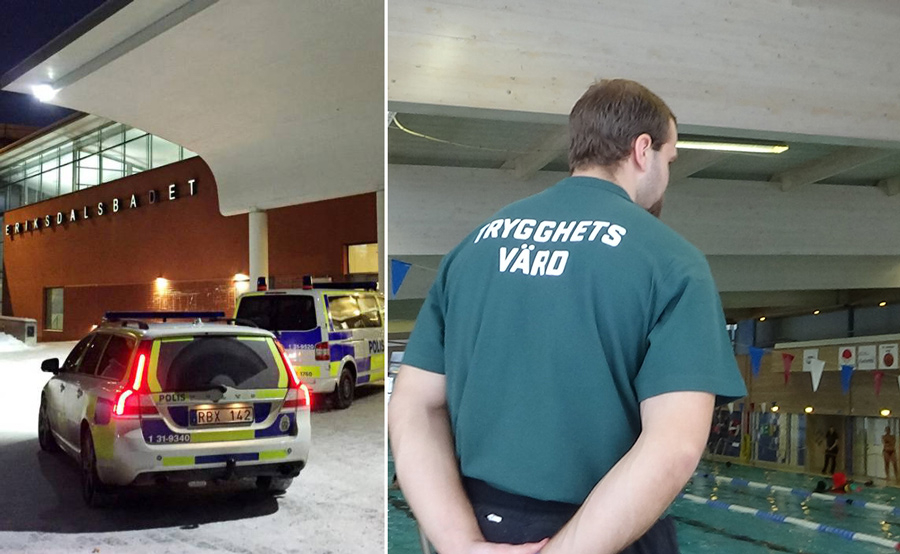
Translate »
Skip to toolbar